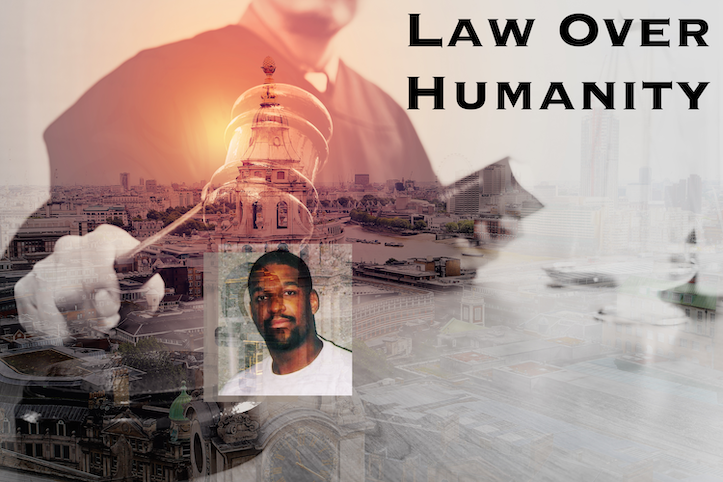
From [HERE] The children of a black man gunned down by a white police officer in Louisiana's capital sued the city on Tuesday, claiming the shooting fit a pattern of racist behavior and excessive force by its police department.
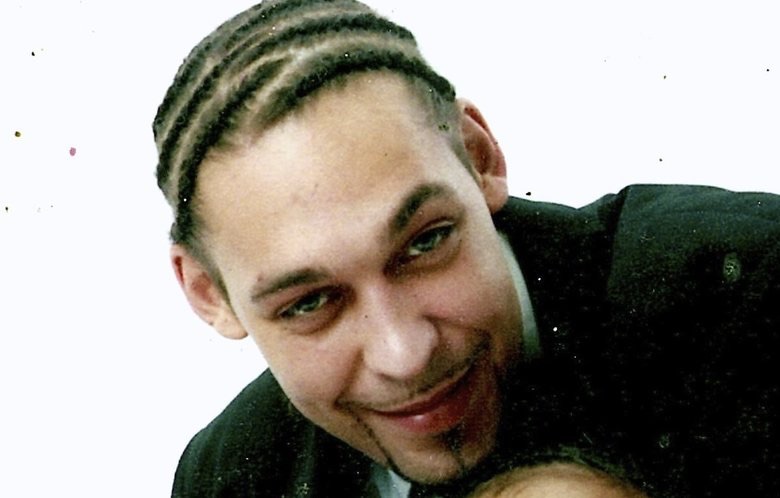
Attorneys for Alton Sterling's five children filed the wrongful death lawsuit in state court against the city of Baton Rouge, its police department and police chief and the two officers involved in last summer's deadly encounter. Officer Blane Salamoni shot Sterling six times during a struggle outside a convenience store where the 37-year-old black man was selling homemade CDs.
On July 5, 2016, Sterling, a 37-year-old black man, was shot several times at close range while held down on the ground by two white Baton Rouge Police Department officers, Howie Lake II and Blane Salamoni, in Baton Rouge, Louisiana.[3] Police were responding to a report that a man in a red shirt was selling CDs, and that he had used a gun to threaten a man outside a convenience store.[4] The shooting was recorded by multiple bystanders. A loaded .38 caliber revolver was in Sterling's right front pocket, but it is unclear whether he reached for it
The Justice Department investigated Sterling's shooting and announced last month that it will not file charges against Salamoni or Officer Howie Lake II, who also wrestled Sterling to the ground but didn't fire his gun. Louisiana Attorney General Jeff Landry's office has opened its own review of the case to determine if any state criminal charges are warranted.
The family's lawsuit, which seeks unspecified damages, claims Sterling's shooting was the product of poor training and inadequate police procedures. The suit also cites two instances in which Baton Rouge police officers allegedly sent racist text messages to colleagues, including an apparent slur against people who protested Sterling's death.
"The City of Baton Rouge has a long standing pervasive policy of tolerating racist behavior by some of its officers," the suit says. "There have also been multiple verbal racist comments by officers reported to the department. This tolerance of such behavior directly leads to the mistreatment of individuals of African American descent."
Plaintiffs' attorney L. Chris Stewart said he expects current and former police officers to come forward, testify under oath and back up "everything" alleged in the suit.
"This isn't just lawyers talking and arguing. We have talked to officers who have said something is wrong and it must stop," Stewart said.
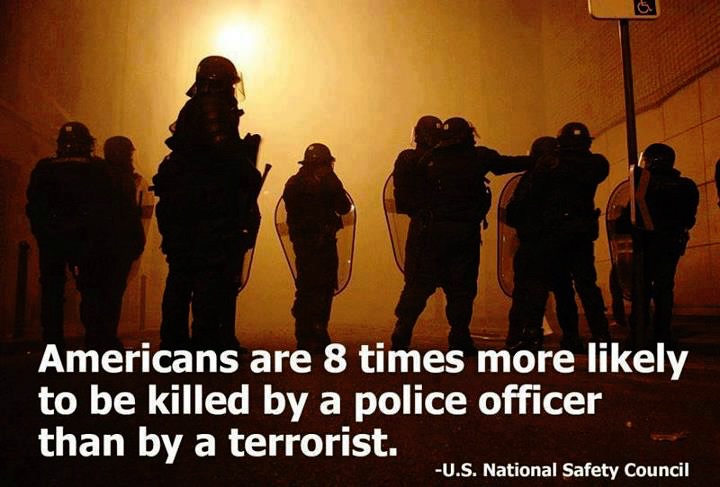
In the West, as in the rest of the nation, Native Americans are the racial group most likely to be killed by law enforcement, at a rate three times higher than whites. In 2016, an estimated 21 Native Americans fell victim to police violence, according to The Counted, a database that tracks people killed by U.S. law enforcement personnel; the previous year, 13 died. The deaths have ignited the same outrage that erupted in recent years following the shooting deaths of numerous African-Americans by law enforcement. Following the Black Lives Matter model, a Native Lives Matter movement has spread, calling attention to what Chase Iron Eyes, a Lakota attorney and activist, calls America’s “undeclared race war.” For police, Covarrubias’ death was a rare tragedy — a product of the split second decision-making that law enforcement officers must make to protect others and themselves. For many Native Americans in Washington and elsewhere, however, his death was an echo of the violence they had endured for centuries.
In the weeks and months following her brother’s death, Lanna Covarrubias kept coming back to one question: Daniel had just left the hospital. He was in pain. Why, she wondered, did the officers take such aggressive action?
That question has reverberated among Native Americans both on and off reservations in recent years. While Native Americans make up less than one percent of the population, they account for nearly two percent of police killings. Several factors contribute to that statistic, including the lack of mental health services (nearly half of the victims had histories of mental illness) and the often-strained relationship between Native Americans and non-native police. Many tribes are under the jurisdiction of nearby non-tribal authorities, leaving cities and counties struggling to come up with the additional policing resources. According to researchers at Claremont Graduate University, 83 percent of the deadly encounters between Native Americans and law enforcement involved non-tribal police.
Yet, for every black Michael Brown who makes the headlines, a victim of police violence in Indian Country remains invisible. The Claremont study found that between May 2014 and October 2015, major U.S. newspapers mentioned just two of the 29 verifiable Native American deaths at the hands of police during that period. The real number of deaths was likely even higher, says Jean Schroedel, one of the researchers, noting that Native deaths often go unrecorded. Many live on remote reservations or in rural border towns, which don’t get as much media coverage as big cities. In urban areas, where more than half of Native Americans reside, they are often identified as another race. Covarrubias, for instance, was identified as Latino even though he is a member of the Suquamish nation.
The Criminal Justice System Only Creates the Appearance of Justice.Anything else is just random. Sounding like a Black probot the special prosecutor above is part of the show. From [HERE] and [HERE] Three current or former Chicago police officers were indicted Tuesday on state felony charges of conspiracy in the investigation of the 2014 shooting death of Laquan McDonald.
Former Detective David March, and former Patrol Officer Joseph Walsh and Patrol Officer Thomas Gaffney were charged with conspiracy, official misconduct and obstruction of justice, according to a news release from Special Prosecutor Patricia Brown Holmes' office. Their arraignment is 7/10/17.
"The indictment makes clear that these defendants did more than merely obey an unofficial 'code of silence,' rather it alleges that they lied about what occurred to prevent independent criminal investigators from learning the truth," Holmes said.
McDonald, 17, was killed in October 2014 when Chicago police officer Jason Van Dyke , racist suspect above, shot him 16 times. Van Dyke has pleaded not guilty to six counts of first-degree murder and 16 counts of aggravated battery with a firearm, with the latter charges apparently corresponding to each shot he fired at McDonald. He is suspended without pay.
Shortly before 10:00 p.m., police were called to investigate McDonald at 4100 South Pulaski Road responding to reports that he was carrying a knifeand breaking into vehicles in a trucking yard at 41st Street and Kildare Avenue.When officers confronted McDonald, he used a knife with a 3-inch blade to slice the tire on a patrol vehicle and damage its windshield.McDonald walked away from police after numerous verbal instructions from officers to drop the knife,at which point responding officers requested Taser backup, according to radio recordings released December 30, 2015, to Politico and NBC Chicago in response to Freedom of Information Act requests.
Video of the shooting shows that Van Dyke was advancing on McDonald, while McDonald was walking away from Van Dyke when the first shot was fired. The first shot hit McDonald, who spun and fell to the ground.As McDonald lay on the ground, still holding the knife, Van Dyke fired more shots into him.[28] In total, Van Dyke shot MacDonald 16 times in 14–15 seconds, expending the maximum capacity of his 9mm semi-automatic firearm.Van Dyke was on the scene for less than 30 seconds before opening fire and began shooting approximately six seconds after exiting his car.The first responding officer said that he did not see the need to use force, and none of the at least eight other officers on the scene fired their weapons.
Laquan McDonald was taken to Mount Sinai Hospital, where he was pronounced dead at 10:42 p.m. [MORE]
Video released after legal battle
Dashcam video of the shooting -- released in November 2015 after a court battle -- contradicted nearly everything police said happened the night McDonald died. It showed McDonald walking away from police as he held a 4-inch knife, not lunging toward officers, as police had said. The shooting led to calls for reforms and fueled a national conversation about police use of deadly force.
"The shooting of Laquan McDonald forever changed the Chicago Police Department and I am committed to implementing policies and training to prevent an incident like this from happening again," police Superintendent Eddie Johnson said. "We will also continue to implement meaningful reforms that build community trust, provide greater training and resources to our dedicated officers, and make Chicago safer."
From [NY Times] Roy D. Oliver II, the white police officer who was fired and charged with murder after killing an unarmed black teenager in April in a Dallas suburb, is facing a new round of legal problems after a complaint that he pulled his gun on a driver about two weeks before the shooting.
A grand jury indicted Mr. Oliver on two counts of aggravated assault with a deadly weapon by a public servant, the Dallas County district attorney said on Friday.
Mr. Oliver was fired from the Balch Springs Police Department after he shot and killed Jordan Edwards, a 15-year-old high school freshman, as Jordan and four other teenagers drove away from a house party on April 29. Mr. Oliver used a high-powered rifle to fire into the vehicle, shooting Jordan in the head as he sat in the front passenger seat. Mr. Oliver was charged with murder on May 5, and the Balch Springs police chief said he had violated department policies.
Mr. Oliver’s new charges stem from a car accident in Dallas 13 days before Jordan was killed. Mr. Oliver was off duty and not in uniform at the time.
A driver, Monique Arredondo, was taking her two sisters and her niece to a birthday party at her grandparents’ house when her car struck Mr. Oliver’s truck from behind. Ms. Arredondo said in an interview that Mr. Oliver startled her when he left his truck and came toward her with his gun pointed at her head while she sat in her car.
“What was going through my mind was that I was about to die in front of my two sisters and my niece,” Ms. Arredondo said. “He had an attitude, and I told him I was not going to give him anything until he got the gun out of my face.”
She added, “He’s getting what he deserves because he doesn’t have the right to pull a gun on me because I hit the back of his truck.”
Each charge carries a punishment of five to 99 years in prison.
On Friday, Mr. Oliver turned himself in and was booked at the county jail and released. His bond for his three pending charges is $700,000.
From [HERE] Can the family of a slain Mexican teenager sue the federal agent who shot himacross the U.S.-Mexico border for damages? The U.S. Supreme Court did not answer this question on Monday, instead opting to send a case back to a lower court.
The case centers on a larger question: whether the Constitution extends protection to an individual who is killed on foreign soil, even though that person is standing just a few yards outside the United States.
It also tests a long-held doctrine, called a Bivens action, in which plaintiffs are permitted to sue federal officials for breaking constitutional law. But that doctrine had never been applied outside the boundaries of the United States.
In oral arguments in February, some justices were concerned that making U.S. agents liable for their actions taken in a foreign nation could be extended to, say, a house full of noncombatants killed by a U.S. drone strike in Pakistan.
Bob Hilliard, the Texas attorney for the Mexican teen's family, argued that a decision could be crafted in such a way as to only address the legally vague U.S.-Mexico borderlands, where this fatal shooting took place.
A Court of Appeals had ruled that the Border Patrol agent, Mesa, had qualified immunity, which means he cannot be sued. But in today's opinion, the justices vacated that ruling.
The Supreme Court said the lower court made a mistake when it found Mesa had qualified immunity. The lower court's rationale stressed that Hernandez was not a U.S. citizen, which the justices say that Mesa did not know when he shot him.
The court also stated that another case that it decided last week, Ziglar v. Abbasi, could have bearing on Hernandez v. Mesa, which the lower court would not have considered.
The final decision has the potential to affect not only the Hernandez family, but several other Mexican families who were waiting to file civil suits against federal officers for cross-border shootings of their loved ones.
The case comes from the death in Mexico of Sergio Hernandez, a 15-year-old boy who was playing in Mexico when he was fatally shot by U.S. Border Patrol Agent Jesus Mesa, who had been standing in Texas across the Rio Grande.
The cellphone video is vivid. A Border Patrol agent aims his gun at an unarmed 15-year-old some 60 feet away, across the border with Mexico, and shoots him dead.
The shooting took place on the border between El Paso, Texas, and Juárez, Mexico.
The area is about 180 feet across. Eighty feet one way leads to a steep incline and an 18-foot fence on the U.S. side — part of the so-called border wall that has already been built. An almost equal distance the other way is another steep incline leading to a wall topped by a guardrail on the Mexican side.
In between is a the dry bed of the Rio Grande with an invisible line in the middle that separates the U.S. and Mexico. Overhead is a railroad bridge with huge columns supporting it, connecting the two countries.
Hernández and his friends were playing chicken, daring each other to run up the incline on the U.S. side and touch the fence, according to briefs filed by lawyers for the Hernández family.
At some point U.S. border agent Jesus Mesa, patrolling the culvert, arrived on a bicycle, grabbed one of the kids at the fence on the U.S. side, and the others scampered away. Fifteen-year-old Sergio ran past Mesa and hid behind a pillar beneath the bridge on the Mexican side.
As the boy peeked out, Agent Mesa, 60 feet or so away on the U.S. side, drew his gun, aimed it at the boy, and fired three times, the last shot hitting the boy in the head.
Although agents quickly swarmed the scene, they are forbidden to cross the border. They did not offer medical aid, and soon left on their bikes, according to lawyers for the family.
A day after the shooting, the FBI's El Paso office issued a press release asserting that agent Mesa fired his gun after being "surrounded" by suspected illegal aliens who "continued to throw rocks at him."
Two days later, cellphone videos surfaced contradicting that account. In one video the boy's small figure can be seen edging out from behind the column; Mesa fires, and the boy falls to the ground.
"The statement literally says he was surrounded by these boys, which is just objectively false," says Bob Hilliard, who represents the family. Pointing to the cellphone video, he says it is "clear that nobody was near " agent Mesa.
In one video, a woman's voice is heard saying that some of the boys had been throwing rocks, but the video does not show that, and by the time the shooting takes place, nobody is surrounding agent Mesa.
In other words, this race soldier cop murdered a teenager for no reason and then lied about it.
The U.S. Department of Justice decided not to prosecute Mesa. Among other things, the department concluded that it did not have jurisdiction because the boy was not on U.S. soil when he was killed.
Mexico charged the agent with murder, but when the U.S. refused to extradite him, no prosecution could go forward.
U.S. Customs and Border Patrol did not discipline agent Mesa — a fact that critics, including high-ranking former agency officials, say reflects a pattern inside the agency.
After Verbal Altercation w/Wife Unarmed Black Man Did Not Threaten Cops or Son. No Gun Found. From [HERE] and [MORE] Attorneys for the family of a mentally-ill, unarmed, African-American man killed by a SWAT sniper in front of his 4-year-old son after a 2013 standoff in Fife told a federal jury Wednesday that Leonard Thomas posed no threat to police, his son or himself when he was killed
Attorney Tiffany Cartwright, one of the lawyers representing Thomas’ parents and his now 9-year-old son, told an eight-member jury in opening statements that nothing that the drunken, despondent, bipolar man did warranted the massive police response the night of May 23, 2013 — two armored vehicles and at least 27 officers, including the Pierce Metro SWAT team — for a misdemeanor, domestic-violence offense.
Based on photographs introduced in trial, most, if not all, of the officers were white, and attorneys for Thomas’ family have alleged in court documents that the case is “steeped in race.”
There was a moment when it looked like the May 2013 standoff between Leonard Thomas and the Pierce County Metro SWAT team was going to have a good ending.
Thomas, 30, drunk and despondent over the sudden death of a childhood friend, had been holed up for hours with his 4-year-old son after his mother called Fife police following an argument. A police negotiator had finally convinced Thomas to let the child go home with his grandmother for the night - which is what Thomas and his mother had fought about in the first place.
Once the child was safe, the negotiator and a SWAT commander figured officers would just let Thomas sleep off a bad night and come back later to deal with a misdemeanor domestic-violence allegation stemming from a tussle over his mother's cellphone while she was talking to 911, according to police reports.
That isn't what happened.
As a skittish Thomas led the boy onto the front porch to send him down the sidewalk to the child's waiting grandmother, members of a SWAT assault team used explosives to blow open a back door, forcing their way in and killing the family dog with a burst of gunfire. Thomas - who was unarmed - reportedly lunged for his son, and he was fatally shot by a police sniper as he held the boy.
The assault-team leader, Lakewood police Officer Mike Wiley, announced the shooting over a SWAT frequency: "We have jackpot."
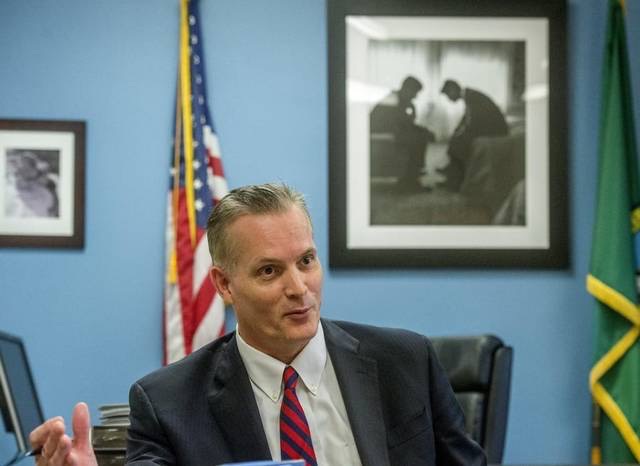
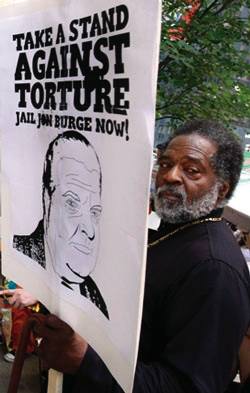
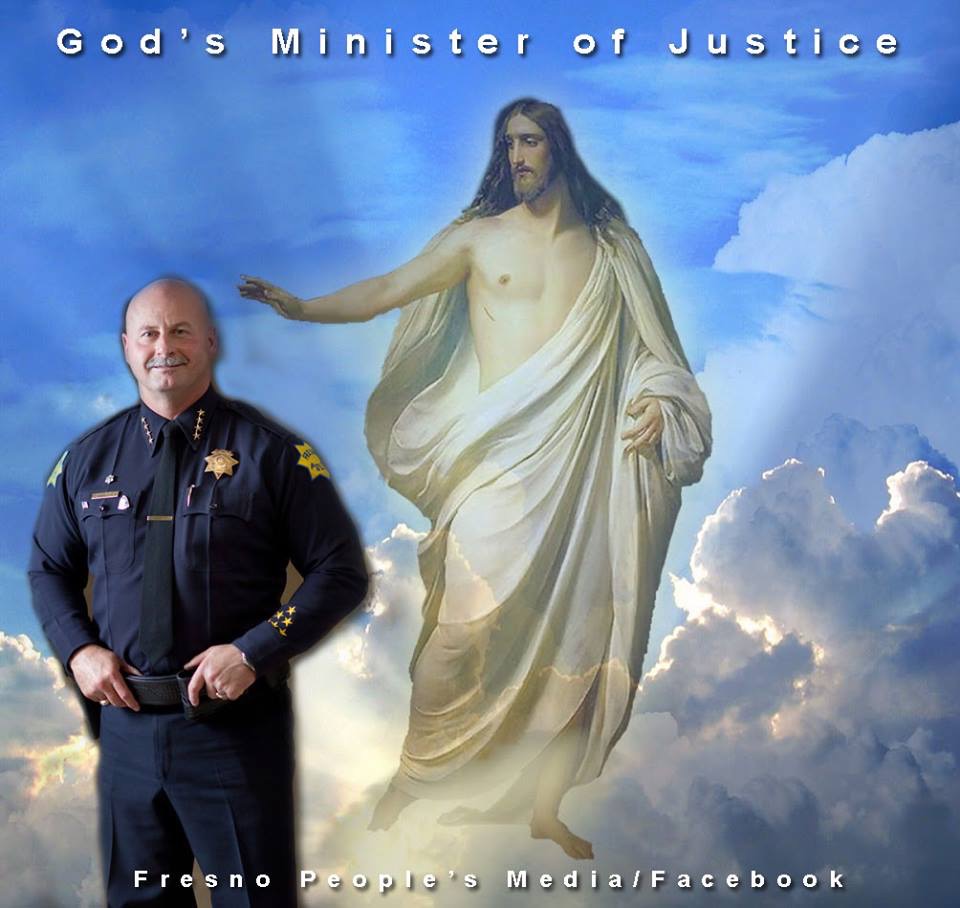
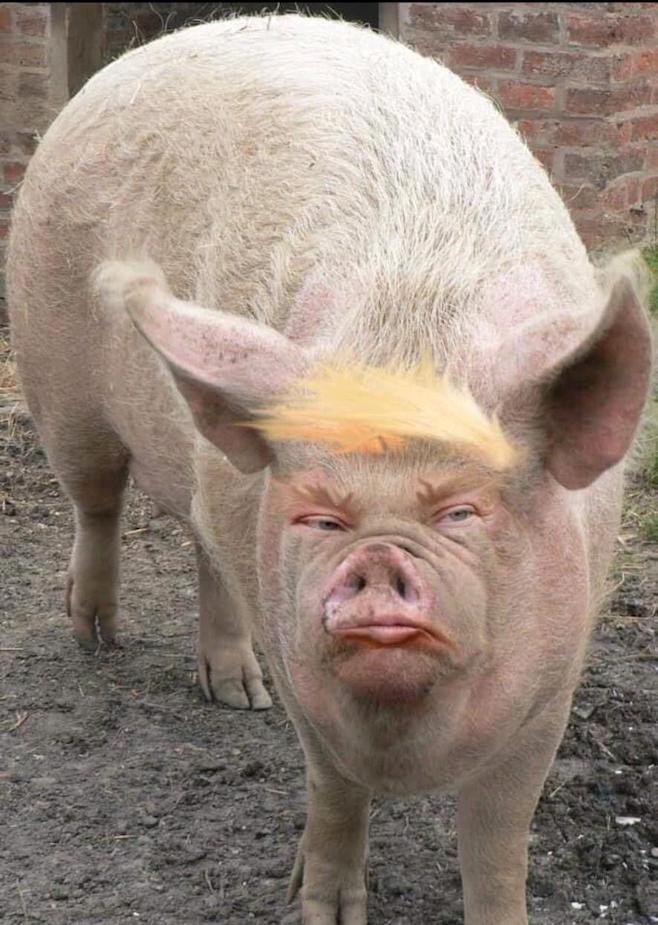
Pierce County Prosecutor Mark Lindquist, racist suspect in photo above, concluded the shooting was lawful and determined the SWAT sniper "did what was necessary to protect a child."
However, Thomas' parents, Fred and Annalesa Thomas, along with a guardian representing Thomas' now 6-year-old son, in January filed a $3.5 million claim against the Metro SWAT team and its member agencies, partly for "intangible injuries like the emotional distress caused by witnessing the killing of a son and father." Such claims usually precede a wrongful-death or federal civil-rights lawsuit.
The family's Seattle lawyers, David Whedbee and Tim Ford, call the incident a "damning story of overreaction and incompetence, and the use of unnecessary military-style force against an American citizen."
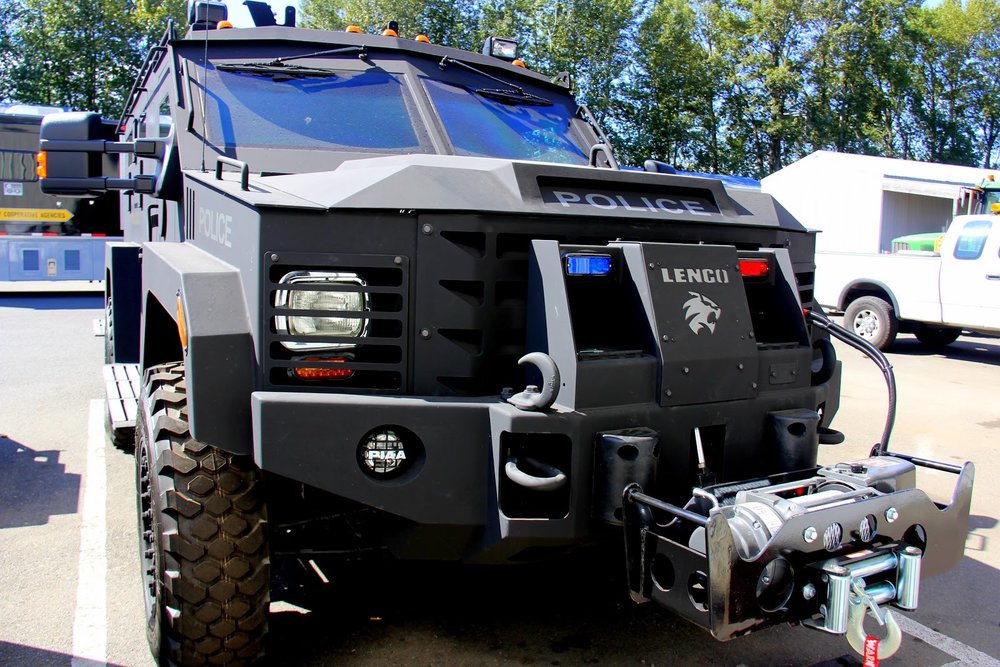
They say the incident was tragically avoidable and that the arrival of the SWAT team - which surrounded the home and parked an armored-personnel carrier on Thomas' front lawn - escalated a minor domestic argument into a siege. [An armoured personnel carrier (APC) is a type of armoured fighting vehicle (AFV) designed to transport infantry to the battlefield. APCs are colloquially referred to as 'battle taxis' or 'battle buses', among other things. Armoured personnel carriers are distinguished from infantry fighting vehicles by the weaponry they carry. MORE See video above about the Metro Swat's tank that was parked on Thomas' front lawn. Racism is a virus in the mind and these mfs are crazy where "race" is a variable]
They also say it is emblematic of the type of police militarization that has alarmed the American Civil Liberties Union (ACLU) and caught the attention of Congress and the White House after the use by police of military-style assault vehicles and heavily armed, camouflage-clad officers in Ferguson, Mo., and elsewhere.
"Like the troubling trend across the country, the police here resorted to military tactics and killed an unarmed man who had done nothing but suffer a bout of despair," Whedbee said. "He hadn't harmed anybody and just wanted to be left alone in his home."
Lakewood police Assistant Chief Mike Zaro, who was in charge of the SWAT operation that night, declined to discuss the incident because of the family's claim, except to say that Thomas "could have obeyed us at any time and chose not to."
However, the family's claim and a review of the reports, documents, transcripts and court records by The Seattle Times raise questions about the accuracy of key information given to officers at the scene regarding Thomas'
Annalesa Thomas took a call from her son around 9:30 p.m. on May 23, 2013, and immediately became worried, according to police reports, interviews and court records. Leonard Thomas, who lived with his son in a house owned by his parents, was upset over the recent, sudden death of a longtime friend and wanted his mother to come and get the boy.
When she arrived at the two-story home on a dead-end road in Fife, Leonard Thomas was outside with his estranged wife, Kimberly. His mother said Thomas was tearful and argumentative, and resisted her suggestion he and the boy come home with her.
When she decided it would be best to just leave with the boy, Thomas resisted and they argued. Annalesa said she slapped Thomas to try to calm him down, and then called police.
While she was on the phone with a 911 operator, Annalesa said Thomas "grabbed her wrist and took the phone." Several officers responded and decided there was probable cause to arrest Thomas for fourth-degree domestic-violence assault, a gross misdemeanor, for interfering with the 911 call.
Meantime, Thomas and his son had retreated into the house.
Fife police Lt. Scott Green, who was in charge of the scene before SWAT arrived, told detectives later that the department was familiar with Thomas from prior contacts. He said there was an officer-safety advisory in a state crime computer, warning that Thomas suffered from mental-health problems - Thomas was bipolar - and was reported to carry a handgun. That information was repeatedly broadcast to officers and the SWAT team.
Officers were also told the advisory said he had in the past threatened "suicide by cop" and that Fife police considered him "uncooperative."
A post-shooting review could not confirm the suicide-by-cop information or identify its source. And police did not attempt to authenticate information that Thomas had been seeking a gun or was known to carry one, according to a review of the documents.
Thomas spoke with two negotiators that night. The first, Milton police Sgt. Nils Luckman, said Thomas' mood was erratic - cordial one moment, angry the next - and he seemed intoxicated and said he was off his medications. Thomas insisted he had not committed a crime and demanded police get off his property.
Luckman told investigators Thomas repeatedly said he was unarmed and that the boy was fine. Luckman said that while Thomas was hostile toward police, he never threatened officers or the child.
Thomas told one officer through an open window that he had a pistol, but none was ever seen or found.
Fife Police Chief Brad Blackburn decided to call out SWAT because he was concerned about the well-being of the child, he told detectives afterward.
SWAT negotiator Lakewood Sgt. Mark Eakes took over just before midnight. By then, the house was being surrounded by heavily armed officers and two snipers were watching Thomas inside the home through their rifle scopes, according to the reports.
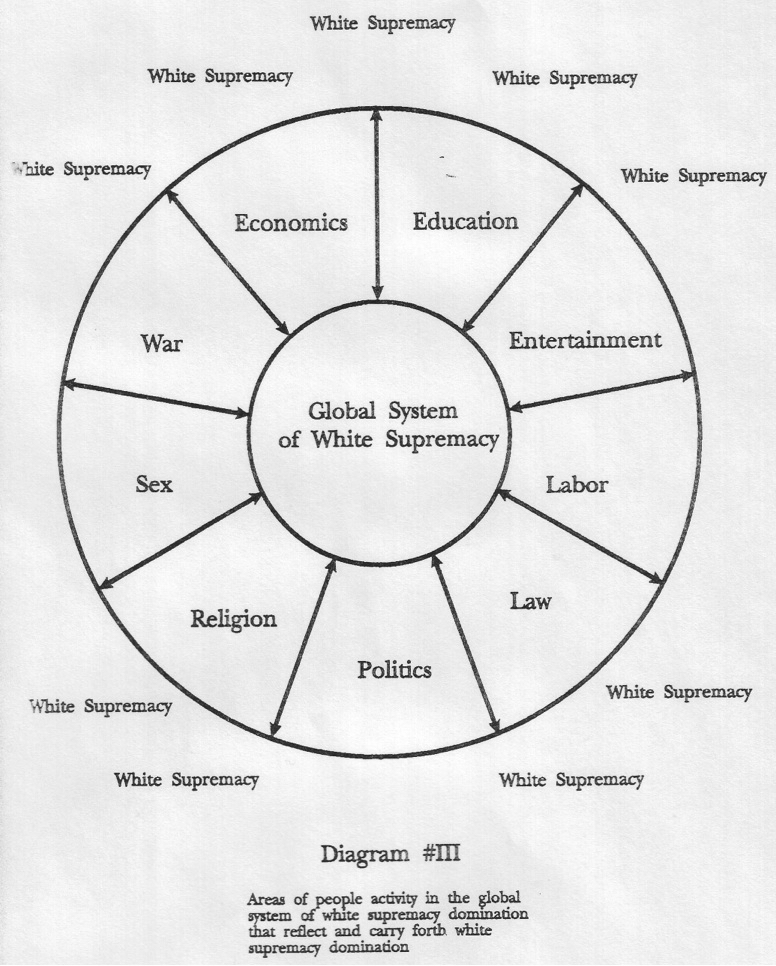
The Psychopathic Racial Personality Racism White Supremacy is carried out by deception and/or violence. JPSO Sheriff Newell Normand thinks handcuffed black man was hit once or twice but it was justified.
Attempt Murder for Murder of Cop. From [HERE] Jerman Neveaux filed a federal civil rights lawsuit against 28 Jefferson Parish Sheriff's Office deputies, accusing them of using excessive force when he was arrested in connection with the shooting death of Detective David Michel Jr.
The deputies beat Neveaux, acting with "willful and wanton indifference" and "deliberate disregard" for his constitutional rights, according to the filing, made Thursday (June 22), one year after Michel's death and Neveaux's arrest.
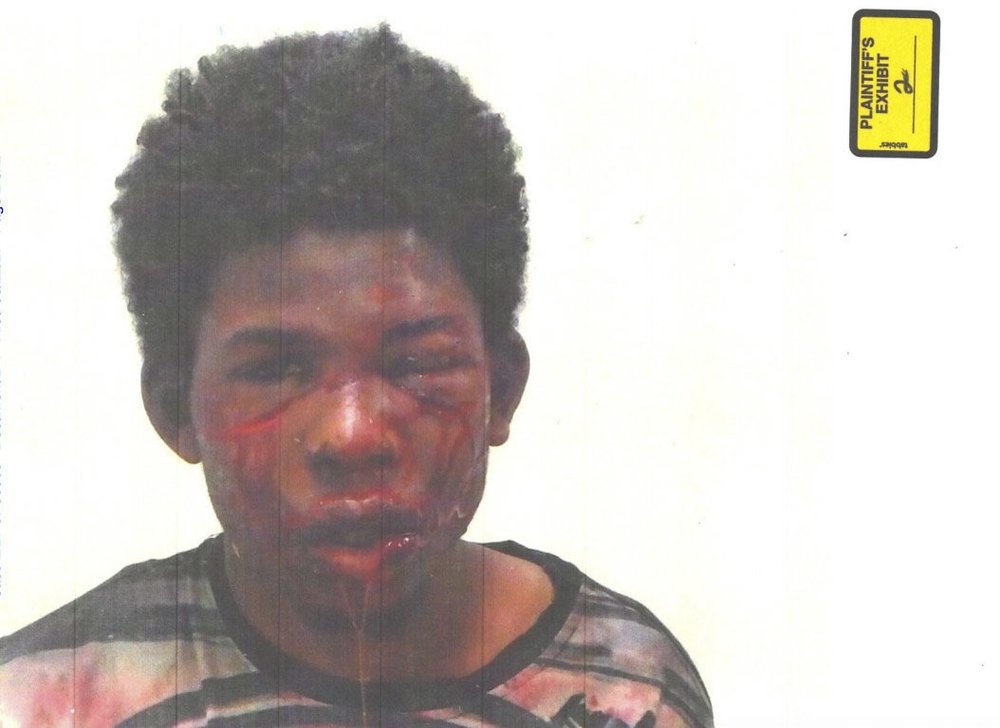
As a result, Neveaux suffered nerve damage, disfigurement, partial blindness in his right eye and mental anguish, the lawsuit says.
Neveaux, 20, is charged in Jefferson Parish district court with first-degree murder, aggravated assault with a firearm, illegal possession of a stolen firearm and two counts of resisting police by force. He is accused of shooting Michel, 50, three times in the back after the detective stopped him as he was walking near Manhattan Boulevard and Ascot Road in Harvey on June 22, 2016.
The Jefferson Parish district attorney's office is seeking the death penalty. Neveaux has pleaded not guilty and not guilty by reason of insanity.
Neveaux's attorney on the civil lawsuit, Williard Brown Sr., had not yet responded to a request for comment Friday afternoon.
Sheriff's Office deputies took Neveaux into custody shortly after the Michel's shooting in the nearby Pebble Walk subdivision where authorities say he tried to hide in the backyard of a townhouse it in the 1500 block of London Cross Road.
Cellphone video recorded of the arrest and released to WVUE-Fox 8 raised questions about excessive force, at the time.
In the video, a deputy who appears to be kneeling near what is possibly Neveaux's head can be seen delivering at least 10 blows.
A resident who witnessed the arrest told NOLA.com | The Times-Picayune, "All I seen was the man handcuffed, and they was beating the hell out him."
The lawsuit contends the video shows Neveaux raising his hands as deputies drew their guns and approached him in the backyard. Neveaux was trying to lie down when several deputies rushed him and forced him to the ground.
The deputies kicked and beat Neveaux while handcuffing him and slammed his face against the corner of a table while walking him through a residence, the lawsuit said.
The court filing includes mugshots of Neveaux's bloodied and swollen face.
In the days after Neveaux's arrest, Jefferson Parish Sheriff Newell Normand reported he suffered a fractured eye socket and cuts to his face. Martin Regan, Neveaux's criminal attorney told Jefferson Parish courts his client also suffered internal injuries, possible spinal damage and had difficulty walking.
Neveaux was still using a wheelchair at his most recent court appearance, a June 7 hearing regarding his mental ability to aid in his defense. Court-appointed doctors found him competent to help his attorney, but the judge granted Regan more time to obtain medical records.
Normand has said Neveaux was in possession of a .38-caliber pistol during the arrest. The sheriff asked the FBI Civil Rights Task Force to take over an investigation into the excessive force allegations. No information was available Friday about that probe.
Neveaux's lawsuit asks for damages and names the following defendants: Sgt. Christy Clement, Sgt. Julio Avarado, Detective George Kister, Dep. Joseph Ragas, Sgt. Frank Renaudin, Detective Blake Hollifield, Detective Todd Rivere, Detective Derek Green, Maj. Michael Dupuis, Sgt. Travis Esennan, Detective Melvin Francis, Sgt. Marlo Bruno, Sgt. Rodney Naumann, Col. John Fortunato, Detective William Roniger, Sgt. Mark Layrisson, Dep. Nathanial Obiol, Detective Adrian Thompson, Detective Stephen Villere, Dep. Eric Hymel, Sgt. Gary Barteet, Detective Donald Zanotelli, Sgt. Thomas Gai, Lt. Elvin Modica, Detective Michael Schmitt, Detective Robert Miles, Detective Jean Lincoln and Dep. Sean Whalen.
From [HERE] The parents of a gun-wielding 14-year-old whom Los Angeles police shot and killed in Boyle Heights last year have filed suit against the city and an officer, alleging that police violated their son’s civil rights, used excessive force and denied him timely medical care.
“By not disciplining police officers when they use excessive force, [the city has] fostered a culture of allowing officers to shoot people and get away with it,” said the family’s attorney, Humberto Guizar, at a Friday press conference.
Police have said Jesse Romero was with two others behind an apartment complex near Chicago Street and Cesar Chavez Avenue on Aug. 9, 2016, tagging gang-type graffiti when gang officers approached. The three bolted, the LAPD said, with Romero “grabbing his front waistband.”
As they approached Breed Street, officers heard a gunshot. One of the officers then saw Romero crouched on the sidewalk with his arm extended, police said in a statement. “Fearing Romero was going to shoot at them,” the officer fired two shots.
In the lawsuit filed in federal court on Tuesday, the family said Medina should not have been allowed to return to the field so soon after his first shooting.
Police also have said that a witness saw Romero fire a handgun in the direction of the officers.
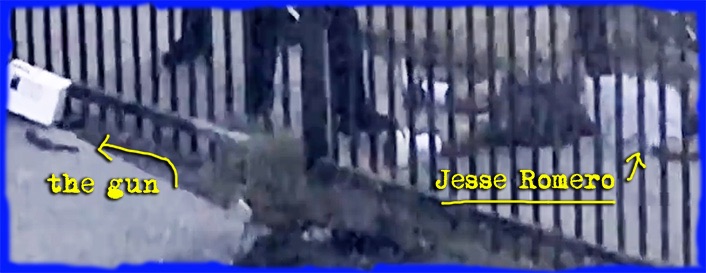
At Friday’s press conference, Guizar also disputed police accounts that a witness saw Jesse fire a handgun, and that he was pointing a handgun at officers when he was shot. Witnesses saw Jesse throw the gun and a video shows the gun on the other side of a wrought-iron fence, Guizar said.
One witness who said she saw the shooting explained that Romero pulled the revolver from his waistband, threw it against a fence and ran. The gun fired when it hit the ground, she told The Times.
“This is an antique revolver, probably a .38 caliber, which does not have a modern safety device that prevents accidental discharges when dropped on its hammer,” Gregory Lee, a retired supervisory special agent with the Drug Enforcement Agency, wrote in an email. “It most probably fired when it was dropped.” [MORE]
“It would have been impossible for Jesse to have a gun in his hand, aiming it at the officers at the time they shot him,” Guizar said.
Videos released by LA Weekly, Democracy Nowcontradict the LAPD version of the shooting.
The video, which begins just after the shooting, shows officers standing over the boy’s body on the sidewalk and then handcuffing him. It shows the alleged gun far way on other side of a metal wrought iron fence. [MORE] and [MORE]
The video, which begins just after the shooting, shows officers standing over the boy’s body on the sidewalk and then handcuffing him.
Another witness described seeing one officer extend his arm and shoot the running teenager twice in the back. Then the boy fell.
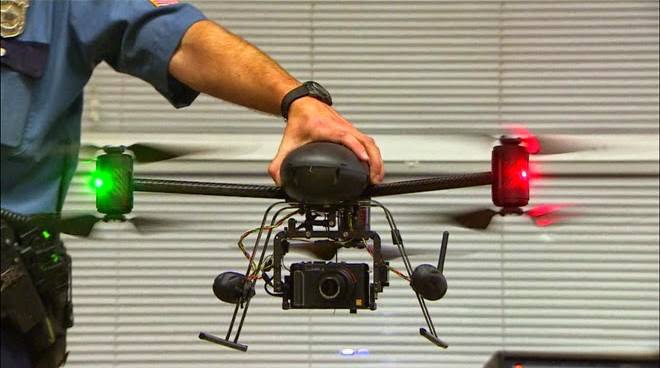
A "Persistent Surveillance System" Watched by Unaccountable, Voyeuristic Government. From [LA Times] The Los Angeles Fire Department could soon seek federal permission to fly drones, a tool that officials say could help them track down missing hikers, gauge the risks in burning buildings and search confined spaces.
A Los Angeles City Council committee voted Tuesday to allow the department to start seekingFederal Aviation Administration authorization to use “unmanned aerial systems,” despite objections from groups concerned about privacy rights. That decision now heads to the entire council for approval.
“I think there’s a tremendous opportunity to save lives,” said Councilman Mitch Englander, who has championed the idea.
Fire officials say no drones will be launched, however, until the Board of Fire Commissioners and the City Council approve a policy outlining how they can be used. The American Civil Liberties Union of Southern California has already raised concerns about draft guidelines, saying they do not go far enough to address “serious privacy concerns.”
Fire Department officials say the drones will not be used for police surveillance, but to assess hazards on the spot.
At the Tuesday committee meeting, LAFD battalion Chief Richard Fields said that the department too often has had to rely on “simple radio communications” to figure out where to put its firefighters and equipment rescue people or snuff out fires.
Fields rattled off several situations that might call for drones, including evaluating the dangers in buildings at risk of collapse. Englander said the drones could also be equipped to communicate with stranded hikers, allowing rescuers to ask, “‘What do you need? What’s hurting? How are you doing?’”
The Fire Department also said the technology could be used for training. “We wouldn’t want to squander the possibilities of drone technology,” said Councilman Mitch O’Farrell, one of four lawmakers who backed the plan Tuesday.
The growing use of drones, however, has also alarmed groups concerned about warrantless surveillance.
Hamid Khan, founder of the Stop LAPD Spying Coalition, argued that allowing the Fire Department to use drones would end up providing a “backdoor” way to share information with police. The group protested when the Los Angeles Police Department got a pair of drones, which have been locked up since then, and has also opposed drone use by the Los Angeles County Sheriff’s Department.
“We are deeply concerned about this development,” Khan said.
The ACLU of Southern California warned that although the Fire Department has pledged not to use the drones for surveillance, the draft set of rules did not spell out what purposes would be allowed.
“We can’t protect against mission creep because we don’t know what the mission is to start with,” staff attorney Melanie Ochoa said.
The ACLU also recommended that the Fire Department hammer out rules for retaining and sharing footage from drones, include oversight and accountability measures such as an independent monitor to track drone use, and require that any future changes to the policy be vetted by the Board of Fire Commissioners and the City Council.
Fire Department officials say that they are undertaking a careful process to address those concerns. In a report, the department said it planned to turn in quarterly reports on drone use, give the public a way to weigh in, and alert Angelenos in advance where a drone was being deployed.
The Fire Department “will engage in regular dialogue with the public safety committee to make sure there’s proper oversight,” said department spokesman Jeremy Oberstein, adding that the drones would operate under “tight guidelines.” [sounds like 100% solid gold bullshit from racist suspects in YOUR Government. LAPD and Home[boy]Land Security will not have access to their feed?]
At the Tuesday meeting, Fire Department officials added that they could lose federal authorization if they used drones for unapproved purposes. However, an FAA spokesman said it does not specify what agencies can or cannot do with drones “except from a safety perspective.”
Department officials estimate that it will cost $40,000 to buy a first set of six drones with cameras, infrared detection and supporting equipment, using money donated by the Los Angeles Fire Department Foundation.
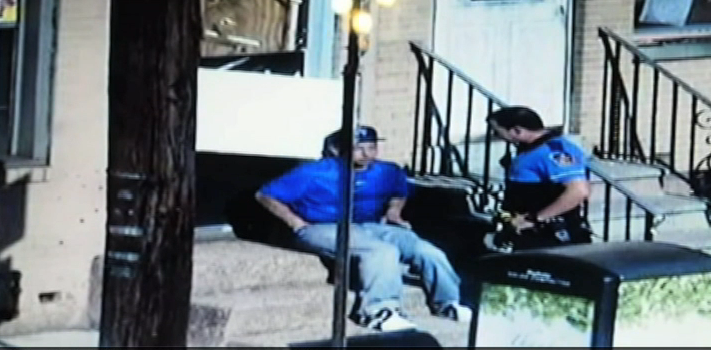
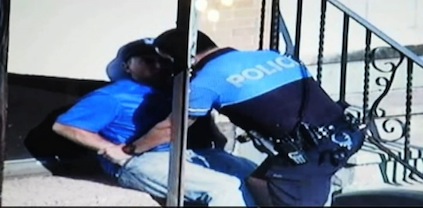
Not Free to Go. From [HERE] On Thursday, several white plainclothes U.S. Park Police officers handcuffed and detained three African American teenagers for selling water on the National Mall without a license. Photos of the detention quickly spread across social media, provoking outrage among some who viewed the move as inappropriate and racially-motivated.
On Friday, D.C. councilmember Charles Allen (D-Ward 6), who chairs the council’s public safety committee, strongly condemned the Park Police’s action in a letter.
“While I understand the need to maintain consistency in permitted actions, I do not understand why the enforcement cannot take place with uniformed personnel and actions less severe than handcuffing individuals suspected of the sales,” Allen wrote. “I can’t help but think how the reaction by these same officers might have varied if different children had set up a quaint hand-painted lemonade stand in the same spot.”
According to the Washington Post, the teens were given a verbal warning and released without charges.
According to Sgt. Anna Rose of the U.S. Park Police, the teens were handcuffed “for the safety of the officers and of the individuals.”
ThinkProgress notes that the “fear defense” has been widely employed by police in a number of police brutality cases, where police have injured or shot and killed black men and women. Lol. It has been widely used for centuries. Think George Zimmerman and check out Dr. Welsing's Color Confrontation Theory.
[In Nazi Germany , as part of the destruction process of the Jews, the Nazi's created an elaborate system of movement restrictions and identification measuresthat included personal Jew identification cards, passports marked with a J, assignment of names and the outward marking of persons with a yellow star. Jews were only allowed to appear in public when wearing the Jewish star. [MORE] In a white supremacy system there is no need for any such star - you are targeted by skin color]
Unstuck White Cop Told White Jury He Was Stuck & Dragged by an Unmoving Car in Murder of Sam Dubose[It Would Be Better If They Had No Eyes. At least there would have been no possibility of misunderstanding.]
From [HERE] The trial of Ray Tensing, a white University of Cincinnati police officer who fatally shot an unarmed black man during a traffic stop in July 2015, resulted in a hung jury on Friday, marking the second time Tensing’s case has ended in a mistrial.
On July 19, 2015, in Cincinnati, Ohio, Samuel DuBose (43), an unarmed Black man, was fatally shot by Ray Tensing (27), a University of Cincinnati police officer, during a traffic stop for a missing front license plate. Tensing fired after DuBose started his car. Tensing stated that DuBose had begun to drive off and that he was being dragged because his arm was caught in the car. Prosecutors alleged that footage from Tensing's bodycam showed that he was not dragged and a grand juryindicted him on charges of murder and voluntary manslaughter. He was then fired from the police department. He was released on bond before trial. A November 2016 trial ended in mistrial after the jury became deadlocked. The retrial began in May 2017 and also ended in a hung jury on June 23, 2017.
In January 2016, following two days of mediation with civil rights attorney Al Gerhardstein, the University of Cincinnati agreed to pay $4.85 million to the DuBose family. In addition to financial compensation, the settlement included free undergraduate education for DuBose's children, the creation of a memorial in his name, an apology from the school's president, and engagement by the family in police reform at the university.It also protected all potential defendants from any future civil litigation in DuBose's death.
Like the previous trial, the jury in the re-trial was mostly white: Nine whites and 3 African Ameircans (9 women and 3 men). [MORE] His previous jury was composed of 10 whites. [MORE]
Car Did Not Move. He Was Not Stuck. But a forensic frame by frame analysis of the the bodycam video [see below] showed that the car did not move or barely moved an inch before Tensing fired his gun. The bodycam video also shows Tensing was not dragged. Also, a report by a risk-consulting firm hired by the university said that the video showed that Mr. Tensing was not being dragged, that the car had barely moved before the gunshot was fired and that Mr. Tensing had made several critical errors — including drawing his gun and reaching into the car.
During the trial Tensing admitted that he was not stuck to anything in the car and that he was not being held in the car by Dubose. He said he misperceived being stuck to the car. He said he realized he was not stuck after he watched the video. [See [full testimony] on video above at 1:45:51]. It also seems improbable that he could perceive being run over because he was on the drivers side of the vehicle - as the car moved forward not sideways.
Tensing's beliefs were actually delusions or misperceptions. He told the jury a story more in accord with the apppetite of the racist listener, not with the realities of life: He was scared to death of a frightening young Black man - and he was by himself.
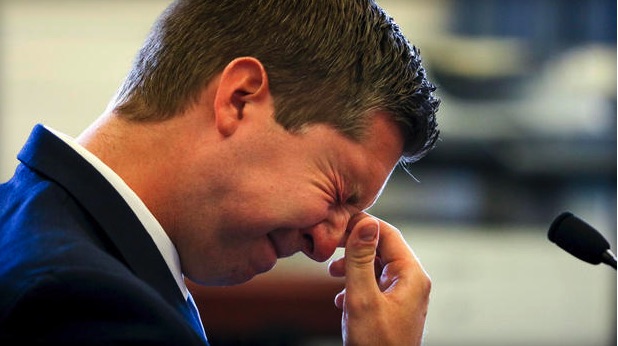
During the white cop's tearful testimony [crying w/o tears, see video] last Friday at the Hamilton County Courthouse in Cincinnati, Tensing, dressed in a dark suit, said that DuBose was evasive during the traffic stop and attempted to speed away.
"He just mashed the accelerator to the floor," said Tensing, who paused occasionally to wipe his eyes with a tissue [yet there were no tears]. "I protected my life," Tensing said when asked by prosecutors if he had served and protected DuBose. Tensing said repeatedly that he shot to "stop the threat."
Whenever the unreality of race is present racists are in a real deep state of attachment that prevents them from being conscious. When YOU appear they have checked out and checked into some robotic beliefs going on in their minds - programmed to believe all sorts of idiocy about non-whites [dangerous, inferior beasts doing this and that]. Believing in an imagined hierarchy based on their lack of skin color and inability to produce color they imagine themselves to be higher than what they imagine"others" to be. This whole little make believe game is going on in their minds. Anything done in this sleeping state will be stupid. How could it not be?
Tensing's mind must have got carried away when he saw Samual Dubose. All his thoughts clouded with smoke, he could no longer physically see things as they were. His mind blocked it. A mind full of smoke. Here, this stupid mf saw only what his mind allowed him to see. Was he intentionally lying or unconscious? His racist mind deceived him so badly that he believed he was stuck to a car and that he could get runover sideways by a car that was not moving.
During an interaction with a white cop this is what you may be dealing with. A psychopath where race is the variable - so you must be aware. Guides and codes will be of no help to you in the present moment of such a confrontation. In fact, blind belief in memorized formatted rules may get you killed. You must be aware of what your mind is thinking and feeling before you also act unconsciously. "Heaven and hell are not geographical. If you go in search of them you will never find them anywhere. They are within you, they are psychological. The mind is heaven, the mind is hell, and the mind has the capacity to become either." [MORE]
Dr. Blynd explains, "awareness is the fundamental force of change for the Self and the natural result of abandoning illusion." [MORE]
Unfortunately, in a system of white supremacy most white judges, jurors, prosecutors, other white police, elected officials and the white mainstream media will believe almost anything a white cop says. [MORE]
The great rebel, Buddha said: "All beliefs are dangerous. You should not believe, you should see.
Belief is a closing of the mind -- then the aperture is closed, then you don't look." In fact, a man who believes becomes afraid to look. Maybe the truth is against his belief. Then what to do? -- he closes his eyes. It is easier to protect one's belief with closed eyes than with open eyes. Who knows? -- the truth may not coincide with your belief, the truth may shatter your belief, the truth may be against your belief. It may not be Christian, it may not be Hindu, it may not be Mohammedan. Then what will you do? So it is better to remain with closed eyes.
A man with belief becomes afraid: he does not seek and he does not enquire and he does not search. He never explores. He remains stuck with his belief. He holds his belief to his heart; this is out of fear." [MORE]
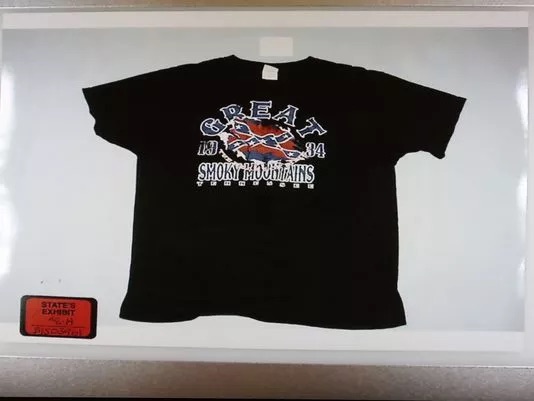
White Cop Was Wearing this Confederate Flag Under Shirt When He Shot Black Man.Along with the Confederate flag, Tensing’s shirt read “Great Smoky Mountains, 1934.”
Final arguments [above in video] were on Monday, June 19, 2017. Jurors returned for a fourth day of deliberations Thursday in the murder retrial of a white University of Cincinnati police officer who shot an unarmed black motorist. [MORE]
Officer Ray Tensing, 27, shot once, hitting 43-year-old Samuel DuBose in the head after stopping him for a missing front license plate on his car in July 2015, a body camera worn by Tensing showed.
Tensing, who is white, was charged with murder and voluntary manslaughter in a retrial of the case. A mistrial was declared last November in the first trial after jurors could not agree on a verdict.
Like the previous trial, the jury is mostly white: Nine whites and 3 African Ameircans (9 women and 3 men). [MORE] His previous jury was composed of 10 whites. [MORE] [Yes nearly all white in a City that is 45% Black. [MORE]]
Tensing fired his gun after DuBose started his car. Tensing stated that DuBose had begun to drive off and that he was being dragged because his arm was caught in the car.
However, prosecutors have clearly demonstrated with footage from Tensing's bodycam that he was not dragged and he was not stuck in the car. A report by a risk-consulting firm hired by the university said that the video showed that Mr. Tensing was not being dragged, that the car had barely moved before the gunshot was fired and that Mr. Tensing had made several critical errors — including drawing his gun and reaching into the car. [MORE]
But what will the white jurors see? [In the presence of Blacks racists cannot see things as they really are. Racism white supremacy is a virus in the mind. [MORE]
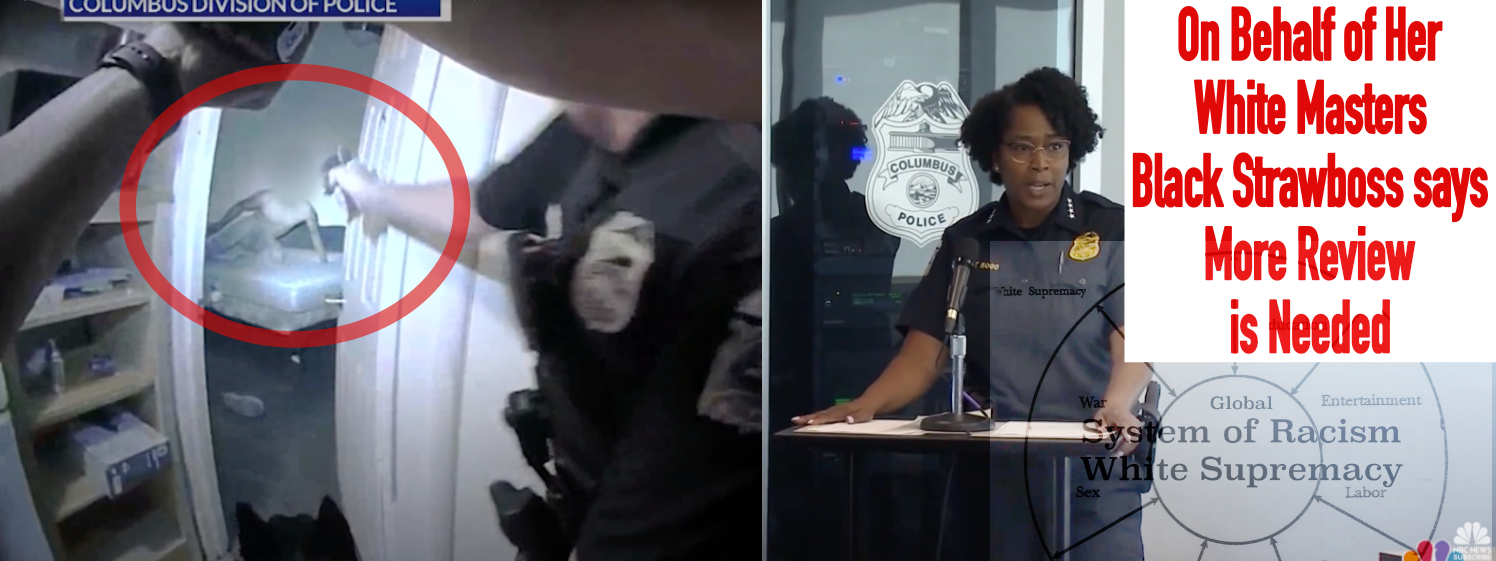
From [HERE] After deliberating for several weeks, Columbus Police Chief Kim Jacobs has recommended that a white police officer who stomped on a handcuffed Black man in April be suspended for only 24 work hours. Chief Jacobs is white.
In a memo dated June 14 to Officer Zachary Rosen, 32, Jacobs said she is recommending the suspension to Public Safety Director Ned Pettus, who will hold his own inquiry and ultimately decide the punishment. Jacobs’ memo was released Wednesday. Pettus is African American.
“Twenty-four hours is an absolute joke,” said Amber Evans, organizer for the People’s Justice Project, which has protested Rosen at the city council. “I think it’s a major slap in the face for the black community, and for the mothers that have lost their family members to police violence, and for the young man who was kicked in his head by Rosen.”
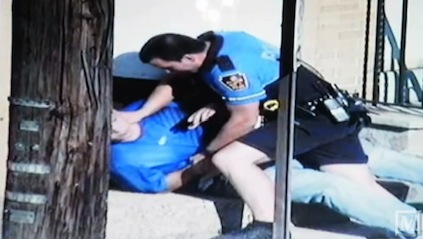
On the video, 26-year-old Demarko Anderson is seen lying on his chest on a concrete driveway, restrained by Officer Darren Stephens with his hands behind his back. Rosen is seen darting into the frame and striking Anderson once in the head with his left foot. Anderson’s head was raised, then seen smashed into the pavement as Rosen struck him.
Anderson is heard on the video saying, “Are you serious? I’ve got cuffs on, sir.”
blah blah. Racism is practiced [deception] through the use of words.
Co-Opting Local Traffic Codes As a Weapon Against Non-Whites.For white folks, the bare essentials of a "routine traffic stop" consist of causing the vehicle to stop, explaining to the driver the reason for the stop, questioning solely based on the stop, verifying the credentials of the driver and the vehicle, and then issuing a citation or a warning. 10 minutes later, have a nice day buddy. [Did you see the Charleston cops pull over Dylann Roof, the so-called white terrorist?]
For many non-white folks the bare essentials of a traffic stop are a records check via radio or computer regarding the criminal history of those stopped and any outstanding arrest warrants for those individuals; interrogation of those stopped directly on the subject of drugs or about the nature and purpose of their travels; seeking (and often obtaining) consent to conduct a full search of the stopped vehicle and the driver/passengers; using a drug-sniffing dog to detect the presence of any drugs in the stopped vehicle and/or verbal abuse and physical beat down.
Great service from contemptuous, racist suspect public servants From [HERE] The American Civil Liberties Union is calling for an investigation after releasing dash cam video of a Worthington, MN police officer pulling a motorist out of a car and beating him.
According to the ACLU, the incident happened in July 28, 2016 and is one piece of evidence of what is says is as systemic problem racial profiling and police brutality in the Worthington Police Department, Nobles County Sheriff’s Office, and the Buffalo Ridge Drug Task Force.
According to the ACLU, the video shows Agent Joe Joswiak of the Buffalo Ridge Drug Task Force opened the door of Anthony Promvongsa car. Agent Joswiak then yells “Get the fuck out of the car, motherfucker!”. He punches and knees Promvongsa repeatedly before another officer assists in pulling him out of the car, putting him face down on the road and handcuffing him.
The pretext of stopping Promvongsa’s car, says the ACLU, was for tailgating. In a post about the incidentthe ACLU says
“It turns out the agitated motorist Anthony encountered before being assaulted by Agent Joswiak was an off-duty police officer who called Joswiak to go after Anthony for tailgating him. The officer reports regarding the incident make no mention of any suspicion that Anthony was committing a drug offense.
“The police have charged Anthony with various offenses, the most serious being fleeing in a motor vehicle and two counts of assault with a deadly weapon — his car. ”
The ACLU says “Agent Joswiak claims Anthony refused his order to leave his car, but the video contradicts this assertion. Instead it shows a textbook case of excessive force.”
More from the ACLU post:
The Worthington Police Department, which employs Sgt. Gaul and appointed Agent Joswiak to the Buffalo Ridge Drug Task Force, needs to immediately investigate the incident, take all appropriate personnel actions, and ensure this never happens again. The ACLU has called for an investigation into Agent Joswiak’s behavior. Agent Joswiak should be held accountable for his actions, up to and including termination and prosecution.
Based on additional complaints that we are receiving, this does not appear to be an isolated incident. Rather there’s evidence that racial profiling and police brutality are systemic problems that span the Worthington Police Department, Nobles County Sheriff’s Office, and the Buffalo Ridge Drug Task Force as Worthington becomes a much more diverse city.
The ACLU is talking with Anthony Promvongsa and his criminal counsel, and we are considering all legal options. No person in Worthington, Minnesota, should have to fear that the people who swear an oath to protect and serve the community are acting like criminals themselves. The video we have of Agent Joswiak and Sgt. Gaul seems to reveal at least two police officers who believe that they are above the law, not bound by it.
From [HERE] and [HERE] The city of Chicago has agreed to pay $9.5 million to settle a federal lawsuit filed by a Latino man who was severely injured when a police officer jolted him with a Taser and he fell and hit his head on the pavement, court records show.
Few lawsuits against Chicago police over the last decade have cost the city as much. Lopez's lawsuit, filed in U.S. District Court in Chicago, said he was not combative before he was shocked and crashed to the pavement. One of his attorneys, John DeRose, said Lopez cannot talk and moves very little. "On a real great day, he can blink to yes or no questions," DeRose said Wednesday. "He's locked in that body."
Lopez's lawsuit, filed in U.S. District Court in Chicago, said he was not combative before he was shocked and crashed to the pavement. Officers alleged that he took a swing at them before Officer Stevan Vidljinovic tased him, according to court records.
Sandra Cardiel sued Chicago police officers on behalf of her husband, Jose Lopez, in Federal Court. Her husband was walking down a sidewalk on the South Side at around 3 a.m. on July 22, 2011 when he began feeling chest pains and his friend called 911 to ask for an ambulance.
Chicago police officers also went in response to the emergency dispatch. At least three or four squad cars of the Chicago Police Department arrived on the scene before or simultaneous with the arrival of the Chicago Fire Department ambulance. ...
When the Chicago police officers ordered plaintiff to stop and come to them, Lopez told them he did not want their help and said he was just fine.
As the Chicago police officers continued to order Lopez to come to them, he was unarmed and non-combative, but told the police that he did not want their assistance.
He disregarded their order, turned, continued to retreat in a direction away from them, and started walking toward his car. As is their want, custom, and practice to so do, when a citizen of the community refuses an order to stop and continues to walk away, the cops draw and use their Taser guns to force compliance.
Ms. Cardiel says there were "more than an ample number" of police officers and firefighters there to seize and restrain her husband, if need be, without Tasering him. In fact, she says, he was "surrounded" by cops and firemen.
But "Because (Lopez) had not heeded their order to stop and come to them, the Cops drew their Taser guns, and without any right or reason to so do, immediately Tased Lopez, sending an electric shock through Lopez's body strong enough to cause him to crash violently to the pavement, crack open his head, and cry out with horrible sounds of pain.
The Chicago police officers immediately rushed him, violently turned him facedown on the sidewalk, and, without any right to so do, handcuffed him behind his back, the complaint states.
Whereupon, Cardiel says, "the Chicago police officers denied that they had done anything wrong to anyone who would listen, including the ambulance paramedics and the bystanders who gathered at the scene."
Cardiel says: Since moments after Tasing Lopez was rendered unconscious and remained in a coma for at least a year.
Upon arrival at Mount Sinai Hospital Emergency Room, Lopez was found to have suffered a traumatic brain injury with subdural hematoma as well as a left temporal lobe contusion.
After being evaluated by neurosurgery at Mount Sinai Hospital, plaintiff underwent a subdural hematoma evacuation and craniotomy and right temporal lobectomy."
Lopez's lawsuit went to trial in February and lasted more than two weeks. A jury found that Vidljinovic used excessive force and unlawfully seized Lopez. Jurors determined the evidence didn't show Lopez swung at police. Before jurors could determine damages, the parties reached a settlement, court records show.
She originally sought at least $4 million in punitive and compensatory damages for false seizure, excessive force, assault and battery, and emotional distress.
[The media has painted this police brutality episode as a Black on Black incident. Elite whites and their media hope you will buy what they work so hard at selling - that Black on Black violence and any other Black on Black hate going on in other contexts has nothing to do with white supremacy/racism. What's really real is that a Black cop would never do this shit to a white person and apparently never has. In reality, 'the black on black [criminal] is a white racist in black skin - a person who has internalized white racist attitudes and has identified with his victimizers and expresses his victimization by victimizing other black people. Filled with self hating venom, his behavior reflexts the absence of an appropriate black and african identity.' [MORE]. Black on black violence is a result of white supremacy. In all contexts a non-white person programmed in service of white domination is just as dangerous as a racist.] [MORE]]
Justice in Courts is Only Random in System of White Supremacy. From [HERE] A jury here on Wednesday acquitted a race soldier cop in the fatal shooting last August of a 23-year-old Black man, Sylville K. Smith, a death that touched off two days of protest and violence on this city’s north side.
The outcome was announced after less than 10 hours of deliberations in a case that was closely watched in Milwaukee. Jurors had been sequestered since June 13. Four of the 12 jurors were black.
Dominique Heaggan-Brown, a Milwaukee police officer for three years until he was fired last fall, had been charged in December with first-degree reckless homicide, a crime punishable by up to 60 years in prison.
Despite the visible public anger over and media attention on police shootings of Blacks & Latinos in recent years, criminal prosecution of the officers involved remains rare, as are prosecutions that end in convictions. Experts say close to 1,000 people are fatally shot each year by police officers in the United States.
The fatal encounter between Mr. Smith and Officer Heaggan-Brown, who were both African-Americans in their 20s, unfolded quickly last August.
Officer Heaggan-Brown and another officer were working in a residential neighborhood in Milwaukee when they approached Mr. Smith, who they suspected was involved in a drug deal. As they exited their squad car, Mr. Smith, who was armed with a handgun, darted away and ran into a yard with a chain-link fence.
When Mr. Smith reached the fence, he threw his gun over it, just as Officer Heaggan-Brown fired at him, a shot that hit Mr. Smith in his right arm.
Mr. Smith then fell onto the ground. Moments later, Officer Heaggan-Brown, standing several feet away, fired again, striking Mr. Smith in his chest. An official from Milwaukee County’s medical examiner’s office said that the second shot traveled through Mr. Smith’s heart and lung and was “not survivable.”
The criminal complaint says the Black man was unarmed when the officer fired the shot that killed him. The complaint says the body-camera video showed Smith was on the ground, unarmed and had his hands near his head when Heaggan-Brown shot him a second time in the chest. [MORE]
The entire episode lasted about 12 seconds.
Using frame-by-frame video from the officers’ body cameras, prosecutors argued that while the first shot fired by Mr. Smith was reasonable, the second shot was not.
The video showed that at the time the officer fired a second shot, Mr. Smith no longer had a gun and was on the ground — “hands up, with no place to go,” said the prosecutor, John Chisholm.
Officer Heaggan-Brown had no reason to fear for his life once Mr. Smith was unarmed, wounded and unable to run away, Mr. Chisholm said during his closing arguments on Tuesday. “Shooting someone point blank when he’s on the ground is utter disregard for life,” he said.
But the defense said that Officer Heaggan-Brown was merely following police procedure when he fired his gun a second time. Jonathan Smith, Officer Heaggan-Brown’s lawyer, told jurors that officers were taught to use the “one-plus rule” — or to expect that if a person has one weapon, he might have another.
Officer Heaggan-Brown was trained to use deadly force until a suspect is no longer a threat, Mr. Smith said.
“A gunfight doesn’t end until the threat is stopped,” he said.
Officer Heaggan-Brown, 25, did not testify at the trial. But he told investigators in an interview after the shooting that he had guessed that Mr. Smith was involved in a drug deal because he was driving a car with out-of-state plates.
During the chase, Officer Heaggan-Brown said that he had ordered Mr. Smith to show his hands and then fired a second shot when he saw that one of Mr. Smith’s hands move “toward his waist.”
Jurors relied on video from two body cameras: one worn by Officer Heaggan-Brown and another by the second officer on the scene, Ndiva Malafa.
On Monday, the jury was told it could find Officer Heaggan-Brown guilty of the original charge, first-degree reckless homicide, or of either of two lesser charges: second-degree reckless homicide, which carries a maximum of 15 years in prison, or homicide by negligent operation of a dangerous weapon, punishable by as many as five years in prison.
After the shooting in August, angry demonstrators took to the streets of Milwaukee, setting fires to businesses and throwing rocks at the police. Gov. Scott Walker declared a state of emergency and activated the state National Guard.
Officer Heaggan-Brown was fired in October from the Milwaukee Police Department on unrelated sexual assault charges.
The night after the shooting of Mr. Smith, prosecutors said Officer Heaggan-Brown went to a bar, met a man, drank heavily and “bragged about being able to do whatever” he wanted “without repercussions.”
According to prosecutors, later that night, Officer Heaggan-Brown sexually assaulted the man. In the morning, Officer Heaggan-Brown left the man at a hospital and texted a superior at the Police Department that he had made a mistake and needed “to handle this in the most secret and right way possible.”
Officer Heaggan-Brown has pleaded not guilty to those charges. He is expected to face a jury trial in August.
From [HERE] Last Friday, the Minnesota race soldier cop who killed Philando Castile last year during a traffic stop was acquitted by a mostly white jury (13 of 15 were white) of all charges he faced over the gruesome death of Philandro Castille. [MORE]
Jeronimo Yanez shot Mr Castile after the black motorist calmly informed him that he had a gun in his car. Mr Castile was licenced to have the weapon, and had been told to calmly inform officers of the firearm in those situations for his safety.
The black man's final dying words were 'I wasn't reaching for it.' It can be heard on the dash cam video released today for the first time to the public. Apparently, the mostly white jury did not find Castille or his girlfriend credible. Rather, the jury believed the race soldier cop, who cried and told them he was sacred of a black man. If you are able to listen and see for a moment without the mind then the video speaks for itself.
The Cop's Two Versions of What Happened Cannot Both Be True [Means he is a liar for those who have ears to hear.]The day after the incident occurred Yanez explained to police officials that he was not sure whether Castile was reaching for a gun. He told the police investigators he never actually saw a gun [MORE] and [complaint PDF]. Yanez also inconsistently told a fellow St. Anthony police officer minutes after the shooting, "And I don't know where the gun was, he didn't tell me where the [expletive] gun was and then it was just getting hinky, he gave, he was just staring ahead, and the I was getting [expletive] nervous, and then I told him, I know I [expletive] told him to get his [expletive] hand off his gun." [MORE]
However, at the trial he said that he actually saw the gun and Castile had pulled it out. Something that Castile's girlfriend Diamond Reynolds denied. Castile also denied it; as his last dying words were, 'I'm not pulling it out,' on a video released by proscecutors during trial. On the video Reynolds also responded by saying, 'he's not pulling it out."
Specifically, last Friday Yanez, testified he fired his weapon because Castile had his hand on a gun, not his wallet and identification papers.
"I had no other choice. I didn't want to shoot Mr. Castile. That wasn't my intention," CNN affiliate WCCO reported. "I thought I was going to die."
Mr Yanez testified that he feared for his life when Mr Castile grabbed for his firearm, even though he was told not to.
"It's your testimony today that you saw Mr. Castile pull out an object?" prosecutor Rick Dusterhoft said Friday.
"It was a gun," Yanez said.
"You said he pulled it out?"
"Correct," Yanez said.
"And he said he wasn't (pulling it out)?"
"Correct, but it doesn't always mean that's what he was doing," Yanez said.
Previously, Yanez said
"When Roseville police officers arrived you never warned them there was a gun did you?" Dusterhoft said.
"No," Yanez said.
Previously Yanez also inconsistently stated to police investigators, "Castille put his hand around something." He said Castile's hand took a C-shape, "like putting my hand up to the butt of the gun." Yanez said he then lost view of Castile's hand. "I know he had an object and it was dark," he said. "And he was pulling it out with his right hand. [MORE]
Previously, Yanez said he thought or believed Castile had the gun in his right hand and he had "no option" but to shoot. [MORE] But he never said that he saw the gun and knew it was a gun [no need for belief when you can see]. On the video Yanez is yelling, “Don’t pull it out!” However, a year later on the witness stand he said he saw a gun.
Prosecutors said Yanez is not credible.
“Based upon the evidence, we believe that Castile never removed, nor tried to remove, his handgun from his front right pocket, which was a foot deep,” said Ramsey County Attorney John Choi. Yanez’s partner also didn’t see a gun. [MORE] On cross examination the race soldier cop was asked,
"When Roseville police officers arrived you never warned them there was a gun did you?"
"No," Yanez said.
Prosecutors say Yanez acted negligently in using deadly force and had not given clear instructions.
According to prosecutors, Officer Yanez asked Castile to produce his driver's license and proof of insurance. Castile first provided him with his insurance card.
Castile then, calmly, and in a non-threatening manner, informed Officer Yanez, 'sir, I have to tell you that I do have a firearm on me.'
Before Castile completed the sentence, Officer Yanez interrupted and calmly replied, 'okay' and placed his right hand on the holster of his own, holstered, gun.
Officer Yanez then said, 'okay, don't reach for it, then.'
Castile tried to respond but was interrupted by Officer Yanez, who said, 'don't pull it out.'
Castile responded, 'I'm not pulling it out,' and Reynolds also responded by saying, 'he's not pulling it out.'
Then Officer Yanez screamed, 'don't pull it out!' and quickly pulled his own gun with his right hand while he reached inside the driver's side window with his left hand.
Officer Yanez pulled his left arm out of the car, and then fired seven shots in rapid succession into the vehicle.
The seventh and final shot was fired at 9:06 and two seconds p.m. After the final shot, Reynolds frantically yelled, 'you just killed my boyfriend!'
Philando Castile moaned and uttered his final words: 'I wasn't reaching for it.'
To which Reynolds loudly said, 'he wasn't reaching for it.'
Before Reynolds completed her sentence, Officer Yanez again screamed, 'don't pull it out!' [he testifed that it was already out]
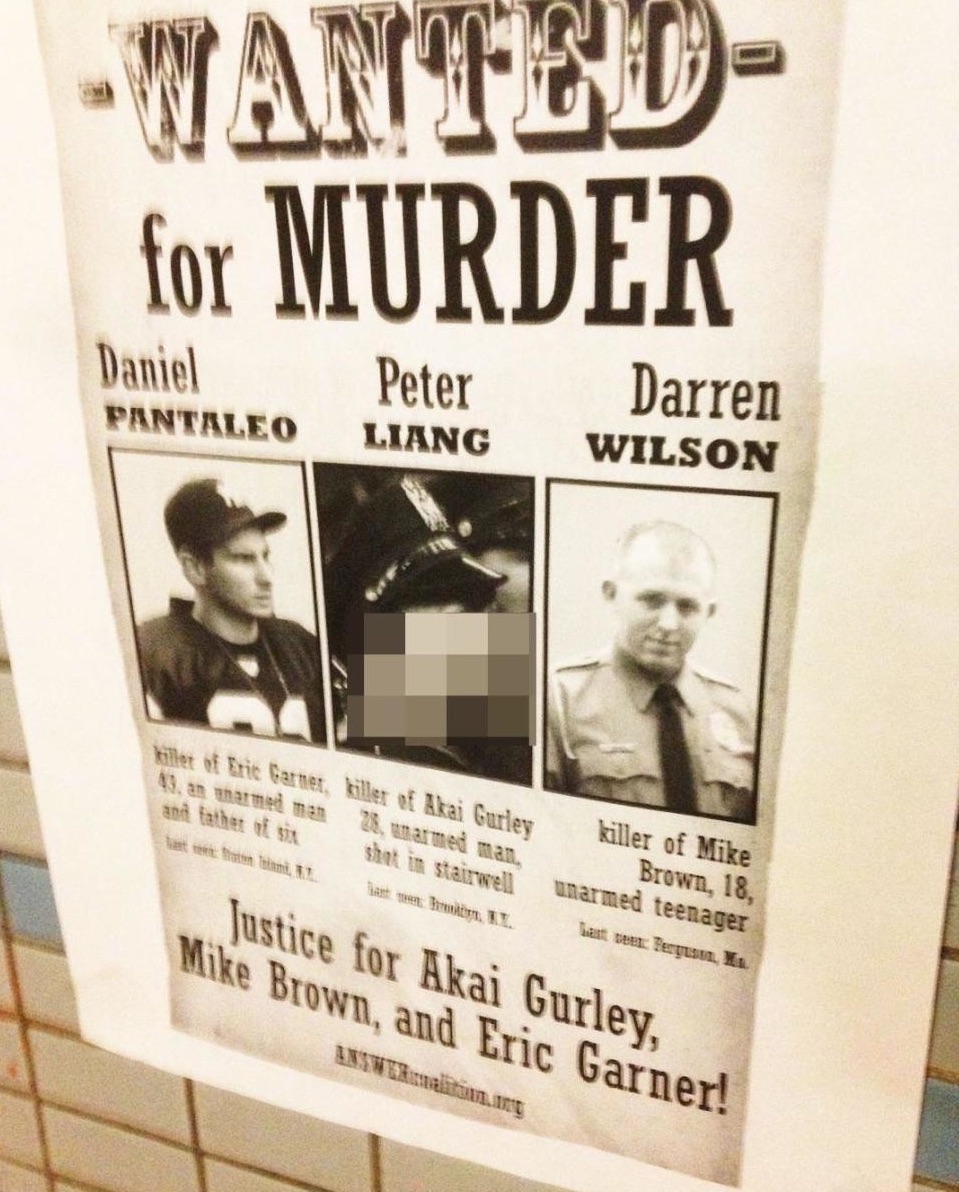
From [HERE] A federal judge on Tuesday approved a settlement in the lawsuit brought by the family of Michael Brown against the white police officer who fatally shot him in Ferguson, Mo., ending the legal chapter of a case that sparked national outrage over the police’s treatment of black people.
Mr. Brown, who was 18 and black, was unarmed when he was shot three years ago by Officer Darren Wilson, who said that Mr. Brown had attacked him and charged toward him when he fired the fatal shots. Some witnesses said that Mr. Brown had his hands up, but both federal and state prosecutors questioned that narrative and determined that there was not enough evidence to charge Mr. Wilson, who is white, criminally.
Judge E. Richard Webber of the Eastern District of Missouri sealed the details of the settlement, which also named the city of Ferguson and the former police chief, Thomas Jackson. The amount would be less than $3 million, according to a person familiar with the details of the case, who spoke on condition of anonymity because no one is alllowed to speak about the particulars of the case. Three million dollars is the most the city can pay under its insurance, according to The St. Louis Post-Dispatch.
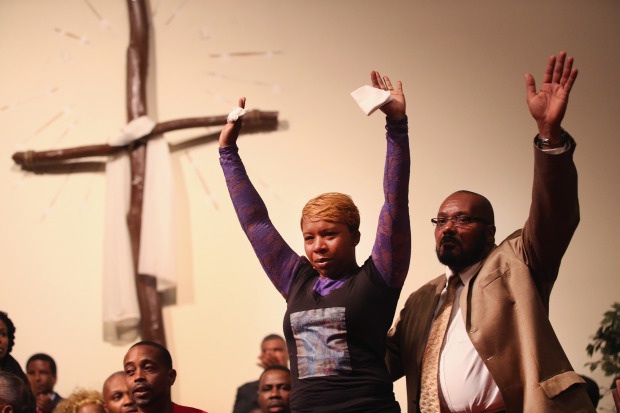
The lawsuit was filed by Mr. Brown’s father, Michael Sr., and his mother, Lesley McSpadden.
The lawsuit argued that Mr. Wilson was aggressive and profane in stopping Mr. Brown and a friend, and that he fired a shot at Mr. Brown as he ran away. Mr. Brown’s parents also cited what they say Mr. Wilson told his supervisor at the scene — that Mr. Brown had put his hands up.
Although Mr. Wilson was never criminally charged, the Justice Department investigated the city’s law enforcement system and issued an excoriating report that found that the police and the courts routinely violated people’s rights. Black people were disproportionately affected by the police’s practices, which included using petty violations and regular traffic stops to pad the city’s coffers.
The fallout from the shooting included the resignations of the city’s police chief, manager and judge. But voters this spring re-elected their incumbent mayor to another term.
The city entered into an agreement with the Justice Department to reform its law enforcement system, including new police training, civilian review and changing a system that locked up people who could not afford to pay fines.