The 4th Amendment Provides No Meaningful Protection from Gov [It Only Exists in the Minds of People who Believe in It] Memo Claims ICE Can Forcibly Enter Homes without a Warrant
/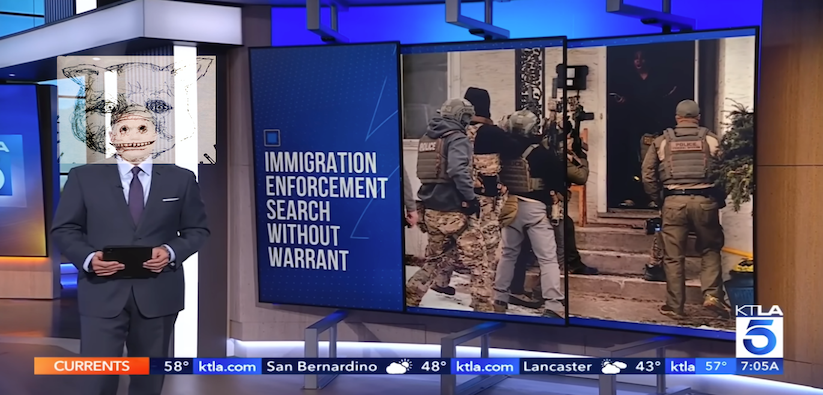
“The United States government is looking for ways around that the Fourth Amendment,” an investigative journalist said of Wednesday reporting by the Associated Press on an internal US Immigration and Customs Enforcement memo claiming that ICE agents can forcibly enter a private residence without a judicial warrant, consent, or an emergency.
The Fourth Amendment to the US Constitution states, “The right of the people to be secure in their persons, houses, papers, and effects, against unreasonable searches and seizures, shall not be violated, and no warrants shall issue, but upon probable cause, supported by oath or affirmation, and particularly describing the place to be searched, and the persons or things to be seized.”
ICE’s May 12 memo, part of a whistleblower disclosure obtained by the AP, says that “although the US Department of Homeland Security (DHS) has not historically relied on administrative warrants alone to arrest aliens subject to final orders of removal in their place of residence, the DHS Office of the General Counsel has recently determined that the US Constitution, the Immigration and Nationality Act, and the immigration regulations do not prohibit relying on administrative warrants for this purpose.”
The January 7 disclosure was sent to the US Senate by the group Whistleblower Aid, which is “keeping the whistleblowers’ identities anonymous even from oversight investigators,” according to the document. It notes that despite being addressed to “All ICE Personnel,” the seemingly unconstitutional memo “has not been formally distributed to all personnel.”[MORE]
As defined in Funktionary:
Constitutional Rights – mythical rites and contractual privileges; the so-called “government” has constitutional rights, i.e. 5th & 6th Amendment rights (powers), etc., you don’t. The Constitution did not and does not give (or bestow upon) anyone any rights. The Constitution and the so-called Bill of Rights for that matter, merely prohibits agents of the government from abrogating or abridging rights people already have or imagine they have (that one was naturally born with). An abstract fictional entity “government” cannot give you any rights, and even if reality was inverted to accommodate this illusion, anything functionaries of a “government” pretend to give they can take away, and the definition of rights is inherent things that cannot be taken away. The constitution is a document declaring law written to set up a government-cum-religion. The only relation the document has to human liberty is establishing means with which to control or muzzle it. Unalienable rights neither start nor stop at the revolving doors of the federal courtroom. One’s imagined “rights” are those that are unalienable allegedly or putatively guaranteed and poorly protected by the so-called “Constitution for the United States.” [MORE]
rights – fantasmatic or fictitious objects having no reality in actuality by those imagining as an identity being in possession of them. Rights are cultural gratuities perceived through various fantasy frames, recognized, and sometimes even created, by man’s system of law to provide a modicum or pretense of civility under a system whereby their very undermining and violation is vouchsafed. Rights are merely rites unless you know how to assert and defend them in order to enjoy them. 2) things people are free to do whether they are able to or not. 3) conditions of existence required by hue-man’s nature for their potential survival (primarily against the cartoon that kills, i.e., the wholly unconscionable entity called the “State”). It is a mistaken notion that rights are enjoyed by one at the expense of the many—that is the realm of privilege. Enjoyment of rights in a neo-imperialistic world controlled by Yurugu through the Greater System (Symbolic Order), paradoxically, entails not only a recognition of their inevitability but, equally, their impossibility. How can we be endowed with rights, or even know what rights are when they are based on binary considerations? Rights, as ontological ephemera, cannot be universally observed, recognized, realized or enforced—and paradoxically, act also as its own eternal source for its assertion and vessel for its fulfillment in our imaginary enjoyment of them. While the law reads rights referentially, what is universally needed in the praxis of rights discourse today is a particular re-inscription, demystification or reontologising of rights (revivified and convivial) by the pan-gendered subject-citizendecoder— taken symptomatically rather than seriously. Most people rarely experience the cognizance of being property of corporate fictions because as long as you don’t violate the rules of society your real status as feudal-property-slave is not involved or revealed. If there is no ‘I,’ to what and to whom do rights as objects accrue? Those who are confused by suffering (and the subject of same) require a re-onotoligisation of rights through the trajectory of meaning independent of their existence. Rights and even ‘lefts’ (i.e., what remains after all of our imaginary rights are traced to their inception as figment) for that matter, like good and evil, are human inventions which humans treat as non-human realities. While fantasy frames invent rights, romanticism reinvents them. Enjoy your symptoms and play with your syndrome—the symptom is the solution. [MORE]