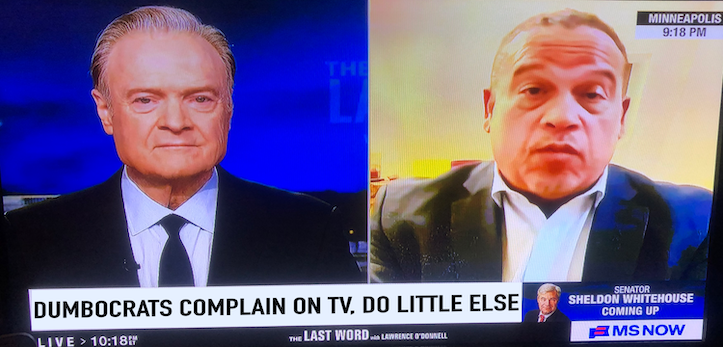
Probable Cause Exists to Arrest and Charge ICE Cop with Murder but Cowardly Dumbocrats Delay. Self Defense is Weak b/c Cop Created the Danger and MN is Not a Stand Your Ground State
/
Attorney Marjorie Cohn explains: A Minnesota prosecutor should charge Ross with first-degree murder. . .
Minnesota Murder Statutes
Given the politics of the case it would seem wise for the state to take charge of the prosecution and to resist efforts by federal authorities to take over the case.
Under Minnesota law, a person who causes the death of a human being with premeditation and the intent to kill is guilty of first-degree murder and shall be sentenced to life imprisonment.
Intent to kill can be shown by circumstantial evidence. Ross’ shooting at Good’s head from a short distance is proof of an intent to kill.
Premeditation can occur in moments; there is no minimum amount of time required. It can happen over a matter of months or in a matter of seconds. Ross has a gun in his hand, methodically raises it and shoots at Good multiple times, while saying, “Fucking bitch.” This is evidence of premeditation.
There is sufficient evidence for a prosecutor to prove beyond a reasonable doubt that Ross is guilty of first degree murder.
When a person has the intent to kill but acts without premeditation, he or she is guilty of second-degree murder, and may be sentenced to a maximum of 40 years in prison.
Even if a jury does not find beyond a reasonable doubt that Ross premeditated the murder of Good, it would likely convict Ross of second-degree murder in light of the strong evidence of his intent to kill her.
Causing the death of another by perpetrating an eminently dangerous act with a depraved mind and no regard for human life constitutes third-degree murder which carries a maximum of 25 years in prison and/or a maximum fine of $40,000.
Shooting at Good’s head through the window of her car constituted an eminently dangerous act with Ross’ depraved mind and no regard for human life, which support a conviction of third-degree murder.
Although at a minimum, Ross’ actions satisfy the elements of manslaughter, they also constitute evidence of murder. A Minnesota prosecutor should charge him with first-degree murder. . .
Supremacy Clause Immunity
In his defense, Ross would try to “remove” the state case to federal court by arguing that he has immunity from state prosecution.
Supremacy Clause immunity is not absolute immunity. It applies only when a federal official acts within the scope of their lawful federal duties. Federal officers are protected against state prosecutions if they can show that although their actions violated state law, they were “’necessary and proper’ in the discharge of their federal responsibilities.”
The inquiry would be whether Ross’ shooting of Good was necessary and proper to enforce the federal immigration law. If he acted beyond the scope of his duties, or behaved in an egregious or unjustified manner, the case would remain in Minnesota state court. Shooting Good dead was not within the scope of Ross’ ICE duties.
Once a state case is removed to federal court, the federal court will apply state substantive law.
The Claim of Self-Defense
Ross will claim that he acted in self-defense when he shot Good so the killing was justified. To prove self-defense, Ross would need to show that shooting Good was necessary to resist or prevent an offense that he reasonably believed exposed him or another to death or great bodily harm.
Minnesota’s use-of-force laws authorize officers to use deadly force only when a reasonable officer would think it necessary to protect themselves or others from death or great bodily harm that “is reasonably likely to occur absent action by the law enforcement officer.”
It allows officers to shoot only when the threat “must be addressed through the use of deadly force without unreasonable delay.” Thus, if the threat can be addressed without the use of deadly force, or if it’s reasonable to delay, the use of deadly force would violate Minnesota law. Ross could have stepped out of the way and gotten Good’s license plate number instead of shooting her.
Last term, the U.S. Supreme Court decided Barnes v. Felix, which said that in assessing the reasonableness of an officer’s use of deadly force, courts must look beyond simply the moment the officer fires the weapon. The court “must consider all the relevant circumstances, including facts and events leading up to the climactic moment.” This would require consideration of what the officer did leading up to the confrontation, including Ross’ decision not to step out of the way of Good’s car.
Minnesota law requires the “duty to retreat.” It requires individuals to avoid the use of deadly force if it is possible to do so safely, before they act in self-defense. [MORE]