“Fear The Foundation of Every Government’s Power”
ROBERT HIGGS [references and footnotes are HERE]
Neither a man nor a crowd nor a nation can be trusted to act humanely or to think sanely under the influence of a great fear.— Bertrand Russell, “An Outline of Intellectual Rubbish”
All animals experience fear—human beings, perhaps, most of all. Any animal incapable of fear would have been hard pressed to survive, regardless of its size, speed, or other attributes. Fear alerts us to dangers that threaten our well-being and sometimes our very lives. Sensing fear, we respond by running away, by hiding, or by preparing to ward off the danger. To disregard fear is to place ourselves in possibly mortal jeopardy. Telling people not to be afraid is giving them advice that they cannot take. Even the man who acts heroically on the battlefield, if he is honest, admits that he is scared. “He would be a sort of madman or insensible person,” Aristotle wrote, “if he feared nothing, neither earthquakes nor the waves” (1938, 249). Our evolved physiological makeup disposes us to fear all sorts of actual and potential threats, however, even those that exist only in our imagination.
And thy life shall hang in doubt before thee; and thou shalt fear day and night,and shalt have none assurance of thy life. (Deuteronomy 28:66)
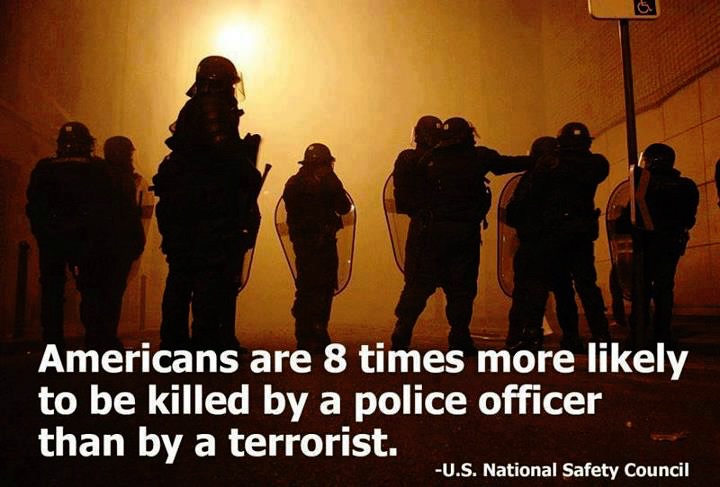
The people who have the effrontery to rule us, who call themselves our government, understand this basic fact of human nature. They exploit it, and they cultivate it. Whether they compose a warfare state or a welfare state, they depend on it to secure popular submission, compliance with official dictates, and, on some occasions, affirmative cooperation with the state’s enterprises and adventures. Without popular fear, no government could endure for more than twenty-four hours.
David Hume argues that all government rests on public opinion, and many oth- ers have endorsed his argument (e.g., Mises [1927] 1985, 41, 45, 50–51, 180; Roth- bard [1965] 2000, 61–62), but public opinion, I maintain, is not the bedrock of government. Public opinion itself rests on something deeper and more primordial: fear. Hume recognizes that the opinions that support government receive their force from “other principles,” among which he includes fear, but he considers these other principles to be “the secondary, not the original principles of government” ([1777] 1987, 34). He argues: “No man would have any reason to fear the fury of a tyrant, if he [the tyrant] had no authority over any but from fear” (34, emphasis in original). We may grant Hume’s statement yet still maintain that the government’s authority over the great mass of its subjects rests fundamentally on fear.
Murray Rothbard considers fear briefly in his analysis of the anatomy of the state, classifying its instillment as “another successful device” by which the rulers secure from their subjects acceptance of or at least acquiescence in their domination—“[t]he present rulers, it was maintained, supply to the citizens an essential service for which they should be most grateful: protection against sporadic criminals and marauders” ([1965] 2000, 65)—but Rothbard does not view fear as the fundamental basis on which the rulers rest their domination, as I do here. Of course, as many scholars have recognized, ideology is critical in the long-term maintenance of governmental power. Yet every ideology that endows government with legitimacy requires and is infused by some kind(s) of fear. Unlike Rothbard, who views the instillment of fear as only one “device” among several by which the government retains its grip on the masses, I maintain that public fear is a necessary (though perhaps not a sufficient) condition for the viability of government as we know it.3
Jack Douglas comes closer to my own view when he observes that myths (a term he uses in roughly the same way that I use the term ideologies) “are predominantly the voice of our emotions, the images of our passionate hopes and fears, or our pas- sionate longings and hatreds” (1989, 220, emphasis added, see also 313 on “the very powerful fear of death that reinforces all of the others [the other natural passions]”). In his extended argument about the longstanding, overarching “myth of the welfare state,” however, Douglas places more emphasis on the element of hopes (millennial- ism) than on the element of fears. Yet even the ideological hopes, I maintain, often center on people’s hopes for governmental deliverance from various sorts of fears. As David Altheide remarks, “People do want to be ‘saved’ and ‘freed,’ but they want to be saved and freed from fear, and this is what makes the [mass media’s] messages of fear so compelling and important for public policy and the fabric of our social life” (2002, 15–16).
The fear need not be of the government itself and indeed may be of the dan- ger from which the government purports to protect the people. Of course, some of the threats that induce subjects to submit to government in the hope of gaining its protection and thereby calming their fears may be real ones. I am not maintaining that people who look to government for their salvation act entirely under the sway of illusory threats, although I do insist that nowadays, if not always, many public fears arise in large part, if not entirely, from stimulation by the government itself. If the people’s fears may be (1) of the government itself, (2) of real threats from which the people look to the government for protection, and (3) of spurious threats from which the people look to the government for protection, we must admit that the relative importance of each type of fear varies with time and place. In every case, however, the government seeks to turn public fear to its own advantage.4 “Directing fear in a soci- ety is tantamount to controlling that society. Every age has its fears, every ruler has his/her enemies, every sovereign places blame, and every citizen learns about these as propaganda” (Altheide 2002, 17, see also 56, 91, 126–33, 196, and passim).
The Natural History of Fear
And my heart owns a doubt Whether ’tis in us to arise with day And save ourselves unaided. —Robert Frost, “Storm Fear”
Thousands of years ago, when the first organized groups we would recognize as governments were fastening themselves on people, they relied primarily on warfare and conquest.6 As Henry Hazlitt observes, There may have been somewhere, as a few eighteenth-century philosophers dreamed, a group of peaceful men who got together one evening after work and drew up a Social Contract to form the state. But nobody has been able to find an actual record of it. Practically all the governments whose origins are historically established were the result of conquest—of one tribe by another, one city by another, one people by another. Of course there have been constitutional conventions, but they merely changed the working rules of governments already in being. ([1976] 1994, 471)7 This view of the origin of the state has great antiquity. As long ago as the late eleventh century, Pope Gregory VII (1073–85), the leader of the momentous Papal Revolution, which began during his papacy and ran its course over a span of nearly fifty years (even longer in England), wrote: “Who does not know that kings and princes derive their origin from men ignorant of God who raised themselves above their fel- lows by pride, plunder, treachery, murder—in short by every kind of crime—at the instigation of the Devil, the prince of this world, men blind with greed and intolerable in their audacity?” (qtd. in Berman 1983, 110). Although certain analytical purposes may be served at times by likening government to a form of exchange between the ruler and the ruled, à la public-choice theory, or by supposing that government might “conceptually” reflect a unanimously accepted “social contract,” à la constitutional economics, these character- izations fail to acknowledge government’s “essentially coercive character” and bear little resemblance to the actual historical establishment of governments—or to their functioning today (Yeager 1985, 269–72, 283–85, 291; see also Olson 2000, 2, 11). The subjugation theory, in stark contrast, rests on a mountain of historical evidence. As Ludwig von Mises remarks, “[f]or thousands of years the world had to submit to the yoke of military conquerors and feudal lords who simply took for granted that the products of the industry of other men existed for them to con- sume.” Moreover, “[t]he supplanting of the militaristic ideal, which esteems only the warrior and despises honest labor, has not, by any means, even yet been completely achieved” ([1927] 1985, 151).
Fear for Your Life and Pay Tribute to the Rulers
Losers who were not slain in the conquest itself had to endure the subsequent rape and pillage and in the longer term had to acquiesce in the continuing payment of tribute to the insistent rulers—the stationary bandits, as Mancur Olson (2000, 6–9) aptly calls them.
Subjugated people, for good reason, feared for their lives. Offered the choice of losing their wealth or losing their lives, they tended to choose the sacrifice of their wealth. Hence arose taxation, variously rendered in goods, services, or money (Nock [1935] 1973, 19–22).8 Thus, for example, in thirteenth-century Bavaria, perhaps the most advanced of all the German principalities at the time, “the entire population of the duchy was taxed, free and unfree, secular and ecclesiastical; and the taxes were administered by a corps of ducal officials” (Berman 1983, 510). Max Spindler remarks that this “tax obligation . . . made the existence and the sover- eignty of the state palpable to every single person” (qtd. in in Berman 1983, 510, from a 1937 work in German). Subjugated people, however, naturally resent their imposed government and the taxation and other insults it foists on them. Such resentful people easily become res- tive; should a promising opportunity to throw off the oppressor’s dominion present itself, they may seize it. One excellent example among many: “In the early thirteen century King Canute II [of Denmark] tried to issue taxes, collect fines, and, in gen- eral, assert royal authority, but he was overthrown and assassinated” (Berman 1983, 515). Even if the people mount no rebellion or overt resistance, however, they quietly strive to avoid their rulers’ exactions and to undermine their rulers’ government appa- ratus. As Machiavelli observes, the conqueror “who does not manage this matter well, will soon lose whatever he has gained, and while he retains it will find in it endless troubles and annoyances” ([1513] 1992, 5). For the stationary bandits, therefore, force alone proves a very costly means of keeping people in the mood to disburse a steady, substantial stream of tribute. If the rulers are to sustain their predation at toler- able cost, they must gain legitimacy (Mises [1927] 1985, 41, 45, 50–51, 180).
Fear for Your Soul and Pay Tribute to the Rulers
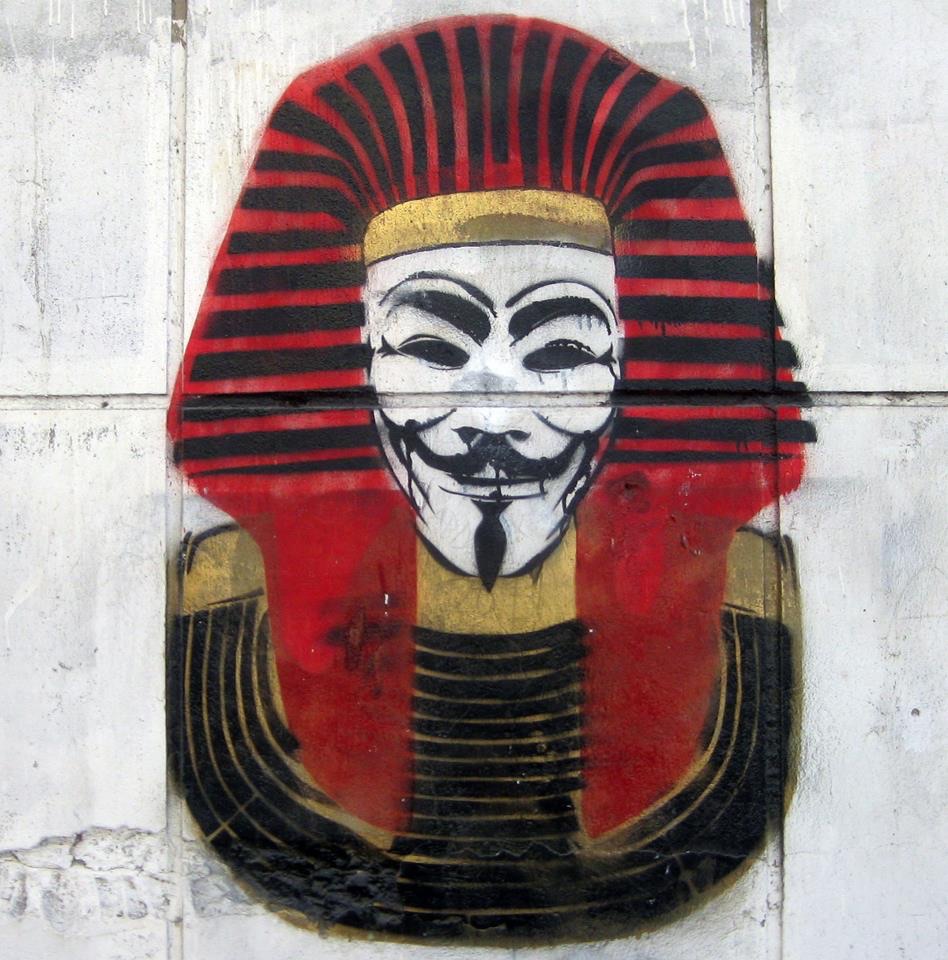
Sooner or later, therefore, every government augments the power of its sword with the power of its priesthood, forging an iron union of throne and altar. The priests were “the ones who fabricated the holy texts purporting to tell how the world was created, how God decreed the ruler’s power, how the king was necessary for every- one’s welfare, and on and on” (Douglas 1989, 129, see also 153, 325, and passim). In ancient times, not uncommonly, the rulers were themselves declared to be gods—the pharaohs of ancient Egypt made that claim for centuries—or the descendants of the gods or the earthly representatives of the gods (Douglas 1989, 63, 107, 129). When Charlemagne was crowned emperor in ad 800, he took the title “Charles, most serene Augustus, crowned by God, great and pacific emperor, governing the Roman empire (Berman 1983, 603). Doctrines of the divine right of kings have deep historical roots in many parts of the world. In Western civilization, they received powerful support in the early fifth century from St. Augustine’s City of God, reached their zenith in the sev- enteenth century in the writings of Jacques-Benigne Bossuet on behalf of Louis XIV in particular, and did not go down—with a thud, as it were—until the French Revolu- tion (Hooker 1996). To the extent that the subjects can be brought to fear not only the ruler’s superior force, but also his supernatural powers or authority—brought, in Harold Berman’s words, to a “belief in his sacred character and thaumaturgic powers” (1983, 406)—the ruler gains an enormous edge in overawing them.
Moreover, if people believe in an afterlife, where the pains and sorrows of this life may be sloughed off, the priests hold a privileged position in prescribing the sort of behavior in the here and now that best serves the people’s interest in securing a blessed condition in the life to come. Referring to the Roman Catholic Church of his own day, Machiavelli takes note of “the spiritual power which of itself confers so mighty an authority,” and he heaps praise on Ferdinand of Aragon, who, “always covering himself with the cloak of religion, . . . had recourse to what may be called pious cruelty” ([1513] 1992, 7, 59, emphasis in original).9 For Roman Catholics, “the church, and more specifically the pope, is [sic] considered to have jurisdiction over purgatory . . . [and] the time to be spent in purgatory can be reduced by clerical deci- sion” (Berman 1983, 171). This clerical power may be—and often has been—used to induce people to fall into line with projects that serve definite secular as well as spiritual interests. For example, “[w]ith the emergence of papal monarchy at the end of the eleventh century, the Council of Clermont under Pope Urban II granted the first ‘plenary indulgence,’ absolving all who would go on the First Crusade from liability for punishment in purgatory for sins committed prior to their joining the holy army of crusaders” (Berman 1983, 171). In our own time and place, a similar example pertains to the support that Protestant evangelicals have given to militarism in general and to the recent U.S. wars against Iraq in particular (Bacevich 2005a, 122–46)—support that George W. Bush’s administration has actively cultivated and exploited, counting the religious right a key part of the Republican Party’s electoral and lobbying “base.”
Naturally, the warriors and the priests, if not one and the same, almost invariably come to be cooperating parties in the apparatus of rule. In medieval western Europe, from the sixth century through the eleventh, secular rulers dominated the church and appointed the highest ecclesiastical officials. Even after the Papal Revolution, in which the church established its corporate independence and gained the power to choose the pope and to appoint the bishops, churchmen and secular rulers continued to be intertwined in countless ways, not least by the often close kinship of their leading authorities. Although the clergy sometimes clashed with secular authorities, their relationship normally entailed cooperation and mutual support.10 This close relation- ship between throne and altar did not end with the Protestant Reformation. Indeed, it persists in many ways even in today’s more secular societies.
Thus, the martial element of government puts the people in fear for their lives, and the priestly element puts them in fear for their eternal souls. These two fears compose a powerful compound—sufficient to prop up governments everywhere on earth for several millennia.
Look to the Rulers for Protection and Pay Them Tribute
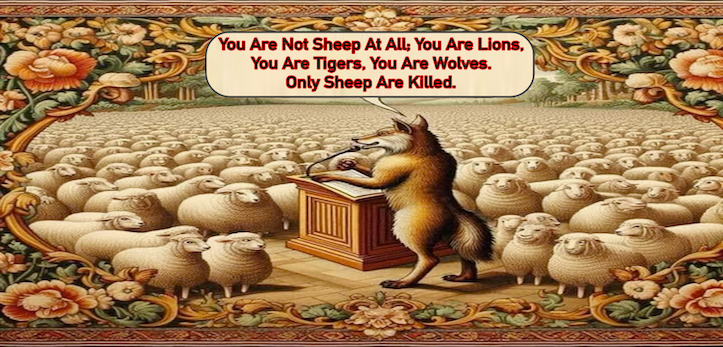
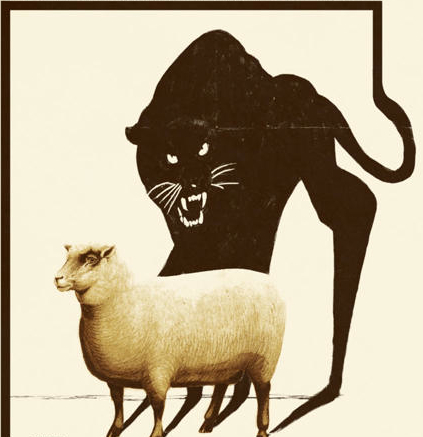
Over the ages, governments refined their appeals to popular fears, fostering an ideol- ogy that emphasizes the people’s vulnerability to a variety of internal and external dangers from which the governors—of all people!—are represented to be their pro- tectors (Higgs 2002). Government, it is claimed, protects the populace from exter- nal attackers and from internal disorder, both of which are portrayed as ever-present threats (Rothbard [1965] 2000, 65). Sometimes the government, as if seeking to nourish the mythology with grains of truth, does protect people in this fashion—even the shepherd protects his sheep, but he does so to serve his own interest, not theirs, and when the time comes, he will shear or slaughter them as his interest dictates.
Olson describes in simple terms why the stationary bandit may find it in his interest to invest in public goods (the best examples of which are domestic “law and order” and defense of the realm) that enhance his subjects’ productivity (2000, 9–10). In brief, the ruler does so when the present value of the expected additional tax revenue he will be able to collect from a more productive population exceeds the current cost of the investment that renders the people more productive. In addition, the ruler sometimes charges directly for the use of his “public good.” For example, “the introduction of a system of royal law into England [by the Anglo-Norman ruler Henry II] was in part a means of enriching royal coffers as well as royal power at the expense not only of barons and ecclesiastics but also of the general population” (Ber- man 1983, 439).11
Robert Bates argues that in western Europe the kings struck deals with the mer- chants and burghers, trading mercantilist privileges and “liberties” for a steady stream of tax revenue, in order to dominate the chronically warring rural dynasties and thereby to pacify the countryside (2001, 56–69, 102).12 Unfortunately, the kings who undertook these measures had foremost in their minds the same thought that the Meiji reformers had in nineteenth-century Japan when they gave their country the slogan “rich nation, strong army” (Kuroda 1997). As Bates recognizes, the kings sought their enlarged revenue for the purpose of conducting ever more costly wars against other kings as well as against domestic opponents. Thus, their “pacification” schemes actually entailed amplified fighting on some front, leaving the net effect on overall societal well-being very much in question, especially when we consider that no single king undertook these measures in isolation: a better-funded king might have pacified his own realm internally, but other kings, also better funded, now presented greater external threats to his realm. Each king’s foreign war entailed some other society’s domestic devastation. Joseph Schumpeter remarks of the rising nation-states of Europe: “None of them had all it wanted; each of them had what others wanted. And they were soon surrounded by new worlds inviting competitive conquest . . . . [A]ggression . . . became the pivot of policy . . . . [M]aximum public revenue—for the court and the army to consume—was the purpose of economic policy, conquest the purpose of foreign policy” (1954, 146– 47).13 Obviously, no one can demonstrate that the displacement of the feudal order by the rising kings and nation-states of Europe gave rise to a continent consistently at peace. Indeed, as traditionally told, the history of the early-modern age runs in terms of a succession of wars, often several at the same time, among the great European powers. Lesser powers, compelled to line up on one side or the other of these armed struggles, suffered a full measure of the destruction.
When the government fails to protect the people as promised, it always has a good excuse, often blaming some element of the population—scapegoats such as traders, moneylenders, unpopular ethnic or religious minorities, or, as in Franklin D. Roosevelt’s case, “economic royalists.” “[N]o prince,” Machiavelli assures us, “was ever at a loss for plausible reasons to cloak a breach of faith” ([1513] 1992, 46). Just consider how many big heads have rolled in order to hold government officials accountable for the security lapses that permitted the attacks on the World Trade Cen- ter and the Pentagon on September 11, 2001. By my count, the total comes to exactly zero—not to mention that the commander in chief on whose watch these devastating attacks took place subsequently engineered his reelection to office, carrying his entire entourage onward to seize further opportunities for “greatness.”
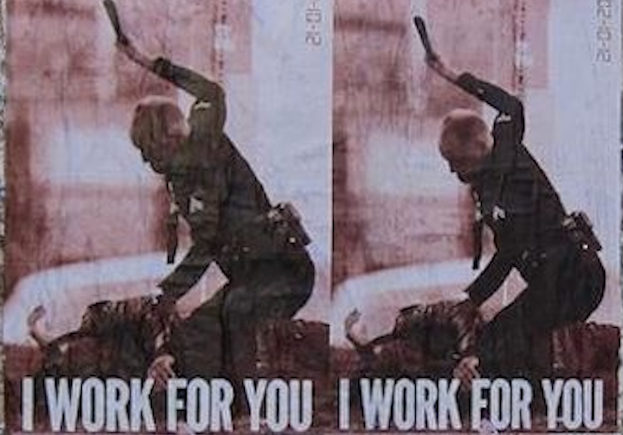
In the crunch, governments always attend first to their own protection, even if the people’s protection must be sacrificed in the process (Lind 2005). Vice President Dick Cheney has become notorious for periodically scurrying into an impenetrable bunker when frightened by specters of terrorism, but we ordinary citizens are strictly on our own for protection when the dreaded weapons of mass destruction come our way.14 Government penal codes routinely make offenses against government officials, agents, or property much graver offenses than are identical offenses against other persons or property (Rothbard [1965] 2000, 80–82). Nor is this kind of “class” inequity in the application of the law a modern development. In the Liber Augustalis, an advanced legal code promulgated in 1231 by Frederick II, tyrant of the Norman Kingdom of Sicily, “higher penalties were imposed for offenses against nobles by nonnobles, and greater weight was given to the oath of a noble in suits for debt” (Berman 1983, 428). In our own time and place, the official reaction to the murder or attempted murder of a government official or even of a low-ranking police officer bears no comparison with the official reaction to the murder of an ordinary citizen: the former offense calls forth legions of SWAT teams ardent to dispatch any suspect on sight, whereas the latter offense may, all in good time, set in motion a lethargic investigation.
Embrace a Collectivist Ideology and Pay Tribute to the Rulers
The religious grounds for submission to the ruler-gods gradually transmogrified into secular notions of nationalism and popular duty to the state, culminating eventually in the curious idea that in a democratic system the people themselves are the govern- ment, and hence whatever it requires them to do, they are really doing for themselves. As Woodrow Wilson had the impudence to declare when he proclaimed military con- scription backed by severe criminal sanctions in 1917, “it is in no sense a conscription of the unwilling: it is, rather, selection from a nation which has volunteered in mass” (qtd. in Palmer 1931, 216–17).
Not long after the democratic dogma had gained a firm foothold, organized coalitions emerged from the mass electorate and joined the elites in looting the public treasury, and, as a consequence, in the late nineteenth century the so-called welfare state began to take shape. From that time forward, people were told that the government can and should protect them from all sorts of workaday threats to their lives, livelihoods, and overall well-being—threats of destitution, hunger, disability, unemployment, illness, lack of income in old age, germs in the water, toxins in the food, and insults to their race, sex, ancestry, creed, and so forth. Nearly everything that the people feared and much that they merely found annoying the government stood poised to ward off. Thus did the welfare state anchor its rationale in the solid rock of fear. Governments, having exploited popular fears of violence so successfully from time immemorial (promising “national security”), had no difficulty in cement- ing these new stones (promising “social security”) into their foundations of rule.
In this quest, governments have enjoyed the support of a growing secular priest- hood of intellectuals and far more numerous pseudointellectuals—F. A. Hayek calls them “secondhand dealers in ideas” (1949, X) —who for various reasons have tended overwhelmingly to espouse collectivist doctrines (Mises [1956] 1972; Nozick [1986] 1998; Rothbard [1965] 2000, 61–70; Feser 2004). These idea peddlers, many of whom now live at taxpayer expense, have advanced a succession of interpretations of the world’s troubles and of its potential salvation, portraying various private actions, especially those bundled in the concept of “capitalism,” as the source of a plethora of threats to life, limb, and happiness, and depicting the government as the savior who will descend from its heaven—located in Berlin, Paris, Brussels, Washington, or other such place—to remedy all the people’s woes and to drive the evildoers, especially the private “money changers,” out of the temple. Karl Marx famously declared that religion is the opium of the people. Not so famously, but equally correctly, Raymond Aron (1957) called collectivism, especially in its Marxist variant, the “opium of the intellectuals.”
From the intellectuals, this ideology seeped out to the masses. Once it had gained sufficient acceptance among them, by the beginning of the twentieth century in Europe and slightly later in North America, it allowed government officials to exploit each great socioeconomic and political emergency to add new weapons to their arsenal of social control (Higgs 1987, 2004; Porter 1994). The upshot of each such crisis included not only a ratcheting up of the government’s size, scope, and power, but also a further weakening of the ideological resistance that had for millen- nia reflected the people’s instinctive appreciation that the government is at best an unavoidable nuisance and at worst an unbearable oppressor. Under the sway of the new dominant ideology—recently analyzed by Daniel Klein (2005) as “the people’s romance”—many people affirmatively support governmental enterprises and adven- tures under the illusion that “we are all doing this together,” as if millions or even hundreds of millions of extremely heterogeneous individuals were nothing more than one big happy family. Although this bizarre phenomenon may well justify calling for the men in white coats to bring out the strait jackets, one cannot deny that it seems to motivate the political speech and actions of many opinion leaders as well as a substan- tial number of ordinary citizens. Thus has fear led people from a well-founded aver- sion to the government itself to a form of mass lunacy in which, like Winston Smith in George Orwell’s Nineteen Eighty-four, they finally love Big Brother—a Stockholm syndrome writ large (Clark 2002).
The Political Economy of Fear
The whole aim of practical politics is to keep the populace alarmed (and hence clamorous to be led to safety) by menacing it with an endless series of hobgoblins, all of them imaginary. —H. L. Mencken, “Women as Outlaws”
Fear, like every other “productive” resource, is subject to the laws of production. Thus, it cannot escape the law of diminishing marginal productivity: beyond a certain point, as successive doses of fear mongering are added to the government’s “production” process, the incremental public clamor for governmental protection declines. The first time the government cries wolf, the public is frightened; the second time, less so; the third time, still less so. If the government plays the fear card too much, it overloads the public’s sensibilities, and eventually people discount almost entirely the government’s attempts to frighten them further. Having been warned in the 1970s about catastrophic global cooling (see, for example, “The Cooling World” 1975), then, soon afterward, about catastrophic global warming, the populace may grow weary of heeding the government’s warnings about the dire consequences of alleged global climate changes—dire unless, of course, the government takes stringent mea- sures to bludgeon the people into doing what “must” be done to avert the foretold disaster.
Former homeland-security czar Tom Ridge revealed recently that other govern- ment officials had overruled him when he wanted to refrain from raising the color- coded threat level to orange, or “high” risk of terrorist attack, in response to highly unlikely threats. “You have to use that tool of communication very sparingly,” Ridge remarked astutely (qtd. in Hall 2005). Other Bush administration figures persisted, however, in drawing from the well of fear. When the president gave still another of his “same old same old” speeches midway through 2005, justifying the war in Iraq by tying it to the emotionally evocative attacks of September 11, the speech fell flat, even with the troops who composed his audience at Fort Bragg. “The president has no one to blame but himself,” commented Frank Rich. “The color-coded terror alerts, the repeated John Ashcroft press conferences announcing imminent Armageddon during election season, the endless exploitation of 9/11 have all taken their numbing toll. Fear itself is the emotional card Mr. Bush chose to overplay, and when he plays it now, he is the boy who cried wolf” (2005).
Fear is a depreciating asset. As Machiavelli observes, “the temper of the multitude is fickle, and . . . while it is easy to persuade them of a thing, it is hard to fix them in that persuasion” ([1513] 1992, 14). Unless the foretold threat eventuates, the people come to doubt its substance or its predicted magnitude. The government must make up for the depreciation by investing in the maintenance, modernization, and replacement of its stock of fear capital. For example, during the Cold War, the general sense of fear of the Soviets tended to dissipate unless restored by periodic crises, many of which took the form of officially announced or leaked “gaps” between U.S. and Soviet military capabilities: troop-strength gap, bomber gap, missile gap, antimissile gap, first-strike-missile gap, defense-spending gap, thermonuclear-throw-weight gap, and so forth (Higgs 1994, 301–2).15
Lately, a succession of official warnings about possible forms of terrorist attack on the homeland has served the same purpose: keeping the people “vigilant,” which is to say willing to pour enormous amounts of their money into the government’s bot- tomless budgetary pits dubbed “defense” and “homeland security” (Higgs 2003a). Investigative journalist James Bamford notes that the Bush administration has made effective use of “the politics of fear” by exploiting “the threat of terrorism to push for harsh assaults on constitutional liberties.” Moreover, Bamford declares, government officials “are succeeding to a remarkable degree, largely because of the nonstop drum- beat of fear and paranoia generated over the issue and the steady, numbing regularity of their attacks on civil liberties” (interviewed in Zeese 2005).
This same factor helps to explain the synchronous drumbeat of fears pounded out by the mass media: besides serving their own interests in capturing an audience, the news media buy insurance against government retribution by playing along with whatever pro- gram of fear mongering the government is conducting currently. Anyone who watches, say, CNN’s Headline News programs can attest that a day seldom passes without some new announcement of a previously unsuspected Terrible Threat—I call it the “danger du jour.”16 New York Times columnist John Tierney refers to “what is known in the [journalism] business as the ‘Fear Stalks’ story, as in, ‘We need a Fear Stalks suburban bus riders’” (2005). By keeping the population in a state of artificially heightened apprehen- sion, the government cum media prepares the ground for planting specific measures of taxation, regulation, surveillance, reporting, and other invasions of the people’s wealth, privacy, and freedoms. As Altheide observes, “The mass media, and especially the news media, are the main source and tool used to ‘soften up’ the audience, to prepare them to accept the justificatory account of the coming action” in an alleged crisis (2002, 12). Left alone for a while, relieved of this ceaseless bombardment of warnings, people would soon come to understand that hardly any of the announced threats has any substance; that such threats are “mostly fertilizer,” as Charley Reese (2005) has described them; and that they themselves can manage their own affairs quite well without the security-related regimentation and tax extortion the government seeks to justify.
Large parts of the government and the “private” sector participate in the pro- duction and distribution of fear. (Beware: many of the people in the ostensibly private sector are in reality some sort of mercenary living ultimately at taxpayer expense. True government employment is much greater than officially reported [Light 1999; Higgs forthcoming] .) Bamford describes the activities of “a shadowy American company, The Rendon Group, that had been paid close to $200 million by the CIA and Pentagon to spread anti-Saddam propaganda worldwide. . . . Its specialty is manipulating thought and spreading propaganda” (2004, 295). Among many other achievements, Rendon created the Iraqi National Congress, a group whose paid informants and assorted con men profited handsomely by serving as critical sources of the disinforma- tion the U.S. government employed to gain support for its 2003 attack on Iraq (296, see also 297–98). Defense contractors, of course, have long devoted themselves to stoking fears of enemies big and small around the globe who allegedly seek to crush our way of life at the earliest opportunity. Boeing’s often-shown TV spots, for example, assure us that the company is contributing mightily to protecting “our freedom.” If you believe that claim, I have a shiny hunk of useless Cold War hardware that I will sell you at an astronomical price. The news and entertainment media enthusiastically jump on the bandwagon of foreign-menace alarmism—anything to get the public’s attention and to keep up its already-elevated pulse rate.
Consultants of every size and shape clamber onboard, too, facilitating the distri- bution of billions of dollars to politically favored suppliers of phony-baloney “stud- ies” that give rise to thick reports, the bulk of which is nothing but worthless filler restating the problem and speculating about how one might conceivably go about discovering workable solutions. All such reports agree, however, that a crisis looms and that more such studies must be made in preparation for dealing with it. Hence, a kind of Say’s Law of the political economy of crisis: supply (of government-funded studies) creates its own demand (for government-funded studies). Truth be known, government officials commission studies when they are content with the status quo but desire to write hefty checks to political favorites, cronies, and old associates who now purport to be “consultants.” At the same time, the government demonstrates to the public in this way that it is “doing something” to avert impending crisis X.
At every point, opportunists latch onto existing fears and strive to invent new ones to feather their own nests. Thus, public-school teachers and administrators agree that the nation faces an “education crisis.” Police departments and temperance crusad- ers insist that the nation faces a generalized “drug crisis” or at times a specific drug crisis, such as “an epidemic of crack cocaine use.” Public-health interests foster fears of “epidemics”— such as the “epidemic of obesity” or the “epidemic of juvenile homi- cides”—that in reality consist not of the spread of contagious pathogens, but of the lack of personal control and self-responsibility. By means of this tactic, a host of per- sonal peccadilloes has been medicalized and consigned to the “therapeutic state” (Szasz 1965, 2001; Nolan 1998; Higgs 1999). In this way, people’s fears that their children may become drug addicts or gun down a classmate become grist for the government’s mill—a mill that may grind slowly, but at least does so at immense expense, with each dollar falling into some fortunate recipient’s pocket (a psychiatrist’s, a social worker’s, a public-health nurse’s, a drug-court judge’s—the list is almost endless). Private parties thus become complicit in sustaining a vast government apparatus fueled by fear.
Fear Works Best in Wartime
It is not bad. Let them play. Let the guns bark and the bombing-plane Speak his prodigious blasphemies. — Robinson Jeffers, “The Bloody Sire”17 17. 1941, reprinted in Jeffers 1965, 76.
Even tyrants can get bored. The exercise of great power may become tedious and burdensome—underlings are always disturbing your serenity with questions about details; victims are always appealing for clemency, pardons, or exemptions from your rules. Charlemagne traveled from place to place in his empire, living off the local nobleman’s fief and the local serfs’ labor as he went, but at each new venue, before he could settle down to sustained feasting, he had to attend to those with a gripe. “When he arrived in a place he would hear complaints and do justice” (Berman 1983, 89, see also 483–84). Likewise, Henry II, the Norman monarch of England and parts of the Continent, “circuited his kingdom at a wearing pace to hear cases in the provinces” (Berman 1983, 439). What a grind.
Besides being a tiresome bore, the efficient and just administration of the laws brings the rulers little credit. Hardly anybody puts Martin Van Buren or Grover Cleveland at the top of a list of “great U.S. presidents.”18 Rulers condemned to spend their time in high office during peacetime are necessarily destined to go down in history as mediocrities at best. Rulers who hold office in wartime, however, come alive. Nothing equals war as an opportunity for greatness and public acclaim, as all such leaders understand (Higgs 1997).19
Moreover, upon the outbreak of war, the exhilaration of the hour spreads through the entire governing apparatus. Army officers who have languished for years at the rank of captain may now anticipate becoming colonels. Bureau heads who have supervised a hundred subordinates with a budget of $10 million may look forward to overseeing a thousand with a budget of $400 million. Powerful new control agencies must be created and staffed. New facilities must be built, furnished, and operated. Politicians who had found themselves frozen in partisan gridlock can now expect that the torrent of money gushing from the public treasury will grease the wheels for putting together humongous legislative deals undreamed of in the past. Apparatchiks who had long har- bored grand ideological visions—such as Paul Wolfowitz, perhaps the most important architect of the second U.S. war against Iraq—may find the doors finally opened for the attempted realization of their fantasies. As Andrew Bacevich has observed, “for Wol- fowitz, therefore, the unspeakable tragedy of 9/11 also signified a unique opportunity, which he quickly seized” (2005b, XX).20 Everywhere the government turns its gaze, the scene is flush with energy, power, and money. For those whose hands control the machinery of a government at war, life has never been better.
Small wonder that John T. Flynn, writing in The Roosevelt Myth about the teem- ing bureaucrats during World War II, titled one chapter “The Happiest Years of Their Lives”: “Even before the war, the country had become a bureaucrat’s paradise. But with the launching of the war effort the bureaus proliferated and the bureaucrats swarmed over the land like a plague of locusts . . . . The place [Washington, D.C.] swarmed with little professors fresh from their $2,500-a-year jobs now stimulated by five, six and seven-thousand-dollar salaries and whole big chunks of the American economy resting in their laps” (1948, 310, 315).
Sudden bureaucratic dilation on such a scale can happen only when the nation goes to war and the public relaxes its usual resistance to the government’s exactions. As Adam Smith wrote in The Wealth of Nations, “When a nation is already overburdened with taxes, nothing but the necessities of a new war, nothing but either the animosity of national vengeance, or the anxiety for nation security, can induce the people to submit, with tolerable patience, to a new tax” ([1776] 1937, 873). Legislators know that they can now get away with taxing people at hugely elevated rates; rationing goods; allocating raw materials, transportation services, and credit; authorizing gargantuan borrowing; drafting men into the armed forces; and generally exercising vastly more power than they exercised before the war. Although people may groan and complain about the specific actions the bureaucrats take in implementing the wartime mobilization, few dare to resist overtly or even to criticize publicly the overall mobilization or the government’s entry into the war—by doing so they would expose themselves not only to legal and extralegal government retribution, but also to the rebuke and ostracism of their friends, neighbors, and business associates. As the conversation stopper went during World War II, “Don’t you know there’s a war on?” (Lingeman 1970).
Because during wartime people fear for the nation’s welfare, perhaps even for its very survival, they surrender wealth, privacy, and liberties to the government far more readily than they would during peacetime. As Murray Rothbard observes, “In war, State power is pushed to its ultimate, and, under the slogans of ‘defense’ and ‘emer- gency,’ it can impose a tyranny upon the public such as might be openly resisted in time of peace” ([1965] 2000, 80). Government and its private contractors therefore have a field day. Opportunists galore join the party, each claiming to be perform- ing some “essential war service,” no matter how remote their business may be from contributing directly to the military program. Using popular fear to justify its preda- tions, the government lays claim to great expanses of the economy and the society. As the government’s taxation, borrowing, expenditure, and direct controls dilate, individual rights shrivel into insignificance. Few people protest. Of what importance are the rights of a few grouchy individuals when the entire nation is in peril? After the September 11 attacks, pollster John Zogby reported: “I’ve never seen anything like it before. The willingness to give up personal liberties is stunning, because the level of fear is so high” (qtd. in Polman 2001).21
Finally, of course, every war ends, but each leaves legacies that persist, sometimes permanently. In the United States, the War Between the States (see Hummel 1996) and both world wars (see Higgs 1987, 2004) especially left a multitude of such lega- cies. Likewise, as Corey Robin writes, “one day, the war on terrorism will come to an end. All wars do. And when it does, we will find ourselves still living in fear: not of terrorism or radical Islam, but of the domestic rulers that fear has left behind” (2004, 25). Among other things, Robin points out, we will find that “various security agen- cies operating in the interest of national security have leveraged their coercive power in ways that target dissenters posing no conceivable threat of terrorism” (189).22 Not by accident, “the FBI has targeted the antiwar movement in the United States for especially close scrutiny” (189).
Such targeting is scarcely a surprise because war is, in Randolph Bourne’s clas- sic phrase, “the health of the state,” and the FBI is a core agency in protecting and enhancing the U.S. government’s health. Over the years, the FBI has also done much to promote fear among the American populace, most notoriously perhaps in its COINTELPRO operations during the 1960s, but in plenty of other ways, too (Lin- field 1990, 59–60, 71, 99–102, 123–28, 134–39). Of course, it has scarcely worked alone in these endeavors.23 From top to bottom, the government wants us to be afraid, needs us to be afraid, invests greatly in making us afraid.
Conclusion
The Lord is my light and my salvation; whom shall I fear? the Lord is the strength of my life; of whom shall I be afraid? — Psalms 27:1
Were we ever to stop being afraid of the government itself and of the bogus fears it fosters, the government would shrivel and die, and the host would disappear for the tens of millions of parasites in the United States—not to speak of the vast number of others in the rest of the world—who now sap the public’s wealth and energies directly and indirectly by means of government power. On that glorious day, everyone who has been living at public expense will have to get an honest job, and the rest of us, recognizing government as the false god it has always been, can set about assuaging our remaining fears in more productive and morally defensible ways.