Racial Justice Act Concludes First Test In North Carolina Court After GOP-Championed Modifications
/Following eight days of highly-charged hearings that highlighted the still-problematic role that race plays in North Carolina's criminal justice system, the first case to test the state's revised racial justice law concluded on Oct. 11. The outcome of the case will lay the groundwork for how the state's landmark Racial Justice Act is interpreted in future cases.
Under the law, death row inmates can appeal their sentences to life without parole if they can demonstrate that race played a significant role in the sentencing process.
Previously, an appeal could rely solely on broader statistical evidence to substantiate its claim, much as an employee would do in a class-action suit. But after the GOP-led state legislature reworked the statute in June, defendants must now demonstrate that prosecutors discriminated in their particular case -- which some claim will make it much more difficult to prove racial bias.
"Just going through this hearing clearly pointed out the continued problems we're having in North Carolina with racism in jury selection," said attorney Ken Rose, who works at the Center for Death Penalty Litigation and has been closely involved with both appeals brought under the RJA. "It also pointed out that the prosecutors seem to be oblivious to those problems."
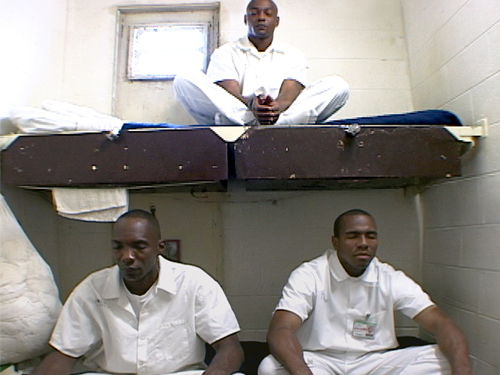
Defendants Tilmon Golphin, Quintel Augustine and Christina Walters are all asking for relief on the grounds that prosecutors struck otherwise-qualified black jurors for their cases at more than twice the rate of white individuals.
In Augustine's case, all five qualified black jurors were kept from serving. Augustine was then sentenced to death by an all-white jury, even though the county in which he committed the crime was 35 percent African-American. The state struck five out of seven black jurors in Golphin's case, and 10 out of 14 in Walters' case.
Golphin and Augustine, who are both black, were convicted of murdering white police officers in 1997 and 2001, respectively. Walters, who is Native American, received a capital sentence after being convicted of involvement in the murders of two white women in 1998.