There was No Probable Cause to Arrest Natalie Good for a Federal Offense, so there is No Immunity. Failure to Prosecute the Murder of a White Woman Will Embolden ICE to Believe They Can Murder Anyone
/
WILL DUMBOCRAT AUTHORITIES DO ANYTHING OR JUST COMPLAIN ABOUT IT ON TV? DR. BLYND EXPLAINS, “Don’t complain about what you’re willing to permit.” FUNKTIONARY STATES:
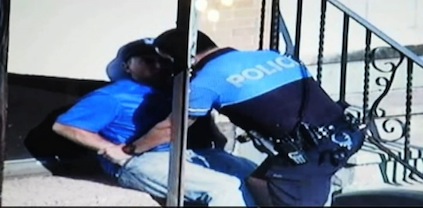
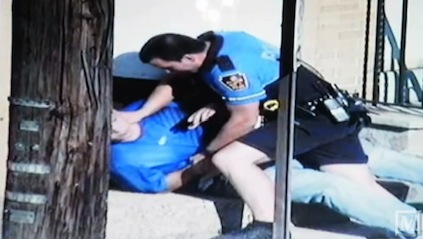
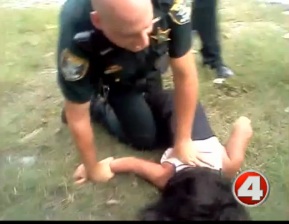
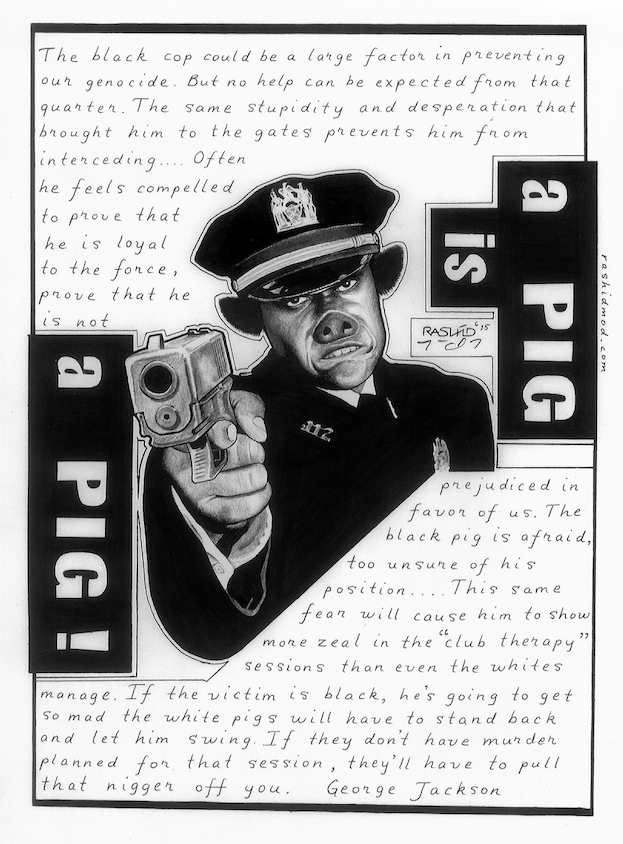
Cop Mantra – “Stop resisting arrest, stop resisting arrest, stop resisting arrest.” A pretense and precursor to murder. Everything cops say or do (including life-ending, life-wrecking abuses and/or rage-inducing bullying they routinely inflict on innocent people with impunity) needs to be looked at with extreme suspicion. Cops (patrolling predators) not only need to wear body-cameras, but they also need to be under surveillance 24/7. “If one million cobras were set loose on our city streets, wouldn’t you think it proper to know where each one was and what it was doing all the time?” ~Fred Woodworth.
No Supremacy Clause Immunity. Due to the facts that; ICE cops did not have probable cause to believe that Natalie Good committed a federal offense and that ICE cops have no authority to enforce traffic or local laws in Minnesota, the ICE cop who fatally shot her should not have Supremacy Clause immunity for his actions.
Under Supremacy Clause immunity a federal official cannot be made “to answer for an act which he was authorized to do by the law of the United States, which it was his duty to [do as a federal officer], and if in doing that act he did no more than what was necessary and proper for him to do, he cannot be guilty of a crime under the law of” any state.” For the defense to apply 2 things are required: 1) the action which forms the basis of the state prosecution must have been within the scope of the federal officer's authority and 2) whether the federal officer's actions, now the basis of a state-court indictment, were “necessary and proper to the execution of his responsibilities.”
It is undisputed that ICE cops have no authority to enforce traffic violations or local criminal laws in Minnesota.
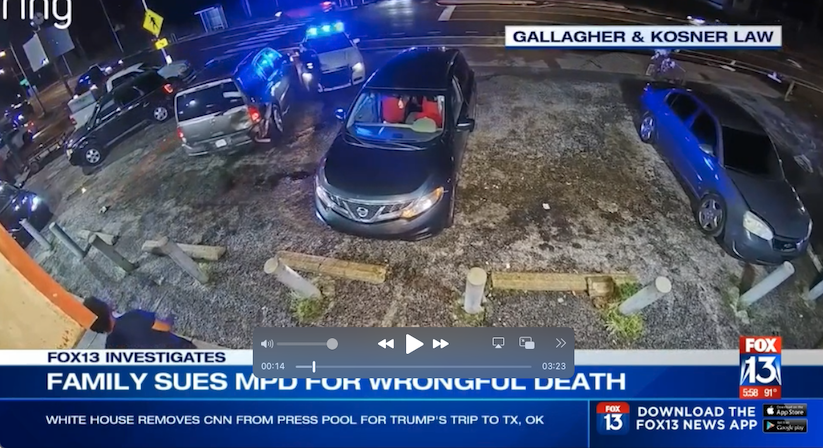
In this case, on 1/7/26 Natalie Good's Honda Pilot SUV was stopped sideways leftward on Portland Avenue about a half block from a school where ICE was posted up surveilling parents and kids. She was blocking one lane of travel on said one way street that has two lanes of travel. Traffic moved around her car in the other lane. Good repeatedly honked her horn. Video shows ICE agents approached her car and witnesses claim they shouted contradictory orders at her to leave and to get out of the car. Good reportedly complied with the order to leave the area as she waved an approaching ICE vehicle to pass by. On video no ICE cops were blocked. Then two agents approached her vehicle. One agent grabbed her car’s door handle while he ordered her to "get the fuck out the car." As the agent grabbed the car door Good put the car in reverse to flee the scene. Meanwhile, when the 2 cops arrived, on video agent Ross is seen walking around the back of her car and then to the passenger side of her car. As Good put the car in reverse Ross moved to the front drivers side of the car but stood at a distance of about 10 feet away - apparently to block her exit. Videos show the car’s wheels turning to the right and Good moving the steering wheel to the right to turn right, avoid Ross (who was in front at a distance) and flee the scene. As the car moved forward Ross stepped to the side and shot Good once through the windshield and twice through the drivers side window. A frame by frame analysis by Washpost appears to show Ross fired all three shots from the side of the vehicle as it veered past him. Federal authorities have refused to release the body-camera footage of the incident.
Good was not under arrest for any federal offense when ICE cops ordered her to get out of the car and pulled on her door handle to physically remove her from the car. Although there was probable cause to believe that Good violated a Minnesota traffic law by blocking a lane of travel and probable cause to believe she violated the disorderly conduct statute, ICE has no authority to enforce such laws. Thus, attempting to stop and arrest Ms. Good for local law violations was beyond the scope of the federal officers’ authority and consequently was also not “necessary and proper to the execution of his responsibilities,” which are only federal. ICE was not enforcing federal law or carrying out federal duties when it interacted with her. As such, Supremacy Clause immunity should not apply.
Although, the government has claimed Good interfered with or stalked ICE cops there appear to be no facts to support the claims. She made noise with her car horn and blocked a lane in the street, so ICE should have called the local police to deal with the traffic violations.
No Qualified Immunity. Also, the ICE cop is not entitled to qualified immunity because it was not 'reasonably arguable’ that there was probable cause for arrest for any federal offense.
An officer who makes an arrest without probable cause, however, may still be entitled to qualified immunity if he reasonably believed there to have been probable cause. See Ramirez v. City of Buena Park, 560 F.3d 1012, 1024 (9th Cir.2009). In this case, Officer Ross was apparently not aware of any specific facts that Ms. Good had committed a federal offense. As such, it is not reasonably arguable that probable cause for a federal offense existed. Therefore, Ross should not be entitled to qualified immunity.
Prosecution Under State Law. Minnesota can prosecute Officer Ross under state law and if so the Minnesota use of Force statute (Minn.Stat. § 609.066) might be applicable to his defense.
As explained by police law legal scholar, Cynthia Lee [MORE], police use of force in the United States is primarily governed by two lines of authority: (1) Supreme Court decisions on what counts as excessive force under the Fourth Amendment in civil rights lawsuits brought under 42 U.S.C. § 1983,36 and (2) state use of force statutes, which specify the requirements for a law enforcement officer’s claim of justifiable force in a state criminal prosecution. Although there are many parallels between these two lines of authority, they are not one and the same. Supreme Court decisions control in § 1983 civil rights actions involving claims that law enforcement officers used excessive force. State use of force statutes control in state criminal prosecutions of law enforcement officers charged with murder, manslaughter, or any other crime of violence who claim justifiable force. An officer’s claim of justifiable force in a state criminal law prosecution is much like a civilian-defendant’s claim of self-defense except state use of force statutes that outline the requirements for the law enforcement defense are generally more forgiving of police officers than self-defense statutes are of civilians.
Most people assume that Supreme Court case law on police use of force controls in state criminal prosecutions of law enforcement officers. Although a state that does not have a use of force statute may follow Supreme Court case law on police use of force, in the vast majority of states that have enacted statutes on police use of force, the use of force statute—enacted by the state legislature—is what controls in a state criminal law prosecution of a law enforcement officer who claims their use of force was justified. While there may be overlap between the two lines of authority, state use of force statutes can and, in many respects, do diverge from Supreme Court case law. Contrary to common belief, state use of force statutes that appear to contradict the holdings of Supreme Court case law on excessive force in the § 1983 context are not unconstitutional by virtue of the fact that they diverge from Supreme Court case law.
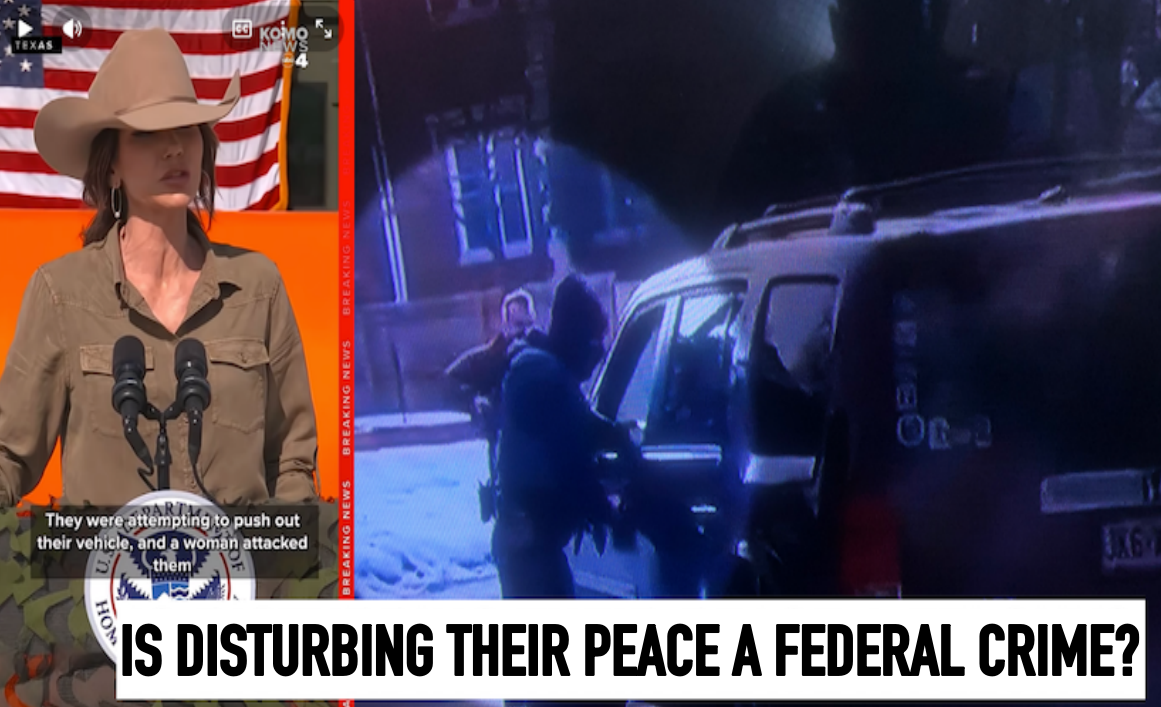
WHAT CRIME WAS MS. GOOD UNDER ARREST FOR WHEN ICE RACE SOLDIERS PULLED ON HER CAR DOOR TO REMOVE HER FROM HER CAR, ORDERED HER TO “GET THE FUCK OUT” AND MOVED IN FRONT OF HER CAR TO STOP HER from leaving??”
Minn.Stat. § 609.066 states:
609.066 AUTHORIZED USE OF DEADLY FORCE BY PEACE OFFICERS.
Subdivision 1.Deadly force defined.
For the purposes of this section, "deadly force" means force which the actor uses with the purpose of causing, or which the actor should reasonably know creates a substantial risk of causing, death or great bodily harm. The intentional discharge of a firearm, other than a firearm loaded with less lethal munitions and used by a peace officer within the scope of official duties, in the direction of another person, or at a vehicle in which another person is believed to be, constitutes deadly force. "Less lethal munitions" means projectiles which are designed to stun, temporarily incapacitate, or cause temporary discomfort to a person. "Peace officer" has the meaning given in section 626.84, subdivision 1.
Subd. 1a.Legislative intent.
The legislature hereby finds and declares the following:
(1) that the authority to use deadly force, conferred on peace officers by this section, is a critical responsibility that shall be exercised judiciously and with respect for human rights and dignity and for the sanctity of every human life. The legislature further finds and declares that every person has a right to be free from excessive use of force by officers acting under color of law;
(2) as set forth below, it is the intent of the legislature that peace officers use deadly force only when necessary in defense of human life or to prevent great bodily harm. In determining whether deadly force is necessary, officers shall evaluate each situation in light of the particular circumstances of each case;
(3) that the decision by a peace officer to use deadly force shall be evaluated from the perspective of a reasonable officer in the same situation, based on the totality of the circumstances known to or perceived by the officer at the time, rather than with the benefit of hindsight, and that the totality of the circumstances shall account for occasions when officers may be forced to make quick judgments about using deadly force; and
(4) that peace officers should exercise special care when interacting with individuals with known physical, mental health, developmental, or intellectual disabilities as an individual's disability may affect the individual's ability to understand or comply with commands from peace officers.
Subd. 2 .Use of deadly force.
(a) Notwithstanding the provisions of section 609.06 or 609.065, the use of deadly force by a peace officer in the line of duty is justified only if an objectively reasonable officer would believe, based on the totality of the circumstances known to the officer at the time and without the benefit of hindsight, that such force is necessary:
(1) to protect the peace officer or another from death or great bodily harm, provided that the threat:
(i) can be articulated with specificity;
(ii) is reasonably likely to occur absent action by the law enforcement officer; and
(iii) must be addressed through the use of deadly force without unreasonable delay; or
(2) to effect the arrest or capture, or prevent the escape, of a person whom the peace officer knows or has reasonable grounds to believe has committed or attempted to commit a felony and the officer reasonably believes that the person will cause death or great bodily harm to another person under the threat criteria in clause (1), items (i) to (iii), unless immediately apprehended.
(b) A peace officer shall not use deadly force against a person based on the danger the person poses to self if an objectively reasonable officer would believe, based on the totality of the circumstances known to the officer at the time and without the benefit of hindsight, that the person does not pose a threat of death or great bodily harm to the peace officer or to another under the threat criteria in paragraph (a), clause (1), items (i) to (iii).
Subd. 3. No defense.
This section and sections 609.06, 609.065 and 629.33 may not be used as a defense in a civil action brought by an innocent third party.