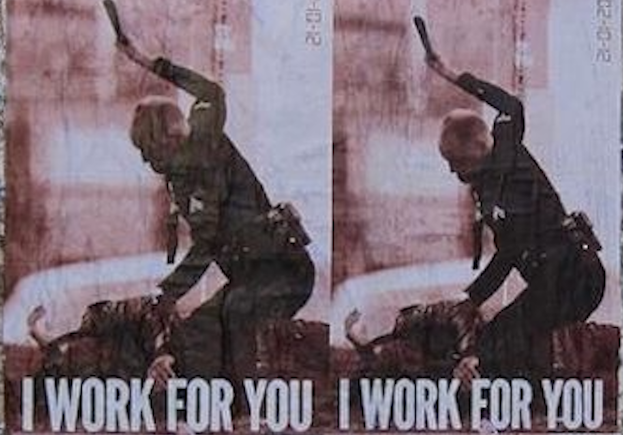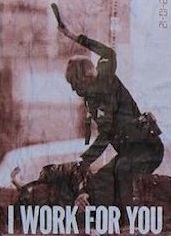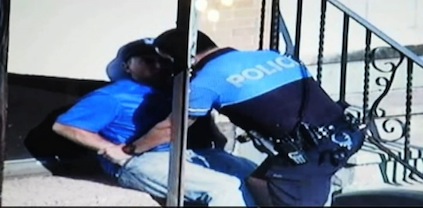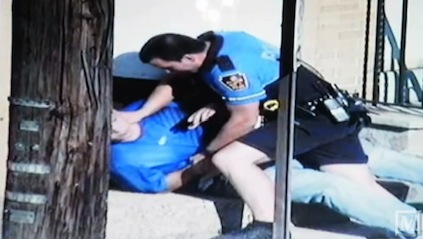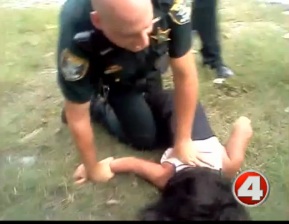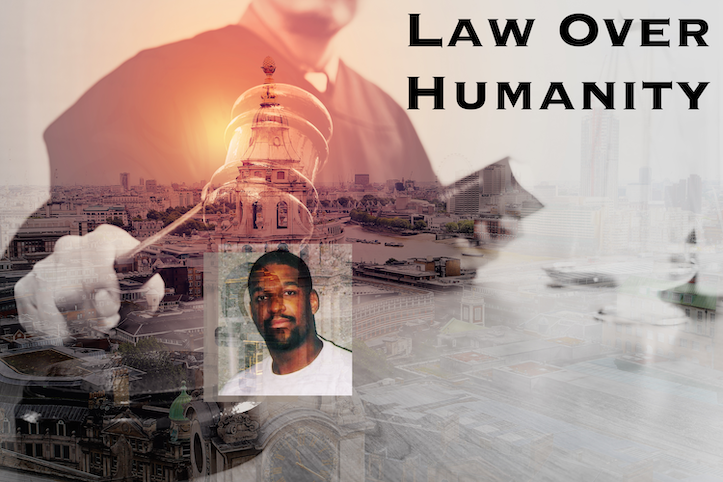
Video Shows a Gang of White Cops Attack a Defenseless Black Man in a Camden County Jail Cell by Repeatedly Punching and Kicking Him. Denied Treatment for 2 Weeks, Liar Cops Claimed They Were Assaulted

From [HERE] Security footage that shows a group of white police officers in Georgia beating a 41-year-old Black man in custody has drawn community outrage. Civil rights attorney Harry Daniels said the incident is yet another case of wrongdoing by Georgia’s Camden County Sheriff’s Office.

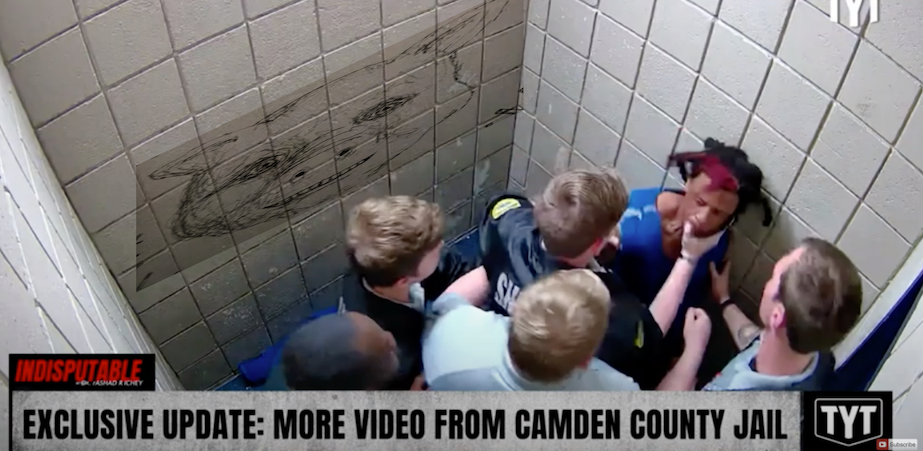
The footage from the sheriff’s office of the Sept. 3 incident was released by Daniels. It shows Jarrett Hobbs standing in a holding cell when an officer enters, seemingly grabbing Hobbs by the neck. Four more officers come in, one of whom begins to punch Hobbs in the back of the neck before other officers join in the attack.

Hobbs, a resident of North Carolina, had been detained earlier that day for allegedly speeding, driving with a suspended driver’s license and possession of a controlled substance. The Georgia Bureau of Investigation announced Wednesday it would begin an independent investigation of the “use of force incident” at the request of Brunswick Judicial Circuit District Attorney Keith Higgins.

Daniels and co-counsel Bakari Sellers announced in August a $25 million lawsuit against Camden County deputies and Sheriff Jim Proctor over the shooting death of 37-year-old Latoya James while executing a drug-related search warrant in her home in May 2021. The district attorney’s office decided not to charge the deputies involved in that shooting, according to ABC affiliate station WJXX in Jacksonville.

“While any loss of life is always tragic, the officers’ use of force in this instance was justified to protect their lives,” Higgins said in a statement in April on the James case.

“This is not a bad apple, this is a bad apple orchard,” Daniels said at a press conference Wednesday.
Hobbs’ two sisters and Camden County NAACP President Timothy Bessent, Sr. also attended the press conference. While the sisters declined to comment, Bessent, Sr. spoke on the local NAACP’s ongoing efforts to mend community-police relations over the past two years.

“We like to say the NAACP of Camden County believes in the rule of law. We want to support the law enforcement officers and treat everyone with dignity that humans deserve,” he said. “The beating of Jarrett Hobbs and other incidents that have come to light show how far the sheriff’s office still have to go.”

Daniels, Sellers, community members, and Hobbs’ family are now calling for the immediate arrest and termination of the officers involved.

“There was absolutely no reasoning, no justification, no cause, no debatable issue, no legal justification to go in that cell with a man sitting there and pummel him,” Sellers said at the conference. “[What] they did to him was a criminal act.”

According to a statement from Daniels, Hobbs had been “suffering a psychological episode” and had asked to be placed in protective confinement on the day of the incident.

According to Daniels, Hobbs suffered injuries including a chipped tooth and swelling and one of his dreadlocks was also pulled out of his head during the altercation. He says that though Hobbs complained immediately afterwards, he did not receive medical attention and was put in solitary confinement for about two weeks.

It is unclear whether any particular event prompted the incident, but Hobbs was later charged with assault and battery against a police officer.

Hobbs bonded out on all charges and was released from Camden County custody on Sept. 30, court records show. He is now in custody in North Carolina for violating his probation due to his Georgia arrest.

The Camden County Sheriff’s Office has not responded to ABC News’ request for comment. In a statement released Monday, Camden County Sheriff Jim Proctor says he ordered an internal investigation, over two months after the incident first occurred.

“Internal investigations involve reviewing of videos, questioning of witnesses, and documentation of evidence recovered which takes time, and not completed overnight,” the statement said. “The Camden County Sheriff’s Office has always been an agency that is transparent allowing the public access to all operations of each division.”

The office says it will not release the names of the deputies involved until the investigation concludes.
Medical Provider Details Severely Malnourished Mostly Black Inmates Wasting Away in "filthy cells" at Atlanta Jail Run by Liberals. Over 90% Not Receiving Meds, Showering, Dressing, Using the Toilet

From [HERE] The facility’s medical provider described people with mental illness wasting away in a unit overrun by an outbreak of lice and scabies.

Early on the morning of Sept. 13, an officer at the Fulton County Jail in Georgia found a man slumped over on the floor of his cell in a unit that houses people with mental illness. He was covered in lice and feces, the officer wrote in an incident report obtained by The Appeal.
The officer had gone to the man’s cell to take him to the Medical Observation Unit for “psych observation,” amid concerns about his rapidly deteriorating health, according to her report. After finding his body, she radioed for medical help. Other staffers arrived and began performing CPR, but the man never regained consciousness. He was 35 years old. (The Appeal was unable to reach the man’s family by publication and is not naming him out of respect for their privacy.)

His court records point to a history of mental health issues that precede his time at the Fulton County Jail. He’d been arrested in Alabama in 2017 for allegedly stealing a car while he was homeless. After his arrest, the Alabama court ordered a competency evaluation and, while his case was pending, he cycled in and out of jail and court-approved placements in a treatment facility and group home. His trial on the theft charge was set for April 2021, but he didn’t show up and a warrant was issued, which would ultimately lead to him being held without bond in Georgia after a misdemeanor arrest in June.

In the days before the man’s death in the Fulton County Jail, officers had become alarmed by his condition and attempted to have medical staff intervene, according to the incident reports. The guard who found his body wrote that she had communicated with mental health staff and a sergeant about his “living conditions” and “voiced concern,” most recently on Sept. 8. A second officer reported that he’d told a “psych nurse” that the “situation needs some attention,” and had attempted to have medical staff move him to the Medical Observation Unit earlier that week. He had also shared his concerns with the same sergeant.

A newly obtained report from the jail’s medical provider reveals that the man’s final days were indicative of widespread neglect of the jail’s most vulnerable detainees, who were wasting away in squalid conditions. At the time of his death, more than 90 percent of people in his unit were so malnourished that they had developed cachexia, a wasting syndrome that typically affects people with advanced-stage cancer, according to the report by NaphCare, a private company that provides health care to the jail’s detainees.
NaphCare reported that the men were detained in filthy cells and most were barely functioning. Over 90 percent of detainees had not been “receiving essential medications” or completing their “ADLS,” which refers to “activities of daily living,” such as showering, dressing, using the toilet, and eating, according to the report, obtained by Atlanta-based civil rights group the Southern Center for Human Rights.
“They were literally physically, visually breaking down,” said Devin Franklin, Movement Policy Counsel for the Southern Center for Human Rights and a former public defender.
The report also states that every person in the unit had lice or scabies—in some cases both—and that the outbreak was discovered “on or around” Sept. 13, the day the man’s body was discovered.

The records custodian for the Fulton County Sheriff’s office told The Appeal in an email that the report, which is not dated or signed and is not on letterhead, was created by the NaphCare health services administrator. Neither NaphCare nor Fulton County Sheriff Patrick Labat responded to repeated requests for comment.

Upon learning of the outbreak, the sheriff’s office “took immediate action” and implemented a decontamination plan that was completed by the end of September, according to the report. All impacted detainees were treated with a 98 percent compliance rate, it states.

The NaphCare administrator detailed a four-point action plan, which includes screening new detainees for vermin and implementing “door-to-door pill pass.” To address rampant malnutrition, the plan advised staff to “increase inmate diet orders to include supplemental nutrition as applicable.”

The NaphCare administrator also recommended that staff conduct daily rounds to identify vulnerable detainees and develop plans for “high-risk” people. There is no mention of individual follow-up with those suffering from malnutrition, or of how often rounds had been taking place before.

NaphCare, which provides medical care in jails and prisons throughout the country, has been repeatedly accused of neglecting the medical needs of detained people, sometimes with catastrophic consequences.

In 2019, 18-year-old Tyrique Tookes had been detained in the Fulton County Jail for about seven weeks when he told medical staff that he was experiencing excruciating chest pains. A physician’s assistant thought he might have heartburn and recommended fluids, Tums, ice packs, and ibuprofen. About a week later, Tookes died of cardiac tamponade, a condition where pressure is placed on the heart from a build-up of fluid. Last year, his parents sued NaphCare and several of the company’s employees, alleging that medical neglect had caused their son’s death.

Fulton County Jail continues to subject detainees to inhumane and sometimes life-threatening conditions. An investigation by the Atlanta Journal-Constitution of the state’s five largest jails revealed that more people have died at the facility since 2009 than any of the other jails studied. As of late October, ten people have died at the jail this year, according to local news reports.

The latest revelations about detainee mistreatment contained in the NaphCare report come as community leaders, the sheriff, and local officials continue to fight over plans to address overcrowding at the facility. This summer, at the sheriff’s urging, the county, sheriff’s department, and the city of Atlanta entered into an agreement to transfer up to 700 people from the Fulton jail to the Atlanta City Detention Center, pending the completion of a jail population study. Labat has called the study a tactic intended to delay the transfers. But Councilmember Liliana Bakhtiari said at a recent council meeting that they “need to understand why people are in there.”

“I will not in the blink of an eye damn people’s lives to be in jail without questioning it,” said Bakhtiari, according to the Atlanta Journal-Constitution, which has reported extensively on the Fulton County Jail.

Civil rights activists have spoken out against the impending transfers, saying the nightmarish conditions underscore the need to reduce the number of people detained, not invest further in incarceration. In an October letter to the Atlanta mayor and city council, dozens of local and national groups lambasted the transfer plan, saying it would “result in more people being locked up,” even though hundreds could be released.

Almost half of the roughly 3,000 people held at the jail have not been formally charged with a crime, according to an analysis of the population at the facility on Sept. 14, conducted by the national American Civil Liberties Union and the ACLU of Georgia. Many of these people had been detained at the jail for months, with some held for more than a year. More than 200 people were detained only on misdemeanors.

“We all agree that this is a humanitarian crisis,” said Franklin from the Southern Center for Human Rights. “But we also think that you have to respond to [a] humanitarian crisis in ways that respect people’s humanity.”

DC Metro Transit Police Cop Found Guilty for Beating Unarmed Man in the Head with a Metal Baton to Enforce Fare Evasion Law

From [HERE] A former D.C. Metro Transit Police officer was found guilty of a civil rights violation after a week-long jury trial at the U.S. District Court for D.C. that ended on Wednesday. The officer, Andra Vance, was found guilty of beating an unarmed resident with a metal baton in 2018.

Vance was indicted in a federal grand jury in 2019. He faced two charges: one for depriving the victim’s civil rights by striking them with a metal baton, and another for depriving their rights by choking them with the baton. The jury ultimately found Vance guilty of the striking, but found him not guilty on the choking charge. MTPD terminated him in 2019.

He faces a maximum sentence of 10 years in prison and a fine of up to $250,000. He is scheduled to be sentenced in March 2023.

According to a press release from the U.S. Attorney for D.C., the incident started when the victim, identified in court documents as “D.C.,” tried to use an invalid Metro card at the Anacostia Station. According to prosecutors, D.C. “became angry” when Metro Transit personnel confiscated the card, and as he complained to Vance, Vance hit him in the head with a metal baton. Vance chased D.C. away from the Metro station as he fled, continuing to hit him on the head and neck, according to evidence presented by the government.

“At least one fellow officer who witnessed the assault testified that D.C. was not a threat to Vance or anyone else at the Anacostia Metro Station,” the press release said.

In a statement released Wednesday, U.S. Attorney for D.C. Matthew Graves said that the crime was a betrayal of law enforcement’s duty to uphold the law.

“When officers violate the civil rights of District citizens through unreasonable and unjustified violence, we will hold them accountable,” said Graves.

Michael Anzallo, the chief of the Metro Transit Police Department, said in a statement that the department “appreciate[s] the opportunity to hold this former officer accountable for his actions.”

The verdict comes as two other District law enforcement officers – Terence Sutton and Andrew Zabavsky, of the Metropolitan Police Department – are also on trial at the U.S. District Court for D.C. in connection with the death of 20-year-old D.C. resident Karon Hylton-Brown. Sutton faces second-degree murder charges for allegedly initiating and continuing a police chase that led to Hylton-Brown’s death. And both officers face obstruction of justice and conspiracy charges for allegedly misleading D.C. police officials about what happened and delaying investigations of the incident.

It also comes amid debates in the D.C. region about policing in the Metro system, as the transit agency announced this fall that it would ramp up ticketing for fare evasion. Proponents of increased enforcement, including Metro leadership, say making sure people pay their Metro fare is a matter of fairness and sound budgeting. But critics of ramped up enforcement argue it unfairly targets Black riders and unnecessarily increases contact between police and residents. They point out high-profile uses of force by Metro transit police, including a separate 2018 incident where a transit police officer was shown in a video pinning a woman down and exposing her breasts.

Liberal Mass Prosecutors say They Didn't Need a Warrant To Put a Pole Camera Outside a Black Woman's Home that Took Images of House 24 hrs a day/7 days a week/for 8 Mos to Bust for Drugs. ACLU Appeals

From [HERE] Attorneys are asking the U.S. Supreme Court to take up a case involving the use of police surveillance cameras outside a Massachusetts woman's home.

The American Civil Liberties Union and the ACLU of Massachusetts filed a petition with the Supreme Court on Friday, citing the case of Daphne Moore, whose Springfield home was under police surveillance for eight months. Police placed a camera on a utility pole outside her home in 2017 during a federal investigation of a drug trafficking ring. Moore's daughter was charged with drug trafficking in 2017. A year later, Moore, then an assistant clerk magistrate Hampden Superior Court, was charged with money laundering, narcotics conspiracy and lying to federal authorities.

Her attorneys asked that the surveillance not be admitted as evidence because it was obtained without a warrant.

"This technology allows police to secretly watch, record and ultimately analyze the details of our privates lives," said Jessie Rossman, managing attorney at the ACLU of Massachusetts. "As the price of this technology continues to drop and as its usage continues to increase by law enforcement, the need for clarity from the Supreme Court about the kinds of constitutional protections under the Fourth Amendment are becoming increasingly urgent."

Lower court rulings have been split on the question of whether the footage from outside Moore's home constituted a search and required a warrant. Prosecutors argued that it is no different from other surveillance methods and the cameras only record what takes place outside a home, for which there is no expectation of privacy. An appeals court was deadlocked on the case and where to draw the line on surveillance.

Because the courts have been divided, the ACLU petition argues that the Supreme Court should take up this case and ultimately set guidelines about when the long-term use of surveillance cameras — so-called "pole surveillance" — requires a warrant.

"This Court’s intervention is necessary in light of the significant threat to Americans’ Fourth Amendment rights posed by the police practice in question," the petition reads. "And while it is clear that police use of pole cameras is proliferating, the full scope of the problem is impossible to ascertain. People who are surveilled but never charged, or against whom the government chooses not to use evidence derived from
the surveillance, will have neither notice nor recourse."

The petition cites a 2018 Supreme Court ruling that said people have a reasonable expectation of privacy while out in public and the government needs a warrant to track someone's cell phone location data.

Massachusetts' highest court ruled in 2020 that the long term use of pole surveillance by police violates the state constitution. But the court declined to decide the case on Fourth Amendment grounds, saying that the “status of pole camera surveillance ‘remains an open question’” under the Fourth Amendment of the U.S. Constitution.

2 Non-White Attorneys Disbarred for Torching Empty NYPD Cruiser During Protest. Indian Atty Gets 1 Year in Prison, Black Atty Sentencing in Dec. [Contrast to the McCloskeys White Privilege Treatment]

White Privileged Neuropeon Couple Allowed to Retain Their Law Licenses Despite Making Threats to Murder Black Protestors. ALSO White Prosecutors Gave Them Misdemeanor Treatment for Said Felony Conduct. ACCORDING TO FUNKTIONARY:

White privilege – an invisible package of unearned assets bequeathed to all Caucasians. 2) an invisible weightless knapsack of advantages including but never limited to: special provisions and dispensations, over-passports, code words, maps, signs, codebooks, visas, clothes, vistas, tools, etc. of which most Caucasians are oblivious to wearing or utilizing.

From [HERE] A former law firm associate at Pryor Cashman and a public-interest lawyer have been disbarred following their guilty pleas for conspiring to toss a Molotov cocktail at an empty police car during New York protests in 2020.

The Appellate Division’s First Judicial Department of the New York State Supreme Court disbarred Colinford Mattis and Urooj Rahman on Tuesday in opinions here and here.

Prosecutors had alleged that Rahman tossed the Molotov cocktail at the police car, and Mattis drove the getaway minivan.

Law360 and Reuters have coverage, while the Legal Profession Blog links to the opinions.

Rahman was sentenced to more than a year in prison Friday by a white liberal NYC judge. 

Brooklyn federal court Judge Brian Cogan admonished Urooj Rahman before handing down the 15-month sentence, calling the firebombing an “attack on the rule of law” carried out by someone who took an oath to uphold the Constitution. 

In the United States, Cogan told Rahman, you “go to the ballot box, not the bomb” if you’re driven to fight for social justice. He added she showed an “amazing level of arrogance” with the attack. [yeah. the ballot box is working so well to prevent cops from murdering NGHRS]

Mattis was formerly an associate at Pryor Cashman. He became a lawyer in 2018 after graduating from the New York University School of Law in 2016.

Rahman had worked at Bronx Legal Services. She became a lawyer in 2019 after graduating from the Fordham University School of Law.

The appeals court said Mattis and Rahman had pleaded guilty to a federal offense that was essentially similar to New York felonies requiring automatic disbarment. They had acknowledged that a likely consequence of their guilty pleas was disbarment.

The disbarments are effectively retroactive to June 2.

Sentencing is scheduled for Nov. 18 for Rahman and for Dec. 16 for Mattis.

"Diverse" Supreme Court is an Illusion to Manufacture Belief in the Lex-icon. Blacks are Unwanted in White Courtrooms Unless They're Criminal Defendants: Only 5% of All Attorneys and Judges are Black

THE CENTER FOR AMERICAN PROGRESS FOUND THAT THE FEDERAL JUDICIARY IS 80% WHITE. AMONG THE HIGHEST STATE COURTS THE JUDICIARY IS 83% WHITE. IN FACT THERE ARE NO BLACK JUSTICES IN 28 STATES, THERE ARE NO LATINO JUSTICES IN 40 STATES, THERE ARE NO ASIAN AMERICAN JUSTICES IN 44 STATES AND THERE ARE NO NATIVE AMERICAN JUSTICES IN 47 STATES. [MORE] ANOTHER STUDY FOUND THAT THE STATE JUDICIARY AT ALL OTHER LOWER LEVELS IS ALSO 80% WHITE. [MORE] and [MORE]

FURTHERMORE, ACCORDING TO A RECENT STUDY AND THE ABA ONLY 5% OF ALL ATTORNEYS ARE BLACK. SAID NUMBER HAS REMAINED STEADY FROM 2009 - 2019. THE LEGAL PROFESSION IS NEARLY ALL WHITE: SPECIFICALLY, IT IS 85% WHITE, 5% BLACK, 5% LATINO, 2% ASIAN AMERICAN AND 1% NATIVE AMERICAN. [MORE] AND [MORE]

ONLY 3% of all prosecutors are black

AN EJI STUDY FOUND THAT BLACKS ARE GROSSLY UNDERREPRESENTED ON JURIES

From [HERE] The Supreme Court looks more like America than it ever has. The lawyers who argue at the nation's highest court? Not so much.

The current two-week session of arguments features 25 men and just two women, an imbalance so stark that the Biden administration's top Supreme Court lawyer made a point of it in her defense of race-conscious college admissions Monday.

Solicitor General Elizabeth Prelogar argued to the court that extreme racial or gender disparities between certain groups "can cause people to wonder whether the path to leadership is open."

Prelogar and Morgan Ratner, a lawyer in private practice, are the lone women who began arguments this week as attorneys customarily do, "Mr. Chief Justice, and may it please the court."

No woman will argue a case in the second week of the court session.

The glaring lack of women was a "common sense example," Prelogar said, that she hoped would resonate with the court, especially when women make up roughly half of law school graduates.

"And I think it would be reasonable for a woman to look at that and wonder, is that a path that's open to me, to be a Supreme Court advocate? Are private clients willing to hire women to argue their Supreme Court cases? When there is that kind of gross disparity in representation, it can matter and it's common sense," she said.

The month before wasn't much different. Eighteen men and four women, including Prelogar, argued eight cases.

The racial and ethnic disparity among lawyers also is stark, at a time when there are four women, two African-Americans and a Latina among the nine justices. Just one Black man has made a Supreme Court argument this term, and the last time a Black woman appeared before the justices was in 2019. [MORE]

White Judge Denies Gov Request to Stop Kevin Johnson's Execution for Killing White Cop. The Same White Liberal DA from Michael Brown's Case Struck Black Jurors and Sought Death on the Basis of Race

HARD TO FORGET THE WHITE, LIBERAL DA WHO sabotageD HIS OWN GRAND JURY TO AVOID FILING CHARGES AGAINST THE WHITE COP WHO MURDERED MICHAEL BROWN? WHITE LIBERAL DEMOCRATS HAVE DOMINATED ST. LOUIS AREA POLITICS FOR DECADES - THEY DON’T DO SHIT FOR BLACK PEOPLE. [MORE]

From [HERE] On Tuesday, Kevin Johnson’s daughter Khorry Ramey pleaded for her father’s death sentence to be vacated during a press conference in Jefferson City.

She was 2 when her father shot and killed a Kirkwood police officer in 2005, and was later sentenced to death.

Ramey recalled how her imprisoned father recently had the opportunity to meet and hold his 2-month-old grandson.

“It was the most beautiful moment in my life. My dad was so happy,” said Ramey, “He’s not a bad person. He just made a terrible mistake.”

Johnson’s execution date is Nov. 29, 2022, and one of his final appeals was coldly crushed on Wednesday morning.

At the press event, held at the Missouri State Capitol Rotunda in Jefferson City, advocates for Johnson’s life delivered 20,000 signatures asking Parson to commute Johnson’s death sentence to life without parole.

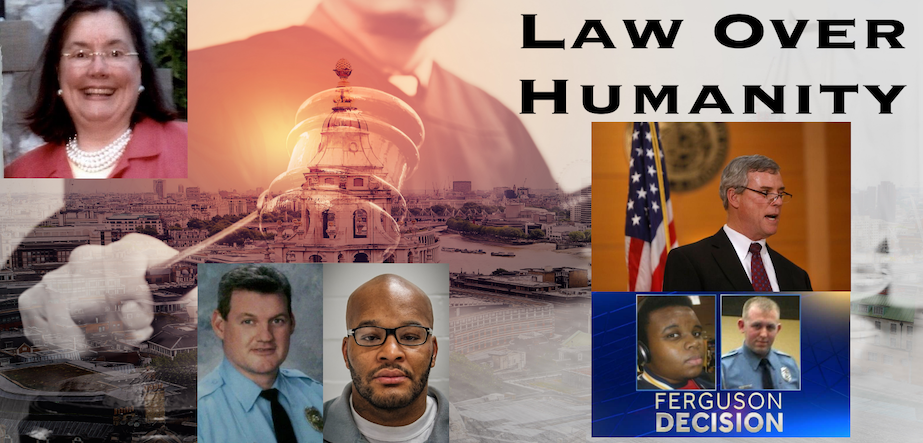
In a terse, two-sentence opinion Presiding Judge Mary Elizabeth Ott (pictured top left) wrote:

“This Court has received a pleading [from a special prosecutor] entitled Motion to Vacate Judgement. The Court enters the following judgment: The Motion to Vacate Judgement is DENIED.”

Johnson’s attorneys were swift in blasting the ruling and former St. Louis County Prosecutor’s racially biased history when it comes to pursuit of the death penalty.

“On Tuesday night, the Special Prosecutor appointed to review death row inmate Kevin Johnson’s case filed a motion to vacate Johnson’s death sentence – a highly unusual move in a system where prosecutors always push to uphold convictions and sentences. On Wednesday morning, only several hours after the motion was filed, the Circuit Court of St. Louis County denied the motion. Kevin Johnson’s execution date is less than two weeks away.”

Shawn Nolan, attorney for Kevin Johnson, said, “The Special Prosecutor’s investigation and motion to vacate raise serious concerns about whether Mr. Johnson received the death penalty because he is Black.”

“That should concern everyone about the integrity of this sentence, but it should especially disturb judges tasked with protecting the integrity of the legal system, a responsibility that is at its apex when a death sentence is on the line. Instead, the motion was summarily denied in just a few hours.”

Nolan said Johnson’s appeals have not ended.

“Our hope is that the court will reconsider that ruling or that the Supreme Court of Missouri will order the evidentiary hearing that is required by law in this circumstance. There is no reason for this execution to go forward without this process,” Nolan said.

“To do so would make a nullity of the statute authorizing prosecuting attorneys to file such motions when the facts at their disposal compel them to do so.”

According to Nolan, the State argued that “at every stage of the capital prosecution overseen by former Saint Louis County Prosecuting Attorney Robert McCulloch, race played a decisive factor. The Special Prosecutor concluded that as a result, the State’s prosecution violated the Equal Protection clause.”

The Special Prosecutor also included these facts:

-Of the five police-killing cases that occurred during his tenure in office, McCulloch sought the death penalty for four Black defendants and declined to seek it against the one white defendant charged with killing a police officer.

-In that case, McCulloch’s office sent a written invitation to defense counsel to submit mitigating evidence and granted the defense nearly a year to prepare their arguments against the death sentence. However, in the cases with Black defendants, McCulloch never issued an invitation to submit mitigating evidence that might convince him to not seek death.

According to the motion to vacate, the Special Prosecutor attempted to contact McCulloch several times during his investigation into the case during the past month. McCulloch did not acknowledge any attempts at contact “all while giving a two-hour news media interview.”

The Special Prosecutor’s investigation also showed that no one on Mr. Johnson’s prosecution team could justify their actions to pursue death for cases with Black defendants and not in a case with a white defendant.

The Special Prosecutor also argued that Mr. Johnson’s prosecutors “intentionally discriminated against Black jurors,” based on his discovery of a prosecution memo that revealed an intent to impermissibly strike jurors based on race.

McCulloch and his team’s racial discrimination against jurors only highlights the pervasive racism underlying the entirety of Mr. Johnson’s trial. 

On Tuesday, November 14, religious leaders, the Missouri State Conference of the NAACP, Missourians for Alternatives to the Death Penalty [MADPMO] and others held a press conference in Jefferson City calling for Gov. Mike Parson to cancel the scheduled execution of of convicted murderer Kevin Johnson.

Nimrod Chapel Jr., president of the Missouri State Conference of the NAACP, said, “No one is here today saying Kevin Johnson needs to go home. Our culture of death has got to stop.” 

“Johnson is scheduled to be executed by the state of Missouri on November 29, 2022, for the 2005 murder of police officer William McEntee. It was a crime, according to MADPMO, Johnson “committed at just 19 years old, just hours after watching his baby brother die in front of his eyes.” 

At the press event, held at the Missouri State Capitol Rotunda in Jefferson City, advocates for Johnson’s life delivered 20,000 signatures asking Parson to commute Johnson’s death sentence to life without parole.

Johnson’s defenders also said his childhood-dominated physical and mental abuse-should have been a mitigating factor when jurors sentenced him to death. The execution, they said, should be called off because Johnson was 19 at the time he shot and killed McEntee.

Additionally, his defenders claim that he was only sentenced to die because of a racially biased prosecution bent on convicting a Black man for killing a white cop. 

“We don’t believe killing Kevin will solve anything,” said Michelle Smith, community spokesperson for MADPMO.

Earlier this month, Johnson’s lawyers appealed to the U.S. Supreme Court to halt the execution. It was filed a day after the Missouri Supreme Court declined to grant a stay.

In a press release announcing the press conference, Chapel, the NAACP President of the Missouri State Conference of the NAACP summarized the appeal for Johnson’s life.

“We all recognize the inherent injustice that is the death penalty and what it does particularly to people of color and poor people. It’s one thing to punish someone, and another thing to take their life away,” Chapel said.

“Looking at the inherent bias in our criminal justice system, we must stop the execution of Kevin Johnson and abolish the death penalty, there is no reason for it at this time.”

White Liberal Judge Ignores Sentencing Guidelines, Gives White Philly Cop Who Murdered Unarmed Black Man Only 1 Year in Prison. Cop Shot Dennis Plowden in the Head Through His Hand as He Surrendered

From [HERE] A former Philadelphia police officer was sentenced Thursday to 11½ to 23 months in prison for the 2017 fatal shooting of Dennis Plowden Jr., a conviction prosecutors called the first for an on-duty killing in recent city history.

The penalty fell years below the minimum state sentencing guidelines for the voluntary-manslaughter conviction that a jury handed Eric Ruch in September, leading Plowden’s family members and criminal justice reform advocates to say he got a sweetheart deal. District Attorney Larry Krasner’s office said convictions on identical charges have yielded 5½-to-11-year sentences on average since he took office in 2018.

In sentencing Ruch, Common Pleas Court Judge Barbara McDermott said that he had demonstrated good behavior since he was charged two years ago and she believed a longer sentence would not offer him rehabilitation.

”Nothing he is going to do in prison is going to make him a better person,” McDermott said to a courtroom packed with family, friends, and colleagues of Ruch and Plowden.

McDermott suggested she would have let Ruch, 34, walk out of court with no prison time would it not diminish the severity of the voluntary-manslaughter charge, which calls for a minimum of 4½ years in prison, according to state sentencing guidelines.

Outside the courthouse, Plowden’s family expressed sharp disappointment over what they called a lenient sentence that failed to account for the family’s loss and suffering.

“I wasn’t surprised, but I was disappointed,” said Tania Bond, Plowden’s widow. “Who wastes five years to come to court and hear 11 to 23 months? Did we value Dennis’ life or did we just throw something out there to feel like we shut the family up and we satisfied?”

McDermott said the sentence came with parole eligibility and carried no financial penalties. A spokesperson for Krasner said the office is “reviewing options” and has 30 days to appeal the sentence to the Superior Court.

In a statement, Krasner noted that the Pennsylvania Sentencing Commission recommendations allow a judge to reduce a sentence by one year below the minimum recommendation. “This sentence falls far below state guidelines,” he said.

In September, a jury found Ruch guilty of voluntary manslaughter for shooting and killing Plowden, a 25-year-old who was in the process of surrendering to officers following a car chase in the Ogontz neighborhood. Officer Eric Ruch Jr. shot and killed Dennis Plowden Jr., 25, only seconds after Plowden crashed his car at 77 mph (125 kph), stumbled out of it and fell to the ground, authorities said.

Over the course of a five-day trial, witnesses said Plowden emerged from his crashed vehicle in a daze and was on the ground in a seated position when Ruch fired a single shot at his head. The bullet tore through Plowden’s left hand before entering his skull — a hand he was raising to surrender. Four other officers who were on the scene and had taken cover did not fire their weapons, according to a grand jury presentment.

Officer Eric Ruch Jr. told jurors he feared for his life when he fired at Dennis Plowden Jr. as the 25-year-old sat on a sidewalk after crashing a car during a high-speed chase. Apparently, the jurors found him to be not credible or a liar.

Ruch and five other officers, including his former partner, testified that they thought Plowden was reaching with his right hand for a gun while on the ground, and that Ruch feared for his life when he pulled the trigger. “The hand you can’t see is the hand that can hurt you,” the former officer testified.

But Plowden didn’t have a gun on him. Officers disputed their department’s own crime-scene sketch that showed Ruch had cover behind police cars when he shot Plowden. And witnesses acknowledged that the man was dazed and defenseless at the time of the fatal shot.

“Ruch intentionally fired on Dennis Plowden less than 20 seconds after the Hyundai he had been driving crashed at nearly 80 miles an hour, Mr. Plowden had fallen to the ground, and yet was still attempting to obey commands,” the grand jury wrote.

Other eyewitnesses said Plowden was on his back and struggling to sit up when he was shot, with one saying Plowden was gesturing with his left hand in front of his face. 

The lawsuit filed by Plowden’s wife said he was propping himself up with his right arm while holding out his left hand in a vain attempt to prevent Ruch from shooting him. A medical examiner said the bullet tore through the fingers of Plowden’s left hand before hitting him in the head, indicating the hand was raised, according to the grand jury.

Ruch fired the fatal shot just 6 to 8 seconds after getting to the crash scene, the grand jury said.

It remained unclear why police sought to stop Plowden’s car in the first place. According to the grand jury, Ruch and his partner began following Plowden and asked police dispatch to check the registration of his car. 

At sentencing, Assistant District Attorney Vincent Corrigan noted that Plowden left behind two children and three stepchildren. His youngest, 5, knows his father only from visits to the cemetery, he said. Family members said they have struggled to make sense of the moments that led to Ruch’s pulling the trigger.

“My heart was ripped from me in six seconds,” said sister Diamond Plowden. “In six seconds, my life changed.”

Plowden’s mother, Shanita McCoy, turned to Ruch and said: “Eric Ruch still gets to see his wife in prison. I hope my son’s death haunts you every day.”

Hetznecker, the lawyer for Plowden’s wife, said that police had no probable cause to stop the car, and that officers’ statements were an attempt to justify the fatal shooting.

The white liberal judge McDermott rejected prosecutors’ depiction of Ruch as a cold-blooded killer who conspired with his colleagues to get away with murder.

In her remarks before sentencing, the judge blamed Plowden for initiating the car chase, striking the open door of a police car, injuring an officer who was trying to exit the cruiser, and then crashing his own vehicle. “He was the one who created the larger danger that the officers found themselves in,” McDermott said.

McDermott said she gave Ruch “credit” for his reportedly positive impact at a nursing home where he took a security guard job after his firing from the department in 2020.

Racist PA Republicans Impeach Philly DA Larry Krasner b/c He Tried to Help Black People. However, "Authority" [the Cop's Uncontrollable Right to Attack People and Rule Over Them] is Not Reformable

STUPID CONFLICTED REPUBLICANS LOVE THEIR FREEDUMB AND WORSHIP AUTHORITY AT THE SAME TIME (SO LONG AS AUTHORITY IS USED AGAINST BLACKS TO TREAT THEM CRIMINALLY). In reality, the so-called “right” to attack people is evil regardless of whether it is done lawfully by persons having “authority” or done unlawfully by criminals. Acts that would be considered unjust or morally unacceptable when performed by people are just as unjust or morally unacceptable when performed by government agents. The fact that PERSONS WEARING blue costumeS WHO HAVE BEEN granted “authority” to be police BY another, higher, authority makes no difference - you are rationalizing away your own slavery if you believe otherwise. [MORE]

WITH REGARD TO CRIME THAT HAS ZERO EFFECT ON THE LIVES OF RACIST REPUBLICANS LIVING IN THE SUBURBS FAR FROM THE PEOPLE THEY HATE FUNKTIONARY states:

Black-on-Black Crime – a psycho-political euphemism, unwittingly used and abused by African-Americans and deliberately by Caucasians, describing demographic criminal activity in general, as people overwhelmingly commit violent crimes on people who live in closest proximity to them, and the violence mostly occurs by those and on those who are held hostage under chronic and cyclical economically disadvantaged circumstances and environments. Do you ever hear of the slogan “White-on-White” crime? Most violent crimes (at least by number, if not also by percentage of population) take place by Caucasians against Caucasians. Where’s the associated terminology? The pathological criminality within Black neighborhoods is maintained by the ones “keepin’ it real”—that is, real quick to murder people who look like themselves. (See: Gangbanking, Pan-Africanism & Racism) [MORE]

From [HERE] The Pennsylvania House impeached Philadelphia District Attorney Larry Krasner, as Republican legislators pushed to remove the twice-elected prosecutor whose liberal policies they blame for fueling record levels of violent crime in the city.

The Republican-led chamber impeached Mr. Krasner, a Democrat, on Wednesday by a vote of 107-85, largely along party lines, after more than two hours of emotional debate. The next step will be a trial in the GOP-led state Senate. Conviction and removal from office would require a two-thirds majority. It couldn’t be determined when a trial might be held.

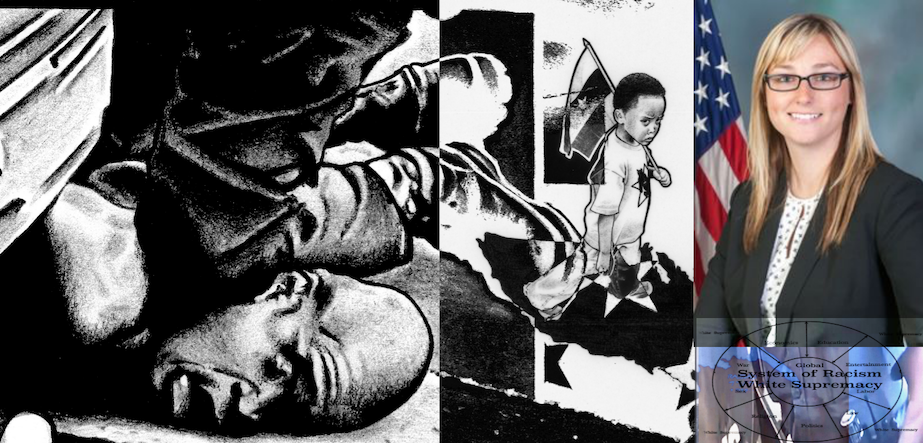
State Rep. Martina White (racist suspect in photo top right), a Philadelphia Republican who was the lead sponsor of the impeachment resolution, exhorted members moments before Wednesday’s vote to support Mr. Krasner’s impeachment.

“His dereliction of duty and despicable behavior is unacceptable and cannot be tolerated,” she said. “The legislature has a duty and the only authority to act when a public official refuses to perform their duties and puts the public in danger.”

Mr. Krasner has said House Republicans mischaracterized his record. When GOP members introduced two articles of impeachment last month, he called the move devastating to democracy, adding, “It shows how far toward fascism the Republican party is creeping.” Lawmakers on the House floor Wednesday added five more articles of impeachment.

The impeachment comes a year after Mr. Krasner overwhelmingly won a second four-year term. He said his office vigorously prosecutes the most serious and violent crimes while adhering to the U.S. and Pennsylvania constitutions.

After the vote Wednesday, Mr. Krasner tweeted: “Philadelphians’ votes, and Philadelphia voters, should not be erased. History will harshly judge this anti-democratic authoritarian effort to erase Philly’s votes—votes by Black, brown, and broke people in Philadelphia. And voters will have the last word.” [MORE]

Manhattan DA Alvin Bragg Dismisses 188 Convictions Following NYPD Officer Misconduct Investigation

From [HERE] Manhattan District Attorney Alvin Bragg, Jr. Thursday moved to vacate 188 misdemeanor convictions tied to eight New York City Police Department officers. This request represents part of an ongoing review by the DA Office’s Post-Conviction Justice Unit of more than 1,100 cases connected to a list of 22 former NYPD officers. Bragg noted that the dismissals are “an important step forward, but we know there is a lot more work to do, and our investigation remains ongoing.” The names of the officers under investigation were provided to the DA’s Office in 2021 by public defenders and advocacy groups.

Speaking on the decision, Bragg emphasised:

Trust and confidence are essential to achieving public safety. New Yorkers must know that everyone is acting with the utmost integrity in the pursuit of equal justice under the law. Without that belief, our criminal justice system will never be able to deliver real and lasting safety that every community deserves.

The arrests in question occurred between 2001 and 2016, and more than half of the sentences resulted in fines or incarceration. The officers involved were convicted of various crimes including planting drugs, receiving bribes, lying under oath and official misconduct for releasing an 18-year-old woman from custody in exchange for sexual favors.

What Matters is What Racists Do to NGHRS Not What They Say About Them; Liberals Go on Pretending Racism is Bigotry, Seek to Reform Language Used by Racist Buffalo Cops who Surveil and Attack Blacks

According to white liberals [HERE] Reports that racist language has been routinely used – including the most hateful epithet of all – by Buffalo police in dealing with the public have recently emerged.

Is it surprising? Despite statements from both Mayor Byron Brown and Police Commissioner Joseph A. Gramaglia that “discriminatory language by any employee is not tolerated in this administration” (Brown), and “it is not acceptable today and it was not acceptable in the past” (Gramaglia), it is all too easy to believe that, regardless of official policies and up-to-date training to guard against bias and biased language, the language can persist. Even now.

A federal lawsuit against the City of Buffalo and the Buffalo Police Department claiming discriminatory policing toward people of color on the East Side has been slowly proceeding in federal court. Brought by East Side activist group Black Love Resists in the Rust in 2018, it reached the deposition stage only this past spring.

The depositions, as revealed by News reporting and in an ongoing story by nonprofit news organization Investigative Post, are beyond damning. Some of the statements by deposed police officers – all former members, who have since retired, of the Buffalo Police Department’s now disbanded Strike Force and Housing units – admit widespread use of hateful racial slurs when these units were in operation (Strike Force was disbanded in 2018). One officer explains the use by saying, “I’m a human being.”

The testimony also indicates that when citizens complained about racist language or behavior by police, those complaints often failed to make their way up the chain of command, were rarely investigated by internal affairs and disciplinary action hardly ever resulted.

Again, are we surprised? But lack of surprise should not be accompanied by acceptance. We should no longer be hearing about police at any level being accused of racist language or behavior. If the current system does include training, reporting and internal follow-up – and those protocols are being strictly followed and enforced – citizens should not need to sue the city and its police department for infractions.

Claudia Wilner, an attorney with the National Center for Law and Economic Justice, which is representing plaintiff Black Love Resists, went through years of records and could not find an instance where former Police Commissioner Daniel Derenda initiated an investigation into a claim of racial discrimination.

If protocols were strictly followed and enforced – Derenda is said to be a stickler and a strict disciplinarian – why weren’t records of investigation and resulting disciplinary action found?

Such lack of documentation makes it very difficult for citizens to have their complaints addressed.

If police officers truly believe their racist language comes from being “human,” it may not be possible to change that mindset. But it is possible to create conditions in which racist behavior on the job is not tolerated, is documented when it happens and comes with consequences.

According to Gramaglia, “implicit bias” training for active police officers exists and is mandated. In fact, Gramaglia notes that the training was just updated according to recent state standards and that 40% of the force had taken it, since it was offered in June.

That’s good to hear, especially since none of the retired officers who were deposed in the current lawsuit had taken any such training. One did not know what “implicit bias” meant.

Clearly, the safeguards that are supposedly in place aren’t enough. Obviously, disciplinary action for racist language and behavior is possible, but it’s rarely, if ever, used. It’s equally apparent that training can only go so far, particularly since a few training sessions, no matter how well-constructed, cannot obliterate prejudices acquired over a lifetime.

Zero tolerance needs to really mean zero tolerance. Brown and Gramaglia say that it does, but the evidence presented in this lawsuit says otherwise. So does the anecdotal evidence found on the streets of Buffalo.

That’s why we’re not surprised. But we want to be. And if the abhorrence toward racism expressed by Buffalo’s top law enforcement officials is inoculated into every single officer on every beat, maybe someday we will be pleasantly surprised. Maybe someday nobody will need to know what “implicit bias” means – because it will no longer exist.

It’s an aspiration. But that’s not where we are now.

Black Children Comprised Almost Half of Kids Arrested in the Public Fool System Even though they Make up only 15% of Students at their schools

From [HERE] A second-grader with autism was forced to the floor of a North Carolina school and held by a police officer for 38 minutes. "Don't make a wrong move," the officer told the child on Sept. 11, 2018, at Pressly School in Statesville. The officer also threatened that if the 7-year-old weren’t yet “acquainted with the juvenile justice system,” he would be very “shortly.” 

The child was accused of spitting at a teacher, and for that, he ended up with School Resource Officer Michael Fattaleh’s knee forced into his back. When a lawsuit was filed on the student’s behalf, the City of Statesville settled it, with neither cop nor teacher having to admit fault or pay toward the settlement, The Charlotte Observer reported earlier this month.

What’s worse is that the case is no exception. More than 700 students were arrested at their schools during the 2017-18 academic year, according to a CBS News analysis of recent data from the U.S. Department of Education's Office for Civil Rights.

Those arrests did not have to happen.

Ron Applin, chief of police for Atlanta Public Schools, told CBS News he’s “never seen a situation or a circumstance” in his six years that warranted an elementary school student being arrested.

"We've never done it,” he said. “I don't see where it would happen."

Black students comprised almost half of those arrested in the data even though they made up only 15% of students at their schools, and children with disabilities were four times more likely than their peers to be arrested, CBS News reported.

Alacia Gerardi, the mother of the student arrested in North Carolina, told the news station when she arrived at her son’s school after receiving a text to pick him up, she couldn't understand why he was handcuffed face down on the floor when an Individualized Education Plan detailed his disabilities.

"It was a very rude awakening, because when I arrived there and I picked my son up off the floor. He was limp, completely limp," she said. "He was just exhausted. I didn't know what had happened, but after I saw the video, it was very apparent that his little body just couldn't take being put in that position for that length of time. He had his chest against the floor, his hands behind his back. This man's applying pressure against his back."

Aaron Kupchik, a sociology and criminal justice professor at the University of Delaware, told the news network that, in an analysis of interviews with 75 School Resource Officers (SROs), those who worked with students in low-income areas tended to "define the threat as students themselves." "Whereas the SROs who work in wealthier, whiter school areas define the threat as something external that can happen to the children," Kupchik said.

An incident involving an 11-year-old Black student with disabilities in Riverside County, California, seemed to exemplify the racist ideology at play. The child, who we’ll refer to as C.B. to protect his anonymity, was handcuffed for refusing to go to the principal's office after being accused a day earlier of throwing a rock at a staff member. She wasn't injured, and in a lawsuit filed on C.B.’s behalf, attorneys alleged police involvement for "low-level and disability-related behaviors" was part of a pattern.

In the incident that led to C.B.’s detainment, attorneys wrote:

C.B. sat with his head down on his desk while the school police officers questioned him. Within ninety seconds of their arrival, the officers physically pulled C.B. from his desk by his arms and shoulders, pushed him with force to the ground, and handcuffed him. One officer pinned his knee in C.B.’s back while another officer placed him in handcuffs.

5. As a result of Defendants’ unnecessary and excessive physical and mechanical restraints, C.B. has suffered and continues to suffer severe emotional distress, mental anguish, pain, humiliation, and exacerbation of his disabilities. His parents have secured therapy services to help him cope with the trauma caused by these incidents.

6. On information and belief, Defendants were and are on notice that interactions with school police officers trigger and exacerbate C.B.’s disabilities and cause emotional distress. Nevertheless, the District continues to request and direct school police officers to respond to C.B.’s minor and/or disability-related behaviors, unnecessarily escalating matters.

HRW and ACLU Report says Government Authorities Use the Child Welfare System to Destroy Black Families; Removing Children from Parents, Charging Them w/Neglect Based on Poverty Level

ARE WHITE LIBERALS DOING THIS TO BLACK PEOPLE? From [HERE] and [HERE] Child welfare systems in the United States too often treat poverty as the basis for charges of neglect and decisions to remove children from their parents, Human Rights Watch and the American Civil Liberties Union (ACLU) said in a report released today. The system’s disproportionate impact on Black and Indigenous families and people living in poverty, and the sheer number of children removed unjustly, make this a national crisis warranting immediate attention and action.

The 146-page report, “‘If I Wasn’t Poor, I Wouldn’t Be Unfit’: The Family Separation Crisis in the US Child Welfare System,” documents how conditions of poverty, such as a family’s struggle to pay rent or maintain housing, are misconstrued as neglect, and interpreted as evidence of an inability and lack of fitness to parent. Human Rights Watch and the ACLU found significant racial and socioeconomic disparities in child welfare involvement. Black children are almost twice as likely to experience investigations as white children and more likely to be separated from their families.

“The child welfare system punishes parents for poverty by taking their children away,” said Hina Naveed, Aryeh Neier fellow at Human Rights Watch and the ACLU and the author of the report. “Parents need resources to help provide for their families, but what they are getting is surveillance, regulation, and punishment.”

Human Rights Watch and the ACLU analyzed national and state data on income and poverty levels, child maltreatment, and the foster system, and interviewed 138 people, including affected parents and caregivers, attorneys, government workers, local, state, and national advocates, and others.

One in three children in the US will be part of a child welfare investigation by age 18. Nearly eight million children were referred to a child maltreatment hotline in 2019, with investigations resulting for three million of them. More than 80 percent were found not to have faced abuse or neglect.

One woman told us her son injured himself when he slipped on water while dancing in the kitchen. “I rushed him to the emergency room when he got hurt. The doctors asked me questions, and I told them everything.” She was shocked to learn they reported her to child protective services for suspected abuse, triggering a cascade of interventions that she said deeply harmed her children and damaged their relationship.

Human Rights Watch and the ACLU found that nearly 75 percent of child maltreatment cases nationwide in 2019 involved “neglect” as defined by the system.

A 52-year-old mother from Oklahoma said the condition of her small mobile home was a factor in a child welfare investigation that caused her to lose custody of her 8-year-old son. “They said [one reason] was because we had no running water, but I had like 12 gallons in my camper,” she said. “We were looking for a [larger] place to rent and hadn’t found one yet.”

Counties with higher poverty rates have higher rates of maltreatment investigations. But investigation rates are high for Black families even in counties with low rates of poverty.

Black and Indigenous families are disproportionately affected. Black children make up just 13 percent of the US child population but 24 percent of child abuse or neglect reports and 21 percent of children entering the foster system. White children make up 50 percent of the US child population, and 46 percent of the children in abuse or neglect. [MORE]

Nearly 35% of Police Stops in Berkeley (a Mecca for White Liberals) in the last year Were of Black People, Despite the Fact that Only 8% of the City is Black, According to the Census

From [HERE] The Berkeley Police Department was in turmoil Thursday following the leak of text messages that allegedly show the president of the police officers union making racially charged remarks and calling for arrest quotas.

The growing scandal resulted in the union president, Sgt. Darren Kacalek, being placed on administrative leave Wednesday, city officials confirmed. He also stepped down from his position as union head. It also put on pause the City Council’s pending appointment of a new police chief, Jennifer Louis, the Berkeley Scanner reported.

The texts were exposed last week by a city police officer who was fired last year, Corey Shedoudy. He claimed he obtained the messages during the arbitration process to get back his job.

“Evidence was uncovered that exposed the unethical and illegal practice of arrest quotas of downtown unhoused ordered by Sgt. Darren Kacalek,” Shedoudy wrote in an email to the mayor and City Council. The officer was reportedly fired for intentionally crashing his bike into a car.

As a member of the Downtown Task Force and BPD Bike Force in 2020, Shedoudy claimed that Kacalek — a sergeant in the Police Department at the time — required him and other officers to make 100 arrests per month, “which was at the time more than the rest of the police department combined,” Shedoudy wrote in the email.

The quotas continued after Louis was named interim chief, Shedoudy said.

The police were ordered by Kacalek to use “questionable legal tactics” such as stop and frisk, probation searches with no reasonable suspicion of a crime, and “stay-away” orders from UC Berkeley.

The selected texts that Shedoudy sent to the mayor on Nov. 10 included racially charged messages about people arrested as well as a joke Kacalek sent seemingly about a disease that “wipes out the homeless pop.” The messages were made public by Oakland advocacy group Secure Justice.

In another instance, Kacalek asked officers if they noticed a similarity among five arrestees.

“They had Covid?” one officer guesses.

“All of the same heritage,” Kacalek responds.

In his email to city officials, Shedoudy called for an investigation into the texts, claiming that Louis has responded to him with “deafening silence.”

Vice Mayor Kate Harrison confirmed that an “independent investigation” would occur before a vote to appoint Louis as chief.

“We do not know if these offensive comments and actions extend beyond the time period and team implicated in the text threads, but the texts validate real concerns in our community,” Harrison said in a statement.

A spokesperson for the city said the independent investigation would be done instead of a Police Department internal affairs investigation “to avoid any question about the impartiality.”

“It’s extremely disgusting. I am cynically and sadly not surprised,” said Brian Hofer, who runs Secure Justice, a criminal justice reform advocacy group. “The text messages are revealing a racist culture and we’re seeing it reflected in the metrics.”

Nearly 35% of police stops in Berkeley in the last year were of Black people, despite the fact that only 8% of the city is Black, according to the census.

At a remove meeting Wednesday, Hofer said Berkeley City Manager Dee Williams-Ridley withdrew the council vote on Louis’ appointment.

Shedoudy also said that at the end of his arbitration process he would be releasing publicly texts that show the practice of “illegal arrest quotas, racism, evidence suppression, lying, and quid pro quos” inside the DTF/Bike Force.

Neither Kacalek nor Shedoudy responded to requests for comment. The Berkeley Police Department did not respond to a request for comment.

In addition to the text scandal, the Police Department has also been accused of denying minors the right to have a lawyer present before waiving their Miranda rights and speaking with police, despite a 2018 law requiring it.

“Recently we have received calls from BPD to provide Miranda consultations where the officers have refused to mirandize the minor while we were on the phone,” Alameda County Public Defender Brendon Woods said in a letter to Interim Police Chief Louis in July.

Woods brought the issue back up at a council hearing Wednesday after the text scandal became public.

“To be honest, I don’t have faith in the chief,” Woods said at the City Council meeting, according to KTVU. “The officers we spoke to were hostile. They were rude and they would often hang up on our attorneys.”

Hawaii Plaintiffs join Contaminated Drinking Water Lawsuit Against US Government Prompted by Navy Fuels Leaks

From [HERE] As of Thursday, more than 100 people have joined a lawsuit against the US government concerning water contaminated with jet fuel. The plaintiffs seek legal remedy under the Federal Tort Claims Act, which provides for compensation for personal injury, death, or property loss or damage from a negligent or wrongful act of an employee of the federal government.

The suit was originally brought in August by four plaintiffs living in Pearl Harbor, Hawaii at the time of the contamination. The complaint states that the US Navy negligently released jet fuel and other toxic substances into the Navy water line in May 2021 and in November 2021, resulting in the contamination of the drinking water near the World War II-era naval fuel storage facility in Red Hill, Hawaii. The Navy allegedly did not report the issue until December 2, 2021.

Plaintiffs report symptoms including seizures, gastrointestinal disorders, neurological issues, migraines, rashes, burns and thyroid issues, and some have undergone surgeries to ameliorate health issues caused by the ingestion of the jet fuel. The complaint also stated that at least one adult in each affected family had to halt their employment or military service to deal with the illness their families experienced as a result of ingesting the contaminated water.

Approximately 9,715 households were affected by the spill.

Black Men Suing Hyundai Plant for Racial Discrimination: Denied Promotions, Required to Call White Manager ‘Master’

From [HERE] Hyundai Motor Manufacturing of Alabama is the subject of another racial discrimination lawsuit - this time filed by five Black men who say they were denied promotions, punished with writeups and, in one instance, told to report to a white manager who was referred to as “master.”

The 34-page lawsuit, filed in U.S. District Court for Alabama’s Middle District, comes a month after former HMMA Director of Administration Yvette Gilkey-Shuford sued the company for racial and gender discrimination. The new suit seeks back pay, lost benefits, compensatory and punitive damages.

Robert Burns, vice president of human resources and administration for HMMA, said the company does not comment on the details of pending litigation.

“HMMA provides a workplace free of discrimination based on race, color, religion, sex, sexual orientation, gender identity, age, national origin or ancestry, citizenship status, physical or mental disability, genetic information, veteran status, uniformed service member status or any other status protected by federal, state or local law,” Burns said in a statement.

According to the suit, Blacks can only rise to a certain managerial level, but comprise a larger percentage of workers who are subjected to more physically demanding work. One of the men details how, once he applied for a higher leadership position, the vacancy was withdrawn.

On another occasion in 2020, the suit states, a white manager approached a group of about 30 Black employees, saying their supervisor, who he referred to as “master,” wanted them inside. When informed the language was offensive, the manager ignored them.

The plant’s “rank-and-file employees fear a culture of retaliation and reprisal if they report discriminatory conduct within the plant,” the suit states.

The five men also allege that Hyundai keeps a list of employees who make discrimination complaints, and that employees can be denied promotion, disciplined, demoted or terminated for making complaints. This despite the Hyundai workforce being staffed by about 85% Black employees.

One challenged several disciplinary measures and was told by other employees, “they want you fired.” Another contends he was terminated after disciplinary measures that were harsher than for his white coworkers for similar infractions.

Another took an extended medical leave. When he returned, he was told he had been reassigned to chassis marriage, one of the more physically demanding jobs, which does not align with company policy following medical leave, the suit states.

Artur Davis, who is co-representing the men, said the four still employed at Hyundai “are risking good paying jobs by standing up for their rights,” he said.

“They are frustrated but they refuse to work on a plantation and no one is their master,” Davis said.

Federal Judge Rules Corpse Biden's Fake Federal Student Debt Relief Plan Unconstitutional

From [HERE] On Thursday, November 11, Judge Mark Pittman of the U.S. District Court for the Northern District of Texas released a decision that found the Biden-Harris administration’s Federal Student Debt Relief Plan was unconstitutional.

Judge Pittman ruled that because the issue of student loan forgiveness is of great “economic and political significance,” and the Department of Education is required to show that it has clear authorization from Congress for the program. Pittman found that the Department did not prove that it had this authorization. He said: “no one can plausibly deny that [the program] is either one of the largest delegations of legislative power to the executive branch or one of the largest exercises of legislative power without congressional authority in the history of the United States.”

The ruling is the result of a lawsuit filed by the Job Creators Network Foundation, a conservative advocacy group. The group filed the complaint on behalf of borrowers who were ineligible to receive full or partial relief from the program, arguing that the administration violated federal procedures by denying borrowers the ability to provide public comment before the program was launched. The group also asserted that the administration lacked proper legislative authority over the program.

The Biden-Harris administration maintains that the Student Debt Relief Plan can be implemented under the Higher Education Relief Opportunities for Students Act (HERO Act, H.R. 1412), which allows the Secretary of Education to waive federal student loan repayments during national emergencies. The administration, which recently signaled that it will continue the COVID-19 Public Health Emergency (PHE) declaration, contends that COVID-19 qualifies as a national emergency.

Department of Education Secretary Miguel Cardona said that the Department is “disappointed” in the ruling. He added that “we are not standing down,” revealing that the Department of Justice has appealed the decision. The loan forgiveness program, for which 16 million applications have been approved for and over 26 million borrowers have applied to without approval yet, will remain in limbo until the Northern District of Texas decision and other lawsuits are resolved.

The moratorium on student loan repayments will only be valid until January 1, 2022. The Biden-Harris administration said in August that the most recent extension was their final, meaning that borrowers will likely be expected to start paying their loans at the end of this year unless President Biden takes action. While the administration has not provided any signs that their decision to halt the moratorium has changed, given the pause on the loan forgiveness program due to legal challenges and the extension of the COVID-19 PHE declaration, it would not be surprising if the moratorium was again extended in the near future.

Please visit AG Study Guide to read our previous coverage of the Student Debt Relief Program and moratorium developments.

Congress Pledged $4 Billion to Black Farmers, but reversed its decision after public pressure. Now, those farmers are suing US Government

From [HERE] The US government doubled back on its pledge to allocate $4 billion in debt relief specifically to Black and minority farmers—originally a part of the 2021 American Rescue Plan Act—after the program received backlash from white farmers who claimed they were excluded from the relief based on racial discrimination. Now, farmers of color who were expecting payments are suing.

The debt relief, which Congress originally aimed towards “socially disadvantaged farmers (SDFs),” was considered a small step in repaying farmers of color for a long history of discrimination and disenfranchisement. Monetarily speaking, discrimination throughout the 20th century cost Black farmers $326 billion in land loss alone.

After the program was stalled by lawsuits from farmers who found it unfair, the provision was ultimately repealed. Now, instead of directing the debt relief specifically to SDFs—a definition that included Black, Native American, Hispanic and Asian farmers—the new language offers loan forgiveness based on economic need and not race.

However, in  an effort to avoid the courtroom, the government has landed in another class action lawsuit, this time on behalf of the National Black Farmers Association. According to the plaintiffs, including the association’s founder, John Boyd, the US breached a contract by going back on the arrangement to distribute the funds among socially disadvantaged farmers.

As a part of the original debt relief plan, the Agriculture Department’s Farm Service Agency sent letters to farmers that would have qualified for the loan forgiveness, assigning potential dollar amounts of debt that each farmer could expect to be covered. According to Roll Call, a few of the now-plaintiffs in the lawsuit borrowed extra money in light of the letters and are facing financial woes as a result of the relief never coming.

​​“They did not receive the benefit for which they had bargained,” says the complaint, which was filed in the U.S. Court of Federal Claims on Oct. 7. “They suffered financial damage in reliance on the U.S. government’s promises by making purchases they are now unable to afford.”

The lawsuit is filed as a class action, allowing for more farmers to join the case.