Incidental, Random Justice in System of Injustice: White Chicago Cop Not Found Credible by Jury & Found Guilty of 2nd Degree Murder of Laquan McDonald After Shooting Him 16 Times

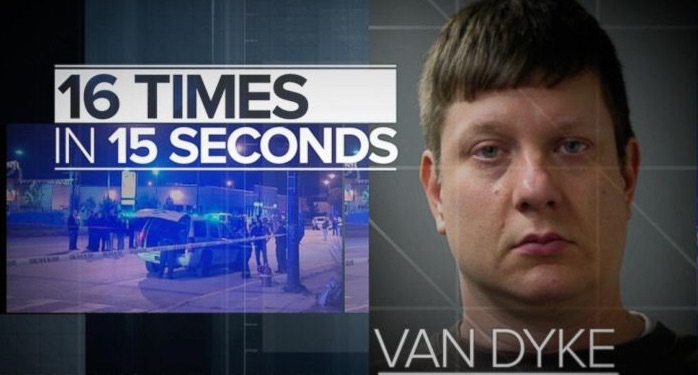
From [HERE] and [HERE] Chicago police Officer Jason Van Dyke was found guilty Friday of second-degree murder in the 2014 shooting of 17-year-old Laquan McDonald.

Van Dyke, who was also found guilty of 16 counts of aggravated battery with a firearm, sat impassively in a dark suit -- his shoulders slumped -- as the verdicts were read in the high-profile case - each count read aloud in the packed courtroom, one for each bullet that struck the teenager, Laquan McDonald. At one point, he sipped water from a bottle. He was found not guilty of official misconduct.

For three years, Chicago was racked by the political, legal and emotional impact of a chilling video that lasted only seconds: A black teenager could be seen collapsing onto a street as a white police officer shot him over and over, 16 times in the end.

Van Dyke's bond was revoked and sentencing was scheduled for October 31. He left the courtroom with an officer. Though he was originally charged with first-degree murder, jurors were instructed Thursday that they also could consider second-degree murder.

The panel of eight women and four men -- seven white, one black, three Hispanic and one Asian -- began deliberations Thursday afternoon.
vandyke cop.jpg

Members of the jury later told reporters that Van Dyke's testimony was not credible and seemed rehearsed. The jurors, who did not give their names, said the veteran police officer did nothing to deescalate the situation that led up to the fatal shooting.

Officer Van Dyke, who is 40 and joined the Chicago police almost two decades ago, confronted Laquan, 17, along a darkened road on the city’s Southwest Side on Oct. 20, 2014. After a truck driver reported that evening that someone was breaking into vehicles in a parking lot, police officers followed Laquan, who was carrying a three-inch pocketknife and refused to stop when they told him to. The pursuit — with Laquan walking down the street and officers on foot and in squad cars behind him — ended when Officer Van Dyke arrived in a car, stepped out and shot him repeatedly, even after his body was crumpled on the street.

The jury deliberated for fewer than eight hours — a shorter period than some people had expected — and some jurors told reporters after the verdict was announced that two of them had at first leaned toward acquittal. The main debate though, the jurors said, was whether to convict Officer Van Dyke on first- or second-degree murder.

Officer Van Dyke had testified on his own behalf during the trial, saying that Laquan had given him a menacing look and angled the knife in his direction before he started shooting — actions that were not visible on the video, which jurors were shown again and again. Jurors did not find the white cop credible.

“He seemed scared on the stand,” said one man on the jury, who like other jurors did not give his name. “He was fumbling around trying to remember things exactly how they were, and his memories and the facts and other evidence didn’t line up.”

No Chicago police officer had been convicted of murder in an on-duty shooting in nearly 50 years, and this city had braced for the possibility of an acquittal and a furious response that seemed certain to follow. But when the verdict came, protesters who had gathered outside the courthouse suddenly broke into cheers. Others wept, calling out: “Justice for Laquan! Justice for Laquan!”

Dashboard-camera video from a police car gave a clear view of the shooting, though the city for months resisted releasing the images and Chicagoans only saw it 13 months after it happened, on a judge’s orders. The fallout was significant: The police superintendent was fired, the local prosecutor lost her re-election bid, and Mayor Rahm Emanuel announced shortly before the trial began that he would not seek re-election next year.

Police union leaders and supporters of Officer Van Dyke sharply criticized the outcome, and said it would have an instantly chilling effect on officers who were simply trying to do their jobs and stop crime. “This sham trial and shameful verdict is a message to every law enforcement officer in America that it’s not the perpetrator in front of you that you need to worry about, it’s the political operatives stabbing you in the back,” Chris Southwood, a state leader of the Illinois Fraternal Order of Police, said.

Chuck Wexler, executive director of the Police Executive Research Forum, suggested that the verdict could affect policing beyond Chicago, particularly when officers confront residents carrying knives and knifelike weapons. “Departments will be taking a second look at how they train officers to deal with individuals with edged weapons,” Mr. Wexler said.

[White Cops are Always Justified in Shooting Armed Non-White People] Prosecutor Fails to File Charges Against White St Paul Cops who Shot Native American 21 Times from 10 ft Away in His Home

William-Hughes-body-cam-series-1.jpg

From [HERE] and [HERE] St. Paul police officers were justified in shooting and killing William "Billy" Hughes on the front porch of his home last August as they responded to a report of a man firing shots in the house, the Ramsey County Attorney's Office said Friday.

The use of deadly force by officers Vincent Adams and Matthew Jones was "objectively reasonable given all of the circumstances that they knew, heard and saw before firing their weapons," Ramsey County Attorney John Choi wrote in a memo describing his decision not to seek charges.

"The body camera footage that captured the death of William Hughes is traumatic and difficult to watch," he added. "This tragedy is something all of us wish had never happened." [apology is always political and always an image saver]

jon choi.jpg

Hughes, 43, was killed early Sunday morning, Aug. 5. A 911 caller reported at about 2:30 a.m. that someone had fired multiple shots on the second floor of house on the 900 block of St. Anthony Avenue in the city's Summit-University neighborhood. The 911 caller then hung up without providing additional information. Cops, of course, do not hear 911 calls.

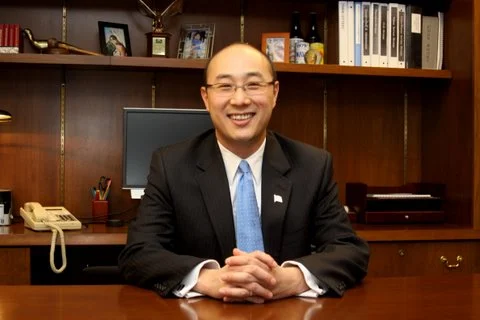
Ramsey County Attorney John Choi [in photo] exonerated the officers after he stated that the use of force by “Vincent Adams and Matthew Jones was objectively reasonable given all of the circumstances that they knew.Investigation documents sent to Choi from the BCA described police officers responding to a 911 call of shots fired.

The officers parked their vehicles some distance and moved on the house with guns drawn and flashlights shining into the dark porch before knocking on one of the two doors. Police claim they heard someone behind the second door police did not knock on say, “I’m going to kill you.” After hearing the voice, they moved back and waited in the dark on the porch.

On Adams' body cam video, he can be heard knocking on the door. The officers don't identify themselves or say police at that point.

The door opened and police switch their flashlights yelling a multitude of commands as Billy Hughes walked slowly onto the porch both his hands at his sides. The commands of “Put your hands up“, garbled over each other, followed by “put it down“. Billy raised his right hand over his head. Police then fired “21 rounds” from “7-10 feet away.

The footage shows the officers walking up to the house in the 900 block of St. Anthony Avenue at 2:30 a.m. In the body camera video, officers Vince Adams and Matt Jones were recorded yelling “Put your hands up” as the door opens onto the unlit porch. Billy walks out as the police continue to yell at him, and he turns to face the police officers. In his right hand he holds the pistol. Both officers continue to yell for him to put his hands up. One officers changes his words to “put it down.”

Billy raises his right hand as the pistol travels up, barrel towards a police officer, before Hughes’ hand comes to rest up near his head, the barrel pointed away, with Billy showing the pistol’s profile to the police. Police then fire, killing Billy Hughes.

As Deana Waukaz stated, nowhere in the video do officers announce themselves, and since both officers had their flashlights aimed at Billy when he moved out onto the unlit porch where officers waited after they knocked on a door, it’s unclear if Billy Hughes can see the police uniforms.

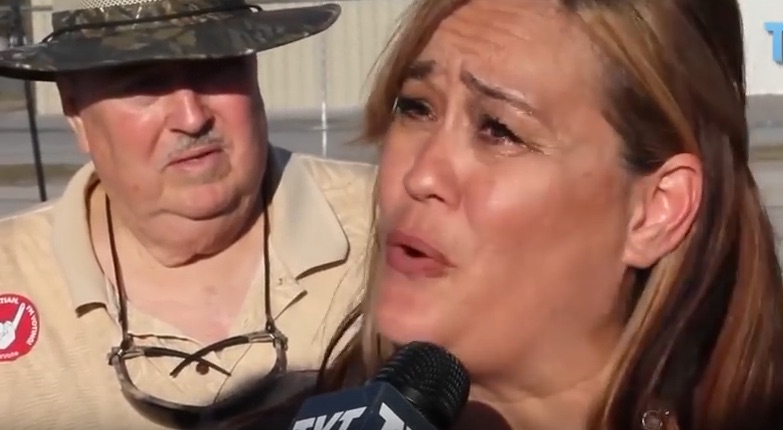
Melissa Waukazo, Hughes’ half sister, said she was angered when she saw the video.

“He did have a gun, but he did what they asked him to do and … they still shot and killed him,” she said Friday.

Nekima Levy-Pounds, founder of Racial Justice Network, wrote on social media on Friday: “Do you agree with the official police narrative on what happened to Billy Hughes? This is highly disturbing to say the least.”

She added later that the “mere presence of a gun (if that’s what was in his hand) does not automatically pose a threat.” [MORE]

The memo also said the BCA traced the source of the 911 call to a man who was a friend of Hughes who'd been sharing the second floor room in the house for several months and told investigators that minutes before he called 911, Hughes had fired two shots into the wall without warning and then put the gun barrel to his friend's head asking, "How many rounds do you think are left in this gun?"

Choi said his decision not to charge the officers came after reviewing evidence collected by the Minnesota Bureau of Criminal Apprehension and from the opinions of two outside experts asked to review the case.

"The officers' actions preceding and during the fatal encounter," he added, "are consistent with commonly-accepted police practices and training.

One of the outside experts, Mike Quinn, a former police officer who has testified for the prosecution in use-of-force cases, said the officers did "what they had to do.

"They backed up when they knew the guy was coming from that porch and tried to create some distance which would have given them a little bit bigger safety factor," Quinn said. "And certainly, they could have shot sooner."

St. Paul Mayor Melvin Carter, a Black strawboss, issued a statement Friday saying he supports Choi's decision after a "thorough, transparent and timely investigation."

After the August 5 police shooting, protests led by local indigenous community members shut down an intersection in front of the American Indian Center in Minneapolis, and the next day rallied in front of the St. Paul Western District police station before marching to Billy’s home.

Family members have called to question the police actions saying that Billy’s life didn’t need to end that day. Some of Billy Hughes’ family feels there are questions left to be answered, and last Unicorn Riot heard they planned to move forward with a civil suit.

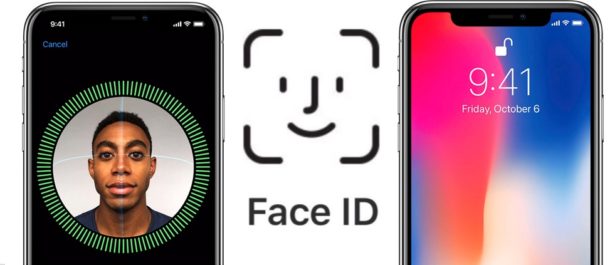
Feds Force Suspect to Incriminate Himself by Unlocking iPhone X With His Face: Cops now using Boiler Plate Language in Warrants to Get Into Your Phone w/Face ID

use-iphone-x-without-face-id.jpg

From [HERE] It finally happened. The feds forced an Apple iPhone X owner to unlock their device with their face.

A child abuse investigation unearthed by Forbes includes the first known case in which law enforcement used Apple Face ID facial recognition technology to open a suspect's iPhone. That's by any police agency anywhere in the world, not just in America.

It happened on August 10, when the FBI searched the house of 28-year-old Grant Michalski, a Columbus, Ohio, resident who would later that month be charged with receiving and possessing child pornography. With a search warrant in hand, a federal investigator told Michalski to put his face in front of the phone, which he duly did. That allowed the agent to pick through the suspect's online chats, photos and whatever else he deemed worthy of investigation.

The case marks another significant moment in the ongoing battle between law enforcement and tech providers, with the former trying to break the myriad security protections put in place by the latter. Since the fight between the world's most valuable company and the FBI in San Bernardino over access to an iPhone in 2016, Forbes has been tracking the various ways cops have been trying to break Apple's protections.

First came multiple cases in which suspects were told to unlock iPhones with their fingerprints, via Apple's Touch ID biometric login. The same technique was then used on dead subjects. Earlier this year, this publication uncloaked GrayKey, a $15,000-$30,000 tool that could break through the passcodes of the latest iOS models, including the iPhone X. Another contractor, Israel's Cellebrite, announced similar services.

Now Face ID is being used for the same purpose. Whilst the feds obtained a warrant, and appeared to have done everything within the bounds of the law, concerns remain about the use of such tactics.

"Traditionally, using a person's face as evidence or to obtain evidence would be considered lawful," said Jerome Greco, staff attorney at the Legal Aid Society. "But never before have we had so many people's own faces be the key to unlock so much of their private information."

iPhone X marks the spot

When David Knight, special agent with the FBI, obtained Michalski's cell and required the suspect to place his face in front of the device, instantly opening it, there were various items of interest inside, according to an affidavit for a search warrant of that iPhone X.

There were conversations over chat app Kik Messenger in which users discussed abuse of minors, according to the affidavit's narrative. It was later discovered that Michalski had used Kik previously to talk with an undercover officer posing as a father interested in sex with children, Knight wrote. As per a previous Forbes investigation, Kik has had to deal with a vast number of child exploitation cases involving its platform, and promised to spend millions of dollars on fixing the problem.

Leading up to the seizure of the device, Knight had learned that Michalski had posted an ad on Craigslist titled "taboo," the investigator wrote. Emails were later shared between Michalski and another defendant William Weekley in which they discussed, amongst other things, incest and sex with minors, according to Knight's telling. That included sexual acts with a Jane Doe, whom Weekley referred to as his daughter. (Both defendants await trial. No date has been set yet).

Whilst Knight may've found some evidence of criminal activity when he manually searched the device, in one respect the forced Face ID unlock of the iPhone X was a failure. It wasn't possible to siphon off all the data within using forensic technologies. That was because the passcode was unknown.

In modern iPhones, to hook the cellphone up to a computer and transfer files or data between the two, the passcode is required if the device has been locked for an hour or more. And forensic technologies, which can draw out far more information at speed than can be done manually, need the iPhone to connect to a computer.

It appears Knight didn't keep the device open long enough and so couldn't start pulling out data with forensic kits. He admitted he wasn't able to get all the information he wanted, including app use and deleted files. What Knight did get he documented by taking pictures.

But he wasn't to be frustrated entirely. In another revelation in the court filings, Knight noted he'd learned both the Columbus Police Department and the Ohio Bureau of Investigation had access to "technological devices that are capable of obtaining forensic extractions from locked iPhones without the passcode." The only two companies known to have provided such services this year are Cellebrite and Grayshift.

Both those companies have been doing big business with the U.S. government of late. Grayshift scored its biggest order to date earlier this month, scoring a $484,000 deal with the Secret Service. That followed a $384,000 contract with Immigration Customs Enforcement (ICE). The Secret Service spent $780,000 on Cellebrite in September too.

It's unclear what the forensic examination of Michalski's phone achieved. Earlier this week an executed warrant filing was signed off by Knight. In the inventory of what was taken from the device, all that was relayed in handwriting was: "Access to phone for digital info/data." (In what's likely a mistake, the executed warrant lists an iPhone 8, a model that doesn't have Face ID and doesn't appear in the affidavit). Forbes contacted the DOJ prosecutor on the case, Heather Hill, who said she couldn't talk about specifics of the case or law enforcement investigative techniques.

"I do not have any knowledge of whether FaceID has been used to unlock an iPhone in any other investigations," Hill added in an email.

Michalski's lawyer Steven Nolder told Forbes the FBI wanted to use Cellebrite tools to extract data from the device, but hadn't been succesful despite the Face ID unlock. "Consequently, at this moment, they've not found any contraband on the cellphone," Nolder said over email. "That's a Pyrrhic victory as there was contraband found on other devices but there would be no need to challenge the warrant's facial recognition feature as my client was not harmed by its use."

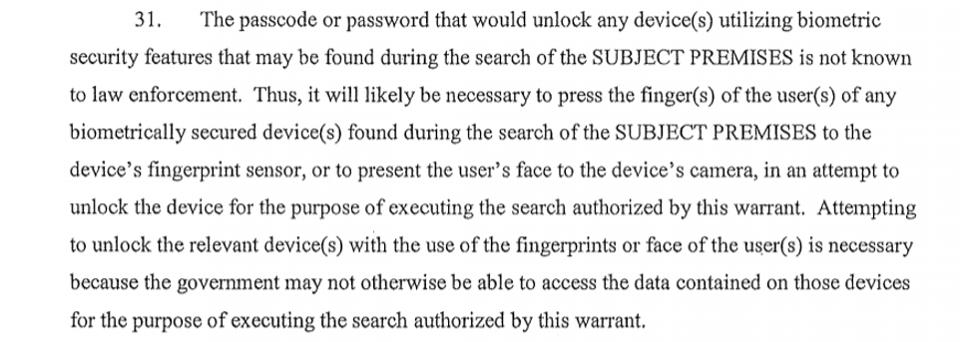
But Nolder said that the cops were now using boiler plate language in warrants to allow them to access iPhones via Face ID. "Law seems to be developing to permit this tactic," Nolder added.

warrants for face phone.jpg

Law behind the times

Thus far, there's been no challenge to the use of Face ID in this case or others. But Fred Jennings, a senior associate at Tor Ekeland Law, said they could come thanks to the Fifth Amendment, which promises to protect individuals from incriminating themselves in cases.

In previous rulings, suspects have been allowed to decline to hand over passcodes, because the forfeiture of such knowledge would amount to self-incrimination. But because the body hasn't been deemed a piece of knowledge, the same rulings haven't been applied to biometric information, like fingerprints or face scans. That's despite the fact that the use of passcodes, fingerprints and faces on an iPhone has the same effect in each case: unlocking the device.

Jennings thinks that as long as there's no specific legislation dealing with this apparent conflict, courts will continue to hear arguments over whether forced unlocks via facial recognition is a breach of the Fifth Amendment.

"The law is not well formed to provide the intuitive protections people think about when they're using a Face ID unlock," Jennings said. "People aren't typically thinking [when they use Face ID] that it's a physical act so I don't have this right against self-incrimination."

And with Apple's devices, it may be more difficult for defendants to argue their face is a piece of knowledge protected by the Fifth, than it is for fingers. "Arguably if law enforcement says use your finger to unlock, the knowledge of which finger [will unlock an iPhone] is still an item of knowledge being produced by the individual," Jennings explained. "Whereas with Face ID, by design it will only unlock with a very specific and obvious and body part."

Investigating the dead's iPhones

In the meantime, the technical tussle between cops and tech firms will only continue.

There are various ways in which the latest iPhones can stymie federal investigations, even if Apple didn't design features for that specific purpose. Beyond the passcode, thanks to a feature called SOS mode, it's possible to shut down Face ID and Touch ID with five quick clicks of the power button in older iPhones. In the iPhone 8 and X, the same is achieved by holding the side button and one of the volume buttons. And if the device hasn't been opened within 48 hours, a passcode is required to open it again.

"Additionally, a long and unique alphanumeric passcode will prevent any forensic imaging attempts from decrypting your phone's data," said Ryan Stortz, a security researcher at Trail of Bits. "However, SOS won't save you if the feds distract you and seize your phone out of your hand." 

Apple's Face ID also requires a person's eyes to be open. Not only that, Apple's tech has "liveness detection" that attempts to determine if the visage looking at the device is alive.

So, unlike Touch ID, Face ID doesn't work with the dead. According to one source in the forensics community who asked to remain anonymous, New York narcotics cops have even tried on multiple occasions to open iPhone X devices of heroin overdose victims but to no avail.

In such cases, hacking tools like the GrayKey offer the only possible way to dig up the dead's smartphone secrets.

Another Accused White Authoritarian Sheds Crocodile Tears Under Softball Questioning: As Chicago Cop’s Murder Trial Ends, Lawless Authorities & Businesses Brace for Injustice for Laquan McDonald

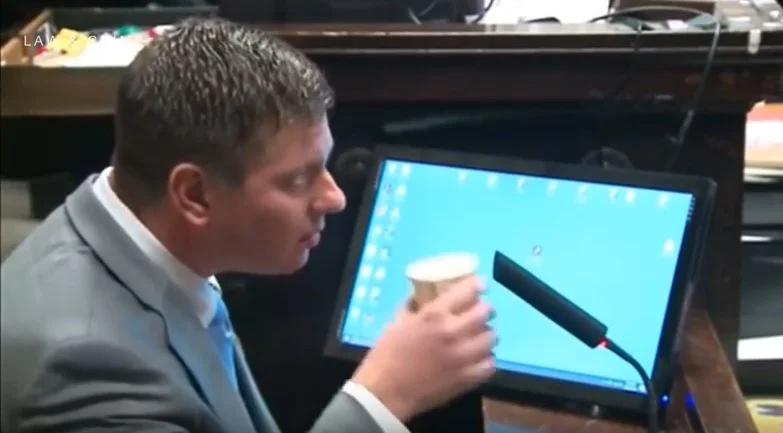
van dyke trial 23.jpg

[MORE] Van Dyke shot Black man 16 times as he walked away from him. In order to shoot him that many times he reloaded his gun and continued shooting him while he was on the ground. The prosecutor’s softball cross examination of Van Dyke did not take full advantage of the impeachment value of video and the contradictory statements he made when the incident was fresh in his mind. Although they have been preparing for months the Government seemed unprepared to cross examine Van Dyke. We will see if it was effective.

According to FUNKTIONARY

authoritarians - the great unweaned of the world 2) violentists. 3) 'reality-violaters.' 4) uniform (costume-wearing) and non-costume wearing purveyors of the absolute worst crimes against humanity. 5) the coercive class within an economic and social caste-based society. While the State is a military formation, it is first and foremost a fruit of justice—not to be confused with (or extrapolated to imply or mean that) justice is a seed of the State. There is a high correlation between justice systems and the development or proliferation of the State. (See: Justice, Control, BOG. Statists, Power. Psychopaths & Violence)
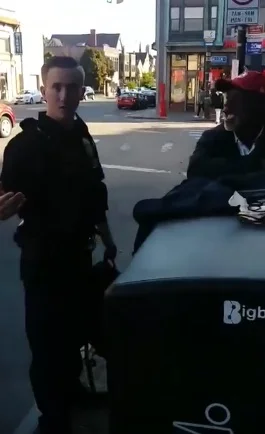
With Crime Low, Bored & Thin Skinned White Buffalo Cops Used their Discretion to Arrest a Homeless Black Man who Called Them Names but Changed Their Minds After White Passerby Intervened

Disturbing the Peace of the Masters in Public. Video from [HERE]. According to FBI data violent crime in the City of Buffalo decreased 11%.

Pursuant to their super powers to detain people and commit acts of violence against them, cops are given official discretion to arrest or not arrest persons who they perceive as violating a “law.” With regard to non-white persons such discretion is often abused or used arbitrarily and capriciously. Such discretion originates from the executive and from his “right to rule” us on our behalf and for our own good, his agents, cops, are empowered to act.

Here, the cops apparently claim the unnamed homeless Black Man allegedly violated NY PEN Law 240.20 Disorderly conduct when he called them obscene names. However, a violation requires an “intent” to cause a breach of the peace to the “public” or inconvenience, annoyance or alarm, or recklessly created risk to the “public.” Does “public” mean persons other than cops? Was the public affected? Did he intend to affect the public? Right or wrong did the cops stop their arrest because the white passerby made good arguments or for another reason? Can white people have disagreements about the best ways to practice racism? Can a subject ever have an arms length conversation with a ruler? Believe in your "rights" at your own risk.

§ 240.20 Disorderly conduct.
    A  person  is  guilty of disorderly conduct when, with intent to cause public inconvenience, annoyance or alarm, or recklessly creating a  risk thereof:
    1.  He  engages  in  fighting or in violent, tumultuous or threatening behavior; or
    2. He makes unreasonable noise; or
    3. In a public place, he uses abusive or obscene language, or makes an obscene gesture; or
    4. Without lawful  authority,  he  disturbs  any  lawful  assembly  or meeting of persons; or
    5. He obstructs vehicular or pedestrian traffic; or
    6.  He congregates with other persons in a public place and refuses to comply with a lawful order of the police to disperse; or
    7. He creates a hazardous or physically offensive condition by any act which serves no legitimate purpose.
    Disorderly conduct is a violation.
buffalo cops .jpg

His “Service" & “Protection" are Unwanted but Community May be Powerless to Stop Re-Hiring of White Cop who Dragged Handcuffed Native American Man & Rammed His Head into Steel Door

DULUTH COP .jpg

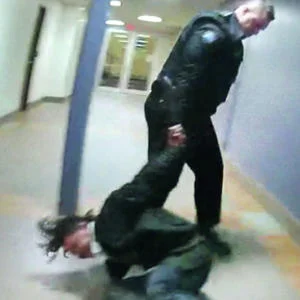
From [HERE] The city is asking a judge to vacate an arbitrator's decision to reinstate a police officer to his position after he was fired for dragging a handcuffed man through a hallway and ramming his head into a steel door.

Officer Adam Huot, a nine-year veteran with a history of excessive-force complaints, was terminated by the Duluth Police Department in wake of the May 2017 incident in which he was captured on video pulling an intoxicated man approximately 100 feet through the downtown skywalk system.

The Duluth Police Union later filed a grievance, acknowledging that Huot's actions "were inappropriate and reflected poorly on all police officers," but contending that the incident did not warrant termination.

Arbitrator Mario Bognanno agreed in June, giving Huot his job back, without the benefit of back pay for the year he was on unpaid leave. While calling the officer's actions "unreasonable" and noting his history of disciplinary action, the arbitrator said the department failed to show "just cause" for termination.

The issue came before Judge Eric Hylden on Monday, Sept. 1, with Police Chief Mike Tusken and several union officials in attendance at the St. Louis County Courthouse.

Susan Hansen, a Twin Cities attorney retained by the city, told the judge that Huot has "demonstrated a proclivity" to violate the social contract between police and the community and "undermined the mission of the DPD and his performance as a police officer for the DPD."

"Returning Adam Huot to his position violates the public's trust and subjects them to unreasonable use of force, unreported police misconduct and abuse of authority by those sworn to protect and serve them," Hansen argued.

The city is asking the court to take the rare step of overturning a binding arbitration decision. State law requires collective bargaining agreements between public employers and unions to contain a provision for disciplinary disputes to be resolved through binding arbitration — as was the case in Huot's grievance.

James Michels, a Minneapolis attorney representing the union, told Hylden that should have settled the case once and for all. He called his opposing counsel's argument "impassioned but totally wrong."

"This matter is now before the court simply because the city seeks to repudiate an arbitration decision it does not like," Michels wrote in a memorandum ahead of Monday's hearing.

According to arbitration and court documents, Huot was the subject of 12 complaints during his tenure, six of which were substantiated. Tusken testified that no other officer in his 155-member department necessitated as much oversight, coaching, training and discipline as Huot.

Huot in 2014 received a one-day suspension after repeatedly punching a man who had escaped from a mental health unit. Among other incidents, he was also disciplined for a "confrontational" response to a call involving four of five youths, in which he ended up wrestling one boy to the ground.

In the May 2017 skywalk incident, Huot was one of three officers called to remove two men from the building. Body camera footage shows one man, 30-year-old Brandon Houle, dropping to the ground and telling officers, "I ain't gonna make it easy for you guys."

Within seconds, without consulting his fellow officers, Huot is seen grabbing Houle by the chain on his handcuffs and forcibly dragging him down the hallway. Houle's head narrowly misses one post before striking the door with a loud thud. Houle, who is Native American and was homeless at the time, suffered a bump on the head but was not otherwise injured.

The video does not show Huot checking on Houle or inquiring about his condition. He also did not report the use-of-force incident to his supervisors. His fellow officers, who said they were left "shocked" by Huot's actions, did so later in the same shift.

In appealing Bognanno's decision, the city is relying on a "public policy exception" established by Minnesota courts. A court may set aside an award "only if the labor agreement contains terms which violate public policy, or the arbitration award creates an explicit conflict with other laws and legal precedents."

Hansen contended the city has met that burden. Noting that Bognanno even expressed concern in his decision about Huot's inability to control his "penchant for misusing vocal and physical force," she said the officer would pose a risk to the public if placed back on the streets.

"Here, there is an indisputable public policy against police officers using excessive force and in favor of transparency and property reporting by police officers," Hansen wrote. "The city of Duluth has an affirmative duty to implement and enforce these public policies."

But Michels said concerns about Huot's future actions as an officer are purely speculative and noted that the arbitrator felt that he was entitled to another opportunity. Further, Michels said a ruling vacating the decision would have a "chilling effect" on public sector laws by circumventing the established collective bargaining process.

"It would create carte blanche for employers to impose discipline against police officers without concern as to an arbitrator's interpretation of 'just cause' since it is difficult to conceive of a situation in which an employer could not subsequently claim to a reviewing court that the employee's conduct calls into question his or her ability to 'self-regulate,' " Michels wrote.

A case with similar legal questions is set to go before the Minnesota Supreme Court next week. The Minnesota Court of Appeals in April sided with the city of Richfield in its decision to fire an officer who was caught on video striking a Somali teenager over the head. The appeals court said a district judge erred in failing to vacate an arbitrator's decision ordering the city to rehire the officer.

Hylden took Huot's case under advisement on Monday, saying he did not plan to wait for the Supreme Court's decision in the Richfield case. The judge, however, acknowledged that any new precedent established by the high court in the coming months could create renewed issues in Huot's case.

Lex-icon Exposed in the Face of Undeniable Conflicts of Interest & a Refusal to Recuse: Given his blatant partisanship & animosity toward liberals, how could Kavanaugh be an Unbiased Justice?

Lex-icon: law as image - the appearance of justice (the form) over the substance of justice via truth and law over humanity. from FUNKTIONARY. “In addition to legal and procedural questions surrounding possible impeachment proceedings, there are a s…

Lex-icon: law as image - the appearance of justice (the form) over the substance of justice via truth and law over humanity. from FUNKTIONARY. “In addition to legal and procedural questions surrounding possible impeachment proceedings, there are a staggering array of issues with which the nominee may well be presented owing to the historically unprecedented fact that Kavanaugh’s patron the president was a named subject and, but for hesitation to indict a sitting president, could well have been a target,[2] in a criminal investigation at the very time that he handpicked the judge—reportedly after White House consideration of the judge’s views on some of these very issues.” [MORE]

By Laurence H. Tribe From [HERE] Much might be said about Judge Brett Kavanaugh’s possible confirmation to the Supreme Court: in terms of his still only partly disclosed professional record, the allegations of sexual assault and his candor, or lack of it, in testifying before the Senate Judiciary Committee.

But apart from all that — and apart from whatever the reopened F.B.I. investigation might reveal — the judge himself has unwittingly provided the most compelling argument against his elevation to that court.

His intemperate personal attacks on members of the Senate Judiciary Committee and his partisan tirades against what he derided as a conspiracy of liberal political enemies guilty of a “calculated and orchestrated political hit” do more than simply display a strikingly injudicious temperament. They disqualify him from participating in a wide range of the cases that may come before the Supreme Court: cases involving individuals or groups that Judge Kavanaugh has now singled out, under oath and in front of the entire nation, as implacable adversaries.

Well before last week’s hearing, public officials and scholars of legal ethics were already debating whether a Justice Kavanaugh, with his unusually expansive views of presidential power, would be required to recuse himself from cases involving the legal fate of the president who nominated him.

This is not an abstract concern: I was a co-author of a Brookings Institution report concluding that conflicts of interest, and the appearance of such conflicts, would be pervasive in cases arising from the special counsel’s inquiry into Russian meddling in the 2016 elections.

The Supreme Court may have to consider questions about whether a sitting president can be indicted or subpoenaed, and what effect pardoning a federal offense would have on state charges for the same conduct — an issue bound up in Gamble v. United States, a double jeopardy case already on the court’s calendar. Many have argued that Judge Kavanaugh should not be confirmed unless he commits in advance to recusing himself from such cases. He has predictably refused to do so.

The accusations made by Christine Blasey Ford raise another order of concern. Some might argue that the unresolved cloud over his past would require a Justice Kavanaugh to recuse himself from any case involving sexual assault or harassment. That might well be, but I have in mind something more sweeping and fundamental.

To be sure, the rules of recusal that bind lower federal court judges do not technically apply to Supreme Court justices — at least according to the self-interested interpretation of the justices themselves. But those rules are not the only source of legal principles requiring all judges, of whatever court, to step aside when the institutional integrity of the judicial process is incompatible with their participation.

Apart from formally promulgated codes of judicial conduct, the Supreme Court has recognized that those whom our legal system entrusts to resolve controversies among litigants have a constitutional duty to step aside whenever a conflict of interest — or the public appearance of such a conflict — is so powerful as to erode public trust in the fair and impartial administration of justice.

In Caperton v. Massey Coal, the court held that a judge politically beholden to one of the litigants must recuse himself, and in Williams-Yulee v. Florida Bar, it held that the need to preserve judicial impartiality trumps the rights of judicial candidates to solicit campaign contributions.

Judge Kavanaugh’s attacks on identifiable groups — Democrats, liberals, “outside left-wing opposition groups” and those angry “about President Trump and the 2016 election” or seeking “revenge on behalf of the Clintons” — render it inconceivable that he could “administer justice without respect to persons,” as a Supreme Court justice must swear to do, when groups like Planned Parenthood, the NRDC Action Fund, the NAACP Legal Defense Fund, Naral Pro-Choice America or the American Civil Liberties Union appear as parties or file briefs on behalf of plaintiffs and defendants.

For a Justice Kavanaugh to participate in internal court discussion or oral argument of such cases, much less vote on their resolution, would involve not just an undeniable appearance of conflict but an actual conflict, given his stated animosities and observation that “what goes around comes around.”

My decades of observing the court’s work and arguing cases there convince me that his required recusal would extend to a very broad slice of the Supreme Court’s docket during his lifetime tenure as a justice. That would leave the court evenly split in far too many cases, for years on end, if he were to recuse himself as required — or deeply damaged in the public’s trust if he were not.

It is up to the president and the Senate to decide whether this situation makes him unacceptable as a nominee. But should he be confirmed, it is impossible to see how Judge Kavanaugh could discharge his responsibilities as an associate justice of the Supreme Court.

Laurence H. Tribe (@tribelaw) is a professor of constitutional law at Harvard Law School and the co-author, most recently, of “To End a Presidency: The Power of Impeachment.”

Sinclair's recent “must-run segments" were a series of Moronic Trump interview [monologue] excerpts about how great he is doing & how unfairly he’s treated

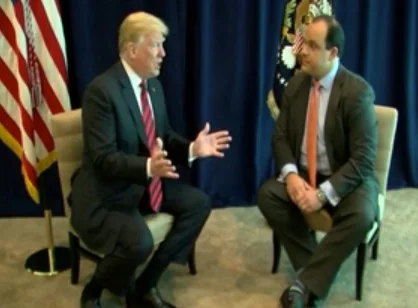
From [HERE] In perhaps the most egregious example yet of the pro-Trump alternate reality Sinclair Broadcast Group presents to its viewers, six “must-run” commentary segments the media company has created since September 21 have all been excerpts of a softball interview of President Donald Trump conducted by a former Trump aide.

Amid last week’s overwhelming news, including Professor Christine Blasey Ford’s powerful testimony before the Senate Judiciary Committee (and Supreme Court nominee Brett Kavanaugh’s blatantly false testimony the same day), Sinclair subjected its local news viewers to a total of six separate “must-run” segments consisting of excerpts from a Trump interview.

The overwhelming themes of the segments boiled down to: The Trump administration is doing great things, and the left and the liberal media aren’t being fair to Trump. The interviewer, Boris Epshteyn -- a former Trump aide, apparent personal friend of Eric Trump and Donald Trump Jr., and Sinclair’s chief political analyst -- mostly nodded along or added details in an attempt to back up Trump’s bonkers statements.

Segment 5 [above]: Trump unintelligibly rants about his relationships with North Korea and Iran, while Epshteyn nods along

In the fifth segment, released on September 27, Trump incoherently discussed relations with North Korea, frequently interrupted by Epshteyn signaling his agreement with everything the president says even though it makes no sense. The one substantive thing Epshteyn said in the entire excerpt was to offer an additional point that backs up Trump’s claim that, with North Korea, “We’re doing a lot of speed. So it’s really coming along well.”

Segment 6 [above]: Trump says he is “treated less fairly than anybody who's probably ever lived” by the media, Epshteyn agrees

Epshteyn finished off the series of interview must-runs on September 28 with an excerpt that sounded like it was ripped straight from a Trump rally: an almost entirely uninterrupted rant from Trump about how he is “treated less fairly than anybody who’s probably ever lived” by the overwhelming “fake news media.”

Just watch this, then imagine flipping channels as you make dinner and landing on your local news and this is what’s playing. See the other “must run segments” here.

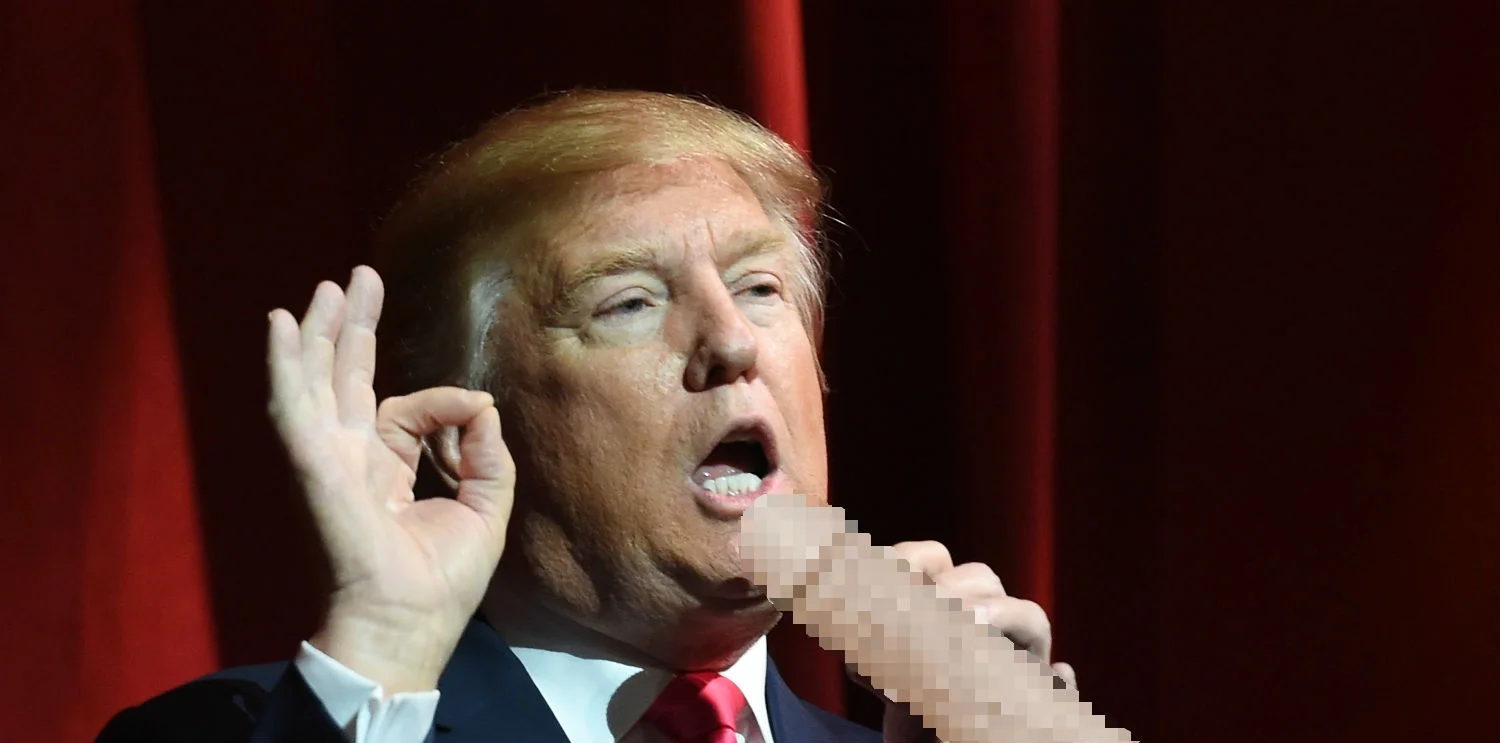
Trump with a dick.jpg

So to recap, Epshteyn secured an interview with a leader of the free world, with excerpts airing on local news stations all over the country. With this opportunity, here is a list of every question or statement Epshteyn uttered throughout the six interview excerpts. They are presented in chronological order:

  • Right.

  • Do you think he will get confirmed in the end?

  • A couple issues on the home front. Let's talk about the declassification of documents. Earlier this week you said you were going to declassify. Now you're saying that you want the inspector general of the Department of Justice to review the documents first. What happened? What's the motivation?

  • Don’t declassify?

  • It’s true.

  • OK. Do you think that in the end the American people should have an eye, have a view into these documents?

  • You mentioned NAFTA. Mexico has already agreed to renegotiate a deal -- something that most people said you couldn't get done. You got that done. Now it's up to Canada. Do you think that Canada, with Justin Trudeau as their leader, will capitulate and join the new deal?

  • Right.

  • Sure.

  • Right

  • Horrible.

  • Right.

  • Mm-hm.

  • Right.

  • Right.

  • Sir, it’s almost been two years. The economy is roaring. The stock market is way up. Unemployment, way down. GDP growth -- it's much better than anybody expected. What do you think can be done to make sure it's long-term sustainable economic growth?

  • Right.

  • The new normal, right?

  • Mm-hm.

  • Highest wage growth since the start of the recession, in fact.

  • No doubt.

  • Right.

  • Kim Jong Un just actually said to Moon Jae-in, the South Korean president, that he's very thankful for the summit and thinks it's the relationship has stabilized in the Korean Peninsula because of your efforts.

  • Mm-hm.

  • Right.

  • Right.

  • The remains.

  • Right.

  • Sure.

  • But the people see through it. Don’t you think? [MORE]

trump sinclair mind control.jpg

Neuropeon Sheople who Want to Be Deceived, Dominated & Feel Necessary to Trump's Domination Discuss Their Jesusized Beliefs or Mental Imprisonment on Video

dummy trump .jpg

According to "FUNKTIONARY, THE KEY HOLDERS ENPSYCHLOPEDIA

Sheople - economic prey. 2) those who are both sheep and asleep. 3) people who mindlessly let others do their thinking for them. 4) people who are not in control of what they allow themselves to come to believe in. 5) people who have not taken personal responsibility to question their belief, faith, the content of truth, the nature of subjective reality. 6) those who watch major misinformation and propaganda television networks presumably for news that is factual. Sheople blindly follow a path where reality is excluded from the process. Are you the shepherd, or the flock? Are you the prisoner, or are you the lock? Sheople line up to get fleeced at the Baa Baa Shop. Scientific studies have found that it takes a minority of just 5 per cent of what they called "informed individuals" to influence the direction of a crowd of a minimum of 200 people. The remaining herd of 95 per cent follow without even realizing it. The coziness of millions of others just like you give you a false sense of safety, but there is no life worth living where reality isn't the glue. Sheople are those whose eyes the shepherd has pulled the wool over. Will the sheople ever wake up and see the light? Na aa aa (See: Internal Revenue Service, Authority, Regalia, Obedience, Judicial Victimization, Mind Viruses, Jury, Psychological Reversal, Memes, Shephard, Eugenics, Danger, Intellectual Incest, Faith Paradox, Belief, Predictive Programming, Conditioning, Fear, Gun Control & Predatory Economics)

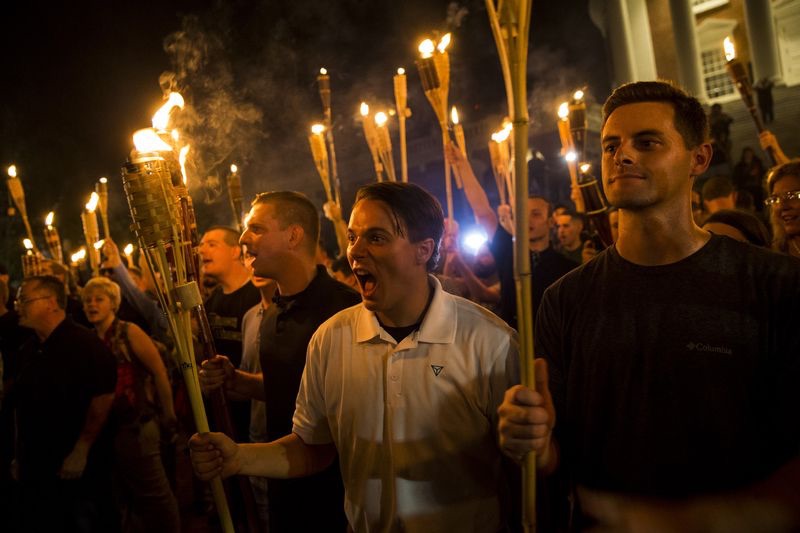
Neuropeons - neurotic, stupid and self deluded poor white trash. 2) skin heads 3) Nazis, neo-Nazis and Theo-nazis (See KKK, WOTAN, Weitko Disease, Fasxism, Racism White Supremacy, Stupidity, Ku Klux Klan & Yurungu). [MORE

Racist suspect - any white person who is capable of practicing racism against non-whites. In general, if a Caucasian is able to be a Racist (White Supremacist), he or she may be one and should be presumed to be racist. According to Neely Fuller, as long as white supremacy exists, every person classified as 'white' should be suspected of being Racist (White Supremacist). Since all whites are able to practice racism in a white supremacy system if they choose to do so, it is correct (and logical) to use the term "racist suspects" to identify whites who do not openly function as white supremacists (racists). [MORE]

Jesusize - to believe in something (or someone—real, mythologized or imagined) or even worship it, based on little (scant and sketchy) to no evidence in support of it (single-source propaganda), and uncorroborated accounts that fly in the face of knows history, facts and science. 2) to turn fiction or fictional accounts into fact and history through propaganda, indoctrination coercion and violence. [MORE

trumple uncle satan .jpg

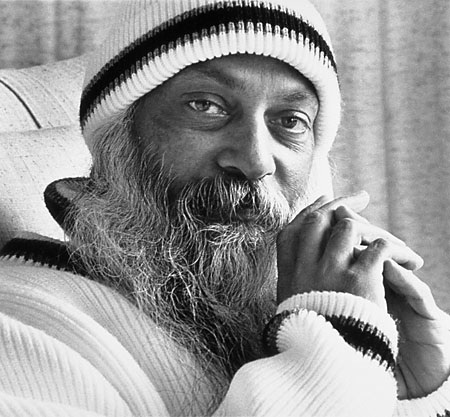
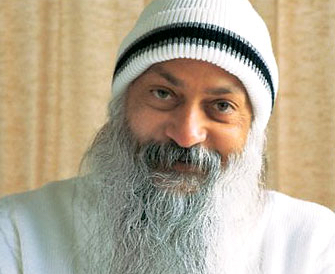
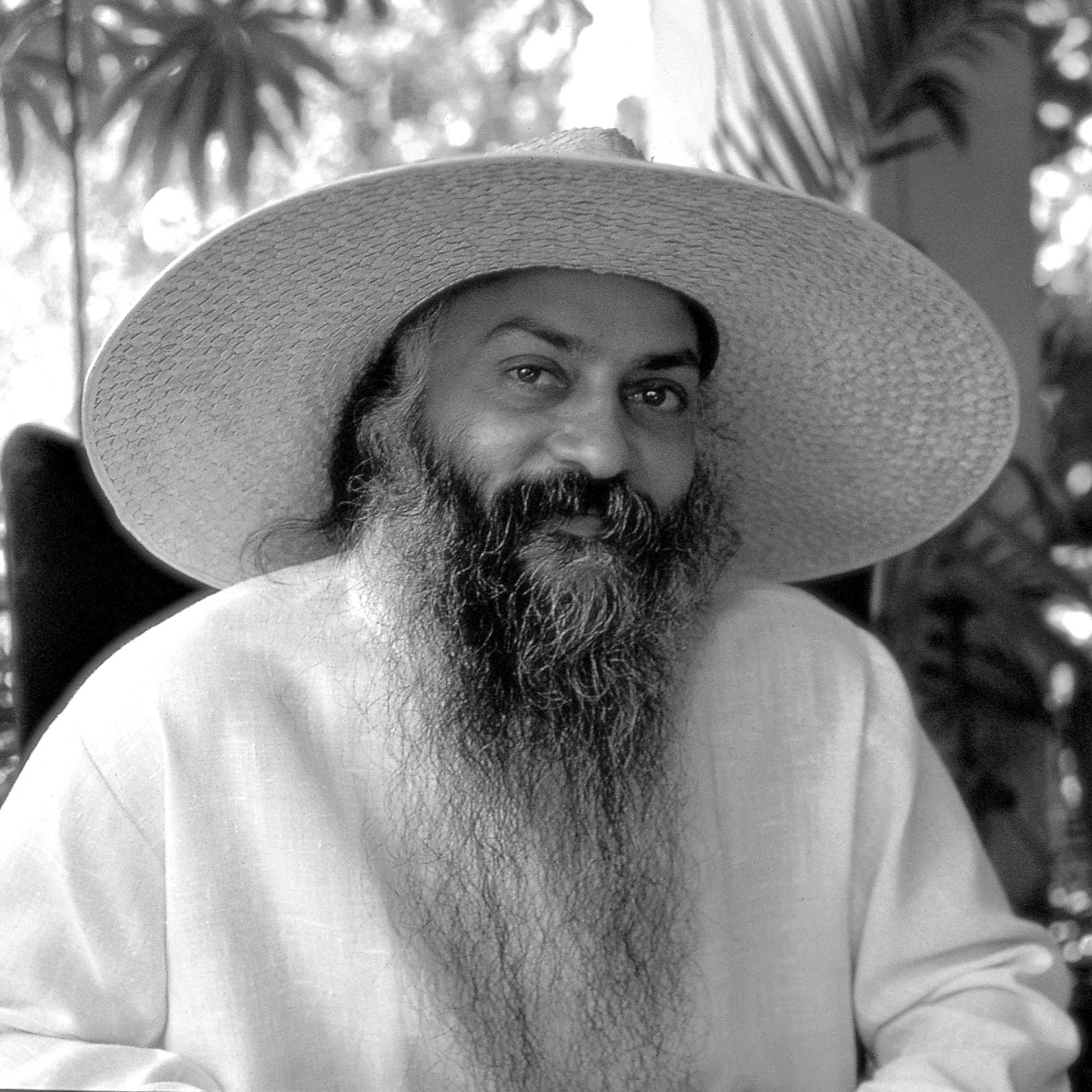
OSHO said,

“Whatsoever you believe, you project. Belief is a projection. It is just like a projector in a movie film-house: you see something on the screen which is not there. The projector is hidden behind, but you never look at the projector, you look at the screen. The projector is at the back, and the whole game is going on there, but you look at the screen. The whole game is going on in your mind, and a mind filled with belief always goes on projecting things in the world, it sees things which are not there. This is the problem. The mind which believes is always vulnerable and always provides an opportunity to be exploited by the cheaters - and the cheaters are all around. The whole path is filled with robbers, because no map exists.

Moving into religion is moving into the uncharted, into the unmapped. Robbers can flourish there very easily, they can wait for you - and they are waiting. And sometimes, even if the person is not deceiving you, you want to be deceived. Then you will be deceived. Nobody can deceive you if, deep down, you are not ready to be deceived.

Just a few days before, a man came to me and he said: A baba has deceived me, and he is a great yogi. I asked him: And what has he done? He said: He can make gold out of any metal. He has shown me and I have seen it happening with my own eyes. Then he said that I should bring all my gold and he would make it tenfold. So I collected all my ornaments and he has simply escaped with them. He has deceived me.

Everybody will think that he had deceived him, but I told this man: It is your greed that has deceived you. Don't throw the responsibility onto anybody else. You are simply foolish. Greed is foolish. You wanted your ornaments to be made tenfold. That mind has deceived you; the other person has simply used the opportunity. He is just a clever person, that's all. You are the real problem. If he had not deceived you, somebody else would have.

So who deceives it not the question. It has been my observation that if somebody deceives you, it shows a certain proneness in you to be deceived. And if somebody can lie to you, it means you have a certain affinity with lies. A man of truth cannot be deceived. A man who lives in truth cannot become a victim of liars. Only a liar can be deceived by another liar; otherwise there is no possibility. There are millions of people who are ready to be deceived, who are simply waiting for someone to come and deceive them - because of their beliefs, because of their vicious desires, because of their greed. And remember well that greed is greed, whether it exists in the material world or in the spiritual makes no difference. The quality of it remains the same. You would like somebody to increase your gold tenfold - this is greed. Then somebody says, "I will make you an enlightened person", and you fall in line immediately. That too is greed.

And I tell you: It is possible to increase gold tenfold very easily, but it is almost impossible to make any other person enlightened. Because that is no game. The path is arduous. In fact nobody ever makes you enlightened - you yourself become enlightened; the other may be a catalytic agent at the most, nothing more. But in fact everything happens within you; the other's presence may have helped, that's all. And if you are really sincere, even that is not needed. If you are sincere, those who can help will seek you, if you are insincere, you will seek those who can harm. That is the difference. When a disciple seeks a master, there is almost always going to be something wrong. When a master seeks a disciple, only then something authentic is going to happen.” [MORE]

Paterson Race Soldiers Caught on Video Assaulting Deaf Black Man

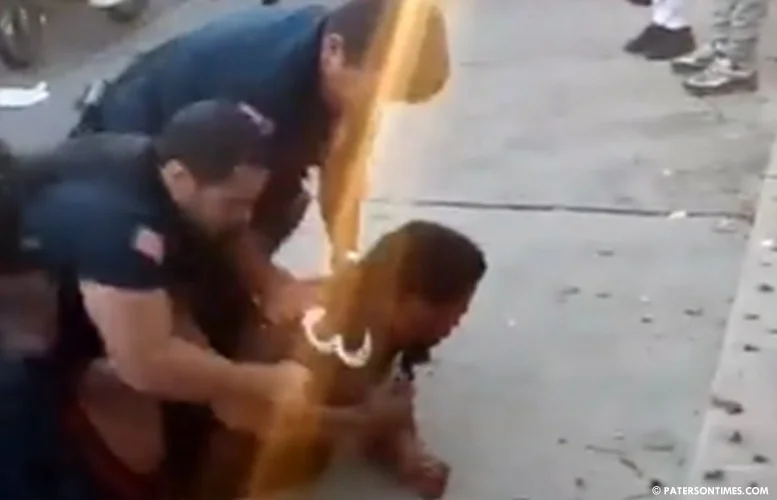
From [HERE] A white city police officer is seen striking a Black suspect in the back of his head while struggling to handcuff him in a video that circulated on social media over the weekend.

Raaseon Adams, 42, of Paterson, is the man being punched at least three times by an unidentified police officer, who, along with two other officers, is attempting to handcuff the resisting suspect, on the sidewalk of Godwin Avenue between Carroll Street and Rosa Parks Boulevard, according to police and family members.

“Why was he beaten up?” asked activist Bilal Hakeem on Saturday. “My nephew is deaf and mute.”

A dozen onlookers gathered around the scene. After the officer struck Adams several times, the crowd began to react. Some taunted the officers and one person hurled an object at them.

Rucker said Adams suffered a seizure soon after he was put into handcuffs.

Adams was caught up in a police drug bust in the area, according to municipal officials. [MORE]

paterson-cop-striking-suspect.jpg

With a Mission "to Defeat Hate," NAACP Urges "Associated Confused People" to Vote for More Friendly Masters in Upcoming Elections [in “Advancement" of an Agreed Upon illusion]

defeat naacp .jpg

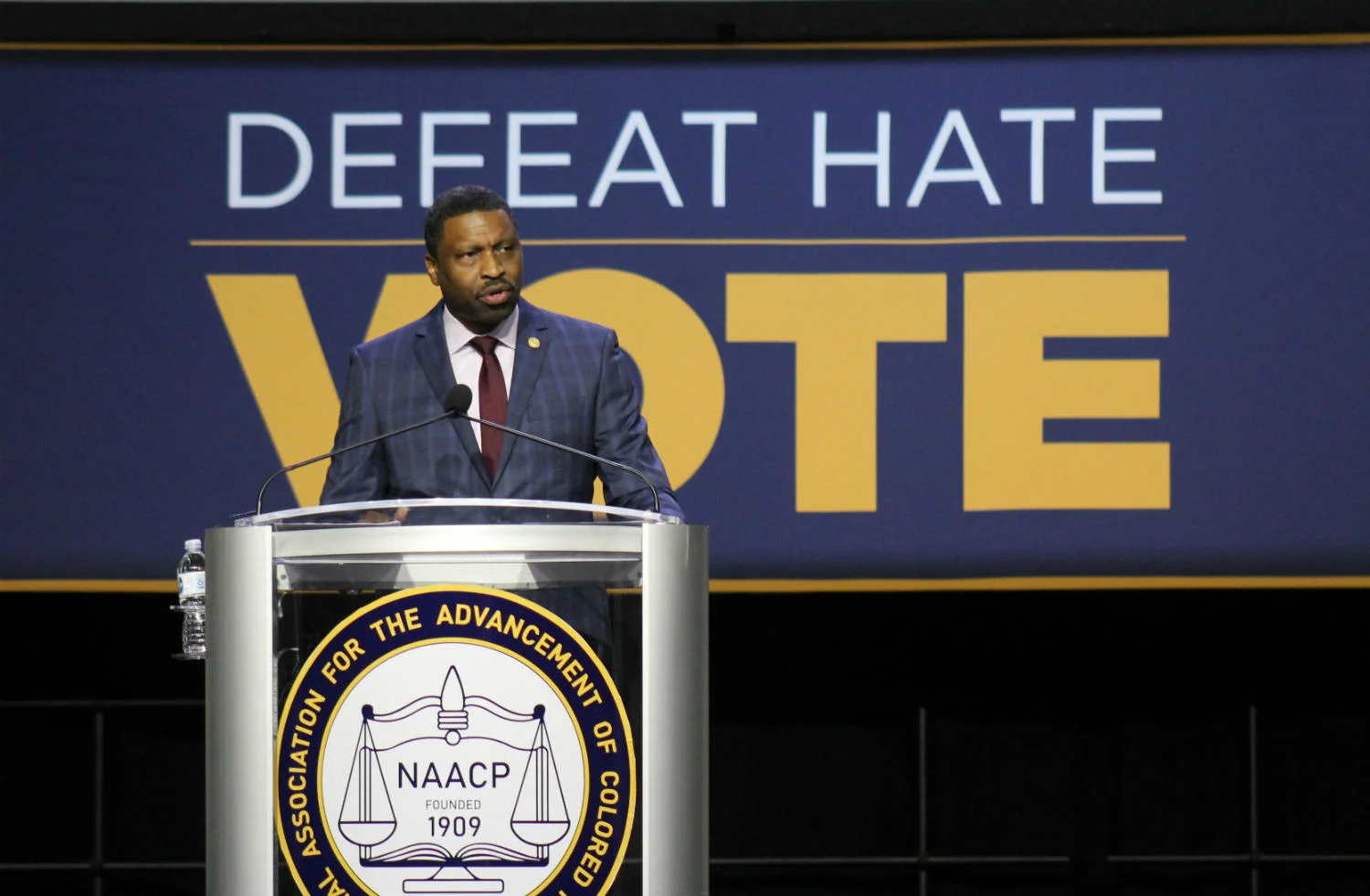
From [HERE] When Derrick Johnson, national president and CEO of the National Association for the Advancement of Colored People said he sees a mission that is as relevant today as it was 100 years ago, and maybe more so given the divisive political climate.

“We’ve seen a rise in racial hate crimes and intolerance since the 2016 elections,” Johnson said before the start of the MetroCom NAACP Unit 4019, Davenport’s annual Freedom Fund Black & White Ball held Saturday at the Rogalski Center at St. Ambrose University, Davenport.

This year’s theme for the NAACP throughout the country is Defeat Hate-Vote.

“A big part of that is because not enough people are participating to ensure their voices are heard,” Johnson said. “Our goal as the NAACP is to change the political landscape to ensure that the elderly are cared for, our young people are prepared and those who are disadvantaged are protected.”

The NAACP itself is 109-years-old, he said. “It was founded by African-Americans, whites, men and women. We recognize that if you discriminate against one community it’s discrimination against all communities. It undermines and subverts democracy as a whole.”

That’s why it is so important to vote, he said.

“Voting is the currency of our democracy,” Johnson said. “Voting is essential to being heard. We must vote in order to be heard.

“I think in this political landscape a lot people, not just minorities, are feeling left out and ignored,” he said. “They don’t feel a part of developing a country that reflects their needs and interests.

“It is the role of the NAACP to be a vehicle to ensure that all people have their voices heard,” he said.

It is imperative, Johnson said, that people vote to ensure that they put into office individuals who will represent the needs of the community. [MORE]

booker gilebrand sanders.jpg

CHOOSING NEW MASTERS IS NOT FREEDOM. Like most Black people the NAACP is engaged in an other directed struggle that will never solve any of Black people’s problems. 'Other directed' here refers to what Amos Wilson described as,

"black consciousness and behavior under the various regimes of White domination characterized by habitual thought patterns and behavioral tendencies which render them pliable to White authoritarian/authoritative social control with minimal resistance; which induce Blacks to accept their subordinate status as natural, perhaps actually to misperceive their oppression as freedom." 

Such a created mind or falsified consciousness in a system of white supremacy "requires that Blacks involuntarily and obsessively deceive themselves. This collective self-deception, which is the benchmark of oppressed Black consciousness, is the main product of White-Black social power relations, motivated by anxiety and ignorance, founded on the denial and distortion of reality. Such a consciousness and its produced behaviors require that Blacks operate against their own best interests in the interests of their White oppressors; that they be self-denying, self-defeating, and oftentimes self-destroying, while convincing themselves that the opposite is true.' [MORE]

An example of self deception from false programming are beliefs in the concept of government in a democracy in which they participate through open, fair elections where their leaders are chosen. This is nonsense.

In photo Congressman Greg Meeks (D-N.Y.). Among other things this puppetician supported THE “Protecting Consumers' Access to Credit Act of 2017.” The legislation allows payday lenders to ignore state interest rate caps on consumer loans TO RIP OFF B…

In photo Congressman Greg Meeks (D-N.Y.). Among other things this puppetician supported THE “Protecting Consumers' Access to Credit Act of 2017.” The legislation allows payday lenders to ignore state interest rate caps on consumer loans TO RIP OFF BLACK PEOPLE as long as they partnered with a national bank. [MORE] he also voted to Make Assault on a Police Officer a Federal Hate Crime. [MORE]

First of all do puppeticians really “represent” you? The claim is that the people, by electing certain individuals into positions of power, are “choosing their leaders” and that those in office are merely representing the will of the people. During every election friendly white puppeticians and bourgeoisie negros from The MoTeaSuh Tribe try to convince the Black votary that they share the same interests and that by voting for them they are in fact helping themselves also. Although racism white supremacy causes more problems than a math book for Black people, the notion of neutralizing white supremacy or economic emancipation and empowerment is never on the agenda.

Amos Wilson explains, 'politicians and the media strive strenuously to convince the Black votary that every conceivable problem which confronts it can be resolved through voting heavily for Black and friendly White politicians. The establishment is ever quick to remind the Black electorate of the historical struggles necessary to achieve their right to vote. It indicts the community for any perceived electoral apathy and seeks to evoke guilt feelings in those who do not participate in the electoral process — making such ritualistic participation emblematic of democracy and first-class citizenship.

This is of special interest when it is realized that very few of the major political, economic and social goals achieved by Black America, including the Voting Rights Act, were accomplished through Black voting prowessThe ballot box has been a relatively impotent weapon in the achievement of major victories by the Black community. Suddenly vigorous protest and direct-action legal suits and extralegal processes such as boycotts, sit-ins, and the like, which were used so effectively by the community to achieve its socio political ends and to fight injustice and oppression, have fallen far behind the election of Black and friendly White politicians to achieve the same ends. [MORE]. In reality so-called “representative governments” are constantly doing things their subjects do not want them to do. Larken Rose explains,

“Even in theory, the concept of “representative government” is inherently flawed, because “government” cannot possibly represent the people as a whole unless everyone wants exactly the same thing. Because different people want “government” to do different things, “government” will always be going against the will of at least some of the people. Larken Rose explains, Even if a “government” did exactly what a majority of its subjects wanted (which never actually happens), it would not be serving the people as a whole; it would be forcibly victimizing smaller groups on behalf of larger groups.

Furthermore, one who represents someone else cannot have more rights than the one he represents. To wit, if one person has no right to break into his neighbor’s house and steal his valuables, then he also has no right to designate a representative to do that for him, To represent someone is to act on his behalf, and a true representative can only do what the person he represents has the right to do. But in the case of “government,” the people whom the politicians claim to represent have no right to do anything that politicians do: impose “taxes,” enact “laws,” etc. Average citizens have no right to forcibly control the choices of their neighbors, tell them how to live their lives, and punish them if they disobey, So when a “government” does such things, it is not representing anyone or anything but itself.

Interestingly, even those who talk about “representative government” refuse to accept any personal responsibility for actions taken by those for whom they voted. If their candidate of choice enacts a harmful “law,” or raises “taxes,” or wages war, the voters never feel the same guilt or shame they would feel if they themselves had personally done such things, or had hired or instructed someone else to do such things. This fact demonstrates that even the most enthusiastic voters do not actually believe the rhetoric about “representative government,” and do not view politicians as their representatives. The terminology does not match reality, and the only purpose of the rhetoric is to obfuscate the fact that the relationship between every “government” and its subjects is the same as the relationship between a master and a slave. One master may whip his slaves less severely than another; one master may allow his slaves to keep more of what they produce; one master may take better care of his slaves – but none of that changes the basic, underlying nature of the master-slave relationship. The one with the right to rule is the master; the one with the obligation to obey is the slave. And that is true even when people choose to describe the situation using inaccurate rhetoric and deceptive euphemisms, such as “representative government,” “consent of the governed,” and “will of the people.”

The notion of “a government of the people, by the people, and for the people,” while it makes nice feel-good political rhetoric, is a logical impossibility. A ruling class cannot serve or represent those it rules any more than a slave owner can serve or represent his slaves. The only way he could do so is by ceasing to be a slave owner, by freeing his slaves. Likewise, the only way a ruling class could become a servant of the people is by ceasing to be a ruling class, by relinquishing all of its power. “Government” cannot serve the people unless it ceases to be “government.” [MORE]

Funktionary.jpg


Dr. Blynd explains in FUNKTIONARY

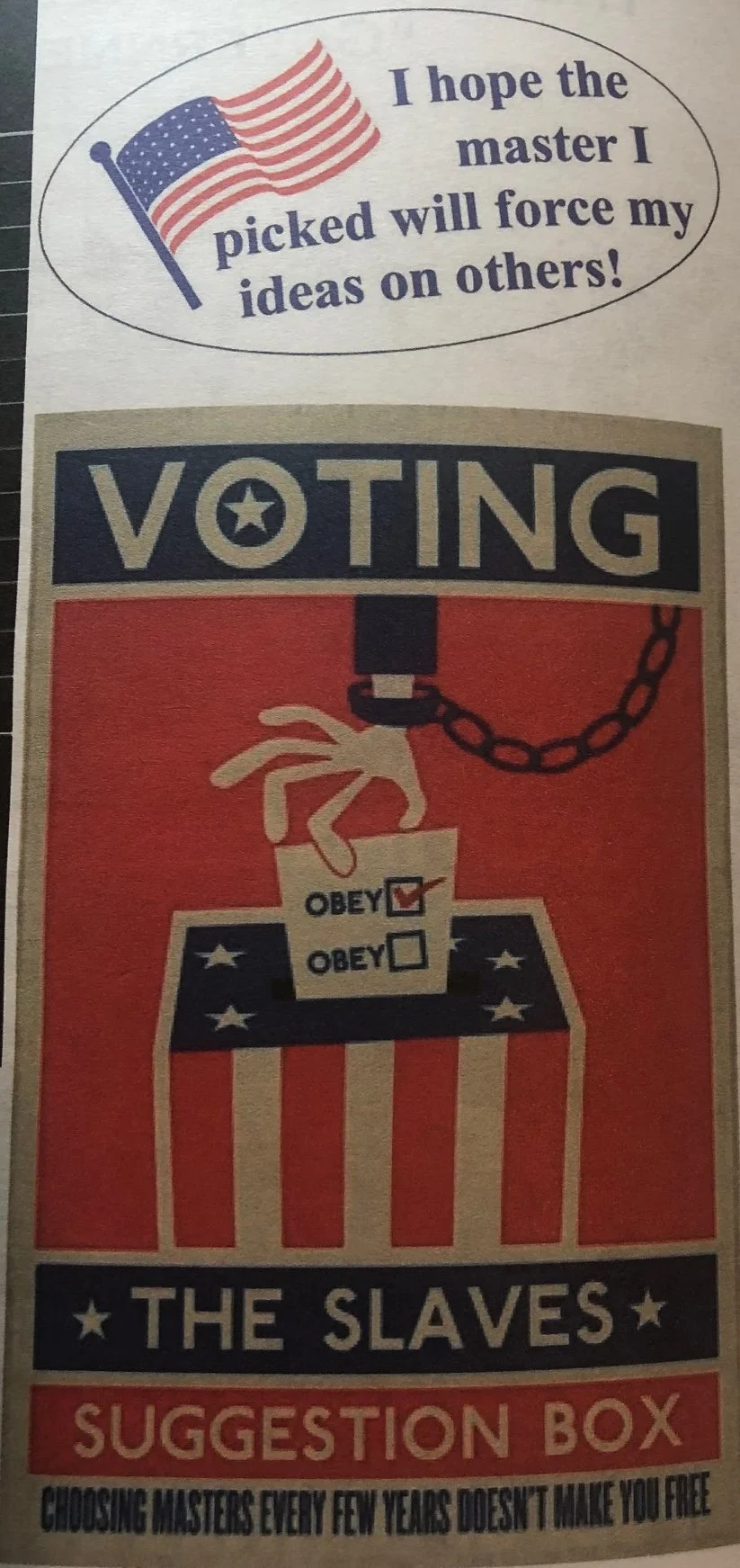
voting - a pacification (sucker) process which allows the votary to make choices provided to her/him, not decisions. 2) a "privilege" of U.S. citizens to do it behind a curtain—as long as they do it alone. 3) political masturbation exercises for those who can't cop real power. 4) a habitually accepted imposition that gives the votary-vassal-suckers an illusion of inclusion or participation. 5) an act of self-abuse. People mistake their voting for their voice—as the voice of the people is seldom, if ever, their own. While some died fighting for the privilege (not right) to vote or not to vote, they were restricted and therefore had no choice in the matter. If voting was a right, no one would ever have had to lose his or her life in a struggle to exercise that right. The Voting Rights Act of 1964 demonstrates that voting is a civic privilege (franchise) bestowed upon a people instead of the act of voting being an inherent right where exercise of the option to vote is one's own decision without an attached obligation (compulsion) or expectation (compunction).

We need to establish and assert our economic rights and declare our "endependence" by designing, collectively owning, controlling and administering our own systems of monetary and economic exchange (that funktion in the interests of its creators and participants) so as to take ownership of our bodies, labor, and fruits of our mental assets in the form of substantive rights receipts (circulating "money" in electronic form or circulating cash). Whoever creates the symbol that acts as a claim on your labor or wealth (in the absence of any other competing system of exchange) is the true owner of same—and you remain a slave to their system of unjust enrichment for exploitative gain. When we learn to vote with our own "money" and control the systems wherein economic power is wielded, political voting will be seen for the wholesale fraud and sham that it really is so that you may one day respect yourself the morning after voting.

Voting without having economic rights and control of substantive rights is voting fraud—you get what you got laid for—a royal screwing (Phillips or Flathead) and it's your own undoing. When we learn to finally wean ourselves off of the official Corporate State imaginary debt-based "dollar" it will one day (like Marvin used to say) make'em wanna' holler! Governance is for mature, clear-thinking, evolving, creative, humane, compassionate, non-coercive, responsible, unselfish and non-authoritarian people who overstand the difference between mutually voluntary acts (overruling self-government) and veiled commands (rule of compelled performance). The Pathocracy grooms and pre-selects those paraded in front of you whom you imagine your votes are counted towards resulting in the "elect." The Elect (the Elite—the aristocratic Dominant Minority families), openly hidden among us transcending generations, plot the scripts through their think tanks, foundations, parallel governments and other high occultic orders that are carried out by the lower level controllers (the puppets). Why would anyone knowingly give away power of attorney over their life, liberty and pursuit of happiness to a bunch of psychopaths, I mean politicians—i.e., Congress collectively? Why would a significant portion of the population give up their birthright (inalienable rights) to become a fictitious entity (citizen of the United States created by Congress in 1866) just for the "benefit" to vote in the very system that is destroying them?

Voting only provides evidence of our complicity as imagined participants in an already-decided outcome. Our existence as economic units (producer-consumers) simply serving a greater overruling elite and their Agenda. To those who believe in democracy—overstand that the act of voting itself is the source of your own pain. Those who look to the political process or political system to end or undo the madness ruling planet earth are simply wasting their precious time. But the choice, as always, is yours—even if it has already been selected for you. You get the democracy you deserve. We are still holding onto the twin illusions: that democracy is an ideal of freedom; and that democracy prevails in the Western world. Voting, like the old shell game, is a racket you can't win. Whichever you choose, you're sure as hell to lose. Happy Voting! (See: Voting Booth, Citizen of the United States, Democracy, Agenda 21, Elections, Politicians, Quirkers, Council on Foreign Relations, Politics, Inalienable Rights, Pathocracy, SLAP-House, Voting Hoax, Economatrix, Funkonomics, Ritual, Politician, The Guardians, Think Tanks, Congress, Substantive Rights, Holodeck Court & Ho Reps) [MORE] and [MORE]

Elections - the tricks of the Elect; the advanced auction of stolen goods. 2) rituals where periodically citizen-subjects are called upon to "participate" in the staged-hoax ratification of one group of state managers or another, which provides the comforting illusion of "democracy" where none exists. 3) Dumbocracy in action; stage prop to enable the puppeteer and his puppeticians to pull the strings of you and me. 4) show and shell games. 5) the orchestration and preservation of the illusion of choice and open competition. . . Elections are always an attempt to stymie cognitive dissidents' (the unlearner and the natural man) and the working poor's struggles, to silence legitimate outrage at psychological, social, judicial, and economic oppression and demands of self-determination. Those that "get in" long before they are chosen by the Elect (the ruling elite) are groomed and tested for their loyalty to the dominant minority ruling class over the interests of the individual or the commoners as we are referred to when in a more jovial mood. Money only makes you eligible, power determines if you're suited to do their bidding and act as a distraction (sideshow) away from the shadow or parallel government where the Agenda of the Pathocracy gets executed while the Punch and Judy show of sham participatory democracy (three-ring media circus) plays out as a daily dose of entertainment for the clueless, conditioned and apathetic masses (the voting public, i.e. citizens of the United States). [MORE]

The Electorant - the ignorant electorate—the suckers (voters and "taxpayers") who delegate and abdicate their power to elected and appointed officials (employees) and the system through which voters" will is subverted through statutes, laws and policies not approved or even known in the election process. The "electorant" are always ranting and raving about their sordid and assorted conditions when they are responsible for them by being ignorant of the nature of delegated power and its effect, i.e., arbitrary power wielded with impunity and State-sanctioned immunity. The electorant have no recourse but to fuss and talk about change—utterly clueless. All power of the State resides in those who hold the purse strings. Control of the ""money" is in the hands of those who further use it to corrupt others in order for one to retain power (dynastic banking cartel families) and the other to remain in power (politician). It is a symbiotic racket and one that continues unabated. (See: Voters, GEO-Dollars, '"Monetized Debt," Federal Reserve System. Gangbanking, Elections, MONEY, S&M Banking, Taxpayers, Second Tax. Dumbing-Down & Citizens of the United States).

Over 80% of the Pennsylvania’s Voters Use Electronic Machines that Do Not leave an Auditable Paper Trail and Are Vulnerable to Hacking

From [HERE] The Blue Ribbon Commission on Pennsylvania’s Election Security issued its interim recommendations this week.

Stressing the “urgency of the threat and that many counties are appropriately undertaking decisions with respect to replacing outdated voting systems,” the commission made its suggestions in advance of its full report, which is slated for early next year. 

The Commission had three principal recommendations, and they apply to any state still using vulnerable paperless electronic voting systems:

  • Counties should replace machines that do not produce a voter-verified paper audit trail and opt for systems using voter-marked paper ballots (either by hand or by machine).

  • When purchasing new machines, counties should safeguard against supply chain vulnerabilities and assess vendors for potential security risks.   

  • The state and federal governments should help counties purchase secure voting systems.

The risk to Pennsylvania’s elections is acute: More than 80 percent of the state’s voters use paperless electronic voting machines. Countless studies and reports have shown that these outdated machines are vulnerable to hacking and present unreasonable security risks. As Brennan Center Counsel Liz Howard recently testified before a Pennsylvania legislative committee, the “unanimous national security and scientific community consensus is that replacing all paperless voting machines with equipment that creates a paper record of every vote cast is the simple solution” to bolster the security of elections.

Pennsylvania officials at the state level have shown an appreciation of the need to replace vulnerable voting machines. In April, Acting Secretary of State Robert Torres directed that counties have “voter-verifiable paper record voting systems selected no later than December 31, 2019, and preferably in place by the November 2019 general election.” The commission applauded this sensible move, urging counties using paperless electronic voting machines to “replace them with systems using voter-marked paper ballots (either by hand or by machine) before 2020 and preferably for the November 2019 election.”

Despite this seeming momentum to replace vulnerable machines, there has been no state commitment to help counties shoulder the cost of purchasing new equipment. Nor has Congress stepped in to fill that void — in fact, the cost of replacing machines in Pennsylvania is well in excess of the roughly $13.5 million allocated by the federal government. The commission’s recommendation that both the state Legislature and Congress provide funding to help counties purchase new, more secure voting machines rightly frames the funding burden as one that should be borne by both the state and federal governments.

Lastly, the commission urged election officials to follow vendor selection and management best practices with an eye toward minimizing vendor security risks and “supply chain vulnerabilities.” Remarkably, there is no federal regulatory regime governing election vendors, which perform many critical election-related functions, such as ballot preparation, logic and accuracy testing, and equipment manufacturing and servicing. This regulatory vacuum puts the onus on state and local officials to closely scrutinize vendors for cybersecurity-related risks and to assess vulnerabilities in vendors’ supply chains. In Maryland, for example, officials learned this summer that a vendor trusted with servicing the state’s voter registration database and other systems was financed by a fund in which a Russian oligarch was a substantial investor. {more]

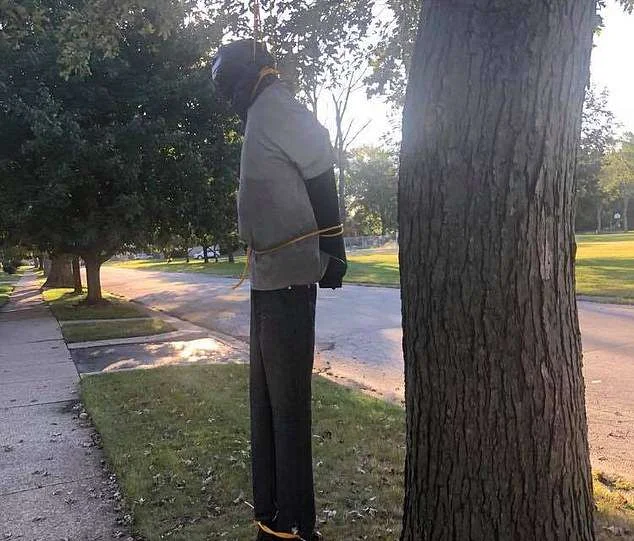
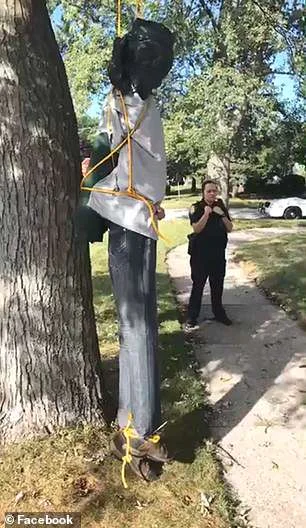
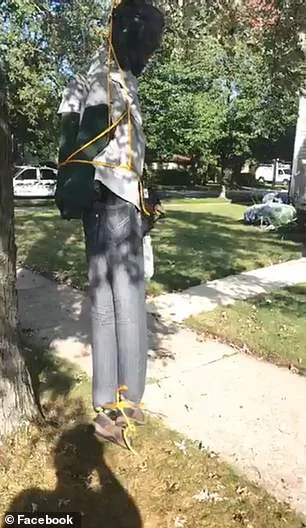
Racist Disturbs the Peace in Lansing with "Halloween Decoration" of Lynched Black Mannequin Hanging From a Tree

From [HERE] Toya Griffin, 37, was on the phone with her 15-year-old daughter Wednesday when she says the teen noticed the visual in Lansing, Illinois

The teen, who is a sophomore at Thornton Fractional South High School, told her mother that she saw a black mannequin with his hands and ankles tied. It was hanging in a tree near the sidewalk. Griffin called the Lansing Police Department but the officer said it appeared to be for a Halloween display. A group of angry neighbors confronted the police and the homeowner, who said that there was a Jason mask on the mannequin that was stolen. Eventually, the mannequin was taken down. [MORE

There is no need for confusion or over reaction. Neely Fuller explains, "most white people hate black people. The reason that most white people hate Black people is because whites are not Black people. If you know this about white people, you need know little else. If you do not know this about white people, virtually all else that you know about them will only confuse you."

There is no need to try to transform racists - people can only change themselves - work on yourself. In their relations with each other white people by and large treat each other humanely. But in their relations with non-whites, racists function as psychopaths. Dr. Bobby Wright explained, 'the psychopath is an individual who is constantly in conflict with other persons or groups. He is unable to experience guilt, is completely selfish and callous, and has a total disregard for the rights of others. Psychopaths simply ignore the concept of right and wrong. By ignoring this trait in the White race (the lack of ethical and moral development) Blacks have made and are still making a tragic mistake in basing the worldwide Black liberation movement on moral suasion. It is pathological for Blacks to keep attempting to use moral suasion on a people who have no morality where race is the variable.' [MORE]

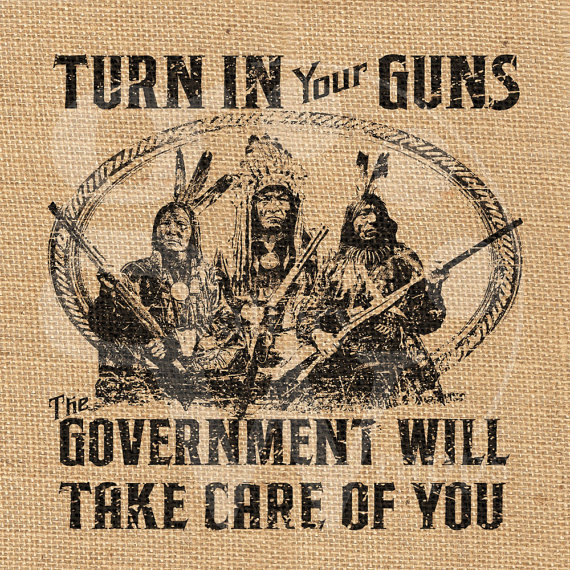
California Governor Accelerates Incremental Disarmament of Law Abiding Citizens [Slavery] with a Stack of New Gun Control Laws

Gun Ban - the precursor to servitude. Enslavement is like old age; it creeps upon you. Banning guns to reduce crime is like banning sex to reduce rape. If guns supposedly cause (or encourage) crime, why are we arming police officers? [MORE]Brainwash…

Gun Ban - the precursor to servitude. Enslavement is like old age; it creeps upon you. Banning guns to reduce crime is like banning sex to reduce rape. If guns supposedly cause (or encourage) crime, why are we arming police officers? [MORE]

Brainwashed white liberal statists only want cops and soldiers to have weapons. The new tactic is to associate anyone who supports freedom from oppressive government and the natural right to defend yourself with the NRA. This mindless TACTIC is similar to racist Republicans associating MS-13 with anyone who supports the humane treatment of non-white immigrants. This is Maya.

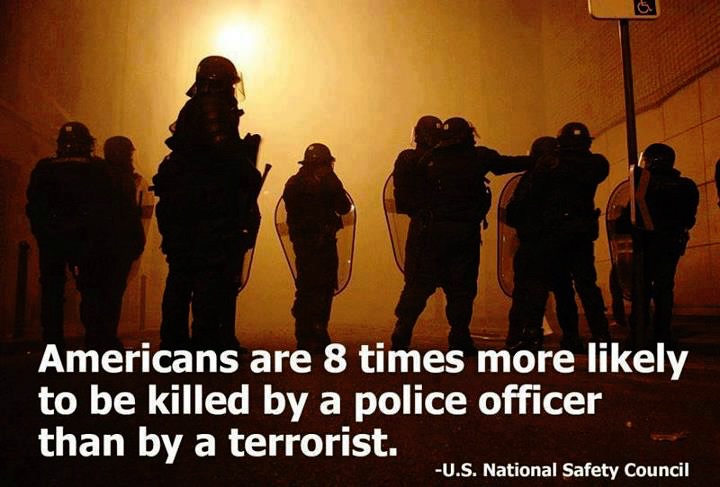
According to the FBI, there is about a 0% chance of of being victimized in a mass shooting or active shooter incident. Such incidents are the rarest of all types of shooting. Black people are more than 55 times more likely to be killed by a police officer than a terrorist. [MORE] Moreover, Black men are conservatively estimated to be 3 times more likely to be killed by cops than white men. Since 2016 Cops have Killed 3x more people than 4 decades of mass shootings combined. [MORE] Gun laws simply disarm the law abiding public so that only lawless cops & criminals have them.

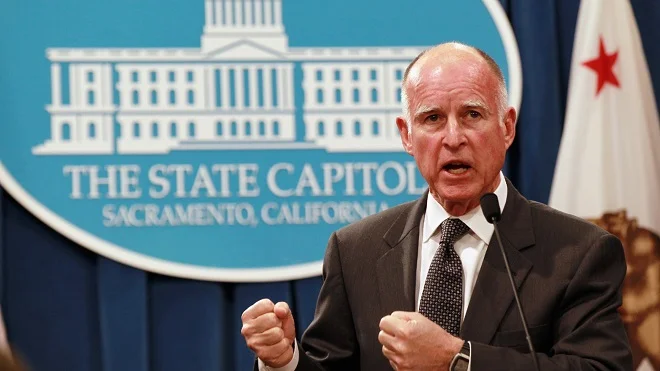
jerry-brown-gun-violence.jpg

From [HERE] Seven months after a teenage gunman killed 17 people at a Florida high school, California Gov. Jerry Brown signed a stack of gun control bills Friday, including a proposal that raises the minimum age for buying rifles and shotguns from 18 to 21.

The Democratic governor followed the lead of Republican Florida Gov. Rick Scott, who in March signed into law a bill raising the minimum age for buying long guns.

Brown also signed into law Friday measures that impose lifetime firearm bans on people convicted of serious domestic violence charges, as well as those who have been hospitalized more than once in a year for mental health problems.

He also enacted laws that will make it easier for police officers and family members to have guns taken away from people deemed a danger to themselves or others, and to require applicants for concealed gun permits to complete at least eight hours of gun safety trainingand demonstrate competency with a live-fire exam.

He vetoed a measure Friday that would have limited people to purchasing no more than one rifle or shotgun in any 30-day period.

State Sen. Anthony Portantino (D-La Cañada Flintridge) authored the California version of the law limiting long gun purchases to those 21 and older, which takes effect Jan. 1.

The higher age for buying guns was supported by the cities of Los Angeles, Burbank, Pasadena, La Cañada Flintridge, Duarte, Glendale, Signal Hill, Thousand Oaks, Norwalk and Carson.

The governor also signed two bills by Assemblywoman Blanca Rubio (D-Baldwin Park), including one imposing a lifetime ban on possessing firearms for Californians convicted of serious domestic violence charges. Until now, convictions resulted in a 10-year ban.

Rubio’s other bill that was signed by Brown on Friday allows family members and police officers seeking gun violence restraining orders to do so verbally when time makes a written request impractical.

A similar bill signed by the governor Friday will waive fees for the restraining orders. Sen. Nancy Skinner (D-Berkeley) said Friday that her proposal “ensures that law enforcement can remove all firearms, including firearm parts, from the persons” subject to a restraining order.

Brown also approved a new law that imposes a lifetime ban on owning firearms for people hospitalized twice in a one-year period for mental health issues that have been deemed to make them a danger to themselves. The measure allows those subject to the law to petition the courts for reinstatement of their right to have a gun.

But earlier in the week, Brown vetoed another high-profile gun control measure that would have expanded the number of people who could petition the courts for a gun violence restraining order to remove firearms from someone thought to be dangerous. The bill rejected by Brown, which was written by Assemblyman Phil Ting (D-San Francisco), would have also allowed teachers, college professors, employers and co-workers to petition for a court order.

Like Portantino, Ting said he proposed the measure in response to the shooting in Parkland, Fla. The legislator noted some school officials had concerns before the shooting about the behavior of the gunman.

But the governor said in a veto message Wednesday that the expansion of the restraining order program is unnecessary.

“All of the persons named in this bill can seek a gun violence restraining order today under existing law by simply working through law enforcement or the immediate family of the concerning individual,” Brown wrote. “I think law enforcement professionals and those closest to a family member are best situated to make these especially consequential decisions.”

Brown also signed a bill this week that will strengthen a law prohibiting multi-burst trigger devices called bump stocks, used in 2017 by a gunman in Las Vegas who killed 58 people and injured hundreds more. Another measure signed by the governor establishes procedures for handling ammunition that has been seized by law enforcement.

Brown vetoed a bill to require the state Department of Justice to study creating a system that would allow gun owners to voluntarily surrender their guns for life. Brown said the mandate is unnecessary in order to look at the idea.

The governor’s actions signing several bills were praised Friday by Peggy McCrum, president of the California Chapters of the Brady Campaign to Prevent Gun Violence, who said California continues to lead the country in gun safety legislation. The bills, she added, “will have a positive effect in continuing to ensure that California works to reduce gun violence."