‘The Green Revolution Failed Africa’ but it Made Bill Gates Richer and Increased Starvation
/Twenty years ago, the Gates and Rockefeller foundations launched the Alliance for a Green Revolution in Africa (AGRA), promising agricultural transformation from improved seeds, synthetic fertilizers, mechanization and commercial markets.
These interventions, they said, would double crop yields and farmer incomes, and cut food insecurity in half in one of the world’s hungriest regions. To achieve these goals, they urged African governments to subsidize inputs, reform policies and court private investments.
Bill Gates became one of the idea’s leading promoters. He argued that the technologies behind the original Green Revolution — particularly “magic seeds” and the “magical innovation” of fertilizer — could lift millions of people out of poverty.
He described the approach as “creative capitalism” — using business incentives, corporate investment and government support to create new markets that raise farmer incomes and thereby reduce hunger.
Africa could avoid many of the problems of the earlier Green Revolution in Asia by pursuing what Gates called a “greener revolution,” one “guided by small-holder farmers, adapted to local circumstances and sustainable for the economy and the environment.”
Many African groups disagreed from the start, arguing that agroecological approaches would reduce hunger more by rebuilding soils, cutting farmers’ dependence on expensive inputs, diversifying crops and making farms more resilient to climate and economic shocks.
What does AGRA’s record show?
Now, nearly 20 years of data are in, and AGRA’s results fall far short of its promises. They raise fundamental questions about AGRA, the Gates Foundation and their influence on African governments and institutions.
The AGRA effort drew more than $1.5 billion in donations (two-thirds from the Gates Foundation), as African governments spent an estimated $1 billion a year in subsidies for fertilizer and other inputs in AGRA’s target countries.
“The Green Revolution has failed Africa,” the Alliance for Food Sovereignty in Africa said in a new report. “Twenty years is long enough to judge the Green Revolution model by its results. The evidence does not justify another decade of the same priorities at greater scale.”
The report is based on an August working paper by Timothy A. Wise, senior research fellow at Tufts Global Development and Environment Institute, that reviews 18 years of United Nations and World Bank data from 2006 through 2024.
The analysis finds that across the 13 countries that were the focus of the AGRA effort, fertilizer use more than doubled and cultivated land expanded by 46% — yet yields for major staple foods increased by only 25%, far less than AGRA’s promised doubling.
Staple-crop yield growth was 1.2%, slightly slower than in the 12 years prior to AGRA, which saw 1.3% yield growth. It slowed even further in the most recent six years, to roughly 0.4% a year.
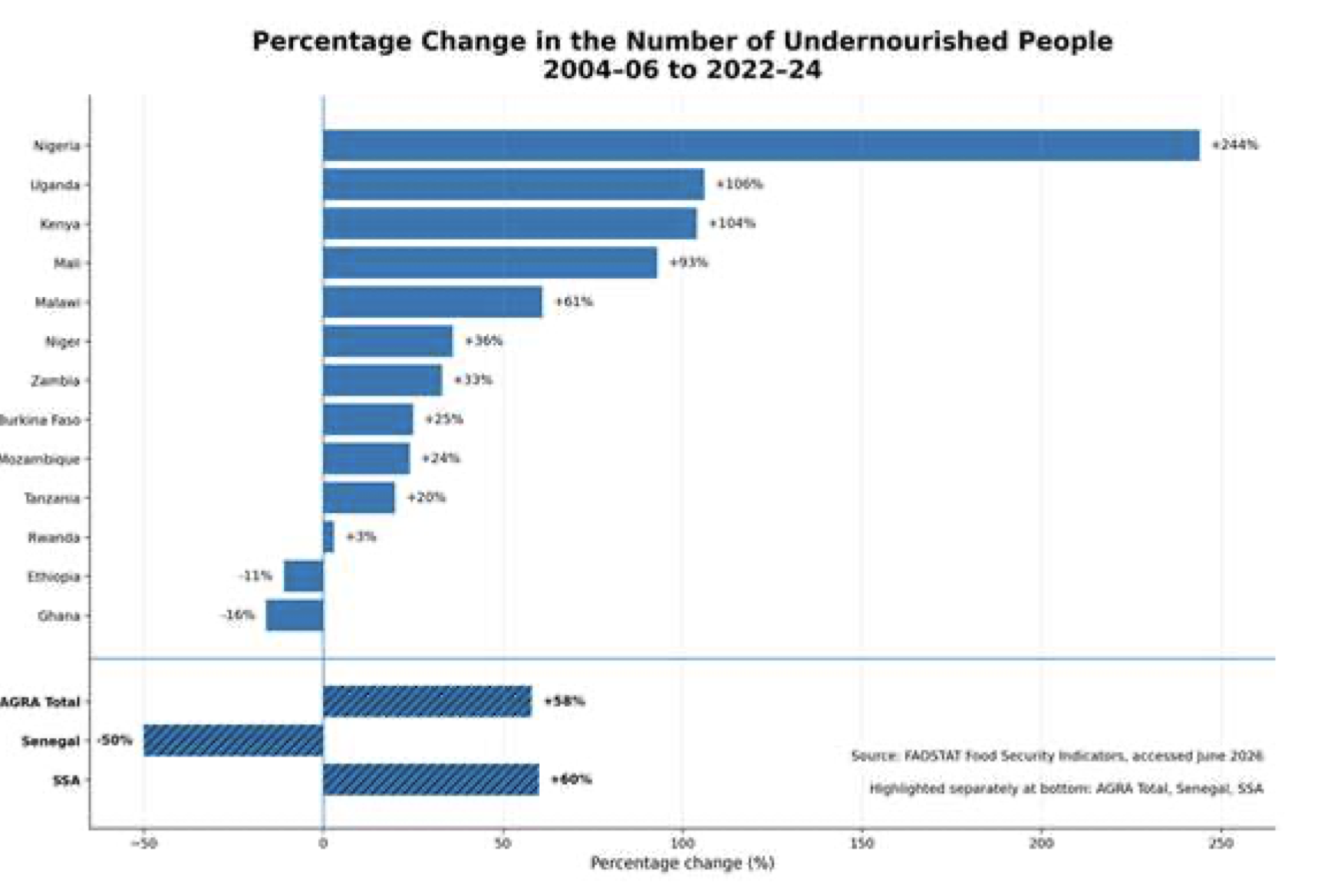
Most troubling, the number of chronically undernourished people increased by an average of 58% across AGRA countries. [MORE]