Analysis of Iran War Video Reveal US Military Strikes were Ineffective; Hitting Already Destroyed Sites, Abandoned Buildings, Empty Boats, etc
/From [HERE A systematic analysis of footage released by US Central Command (CENTCOM), together with open-source videos circulating on Iranian social media, suggests a campaign that has largely exhausted its finite target bank and is approaching the limits of its military effectiveness.
The visual record
CENTCOM's released strike footage follows a consistent and familiar narrative. The targets are presented as militarily significant, the imagery is clean, and the message of precision and operational purpose is carefully reinforced.
But a closer examination of that footage – alongside videos recorded by Iranian civilians and journalists and shared on Telegram, X, and Iranian news platforms – suggests a different reality.
Every air campaign against an adversary faces the same structural constraint: its target bank is ultimately finite. The United States entered this campaign with an intelligence picture built over decades of satellite surveillance, signals intelligence, and human intelligence, identifying what it assessed to be Iran's highest-value military targets.
The evidence now emerging suggests that much of that target bank has already been worked through. What remains is an increasingly limited pool of objectives with far lower strategic value, raising questions about how much military utility the continuing strikes can still deliver.
This shift toward increasingly ambiguous targets is operationally revealing. A campaign that has exhausted its pool of high-value objectives and is increasingly striking targets of questionable military significance is, by definition, one that has reached its limits.
At that point, the relationship between individual strikes and any meaningful strategic effect becomes progressively more difficult to establish.
The official record
The following footage was released by CENTCOM itself as part of the public record of the campaign. Yet rather than documenting strikes on high-value nuclear, missile, or command-and-control targets, the videos frequently reveal a different pattern: attacks on objects whose military significance is unclear or appears limited at the time they were engaged.
1. A strike on an already-destroyed structure, southern Iran
The structure targeted in this clip shows clear signs of prior damage, collapsed sections, exposed structural elements, and debris consistent with an earlier strike. Whatever this structure once was, it had already been rendered non-functional prior to this particular engagement.
The repetition of strikes on already-degraded locations is a clear indicator of target bank exhaustion. Analysis of the visual record shows multiple instances of sites being struck in successive waves.
This pattern is difficult to explain on purely military grounds once a target has been rendered non-functional. When such a pattern of repetition extends across a broad range of target types, including sites that were not hardened to begin with, it suggests that the military campaign is desperately trying to maintain operational tempo against a shrinking pool of identified targets.
2. A strike on a moving bulldozer
This clip shows a single bulldozer, in motion, with no visible markings or context tying it to military use.
Construction equipment of this kind is hardly a strategic asset, as it would be a phone call away from procurement in a country like Iran. Moreover, there is nothing in the footage to confirm it was even military-related rather than civilian machinery.
3. A strike on a small boat, abandoned on land
The boat shown has no engine and no equipment aboard, and it rests on land rather than in water or in the proximity of a fortified base. The absence of propulsion or mounted military gear is consistent with a vessel that had already been abandoned, retired, or taken out of commission well before the strike.
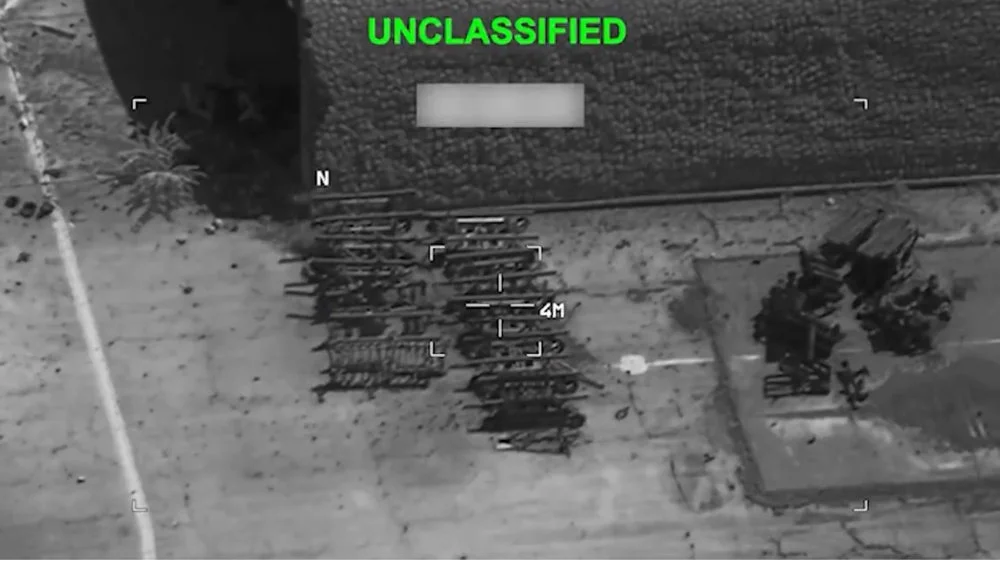
CENTCOM strike footage, Bushehr Airport storage (Above). Satellite imagery comparison, the casings can bee seen in the same location over the years (Below)
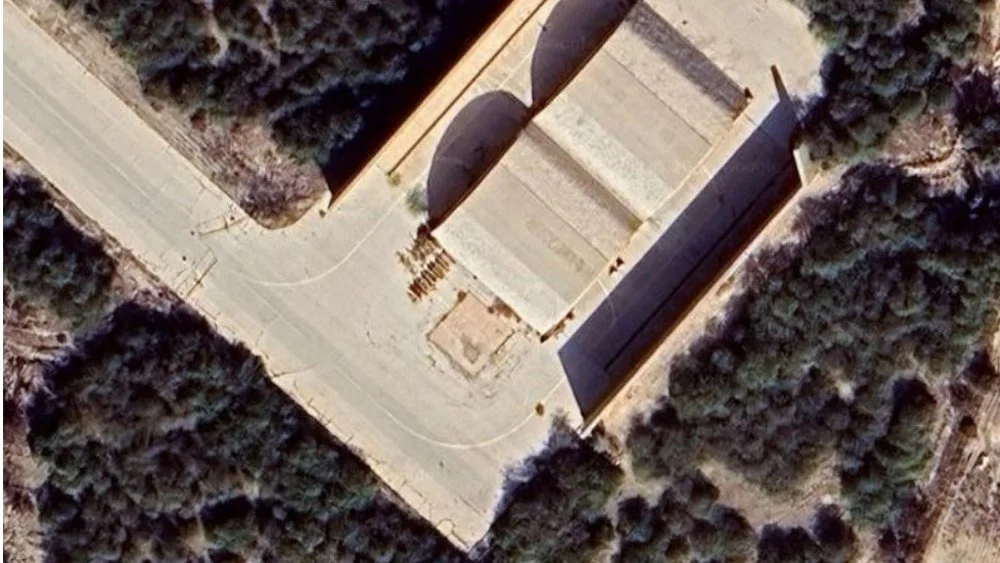
4. A strike on a waste storage site at Bushehr Airport
Satellite imagery of this location shows the same waste storage area present for roughly fifteen years prior to the strike. This location, which contains what seems to be empty bomb casings, had seen no change for many years.
A site with over a decade of unchanged storage use in the historical record is difficult to characterize as a target of present-day significance. [MORE]