The point here is not a theoretical discussion about the purpose of government or history of government or how it should run. Rather, the question is - for what reasons does one man (or government) have supreme authority over another? Although explanation and justification for the right to rule is necessary, none exists.
Other commonly asserted basis for authority have been thoroughly debunked and at this point are mythology:
MAJORITY RULE. Is government authority justified or made legitimate if a majority of people support it? Rose explains that the above stated clogic concerning representation doesn’t get stronger when you add more people to the mix.
To claim that a majority can bestow upon someone a right which none of the individuals in that majority possess is just as irrational as claiming that three people, none of whom has a car or money to buy a car, can give a car to someone else.
Additionally, as Michael Huemer explains, “The fact that a majority of persons favor some rule does not justify imposing that rule by force on those who do not agree to it nor coercively punishing those who disobey the rule. To do so is, typically, to disrespect the dissenters and treat them as inferiors.” He states, “the will of a majority does not suffice to cancel or outweigh the rights of a minority. An action that is normally impermissible does not suddenly become alright merely because most people support it. Consider a hypothetical example, which I call the Democratic Dinner Party:
I go out for dinner with four students, At the end of the meal, there is a debate about how the bill should he divided up, a topic we have not previously discussed. I propose that each person should pay for the items that he or she ordered. "Three of the students, however, make the alternative proposal that I should be forced to pay for the entire meal, Since they are a majority, am I now morally obligated to pay for their meals? And are they entitled to force me to do so? If I refuse, may they kidnap me and lock me in a cage?
No, I am not obligated to pay for everyone, and they are not entitled to force me to do so. This example shows that majority will does not cancel or outweigh individual rights. In this case, my right to my own money and my general liberty right are not canceled or outweighed merely because a majority of the group wants to take away my money or imprison me.
This example is on point because, again, what we need from a theory of political authority is an explanation for why the state should be entitled to engage in behavior that would be deemed to violate individual rights if performed by anyone other than the government. [MORE]
SOCIAL CONTRACT THEORY. How about the social contract theory - the idea that there is a contract between people and the government in which the government protects the people and enforces the laws, in exchange for citizens obedience and taxes? That is, individuals have contractually agreed to obey the government and must do so and the government is obliged to provide services and protection. However, if such an agreement exists, WHEN DID YOU SIGN IT? We were born into this arrangement, no one signed anything. Yet we are bound to obey authority. Therefore, there is no contract and no social contract exists.
At any rate, the so called “public duty” doctrine renders the “social contract theory” meaningless. The Supreme Court has explained the fundamental principle that a government and its agents are under no general duty to provide public services, such as police protection, to any particular individual citizen. [MORE] and [MORE]. This means for instance, police departments and their officers have no legal duty to protect any particular person. Courts throughout the nation have upheld and expanded on what is known as the “public duty doctrine.” Specifically, with regard to police protection services, governments and their agents have no legal duty to protect any victim from violence by other private parties unless the victim was in government custody. [MORE] and [MORE] This means that police cannot be sued for any federal constitutional claim for an alleged failure to protect citizens unless they were in government custody. Despite reality concealment by puppeticians and their Dependent Media, the public duty doctrine is a legal reality that, as explained by the DC Court of Appeals, is “well established” throughout the nation. Most recently in the so-called Parkland “mass shooting” a failure to protect children was claimed and then dismissed without controversy. A federal court ruled that students were not in “custody” and dismissed all claims concerning a failure to protect.
With regard to the social contract undeceiver Michael Huemer states, ‘Given the wide and indefinite range of laws that might be created by the state and the range of punishments to which one might be subjected for violating them, an individual’s concessions to the state under the social contract are quite large. The state, in turn, is supposed to assume an obligation to the citizen, to enforce the citizen’s rights, including protecting the citizen from criminals and hostile foreign governments.’ Although ‘protection from crime is the most central and widely recognized function of the state,’ under the public duty doctrine the state has no obligation to protect individuals from crime and no circumstances exist that count as failing to meet the obligation. Under the social contract theory, citizens are theoretically contractually obliged to obey all laws and commands and when they fail to do so the government can punish them, usually with fines or imprisonment. However, authorities are bound to do whatever they want to do, whenever they want to do it and to whom they choose, but to no one in particular. Dr. Blynd asks “Makes you feel like a fool, doesn’t it? Huemer states, ‘one cannot maintain that the individual owes duties to the state but that the state owes nothing to the individual.’ Thus, the social contract theory do not legitimize authority, the government’s implied right to forcibly control people and its right to be obeyed.
IMPLICIT AGREEMENT. What about an implicit agreement to obey authority - where we are deemed from birth to have agreed to obey authority until we decline, opt out or reject it? This proposition is also an illusion because whether you reject or object to authority you must obey authority regardless. You have no real choice in the matter. Like a plantation system, there is no way to opt out and avoid being subject to another authority
AGREEMENT BY ACCEPTING BENEFITS. Perhaps authority is made legitimate when citizens agree to accept the benefits provided by government, such as public schools or police “service?” For the same reasons no one has an implicit contract with the government, government authority is not made legitimate through acceptance of benefits. Whether a person accepts the benefits of government or not, all persons are still subject to the laws and required to obey authority.
CONSENT BY PRESENCE. How about consent to authority by simply remaining in a particular location - consent by presence on the land? In other words, in order to remain on your own land then you must pay a government and obey laws to do so. Said theory means governments own all land and property everywhere government exists. According to such clogic as stated by Huemer, “Those seeking to avoid all governmental jurisdiction have three options: they may live in the ocean, move to Antarctica, or commit suicide.” [MORE]
Larken Rose explains, “To tell someone that his only valid choices are either to leave the “country” or to abide by whatever commands the politicians issue logically implies that everything in the “country” is the property of the politicians. If a person can spend year after year paying for his home, or even building it himself, and his choices are still to either obey the politicians or get out, that means that his house and the time and effort he invested in the house are the property of the politicians. And for one person’s time and effort to rightfully belong to another is the definition of slavery. That is exactly what the “implied consent” theory means: that every “country” is a huge slave plantation, and that everything and everyone there is the property of the politicians. And, of course, the master does not need the consent of his slave.”
It is also obviously circular thinking to say ‘the government has authority over everything and everybody because it has authority over everything and everybody’ - such statement may indeed be the case but it cannot be a justification for the legitimacy of authority in the first place.
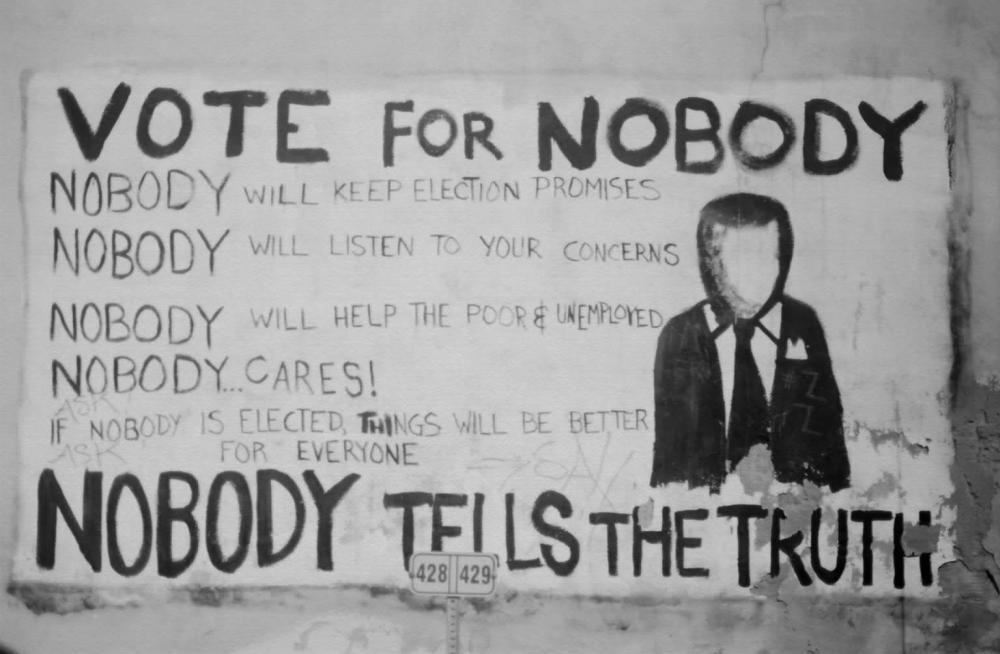
CONSENT THRU PARTICIPATION. Finally, does consent through participation make government authority legitimate or valid? Not at all. “If you didn’t vote in the election, would you then not have to obey the laws made by whoever wins? Of course not. You will be subject to the same laws whether you vote or not.” [MORE]
It should also go without saying but there is no magic ceremony, voting process or magic statements (oaths) which can grant certain people extra-human powers to rule over people, exempt them from morality, accountability and do things which no individual or group of individuals can do.