Johnson & Johnson Ordered to Pay $966 Million to Family of Woman Whose Deadly Cancer Was Linked to Baby Powder
/From [HERE] A Los Angeles jury this month ordered Johnson & Johnson (J&J) to pay $966 million to the family of a woman who died in 2021 from mesothelioma, a rare and aggressive cancer linked to asbestos exposure.
The family of California resident Mae More, who died at age 88, sued the company, alleging its talc-based baby powder products contained the asbestos that caused her cancer.
The jury ordered J&J to pay $16 million in compensatory damages and $950 million in punitive damages. It is the largest settlement yet awarded in a mesothelioma case against the company, handed down just days after a South Carolina jury rejected a similar claim.
Trey Branham, a lawyer for Moore’s family, told Reuters he is “hopeful that Johnson & Johnson will finally accept responsibility for these senseless deaths.”
Erik Haas, J&J’s vice president of litigation, said in a statement that the company plans to immediately appeal the verdict, which he called “egregious and unconstitutional.” U.S. Supreme Court rulings have generally capped punitive damages at nine times the amount of compensatory damages.
J&J maintains that its products are safe, do not contain asbestos and don’t cause cancer. However, the company stopped selling its talc-based baby powder in the U.S. in 2020, and ended global sales in 2023 after facing tens of thousands of lawsuits alleging that asbestos in the talc had caused mesothelioma, ovarian and other cancers.
It replaced the talc version of its powder with a cornstarch-based formula.
Internal memos showed that company officials worried for decades that the talc could be contaminated with asbestos, and that J&J ramped up its marketing to African American womenand other high-use groups. [MORE]

Advocates/Italian Archbishop Seek Release of Reiner Fuellmich: Attorney Kidnapped and Locked Up by Authority b/c He Investigated COVID Shots as Genocide and Attempted to Convene "2nd Nuremberg Trial"
/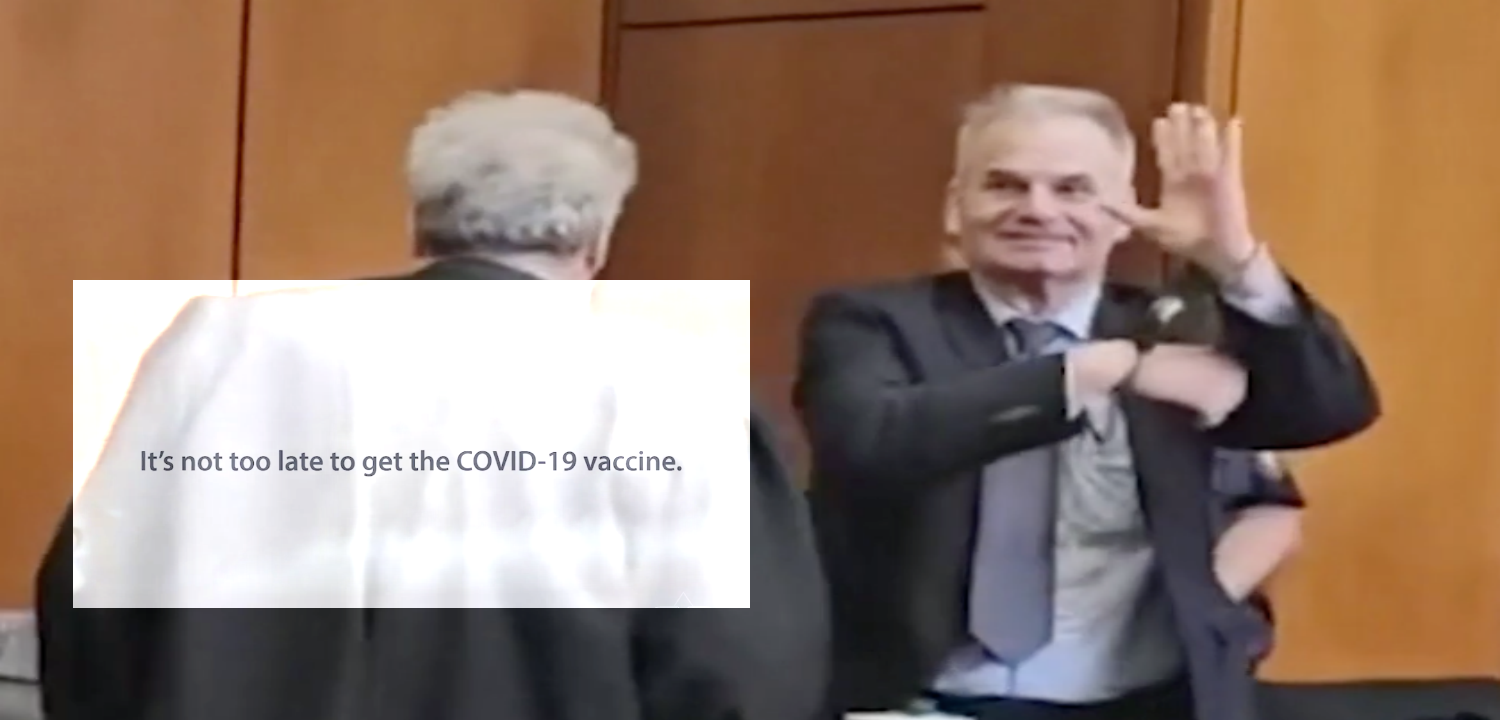
From [HERE] Dr. Reiner Fuellmich was kidnapped from Mexico in October 2023, taken to Germany, arrested and incarcerated. He has been in a German prison ever since.
There are many things about his case which expose that the German criminal justice system is broken, but above all, extradition laws prohibit someone from being extradited for political prosecution or persecution reasons.
Earlier this month, Andrew Bridgen posted on Twitter (now X) that he was arranging to visit Dr. Reiner Fuellmich in prison “as soon as is possible.”
A couple of weeks earlier, Ni-Vanuatu film director Philippe Carillo had compiled calls from around the world, from well-known freedom advocates, for the immediate release of Dr. Fuellmich. One of the contributors was Bridgen.
“Reiner is a courageous lawyer who was an early warner about the dangers of the covid jabs and the whole pandemic response … The German government saw him as a danger to their narrative … Reiner Fuellmich is a political prisoner and his continued incarceration is an affront to freedom in Europe and Germany,” Bridgen said.
Adding, “I would urge Donald Trump’s Administration to acquaint themselves with the facts around this case and put pressure on the German government to release him as soon as possible.
“Remember Reiner Fuellmich. He’s in prison for warning us of the threats, the existential threats from the pandemic response. He must not be forgotten. He must be released.”
Reiner Fuellmich (also written as Füllmich) is a German lawyer and former spokesman for the Corona Investigative Committee, a non-governmental investigative group based in Germany. He has been involved in efforts to pursue class action lawsuits in the United States against entities he alleges were responsible for damages stemming from the management of the covid pandemic, including claims related to the alleged misuse of PCR testing by German virologist Christian Drosten.
In September 2022, Viviane Fischer, a partner in the Corona Investigative Committee, accused Dr. Fuellmich of embezzling funds through overbilling for legal services. Fuellmich denied the allegations, claiming they were politically motivated to undermine the Committee’s investigation into deep state involvement in the global pandemic response.
Not to be deterred by Fischer’s false accusations, Dr. Fuellmich left the Corona Investigative Committee and founded the International Crime Investigative Committee (“ICIC”) to continue his work.
An arrest warrant for Dr. Fuellmich was issued in March 2023 while he was in Mexico. In October 2023, he was abducted by agents of the German state at an embassy in Mexico and taken to Germany, where he was arrested and held in pre-trial detention at Rosdorf prison.
In April 2025, Dr. Fuellmich was sentenced to three years and nine months in prison. The Berlin prosecutor’s office had previously stated there was no cause for a criminal investigation. [MORE]
Did COVID Injections Also Kill D'Angelo? New South Korean Study Demonstrates that COVID Boosters Increase the Risk of Pancreatic Cancer by 125%
/D'Angelo passed away on 10/14/25 without much attention from massa media. According to media reports he died from pancreatic cancer in New York City at the age of 51. A family member told People that D'Angelo had been in a hospice for two weeks, and had been hospitalized for months.

From [HERE] COVID-19 vaccines and boosters — both mRNA and non-mRNA — pose an increased risk of six types of cancer and a 27% higher risk of cancer overall, according to a recent South Korean study of over 8 million people.
Four South Korean researchers published the report last week as a letter in Biomarker Research, a Springer Nature journal.
According to the study, COVID-19 vaccines and boosters are associated with a higher risk of breast, colorectal, gastric, lung, prostate and thyroid cancer, across all vaccine types and age groups.
Mainstream medical commentators were quick to dismiss the findings, with MedPageToday describing it as “flawed.” But other medical and scientific experts disagreed.
“In plain terms: both major COVID-19 vaccine platforms appear to be carcinogenic,” epidemiologist Nicolas Hulscher wrote in a post on Substack.
Dr. Angus Dalgleish, a medical oncologist, told The Defender the study builds on other recent findings but “is the first to show that cDNA [non-mRNA] and mRNA vaccines are associated with cancer risk, suggesting that the spike protein is directly carcinogenic.”
Medical commentator John Campbell, Ph.D., said this week on his YouTube show that the research marks “the largest-scale study so far” examining the association between the COVID-19 shots and cancer.
‘No vaccine technology was free from cancer risk’
According to the study, while the carcinogenic potential of the SARS-CoV-2 virus responsible for COVID-19 “has been hypothetically proposed,” there has been little research on the potential cancer risk from COVID-19 vaccines.
The researchers said the “shared structures” contained within the SARS-CoV-2 virus and the COVID-19 vaccines, including the spike protein, might mean that the COVID-19 shots are associated with cancer risks.
The study used data from 2021-2023 for over 8.4 million people in South Korea’s National Health Insurance Service database. The sample was split into two groups based on vaccination status. The vaccinated sample was further split into booster and non-booster groups.
Researchers tracked the patients for one year. The vaccinated group was tracked following vaccination. The results showed a statistically significant higher risk of cancer in the vaccinated group, including:
Overall cancer: 27% higher risk
Breast cancer: 20% higher risk
Colorectal cancer: 28% higher risk
Gastric cancer: 34% higher risk
Lung cancer: 53% higher risk
Prostate cancer: 69% higher risk
Thyroid cancer: 35% higher risk
The statistical analysis of the results showed that there is a “1 in 1,000 chance that this result arose by chance,” Campbell said.
COVID-19 mRNA vaccines produced by Pfizer and Moderna showed a 20% higher overall risk of cancer and were most closely linked to a higher risk of breast, colorectal, lung and thyroid cancers.
Non-mRNA COVID-19 vaccines, known as cDNA vaccines and which include the AstraZeneca and Johnson & Johnson (Janssen) shots, were associated with a 47% higher overall risk of cancer. They were specifically linked to an increased risk of colorectal, gastric, lung, prostate and thyroid cancers.
Patients who received a mixture of mRNA and cDNA doses also faced an increased risk, with a 34% higher incidence of cancer overall and a close association with a higher risk of breast and thyroid cancers.
“The elevated cancer risks were not confined to one vaccine platform,” Hulscher wrote. “Each vaccine type was associated with a measurable increase in overall cancer — and each had specific cancer sites driving the signal. In other words, no vaccine technology was free of cancer risk in this dataset.”
Internal medicine physician Dr. Clayton J. Baker said the data show that among vaccinated people, the cancer risk increases with time.
“The increased risk of cancer for vaccinated subjects rises in a linear fashion over the entire period of the study, at a steeper angle than the unvaccinated curve, and it does not flatten out. The increased incidence just keeps getting bigger. It could go on for decades. It’s truly alarming,” Baker said.
‘Every demographic group experienced elevated cancer risks’
The results also showed vaccinated people under 65 years of age were at particular risk of some types of cancer.
“The relatively younger population (individuals under 65 years) was more vulnerable to thyroid and breast cancers; by comparison, the older population (75 years and older) was more susceptible to prostate cancer,” the researchers wrote.
Overall, vaccinated people under age 65 showed an overall increased risk of cancer, while elderly adults — particularly those over 75 — had the highest overall risk.
Vaccinated women also had a relatively higher risk of cancer than vaccinated men, with vaccinated women showing a particularly increased risk of colorectal and thyroid cancers, and vaccinated men showing a higher risk of gastric and lung cancers.
Hulscher wrote:
“Both the overall and site-specific results show a consistent pattern — every demographic group experienced elevated cancer risks, though the type and absolute burden varied. Women and the elderly were hit hardest, but no population segment was spared.”
The study’s results also showed that COVID-19 boosters resulted in a substantially higher risk of certain types of cancer. This included a 125% higher risk of pancreatic cancer and a 23% higher risk of gastric cancer.
Dalgleish called the numbers “striking,” saying the jump in risk after booster shots “is an unexpected increase that we are also seeing in the United Kingdom.” [MORE]
‘The More Doses You Get, The Sooner You are Likely to Die’: Japanese Data Suggest COVID Shots Led to Surge in Excess Deaths, Killing People Now
/From [HERE] People who received COVID-19 vaccines had a significantly higher risk of death in the first year after vaccination compared to the unvaccinated, according to an analysis of a Japanese database of 18 million people. The data, not yet published in a peer-reviewed journal, is impressive in size, but requires further analysis, said CHD Senior Research Scientist Karl Jablonowski.
People who received COVID-19 vaccines had a significantly higher risk of death in the first year after vaccination compared to the unvaccinated, and the risk increased with each additional dose, according to an analysis of a Japanese database of 18 million people.
Medical commentator John Campbell, Ph.D., examined the data on his YouTube show this week. The data were originally released in June as part of a roundtable discussion, which was streamed onlineand led by Yasufumi Murakami, Ph.D., vice director of the Research Center for RNA Science at the Tokyo University of Science.
“The more doses you get, the sooner you are likely to die, within a shorter period,” Murakami said during the roundtable.
In his analysis, Campbell said deaths in the vaccinated group were up to four-and-a-half times higher than in the unvaccinated group. The data also showed that deaths among the vaccinated peaked between 90-120 days after vaccination, with the peak occurring sooner as the number of doses increased.
“If someone had had three doses, the peak might be after about … 120 days,” Campbell said. “But if they had four or five doses, the peak in deaths would be earlier, maybe about 90 days.”
The risk of death in vaccinated people remained elevated for the first year following vaccination, “significantly so for the first 240 days,” whereas for unvaccinated people, “no peak forms, which is the expected” outcome, Campbell said.
Japanese data indicate causal link between vaccinations, excess deaths
In his presentation, Murakami said the data show a clear causal link between vaccinations and excess deaths. Campbell agreed, noting that the excess deaths were “probably due to the vaccine’s influence, with adverse reactions occurring leading to death.”
“If the vaccine had no toxicity or didn’t induce death, there wouldn’t be a peak. That’s the point,” Campbell said.
According to immunologist and biochemist Jessica Rose, Ph.D., the spike protein in mRNA COVID-19vaccines, such as those produced by Pfizer and Moderna, is likely a contributing factor to the higher death rate among the vaccinated.
She said:
“The spike protein is highly inflammatory and induces powerful immune reactions against affected cells. Cells transfected and producing spike protein are targeted for destruction, and since the lipid nanoparticles assure any cell can be a spike-producer, including heart cells, it explains much of cardiac-associated deaths.”
Karl Jablonowski, Ph.D., senior research scientist for Children’s Health Defense, agreed.
“The spike protein is a toxic component of SARS-CoV-2, and unanimously the antigen of choice for all mRNA vaccines,” he said. “The mRNA technology has many components that may be a driving force for increases in excess deaths.”
According to Rose, lipid nanoparticles, which help deliver mRNA throughout the body, can also cause blood clotting, contributing to adverse health events and deaths.
“Many components of the mRNA platform can facilitate disease and death,” Jablonowski said. This includes DNA contaminants that have been identified in the mRNA COVID-19 vaccines, which he said “may trigger a deleterious immune response.”
Jablonowski said the Japanese dataset, which has not yet been published in a peer-reviewed journal, requires further analysis:
“Though 18 million is an impressive number, the size of the dataset doesn’t make it good science — the control does. Without detailed data, it is impossible to distinguish between vaccination-induced death or death of those more likely to be vaccinated.”
But if the dataset includes data for “millions of people within the same narrow age range, the same comorbidity grouping and no difference in confounders” and shows elevated death rates for these groups, then the Japanese data would be enough to “sink the mRNA platform worldwide,” Jablonowski said.
Albert Benavides, founder of VAERSaware.com, has analyzed the Japanese data on his Substack page and in an online dashboard he developed. He said the data “appears to be very sound and in line to what appears and what does not appear in VAERS.”
VAERS is the U.S. government-run Vaccine Adverse Event Reporting System.
“Japan (2,396 deaths) sits at second place, only behind Germany (2,709 deaths), as the foreign country with the most COVID-19 deaths in VAERS,” Benavides said.
Data ‘enough to raise questions in the minds of all regulators’
The Japanese data are “enough to raise questions in the minds of all regulators for all mRNA products,” Campbell said, though he doesn’t expect it will.
Many researchers have focused their examination of vaccine-related adverse events on the first days following vaccination, he noted. “When it’s been 90 days, 120 days, they kind of lost interest and don’t make the link anymore.”
Yet, the Japanese data confirm findings of other studies that examined the longer-term effects of the mRNA COVID-19 vaccines.
In a March interview, Campbell spoke with Robert Clancy, Ph.D., emeritus professor at the University of Newcastle’s School of Biomedical Sciences and Pharmacy in Australia, who is reviewing data from a separate dataset that indicates a peak in excess deaths three months after vaccination.
In a May analysis, Campbell examined excess death figures from Our World in Data for 20 countries. The data showed that excess deaths remain high in most Western countries — where mRNA COVID-19 vaccines were widely administered — but are lower in countries where mRNA vaccines were less commonly used.
A 2023 analysis by Phinance Technologies found that, in the U.S., COVID-19 vaccines caused more than 300,000 excess deaths, injured 26.6 million people, disabled 1.36 million people, and cost an estimated $147 billion in damage in 2022 alone.
According to a 2023 report in InsuranceNewsNet, U.S. insurance companies expected higher-than-normal payouts from excess deaths during the COVID-19 pandemic.
Insurers saw death benefits rise 15.4% in 2020, the biggest one-year increase since the 1918 Spanish flu epidemic, followed by a record $100.28 billion — nearly double the historic norm — in total death benefits paid out by the industry in 2021.
A paper published in April in the JMA Journal, the official peer-reviewed journal of the Japan Medical Association, found that Japan had “the world’s highest rate” of COVID-19 mRNA vaccine doses per capita — and “a significant increase in excess deaths in 2022 and 2023.”
“Although several hypotheses have been proposed to explain these phenomena, the truth remains to be established because sufficient studies and data disclosures have not been conducted to adequately investigate the possible contribution of mRNA vaccines,” the paper stated. [MORE]
New Report: ‘Garbage Science’ Behind Claims COVID Shots Saved Millions
/From [HERE] A new report by Canadian researchers challenges widely cited claims that COVID-19 vaccines saved millions of lives in the U.S.
The authors of a preprint paper published this week by Correlation, a Canadian nonprofit research organization, argue that the claims are based on modelling studies that use flawed assumptions resulting in “fantastic and unverifiable” conclusions.
For example, Peter Hotez, M.D., Ph.D. — in interviews and in his 2024 congressional testimony — cited a 2022 study by Meagan Fitzpatrick, Ph.D., touting 3.2 million lives saved by the vaccines.
Legacy media latched onto Fitzpatrick’s and Hotez’s claims, widely repeating and amplifying them.
But according to all-cause mortality experts Denis Rancourt, Ph.D., and Joseph Hickey, Ph.D., Fitzpatrick used a “counterfactual theoretical calculation” that yielded incorrect assumptions about infection fatality rates and vaccine efficacy.
In their new paper, Rancourt and Hickey argue that counterfactual calculations like those used by Fitzpatrick and other researchers can lead to dangerous conclusions and shouldn’t be used to drive policy.
“False claims accepted by government officials and their advisers can have a disastrous effect on public health policy and society,” they said.
They also reassess the claims made in several studies that estimate the number of lives saved by COVID-19 vaccines, and challenge the validity of the studies’ underlying assumptions. [MORE]
New South Korean Study Concludes All COVID Shots (both mRNA and non-mRNA) Increase Cancer Risk
/
From [HERE] COVID-19 vaccines and boosters — both mRNA and non-mRNA — pose an increased risk of six types of cancer and a 27% higher risk of cancer overall, according to a recent South Korean study of over 8 million people.
Four South Korean researchers published the report last week as a letter in Biomarker Research, a Springer Nature journal.
According to the study, COVID-19 vaccines and boosters are associated with a higher risk of breast, colorectal, gastric, lung, prostate and thyroid cancer, across all vaccine types and age groups.
Mainstream medical commentators were quick to dismiss the findings, with MedPageToday describing it as “flawed.” But other medical and scientific experts disagreed.
“In plain terms: both major COVID-19 vaccine platforms appear to be carcinogenic,” epidemiologist Nicolas Hulscher wrote in a post on Substack.
Dr. Angus Dalgleish, a medical oncologist, told The Defender the study builds on other recent findings but “is the first to show that cDNA [non-mRNA] and mRNA vaccines are associated with cancer risk, suggesting that the spike protein is directly carcinogenic.”
Medical commentator John Campbell, Ph.D., said this week on his YouTube show that the research marks “the largest-scale study so far” examining the association between the COVID-19 shots and cancer.
‘No vaccine technology was free from cancer risk’
According to the study, while the carcinogenic potential of the SARS-CoV-2 virus responsible for COVID-19 “has been hypothetically proposed,” there has been little research on the potential cancer risk from COVID-19 vaccines.
The researchers said the “shared structures” contained within the SARS-CoV-2 virus and the COVID-19 vaccines, including the spike protein, might mean that the COVID-19 shots are associated with cancer risks.
The study used data from 2021-2023 for over 8.4 million people in South Korea’s National Health Insurance Service database. The sample was split into two groups based on vaccination status. The vaccinated sample was further split into booster and non-booster groups.
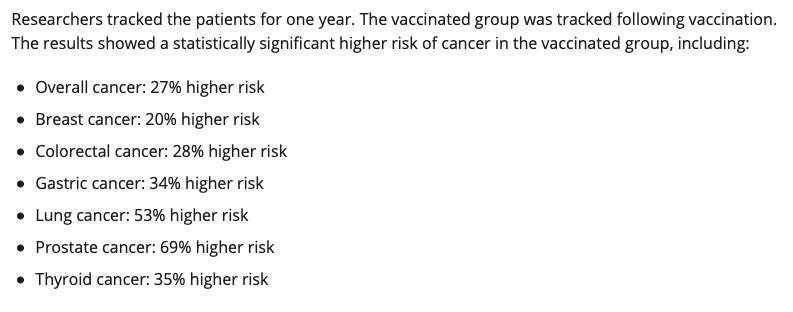
Researchers tracked the patients for one year. The vaccinated group was tracked following vaccination. The results showed a statistically significant higher risk of cancer in the vaccinated group, including:
Overall cancer: 27% higher risk
Breast cancer: 20% higher risk
Colorectal cancer: 28% higher risk
Gastric cancer: 34% higher risk
Lung cancer: 53% higher risk
Prostate cancer: 69% higher risk
Thyroid cancer: 35% higher risk
The statistical analysis of the results showed that there is a “1 in 1,000 chance that this result arose by chance,” Campbell said.
COVID-19 mRNA vaccines produced by Pfizer and Moderna showed a 20% higher overall risk of cancer and were most closely linked to a higher risk of breast, colorectal, lung and thyroid cancers.
Non-mRNA COVID-19 vaccines, known as cDNA vaccines and which include the AstraZeneca and Johnson & Johnson (Janssen) shots, were associated with a 47% higher overall risk of cancer. They were specifically linked to an increased risk of colorectal, gastric, lung, prostate and thyroid cancers.
Patients who received a mixture of mRNA and cDNA doses also faced an increased risk, with a 34% higher incidence of cancer overall and a close association with a higher risk of breast and thyroid cancers.
“The elevated cancer risks were not confined to one vaccine platform,” Hulscher wrote. “Each vaccine type was associated with a measurable increase in overall cancer — and each had specific cancer sites driving the signal. In other words, no vaccine technology was free of cancer risk in this dataset.”
Internal medicine physician Dr. Clayton J. Baker said the data show that among vaccinated people, the cancer risk increases with time.
“The increased risk of cancer for vaccinated subjects rises in a linear fashion over the entire period of the study, at a steeper angle than the unvaccinated curve, and it does not flatten out. The increased incidence just keeps getting bigger. It could go on for decades. It’s truly alarming,” Baker said.
‘Every demographic group experienced elevated cancer risks’
The results also showed vaccinated people under 65 years of age were at particular risk of some types of cancer.
“The relatively younger population (individuals under 65 years) was more vulnerable to thyroid and breast cancers; by comparison, the older population (75 years and older) was more susceptible to prostate cancer,” the researchers wrote.
Overall, vaccinated people under age 65 showed an overall increased risk of cancer, while elderly adults — particularly those over 75 — had the highest overall risk.
Vaccinated women also had a relatively higher risk of cancer than vaccinated men, with vaccinated women showing a particularly increased risk of colorectal and thyroid cancers, and vaccinated men showing a higher risk of gastric and lung cancers.
Hulscher wrote:
“Both the overall and site-specific results show a consistent pattern — every demographic group experienced elevated cancer risks, though the type and absolute burden varied. Women and the elderly were hit hardest, but no population segment was spared.”
The study’s results also showed that COVID-19 boosters resulted in a substantially higher risk of certain types of cancer. This included a 125% higher risk of pancreatic cancer and a 23% higher risk of gastric cancer.
Dalgleish called the numbers “striking,” saying the jump in risk after booster shots “is an unexpected increase that we are also seeing in the United Kingdom.”
Critics call one-year follow-up period ‘bonkers’
According to MedPageToday, the one-year follow-up period the researchers used in the study was “bonkers,” and the study didn’t take into account the patients’ family histories of cancer and their screening history.
Karl Jablonowski, Ph.D., senior research scientist at Children’s Health Defense, said “the criticism levied against the study is of healthy user bias.” He explained:
“The idea that people more likely to engage in one medical intervention (vaccination) are also more likely to engage in another (cancer screening) … is a valid concern for a vaxed-unvaxed study such as this one, as those seeking a vaccine will have drastically different healthcare-seeking behavior than those not seeking a vaccine.
“[However,] this is not just a vaxed-unvaxed study — it also differentiates the vaccines. Healthy user bias is not a point of argument for why one vaccine (cDNA) shows a strong cancer risk above another (mRNA). Further, the study doesn’t say vaccines cause cancer, but are associated with them.
“We are complex multicellular organisms. Cancerous cells are created within us with great frequency, and are usually subdued by our anti-cancer mechanisms. … If a vaccine can disrupt that anti-cancer mechanism, then cancers can manifest in a short time window.”
Even if cDNA vaccines were shown to pose a higher cancer risk, Baker said the study also highlights the risk of mRNA technology.
“This study absolutely implicates the mRNA platform,” he said. “Remember, COVID-19 was the first widespread use of that technology platform in humans … In its first application, it increases cancers.”
Campbell said official South Korean data is typically reliable, and the study was well structured.
“South Korea was a very heavily vaccinated country,” he said. “There was … just a few hundred thousand in the unvaccinated group, but that’s good enough to get some pretty good data from.”
The study’s authors did not elaborate on possible mechanisms contained within the COVID-19 vaccinesthat might result in a higher cancer risk.
Baker said the “significantly increased hazard ratios for six different cancer types suggests to me a possible immune system impairment contributing to the increased risk. It’s frightening, because the risk is not limited to any one type of cancer that might be screened against.”
According to Campbell, the spike protein and DNA contaminants found in the mRNA vaccines may be among the factors contributing to this risk.
The authors suggested that more research is necessary “to elucidate potential causal relationships, including the underlying molecular mechanisms related to COVID-19 vaccine-induced hyperinflammation.”
Growing number of studies link COVID shots to severe adverse events
Other recent large-scale studies and analyses suggest a link between the COVID-19 vaccines and serious adverse events such as cancer.
Earlier this year, an analysis of a Japanese database of 18 million people showed that people who received COVID-19 vaccines had a significantly higher risk of death in the first year after vaccination compared to the unvaccinated. The risk increased with each additional dose.
A study of 1.3 million women in the Czech Republic published in the International Journal of Risk & Safety in Medicine in June showed that the rate of successful conception — a pregnancy leading to live birth nine months later — for vaccinated women was “substantially lower” than for those who were unvaccinated.
A 30-month study of nearly 300,000 people in Italy, published in the journal EXCLI in July, found a 23% increased risk of cancer following one or two doses of the COVID-19 vaccine, and an additional 9% increased risk among those who received three or more doses.
The Italian study’s results also showed statistically significant increases in breast, bladder and colorectal cancers.
Jablonowski said the Italian study’s findings largely mirror those of the South Korean study, as there is “a corroboration of evidence that cannot be ignored.”
“The comparison of the results … is awfully interesting,” Jablonowski said. “The two studies generally agree on many cancer types. One form of cancer that they do not agree on is prostate cancer. It is not remotely noteworthy in the Italian study, and the strongest signal in the Korean study.”[MORE]

Trump is All Talk About Protecting Human Freedom: The Blight House Misses Key Deadlines for Imposing Restrictions on Gain-of-Function Research
/Biosafety hawks were initially optimistic that the incoming second Trump administration would at last place binding constraints on so-called "dangerous gain-of-function" research, in which pathogens are manipulated in laboratories to be more virulent or transmissible in humans.
The administration's picks for top health policy jobs—most notably National Institutes of Health (NIH) Director Jay Bhattacharya and Health and Human Services Secretary Robert F. Kennedy Jr.—are both gain-of-function critics who have asserted that this type of research created SARS-COV-2 in Wuhan, China.
In May, the White House issued an executive order creating a broader definition for dangerous gain-of-function research and promising that new restrictions on it would be issued within a few months.
"The conduct of this research does not protect us from pandemics. There's always a danger that in doing this research, it might leak out by accident even and cause a pandemic," said Bhattacharya at the Oval Office press conference when the order was signed. With the order, "the public can say 'no, don't take this risk.'"
But the deadlines for the new restrictions called for in that order have since come and gone without any new policy being released. Meanwhile, there are indications that the NIH is continuing to fund risky virological research.
Gain-of-function critics who were optimistic that this research would finally be put back in the box are now concerned that the Trump administration will fail to implement meaningful restrictions. [MORE]
Emails Show Fauci Told Colleagues to Delete COVID-Related Communications
/Sen. Rand Paul (R-Ky.) called on Dr. Anthony Fauci to testify before the U.S. Congress after Paul released several emails from 2020 that show Fauci instructing colleagues to delete messages after reading them.
The email directives, which may violate federal law, contradict Fauci’s congressional testimony last year, when he repeatedly denied deleting official records or engaging in “attempts to obstruct the Freedom of Information Act and the release of public documents.”
Paul published the emails on Wednesday in a series of X posts.
He also posted a copy of a letter he sent to Fauci on Tuesday, asking Fauci to turn over documents and other records and to state his availability to testify before Congress this year.
The emails show that Fauci, who directed the National Institute of Allergy and Infectious Diseases (NIAID) from 1984 to 2022, asked colleagues on at least two occasions to delete messages, a possible violation of federal records laws.
The emails also disclose Fauci’s discussions with key public health figures about how to “get ahead of the science and the narrative” during the early days of the COVID-19 pandemic. The emails exchanged ideas on how to promote the “zoonotic” — or natural origin — theory of the SARS-CoV-2 virus. [MORE]
Attorney Aaron Siri Told Senate Puppeticians that a Large Study Found Vaccinated Kids were Far More Likely to Develop Chronic Disease than Unvaccinated Kids, But Researchers Fear Releasing It
/In a U.S. Senate hearing today, attorney Aaron Siri revealed the results of a large study that found vaccinated children were far more likely to develop chronic disease than unvaccinated kids.
The study never underwent peer review and was never published, because the authors — staunch vaccine supporters — told Siri they were concerned about losing their jobs or reputations because their findings contradicted the official public health narrative and vaccine policy.
Siri’s testimony, delivered during Tuesday’s Senate hearing, “How the Corruption of Science has Impacted Public Perception and Policies Regarding Vaccines,” addressed the study’s origins, findings and suppression.
The study involved over 18,000 children enrolled in Henry Ford Health system’s insurance plan in Michigan.
“The results are astonishing,” Siri told The Defender. “For example, vaccinated children had 4.29 times the rate of asthma, 3.03 times the rate of atopic disease (a group of allergic conditions), 5.96 times the rate of autoimmune disease, and 5.53 times the rate of neurodevelopmental disorder.”
These findings were statistically significant — even when accounting for gender, race, birthweight, premature birth, and respiratory distress or trauma at birth.
But rather than publishing the results, the study authors and their bosses at Henry Ford Health refused to make them public — even though the lead author previously assured Siri and Del Bigtree he would publish the results, whatever the findings. [MORE]