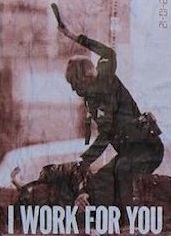
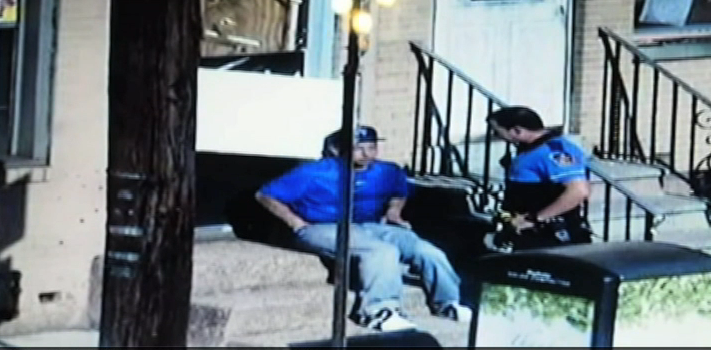
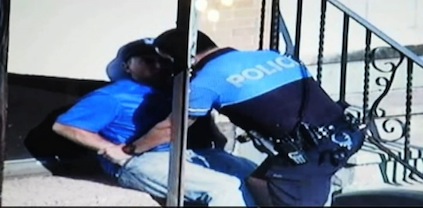
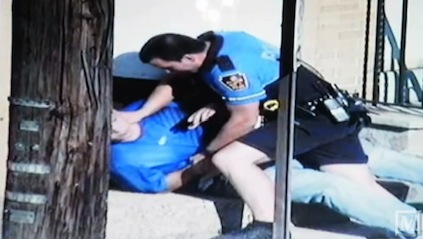
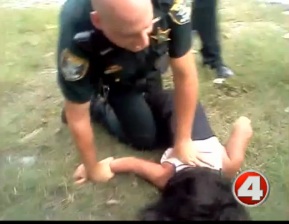
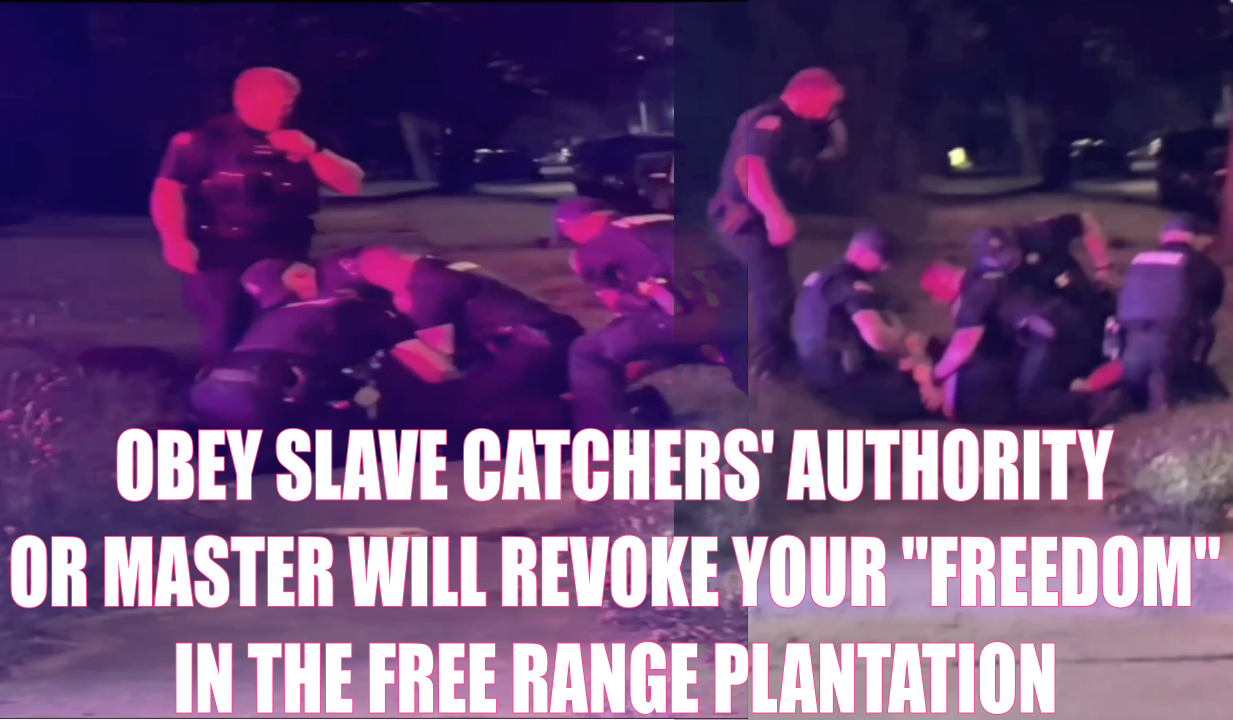
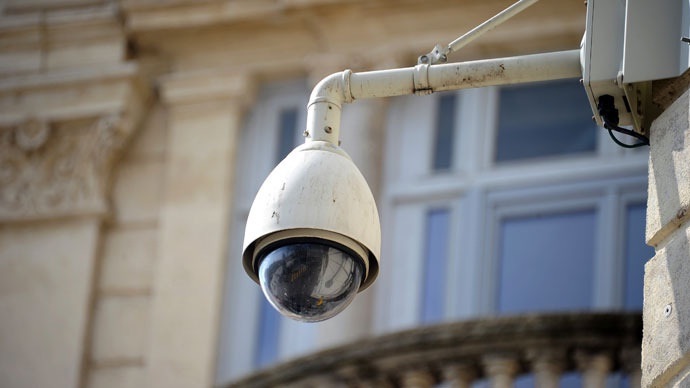
Surveillance footage of the incident shows Murphy (wearing white) jump out of his seat and point his pistol at a man named Obed DeLeon (wearing blue), who had walked inside the restaurant to complain about a car blocking the restaurant parking lot, near the intersection of Harlem and Higgins. The assault can be seen in the video above at about 1:13 minutes in. The officers later claimed he provoked them by yelling gang slogans—but witnesses didn't corroborate those claims. Murphy then allegedly began beating DeLeon.
Orsa, a friend, and another officer, Daniel McNamara, also allegedly got involved in beating, kicking and holding down DeLeon. The police department later could not determined whether McNamara had an active role in beating DeLeon, but he was suspended for 18 months for not telling his supervisors what had happened.
It took five years for the police board moved to fire Murphy and Orsa, but after a county judge reversed the board's decision, the two men remained on the police force for another five years. Finally, this past August, an Illinois appeals court panel of judges upheld the original police board decision to dismiss them, reasoning that the mere fact that Murphy pulled out a gun "unprovoked" in the restaurant was damning enough.
“Our careful and close review of the video leaves us dumbfounded by the circuit court’s rejection of the [b]oard’s prima facie true and correct findings,” Justice Michael B. Hyman wrote in the August ruling, according to Chicago Law Bulletin. “Misconduct and manipulation of the sort that occurred here leaves a stain on the good honor of the vast majority of police officers in the department who comport themselves with integrity, dignity, decency and discipline." [MORE]
From [HERE] A Black Army veteran has filed notice of a complaint against the Jefferson County Sheriff’s Office and intends to file a lawsuit in the coming weeks over police brutality.
“They [white cops] beat him. They slapped him. They punched him. They kneed him. They elbowed him. While he was in handcuffs. They cursed him,” Attorney Franie Lee said.
His client, Tommy Guyton, is claiming police brutality.
“Mr. Guyton had no warrants on him. He had no drugs on him. He had no guns on him. He was just simply asleep in the house where he had been invited,” Lee said.
Guyton's attorney said he had been sleeping at the house of a woman he had just met when her estranged husband called the police after seeing another man in the house.
“Once the officers arrived, they went to the bedroom and they immediately said, 'Get the (blank) up. Get the (blank) up, homeboy. What is your name, homeboy? What is your name, homeboy?’” Lee said.
His attorney said the deputies shocked Guyton two or three times with a stun gun.
He believes the deputies' actions were racially motivated.
“They kept or continued to ask him, 'What is your name, homeboy? What is your name, homeboy?'” Lee said.
A Sheriff's Office spokesman said that isn't something they would ever condone and that the department "(doesn't) operate in black and white."
The incident happened November. Guyton was arrested and charged with disorderly conduct, resisting arrest and drug paraphernalia.
In September, he was acquitted of all charges.
“He's seeking justice. In whatever form or fashion that may come. We do believe the individuals who were involved in the brutality should be prosecuted,” Lee said.
The chief deputy of the Sheriff's Office said they fired one of those two deputies. That termination was finalized in November.
"To say this employee fell short of what our expectations are as an agency would not do this justice. We were happy and appreciative to be made aware of this issue and happy to take swift corrective action,” he said in a statement.
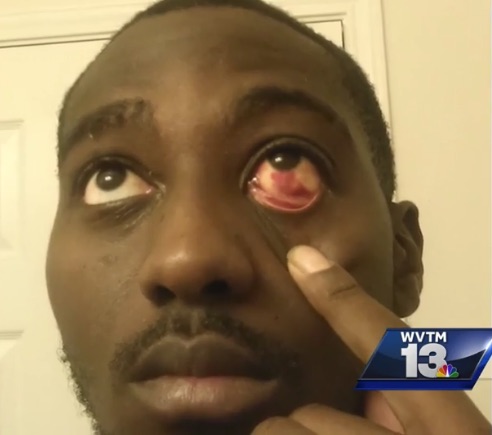
It Would Be Better If They Had No Eyes. At least there would have been no possibility of misunderstanding.
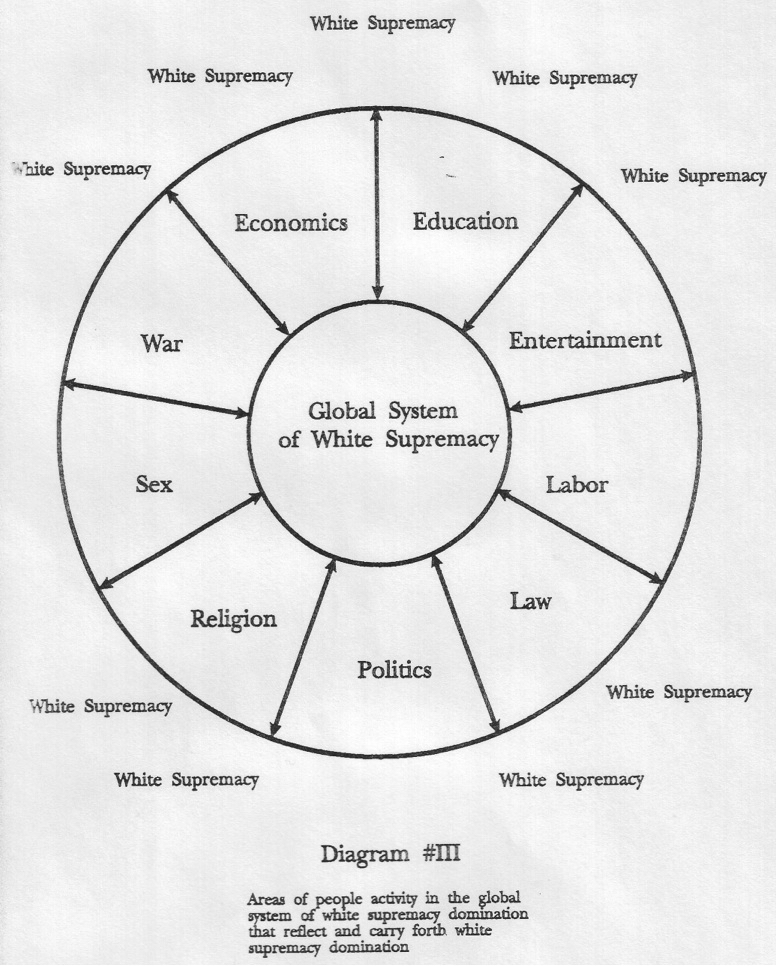
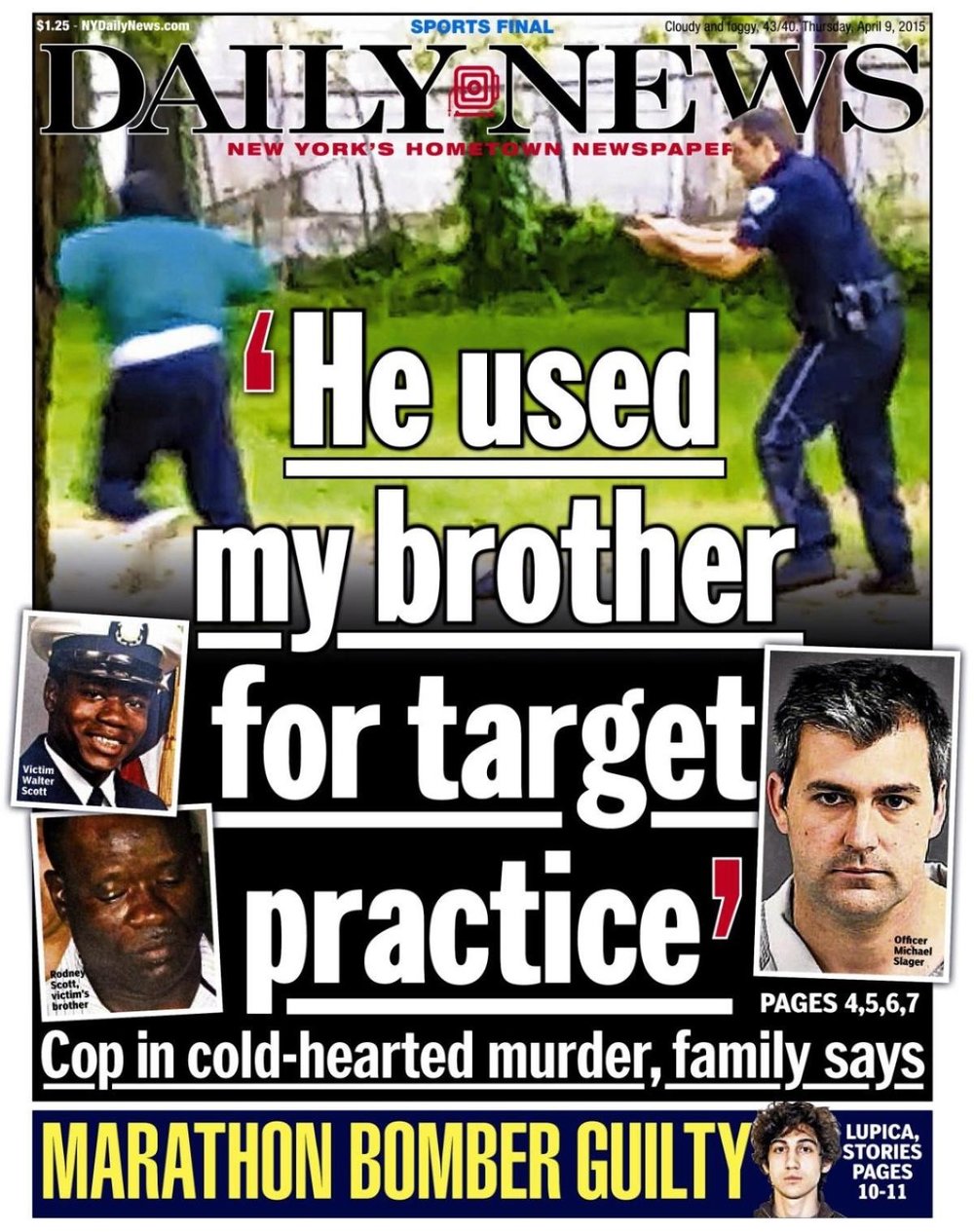
Overseer [officer] Slager told the jury (11 whites) "My Mind was Like Spaghetti" and he was "scared to death" of the fleeing, unarmed Black man he shot to death. Like the white cop, perhaps the white jurors' minds are also like pasta in the presence of Blacks. With their minds blown, clouded with racist nonsense, it is difficult to see what is right in front of you. As stated by Doc Blynd, "white supremacy is a virus in the mind." Before They Looked @ the video & heard any facts They probably Already Had An Idea. Their eyes carry some experience, some opinion, ideology about Blacks; 'a set of assumptions older than this nation about Black people's abilities, criminality, marriageability, sexual desires, morality, etc. Most whites, when they are being honest with themselves, know that these racial understandings are part of their consciousness [MORE]. These objects are barriers that corrupt understanding, seeing reality, the obvious. [MORE] and [pdf]. Yet racist suspects have so much invested in their interpretations.
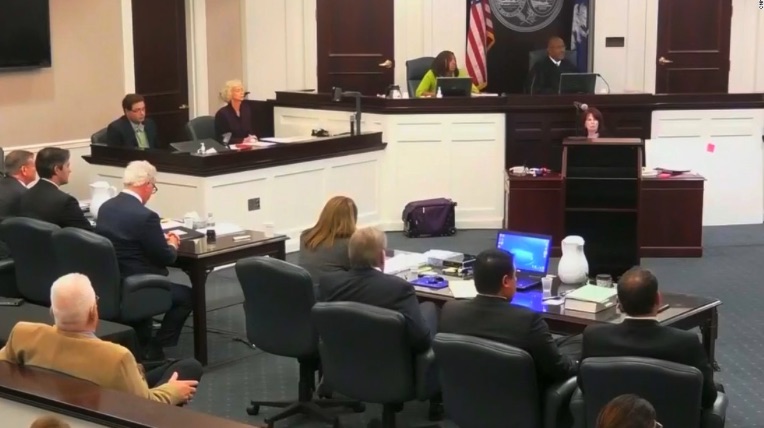
Advertising Justice. Here in photo, the white media is letting us know that a Black judge heard this case. White media make every effort to create the appearance of justice in the criminal justice system. A system that is rigged. If it didn't look right we wouldn't believe in it. Our belief in it, is its only real power. We hope that it looks fair and just because in fact it is fair and just - as opposed to it just being a show to deceive.
From [HERE] A jury of 11 whites and 1 black person deadlocked Monday in the case of a white South Carolina police officer charged with murder after he was recorded on video last year firing a barrage of bullets into the back of Walter Scott, a Black man, in one of the most high-profile shootings to rattle the nation in recent years. Like the murder of Eric Garner by a gang of white NYC cops in broad daylight, Scott's entire murder took place in front of a camera - but that's not what the white jury saw [an all white grand jury in Garner case].
“We as the jury regret to inform the court that despite the best efforts of all members, we are unable to come to a unanimous decision,” the jury wrote in a note that Circuit Court Judge Clifton Newman read aloud in the courtroom.
Newman declared a mistrial on shortly before 3:40 p.m., and thanked the jurors for their “hard work in trying to reach a unanimous verdict in this case.”
Racists are blind w/perfect eyes. Cop Said "My Mind was Like Spaghetti" and he was "scared to death" of the fleeing, unarmed Black man. Are the 11 white jurors minds also like pasta in the presence of Blacks? They are still unable to see murder on this video. A racist would have difficulty with this. Before They Looked They probably Already Had An Idea. Their eyes carry some experience, some opinion, ideology about Blacks. These objects become barriers that corrupt understanding, seeing reality, the obvious. [MORE] and [pdf]
From [HERE] To [non-white persons] it looked like an absolutely open-and-shut case. As video footage captured by a bystander clearly showed, Walter Scott was running away from Michael Slager with his back obviously turned on April 4, 2015, when Slager, then a police officer in North Charleston, South Carolina, aimed his gun and shot at the 50-year-old a total of eight times. Even compared with other police shootings of unarmed black men, this one was so gratuitous and so manifestly indefensible that even the local police union declined to pay Slager’s legal fees when he was charged in connection with Scott’s death several days after the killing.
Slager’s criminal trial started one month ago. It came within a hair’s breadth of ending in a mistrial Friday afternoon when the jury foreman informed the judge in the case, Clifton Newman, that the jury could not come to a unanimous verdict. It seems that deliberations had hit a wall because of just one juror, with the other 11 apparently in favor of convicting Slager of either murder or manslaughter.
Typically, that would be the ballgame: a hung jury, a mistrial for the defendant, and the possibility of a second trial. However, after initially telling Judge Newman that the jury was deadlocked, the foreman surprised the courtroom by informing the judge that, actually, they wanted to continue deliberating. The judge allowed them to do so before dismissing court for the weekend. And so, deliberations will resume Monday.
The 12 jurors on the case—eleven are white and one black man—had three options after Slager's defense rested their case on Wednesday: find the defendant guilty of murder, find him guilty of manslaughter, or find him not guilty of either on the basis that shooting Scott was an act of self-defense.
On Friday afternoon, Judge Newman read out two unusual notes submitted to him by members of the jury. One came from the foreman, and said simply, “It’s just one juror that has the issues.” The second apparently came from that juror, and took the form of a lengthy letter. In it, the juror wrote, “I cannot in good conscience consider a guilty verdict. I respect the position of my fellow jurors, some of which oppose my position. I expect those who hold opposing views not to change their minds.”
The juror continued: “We all struggle with the death of a man and with all that has been put before us. I still cannot, without a reasonable doubt, convict the defendant. At the same time my heart does not want to have to tell the Scott family that the man that killed their son, father, and brother is innocent. But with the choices I cannot and will not change my mind.”
Again, this seemed pretty definitive, and the judge appeared ready to declare a mistrial. Before doing so, however, he had his clerk ask the foreman whether the jury was, indeed, "hopelessly deadlocked." A note came back saying that they were.
And yet it still wasn't over. When Newman brought the jury into the courtroom to confirm, in person, that they couldn't come to a verdict, he asked the foreman—in an apparent last ditch effort to prevent the month's worth of work he and his staff had just done from going down the tubes—whether further explanation of the law might help the jury come to a unanimous conclusion. That was when the foreman threw his final curveball, replying that it would and keeping these maddening deliberations going.
Even prior to Friday, it has been an unusual trial all around. Earlier this week, Slager took the relatively rare step of testifying in his own defense. He told the jury that he had become scared for his life after pulling Scott over for a broken taillight. That was when, Slager claimed, he entered into a struggle with Scott, at which point the man ran from his car. Speaking with tears in his voice, Slager testified that Scott grabbed his Taser from him during the struggle and pointed it at him, putting the officer in a state of “total fear” and disorientation. “I see him with the Taser in his hand,” he said, according to the Post and Courier. “That’s the only thing I see. ... I see that barrel … coming at me, and I knew I was in trouble.” Slager said he made the decision to use lethal force when Scott was just a few feet away from him.
Later, when Slager was asked on cross-examination why he had picked the Taser up off the ground and planted it at Scott’s feet after shooting him—as the video tape of the incident clearly showed him doing—Slager said he could not remember many details of what happened in the moments after he decided to fire his gun. “I don’t know why I dropped it on the ground,” he said, noting that he picked the Taser back up a few seconds later. Reflecting on his anxious state in the heat of the moment, Slager memorably testified, "My mind was like spaghetti.”
The stakes in the Slager case have always been stark: as the New Yorker’s James Surowiecki put it on Twitter on Friday after news broke that the jury was deadlocked, “If a jury can't convict under these circumstances, what will it take?” Put another way: If even Slager's actions can be successfully defended in court, it's hard to imagine a police officer ever being held accountable for killing someone in the line of duty.
The reasons for this are multiple, but chief among them is that the laws governing police use of force tend to be impossibly vague and flimsy. Back in November, while the prosecution was still in the midst of presenting its case against Slager, I wrote that the law in South Carolina is particularly complicated because the state doesn't even have a formal statute that defines the circumstances under which police officers are legally allowed to use lethal force. Instead, judges, prosecutors, and defense attorneys in the state must look to a 2004 ruling from the South Carolina Supreme Court—one that is based on an utterly incoherent interpretation of a so-called common law standard that says police can use any amount of force, including deadly force, to “seize” a fleeing felon if necessary. Inevitably, experts told me, jurors are left confused when trying to determine an officer’s guilt or innocence.
As it turned out, none of that really mattered in the Slager trial, as the defense team argued that Slager acted in self-defense, and did not technically ask the jury to give his status as a law enforcement agent any special consideration in evaluating the legality of his actions. Slager used lethal force the way any reasonable person might have done in the same situation, the defense argued, and he would deserve acquittal regardless of whether or not he had been carrying a police badge at the time.
If Slager ends up walking, expect his defenders to say he was treated the same way under the law as anyone else would have been. And yet, it's hard to explain away the fact that we're headed toward Day 4 of jury deliberations over the guilt or innocence of a man who fired eight bullets at someone who was running away from him, was caught on video while doing it, and appeared to plant evidence on his victim before thinking better of it. The particulars of Slager’s legal defense notwithstanding, it’s hard to imagine this case would have ever gotten past the plea bargaining phase if the defendant was anyone but a police officer.
What Did the White Cops Think They Saw?When white Cleveland cops arrived information from the police radio run was not corroborated. 1) No "guy" or grown man was present - only a 12 yr old child. 2) There were no people around - the child was alone. So no ongoing emergency existed. 3) No gun was visible - apparently the toy gun was in the child's pants and out of site when police arrived = so no legal basis to stop, seize or use force.
In the context of White American domination there is no innocent Black male, just Black male criminals who have not yet been detected, apprehended or convicted. Their mere presence inspires in White Americans, fears of being assaulted, raped, robbed, or some other indefinable dread of being criminally victimized.[MORE] "A mind that is filled with belief is a mind which can project anything according to the belief." When these frightened Cleveland white cops heard the radio run & saw Tamir Rice their racist minds must have got carried away. Their thoughts clouded with smoke - they could no longer physically see or hear things as they were. Their minds blocked it. [MORE]and [MORE]
From [HERE] A judge for the Cuyahoga County Probate Court in Ohio approved a settlement on Wednesday in which the city of Cleveland will pay $6 million to the family of Tamir Rice, a 12-year-old black child who was shot and killed by a white police officer in a recreation center in November 2014. The parties reached the settlement in April, but it required the approval of a probate judge. The police officer, Timothy Loehmann, and his partner Frank Garmback were dispatched to investigate an emergency call about a "guy with a gun." Last December, a grand jury failed to indict the officers. Under the terms of the settlement, the city made no admission of wrongdoing.
The boy had an airsoft gun that shoots nonlethal plastic pellets when a rookie white officer shot him at a Cleveland playground.
Surveillance video released by police shows Rice being shot less than two seconds after the patrol car stopped near him. Officer Timothy Loehmann told the boy to put his hands up, but he didn't comply, according to police.
According to police,he reached for a gun in his waistband. The toy gun was in his waistband -- that is he was not holding in it. [MORE] The police chief said there was no confrontation between the boy and the cops and he did not threaten the officers with the gun or otherwise. See video above. In other words, when the cops arrived no crime was being committed in their presence and no visible danger was present. As such, there was no legal basis to order him to stop or to pull out their loaded weapons and point them at him in the first place. When they arrive they see a Black kid, alone. [MORE]
Police were called to N Portland in September 2014 after neighbors reported nine African American men and women had threatened to shoot someone and were damaging property.
Portland Police said they found a group "matching the description", and when police tried to put handcuffs on the then-16-year-old boy Thai Gurule, he struggled with them. They said he choked an officer in the process. Two officers and a sergeant suffered minor injuries during the altercation, and the teen was also treated for injuries at the scene and sent to the hospital before being sent to a juvenile detention home, police said.
Mariah Lund, a witnesses, said she was with the group, and they were coming home from a party. She disagreed with what police said about the incident.
"I couldn't really hear what was going on at first and then all of a sudden we just start hearing yelling and then they pushed my friend's brother, Thai, onto the floor," she said.
Lund told KATU they weren't doing anything and were just walking home.
Gurule's charges were dropped last year, when a Multnomah County judge ruled the teen wasn't assaulting officers. A liar white cop's pollice report is posted [HERE]
From [HERE] A judge has approved a settlement of $1 million to the family of William Chapman, the Black teen fatally shot by Portsmouth cop Stephen Rankin, a racist suspect who made Nazi postings on the internet. [MORE]
Sallie Chapman, the mother of William Chapman, will receive $300,000 while Chapman's father will get close to $150,000. Another part of the settlement will go to attorney fees and the rest will be split between seven of William Chapman's half-siblings.
Rankin was convicted on a manslaughter charge this year and sentenced to spend only two years and six months behind bars for shooting the 18-year-old, who was unarmed in the parking lot of Wal-Mart off Frederick Blvd. He shot Chapman in the face and chest outside a Walmart store last year, after a security guard reported a theft from the store.
No video exists of the killing that took place on April 22, 2015, and testimony in the criminal case conflicted on the details, but most witnesses said Chapman had his hands up. Prosecutor Stephanie Morales said the officer could have used non-deadly force.
His family now plans to sue Walmart.
This was not the first fatal shooting for Rankin. The Guardian reported that four years before his confrontation with Chapman, Rankin was cleared of wrongdoing when he fired 11 times at an unarmed burglary suspect, Kirill Denyakin. In that incident, Rankin claimed the man charged at him while reaching into his waistband with his hands.
Trial prosecutors were barred by the judge from telling the jury about Denyakin. When Rankin was indicted on the second shooting, he was fired from Portsmouth police.
From [HERE] On the evening of Nov. 25, 2014, Rebecka Jackson-Moeser, 30, marched with a crowd of thousands from Leimart Park to L.A. City Hall to protest the decision of a Missouri grand jury to not indict the white police officer who shot and killed an unarmed black teenager in Ferguson. At around 9:30 p.m., Jackson-Moeser joined a group of about 100 protesters that split off from the main rally at City Hall and managed to walk onto the 101 freeway downtown, blocking traffic in both directions.
Within minutes, officers from the California Highway Patrol arrived in riot gear and began to disperse the protesters. Jackson-Moeser was there with her younger brother, the two of them part of a group of protesters the police were forcing to exit the freeway near Grand Avenue. “There was a whole line of them,” she tells L.A. Weekly. “It felt like a military action of them just like forcing us off the highway."
Jackson-Moeser, who is from St. Louis, was a master's student in theater at the California Institute of the Arts at the time of the protest. Currently, she works as a stage manager for a theater company in L.A.
The complaint alleges the CHP violated her First Amendment right to freedom of speech and her Fourth Amendment right against the use of excessive force.
A video captures the moment Jackson-Moeser was injured. She is exiting the freeway, walking backward up the hill. After she turns her back to the skirmish line of police, an officer swings a baton with a backhand motion that strikes the left side of her face. The blow split her left earlobe and opened a gash on the side of her head, requiring 20 stitches altogether and leaving her with a concussion, the complaint states.
From [HERE] and [HERE] and [HERE] Two white L.A. sheriff's deputies will spend time in federal prison for the beating of a Black mentally ill jail inmate in 2010, U.S. District Judge George W. Wu ruled today.
Bryan Brunsting, 32, was leniently sentenced to 21 months behind bars; Jason Branum, aka Jason Johnson, 36, received five months - also a lenient sentence. They were found guilty in May of violating the inmate's civil rights and of falsifying records to cover up the beating.
Brunsting instigated the attack in a Twin Towers Correctional Facility in a locked hallway where no cameras were present, federal prosecutors said, because he felt the victim had shown disrespect to a civilian sheriff's employee. Ex-sheriff's trainee Joshua Sather testified in court that Brunsting said he and Branum were about to "teach" the inmate "a lesson." Sather quit after the incident.
The victim, Philip Jones, was punched, kicked in the genitals and doused with pepper spray before he was handcuffed and sent for medical care, authorities said. Prosecutors said the victim suffered from schizophrenia and sometimes heard voices in his head. He was screaming and crying during the assault, Sather testified.
When they were done, Sather testified, the deputies gathered privately to concoct a justification for the beating that they gave sheriff’s officials in falsified reports.
“They conspired to assault somebody,” Fox said. “They conspired to cover it up.”
The rookie deputy testified that he was told what to say and how to write his report. As prosecutors argued at trial, the reports submitted by Brunsting and the rookie were strikingly similar, and were written to justify the use of force by falsely claiming that the victim had attempted to punch the rookie.
The deputies' cover story included allegations that Jones was combative and thus instigated the use of force. Brunsting also faced allegations of brutality in a 2009 case involving an inmate at the same facility.
"Deputy Brunsting’s conduct was even more egregious given that he was involved in the abuse of a second inmate, and he was training new deputies on how to violate inmates’ civil rights and get away with it," the U.S. Attorney in L.A., Eileen M. Decker, said in a statement today.
As a training deputy Brunsting taught the officers he mentored how to use violence to command respect from inmates and then lie to cover it up. In August 2009, Fox wrote in a court filing, Brunsting choked out an inmate and wrote a false report under the name of a deputy he was training. Prosecutors dropped the charges stemming from that incident in exchange for Brunsting agreeing to allow the judge to consider the conduct when he is sentenced.
“This is acting with impunity,” Fox said. “This is saying, ‘We are above the law.’”
From [HERE] and [HERE] and [HERE] The unnamed Chicago Police sergeant involved in the fatal shooting of 19-year-old Kajuan Raye has now been relieved of his police powers pending the completion of the Independent Police Review Authority's investigation.
The sergeant says Raye pointed a gun at him, but police have not found a weapon. Chicago police Superintendent Eddie Johnson said;
"Having been a police officer for 28 years, I know that this job is not easy and the decision to use force is extremely complex and must be made in seconds without the benefits of formal reviews and deliberations," Johnson said. "However, based on the little information we know at this point, I have concerns about this incident and feel this decision is in the best interest of the department and the people of Chicago as we await a methodical and impartial investigation into exactly what transpired.”
"We were not able to locate a weapon as of yet," Johnson said in remarks at police headquarters on the South Side. “We have some missing information in our timeline."
On Wednesday, Raye, of south suburban Dolton, died of a gunshot wound to the back, according to the Cook County medical examiner’s office. His death was ruled a homicide, the office said.
Police, including an Englewood District police sergeant, responded at 11:07 p.m. Wednesday to a battery in progress in the 1400 block of West 65th Street, Johnson said earlier.
The sergeant spotted a man who "matched the description of the offender" in the battery, Johnson said. The sergeant identified himself as an officer and approached the man, but he began to run and the sergeant gave chase.
During the pursuit the man "turned and pointed" a weapon at the sergeant two separate times, which led the sergeant to shoot him, Johnson said.
Police said no gun had been found at the shooting scene as of Thursday, and declined to say Friday whether a search of the surrounding area was still ongoing.
Apparently the medical examiner’s office has not indicated whether Raye showed any physical signs of being involved in a battery. No other corroborative details about the alleged battery (such as how Raye matched the description of the suspect) have been provided.
In an interview with the Chicago Sun-Times on Friday, attorney Jay Payne said he is representing the family, and planned to file a civil rights lawsuit in U.S. District Court on Monday against the CPD and the officer who shot Raye.
Johnson also said it was not clear if the officers involved in the chase and shooting were wearing body cameras, though the department announced in September that body cameras would be issued to all patrol officers in six police districts, including the 7th District-Englewood, where Raye was shot. A spokeswoman for the Independent Police Review Authority, the city agency that investigates police misconduct, said Thursday that officers in the 7th District had not yet been outfitted with body cameras.
Surveillance camera video from a church near the shooting scene shows Raye sprinting away from a police officer, who trails the teen by a a half-dozen yards. The footage does not capture the shooting. [MORE]
He Thought Maniac Cops Meant Put Your Hands Up. So He Did. [Shooting at 6:45] From [HERE] and [HERE] The estate of Juventino Bermudez-Arenas, who was shot and killed by racist suspect McMinnville police officers two years ago, has filed a wrongful death and negligence lawsuit against the city and three officers.
The federal suit accuses white Officers Brian McMullen, Justin James and Sgt. Rhonda Sandoval of using excessive force in violation of Bermudez-Arenas' civil rights. It accuses the city of failing to train its officers in the proper use of force and conversational Spanish.
Bermudez-Arenas, 33, was a customer at a 7-Eleven convenience store in McMinnville on Nov. 15, 2014. For unknown reasons, the suit said, he stabbed another customer and then fled on foot.
Officer Brian McMullen and Sgt. Rhonda Sandoval responded to the store and began to provide emergency aid to the victim. A witness gave the officers a description of the suspect.
Bermudez-Arenas returned home, told his family members in his native language of Spanish "words to the effect that he 'had a problem and was going to turn himself in,''' the suit said. He walked back toward the 7-Eleven to talk to the officers and turn himself in.
According to the claim, McMullen and James, who had also arrived at the scene, were standing on the sidewalk outside the store with the store clerk when Bermudez-Arenas came around the corner and stood several yards away from them.
One of the witnesses spotted him and identified him as the suspect. James immediately drew his gun and pointed it at Bermudez-Arenas as he gave verbal commands to him in English, which Bermudez-Arenas didn't speak, the lawsuit said.
McMullen, who had gone into the store briefly, drew his gun when he came back out along with Sandoval.
Bermudez-Arenas, the suit alleges, stayed where he was with his hands up when the officers fired at him. The three officers fired a total of 15 shots.
Bermudez-Arenas was taken by ambulance to Willamette Valley Medical Center, where he suffered gunshot wounds to his chest, thighs, groin, arms and back. He died of the wounds to his chest, an autopsy found.
Footage from the police dashboard camera showed Bermudez-Arenas had raised his hands above his head, with a knife in one hand. Over the next 15 seconds, officers are heard yelling at him to get on the ground and drop the knife. He made no sudden or fast movements and kept his hands raised above his head. He placed his hands in the air upon hearing their commands - which he could not understand. The cops made no attempt to speak Spanish - within 15 seconds he was shot over and over.
According to Yamhill County District Attorney Brad Berry, the officers fired at Bermudez-Arenas when he shook his hands in the air and appeared to take a step toward police. Berry defended the actions of the officers, saying they did what they were trained to do when Bermudez-Arenas failed to drop his knife.
What good is a job if there is no safe water to survive on? From [ThinkProgress] The Army Corps of Engineers announced plans that on December 5, they plan to evict all water protectors at the Oceti Sakowin camp in North Dakota, just a day after hundreds of U.S. veterans are expected to join the protest. The camp is a key site in the ongoing fight against the Dakota Access Pipeline, a controversial $3.8-billion pipeline project that would run through the only water supply for the Standing Rock Sioux Reservation.
The United States Army Corps of Engineers (USACE),sometimes shortened to CoEis a U.S. federal agency under the Department of Defense and a major Army command made up of some 37,000 civilian and military personnel,making it one of the world's largest public engineering, design, and construction management agencies. [MORE]
The mostly Native American pipeline protestors — who call themselves water protectors — face arrest if they don’t vacate the camp in time, Col. John Henderson of the Corps said in a letter delivered to Tribal Chairman Cave Archambault II on Friday. Citing weather and safety concerns, Henderson claimed the decision was “necessary” to shield the public from “the violent confrontation between protestors and law enforcement officials that have occurred in this area.”
In a statement issued in response to the letter, Archambault II said that the Tribe was “deeply disappointed” by the decision, but reiterated their commitment to protecting the water supply and opposing the pipeline’s construction, particularly the section that would impact the Oahe Lake. “The best way to protect people during the winter, and reduce the risk of conflict between water protectors and militarized police, is to deny the easement for the Oahe crossing, and deny it now,” he said.
The Dakota Access pipeline is a 1,172 mile project that would move close to half a million barrels of crude oil per day through the Dakotas, Iowa, and Illinois. The project would run under a portion of the Missouri River that sits than a mile from the Standing Rock Sioux reservation. For months, tribal members and Indigenous activists concerned that a spill could devastate the tribe’s sole water supply and destroy sacred sites have been protesting the pipeline’s construction, amid increasing tension between law enforcement officials, who have deployed tear gas and water hoses against hundreds of protestors. According to NBC, a protestor was hospitalized after a grenade nearly blew off her arm.
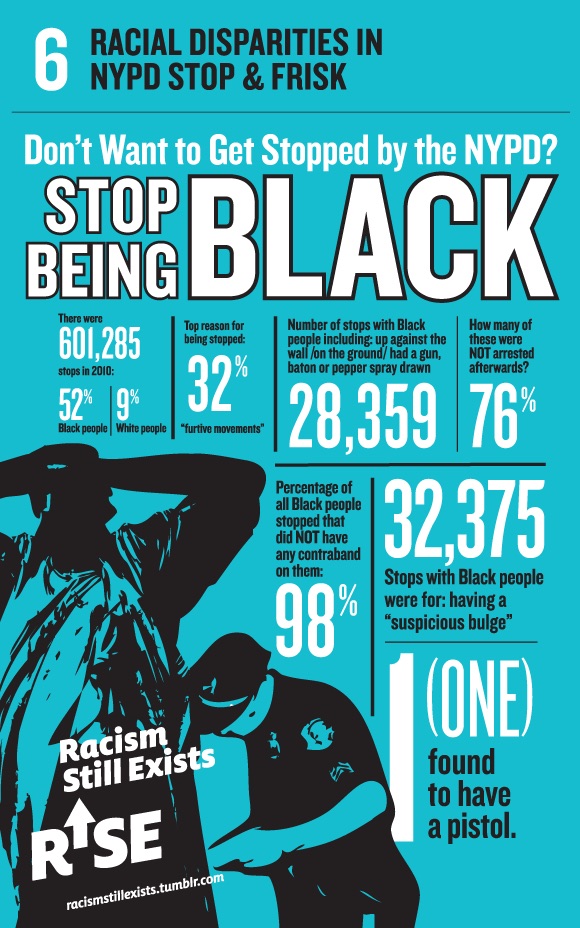
In order for the police to stop you the Supreme Court has ruled that police must have reasonable articulable suspicion that there is criminal activity afoot and that you are involved in the activity. In order to frisk you the Supreme Court has ruled that the police must have independent reasonable articulable suspicion that the person is armed and dangerous before they may touch you (a cursory patdown for weapons). Police may not act on on the basis of an inchoate or unclear and unparticularized suspicion or a hunch - there must be some specific articulable facts along with reasonable inferences from those facts to justify the intrusion.
Clearly, these rules are only intended for white people. [MORE] and [MORE] Believe in the 4th Amendment at your own risk. Non-white people's right to be free from unreasonable search & seizure is not even an afterthought to the elite white media.
[HERE] and [HERE], on Tuesday, around 12:30 p.m. Durham police say three uniformed officers, Charles Barkley, Monte Southerland and Christopher Goss were patrolling the area because of a recent increase in crime there. They came across Frank Nathaniel Clark on foot and stopped to talk to Clark. That is, police ordered Clark to stop and he did. He was not free to go. When the cops stopped him they had no reasonable articulable suspicion that crime was afoot and had no particularized facts to suspect Clark of being involved in any crime. As such, this initial stop by police was unlawful - violating his so-called "4th Amendment rights."
Police claim that during their conversation with Clark that Clark made "a sudden movement towards his waist band and a struggle ensued. During the struggle the officers heard a gun shot. In repsonse an officer fired his weapon." A gun was then found next to his dead body on the ground. [see video of police chief below. never trust a black probot].
Two witnesses told WRAL News that, while Clark might have had a weapon, he did not reach for it or fire it before he was killed. Police found a gun not belonging to the Durham Police Department near his body, Davis said.
"He (the officer) saw a gun on his waist, and he yelled 'gun' and pushed him away from him, and that's when the other officer shot him," a witness, who did not want to be identified, said
Clark had a long criminal record, including charges of assault, trespassing and drug possession dating to 1999, according to court records. His most recent conviction – on charges of drug and weapons possession – resulted in a five-year jail sentence. He got out in April 2015. However, the cops did not know that info prior to the stop. Therefore, it is not relevant to whether the stop by police was legal. However, such information about his background is relevant to racists b/c they believe there is no innocent Black male, just Black male criminals who have not yet been detected, apprehended or convicted. [MORE]
Davis said she didn't know if Clark and the officers knew each other, but she did say the three officers are "very familiar" with that area, where patrols have been stepped up in response to recent criminal activity.
The three officers were placed on administrative assignment, and the State Bureau of Investigation will investigate the shooting, standard procedure after an officer fires a weapon in the line of duty.
From [HERE] and [HERE] The American Civil Liberties Union (ACLU) [advocacy website] on Tuesday reported [press release] that police at the Standing Rock site in North Dakota have used life-threatening weapons to control protesters over the last two days. The ACLU reports that tear gas, rubber bullets, concussion grenades, mace, and water cannons have been used on the protesters. The Morton Country Sherriff [official website], Kyle Kirchemeir, rejected some of those claims in a press conference [Facebook video]. The protesters stated that the force was excessive and that the protests were peaceful while the most white police departments contend that the force was necessary in response to fires being started [NYT report] along a police barricade.
The standoff at Standing Rock in North Dakota—the struggle against the $3.8 billion Dakota Access pipeline that has galvanized the largest resistance movement of Native Americans in decades. The movement has largely been ignored on this year’s presidential campaign trail and by the national corporate media.
According to Bibens, several demonstrators suffered seizures, broken ligaments, loss of bowel control, and, in some cases, loss of consciousness, including one elder who went into cardiac arrest. A reported 300 people have been injured, 26 hospitalized, and several arrested. Both the Standing Rock and Cheyenne Sioux Tribes deployed emergency services for on-the-ground resuscitation and opened a nearby community center for evacuation.
The Morton County Sheriff's Department tried to justify their use of force by calling the protestors ”very aggressive” and framing their demonstration as an “ongoing riot,” while simultaneously denying their use of certain less-lethal weapons entirely.
In a press conference, Sheriff Kyle Kirchmeier told reporters, “We don’t have a water cannon. I don’t know where the term water cannon comes from. This was basically just a fire hose.”
The sheriff’s office claimed that fire trucks were used to stop fires they say were started by the activists. But a video posted to Twitter yesterday clearly shows authorities drenching protestors in areas where there were no fires, using tanks that bear no resemblance to fire trucks.
The health risks associated with deploying these weapons cannot be understated. In a joint report by the International Network of Civil Liberties Organizations (of which the ACLU is a founding member) and Physicians for Human Rights, water cannons are characterized as particularly dangerous and life-threatening weapons. The use of water cannons can induce facial, skull, and rib fractures; brain trauma; bruises; prolonged nausea; and even blindness. Water cannons have been attributed to deaths in Indonesia, Zimbabwe, Turkey, South Korea, and Ukraine.
In North Dakota this weekend, temperatures reached 26 Fahrenheit, or -3 Celsius, making the targets of water cannons also susceptible to hyp0thermia and frostbite. A member of the Standing Rock Medic and Healer Council told reporters that she could hear the sound of clothes “crunching” as people walked in garments frozen to their bodies. For this reason, the Healer Council demanded the immediate cessation of these weapons and expressed concern for “the real risk of loss of life due to severe hypothermia under these conditions.” [MORE]
From [HERE] and [HERE] Caught on video deploying a Taser against a Black mother in a wheelchair simply recording her pregnant daughter’s arrest, several deputies from the Harris County Sheriff’s Office are under an internal affairs investigation for needlessly attacking the disabled woman. Instead of treating her like a human being, the deputies can clearly be seen grabbing her cellphone and throwing it away before tasing the disabled woman until she collapsed out of her wheelchair.
Last Wednesday, 36-year-old Sheketha Holman arrived at a Valero gas station in northwest Houston after discovering her daughter was under arrest for marijuana possession and criminal mischief. A surveillance camera recorded Holman in her wheelchair as she filmed her daughter’s arrest with her cellphone camera.
When she arrived at the gas station, her daughter was being arrested.
“They were grabbing her handcuffs and ramming her into the back of the car. I was like, ‘Hey! Hey! Don’t do that! She’s pregnant!," Holman said.
“I was taking pictures of them, and he was like, ‘Just leave the property, you’re trespassing. They don’t want you here,’” Holman told KHOU.
“I was like, ‘I’m trying to leave. I can’t take off running, but I’m trying to leave,’” Holman recalled. “‘Oh, you’re resisting?’ I was like, ‘I’m not resisting.’ That’s when I had my hands up like this.”
Despite the fact that Holman appears non-threatening in the video, a white deputy can be seen abruptly snatching the phone out her hand before immediately tossing it away. Instead of using her cellphone footage as potential evidence against Holman or her daughter, the white deputy appears to be obstructing justice by attempting to destroy evidence during an open investigation.
She said she could not put her hands behind her back. In the surveillance video, officers clearly struggle to keep her arms pinned, before one deputy shocks her with a Taser.
From [HERE] A white police chief who oversaw an Alabama department while one of its officers was accused of violating the civil rights of an Indian man during a takedown last year is expected to resign in two weeks.
Madison Police Chief Larry Muncey's resignation, effective Dec. 1, comes while he was on administrative leave following a contempt-of-court conviction that stemmed from a federal trial involving Officer Eric Parker., who is also white
Parker was tried twice in the February 2015 takedown of then 58-year-old Sureshbhai Patel, a grandfather from India who suffered serious injuries after being brought to the ground following a police stop. Both trials ended in hung juries; the judge acquitted Parker in January.
Muncey was found guilty in April of federal criminal contempt in connection with Parker's first trial. Those charges stemmed from his discussing testimony with the officer's colleagues. Muncey was ordered to pay a $2,500 fine and attend training for legal exposure and liability.
Maj. Jim Cooke has been serving as the department's acting chief and will continue to do so until the position is filled, the mayor said.
It wasn't immediately clear why Muncey submitted his resignation, which the mayor's office said will be delivered to the City Council on Nov. 28.
Still pending is a federal lawsuit Patel filed against Parker and the City of Madison. Parker, then 27, encountered Patel while responding to a call of a suspicious black man looking at garages and walking near houses. Patel, who was in from India and visiting his son and grandson, testified he did not understand English or the officers who confronted him while out for a walk.
A widely viewed police dashcam video captured Patel's subsequent police takedown, which resulted in injuries to Patel's spine and partial paralysis. Parker has denied the allegations in Patel's lawsuit, saying in court papers that he took Patel to the ground after he jerked away a fourth time during a weapons frisk.
Patel's lawsuit argues that the City of Madison violated federal law by allegedly failing to train its police officers and employing department policies, such as police stops and weapons pat downs, that resulted in a violation of Patel's constitutional rights.
From [HERE] A white Houston police officer smashed a Black man's head into a jail cell door and put him in a neck hold until the bleeding man passed out, according to a lawsuit.
Reuben Williams accused Officer S. Corral of excessive force following his DUI arrest in a lawsuit filed Sunday against Corral and the city of Houston. Williams faces a charge of felony harassment of a public servant after police said he started it by spitting on Corral in November 2014.
Police conducted an investigation, and a Harris County grand jury declined to charge the officer. Yet Williams’ attorney, Randall Kallinen, alleged in the lawsuit that the lack of charges fit a larger pattern around police conduct in the Houston area.
“Despite changes occurring nation-wide Houston has chosen to remain in the Dark Ages when it comes to curtailing excessive force and police misconduct transparency,” Kallinen said in a statement.
“Cops can do whatever they want because this video was never supposed to surface," Williams said.
The Harris County grand jury cleared the officer in June 2015. Corral later received counseling, but Williams received ten stitches over one of his eyes and a permanent scar on his forehead, according to the lawsuit.
From [HERE] A judge sentenced a white Baltimore police officer Friday to 12 years in prison for shooting an unarmed Black man suspected of burglary, citing irreparable harm to the victim and the community's trust in police.
Circuit Judge Wanda Keyes Heard said Wesley Cagle, 47, committed "an egregious violation" and failed to "serve and protect" when he shot Michael Johansen in December 2014.
Cagle, a 15-year-veteran of the force, was convicted in August of first-degree assault and a handgun charge for shooting Johansen in the groin as he lay in the doorway of an East Baltimore corner store after two other officers had already shot him.
Johansen testified that Cagle stood over him and called him a "piece of shit" before shooting him.
Heard spoke of the comment during the sentencing, describing how Cagle did not refer to Johansen as a citizen as he lay on the ground, but "something that might be stuck on a person's shoe." She also pointed out that Johansen lost a large stretch of his intestines and part of his kidney as a result of the shooting.
Heard sentenced Cagle to 12 years for the first-degree assault charge and the five-year minimum sentence for the handgun charge, which does not allow parole. The sentences are to run concurrently.
Cagle was terminated by the department Friday, a police spokesman said.
From [HERE] A Miami jury on Friday cleared three Broward Sheriff's Office deputies accused of using excessive force in a beating that left a 20-year-old man with a factured skull and other injuries.
"I'm thrilled my clients have been vindicated and this was the right result," David Ferguson, attorney representing the deputies, said in federal civil court where a jury of eight had spent the week hearing two contradictory versions of Bryan Atkinson's Aug. 17, 2013, arrest in North Lauderdale.
Deputies Dimitri French, Eddy Hernandez and Todd Yoder were accused in a civil lawsuit of using excessive force and delivering a viscious beating that fractured Atkinson's skull, part of his face and caused a brain bleed during the arrest.
Each deputy testified there had been no beating.
They said that Atkinson injured himself when he fell and landed face first on a sidewalk while running away from the deputies during a traffic stop. They said he fell and then got tackled when he tried to get up and run again.
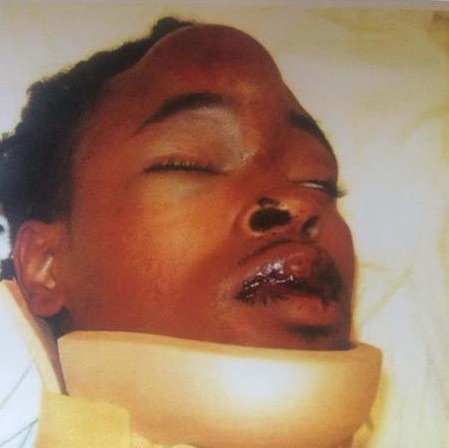
The 24-year-old says the deputies beat, stomped and kicked him into unconsciousness. And an emergency room trauma surgeon testified that “a picture is worth a thousand words.
With a photograph displayed on a projector of Atkinson in a hospital bed wearing a neck brace, a softball-sized lump on his forehead, and his lips caked in dried blood, Greg Lauer, lawyer for Atkinson, gave his opening statement.
“Bryan remembers before he was knocked unconscious, before his skull was fractured, being surrounded by three deputies who said: ‘If you run like a b----, we’re going to beat you like a b----.’
“And that’s what they did.”
Atkinson awoke in the hospital’s ICU with a brain bleed, a skull fracture and a facial fracture running from his forehead to his lower cheekbone and two chipped teeth, Lauer said.
Atkinson told jurors he ditched his car and ran from police in a panic over an illegal vehicle tag but came to his senses, fell to his hands and knees and surrendered. He said that's when the trio of deputies converged, kicking, punching and stomping him until he passed out.
Two neurosurgeons who treated Atkinson in the emergency room at Broward Health Medical Center said it was doubtful his injuries came from a fall.
“I did not believe that what I was seeing was consistent with a fall. I did not believe that story,” trauma surgeon Ralph Guarneri told jurors. He dictated into his medical report that “a picture is worth a thousand words.”
Neurosurgeon Amos Stoll concurred: “It seemed like his injuries were not consistent with a fall, you wouldn’t expect this much injury in this many places.”
Atkinson, a graduate of Lauderhill High School, worked at Burger King at the time and was slated to begin studying auto mechanics at a vocational school. He had no criminal record. Tests for alcohol and drugs came back negative and no gun was ever found, Lauer said.
From [HERE] Lies and excessive force are what Pinellas County Sheriff Bob Gualtieri says got a white deputy fired after he assaulted an unarmed Black woman. “Everybody, especially a deputy sheriff, has to tell the truth. If you don't tell the truth, you won't work here. It’s that simple,” Gualtieri said. The sheriff says video helped reveal the truth about Deputy Wayne Wagner repulsive behavior during a traffic stop at a gas station.
About 9:40 p.m. on March 25, Wagner pulled over a car into the Mobil station at 10021 4th St. N. in St. Petersburg, according to the sheriff's office. He arrested the driver, Paige Taylor, for driving on a suspended license, then directed the Black woman to get out of the vehicle.
“She takes the driver’s license out of his hand, and then turns to walk away. At that point, Deputy Wagner slammed Taylor up against the side of the vehicle, and then took her to the ground and used improper force,” says Sheriff Gualtieri. The video shows the white cop snatch the Black woman, push her into the side of the truck and then tackle her to the pavement.
Gualtieri told 10News that the violence Wagner used on Paige Taylor was too much, but insists what happened next was worse – the deputy claimed she attacked him.
On the dashcam video of the incident, you hear Wagner call out on the radio, “I'm in a fight!”
Taylor calmly responds as she’s on the ground, “You’re not in a fight officer.” She then says, “Stop! What are you doing?”
Wagner: “You're under arrest.”
Taylor: “For what?”
Wagner: “For battery on a law enforcement officer.”
Taylor: “I didn't do anything to you.”
The sheriff said the Wagner then lies to his backup, saying Taylor shoved him and he arrested her for it.
“He demonstrates that Taylor pushed him. That just simply didn't happen,” Gualtieri said.
The deputy continued to stick to his story for months in follow-up reports.
Taylor filed a complaint and the department launched an internal investigation. Charges were dropped against Taylor.
The sheriff said the video uncovers the truth.
“As the video clearly shows, Taylor didn't touch deputy Wagner at all. There's absolutely no room for a deputy sheriff to not tell the truth,” Gualtieri said.
Records from Wagner’s personnel file show this wasn't the first time he’d been in trouble since joining the department in 2014. He got a week suspension earlier this year for a chase topping 130 miles an hour without emergency lights on U.S. Hwy. 19.
He crashed as part of a motorcade escorting vice presidential candidate Tim Kaine, then got busted sending a picture of his privates to a gas station employee while working at Winter Springs Police Department, near Orlando.
To download Wagner's public record files and reports, click here.
Taylor's attorney told 10News that she's still fearful of law enforcement, but feels Wagner's firing is justice.