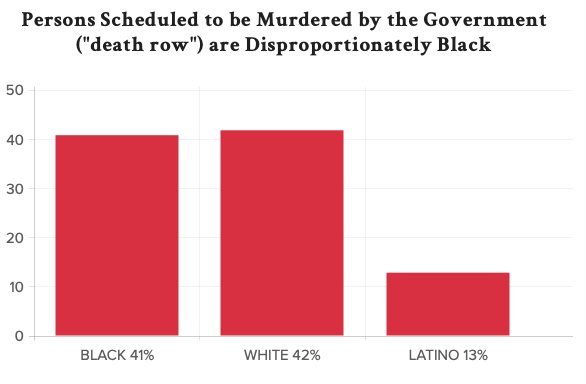
New Report Examines the Unprecedented Execution Pace in Florida- which accounted for 40% of All Executions in the US in 2025 (35% of those Murdered by FLA Authorities were Black)
/
From [HERE] and [HERE] The United States carried out 47 executions in 2025, and Florida carried out 19 — the highest number in state history and more than double its previous modern record, according to a year-end report from Floridians for Alternatives to the Death Penalty (FADP). Executions in Florida — which averaged one execution every 16 days from February 2025 through December 2025 — accounted for 40% of the 47 executions nationwide, making Florida a clear outlier in the use of the death penalty in the United States. Setting Florida’s record-breaking numbers aside, 28 people were executed in 10 states in 2025, similar to 2024’s total of 25 executions in nine states.
Prior to 2025, the only state that had ever exceeded 18 executions in a single year was Texas, which last did so in 2009. States executed prisoners at higher rates in the late 1990s and early 2000s, when public support for the practice was much higher than it is today. Unlike most states, where courts and prosecutors set execution dates, Florida’s governor holds sole authority to sign death warrants.
“Despite [the governor’s] previous middling interest in capital punishment, Gov. [Ron] DeSantis elected to use his power extensively in 2025.”
WE, THE PEOPLE: A RECORD OF FLORIDA’S DEATH PENALTY IN 2025, FLORIDIANS FOR ALTERNATIVES TO THE DEATH PENALTY.
The Florida legislature enacted several bills related to death penalty expansion in 2025, including a mandatory death penalty provision for unauthorized immigrants convicted of certain capital crimes; additional aggravating factors for crimes at schools, government, or religious gatherings, and for the deliberate targeting of politicians including governors and other high-ranking officials; and expansion of possible execution methods to include any method “not deemed unconstitutional.” FADP’s report notes the U.S. Supreme Court has never found a method of execution unconstitutional and “that Florida’s prisoners could presumably be executed by firing squad, nitrogen suffocation, hanging, beheading, or any other method imaginable.” The state also designated sexual trafficking of a vulnerable person as a capital felony, despite Supreme Court precedent established in Kennedy v. Louisiana (2008) prohibiting death sentences for non-homicide crimes.
The state’s current execution method also received scrutiny in FADP’s report. Florida remains the only state using a three-drug protocol consisting of etomidate, rocuronium bromide, and potassium acetate. Court filings from December 2025 presented evidence of significant procedural failures, including four executions using expired etomidate, underdosing of required drugs in two executions, unlogged etomidate appearing in autopsy results, and using lidocaine, which is not listed in the state’s execution protocol. In response to these failures, former Florida State Prison Warden Ron McAndrew, who oversaw three executions, warned in the Tampa Bay Times that the current pace of executions is “testing the limits of the law.” FADP’s report notes the lack of transparency surrounding Florida’s execution protocol makes it “increasingly likely that additional details about the procedural failures and moral injuries inflicted upon state employees during this execution spree will reveal themselves.”
The report also documents several troubling patterns among those executed in Florida in 2025. Four individuals—James Ford, David Pittman, Victor Jones, and Frank Walls—had thoroughly documented intellectual disabilities, though the report states all four individuals’ claims were dismissed “not due to a lack of merit, but because they were deemed raised too late or incorrectly.” Florida executed these four men despite categorical legal protections for individuals with intellectual disability under both Florida and federal law. Eight people executed were sentenced to death under schemes allowing non-unanimous jury recommendations, and Florida’s current statute permits death sentences with just 8 of 12 jurors in agreement, the lowest threshold in the country. FADP highlights that almost all, 97%, of Florida’s 30 death row exonerees were sentenced to death by non-unanimous juries. Seven1 of the 19 executed individuals had served in the U.S. military, constituting 70% of veterans executed nationwide in 2025. Four individuals faced execution without adequate legal representation, with Bryan Jennings and Norman Grim having death warrants signed while they did not have state-appointed counsel, and Anthony Wainwright’s attorney had not visited him in more than a decade. Two executed individuals — Victor Jones and Michael Bell—were survivors of abuse at state-run reform schools that the Florida Legislature officially acknowledged the trauma endured at these state facilities and compensated victims. [MORE]