Spartanburg Deputy Shoots Black Man Multiple Times: Officer Claims Self Defense

jennings.jpgjennings2.jpg 
Jennings Challenges the Police to Show the Video tape
The Spartanburg County Sheriff's Office initially told usPaul Jennings tried to run over a deputy-- and that's when the deputy opened fire. But the driver says it didn't happen that way and is banking on dash-cam video to prove his case. Shot up--with bullet holes in his arms and a bullet lodged in his chest, Paul Jennings waited nearly 24 hours before checking himself in at a hospital. Partly, he says, because we didn't hear his side of the story. He said, "that’s right, I'm bleeding, I was upset. I'm not going to say I was perfect in the situation but to be shot at like a dog, now that was wrong." On Thursday night, Sheriff's Deputies tell us Jennings continued driving through a safety checkpoint-- triggering a small chase that ended in gunfire and could have ended in death. Sheriff Chuch Wright/Spartanburg County: "State law says when a deputy motions for you to stop, you stop, whether you're at a checkpoint or not. And that was happening and he didn't stop." Jennings admits he should have stopped sooner, once the blue lights were on, but he says the Sheriff's Office should admit that he also didn't shift his car out of park until the deputy started shooting at him. Jennings: "And then he went to the windshield with the gun. I said ok.....then 'bang', 'bang', 'bang'. I backed up. That’s when I left and when I put my hand on at the switch. Then he shot at me 3 times...the only reason I backed up and got away was when I got shot. They will not show that tape; the tape in the patrol car." So far, no charges have been filed against Jennings. [MORE]

Mexican Immigrant Fleeing Hillsborough County Deputy Shot Dead

The wife of the man shot to death last Friday by a Hillsborough County deputy refuses to believe he tried to attack the officer. At their Ruskin home Saturday, April Lopez said her husband, whom she called Herman, was an illegal Mexican immigrant who became terrified of being deported after a deputy caught him speeding through a Wimauma neighborhood. The 31-year-old driver led deputies on a two-mile pursuit before crashing his pickup into two patrol cars. Saturday morning, sheriff's spokesman J.D. Callaway released the driver's name as Sergio Lopez-Flores. Callaway said Lopez-Flores had a small amount of marijuana with him when he sped past a Hillsborough County deputy trying to wave him down and later pulled a knife on Deputy Daryl Bowden before the officer shot him at least twice. After the crash, Callaway said, Lopez-Flores climbed out of his overturned truck in the median of U.S. 301 north of Highway 674 and continued to approach Bowden with the knife before he was shot. Lopez-Flores was pronounced dead at Tampa General Hospital. An autopsy was scheduled for Saturday. It could take weeks for results to be released. April Lopez, 33, married her husband just two days before the shooting. They have a 19-month-old daughter. [MORE]

N.J. Indian tribe decries deadly police shooting

vandunk.jpg
The gathering started, as it does each spring, with members of the Ramapough Lenape Indian tribe meeting for a cookout and a day in the woods, celebrating the warm weather and the beauty of the Earth. It ended with one of the tribe members mortally wounded, shot three times by a state park police officer who had told the Indians they were not allowed to ride their all-terrain vehicles in the area. The death 10 days later of Emil Mann, 45, of Monroe, N.Y., has tensions running high, with the tribe decrying years of bias, state officials pleading for calm and a grand jury investigating whether the shooting of the unarmed man was justified. “It's murder,” said Rodney Van Dunk, a cousin of the tribal chief. “Even a bear doesn't get shot three times.” The facts of the April 1 shooting on Stag Hill, 27 miles northwest of Manhattan, are in dispute. Authorities contend that four park police officers were patrolling an area near the Ramapo Mountain State Forest when one of them saw Otis Mann, a cousin of the dead man, riding an ATV and asked him to stop because the vehicles were not permitted on state parkland. Otis Mann rode away from the officer. About 20 minutes later, officials say, Lt. Kelly Gottheiner saw Otis Mann and said she planned to arrest him, but he resisted and tried to grab her baton. A second officer handcuffed him. The Ramapoughs give a starkly different version, saying that police slapped and used chemical spray on Otis Mann's 14-year-old daughter during the dispute about the ATV. They also say that Emil Mann approached the officers as a peacemaker, with his hands in the air, when he was shot. Emil Mann “was just trying to calm things down.” While tribal leaders said they were satisfied with the state's willingness to investigate, they said the killing was the culmination of decades of anti-tribe bias from the government and neighbors alike. [MORE]

New Jersey Governor to Meet with Indian Tribe tp Discuss Police Killing
Gov. Jon S. Corzine, state Attorney General Zulima Farber and other officials were to meet this evening with leaders of a north Jersey Indian tribe to try to ease tensions caused by the fatal shooting of a tribe member by a park police officer. The officials will meet privately with leaders of the Ramapough Lenape Indian Nation to discuss the April 1 shooting. No charges have been filed against Walder, who is claiming self-defense. A grand jury will review the shooting. Mann, 45, died April 10. Anthony Coley, a Corzine spokesman, called the meeting "an important dialogue with leaders of an important community.'' [MORE]

Stockton Officer Cleared in Fatal Shooting of Latino Man with a Skateboard in his Hand

A Stockton police officer was justified when he shot and killed a man who threatened him with a wooden stake on the Cesar Chavez High School campus late last year, the San Joaquin County District Attorney's Office said Thursday. Prosecutors found that Gustavo Peña Izaguirre's methamphetamine use - not the 26-year-old Mexican immigrant's inability to understand commands officers shouted in English - led to the shooting. "He was acting bizarre. He wasn't rational," said Deputy District Attorney Seth Hoyt, who reviewed the case. "At some point, he raises a stake and a broken skateboard and comes at the officers." Sgt. Kenneth Brown was left with no choice but to fire two rounds at Peña, Hoyt said.  An attorney for Peña's family is still considering filing a lawsuit seeking at least $25,000 for what he called Peña's "unlawful" killing. The confrontation began on the morning of Nov. 12 when a Stockton Unified School District officer found Peña on campus with a broken-down car. Officers tried to communicate with Peña through the afternoon, urging him to leave campus. Those officers who didn'tspeak Spanish used hand signals with Peña. At one point, an officer put Peña on the phone with a Spanish-speaking officer. Peña continued to resist officers and grew combative, the report said. A school police officer then sprayed Peña with a chemical agent when he wielded a broken skateboard and the stake at officers. Brown arrived and tried to stop Peña with a stun gun. That too didn't deter Peña, who threatened Brown with the stake. From a distance of about 12 feet, Brown fired at Peña, the report said. At 7:25 p.m., doctors pronounced him dead. Gessell said witnesses told him a different version of the shooting.[more]

Appeals Court Upholds Ruling Dismissing Case of Black Man Killed by Knoxville Police

sgillespie.jpg
  •  Mother says son holding cell phone, not gun, when KPD officer shot him [MORE]

A state appellate court has upheld a ruling clearing two Knoxville Police Department officers of claims of negligence in the controversial shooting death of a teenager. The state Court of Appeals ruled in an opinion released this week that KPD officers Jason Keck and David Ogle were not at fault in the May 2003 fatal shooting of 19-year-old Sean Gillispie. Keck shot Gillispie once in the chest after he saw what the officer testified was a gun in the teenager's hand. Gillispie was in the back of a car parked at the Weigel's convenience store on Summit Hill Drive, where the officers had been sent to handle a complaint by store employees of a loud crowd in the parking lot. Gillispie's mother, Tanya Gillispie, filed a lawsuit in Knox County Circuit Court alleging that what Keck believed was a gun was actually a cell phone. She blamed Ogle for failing to properly communicate with Keck in the moments before the shooting. Testimony at a hearing in the lawsuit last year showed that Ogle saw a gun on the back seat where Gillispie was seated. Ogle testified that Gillispie's hand was on top of the weapon. Keck testified that Gillispie lowered his hands and then pointed the gun at the officer. When the teenager refused Keck's demand to disarm, Keck testified that he fired one shot, which struck Gillispie in the chest. Ogle pulled Gillispie from the car and onto the pavement, where he died. The gun was found on the back seat. There was no blood on it. A bloody cell phone was later discovered inside a bag of clothing removed from the teenager's body at the morgue. Judge Dale Workman ruled Keck's testimony was unequivocal and undisputed - it was a gun and not a cell phone in Gillispie's hand. The officer's use of deadly force was, therefore, justified, the judge opined. The court also turned aside Tanya Gillispie's contention that Workman, whose son is a deputy with the Knox County Sheriff's Office, should have bowed out of the case. [MORE]

Jail Guard Shoots Escaping Hawaiian Man in the Back

A jail guard who shot and killed an escaping prisoner April 11 in downtown Hilo told a 911 operator that the prisoner "used bodily harm" against him before the shooting, according to tapes from Hawaii County Police and Fire departments. The guard, whose name has not been released, shot Thane K. Leialoha, 28, after Leialoha got out of handcuffs and ran across busy Haili Street in midafternoon. The tapes were released yesterday at the request of news media. "Why did you shoot him?" a fire dispatcher asked the guard moments after the shooting. "He escaped from my van," the guard answered. "He used bodily harm to push me away." His language indicated he was angry. "The f-- wen' push me down, so I f--" His voice halted, then he resumed. "I don't know what he had in his hand," he said. But he later told the dispatcher that he knew Leialoha was unarmed. "OK, did he have a weapon?" she asked him. "No, he didn't have a weapon," the guard replied. "But he broke out of the van, he got out of his restraints and then he crawled under the van, and when I tried to grab him, he (inaudible), he hit me and I fell to the ground, and he was running away and I shot him." Police and the state Department of Public Safety, which employs the guard, are continuing investigations to determine whether the shooting was justified. [MORE]


LAPD Commission Refuses to Release Name of Police Officers who Killed Devin Brown

lapdkkk.jpg
The Police Commission unanimously rejected a Public Records Act request Tuesday to release a pair of reports that name the officer who fatally shot 13-year-old Devin Brown last year. However, in an attempt at a compromise, the commission also voted 5-0 to direct the Los Angeles Police Department to issue news releases naming officers involved in all categorical use-of-force incidents, which includes shootings, head strikes or any other confrontations that could lead to death or injury."This clearly is a very difficult, challenging matter because we have two major competing interests," Commission President John Mack said. "On the one hand we have the public's right to know -- and on the other hand, we also want to protect the rights of the officers involved in these types of incidents. It's a collision course."Los Angeles Times reporters Scott Glover and Matt Lait submitted a records request to the commission Feb. 15, asking for two documents that would name the officer who fatally shot Devin Brown after a short pursuit in south Los Angeles. One document was a report written by Police Chief William Bratton, while the other was the LAPD's officer-involved-shooting evaluation of the incident.The commission adopted a policy two months ago to withhold the names of officers involved in shootings and other uses of force. The move was made so the commission could post details of use-of-force incidents without compromising the officer's identity. Commissioners Andrea Ordin and Anthony Pacheco said they studied the matter with city lawyers and others familiar with California Public Records laws and said they considered the documents requested by The Times as personnel records, because they comment on the officer's actions. Times attorney Susan Seager argued that neither document requested by the newspaper should be considered part of a personnel file, since medical information, the officer's home address or other personal items are not included in the paperwork. Ordin and Pacheco noted that officers are usually named in press releases issued immediately following officer-involved shootings and "other newsworthy categorical use of force incidents.""If you do the research, the names are already out there," Ordin said. [MORE]


Rampart Case Not Closed Yet for LAPD

In the five years since the Rampart Division corruption scandal stunned the city and voided more than 100 criminal convictions, the Los Angeles Police Department has struggled to reform itself under a controversial court decree. Officers today face more rigorous training and supervision, confidential informants are monitored more closely, and use-of-force incidents are more thoroughly investigated. Yet, by its own admission, the department has fallen short in important areas. As a result, U.S. District Judge Gary A. Feess is expected as early as May 15 to extend the five-year federal consent decree for at least two more years, a move that would not only embarrass city officials and LAPD brass but serve as a costly and continuing distraction. LAPD officials say the city has substantially complied with 149 of the 191 consent decree mandates agreed to under threat of a lawsuit by the U.S. Department of Justice. In the Rampart scandal, members of the LAPD's Rampart Division anti-gang unit were accused of shooting and beating suspects, planting evidence and using confidential informants without registering them with the department, leaving their reliability unchecked. One officer, Rafael Perez, admitted that he and a partner obtained an assault rifle from an informant and shaved off the serial number before planting the weapon on a wounded man. In another case, officers were accused of providing crack cocaine to an informant in exchange for information. A review of cases handled by the rogue officers caused more than 100 criminal convictions to be overturned, and about a dozen LAPD officers resigned or were fired. The city also paid $70 million to settle lawsuits by more than 200 people, many of them suspected drug dealers and gang members who alleged that they were shot, beaten or framed. [MORE]

Latino Man Shot in the Face by Kerrville Police Officer Files Excessive Force Suit

A man shot by a Kerrville police officer filed suit against the city in federal court on Tuesday. Alfredo Ramirez Jr., 23, claims in the suit that Kerrville police Cpl. John Knoulton, who shot Ramirez on Jan. 18, 2005, unnecessarily used excessive force. Ramirez's suit also alleges officers violated his constitutional rights and were negligent. The suit seeks unspecified damages. Kerrville police have said Ramirez was shot in the face after brandishing a pistol at officers who stopped his car on Town Creek Road. Officials said a detective had called Ramirez and was talking to him about another investigation when Ramirez spoke of committing suicide. The detective alerted superiors, who dispatched officers who later encountered Ramirez as he drove away from his home. [MORE]

Lawsuits Allege that Riverside Fire & Police Officers Beat Diabetic Black Man and Let him Die

Family members of a 35-year-old diabetic, who died after an Oct. 2 struggle with Riverside police while he was in medical distress, have filed wrongful death claims against the city. Two separate claims state that police and firefighter paramedics who were called to assist Terry Rabb, who was having a diabetic episode, used excessive force. Lt. Darryl Hurt said police assisted firefighter paramedics because Rabb's behavior was "hostile." Sgt. Leon Phillips said in October that the officers struggled briefly with Rabb and handcuffed him, but Rabb died later that evening. Phillips said the officers did not use any weapons in the struggle with Rabb. A damage claim submitted to the city clerk's office March 13 by the law office of Douglas Pryor of Beverly Hills, on behalf of Rabb's daughter and former wife,states that Rabb "was in obvious need of immediate medical attention" and alleges that emergency responders used "excessive force" and "did willfully and maliciously cause the wrongful death" of Rabb. A separate claim, filed March 10 by attorney Mark Huston of Orange, on behalf of Rabb's two sisters and three of his children, alleges that police "physically beat Terry Rabb, handcuffed him and treated him as if he were resisting arrest, violating his civil rights, and otherwise failed to treat his medical emergency thereby directly causing his untimely and immediate death." Rabb was Black and the involved city employees are not, the claim states, adding, "It is believed that race was a motivating factor in the treatment given to Mr. Rabb." Huston said, "That doesn't jibe with what the witnesses say -- he was not hostile." He said the city must respond to the claims before a lawsuit is filed.  [MORE]

Two Years Later Still No Officers Punished in Beating Death of Black Man by Greenville Police

suggs.jpg
Kenneth Gray Suggs died on Jan. 31 at Pitt County Memorial Hospital from injuries his family believes were suffered while he was in Greenville police custody nine days earlier. Suggs ran from police after being spotted with an open alcohol container near Fourth and Hudson streets about 7:30 p.m. on Jan. 22. Suggs was apprehended at Martin Luther King Jr. Drive and 14th Avenue and charged with resisting a public officer, consuming alcohol in public and being intoxicated and disruptive. He was held on a $1,000 bond at the Pitt County jail. Family members believe Suggs was kicked, stomped and choked by at least three officers after he was apprehended. "This is what you get for making me run after you," one officer allegedly said, according to an affidavit by the victim's wife, Amia Clopton-Suggs. Suggs allegedly kept passing out while in police custody and officers used either smelling salt or ammonia to revive him several times, according to an affidavit given by Suggs' mother, Sylvia Suggs. After complaining of asthma symptoms at the police station, Suggs was taken to the hospital where he was treated and released, police officials said. Sylvia Suggs' affidavit stated that hospital officials only checked his pulse and temperature before he was cleared. After the victim's mother and wife posted bond and Suggs was released from the Pitt County Detention Center, they said Suggs had to be helped to a vehicle. He was admitted to the hospital again the following day where he died a few days later. [MORE]


Letter from Coalition Againt Racism
On Jan. 29, the family and friends of Kenneth Gray Suggs Jr., along with community justice advocates, gathered at Thomas Foreman Park to memorialize the second anniversary of Kenneth's death after being beaten by Greenville police officers. There was talk of the pursuit and eventual fatal shooting, three days earlier, of Kerry Turner.

Aside from establishing a truly independent, elected, Civilian Complaint Review Board:

– Prospective police officers should first be screened for tendencies toward brutality and denial of basic human rights.

– They should then be trained to defuse potentially volatile situations and less violently protect themselves and those they are supposed to be trying to help.

It would certainly take more than the above to decrease the disproportionate arrest, brutalization and even death of young black men and other people of color. But maybe we would have fewer people with mental disabilities dying due to the use of lethal force. How absurd it is to take the life of a tortured soul in the effort to execute an involuntary commitment order designed to better his life and the life of others?

Have we made no progress in our understanding of mental illness and treatment? Is it possible we simply don't value our youth, especially if they are people of color? Most of the talk of gangs, drugs and curfews only serves to further criminalize an entire generation.

Why should our youth look to the military as their best way to get training/formal education today?

Let's instead invest our financial and creative resources in quality health and mental health services for everyone; schools, not jails, and job training, not wars overseas.

DON CAVELLINI
Coalition Against Racism Greenville
[MORE]

Family Demands Answers in Elk Grove Police Shooting of Black Man

lamaralaexander.jpg
On Tuesday, Lett studied the home on Owl Court where his younger brother was shot several times during an apparent fracas with the Elk Grove police officer. The shooting capped a minutes-long pursuit that ended in the cul-de-sac shortly after 4 a.m. April 11. As relatives pressed for answers, the Sacramento County Sheriff's Department, which is investigating the shooting, sent a memo offering more details on the location of Alexander's gunshot wounds. The Bee had reported a discrepancy between the department's initial account of shots to the torso and "again in the upper chest" with the coroner's finding on cause of death: "gunshot wound of back into chest." In the department memo, Capt. James E. Lewis, who also wrote the press release, said Alexander suffered additional gunshot wounds to his "frontal upper body, a head wound and an apparent exit wound in the chest." Family members of LaMarr Alexander gathered this week at the spot where the 26-year-old man was shot to death by an Elk Grove police officer in the backyard of a Laguna home. They say they will continue to come, hold vigil and demand answers in the shooting in which the fatal bullet struck the man's back. "I'm not saying the shot was necessarily wrong, but there are a lot of questions," said Alexander's brother, Ishmill Lett, a police officer from Southern California. "And I have to say, this doesn't look good."

  • Black Man Armed with Garden Tools? : Alexander apparently ran to a backyard, where sheriff's officials reported he "was actively fighting with the officer" as other officers arrived at the scene. He allegedly threw a 12-inch ceramic flowerpot at the officer's head and apparently was grabbing nearby garden tools when the shots were fired. A semiautomatic pistol was found later in Alexander's pants pocket, but it was not drawn during the ordeal. "I heard him yelling for help; I didn't know it was him," recalled Alexander's aunt, Lorraine Johnson, who lives a few doors from the shooting scene. After hearing seven gunshots from her window, she heard a man's plea: " 'Help me! Help me! I'm right here, I'm in the backyard.' " Johnson said she heard a female officer's voice tell the man to get down. She said she heard the man plead again for help before the officer said, "OK." "And then," Johnson said, "it was quiet." [MORE]

La Porte Police Officer Charged with Attacking Black Man with Taser

laporte.jpg
The incident happened March 29 inside the interrogation room at the La Porte police department. "Get up, get up," the officer shouted as the suspect moaned on the floor. In addition to the assault charge, Officer Carl Davis was also suspended. And it's not the first time. Davis was suspended last year for allegedly beating a woman he was arresting. He was never charged in that case. [MORE]


Redwood City Facing Wrongful Death Suits Involving Latino Men Killed in Custody of Police

escobedo.jpg
A year after Redwood City settled a wrongful death lawsuit with the family of Ricardo Escobedo, the 29-year-old resident who died after a scuffle with eight officers, a different civil rights complaint on behalf of the man himself remains unresolved. The estate of Ricardo Escobedo and Redwood City are scheduled for trial in January, said attorney Mark Martel who said there are no plans to settle the suit for anything close to the $250,000 handed to the deceased man’s two children. “For the family, the most important thing is that the officers in the city are held liable. In a civil suit, all you can get is money damages,” Martel said. In March 2005, the ongoing federal suit in Escobedo’s death appeared finished. Without admitting any wrongdoing on the part of police, Redwood City agreed to put $250,000 in a trust for Escobedo’s two children. Now, a suit on behalf of Escobedo claiming excessive force and deprivation of life is still unresolved, he said. “I don’t see this settling. The wrongful death claim was a very low amount and I don’t see the representatives of his estate even considering settling for that,” Martel said. Escobedo, known as “Ricky,” died Nov. 17, 2002 after officers responded to a domestic dispute at his ex-girlfriend’s Woodside Road apartment. The official cause of death was a heart attack due to “excited delirium” after the scuffle which included pepper spray, nunchucks and a straight jacket-like wrap, according to the report by Coroner Robert Foucrault. Both internal affairs and District Attorney Jim Fox cleared the officers of any criminal wrongdoing. However, Escobedo’s family said the amount of force used by the police broke seven ribs and damaged his trachea, leaving him unable to breathe. They unsuccessfully filed claims against the city and battled to have the case re-opened. The lawsuit argued that the officers never tried diffusing the situation before resorting to brute force in subduing Escobedo. The suit also maintained that the officers failed to provide swift medical care.

Fernando Cazares also Killed by Redwood City Police A similar search for justice is also under way by the estate of Fernando Cazares, a 36-year-old Redwood City man who died while being arrested by sheriff’s deputies more than a year ago. His family is suing San Mateo County for wrongful death after a $2.75 million claim was denied. Martel represents the family in that case, too.Cazares died while being taken into custody just outside city boundaries. Cazares was pronounced dead an hour after deputies were dispatched to the 300 block of Second Avenue in unincorporated Redwood City. Ana Cazares, the deceased’s sister, hysterically told the dispatcher that her brother was a crazy person who was on drugs. His mother, Maria, later told investigators she was afraid of her son, who arrived home at 1 a.m. acting strangely. Both women also claimed to have struck Cazares over the head with a beer bottle. His family’s lawsuit, however, argues that Cazares was hit four times on the head with a flashlight or baton. The two officers first on scene admitted striking him with flashlights but the force was deemed acceptable. The autopsy showed no head injuries or brain swelling consistent with the repeated strikes neighbors recalled. During the investigation of Cazares’ death, three deputies cooperated while two declined to be interviewed.The county denied the claim about six months ago, said County Counsel Tom Casey.

  • Redwood City settles Lawsuit in Police Beating Death of Latino Man [MORE]
  • Pepper spray death was accidental [MORE] and [MORE]
  • Pictured above: Ricardo Escobedo

Lawsuit in St. Paul Police Shooting of Mentally Ill Hmong Man Dismissed

Ending a lawsuit over a shooting that seemed to cause anguish for everyone involved, a federal judge Thursday threw out a case brought by survivors of a mentally ill man killed by a St. Paul police officer in 2002. U.S. District Judge Paul Magnuson dismissed claims that the St. Paul Police Department didn't adequately train its officers to deal with mental illness and that the lack of training contributed to the shooting death of Ki Yang, 46, who suffered from schizophrenia and had a history of violent episodes. "Undoubtedly, Ki Yang suffered from a severe mental illness that made his life difficult. The Court does not mean to minimize the effects of Ki Yang's mental illness," Magnuson wrote. However, he said, Ki Yang's family didn't prove that officers acted unreasonably that night. On Sept. 27, 2002, Ki Yang, a postal worker originally from Laos, barricaded himself inside his home. His family called police, warning dispatchers about his history and telling them he had stopped taking his medication. Officers Shannon Sills and Michael Tharalson arrived on the scene. Ki Yang refused to let anyone enter, and police would not force their way in because he hadn't threatened anyone.  Ki Yang then appeared with a BB rifle in one hand and a sickle in the other. Tharalson ordered him to drop the gun. Instead, Ki Yang approached him. Tharalson retreated. After being backed into a corner, Tharalson shot Ki Yang several times, mortally wounding him. Ki Yang's family — including widow Yeng Thao — sued the city and the two officers, claiming that his civil rights were violated and that he experienced discrimination under the Americans With Disabilities Act. They were represented by the University of Chicago Law School's MacArthur Justice Center, which specializes in human rights and social justice litigation[MORE]

 

Handcuffed, Subdued Black Man Mysteriously Dies in Cobb County Police Custody

The NAACP is calling for an independent is calling for an independent investigation into the death of a man while in police custody. 48-year-old Alfred Fleming died on April 13th after police came to his house on a domestic call. Police say the officers got into a struggle with Fleming and were forced to use pepper spray. A short time later, Fleming became unresponsive and was taken to Cobb Hospital where he was pronounced dead. Edward Dubose, NAACP: "I stand here today and tell you there is no reason why a man who is handcuffed, pepper-sprayed and already subdued, should have died in police custody." The officers involved in the incident have been placed on paid administrative leave, pending the outcome of an internal investigation. Cobb County police have not commented on this case. [MORE]


Police brutality charges dropped- East Palo Alto Cops were "Off Duty" when they Beat Down Black Man

  • Officers still face battery charges 

Police brutality charges have been dismissed against two East Palo Alto police officers on trial for allegedly beating a man during off-duty hours. But Officers Edward Rivers Jr., 39, and Johnny Taflinger, 33, remain on trial for felony assault and misdemeanor battery, charges that could result in four-year prison terms. Judge Carl Holm dismissed the police brutality charges on Wednesday and said the prosecution didn't prove beyond a reasonable doubt that defendants were acting under the color of authority when the alleged crime occurred. Rivers and Taflinger are accused of chasing down and beating East Palo Alto resident Calvin Brooks on Aug. 21, 2004 after they solicited Brooks to sell them crack cocaine in a west-side 7-Eleven parking lot. The officers admit to chasing Brooks but deny the assault. Brooks was hospitalized the next day with a fractured rib, which the defense doubts was inflicted by the accused officers. The District Attorney's Office initiated its investigation after Officer David Carson reported Rivers disclosed the beating to him.  Rivers and Taflinger told investigators — and Rivers testified on the stand — that Rivers identified himself as a police officer when they gave chase. Brooks and a civilian witness who was had been with the officers gave similar testimony. However, Holm opined that Rivers' own words couldn't be used as evidence and that there had to be independent evidence that they had assumed their authority as police officers, despite being off the clock. Prosecutors disagree and feel the statements were sufficient proof, because they occurred during the act. The trial continues today with further testimony from defense witnesses. Jury deliberations are likely to start on Monday.

Topeka Officer Accused of Excessive Force for Throwing Handcuffed Black Man to the Ground on Video

topeka.jpg
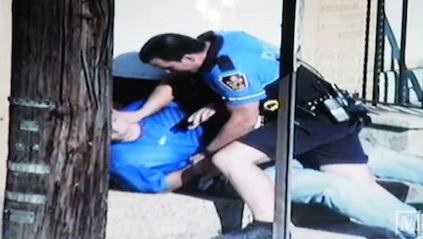
Topeka police here received their third dose of bad publicity in six months with the release Thursday of a DVD file showing a sergeant grabbing a suspect by the neck and wrestling him to the ground at the county jail. The question was whether Sgt. Steve Thompson used excessive force in booking the suspect into the Shawnee County Jail. The incident, which occurred about 3:30 a.m. April 2, was captured on a jail camera, and the county commission made it public Thursday. The Kansas Bureau of Investigation is examining the incident, which also prompted interim Police Chief Steve Harsha to publicly apologize to the city's residents.  "There is no excuse for substantiated misconduct of any kind, and we will hold our employees accountable," Harsha said during a news conference. KBI Deputy Director Kyle Smith said his agency was asked Wednesday by the district attorney's office to look into the matter. Thompson, 34, was placed on paid leave pending the outcome of the investigation. He joined the department in June 1994. The incident occurred about a month after Harsha disciplined two detectives for making racially charged statements in e-mails and a letter to the president of the local chapter of the National Association for the Advancement of Colored People, criticizing a newspaper column she wrote. [MORE]

New Details in Eaton County Deputy Accused of Shooting Himself- White Cop said a Black Man Did It

bullshitsketch.jpg
New developments in the case of the Eaton County sheriff's sergeant who prosecutors say made up a story about being shot by a black man, when he really shot himself. The Michigan State Police handed over a report to the Eaton County prosecutor as part of the investigation. Prosecutors aren't sharing the details but state police claim that Jeff Lutz did not use his own gun to shoot himself. Police say they found a 25 caliber gun, and the bullet casing matched those found at a Delta Township shopping center where the incident happened. Investigators aren't saying where that gun came from. You'll remember Lutz originally blamed a black suspect for the shooting, and that's when greater Lansing clergy forum called for Eaton County to investigate racial profiling and hiring practices in the sheriff's department. The head of the forum says they've gotten most of the information they need, but says they still want details about the how the department stops and arrests people of color along the Waverly Road corridor. Melvin T. Jones, greater Lansing clergy forum head: “Residents have been complaining that there are stops taking place that are harassments, more so than stops that are aligned with some sort of criminal behavior.” [MORE]

NO JUSTICE: White Milwaukee Police Officers Acquitted by ALL White Jury in Brutal Beating of Black Man

 April 15, 2006

judebefore.jpgjudeafter.jpg

  • NAACP Denounces Verdict [MORE]

Defenseless, Handcuffed, Unarmed, Half-naked Black Man Beaten by at least 9 Officers
An all white jury cleared three white former police officers of most charges in the 2004 brutal beating of a biracial man that enflamed racial tensions, but city officials vowed to ask federal prosecutors to consider pursuing the case. An all-white jury deliberated for more than 26 hours and returned not guilty verdicts late Friday on the charges against Daniel Masarik and Andrew Spengler, both 26. John Bartlett, 34, was cleared on one charge but the jury deadlocked on a charge of substantial battery. Prosecutors claimed the men beat Frank Jude Jr. on Oct. 24, 2004 because they thought he stole a badge at a party. District Attorney E. Michael McCann said the officers relied on a code of silence within the department to protect them. "I am absolutely shocked and outraged by these verdicts," said Mayor Tom Barrett, who said he had already spoken to the U.S. Attorney about a possible civil rights action. "Mr. Jude was beaten badly and we need to hold accountable those who are responsible. This is not over." McCann said he would pursue a retrial on the remaining charge against Bartlett, and also would ask the U.S. attorney to investigate whether federal charges could be filed. Before the verdict was read, police in riot gear surrounded Milwaukee County Courthouse in the city, which is 37 percent black. "I was numb. It was like `Mississippi Burning' all over again," said Jude's aunt, Doris Porter Jude. The three men were among nine officers fired as a result of the beating outside a house in a mostly white, working-class neighborhood on the city's south side. Witnesses said they heard someone call Jude and a black friend racial slurs during the assault. Jude, 27, of Appleton, said the group kicked and punched him, someone put a knife to his throat and someone stuck something in his ears. He couldn't identify his assailants but said he heard Spengler threaten him. [MORE] and [MORE] and [MORE]

  • Milwaukee Mayor Barrett: Statement on Jude Trial Verdict [MORE]
  • U.S. Sen. Feingold: Statement on the Verdict in the Frank Jude Case [MORE]
  • Attorney General Lautenschlager: Statement on Jude Beating Case Verdict [MORE]
  • "A ferocious beating is administered and no cop sees it? What's going on here? Cover-up." [MORE]
  • State law keeps 3 fired officers on payroll [MORE]
  • Original Reports Stated Jude was Sodomized with a Knife by Milwaukee Police [MORE]
  • 'If Frank Jude could be beaten half to death, so can you [MORE]
  • more below