Ecuadorian Prosecutor who was Investigating U.S. Boat Strikes and Claims of Torture in Ecuador was Murdered by Hitman on Motorcycle

From [DROP SITE] Alexandra Bravo, the prosecutor assigned to investigate U.S. strikes on three Ecuadorian boats and the 36 survivors’ subsequent accounts of torture and kidnapping, was shot dead in the coastal city of Manta last month. According to police, on June 14 a hitman aboard a black motorcycle opened fire on Bravo as she and her sister were leaving a café at about 11 a.m. Bravo’s sister, who jumped to protect her, was also killed in the attack.

Upon arriving at the crime scene, officers say they found five 9mm shell casings and Bravo’s injured driver, but no sign of the police detail that had been assigned to protect her. The Police Directorate, which operates entirely under the executive branch, has launched a probe to determine if there’d been an internal security breach.

Bravo is the 26th member of Ecuador’s justice system to be assassinated since 2020 and the second individual investigating state crimes murdered that week. Besides her usual caseload of homicide and organized crime, Bravo had been working the Fiorella, Negra Francisca, and Don Maca cases—a series of drone attacks on civilian fishing ships exposed by Drop Site in April. Two of the boat’s crews returned home and reported being abducted, blindfolded, and starved for eight days by American gunmen in U.S. military uniforms aboard a U.S.-flagged patrol ship, before being abandoned in El Salvador. The UN Committee on Enforced Disappearances endorsed the calls for an investigation, demanding that the U.S. provide information on the whereabouts of the eight still-missing men and any involvement in the matter by April 27. To date, the United States has not responded. [MORE]

New York Court sets June 2027 Rigged Mock Trial Date for Kidnapped Venezuelan President Nicolás Maduro

Venezuelan President Nicolás Maduro and his wife Cilia Flores appeared in a Manhattan federal court Wednesday, where Judge Alvin K. Hellerstein set a June 1, 2027 trial date at the request of lawyers for both the prosecution and the defense.

Under the now approved schedule, the defense will file requests in early September to challenge the indictment. The couple will appear again in court on November 17 for oral arguments in this motion. During the 15-minute hearing, the defense reiterated their objection to the US military operation of January in which the Venezuelan president and his wife were abducted from their Caracas residence, and which killed more than 100 people according to the Venezuelan government. Maduro appeared noticeably thinner than in his prior appearances. Neither Maduro nor Flores spoke during the hearing.

The couple first appeared in court this past January, where the two pleaded not guilty to all charges laid against them. The indictment was originally filed in March 2020 in the US District Court for the Southern District of New York. It charges Maduro with narco-terrorism conspiracy, cocaine importation conspiracy, and weapons offenses related to an alleged state-sponsored drug trafficking conspiracy at the highest levels of the Venezuelan government. Flores is only charged with cocaine importation and the weapons charges, not narco-terrorism, the charge which carries the longest sentence.

In his first appearance, Maduro reaffirmed his innocence, stating: “I am president of the Republic of Venezuela… I was captured at my home inn Caracas, Venezuela. I am a kidnapped president, prisoner of war. I am innocent. I am not guilty. I am a decent man.”[MORE]

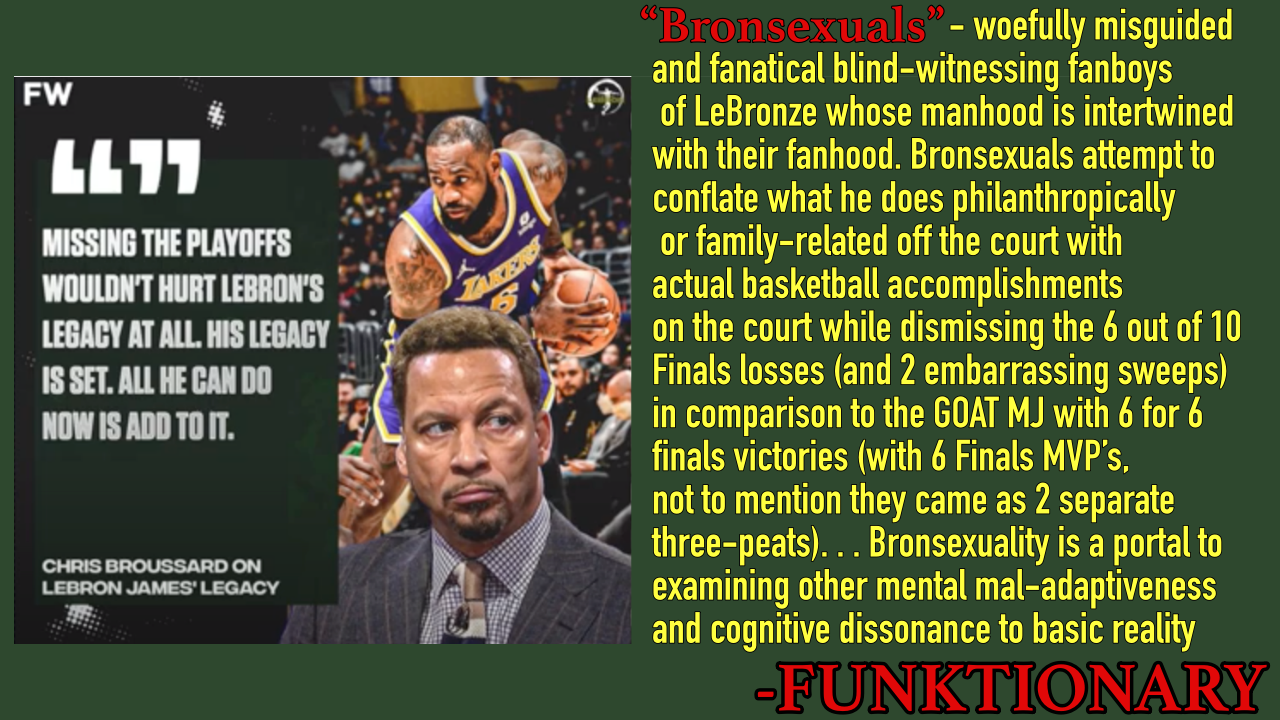
[“GOAT = Goes On Another Team”] No One Cares Where Lebron James Goes Except for LeMedia and Bronsexuals. The Promotion of Black Mediocrity is Priceless to White Supremacists

Bronsexual.

What or who is a Bronsexual? Bronsexual is a slang term from sports-fan culture—especially NBA circles—used to describe someone who is an extremely devoted, sometimes uncritically loyal fan of LeBron James.

What it means A Bronsexual is typically someone who:

  • Defends LeBron James in nearly every debate

  • Attributes team success primarily (or solely) to him

  • Downplays or excuses his losses, shortcomings, or controversial moments

  • Often follows LeBron more than any single NBA team

Tone & usage

The term is informal and usually teasing or critical, not a literal reference to sexuality. It’s often used by rival fans in arguments about: “Greatest of All Time” (GOAT) debates Comparisons with Michael Jordan MVPs, Finals records, or team changes Example in context “Anyone who thinks that Finals loss wasn’t on LeBron is a Bronsexual.” Related slang LeBron stan – similar meaning, internet-culture phrasing

The PropaGenda of ‘Black Mediocrity as Excellence’ is a Political Necessity for the System of White Supremacy:

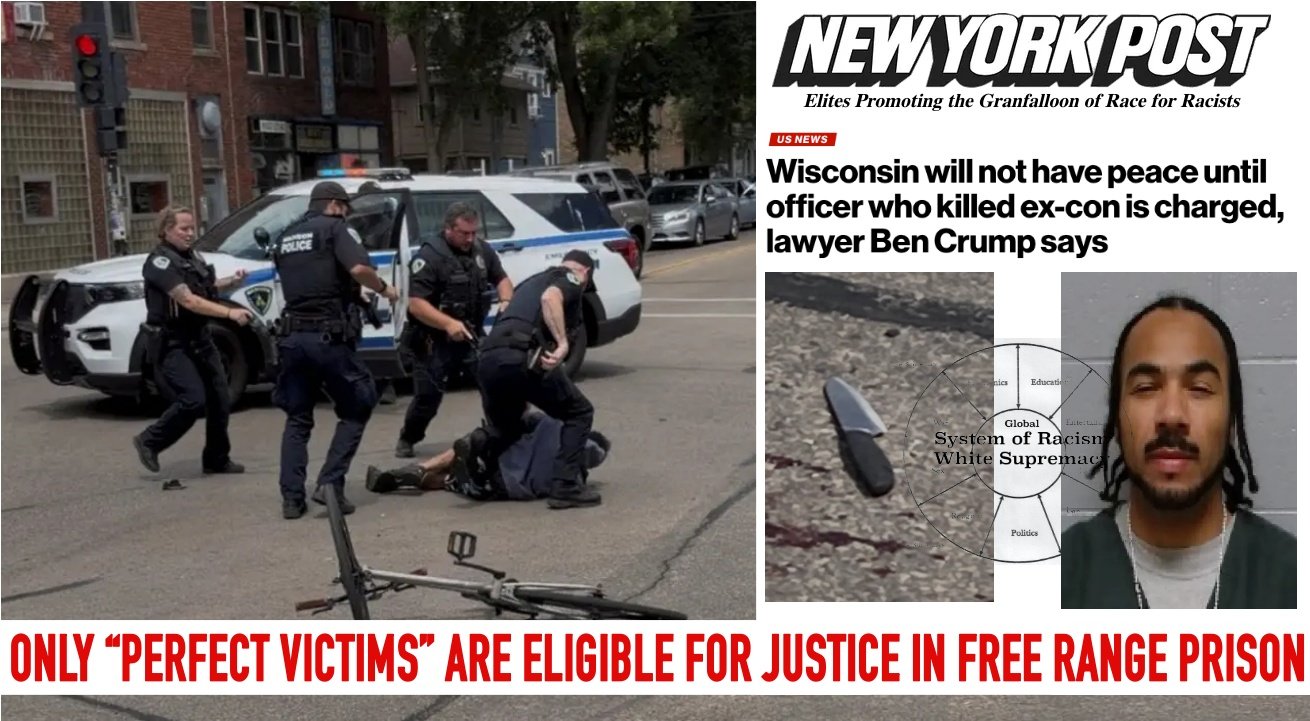
Massa Media Imply Corey Ruiz is Unworthy of Justice b/c He “Had a Knife” and is “Ex-Con:” A White Cop Fatally Shot Black Man in a Fetal Position Surrounded by Cops, Posed No Immediate, Deadly Threat

ONLY “PERFECT VICTIMS” ARE ELIGIBLE FOR JUSTICE & MOURNING TO RACISTS. According to the racist suspects at NY Post: The police officer who shot ex-con Corey Ruiz in Madison, Wisconsin after being knifed should be criminally charged, the attorney for the dead man’s family declared Friday.

Ben Crump, who has represented the family of George Floyd and Michael Brown, gave a fiery press conference, two days after the caught-on-camera police shooting.

“The way he shot him repeatedly? Yes,” Crump said at the press conference when asked if the officers should be charged.

Crump promised that “there will be no peace and business as usual in Madison, Wisconsin,” until the police are held accountable.

He spoke alongside the mother of Ruiz’s daughter, siblings and mother — who broke down in sobs at the podium as supporters chanted “Justice for Corey!” [MORE]

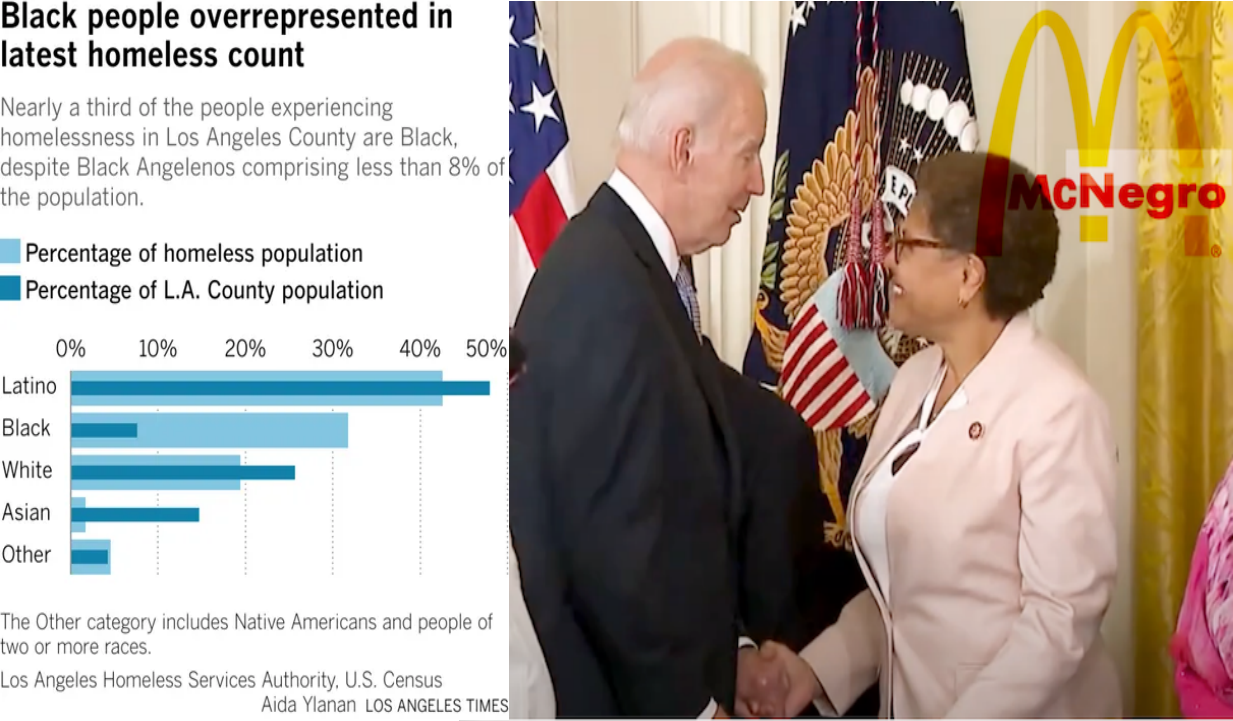
Shelters "Sold Out," Homelessness in LA Increasing Under McNegro Mayor's Watch. Black People are 33% of All Homeless, Despite Being Only 8% of Liberal City

Mayor Karen Bass and her challenger in the Nov. 3 election, Councilmember Nithya Raman, traded jabs Friday as they criticized one another over the increase in homelessness in Los Angeles.

Homelessness increased by 3.4% in the city to an estimated 45,194 people, and unsheltered homelessness also rose by nearly 8%, according to figures from the 2026 Greater Los Angeles Homeless Count. The data showed the first increase in the unhoused population following two consecutive years of decreases.

Raman, who represents the Fourth Council District, held a news conference in Studio City to discuss the results of the count released Friday afternoon. [MORE]

"I Will Never Betray [Big Pharma's] Science:" Black Probot CDC Nominee Survives ‘Kabuki Theatre’ Hearing by Pledging Obedience to Medical Establishment on Vaccines and Autism, Despite Dangers, Death

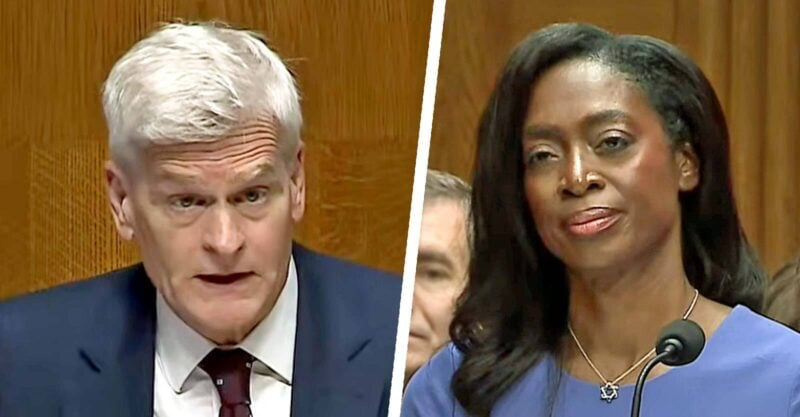
On July 15, Dr. Erica Schwartz appeared before the U.S. Senate HELP Committee to make her case for leading the U.S. Centers for Disease Control and Prevention (CDC).

But before the nominee had answered a single question, the terms of her confirmation had already been laid down. HELP Committee chairman Bill Cassidy wasted no time.

“A lot of this conversation for me is going to revolve around vaccines,” he announced. “Vaccines should be settled.”

He blamed “a flurry of misinformation” around immunization, saying some people cast doubt on mRNA vaccines “for no other reason than people don’t understand them.”

Mothers and fathers, he said, had become “confused as to whether vaccines are safe to give their children.”

The result was thousands of measles infections, with children hospitalised or dying from vaccine-preventable diseases.

Then came the ultimatum.

“Vaccines are overwhelmingly safe and effective,” Cassidy declared. “Study after study shows they do not cause autism.”

“Any equivocation on these facts,” he warned Schwartz, “and I shall not be able to support your nomination.”

Only then did the questioning begin. Confirmation hearings are meant to test a nominee’s judgment, independence and fitness to lead. Instead, Cassidy announced the conclusions he expected Schwartz to affirm before she had given a single substantive answer. From the outset, it was clear there was no room for dissent.

Cassidy’s concern was whether Schwartz would publicly defend what he regarded as settled science on vaccines. He pointed to her predecessor, Susan Monarez, Ph.D., saying she had been dismissed after refusing to carry out instructions she believed would harm public health.

Would Schwartz show the same resolve and stand up to political pressure? Schwartz responded as most nominees do. She spoke of integrity, the Hippocratic oath and her commitment to public health.

“I will never compromise on that,” she said.

Cassidy pressed her again on whether she would have the authority to reassign or remove CDC staff who were pursuing an agenda he believed was harmful to public health. Schwartz tried to explain that the health secretary had nominated her to lead the CDC and that she expected to carry out that role. Cassidy cut her off several times.

An oath to orthodoxy

“We need a CDC director that will actually stand up to crazy, stupid things being said that undermine faith in immunization,” Cassidy said. “Are you the person?” Schwartz answered cautiously.

“You have my assurances that I will continue to lead by my integrity. I will never compromise on the science.” Cassidy noted that she had already been through a “murder board.”

That is Washington shorthand for the gruelling mock confirmation hearings in which nominees rehearse difficult questions with advisers before appearing before senators.

He pressed once more, asking whether she would say no to “junk science” and stand up for what was “right and true.”

Schwartz replied, “I have always stood up for what is right and what is true,” adding, “I will never betray the science.”

Cassidy left little doubt that his support was contingent on Schwartz affirming conclusions he regarded as settled.

Did a Black Dumbocrat District Attorney in Mississippi Try to Use His Authority to Help Black People or Engage in Bribery, Wire Fraud, Laundering and Making False Statements?

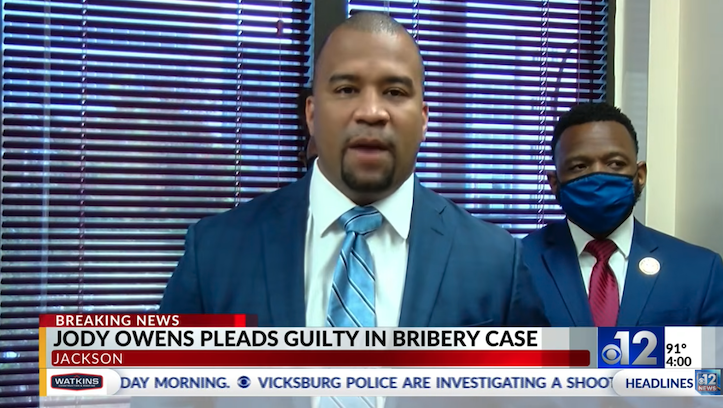
A “Black” district attorney in Mississippi will resign Wednesday after pleading guilty to conspiracy in federal court.

Hinds County, Mississippi, District Attorney Jody Owens was indicted on several charges—including conspiracy, federal program bribery, wire fraud, money laundering and making false statements—in October 2024, according to a story from the Magnolia State Live. Prosecutors alleged that Owens accepted at least $115,000 in exchange for helping advance a convention center hotel project in Jackson, Mississippi.

Among prosecutors’ other allegations, Owens discussed how to bribe public officials and launder money through businesses and campaign donations in recordings that were captured during an undercover FBI operation in 2022, according to the Magnolia State Live.

Owens now faces up to five years in prison, three years of supervised release and a $250,000 fine.

Former Jackson, Mississippi, Mayor Chokwe Antar Lumumba and former Jackson, Mississippi, City Council President Aaron Banks have also been charged in the case, the Magnolia State Live reports. Their trial begins July 13.

What to Know: Prosecutorial Misconduct and the Death Penalty Disproportionately Harms Black People

DPI’s ​“What to Know” series exam­ines cap­i­tal pun­ish­ment from mul­ti­ple angles, one top­ic at a time. Each install­ment pro­vides essen­tial facts and data on spe­cif­ic aspects of the death penalty.

Why it mat­ters: More than 600 cap­i­tal con­vic­tions or death sen­tences have been over­turned or led to exon­er­a­tions because of pros­e­cu­to­r­i­al mis­con­duct, and researchers say the true scope of the prob­lem is like­ly far greater.

  • DPI has iden­ti­fied more than 600 instances in which a cap­i­tal con­vic­tion or death sen­tence has been over­turned or a death-sen­tenced pris­on­er was wrong­ful­ly con­vict­ed as a result of prosecutorial misconduct.

  • More than 6.3% of all death sen­tences imposed since 1972 were reversed because of pros­e­cu­to­r­i­al mis­con­duct or result­ed in an exoneration.

  • Of the 202 total death row exon­er­a­tions, at least 144, or rough­ly 70%, involved pros­e­cu­to­r­i­al mis­con­duct specif­i­cal­ly (a sub­set of the broad­er ​“offi­cial mis­con­duct” cat­e­go­ry, which also includes police and oth­er government misconduct).

  • The most com­mon types of mis­con­duct were with­hold­ing favor­able evi­dence, impli­cat­ed in 35% of reversed con­vic­tions or sen­tences, and improp­er argu­ment, present in 33% of reversed sentences.

  • A report by Harvard Law School’s Fair Punishment Project found that just five pros­e­cu­tors with high rates of mis­con­duct are respon­si­ble for more than 440 death sentences.

Key Facts

  • Prosecutorial mis­con­duct is rarely pun­ished. Many instances of mis­con­duct go unad­dressed, and most pros­e­cu­tors who com­mit mis­con­duct are not held accountable.

  • Courts fre­quent­ly deny relief even when mis­con­duct is proven, dis­miss­ing it as ​“harm­less error.” DPI’s doc­u­ment­ed mis­con­duct dataset reflects only cas­es where courts con­clud­ed that vio­la­tions were seri­ous enough to warrant reversal.

  • Evidence sup­pres­sion is the most com­mon form of mis­con­duct. Under the 1963 U.S. Supreme Court rul­ing in Brady v. Maryland, pros­e­cu­tors have a con­sti­tu­tion­al duty to turn over all evi­dence favor­able to the defense. DPI’s Prosecutorial Accountability project lists more than 200 cap­i­tal con­vic­tions or death sen­tences that have been reversed based on pros­e­cu­tors’ fail­ure to dis­close excul­pa­to­ry evi­dence. A study in the Journal of Criminal Law and Criminology found that courts found Brady vio­la­tions in 10% of cas­es reviewed, and pros­e­cu­tors ​“were almost nev­er referred to the Bar for discipline.”

  • Racial dis­par­i­ties com­pound the prob­lem. Prosecutorial mis­con­duct can include the ille­gal exclu­sion of peo­ple of col­or from juries, in vio­la­tion of Batson v. Kentucky. All-white and near­ly all-white juries have been found to be more con­vic­tion-prone and more like­ly to impose death sen­tences. A 2020 report by the National Registry of Exonerations found that police or pros­e­cu­to­r­i­al mis­con­duct occurs more fre­quent­ly when the defen­dant is a Black person.

  • Misconduct pro­longs wrong­ful impris­on­ment. Exonerations take longer in cas­es involv­ing offi­cial mis­con­duct because of ongo­ing efforts by gov­ern­ment offi­cials to hide mis­con­duct and false tes­ti­mo­ny or accu­sa­tions. Prosecutorial offices also tend to more aggres­sive­ly defend cas­es and legal claims in which offi­cial mis­con­duct is charged. Official mis­con­duct was present in all eight of the cas­es in which an exon­er­a­tion occurred 31or more years after conviction.

  • The prob­lem isn’t lim­it­ed to cap­i­tal cas­es. Official mis­con­duct was the lead­ing cause of wrong­ful con­vic­tions in 2024, present in at least 104 exon­er­a­tions, or rough­ly 71% of all exon­er­a­tions dur­ing the year. Misconduct con­tributed to wrong­ful con­vic­tions in about 79% of homicide exonerations. [MORE]

Latest crime trends report projects historic low for US homicide cases - on track for lowest annual homicide rate in over a century

The Council on Criminal Justice (CCJ) on Wednesday  released a mid-year crime trends report which illustrated that homicides in large US cities fell by 18 percent in the first half of 2026 compared to the same period last year, effectively putting the country on track for its lowest annual homicide rate in over a century.

The CCJ analyzed 13 crime categories across 336 cities that have consistently reported monthly crime data for the past nine years. Nine of these offenses declined in the first half of 2026, with carjackings showing the largest decrease at 47 percent. Homicides have dropped 51 percent since their peak in early 2022, and carjackings have decreased 73 percent since their 2023 peak. The report also noted a 13 percent year-over-year reduction in residential burglaries and a 56 percent decline compared to their 2018 peak.

However, not all categories improved. Drug offenses increased by 12 percent compared to the first half of 2025, and domestic violence incidents rose by 8 percent. Shoplifting remains the only offense still elevated above pre-pandemic 2019 levels, up by 5 percent.

Roughly a third of the 36 sample cities recorded an increase in homicides compared to the first half of 2025, including Norfolk, Virginia, which saw a 64 percent rise, and San Francisco, which saw a 55 percent increase. [MORE]
'The whole of Gaza is Under Israeli Occupation,' UN official says

The United Nations has condemned the continued killing of civilians as intensified Israeli attacks across Gaza left dozens of Palestinians killed or injured in recent days, while a sharp rise in settler violence in the occupied West Bank has added to mounting humanitarian concerns.

“We condemn all killings of civilians,” the UN spokesperson said on Tuesday, stressing that international humanitarian law requires the protection of civilians and civilian infrastructure.

According to the latest update from the UN Office for the Coordination of Humanitarian Affairs (OCHA), ongoing Israeli aggression, fresh displacement, and worsening access conditions have further restricted humanitarian aid efforts and heightened protection concerns throughout Gaza.

UN calls for respect for Palestinian rights

Speaking at a press briefing in Geneva on Tuesday, Thameen Al-Kheetan of the Office of the High Commissioner for Human Rights (OHCHR) said recent Israeli military attacks had killed and injured dozens of Palestinians across Gaza.

Among the incidents highlighted was an Israeli drone strike that killed seven people and others outside a grocery store west of the Nuseirat refugee camp. In another case, a teacher was injured after reportedly being targeted by a bullet fired by Israeli forces while working inside a temporary learning center west of Khan Younis.

Al-Kheetan said that nine months after the announcement of a ceasefire, no place in Gaza could be considered safe. [MORE]

US Authorities Have "Collected" About $13 Billion of Venezuela's Oil Money. Where is it?

The Trump administration has collected more than US$13 billion in revenues from Venezuelan oil sales this year, according to FT calculations, but has said almost nothing about what has happened to the money.

The U.S. took control of Venezuela’s oil exports and suspended some sanctions after capturing President Nicolás Maduro in January and installing vice-president Delcy Rodríguez as leader.

Oil revenues make up around a quarter of Venezuela’s GDP, and the sanctions relief was expected to provide a major boost to the economy, which was in crisis even before last month’s devastating earthquakes.

But six months after the U.S. seized control of the funds, economists say the evidence of a recovery in Venezuela is relatively muted — a potential sign that the U.S. has not sent all the revenues back to Caracas.

Washington has given diverging accounts of what it is doing with the money, ranging from an executive order describing its own role as “custodial” to U.S. President Donald Trump saying the U.S. was “making a lot of money” from Venezuelan oil.

U.S. lawmakers from both parties are starting to pressure the administration to explain where it has gone and what it is doing to prevent corruption around its allocation. [MORE]
Rule by Force or Consent? Report Reveals that Marco Rubio "Governs" Venezuela, Since US “Government” Kidnapped Maduro

Some critics of the Trump administration are reacting with horror to revelations that US Secretary of State Marco Rubio has been serving as the de facto ruler of Venezuela.

According to a Saturday report in The New York Times, Rubio for the last several months has been acting informally as the “viceroy” of Venezuela ever since its recognized president, Nicolás Maduro, was abducted by the American military in January and brought to the US to face charges related to “narco-terrorism.”

The Times’ sources revealed that Rubio “effectively controls Venezuela’s finances, the distribution of its natural resources, and its government” and “is deeply involved in the country’s day-to-day operations,” while maintaining regular contact with acting Venezuelan President Delcy Rodríguez.

Under current arrangements, the US Treasury Department takes in revenue from Venezuela’s exports, including its petroleum, and then disperses the money back to the country through its private banks with strict conditions set by Rubio over what it can be spent on.

In explaining the system, the Times likened it to “parents handing out allowances to children,” adding that it gives Rubio “immense leverage over... Rodríguez, who depends on the money to pay workers and prop up the national currency.”

Elizabeth Saunders, professor of political science at Columbia University, described Rubio’s power over Venezuela as “insane,” as well as “derelict, unconscionable, and impeachable.”

“The secretary of state’s time is scarce, valuable, and not outsourcable,” Saunders emphasized.

Orlando J. Pérez, professor of Political Science at the University of North Texas at Dallas, said the Times report made a mockery of Rubio’s professed claims to want to bring democracy back to Venezuela. [MORE]

ICE says only 1 of its Race Soldiers Faced Discipline Amid 56 Excessive Force Complaints

ICE officials told House Democrats that only one officer has been referred for disciplinary action in a use-of-force case since the Trump administration began. The disclosure has deepened concerns over oversight, training and vehicle-stop tactics after two recent fatal shootings.

US Immigration and Customs Enforcement officials told Democratic members of the House Homeland Security Committee on Wednesday that only one officer has been referred for disciplinary action in a use-of-force case since the start of the Trump administration. The closed-door briefing covered body cameras, vehicle stops and training, and came amid growing scrutiny of the agency after two recent fatal shootings involving immigrants ICE officers were trying to arrest.

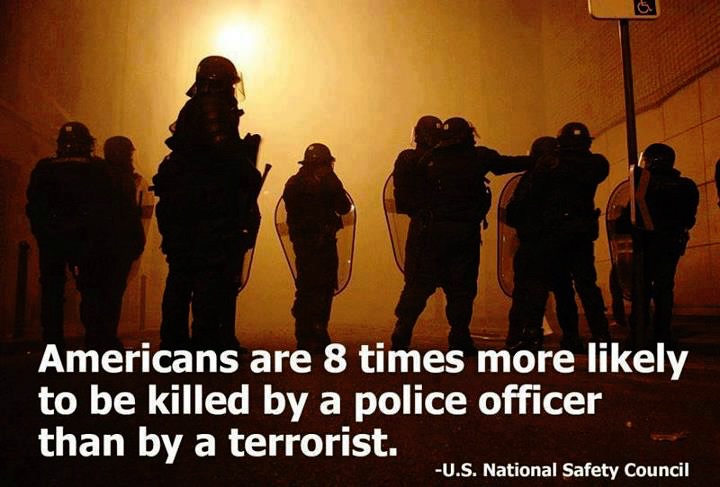
The shootings in Maine and Houston, which took place within a week of each other, have raised concerns about ICE tactics as the agency steps up arrests under President Donald Trump's mass deportation drive. At least 10 people have died in encounters with immigration agents since Trump returned to office, and in the Maine case, family members of the officer who opened fire have said he had a history of violent behaviour and should not have been given a badge and gun.

Representative Seth Magaziner, a Democrat from Rhode Island, said lawmakers were told there had been 56 complaints of excessive force against ICE officers. Of these, 32 were cleared and one was referred for disciplinary action, while the rest remain under investigation. Magaziner said they were told that no discipline had yet been imposed. He said, "It just defies belief that an agency of 20,000-plus officers with all of the chaos that we've seen over the last year and a half through the surges and civilians being injured and killed, that no one would be found to have violated use of force with the exception of possibly one person." [MORE]
US to Deny Green Cards to Mostly Non-White immigrants who use Public Benefits

US Citizenship and Immigration Services (USCIS) on Thursday announced the return of the “public charge” rule for immigrants. Immigrants must already demonstrate that they will not become public charges, or persons who depend on the government for subsistence, but the new rule will expand the range of public benefits that immigration officials may consider when determining whether immigrants are likely to become primarily dependent on government assistance.

The expanded list could include Supplemental Nutrition Assistance Program (SNAP/food stamps), Temporary Assistance for Needy Families (TANF), Medicaid, housing vouchers and others programs. The rule will also allow immigration officials to consider age, health, education, and job skills in determining eligibility for green cards.

USCIS announced the change on social media platform X, saying, “This final rule is intended to help ensure that those seeking permanent residence are able to support themselves and are not likely to become primarily dependent on public assistance… [USCIS is] protecting public resources and ending policies that encouraged dependency on the backs of hard-working American taxpayers.”
The rule change appeared in the Federal Register on July 16. It will be formally published on July 20 and expected to take effect on September 18. [MORE]

Another White Supremacy Mystery as Independent Autopsy Finds Nolan Wells' Cause of Death Undetermined

[MORE]

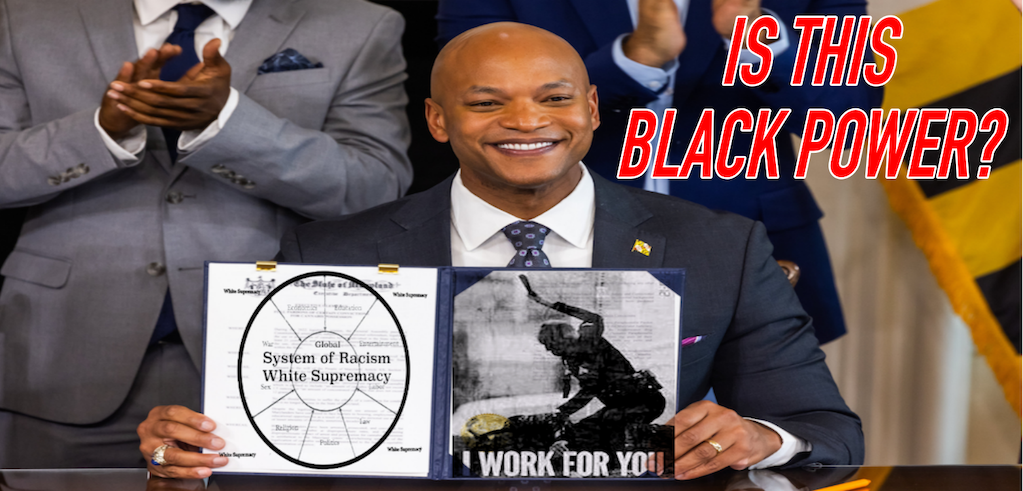
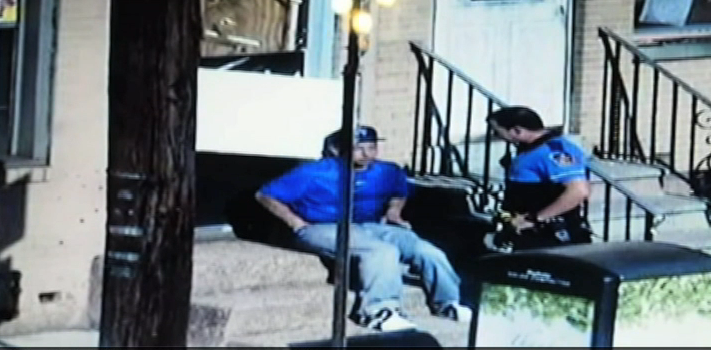
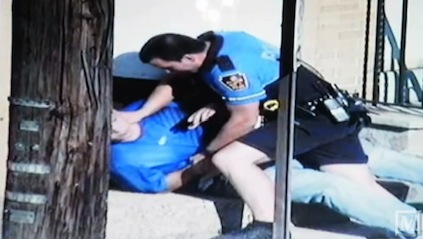
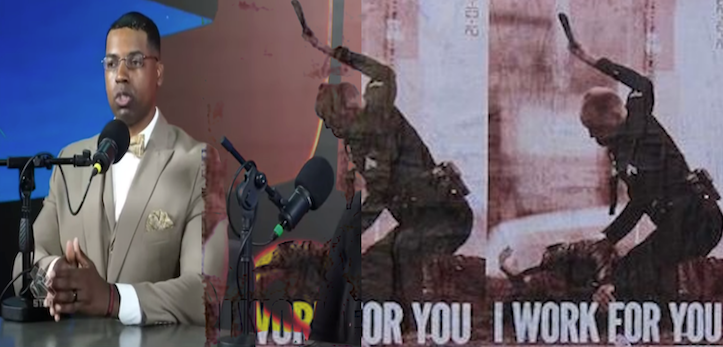
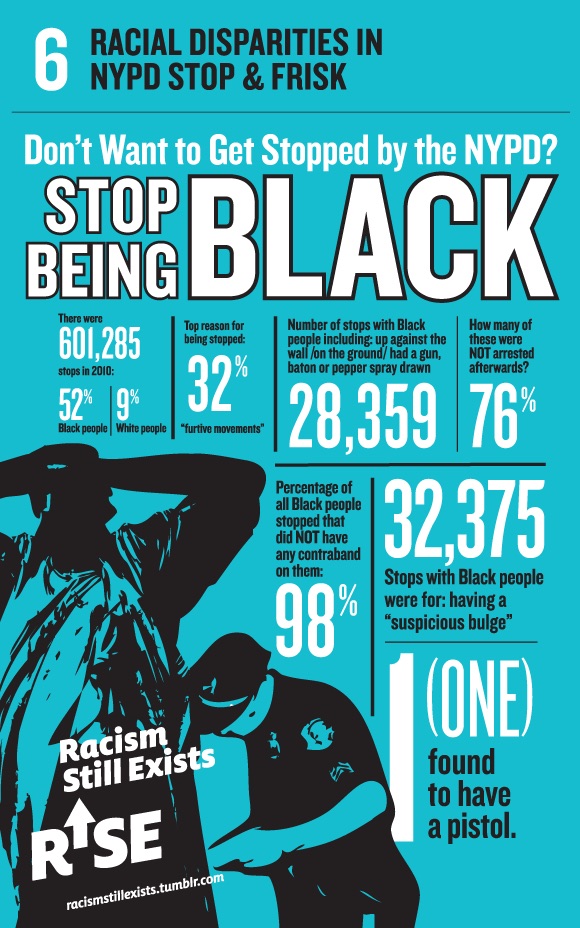
Another Black Person Killed by Cops in a City Controlled by White Liberals: Madison Cops Fatally Shoot Black Man, Didn’t Appear to Pose an Immediate Deadly Threat while Lying in a Fetal Position

Michael Doubek, a witness who was on the way to Willy Street Co-Op, recalled what he saw.

"The victim came flying around on his bicycle. One officer tackled him off...Two other officers kind of rushed over, and one of the officers yells, "He has a knife. One of the officers then draws a taser and yells, 'Taser, taser, taser.' He tasers him, [and the victim] falls to the ground," Doubek said. "The three continue to struggle for a second or two. Then, one of the officers stands just a couple feet above his head, shooting [the victim] three times to the head."

The Madison Police Department will not conduct an investigation into this incident and will be led by the Wisconsin Department of Justice Criminal Investigation, officials confirmed.

Additional video, that has not been circulated online, is being reviewed by cops. [MORE] and [MORE]

Maryland Has the Highest Rate of Incarcerating Black People. Electing a “Black” Dumbocrat Governor Hasn’t Stopped Blacks from Being Disproportionately Stopped, Searched, Arrested, Charged or Sentenced

According to the Maryland Alliance for Justice Reform:

What’s the problem?

Throughout Maryland’s criminal justice system, African-Americans and other minorities are impacted at more than twice the rate of White Marylanders, although whites are reported to violate the laws at roughly the same rates. This phenomenon repeats from traffic stops, to searches, arrests, charges, pretrial incarceration, prison sentences, and parole or probation.  

Some Maryland counties and Baltimore City experience this problem at rates higher than others.  

The Maryland State Commission on Criminal Sentencing Policy (MSCCSP) also is charged by statute with the responsibility to “reduce unwarranted disparity, including any racial disparity, in sentences for criminals who have committed similar crimes and have similar criminal histories.” Md.Code, Crim.Proc.Art.,sec.6-202. MSCCSP, in recent years, considered the question and  concluded that a more comprehensive study reaching far beyond sentencing is needed: 

MSCCSP, in its (December 2023-revised) “Assessment of Racial Differences in Maryland Guidelines-Eligible Sentencing Events” report, confirmed that the problem is not limited to our sentencing process: Black and Hispanic individuals generally received more stringent criminal sentences in Maryland, including higher incarceration rates and longer sentences, on average, in comparison to White sentenced individuals”; and, further, that “Blacks’ mean offender scores are only 22% higher than Whites’ offender scores, [but] Black Marylanders’ pretrial detention is substantially higher than Whites’ and their median overall non-suspended sentences is double that of Whites.

Overall, the disproportionate rate of incarceration of African-Americans in Maryland prisons is the highest in all 50 U.S. states – even higher than that in #2 Mississippi. Why? [MORE]

According to FUNKTIONARY:

reform – superficial change in form and formalities (fictitious change) which only further lubricates the status quo by renovating and painting old society in new colors. 2) appearance of change sans the change. Reform is always in the service of the status quo and the politician: it serves the privilege of the past not the promise of the future. Reform creates hypocrisy as a matter of course. Reform is the first stage in the three “R’s” in hue-man evolution; the other two being revolution and rebellion. There are two basic types of reformists: those who are preparing the ground for Third Eye revolution and those who are trying to prevent the conscious revolution. (See: Revolution, Status Quo, Meme & Change)

reformers – naïve politicians. They came to do good and stayed to do well. Reformers themselves get reformed into the structure, consciousness and content of the dominant exploitative system—and thus become the system. (See: Revolution)

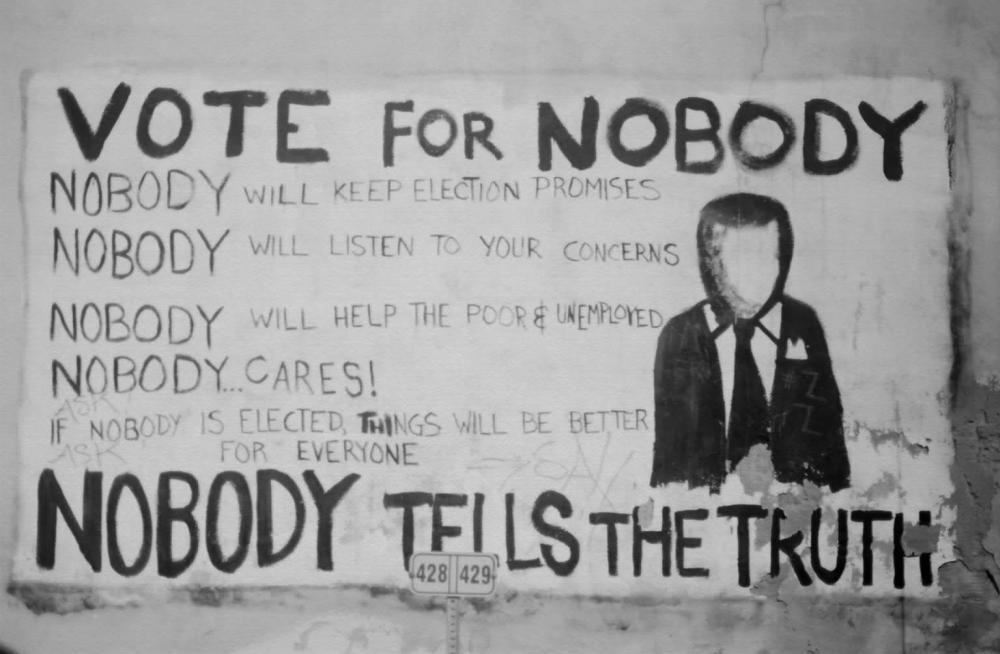
voting – a pacification (sucker) process which allows the votary to make choices provided to her/him, not decisions. 2) a “privilege” of U.S. citizens to do it behind a curtain—as long as they do it alone. 3) political masturbation exercises for those who can’t cop real power. 4) a habitually accepted imposition that gives the votary-vassal-suckers an illusion of inclusion or participation. 5) an act of self-abuse. People mistake their voting for their voice—as the voice of the people is seldom, if ever, their own. While some died fighting for the privilege (not right) to vote or not to vote, they were restricted and therefore had no choice in the matter. If voting was a right, no one would ever have had to lose his or her life in a struggle to exercise that right. The Voting Rights Act of 1964 demonstrates that voting is a civic privilege (franchise) bestowed upon a people instead of the act of voting being an inherent right where exercise of the option to vote is one’s own decision without an attached obligation (compulsion) or expectation (compunction). We need to establish and assert our economic rights and declare our “endependence” by designing, collectively owning, controlling and administering our own systems of monetary and economic exchange (that funktion in the interests of its creators and participants) so as to take ownership of our bodies, labor, and fruits of our mental assets in the form of substantive rights receipts (circulating “money” in electronic form or circulating cash). [MORE]
William Blake: I Will Choose Death Over Life Behind Bars Unless New York Changes Its Parole Laws

In 2013, when I had been locked up in solitary confinement for 25 years, I wrote an essay entitled “A Sentence Worse Than Death,” which I’m told has been read by upwards of a million people to date. It describes what life was like in “the box” (the special housing unit, or SHU for short) in New York’s state prisons, and posited that if given the choice, I would have opted for a sentence of death over more than two decades of incarceration in abject isolation.

At the time, I didn’t have that choice. Now, it appears, I do.

I am a 62-year-old man and have recently developed health issues that have led me to start thinking quite a bit about death and dying. When the problems you’re confronted with can kill you, it’s only natural to do this. Sooner or later, we will all have to face the fact of our mortality.

Not everyone, though, is locked up and serving a prison sentence longer than they will live to finish.

I am a prisoner who is serving such a sentence. Currently, I have been locked up for 39 years. I am not eligible for parole until August 2060, when I would be two months shy of my 97th birthday. Unless the law changes, in all likelihood I will be in prison for the rest of my life. Mine could be a sentence of death by incarceration.

I started my death thoughts at the obvious place: I thought about the life I would likely be living if I fought hard to beat the lung disease I have that could kill me, and managed to conquer it. [MORE]