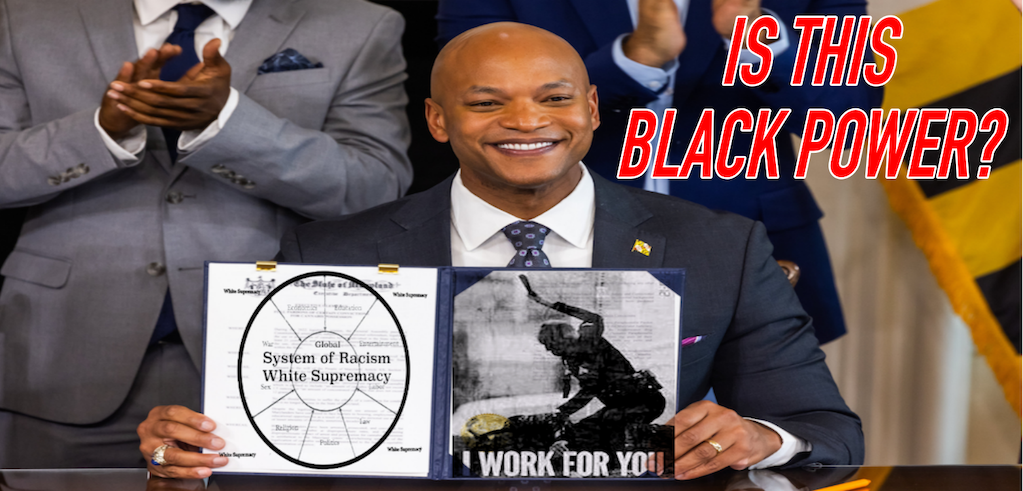
Maryland Has the Highest Rate of Incarcerating Black People. Electing a “Black” Dumbocrat Governor Hasn’t Stopped Blacks from Being Disproportionately Stopped, Searched, Arrested, Charged or Sentenced
/
According to the Maryland Alliance for Justice Reform:
What’s the problem?
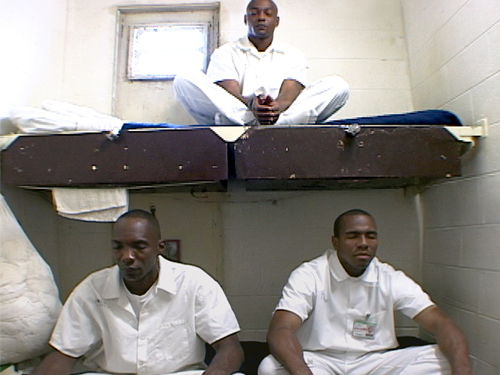
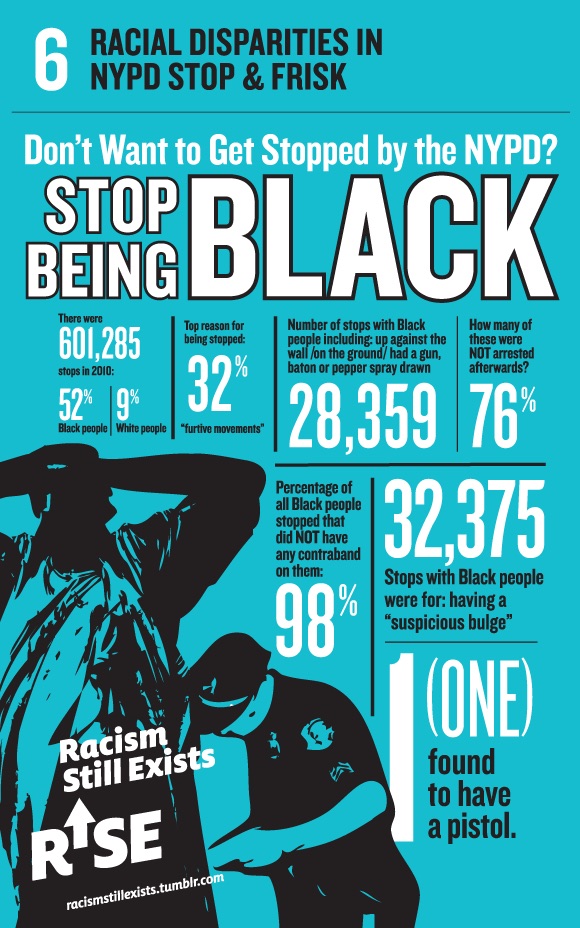
Throughout Maryland’s criminal justice system, African-Americans and other minorities are impacted at more than twice the rate of White Marylanders, although whites are reported to violate the laws at roughly the same rates. This phenomenon repeats from traffic stops, to searches, arrests, charges, pretrial incarceration, prison sentences, and parole or probation.
Some Maryland counties and Baltimore City experience this problem at rates higher than others.
The Maryland State Commission on Criminal Sentencing Policy (MSCCSP) also is charged by statute with the responsibility to “reduce unwarranted disparity, including any racial disparity, in sentences for criminals who have committed similar crimes and have similar criminal histories.” Md.Code, Crim.Proc.Art.,sec.6-202. MSCCSP, in recent years, considered the question and concluded that a more comprehensive study reaching far beyond sentencing is needed:
MSCCSP, in its (December 2023-revised) “Assessment of Racial Differences in Maryland Guidelines-Eligible Sentencing Events” report, confirmed that the problem is not limited to our sentencing process: “Black and Hispanic individuals generally received more stringent criminal sentences in Maryland, including higher incarceration rates and longer sentences, on average, in comparison to White sentenced individuals”; and, further, that “Blacks’ mean offender scores are only 22% higher than Whites’ offender scores, [but] Black Marylanders’ pretrial detention is substantially higher than Whites’ and their median overall non-suspended sentences is double that of Whites.”
Overall, the disproportionate rate of incarceration of African-Americans in Maryland prisons is the highest in all 50 U.S. states – even higher than that in #2 Mississippi. Why? [MORE]

According to FUNKTIONARY:
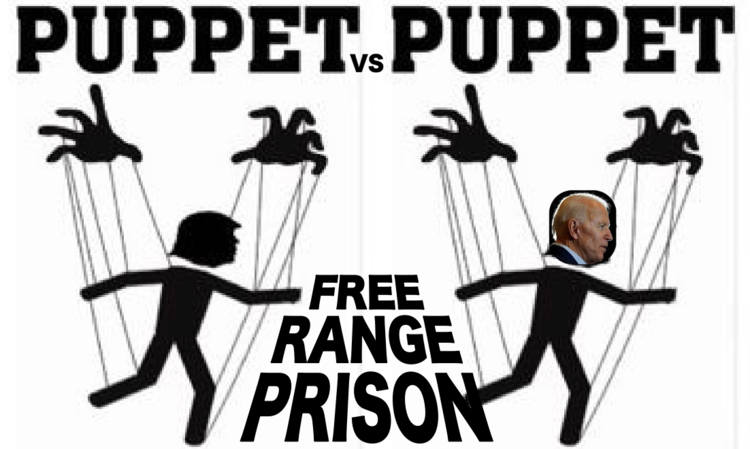
reform – superficial change in form and formalities (fictitious change) which only further lubricates the status quo by renovating and painting old society in new colors. 2) appearance of change sans the change. Reform is always in the service of the status quo and the politician: it serves the privilege of the past not the promise of the future. Reform creates hypocrisy as a matter of course. Reform is the first stage in the three “R’s” in hue-man evolution; the other two being revolution and rebellion. There are two basic types of reformists: those who are preparing the ground for Third Eye revolution and those who are trying to prevent the conscious revolution. (See: Revolution, Status Quo, Meme & Change)
reformers – naïve politicians. They came to do good and stayed to do well. Reformers themselves get reformed into the structure, consciousness and content of the dominant exploitative system—and thus become the system. (See: Revolution)
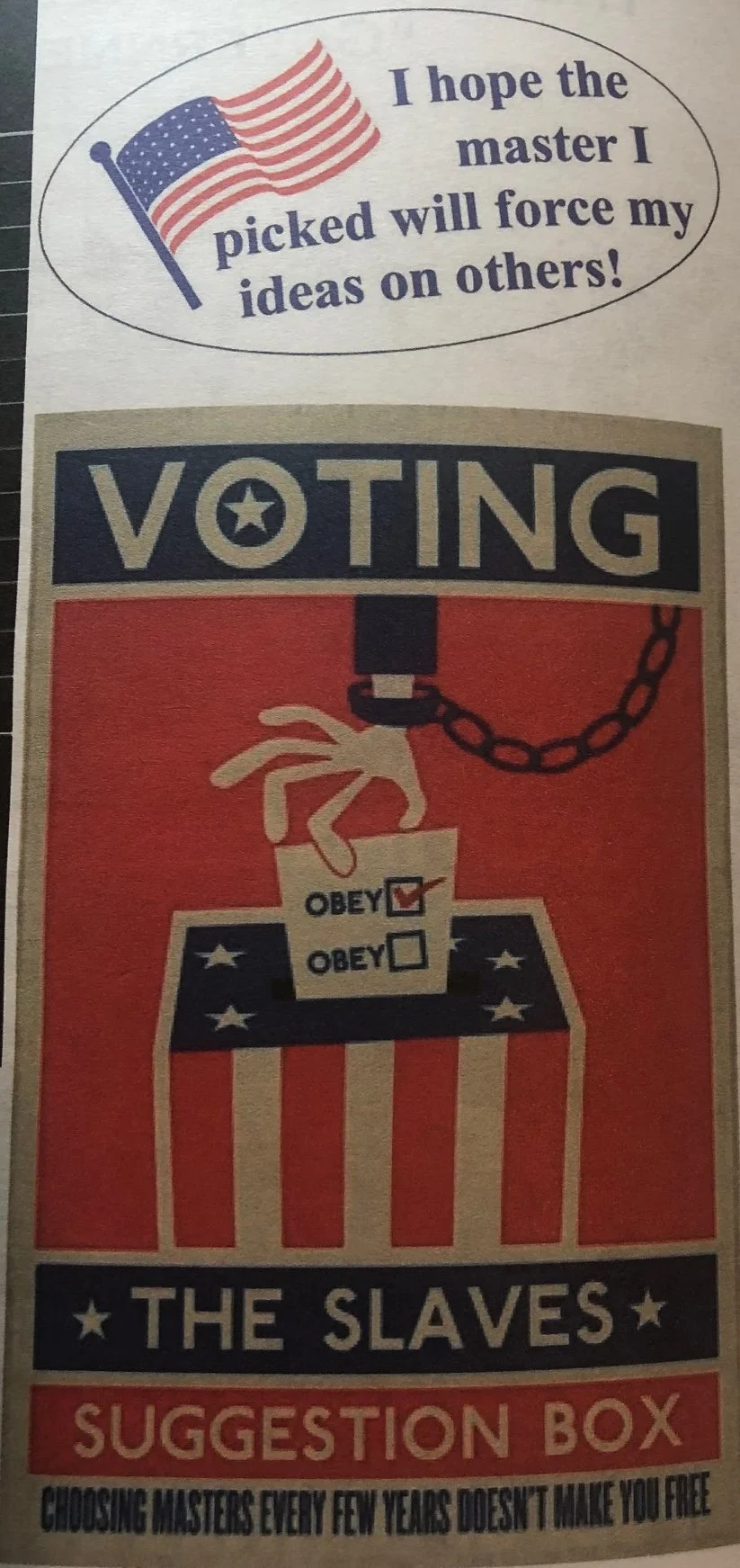
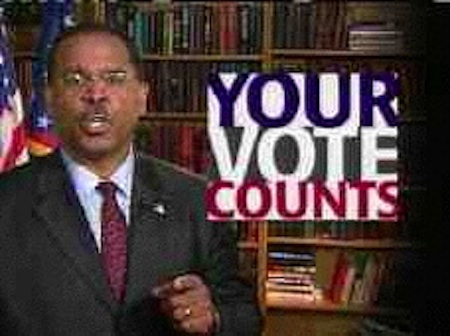
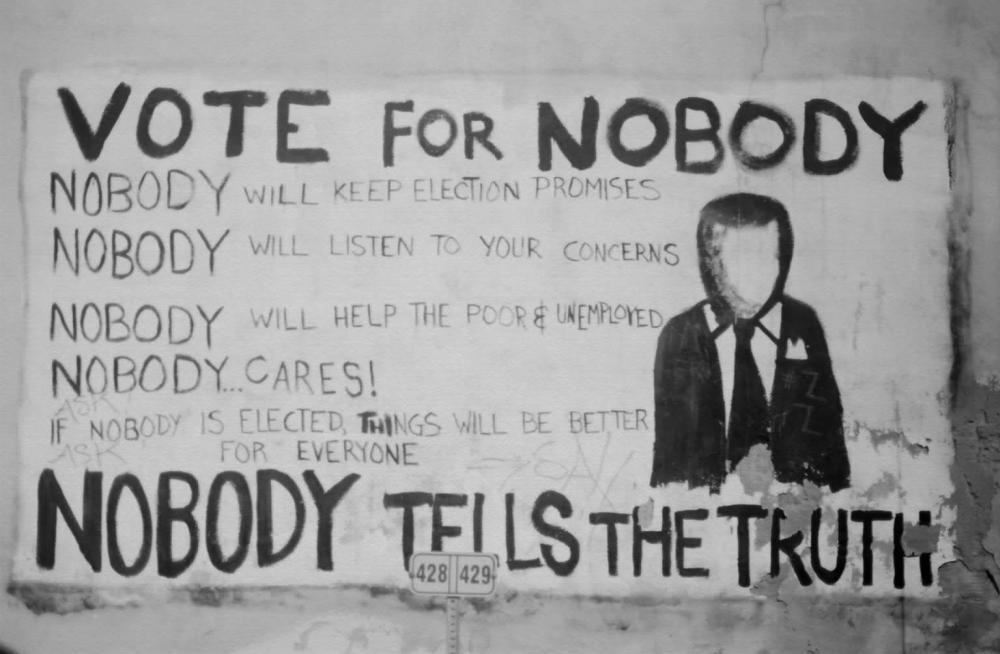
voting – a pacification (sucker) process which allows the votary to make choices provided to her/him, not decisions. 2) a “privilege” of U.S. citizens to do it behind a curtain—as long as they do it alone. 3) political masturbation exercises for those who can’t cop real power. 4) a habitually accepted imposition that gives the votary-vassal-suckers an illusion of inclusion or participation. 5) an act of self-abuse. People mistake their voting for their voice—as the voice of the people is seldom, if ever, their own. While some died fighting for the privilege (not right) to vote or not to vote, they were restricted and therefore had no choice in the matter. If voting was a right, no one would ever have had to lose his or her life in a struggle to exercise that right. The Voting Rights Act of 1964 demonstrates that voting is a civic privilege (franchise) bestowed upon a people instead of the act of voting being an inherent right where exercise of the option to vote is one’s own decision without an attached obligation (compulsion) or expectation (compunction). We need to establish and assert our economic rights and declare our “endependence” by designing, collectively owning, controlling and administering our own systems of monetary and economic exchange (that funktion in the interests of its creators and participants) so as to take ownership of our bodies, labor, and fruits of our mental assets in the form of substantive rights receipts (circulating “money” in electronic form or circulating cash). [MORE]