Brown University Donates Land to Native American Tribe

Brown University gave a portion of its Rhode Island property to a Native American Tribe in November after years of negotiations.

The Ivy League university transferred approximately 255 acres of “traditional cultural property” to the Pokanoket Indian Tribe who claimed ownership of the land after the school commissioned a “cultural sensitivity assessment” of the site, according to a Nov. 15 announcement. The land was transferred at no cost to the Native American group as part of an agreement reached in 2017 by Brown and the tribe after several Pokanoket people set up a month-long encampment on the university’s property.

“Brown University has transferred ownership of a portion of its land in Bristol, Rhode Island, to a preservation trust established by the Pokanoket Indian Tribe, ensuring that access to the land and waters extends to tribes and Native peoples of the region for whom the land has significance,” Brown wrote in a statement announcing the transfer. “As the ancestral home of Metacom, known also as King Philip — the leader of the Pokanoket people — and the site of his 1676 death during King Philip’s War, the land holds great historical and cultural significance to members of many Native and Indigenous communities.”[MORE]

Federal Judge Upholds Race-Based Admissions at Naval Academy, Concluding Diversity ‘Remains Critical’ for National Security

From [HERE] A federal judge has upheld the U.S. Naval Academy’s use of race in admissions practices, ruling that the school has “established a compelling national security interest” in championing diversity and inclusion within the military.

Friday’s decision deals a blow to Students for Fair Admissions (SFFA), the same group that challenged affirmative action at Harvard College and the University of North Carolina. That case resulted in the Supreme Court’s June 2023 decision, which banned race-based admissions at civilian universities. The question remained whether that ruling applied to military academies as well.

U.S. Senior District judge Richard Bennett of Maryland found that it did not, concluding that the “U.S. Naval Academy is distinct from a civilian university.”

“At bottom, the Court, considering all evidence before it, finds that the military’s interest in growing and maintaining a highly qualified and diverse officer corps is informed by history and learned experience, and that a highly qualified and diverse officer corps remains critical for military effectiveness and thus for national security,” Bennett wrote in the 179-page ruling.

“Plaintiff’s suggestion to the contrary contradicts decades of broad historical and military consensus,” Bennett added, rejecting SFFA’s legal challenge.

In its landmark ruling on affirmative action last year, the Supreme Court exempted the nation’s military academies — including West Point, the Naval Academy, and the Air Force Academy — from its purview. The Court left open the possibility that there are “potentially distinct interests that military academies may present” in the future, Chief Justice John Roberts wrote in a footnote of the majority opinion. [MORE]

OH High Court (a nearly All-White Jury) Says the Unaccountable White Akron Cops who Murdered Jayland Walker Can Remain Unidentified; Shot Unarmed, Fleeing Black Man 47X after Suspect Traffic Violation

From [HERE] In a 5-2 decision, the Ohio Supreme Court ruled Friday that unidentified Akron police do not have to release the names of eight officers who participated in the fatal shooting of Jayland Walker. Said court is composed of 7 judges, 6 are white and 1 is black. Akron is a city run by elite, white liberals as Democrats control all branches of government.

Mr. Walker was murdered on June 27, 2022 Eight officers fired dozens of rounds at Walker following a car and foot chase. Autopsy records show that eight officers fired more than 90 rounds at Walker, with more than 60 striking his body. Seven of the cops were white. Police said it began when they tried to pull him over for unknown, minor equipment violations and he failed to stop, cops then claim he fired a shot from his car 40 seconds into the pursuit.

Police body camera video showed Walker eventually bailed from his slowly moving car while wearing a ski mask and ran into a parking lot, where pursuing officers opened fire. On video police chased Walker for about 10 seconds before officers fired from multiple directions in a burst of shots that lasted 6 or 7 seconds. A handgun, loaded magazine and wedding ring were found on the driver’s seat of the car. As such, the officers couldn’t have seen a gun in his hand as he ran away from them on foot.

According to the autopsy report, his body arrived handcuffed at the coroner's office.

Walker had no criminal record.

Unnamed Officer(s) claim that they thought Mr. Walker had fired a weapon from his car during the high speed chase and that they feared he would fire again, prompting them to shoot him. How police could hear one gun shot during such a high speed chase is a white supremacy mystery. Nevertheless, whether a gun was fired is simply police misdirection and distraction from the only material issue which is whether the black man posed a threat when he fled on foot from police. He had no object in his hand and the cops never saw a gun, because it was on the car seat.

Insofar as it applies to white citizens, the Supreme Court has explained, ‘a police officer can use deadly force to prevent the escape of a fleeing felon ONLY where he has probable cause to believe the suspect poses a threat of death or serious physical harm to the officer or to others.’ Tenn v Garner, 475 US 1 (1985). The Court stated,

The use of deadly force to prevent the escape of all felony suspects, whatever the circumstances, is constitutionally unreasonable. It is not better that all felony suspects die than that they escape. Where the suspect poses no immediate threat to the officer and no threat to others, the harm resulting from failing to apprehend him does not justify the use of deadly force to do so. It is no doubt unfortunate when a suspect who is in sight escapes, but the fact that the police arrive a little late or are a little slower afoot does not always justify killing the suspect. A police officer may not seize an unarmed, nondangerous suspect by shooting him dead. [MORE]

Walker was not a fleeing felon, he had no criminal record and police manically chased over an unknown traffic violation. He posed no reasonable threat to police as no officers even claimed to have seen him brandish a weapon and he was running away from police when he was shot over 90 times. As such, it is not rational that police reasonably believe they faced an imminent threat of death or serious bodily harm.

Akron is a city run by white liberals as Democrats control all branches of government. Attorney General Yost of Ohio, who is a white Republican, took over the investigation last summer at the request of Akron police. Yost claimed on Monday that Mr. Walker had fired at least one shot at the police from his car. Yost did not explain when exactly the gun was fired or how he knew it was fired at police or whether he shot through his windows. Previously it had been reported that there was no forensic evidence that a gun was fired. Few other details have presented from the disinterested white media.

Yost seems to have unzealously sought to prosecute the police officers, who apparently were all white. Generally speaking, prosecutors direct their grand juries to do as they please - if they don’t get an indictment its because they don’t really want an indictment - similar to the Michael Brown or Eric Garner grand juries for white cops. As the saying goes a grand jury would indict a ham sandwich if the prosecutor wants them to. The Dependent Media, which is run by elite whites did not bother to report on the racial makeup of the grand jury. Eric Garner’s jury in white liberal, NYC was all-white.

Jayland was murdered for failing to comply with an order to pull over and an order to remain in his vehicle or to stop. In other words, he was murdered for failing to comply with authority. All laws or commands by authorities are threats backed by the ability and willingness to use violence/force against those who disobey. The reality is simply obey authority or go to jail or be murdered. Fool yourself if you want to, but there is nothing consensual or voluntary in our legal system. The legal system is entirely based on and anchored in physical coercion, violence.

However, authority is not real, it is simply a belief. Authority is the belief in the government’s implied right to rule over people in the first place. Authority is the belief that some people have the legal and moral right to forcibly control others, and that, consequently, those others have a legal and moral obligation to obey.’ Michael Huemer defines political authority as “the hypothesized moral property in virtue of which governments may coerce people in certain ways not permitted to anyone else and in virtue of which citizens must obey governments in situations in which they would not be obligated to obey anyone else.”

In real life authority is a granfalloon, an unreality. FUNKTIONARY explains Authority “has no meaning in reality,” it “is the means by which society uses to control its population.” Authority is a “cartoon” or an “image of law” because among other things the social contract is a lie told to you by your masters. Consequently, there is no rational justification for anyone or entity to rule over other human beings. Authority is rule through coercion.” Coercion here means physical force. “Laws” are threats backed by the ability and willingness to use violence/force against those who disobey. Huemer explains ‘the legal system is anchored by a non-voluntary intervention, a harm that the state can impose regardless of the individual’s choices.’ The only actual choice authority presents to citizens is to obey commands and laws or go to jail. Locke states, “The lie of tyranny is that you will maintain the freedom of life by obeying authority. The choices it offers you are a lifetime of obedience or death.”

Liberal Memphis Authorities Deprive Blacks' Rights, Impose 2nd Class Citizenship w/Violence in Segregated City: DOJ says Predatory Cops "Flood" Neighborhoods to Stop, Search, Degrade and Arrest Blacks

From [HERE] The Memphis Police Department routinely and pervasively deprives Black people of their Constitutional rights and follows policies that grossly discriminate against black people in its highly segregated city, the US justice department has said.

The justice department began investigating the police force for the Tennessee city in 2023, after the death of Tyre Nichols, who was brutally tortured and murdered by police during a traffic stop.

In its report from the investigation, released on Wednesday, the department said Memphis police "must correct these issues" that it said were part of a "pattern" of civil rights violations.

The report states, “We have reasonable cause to believe that MPD and the City engage in a pattern or practice of conduct that violates the Constitution and federal law. First, MPD uses excessive force. Second, MPD makes unlawful stops, searches, and arrests. Third, MPD unlawfully discriminates against Black people when enforcing the law. Fourth, the City and MPD unlawfully discriminate when responding to people with behavioral health disabilities.”

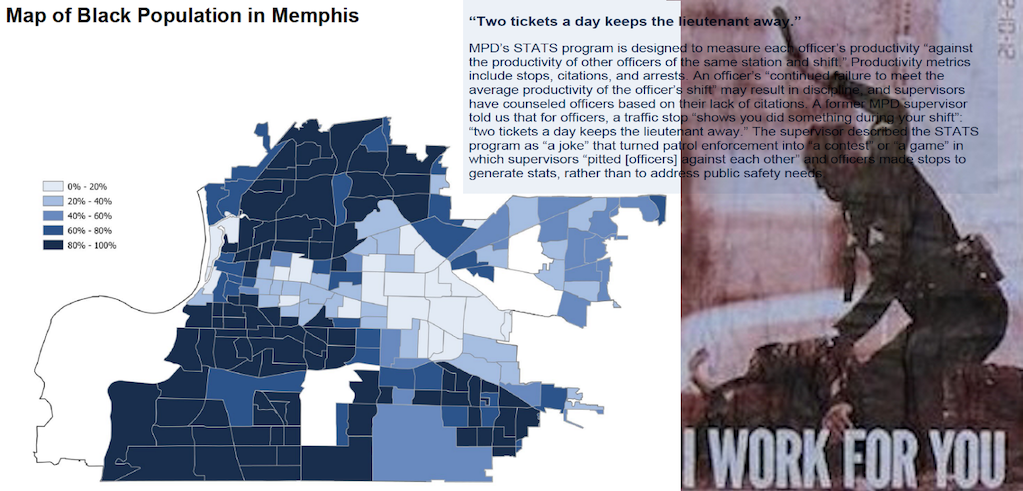
Memphis has relied on traffic stops to address violent crime. The police department has encouraged officers in specialized units, task forces, and patrol to prioritize street enforcement. Officers and community members have described this approach as “saturation,” or flooding neighborhoods with traffic stops…

Memphis police officers regularly violate the rights of the people they are sworn to serve. Our investigation found that officers use force to punish and retaliate against people who do not immediately do as they say. They rapidly escalate encounters, including traffic stops, and use excessive force even when people are already handcuffed or restrained. They resort to intimidation and threats. They have put themselves and others in harm’s way—officers have unlawfully fired at moving cars and accidentally pepper sprayed and fired Tasers at each other. ..

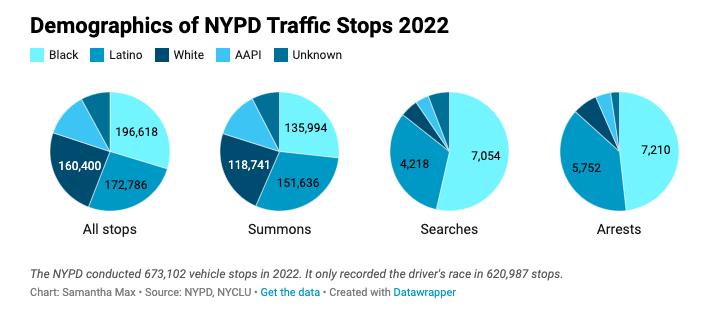
The report explains that “police officers [are] stopping and detaining large numbers of drivers for minor infractions without legal justification. In a city of about 630,000 people, MPD officers reported making 866,164 traffic stops between January 2018 and August 2023. The number of stops may be even greater. They cited or arrested drivers in at least 296,685 cases, predominantly for minor infractions. ..

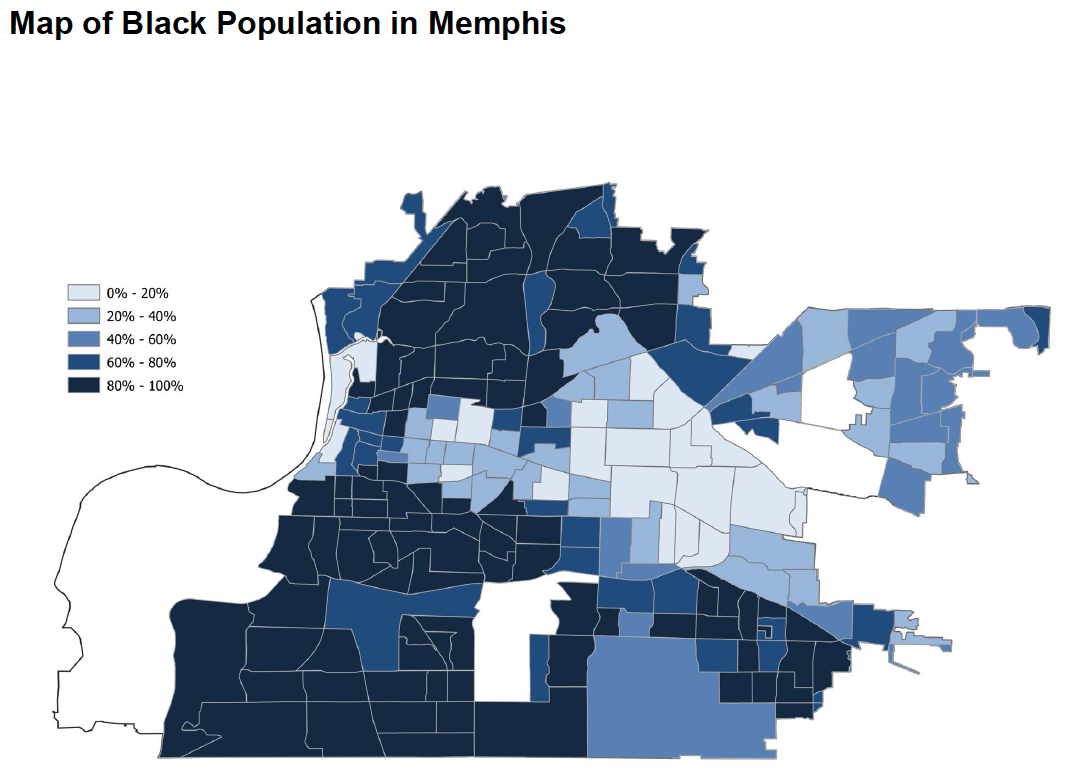
Memphis is a majority-Black city, but Black people in Memphis disproportionately experience these violations. MPD has never assessed its practices for evidence of discrimination. We found that officers treat Black people more harshly than white people who engage in similar conduct… 

Memphis is a racially segregated city. Both north and south Memphis are predominantly Black, while a string of majority-white neighborhoods leads from downtown towards east Memphis and wealthier suburbs…

Below are a few excerpts from the report

A. The Memphis Police Department Uses Excessive Force in Violation of the Fourth Amendment.

Our review of a random sample of force incidents showed that MPD officers regularly escalate encounters involving nonviolent offenses and use unreasonable force against unarmed people who pose no threat. Officers punch, kick, and tackle people just moments into an encounter without justification. Officers use disproportionate force against people who have committed, at most, minor offenses such as traffic infractions, and use force even after people are restrained. Officers use force to retaliate and punish, especially when people talk back to them. MPD has used unreasonable deadly force, such as shooting at moving cars and using unjustified neck restraints. Officers also use excessive force against people with behavioral health disabilities. Officers face little accountability when they use excessive force, and commanders in the police department have ignored clear warning signs about its prevalence…

1. MPD Escalates Encounters Involving Low-Level and Traffic Offenses, Leading to Unreasonable Uses of Force. Memphis police officers regularly escalate situations and use severe, excessive force against people suspected of nonviolent offenses, including traffic violations or shoplifting. A significant share of the unreasonable force we found resulted from these types of encounters. Police officers are required to consider the totality of the circumstances when deciding whether and how to use force, including the severity of the alleged offense and if the person resisted the officer’s control. But MPD officers resort to force likely to cause pain or injury almost immediately in response to low-level, nonviolent offenses, even when people are not aggressive

2. MPD Uses Unjustified Neck Restraints. Neck restraints include chokeholds, strangleholds, or other maneuvers that apply pressure to a person’s neck or throat in a way that limits air or blood flow. These restraints can cause permanent brain injury, stroke, cognitive impairment, and death. Since 2019, Tennessee law has banned officers from using certain neck restraints unless deadly force is justified. For such tactics to be permissible under MPD policy, officers must believe there is an “imminent danger of death or serious bodily injury to the officer or a third person.” MPD policy makes no exception for “the use of hands, knees, feet, or one’s body weight to restrict a subject’s ability to breathe.” Despite these prohibitions, MPD officers regularly use unlawful restraints, sometimes repeatedly in a single incident.

In over 90 percent of the incidents we reviewed involving neck restraints, neither the officers nor supervisors reported the neck restraints. If mentioned in reports at all, officers described neck restraints simply as “physical force.” In one incident, the reviewing lieutenant colonel sent a use-of-force report to a front-line supervisor to “research” officers’ “omissions.” The supervisor instructed the officers to add that there had been “impact” to the face—the body-worn camera video shows they punched the person. But the supervisor failed to identify or mention the two obvious neck restraints that the video showed during the same incident and were also omitted from the officers’ reports. At the time of our review, no officer who used an unjustified neck restraint in the incidents from our sample had received discipline…

3. The Memphis Police Department Uses Unreasonable Force on People Who Are Restrained or Under Control. MPD officers punch, kick, and use other force against people who are already handcuffed or restrained. The gratuitous use of force against a person who has surrendered is unconstitutional. We found many incidents in which officers used unreasonable force against people who were restrained. In nearly all of them, supervisors approved the use of force. One officer hit a handcuffed man in the face and torso with a baton eight times. In a different incident, officers kicked a woman in the chest three times while she was handcuffed in the back of a squad car. In another case, officers punched a man in the throat while he was handcuffed to a chair. Officers repeatedly permitted police dogs to bite or continue to bite people, including children, who were nonresistant and attempting to surrender.

MPD’s Dangerous and Punitive Use of Police Dogs MPD’s Canine Unit trains dogs to bite suspects immediately after they locate them and to hold the bite until a handler directs them to release. In practice, this results in unnecessary and unreasonably long bites that hurt people who are not a threat. MPD officers have allowed c anines to bite people, including teenagers, who were trying to surrender. One MPD officer commanded his dog to bite a person who was sleeping. Another dog bit a 17-year-old’s arm for at least 30 seconds as he begged officers to release the dog; the teenager was later taken to a children’s hospital for treatment. These bites were unnecessary and unreasonable because the people posed no threat to the dogs or their handlers.

One training officer told us that officers often need to insert a device into a dog’s mouth to get the dog to release the bite, indicating that they do not reliably release on command. And even though MPD policy limits use of dogs to cases with felony suspects, we reviewed an incident in which an officer released his dog to apprehend a man suspected of shoplifting household items. The dog bit the man multiple times, causing injuries that required hospitalization. Supervisors found no policy violations.

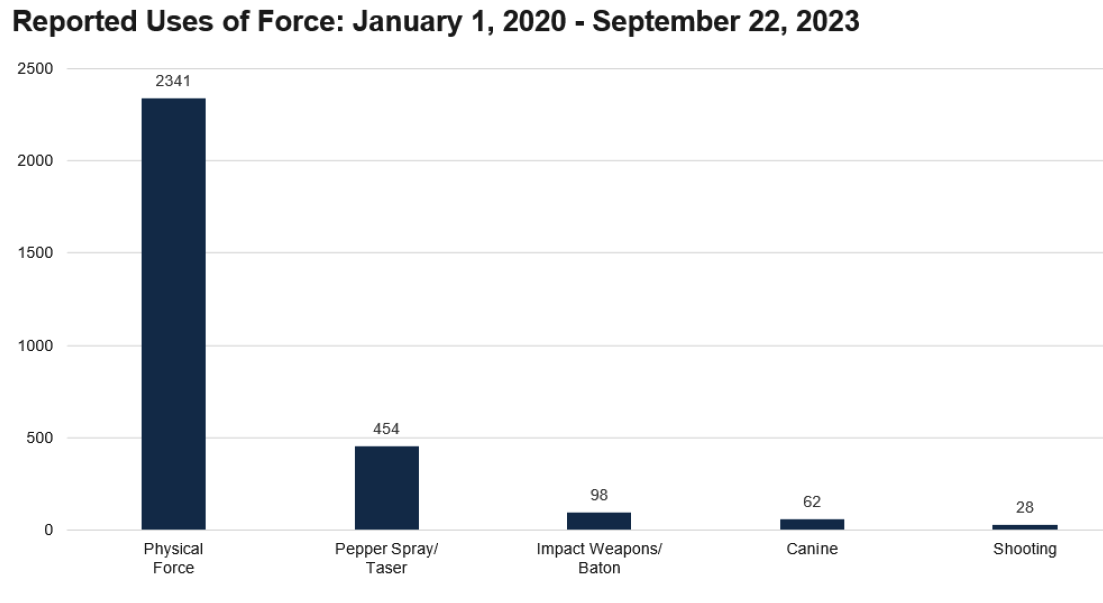
4. MPD’s Use of Less-Lethal Weapons Violates the Law. Memphis police officers unreasonably use less-lethal weapons, such as Tasers and pepper spray, often without first attempting to resolve situations peacefully. Of the 2,669 reported less-lethal force incidents between January 2020 and September 2023, MPD officers used a Taser or pepper spray in at least 454 of them. Officers have used Tasers and pepper spray recklessly, and they have accidentally discharged these weapons at other officers, or even themselves.

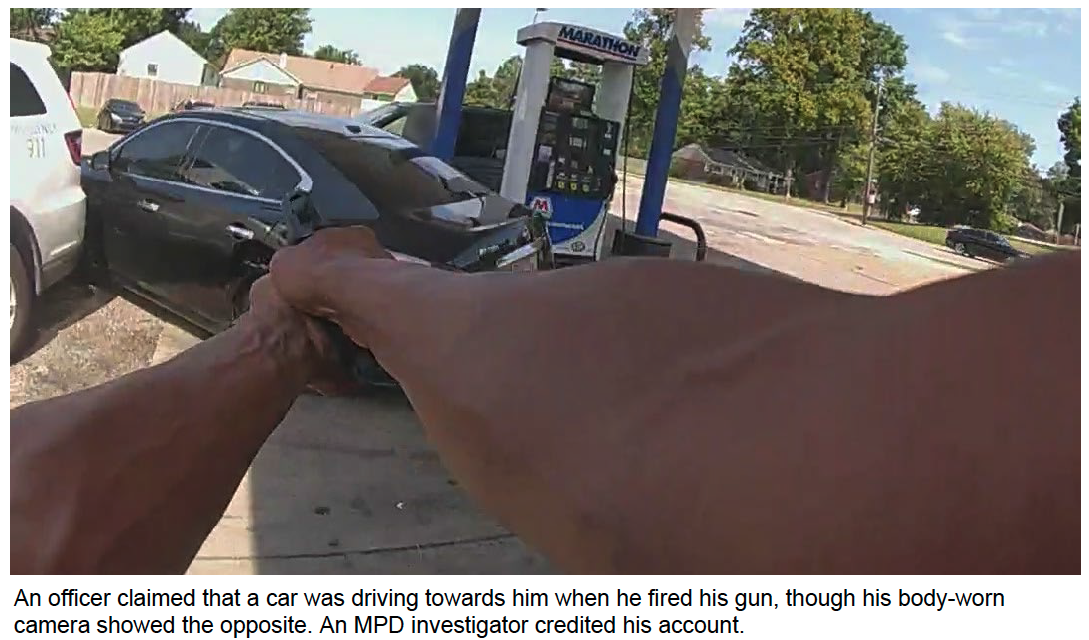
5. MPD Officers Unreasonably Shoot at People and Cars After Placing Themselves in Dangerous Situations. We reviewed all 18 Memphis police shootings from 2018 through 2022. A significant number of them involved officers firing into cars or at moving vehicles, without justification. Shooting at a moving car is deadly force and therefore permissible only when an officer has probable cause to believe a suspect poses an immediate threat of serious physical harm to the officer or another person. It is also highly dangerous because it presents risks of an uncontrolled vehicle. MPD officers have fired at moving cars without justification. An officer may be justified to use deadly force against “a driver who objectively appears ready to drive into an officer or bystander with his car.” But that justification ends “once the car moves away, leaving the officer and bystanders in a position of safety.” 13 MPD officers have disregarded tactical basics and placed themselves in dangerous and avoidable situations when approaching cars. “Where a police officer unreasonably places himself in harm’s way, his use of deadly force may be deemed excessive.” 14

In one shooting, an officer fired at a car at least eight times at a fast-food drive-thru in the middle of the day, jeopardizing other officers and bystanders. The officers had been alerted to a stolen car, and two police cars approached from different directions, trying to box the car in. One officer got out of his car and ran towards the suspect’s car but tripped and fell to the ground as the suspect’s car moved slowly in his direction. As he regained his footing and jumped out of the car’s path, another officer fired twice at the car. The officer fired another six shots after his partner had retreated to safety, including the final two as the suspect’s car slowly came to rest against a brick wall. When he continued to fire after the car no longer presented a threat, the officer used unreasonable force and unnecessarily placed bystanders and officers in harm’s way. MPD’s investigation improperly found that this use of deadly force was justified.

6. MPD’s Deficient Policies and Training Contribute to Excessive Force. MPD’s deficient policies and training fail to advise officers on the constitutional requirements for using force. MPD’s use of force policies are missing critical elements, like the basic legal requirement that force must be proportionate in light of the severity of the offense and the threat that officers face. Instead, MPD policy suggests that force may be necessary if a person’s non-compliance prevents an officer from accomplishing their duties in a “timely manner.” The desire to resolve an interaction quickly does not justify the use of force. As described above, we reviewed multiple incidents in which MPD officers used force unnecessarily just because a person did not immediately follow their commands.

B. MPD Conducts Unlawful Stops, Searches, and Arrests. We have reasonable cause to believe MPD engages in a pattern or practice of making stops, searches, and arrests that violate the Fourth Amendment. During minor traffic and pedestrian stops, MPD officers conduct unjustified frisks and more intrusive searches, or handcuff and hold people in patrol vehicles just to write a simple citation. At times, officers unnecessarily prolong these stops, or search and seize the drivers’ vehicles. MPD officers also make unlawful arrests for low-level offenses, such as arresting people for disorderly conduct even as they are following officers’ instructions and commands.

Our findings are based on a variety of evidence. We interviewed MPD officers and supervisors and observed their activities during ride-alongs. We reviewed MPD policies and training materials concerning stops, searches, and arrests. We analyzed a random sample of traffic stops from 2021 through 2023, as well as a random sample of arrests for minor offenses, such as disorderly conduct, resisting arrest, loitering, and curfew violations from 2022 through 2023. For each incident in our sample, we examined officers’ body-worn camera footage and all available documentation for evidence of constitutional violations. We also reviewed dozens of complaints and internal affairs investigations, use of force incidents, and court cases involving stops, searches, and arrests by MPD officers, including numerous cases in which federal courts suppressed evidence because of MPD’s unconstitutional conduct. And we interviewed judges, judicial commissioners, prosecutors, and defense attorneys, as well as community members who have been impacted by MPD’s practices.

DOJ STATES: MPD promotes “saturation” policing to flood certain neighborhoods with traffic stops. For example, the police department’s Gang Response Team, a specialized unit of officers who work in plainclothes, will “saturate” an area with “zero tolerance” enforcement and traffic stops. But officers target a particular neighborhood rather than trying to locate and apprehend specific suspects in gang-related crimes. 

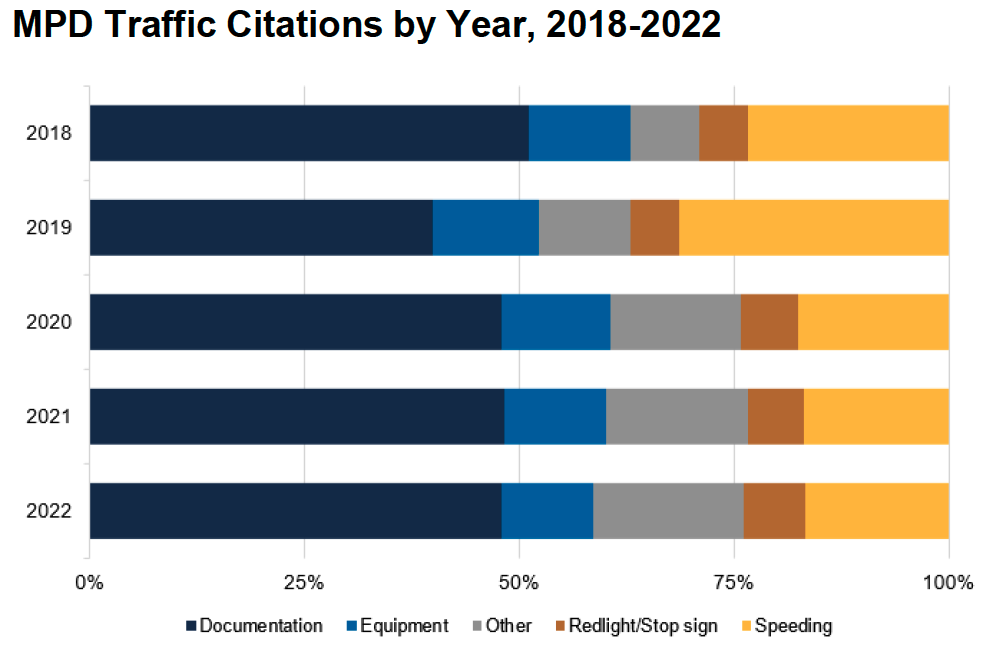
1. MPD Makes Unconstitutional Stops. Under the Fourth Amendment, police can stop and briefly detain people if they have reasonable suspicion the person is engaged in criminal activity. Reasonable suspicion must be “articulable,” not just an “unparticularized suspicion or hunch.” 15 MPD officers violate these standards while enforcing traffic laws and during other interactions with people they encounter on Memphis streets. The pattern of Fourth Amendment violations stems from MPD’s decision to prioritize traffic enforcement as a central method to address crime in Memphis, while at the same time failing to ensure that officers understand and follow constitutional requirements when they stop and detain people. MPD officers face pressure to make stops. Many of these traffic stops involve documentation or equipment violations, like broken taillights and expired tags. MPD’s data show that from 2018 to 2023, more than half of MPD’s citations involved documentation or equipment violations. The chart below shows MPD’s traffic citations in more detail. This data does not include hundreds of thousands of traffic stops that did not result in citations, because MPD officers do not document the reason for those stops.

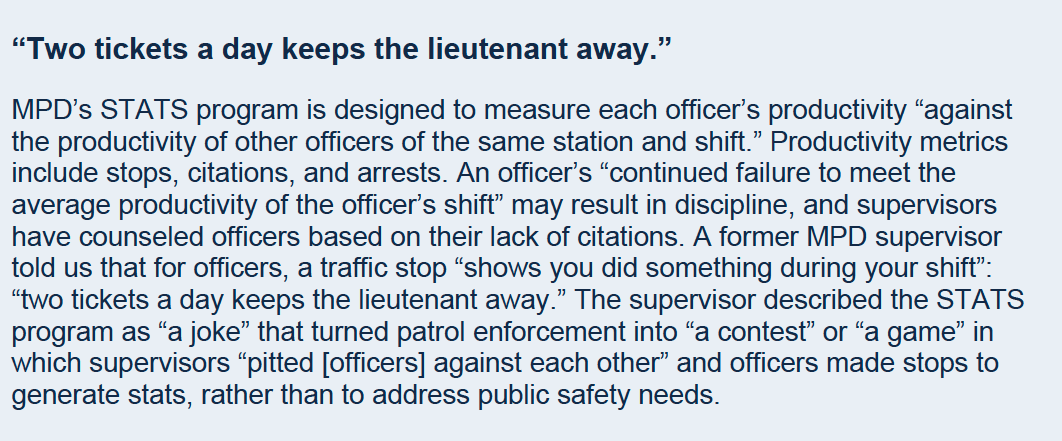
Supervisors rarely review traffic stops to ensure they meet constitutional standards. But they do measure officers’ “productivity” based in part on how many stops and citations they generate. Supervisors look at officers’ totals at the end of each month to ensure that they are making enough stops. Officers can face discipline if they fail to meet productivity averages for their shifts, and supervisors have even cited officers’ productivity as grounds for leniency in disciplinary hearings. Reflecting the pressure to make stops as an overall enforcement strategy, one officer said to a colleague after a traffic stop, “You guys wanted to find something . . . Traffic stop. Traffic stop. Traffic stop. Check. Check. Check . . . You guys asked, I just delivered.” MPD stopped and cited one Black man 30 times in three years. At the same time, MPD’s failure to properly supervise its officers results in unconstitutional stops, searches, and arrests.

2. MPD Searches People Unlawfully. Memphis police officers conduct unreasonable frisks or searches following pedestrian or traffic stops. The Fourth Amendment permits police to “frisk” or “pat down” people for weapons if there is reasonable articulable suspicion that the person is armed and dangerous. The scope of a lawful frisk is limited to a person’s outer clothing, and once an officer determines a person is unarmed, there is no longer justification to continue to search. To conduct a more intrusive search of a person, officers must have probable cause to believe they will find evidence of a crime.

A stop or a frisk is far more than a “petty indignity”—it is, rather, “a serious intrusion upon the sanctity of the person, which may inflict great indignity and arouse strong resentment.”18 But MPD officers order drivers out of their cars and frisk them for weapons without justification to believe they are armed and dangerous. Courts have recognized that nervousness is an “unreliable indicator” of dangerousness, “especially in the context of a traffic stop.” 19 This may be particularly true for individuals who, due to fear that police may treat them unfairly because of their race, may display symptoms of stress during encounters with the police. Still, MPD policy lists “[t]he appearance and demeanor of the suspect, i.e. person appears to be unusually scared, jittery, or acting in a strange manner” as a factor that may serve as the basis for a frisk. In our review of a random sample of traffic stops, officers often frisked individuals with no explanation at all.

MPD does not require officers to record when they frisk or search people, which means police leaders cannot assess how common the practices are. Even when officers do record their actions, they often do not cite specific facts that support their conduct. For example, in one incident in which an officer stopped a driver for improper tags, handcuffed the driver, searched the car, and searched the driver’s purse inside the vehicle, the officer’s report did not mention any of these activities. In another incident in which officers were responding to a call about a car at an abandoned home, the officers similarly failed to document that they had handcuffed, frisked, and searched the occupant of the car and searched the car. Supervisors therefore are not easily able to review and assess whether officers are engaging in unlawful conduct during these frisks and searches. This lack of documentation also prevents MPD leadership from assessing whether MPD’s search practices are legal and effective.

Officers also frisk and search people after stopping them on the street. After stopping a Black man for “walking into traffic,” officers immediately bent the man over the hood of their patrol car, patted him down, manipulated the outside of the man’s pocket, and reached inside. The officers noted in their report that the man was a “known panhandler,” but did not mention or seek to justify the frisk and search. They released him twenty minutes later with a citation. In another incident, when an officer stopped three Black teenage boys for a curfew violation in downtown Memphis, the officer frisked all the boys even though he had no reason to believe they were armed and dangerous. The boys, who were suspected of nothing more than a curfew violation, were compliant and had not tried to reach or conceal anything in their pockets before he began frisking them, and the officer’s report did not mention or justify the frisk. Body cavity searches implicate greater constitutional concerns than searches of a person’s clothing and generally require a warrant. MPD policy requires a warrant to conduct “an inspection, probing, or examination of the inside of a person’s anus, vagina, or genitals.” 20 But MPD officers ignore these requirements and conduct invasive searches in public view. In one incident, MPD officers seemed to believe a more intrusive search was warranted “to catch bigger fish.” During a “zero-tolerance” operation in a “high-crime and known-drug area,” officers saw two men who had been standing on a corner walk away when the patrol car approached. Finding these actions “suspicious,” the officers detained, handcuffed, frisked, and searched the men. During the search, one officer asked, “Did you check his ass crack yet?” and another officer responded, “Yes.” Both men complained that an officer searched their rectums. The officers were not disciplined for the searches.

3. MPD Unlawfully Searches and Seizes Cars. To search a car, officers must have probable cause to believe they will find evidence of a crime. Police can also search vehicles when they make an arrest, when there is reason to believe a person is armed and dangerous, when evidence is in “plain view” of the officers, and if they take lawful possession of the car. Although officers may ask a person to waive these requirements and consent to a search, the consent must be voluntary and not the product of police coercion. During traffic stops for minor violations, MPD officers violate people’s rights by illegally searching their vehicles. For example, officers stopped a man for driving without tags on his car, told him to get out of his car, then, without explanation or warning, frisked the man and held him in the backseat of a locked patrol vehicle. Officers then searched the man’s car, including opening the glove compartment and looking under the seat. Finding nothing, the officer issued the man a citation and released him more than 30 minutes later. The officer’s report did not mention the search.

4. MPD Makes Unlawful Arrests. Under the Fourth Amendment, arrests must be supported by probable cause, which requires “a probability or substantial chance of criminal activity.” 22 Each year, MPD makes thousands of arrests for nonviolent misdemeanor offenses, such as trespassing, disorderly conduct, panhandling, curfew violations, drug possession, drug paraphernalia possession, public intoxication, and vandalism. Unlike arrests for more serious, violent crimes, officers have significant discretion on how to handle such low-level violations, such as whether to make an arrest, issue a citation, or let people off with a warning. MPD officers abuse that discretion and arrest people for minor offenses without probable cause, at times in apparent retaliation or to justify the officer’s own conduct. Adults who are arrested are transported to jail where County magistrates review their charges, while children who are arrested for low-level offenses often receive a summons to appear in juvenile court.

MPD’s intrusive and unconstitutional stops, searches, and arrests violate the rights of people throughout Memphis. The impact of being unlawfully stopped, frisked, detained, handcuffed, searched, or arrested is hard to quantify. The damage to one’s dignity, reputation, and self-image can be lasting and traumatic. One man told us, “Getting pulled over in our community is a frightening experience.” He said officers “spark fear in order to control.” A man who experienced a cavity search said that he now spends more time in his house, “can’t eat,” and gets jumpy whenever he sees a police car. One woman told us that her family’s experiences meant she would only call MPD in a life-threatening situation: “They are not the first resort. They are the last resort.” Many of these improper stops result in nothing more than traffic citations or other charges that are ultimately dropped. Some people are taken into custody and may sit in jail away from their families and jobs for charges that, as a result of MPD’s unlawful conduct, are likely to be dismissed. These interactions can be degrading and humiliating and result in other negative impacts, such as loss of employment or transportation or separation from families. Although their actions have serious consequences, one judicial commissioner said, “[MPD officers] don’t get sometimes this is not a game.”

MEMPHIS IS A CITY CONTROLLED BY ELITE WHITE LIBERALS. Memphis is home to Memphis International Airport, the world's busiest cargo airport, surpassing Hong Kong International Airport in 2021. Memphis serves as a primary hub for FedEx Express shipping.

As of 2014, Memphis was the home of three Fortune 500 companies: FedEx (no. 63), International Paper (no. 107), and AutoZone (no. 306). Other major corporations based in Memphis include Allenberg Cotton, American Residential Services (also known as ARS/Rescue Rooter); Baker, Donelson, Bearman, Caldwell & Berkowitz; Cargill Cotton, City Gear, First Horizon National Corporation, Fred's, GTx, Lenny's Sub Shop, Mid-America Apartments, Perkins Restaurant and Bakery, ServiceMaster, True Temper Sports, Varsity Brands, and Verso Paper. Corporations with major operations based in Memphis include Gibson guitars (based in Nashville), and Smith & Nephew.

The Federal Reserve Bank of St. Louis also has a branch in Memphis. [MORE]

C. MPD Unlawfully Discriminates Against Black People in its Enforcement. We have reasonable cause to believe that MPD engages in racial discrimination in violation of Title VI of the Civil Rights Act of 1964 and the Safe Streets Act. These laws prohibit police practices that discriminate on the basis of race. 25 We examined MPD’s enforcement of low-level, minor offenses, where officers have more discretion over whether to stop, cite, and arrest people. MPD’s own data show that across a range of different law enforcement actions, MPD treats Black people more harshly than white people when they engage in similar conduct. These disparities are driven by MPD’s saturation-style enforcement of low-level offenses, including traffic violations, with limited supervision and safeguards. MPD’s stops and citations impose a heavy burden on Memphians, especially on those who have been stopped repeatedly. But MPD has never meaningfully assessed whether these practices are effective or necessary to address violent crime, or whether they result in discriminatory treatment. 26

1.MPD Engages in Racially Disparate Enforcement.We examined records from MPD’s 911 system and data recording stops and arrests to determine whether MPD officers treat similarly-situated people differently, without a reasonable basis to do so. We based our analyses on officers’ own descriptions of people’s conduct. We then measured officers’ actions against reliable benchmarks to understand how officers treat people of different races who engage in the same conduct. These analyses allow us to rule out alternative explanations for racial disparities and assess the role of race in how MPD enforces the law. We found that MPD treats Black people more harshly than white people who engage in similar conduct.

MPD enforces traffic laws more aggressively against Black drivers and in Black neighborhoods. Each year, MPD officers cite thousands of drivers for moving violations, such as speeding or running a red light. But officers treat people engaged in similar driving behavior differently, due, in part, to race. We designed this analysis to find similarly-situated drivers—those engaged in dangerous driving behavior at similar locations and times of day. We first identified a pool of drivers engaged in dangerous driving behavior that led to crashes. 27 We then compared this dataset to citations MPD officers issued to drivers for moving violations along the same stretch of road at around the same time of day. If MPD enforced traffic laws without regard to race, we would expect officers to treat drivers whose dangerous driving led to crashes similarly to drivers whose dangerous driving led to traffic stops. Instead, we found that MPD is 21 percent more likely to cite Black drivers for moving violations, as compared to white drivers who engaged in dangerous driving that led to at-fault crashes in the same place and time.

MPD is more likely to cite or arrest Black people for drug-related offenses than white people. MPD officers are more likely to arrest or cite Black people for drug offenses than white people who they describe as engaging in similar conduct. We analyzed MPD’s data regarding incidents in which officers encountered people using drugs, and then compared how officers treated people of different races in those encounters. We identified these “similarly situated” people based on officers’ own reports. We designed this analysis to rule out factors other than race: the analysis only compared people who were accused by officers of engaging in similar types of conduct, as described by the officers themselves. If race did not factor into officers’ decision making, then we would expect the outcomes of those encounters to be closely the same. Instead, we found that officers are 17 percent more likely to cite or arrest Black people for drug-related offenses, as compared to white people who were described by officers as engaging in the same conduct.

MPD arrests Black people for marijuana possession at more than 5 times the rate of white people. We also found significant disparities in MPD’s enforcement of laws prohibiting the possession of marijuana. Data on drug arrests can be compared to relevant benchmarks on drug use to evaluate whether MPD enforces drug laws disproportionately. Public health data show that Black people and white people use marijuana at similar rates. If MPD enforced marijuana possession laws without regard to race, we would expect that Black people and white people in Memphis would be charged with marijuana possession violations at roughly equal rates. But that is not what the data shows. Instead, we found that MPD cites or arrests Black adults for marijuana possession at 5.2 times the rate of white adults, based on MPD’s data from 2018 to 2023. Disparate drug enforcement is not new in Memphis. A 2016 report found that MPD arrested Black people at more than 3.5 times the rate of others, when adjusted for the city’s racial demographics. The disparity was larger for marijuana possession: MPD arrested Black people for marijuana possession at more than 4 times the rate of others.

MPD disproportionately cites Black drivers for minor traffic offenses. MPD’s traffic stops often involve equipment or documentation violations, rather than dangerous driving behavior. MPD disproportionately cites Black drivers for minor traffic offenses such as improper tags, tinted windows, faulty taillights, and other equipment violations, as compared to their share of the residential population. Overall, MPD cites Black drivers for equipment violations at 4.5 times the rate of white drivers, based on their share of the residential population. Black drivers receive citations for improperly tinted windows at 9.8 times the rate of white drivers, and for defective lights at 6.1 times the rate of white drivers. Nearly 90 percent of MPD’s equipment violation citations were of Black drivers.

MPD disproportionately cites or arrests Black people for highly discretionary misdemeanor offenses. These stark disparities extend to other discretionary misdemeanor offenses. For example, MPD cites or arrests Black people for loitering or curfew violations at 13 times the rate of white people. And MPD cites or arrests Black people for disorderly conduct at 3.6 times the rate of white people.

MPD’s enforcement of low-level, discretionary offenses also impacts Black youth in Memphis. Data confirm that officers disproportionately arrest Black youth for a variety of highly discretionary offenses. From January 2018 through August 2023, MPD arrested 180 Black children for loitering or curfew violations, as compared to just 4 white children. MPD arrested 120 Black children for disorderly conduct, as compared to just 1 white child.

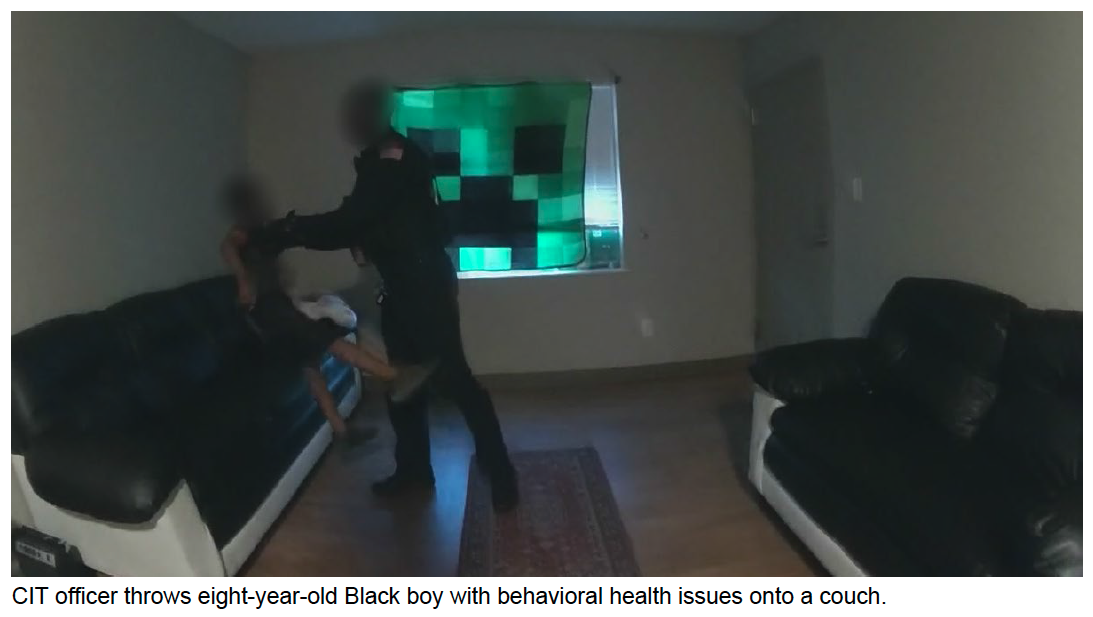
D. The City and MPD Unlawfully Discriminate in Their Response to People with Behavioral Health Disabilities. The City of Memphis and MPD violate the Americans with Disabilities Act (ADA) by discriminating against people with behavioral health disabilities 30 when providing emergency response services. 31 Each year, MPD officers respond to tens of thousands of 911 calls involving behavioral health. Some of these calls are from people with behavioral health disabilities, calling because they are experiencing a crisis. Other calls are from family members or bystanders who call when they see someone who may need behavioral health support. The City’s own 911 call-takers code the majority of these calls as “nonviolent.” But the City requires MPD officers to respond to all of these calls, which leads to unnecessary police interactions. In a significant number of these incidents, MPD officers—including specially trained Crisis Intervention Team (CIT) officers—use unnecessary force or mock and belittle people with behavioral health disabilities. [MORE]

Contrary to Massa Media, Black Unemployment is Soaring. According to the BLS Survey, Job Creation Stands at Negative 723,000 Since October

From [HERE] The Bureau of Labor Statistics released the results of its twin labor market surveys for November. From the establishment survey, non-farm payroll job creation printed at (salted, peppered, and heavily seasoned) growth of 227,000, while revising the months of September and October up a combined 56,000. That's a net creation of 283,000 jobs, if one can trust the numbers, which is asking a lot.

Why the skepticism? Aside from the poor past performance of this series, one only has to go as far as the BLS household survey to find stark contrast in just how many jobs were created in November. This is astonishing. For November, the household survey shows a decrease of 355,000 employed people on top of an October decrease of 368,000. In other words, over the past two months, according to the BLS survey that the financial media loves to ignore, job creation stands at negative 723,000. Things that make you go hmmm? One more thing on this topic. It looks like there were job losses across both full and part time labor forces, so a mass reduction of hours does not seem to be part of this story. 

Digging into that household survey, we see a decrease in the civilian labor force of 193,000 individuals and an increase of 161,000 officially unemployed persons. This takes the participation rate down to 62.5% from 62.6% and the employment to population ratio to 59.8% from 60%. Two months ago, this metric stood at 60.2%. Finally, the official unemployment rate that does not count those folks who simply dropped out of the labor force, increased to 4.2% from 4.1%, while the underemployment rate increased to 7.8% from 7.7%.

In a troubling sign that one prominent economist called a “serious cause for concern,” the Black unemployment rate in November surged to its highest level in eight months.

Additionally, according to the establishment survey, the average full-time workweek improved to a historically low 34.3 hours from a ghastly 34.2 hours in October. Average Hourly Earnings remained precisely on pace with October at year over year growth of 4%. 

Unemployment Rate by Gender / Age

Adult men: stable at 3.9%.

Adult women: increased from 3.6% to 3.9%.

Teenagers: improved from 13.8% to 13.2%.

Unemployment Rate by Race

White: stable at 3.8%.

Black or African American: soared from 5.7% to 6.4%.

Asian: decreased from 3.9% to 3.8%.

Hispanic or Latino: increased from 5.1% to 5.3%. [MORE]

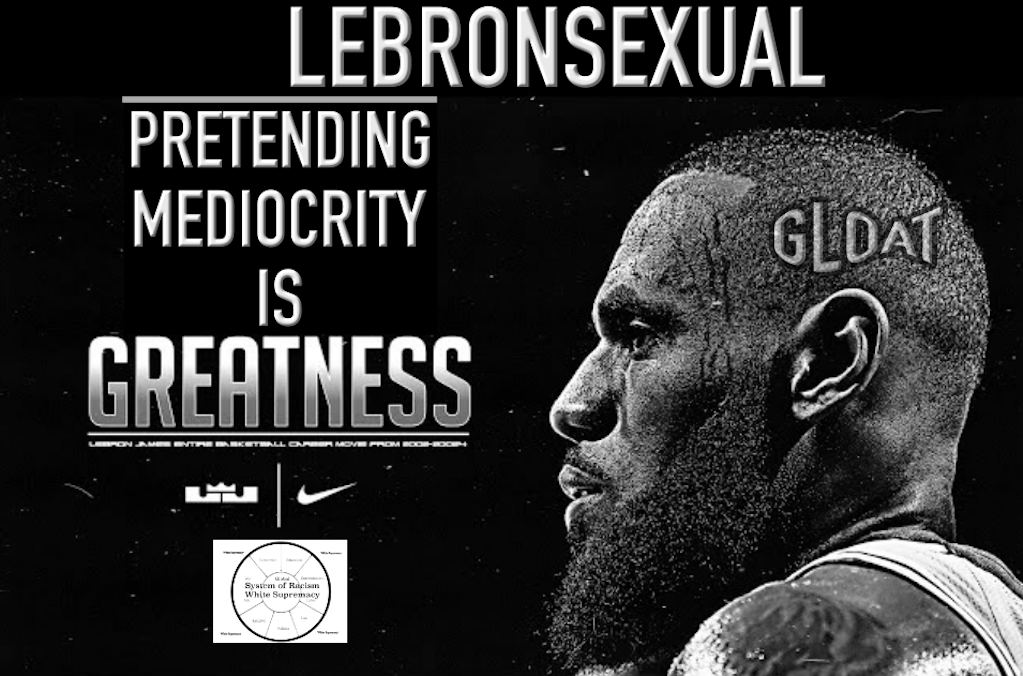
GLOAT Lebron James also Losing Money - Media Company Lost Nearly $30 Million Last Year

From [HERE] The media company founded by NBA all-star LeBron James reportedly lost nearly $30 million last year and will likely lose millions more.

SpringHill, the production company LeBron James cofounded with Maverick Carter in 2020, has lost $28 million despite producing films like Space Jam and Shooting Stars along with the talk show The Shop. Though the company pulled in $104 million in revenue in 2023, it will be finishing in the red this year, according to Bloomberg.

“The entertainment market shift in 2022/2023 toward profitability brought rising costs, slower buyer decisions, and impacts from industry strikes, prompting us to recalibrate, including writing off underperforming projects to position ourselves for future growth,” Maverick Carter, CEO of SpringHill, told Bloomberg.

Carter did say the company will exceed projections this year. Per Bloomberg:

The company lost $28 million on sales of $104 million last year, according to documents obtained by Bloomberg News. SpringHill lost $17 million in 2022 and is on pace to lose millions more in 2024.

SpringHill recently agreed to a merger with Fulwell 73, the British production outfit behind The Kardashians and the Grammy Awards, a deal that will give the combined company more scale during a challenging business environment. The company, which will have 250 employees, is aiming to be profitable by the end of next year, following a round of staff cuts. [MORE]

White Akron Cop Uses Assault Rifle to Execute Black Teen Apparently Posing No Threat. Police Never Saw a Gun b/c it Was Inside a Zipped Pocket- as Murders of Blacks by Cops Continue in Liberal Cities

Akron has been dominated by Democrats over the past 25 years. Democrat mayors have held office, including Don Plusquellic, who served from 1987 to 2015, followed by Democrat Dan Horrigan. The City Council also has a Democrat majority, reflecting the city's liberal-leaning in local politics. [MORE]

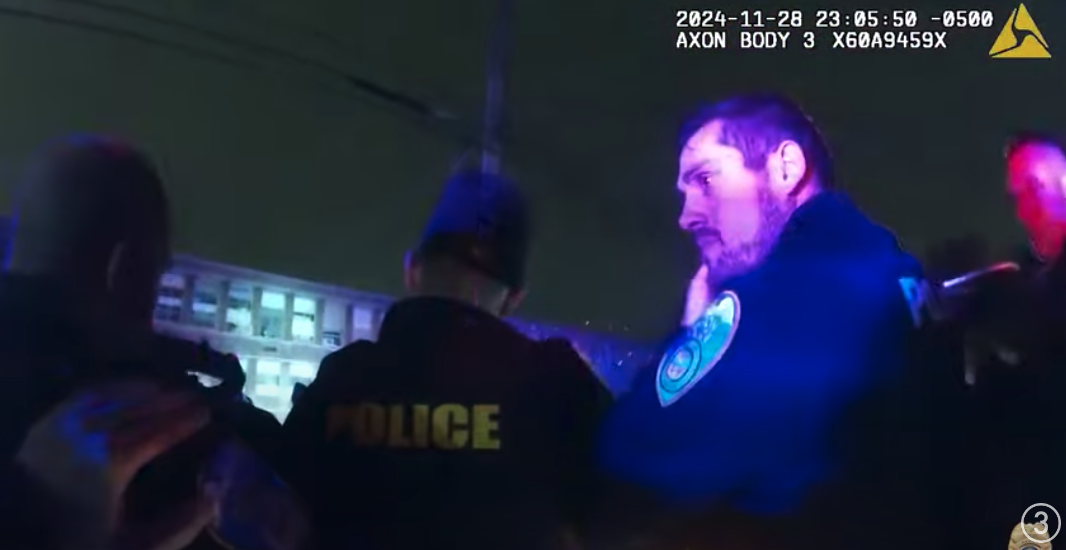
From [HERE] Police in Akron, Ohio, have released body-camera footage of the fatal shooting of a 15-year-old boy, in an incident the city’s mayor called “deeply troubling”.

Video of the Thanksgiving night killing of Jazmir Tucker does not clearly show what led up to the shooting, but suggests that an officer quickly fired at the teenager upon encountering him, and that a group of officers waited seven minutes to approach the boy after he had been shot. The family’s attorneys have said officers did not start rendering aid for 10 minutes.

“In hindsight, the amount of time that expired between the shooting and the initiation of physical aid to Jazmir is deeply troubling to me,” Akron’s mayor, Shammas Malik, said in a statement on Thursday, alongside the release of the footage. “I want to be clear that any unreasonable delay in the rendering of aid by police officers is unacceptable and has no place in Akron.”

Police have said that two patrol officers heard nearby gunshots just after 11pm on 28 November and got out of their parked car to investigate. The officers then encountered Jazmir and ran after him, officials said. One officer fired his assault rifle at the teen, fatally striking him. The boy was later pronounced dead at a hospital and no officers were injured.

The boy was found with a gun in a zipped-up pocket, raising concerns about why lethal force had been used, Malik said: “Why did the officer decide to use his weapon?”

The roughly eight-minute video released by police is difficult to decipher. The sound is off for the first 30 seconds, which is standard when a body camera first turns on. The shooting happens within that timeframe. The footage suggests the officer was chasing Jazmir, raised his rifle and fired at him for about three seconds, potentially shooting about seven times.

The shooting officer’s arms and long gun, however, block the camera’s view, and Jazmir is not visible in the moments before and during the shooting.

Once the sound on the footage begins, that officer and others are heard yelling at Jazmir, who is on the ground, repeatedly telling the unresponsive teen to raise his hands. Between eight and 10 officers ultimately converge on Jazmir about seven minutes after he is shot. At that point, officers handcuff him and search his pockets. Police have not released details about what any of the officers did to try to save his life.

The mayor said the footage left him with “serious questions”, including why officers did not activate their cameras upon arrival. He said their cameras eventually started automatically recording due to the presence of a nearby cruiser with activated lights.

“I also believe that many will ask why the officers used rifles instead of handguns in responding to this incident,” Malik said. “This will be something that we discuss more going forward, including in the internal investigation, and as part of our comprehensive review of use of force, including when and how different weapons are used.”

The family’s attorneys said in a statement that the fact that Jazmir had a weapon was “irrelevant because officers didn’t know he had it until they unzipped his pocket after he was shot”.

“The police department did a number of things tactically wrong in this case, starting with the aggressiveness that they initiated this pursuit … These officers came out with the intent to do one thing: shoot and kill,” the attorney Robert Gresham said in a statement. “What I perceive to be the biggest issue here is there’s a culture of violence in this particular police department.”

Stanley Jackson, another family attorney, added: “The mayor and the police department weaponized the police by allowing them to carry assault rifles, right? And then, the police department weaponizes Jaz’s skin and his youth. That’s the problem.”

At a news conference, Jazmir’s relatives said they are devastated by his death. Ashley Greene said her son was a “great kid”, adding she was “extremely hurt that I couldn’t help my baby”.

“It hurt me to see that no one helped my baby,” Greene said, according to Fox 8 News. “The police never addressed us. I had to find out that was my son through social media.”

Jazmir’s great-aunt, Connie Sutton, described him as a child who was always laughing: “Everybody loved Jaz, and Jaz loved everybody else.”

The officer who fired the shots has been on the force for nearly five years. He and his partner were placed on paid administrative leave, per department policy, and their names have not been released.

The Ohio bureau of criminal investigation is leading the inquiry, and Akron police are conducting a separate internal investigation.

In October, the city of Akron paid the family of Jayland Walker a $4.8m settlement, after eight police officers fired 94 bullets at the 25-year-old in a 2022 incident that sparked widespread protests. A grand jury declined to indict the officers last year over the killing, which began with a traffic stop over a broken taillight.

On Friday, the Ohio supreme court ruled that the city could continue to conceal the names of the officers who shot Walker.

A White OKC Cop Assumed an Unarmed Black 8th Grader Had a Gun, Ordered Him to Drop It and Fired 4 Shots All in Less than 1 Second. Appeals Ct Denied Immunity, Allows Lorenzo Clerkley’s Suit to Proceed

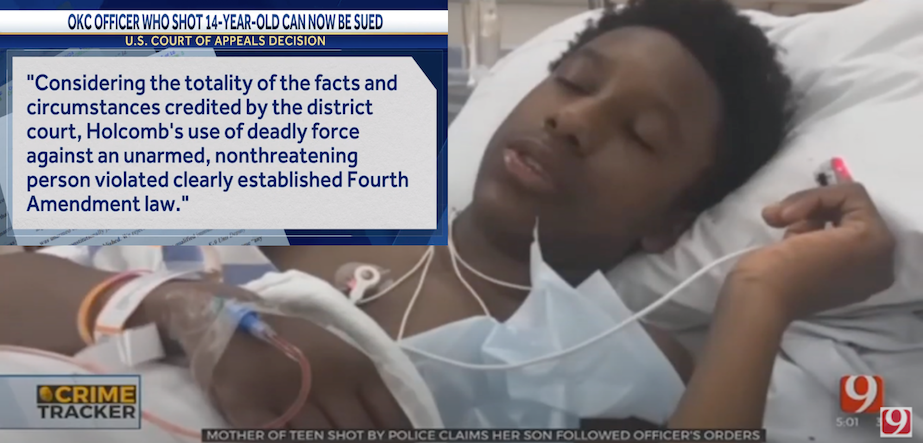
From [HERE] The U.S. Court of Appeals has denied qualified immunity to a white Oklahoma City police officer who shot a Black 14-year-old in 2019, allowing the family to proceed with a lawsuit.

The court affirmed a lower court's denial of qualified immunity — which protects government officials from accountability for their actions, including police officers, when they are sued — for Officer Kyle Holcomb.

According to court documents, someone (probably a racist suspect) called 911, saying four men were breaking into a home and that they saw a gun. Police later discovered they were all teens playing with BB guns in the backyard.

Upon arrival the officer states “I think its a cap gun.” Police officers know what guns sound like. He approached the wooden fence that rings the house’s yard, moving toward one of the many holes in it, the video shows. He waited for a moment, his gun pointed through the gap in the fence. Someone materialized from the house.

“Show me your hands! Drop it!” Holcomb said, firing four shots in rapid succession. According to the video footage, no more than six hundredths of a second had passed since he had finished the command.

“Drop the gun!” he then said, before radioing in the incident. “Shots fired, shots fired. Black male with a gray hoodie had the gun."

Holcomb claimed Lorenzo Clerkley Jr. was holding what he thought was a black handgun. When he ordered him to drop it, he said Clerkley pointed it at Holcomb, who then shot him.

Lorenzo told the police, however, that his hands were empty and that he was holding them up when he was shot. The then-14-year-old was shot in the hip and leg.

Lorenzo told The Washington Post that he and some friends had planned to play basketball that day, but rain meant they had to find an indoor activity. They went to an abandoned house and brought with them some airsoft guns, which resemble firearms and shoot small projectiles, typically made from plastic. His lawyer says some of the four or five guns the kids had were BB guns, which are similar. Both are different from cap guns, toys that don’t shoot projectiles but make firing sounds and emit smoke.

Lorenzo said he had climbed out a window because the house’s back door was locked while his friend was showing him around. Holcomb was standing at the fence outside, according to the video.

“I jumped, and he just started firing his gun,” he said, referring to Holcomb.

Lorenzo had been shot twice, once in the leg and once near his hip, he and Smolen said, and he had entry and exit wounds. Smolen is in the process of doing an investigation to determine where the bullets entered and exited.

Lorenzo shows the entry and exit wounds where one bullet struck him Sunday at his home in Del City, Okla. (Nick Oxford for The Washington Post)

A police officer dragged Lorenzo over broken glass from the front of the house to the side, he and Smolen said.

The district court found low resolution and obstructing vegetation made it difficult to see much detail and said the footage and the still-framed photographs do not show that Clerkley was holding something black in his hand.

The Court of Appeals concluded, "Considering the totality of the facts and circumstances credited by the district court, Holcomb's use of deadly force against an unarmed, nonthreatening person violated clearly established Fourth Amendment law."

Police released a photo of the gun they said Lorenzo had carried in his hand, saying it was a BB gun that mimicked a real handgun. Capt. Robert Mathews, the department’s spokesman, said the gun was found in the backyard, where he said Lorenzo had dropped it. In an interview with The Post, Lorenzo said he did not have a gun on or near him at the time of the shooting.

Maki Haberfeld, a professor at John Jay College of Criminal Justice and an expert in police use of force said she thought the officer did not give Lorenzo any time to comply. “Watching this, I don’t see how the officer could have arrived at the conclusion that his life or someone else’s life was in danger,” she said. “He asks the teenager to drop his hands and show the gun. And then immediately he shoots. There’s no time lapse between ‘Show me the gun; drop your hands,’ and then he fires. . . . He’s already pushing the trigger.”

She also said she found it disturbing that Lorenzo was handcuffed as officers awaited emergency medical personnel to arrive. The video, which ends about 10½ minutes after the shooting, does not show any medical personnel arriving on the scene.

White liberal prosecutor David W. Prater failed to charge Holcomb with any crime for this shooting, and he is still employed by the Oklahoma City Police Department.

Revised North Carolina Law Enables Mostly White Prosecutors to Disproportionately Charge Black Children as Adults In order to Address the Public's Perception of Rising Crime

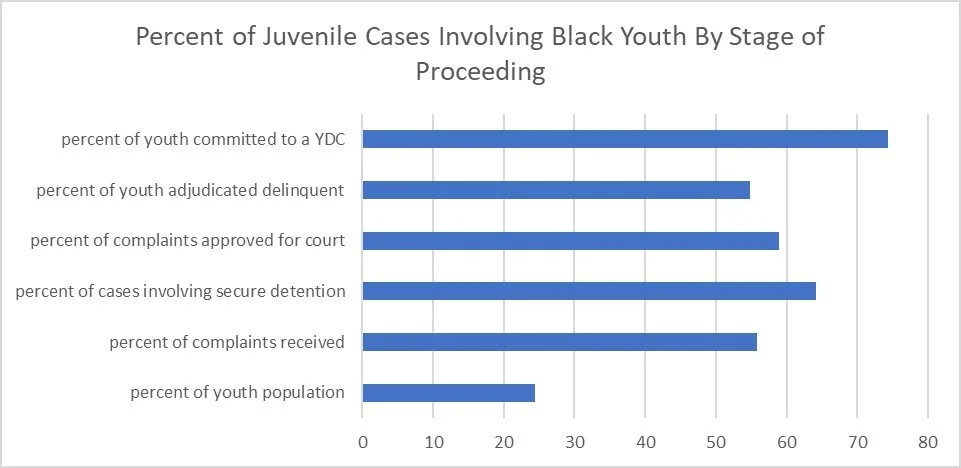
North Carolina’s most recent study, Disproportionate Minority Contact in North Carolina: An Assessment Study (hereinafter “Assessment Study”), funded by the Governor’s Crime Commission and authored by Stan Orchowsky, Ph.D. of Cambiare Consulting and Michael Leiber, Ph.D., and Chae Jaynes, Ph.D., of the University of South Florida FINDS THAT youth of color are represented throughout the juvenile justice system in far greater numbers than they are represented in the general population. [MORE]

Youth Justice by the Numbers

From [HERE] A newly revised North Carolina juvenile justice law will take effect Sunday, aiming to address gaps in handling serious offenses by minors. Amidst increased reports of teenage crime in the Piedmont Triad, including armed robberies and shootings into occupied homes, local law enforcement officials were prompted to reconsider the state’s accountability mechanisms for crimes perpetrated by juveniles; according to a video posted to X by the Greensboro Police Department, “These are not childish acts.”

The updated legislation allows 16- and 17-year-olds charged with Class A through E felonies to now be tried as adults. This represents a significant change from the 2019 Raise the Age law, which allowed most 16- and 17-year-olds to remain under juvenile court jurisdiction regardless of the severity of the charges.

The new law also includes provisions for flexibility. Cases involving Class F through I felony offenses and non-motor vehicle misdemeanors for 16- and 17-year-olds will remain in juvenile delinquency court. Additionally, cases previously transferred to adult court may be reconsidered for juvenile jurisdiction, depending on the charges and circumstances. For youth ages 13 to 15, serious felony cases may also be moved from adult criminal court back to the juvenile system.

The statute also requires school principals to be informed when students face charges for offenses that would constitute Class A through E felonies if committed by adults. However, the law prohibits automatic suspension policies, requiring schools to make individualized decisions about students’ educational status during ongoing legal proceedings.

The right for 16- and 17-year-olds to have a parent, guardian, custodian, or caretaker present during a custodial interrogation in North Carolina remains intact. This safeguard applies to all youth in this age group, regardless of whether their charges fall under criminal or juvenile jurisdiction. This principle is rooted in the 1983 North Carolina Supreme Court decision State v. Fincher, which emphasizes that the key factor is the age of the individual being questioned, not the court system handling their case.

Black Lawmaker Proposes California Bill that Would Allow Public University Admission Priority for Slaves’ Descendants

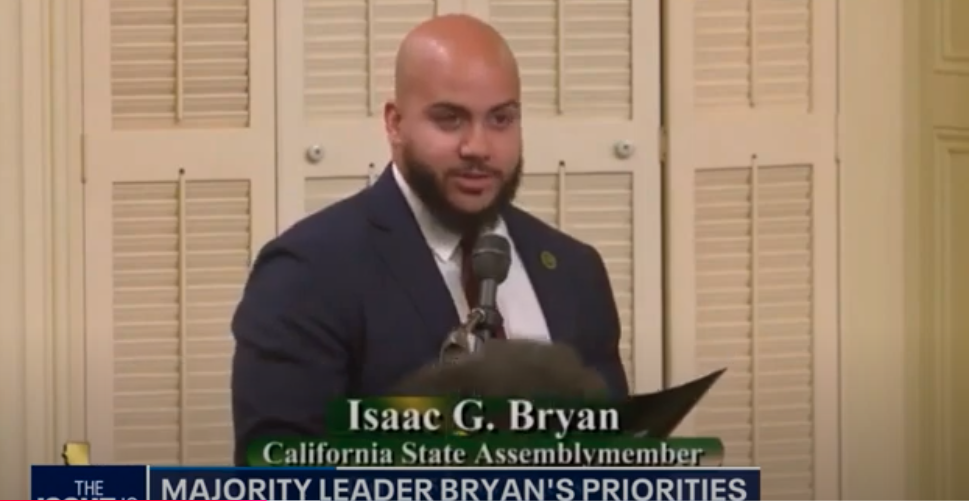
From [HERE] A Black lawmaker introduced a bill Monday to allow admission priority to the descendants of slaves at the University of California and California State University, two of the largest public university systems in the nation.

Assemblymember Isaac Bryan, a Democrat who represents parts of Los Angeles and authored the legislation, said it would help rectify past and current discrimination at universities.

“For decades universities gave preferential admission treatment to donors, and their family members, while others tied to legacies of harm were ignored and at times outright excluded,” Bryan told The Associated Press. “We have a moral responsibility to do all we can to right those wrongs.”

Lawmakers also convened a special session Monday to consider ways to protect the state’s progressive policies ahead of President-elect Donald Trump’s second term.

In California, voters approved a ballot measure in 1996 that banned the state from giving preferential treatment based on race, sex, ethnicity, color or national origin in public employment, education or contracting. The proposition, which outlawed affirmative action in public university admissions in the state, was upheld by voters in 2020. Bryant's legislation would permit, but not mandate, preferential admissions treatment for the descendants of slaves. [MORE]

California is a state controlled by elite white liberals.

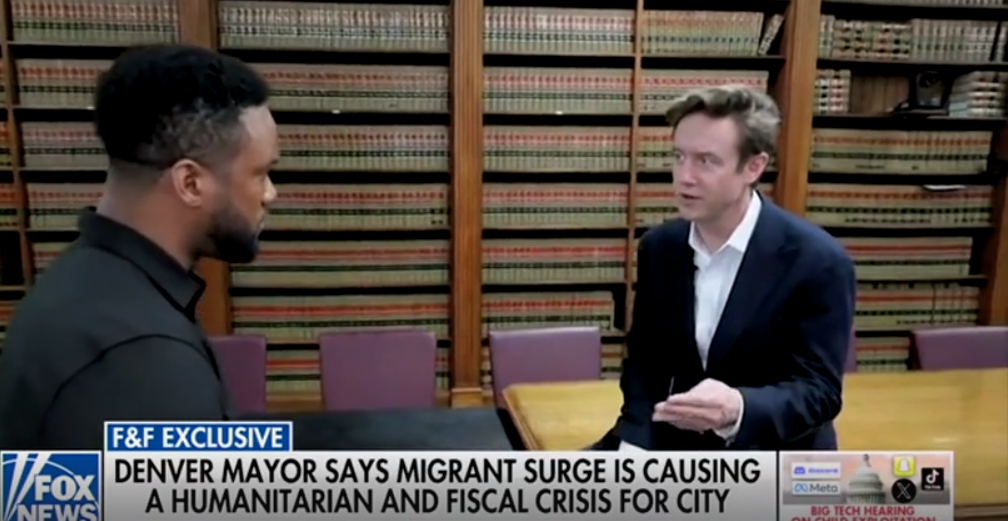
Tax Invasion and Theft: White Liberal Denver Mayor Spent $350M on Migrants, Mostly on Education -Meanwhile DPS Data Shows that 95% of Black and Latino 3rd Graders Cannot Read at Grade Level

From [HERE] Far-left Democratic Denver Mayor Mike Johnston has overseen $356 million of taxpayers’ hard-earned money being spent on migrants. The total amounts to $7,900 per foreign national in the Mile High City.

The sum was revealed by the Common Sense Institute (CSI), a non-partisan research organization dedicated to protecting and promoting the U.S. economy, Fox News reports.

The group says it used city data to arrive at the sum which equates to eight percent of the city’s 2025 budget of $4.4 billion. The figures combine the Colorado city’s budget as well as regional education and healthcare organizations.

Johnston has already slashed city services to house and feed those migrants.

Cuts included reducing services at recreation centers and stopping the planting of spring flower beds, while the city tapped into a contingency fund to pay for the spiraling costs, Fox News notes. It adds:

The CSI claims that the bulk of the $356 million spent on migrants was through education, with the city also splashing out on healthcare, hotels, transportation and childcare. Denver is a sanctuary city, meaning it does not enforce immigration law, nor does the city cooperate with Immigration and Customs Enforcement agents.

The group says that about 45,000 migrants have arrived in the Denver metro area since December 2022, with 16,197 migrant students enrolling in Denver metro schools.

“The total cost to Denver metro schools related to new migrant students is $228 million annually, which would equate to 1-2% of the total state K-12 education budget for the 2024-25 academic year,” the group writes.

“Previous CSI reporting estimated the per-student cost of instruction and support in the Denver metro to be $14,100 per year. Assuming this cost across all recent migrant students totals $228 million.

Meanwhile, according to Denver Public School (DPS) records Thirty percent of white students are on track while just 5% of African American and Latinx students are. Nicholas Martinez with Transform Education Now says 95% of black and brown kids in DPS have trouble reading, the district should be sounding an alarm. Instead, he says it buried the data and he had to file an open records request to get access.

The DPS spring statewide assessment found that 95% of Black and Brown third graders at DPS could not read at grade level. The test also found only 18% of fourth-graders were proficient in math. [MORE]

Martinez says it's a wake-up call, especially in a school district that says equality matters, "We know when students are behind it's very, very difficult for them to catch up and so if we don't act swiftly, if we don't act decisively, these students learning progress for the rest of their academic career will be drastically impacted."

As Breitbart News reported, Johnston is known for his generous support for President Joe Biden’s illegal migrants and promised to use the city’s police department to physically oppose the efforts of Immigration and Customs Enforcement (ICE) to fulfill President-elect Donald Trump’s repatriation mandate.

Tom Homan, Trump’s “border czar” designate, has responded by saying he would jail Johnston if he broke the law in shielding illegal migrants.

“All he has to do is look at Arizona v. U.S., and he would see he’s breaking the law. But, look, me and the Denver mayor, we agree on one thing. He’s willing to go to jail, I’m willing to put him in jail.” [MORE]

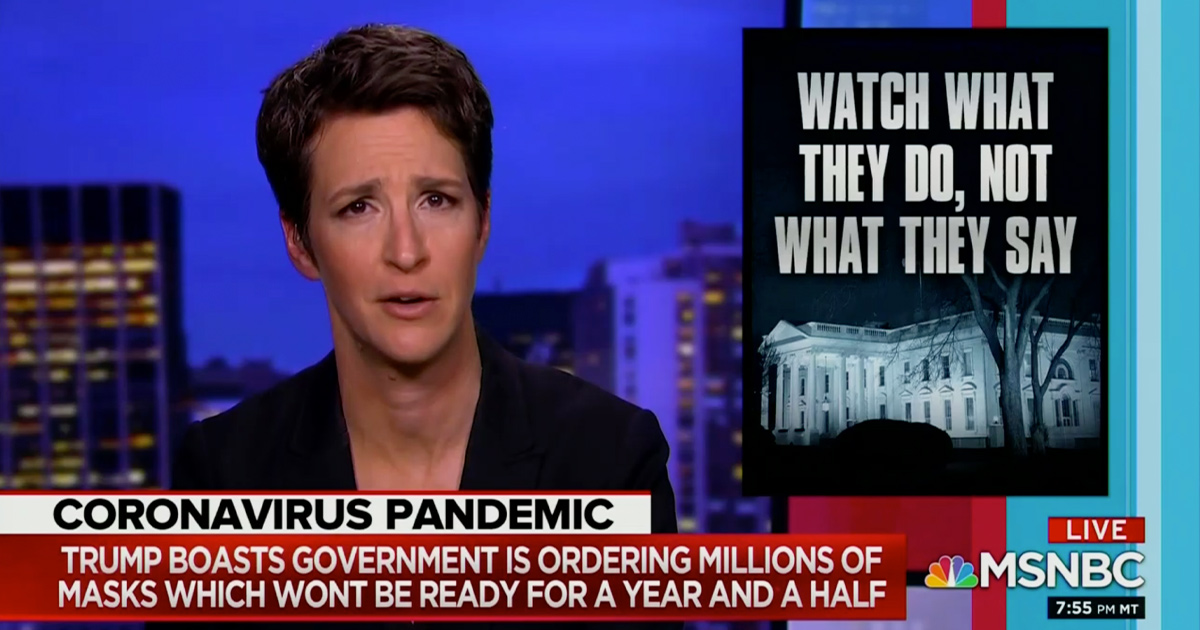
Public Turning Off Channel Zero: Probot Rachel Maddow's Ratings Drop Significantly. Her Disinfotainment Drama Show Being Outdrawn by "Family Guy" and "Ancient Aliens"

From [HERE] The ratings woes continue for MSNBC post-election, as the liberal cable news channel saw nearly half of its viewers flee following President-elect Donald Trump’s victory. Perhaps even more stark, though, is that the network’s biggest (and highest-paid) star just saw her viewership sink to the point where she was recently beaten by a rerun of Ancient Aliens.

According to Nielsen Media Research, MSNBC has lost 47 percent of its overall audience since Election Night compared to the rest of the year, averaging just 497,000 total-day viewers and 49,000 in the advertising demographic of adults aged 25-54. CNN has also seen double-digit losses, dipping 33 percent and pulling in just 357,000 total-day viewers and 65,000 in the key demo.

In primetime, the post-election drop is even more severe. While right-wing juggernaut Fox News has unsurprisingly seen its ratings soar with Trump’s win, surging 24 percent year-to-date and drawing 3 million viewers, MSNBC has sunk 52 percent. In the 8-11 p.m. time slot, the network’s total audience has collapsed to 644,000 viewers and 63,000 in the 25-54 demographic. CNN is also significantly down, shedding 39 percent of its total primetime viewership and drawing just 453,000 viewers.

The decisive loss by Democratic presidential nominee Kamala Harris, which included Trump sweeping all seven battleground states, has obviously prompted disenchanted progressives and Democrats to flip the channel or just withdraw from cable news altogether. Since the election, for instance, Fox News now holds 62 percent of the cable news audience in total day and 73 percent in primetime.

Making matters worse for MSNBC, the network’s star has also seen viewers flee in droves. Rachel Maddow, who recently extended her contract to the tune of $25 million annually (still a pay cut of $5 million per year), now only broadcasts her primetime show on Monday evenings. Since moving to a once-a-week schedule, her show has typically been seen as something of a special attraction for MSNBC’s audience and is generally one of the top-rated programs on cable.

However, this past Monday, The Rachel Maddow Show attracted just 1.3 million total viewers and a paltry 84,000 in the key 25-54 demographic. (It still more than tripled its CNN 9 p.m. competition.) The telecast represented Maddow’s lowest overall viewership of the year and the worst performance in the demo since 2015. Week to week, Maddow is down 13 percent in total viewers and 34 percent in the demographic.

Even more startling, though, is just how far she was behind the rest of the cable TV competition in the demographic audience. In her 9 p.m. time slot, for instance, FXX’s broadcasts of Family Guy and Adult Swim’s airings of Bob’s Burgers both outdrew The Rachel Maddow Show in the advertising metric. Expanding out to later time slots, an 11 p.m. repeat of History’s Ancient Aliens pulled in 5,000 more demo viewers than Maddow. [MORE]

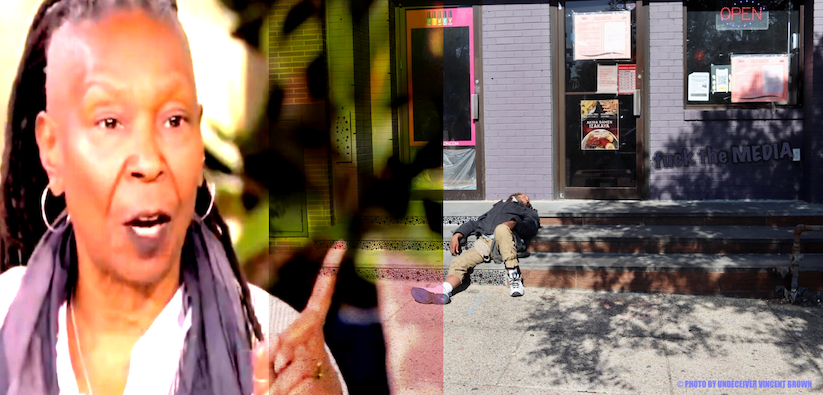
Like a Fan Cheering at the Wrong Time During a Game, Loyal Negro Whoopi Goldberg Dogmatically Barks, Claps and Pardons Massa Biden- as If he Delivered Something Tangible to Black Communities

NOT GOING BACK? BLACK PEOPLE ARE IN A STATE OF DEVOLUTION, FROM GOLD TO BRONZE OR FROM THE TAP DANCE TO THE LAP DANCE. ACCORDING TO THE State of Black America,, BLACK PEOPLE HAVEN’T PROGRESSED SINCE 1965. the Black-White disparity persists across virtually every line or indicator of life and quality of life in the US. Blacks are about three-fifths along the way to experiencing equal status with White Americans. VOTING FOR WHITE LIBERALS AND THEIR “AGENDA” for the past 50 years has been a disaster for blacks - who remain in a state of delusion about their present circumstances. OTHER THAN WHAT ELITE LIBERALS TELL THEM, BLACKS have no idea what has happened to them or how. Today’s Black VOTERS (SLEEPING TOMS) are probably similar to the jews during Nazi Germany- prior to their destruction, jews imagined themselves to be fully assimilated and thoroughly integrated into German society as German citizens. KEEPING JEWS IN THAT DELUDED STATE OF MIND WAS PROBABLY A POLITICAL NECESSITY FOR NAZI AUTHORITIES. LIKE A SALMON TO A BEAR, BLACKS GO ON BELIEVING THE WHITE LIBERAL IS HIS GREAT ALLY DESPITE EVER PRESENT EVIDENCE TO THE CONTRARY IN THE URBAN CITIES THEY LIVE IN. 

“What Happens when Tokens Go Solo.” From [HERE] The View co-host Whoopi Goldberg won’t hear a bad word against Joe Biden.

On Tuesday’s edition of the ABC show, Goldberg got in a spat with fellow co-host and the show’s token “conservative,” Alyssa Farah Griffin, when discussing Biden’s decision to pardon his son Hunter on a variety of criminal charges.

The pardon absolves Hunter of any and all federal crimes committed between 2014 and 2024, including those that he may still be charged with.

The start date is the same year that Hunter joined the board of the Ukraine energy firm Burisma in an influence-peddling scheme allegedly involving his father.

All the rah-rah for corpse Biden and puppet Kamala by Whoopi and other Black spokespuppets is a sign of their delusion or separation from reality.

According to FUNKTIONARY:

Negro – a nonexistent person. The word “Negro” is an adjective—and has only within the last century become used as a Noun. Since becoming used as a noun, it is a word to describe a man or woman of Afrikan descent living in pathological mental state of cultural abstinence and historical amnesia—one who wants to impress his or her oppressor while ignoring the effects and plight that his or her accommodationist posture inures. 2) a Hanky-head. 3) an indigenous-to-the-land (American) Afrikan who does everything in his or her power to suppress or pretend that he or she is other than someone of recent Afrikan descent. 4) ethnicitydenying, assimilated and confused formerly enslaved natives (largely indigenous to America) as well as the smaller percentage Afrikan captives kidnapped and brought to America in ships and chains. 5) one who truly believes he or she is white American— masquerading in black face. In the preface to “The Nigger Bible,” written by Robert H. decoy, the late social activist Dick Gregory, defines Negro as, “A state of a Nigger’s mind which describes how Caucasian and Christian he hopes to be.” ~The Nigger Bible. Mirror, mirror on the wall, who’s a Negro after all? (See: Nigger, Rentellectual, McNegro, $nigger, Coin-Operated, Double Consciousness, Sambo & Negropolitan)

dogmatic – habituated to a way of seeing without looking, or while looking the other way—unable to see or entertain uncomfortable realites and unchallenged truths in any other way but in a definitive, exclusive, conclusive and absolutist manner. “Dogmas and obscurant revelations mesmerize the fearful. They are badges for the meek.” ~The Holey Psyble.

dogmatized – hypnotized and entrained by religious dogma to the extent where reality becomes an orphan to truth. 2) hypnotized by and through the worship of one’s beliefs (religious, ideological, or political).

Non-Profit Organization Gets Kenya Court to Temporarily Suspend Diplomatic Immunity for Bill Gates

From [HERE] The Bill & Melinda Gates Foundation no longer has diplomatic immunity and privileges in Kenya, at least for now. Kenya’s High Court suspended the immunity after the Law Society of Kenya filed a legal challenge against the government.

The Kenyan government in October recognized the Gates Foundation and its employees as a charitable trust with special rights in Kenya, under the Privileges and Immunities Act. The new status exempted the foundation and its employees in Kenya from legal action for acts performed in Kenya as part of official duties.

However, the Nov. 25 ruling by Justice Bahati Mwamuye suspends the immunity until at least Feb. 5, 2025, when a court will “review progress and set a hearing date for oral submissions on the petition.”

The ruling also requires all defendants, including Kenya’s minister of foreign affairs and the State Law Office, “to collect, preserve, and compile all documentation regarding the privileges granted to the Gates Foundation, including details of the cooperation agreement,” under threat of legal consequences for non-compliance.

The Gates Foundation and the Kenyan government have until Dec. 10 to respond, Eastleigh Voice reported.

The diplomatic privileges allowed the Gates Foundation “to engage in contracts, legal actions, and property transactions within the country” and granted the foundation “tax exemptions and immunityfrom legal actions related to their official duties,” leaving many Kenyans “with raised eyebrows,” Kenyans.co.ke reported.

In its legal challenge, the Law Society of Kenya said the immunity “undermines public interest and constitutional principles” and argued that the government’s decision should be declared null and void.

Gates ‘holds governments ransom’

Dr. David Bell, a public health physician and senior scholar at the Brownstone Institute, said the High Court’s suspension “shows the Kenyan system is functioning as it should.”

“From the point of view of the average Kenyan citizen, granting immunity to a large collection of foreigners working for a private foundation … with financial interests in the drugs they are being told to take should be really alarming,” Bell said.

Shabnam Palesa Mohamed, executive director of Children’s Health Defense Africa and founder of the health advocacy organization Transformative Health Justice, said Gates “operates from a position of immense financial wealth and thus political clout. Through using mechanisms of the carrot (funding) and the stick (withdrawal of funding), he holds governments ransom.”

Mohamed called the Kenyan government’s decision to offer the Gates Foundation immunity “horrifying” and said it shows “our governments are captured.”

She added:

“The negative consequences of this shocking decision are far-reaching. They include the erosion of accountability, unequal treatment in the law, damage to national sovereignty, the mockery of public transparency and participation.”

HONORED & REMEMBERED

10 a.m. ET 
Monday, Dec. 2
to noon ET
Wednesday, Dec. 4

DONATE NOW

Tim Hinchliffe, editor of The Sociable, said he believes Gates’ efforts to attain diplomatic immunity in countries like Kenya are connected to a profit motive.

“Wherever Gates goes, he stuffs his pockets under the guise of philanthropy while he sits back and collects his returns on investment, no matter the outcome,” Hinchliffe said.

“When you have that much wealth and power — when you have an organization that contributes more to the annual WHO [World Health Organization] budget than most nation-states — then you can buy your way into anything you want, including diplomatic immunity,” Hinchliffe said. “But, that immunity can only last so long.”

For other experts, Gates’ drive to attain diplomatic immunity is an effort to shield himself from legal consequences for his actions and those of the Gates Foundation.

Dr. Meryl Nass, founder of Door to Freedom, told The Defender, “It should be assumed that no one entity would seek such immunity unless they thought they might be at risk of legal penalties.”

Nass added:

“Gates has been charged with many crimes, including for monopolistic business practices, for conducting a clinical trial involving girls in India that was associated with child deaths and lack of informed consent. He has certainly been accused of false advertising of agricultural products in India and Africa.”

Francis Boyle, J.D., Ph.D., professor of international law at the University of Illinois, said, “It is pretty bizarre that they gave Gates privileges and immunities under their domestic legislation in the first place. Obviously, this was an attempt by Gates to shield himself and his accomplices from criminal prosecution and civil liability in Kenya.”

Gates is currently facing a lawsuit in The Netherlands filed by seven COVID-19 vaccine injury victims, and faces legal challenges in at least one other country, India, for damages connected to the vaccines.

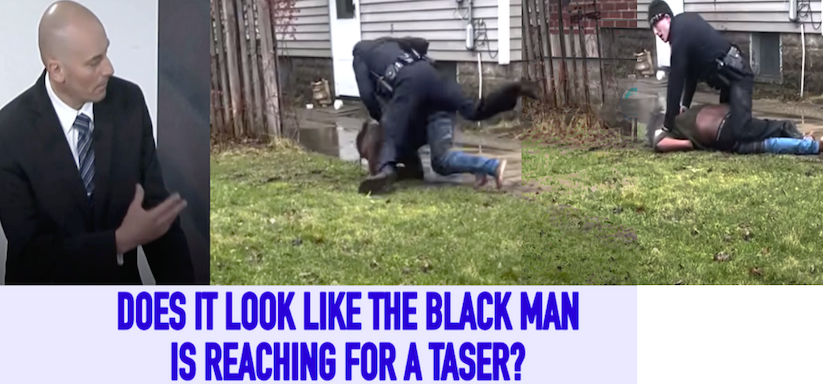
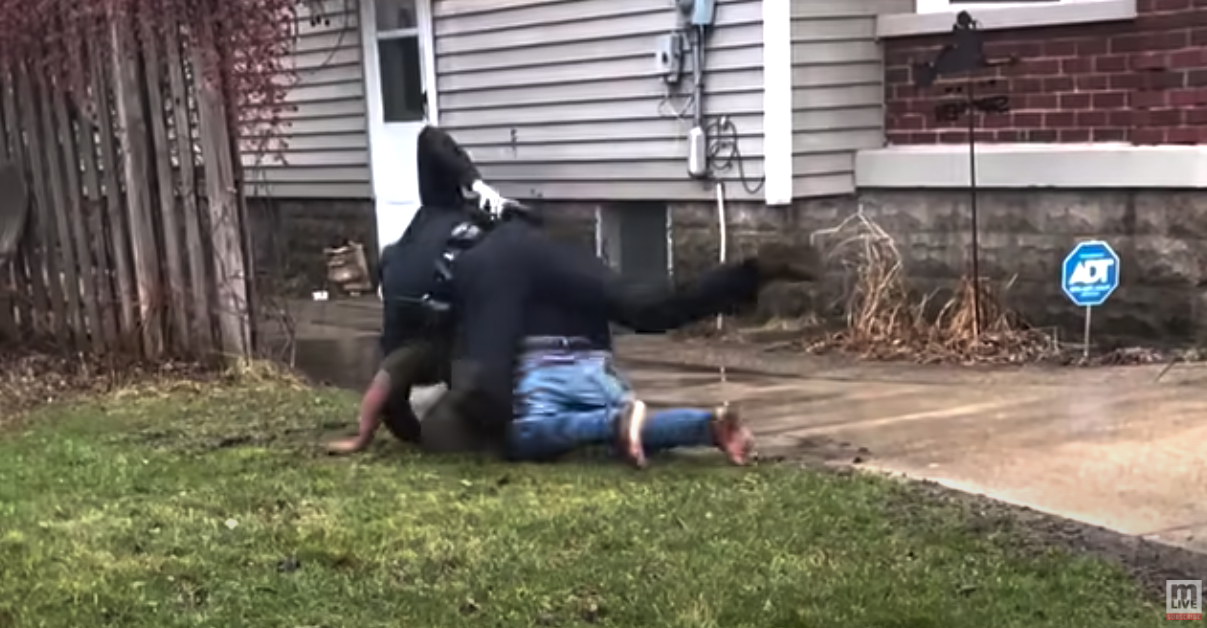
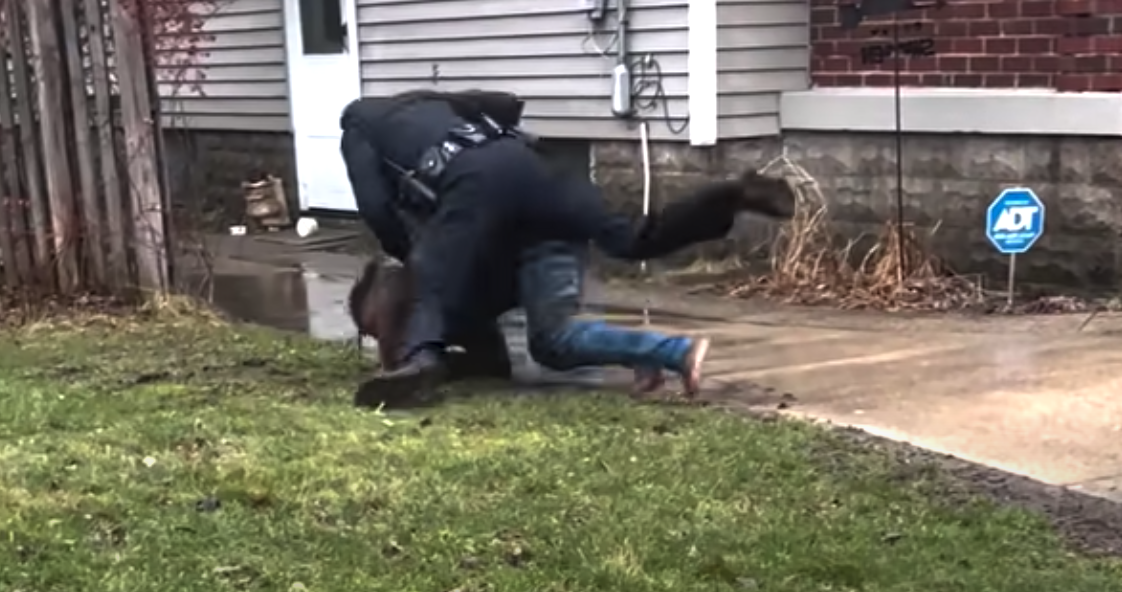
If an Officer is Too Slow or Weak to Stop an Unarmed, Non-Dangerous Suspect Can he Use Deadly Force? Michigan Ct Rules Weak White Grand Rapids Cop Must Face Murder Charge for Shooting Patrick Lyoya

From [HERE] The Michigan Supreme Court turned down an appeal Monday, clearing the way for a police officer to face trial for second-degree murder in the death of a man who was shot in the head in 2022.

In a 5-2 order, the court let stand a Court of Appeals opinion in favor of the Kent County prosecutor.

Patrick Lyoya, a Black man, was killed at the end of a traffic stop in Grand Rapids. Initially, the circumstances that led to the traffic stop weren’t clear, but police said after further inspection the vehicle had a license plate not registered to the vehicle. Unregistered vehicle is a minor traffic misdemeanor. After stepping out of his car, videos released by the police show, Mr. Lyoya appears confused as the officer tells him to get back in the vehicle. Officer Schurr asks him whether he speaks English. Mr. Lyoya responds that he does speak English and asks, “What did I do wrong?” After a brief exchange about whether Mr. Lyoya has a driver’s license, Officer Schurr grabs Mr. Lyoya, who pulls away and starts to run, the footage shows.

Mr. Lyloa had not committed any felony (unregistered vehicle is a minor traffic misdemeanor) and the white cop was not authorized to use deadly force to apprehend him as a fleeing felon.

The officer tackles Mr. Lyoya in a nearby lawn, yelling “Stop!” as Mr. Lyoya appears to try to regain his footing.

Midway through the struggle, the officer’s body camera stops filming. Chief Eric Winstrom of the Grand Rapids police said pressure was applied to the camera to turn it off during the struggle. It was not clear who applied that pressure or whether it was intentional. But Cops lie about everything - statements about any malfunction from the person accused of murder are probably self-serving until proven at trial.

Other cameras — from the officer’s vehicle, a nearby doorbell security system and a bystander’s cellphone — capture different portions of the encounter. Shortly before the fatal shot is fired, Officer Schurr yells, “Let go of the Taser!” Mr. Lyoya is facing the ground and pushing up, with the officer on top of him, in the moments just before the shooting. Again, said statement from a cop-actor performing for the camera is self-serving - the video speaks for itself.

At any rate, Lyoya was under arrest for a traffic violation, which is a minor misdemeanor. As such, he was not a fleeing felon. The Supreme Court has explained the use of deadly force to prevent escape is unconstitutional, at least in regard to white citizens that is. The Court has explained,

The use of deadly force to prevent the escape of all felony suspects, whatever the circumstances, is constitutionally unreasonable. It is not better that all felony suspects die than that they escape. Where the suspect poses no immediate threat to the officer and no threat to others, the harm resulting from failing to apprehend him does not justify the use of deadly force to do so. It is no doubt unfortunate when a suspect who is in sight escapes, but the fact that the police arrive a little late or are a little slower afoot does not always justify killing the suspect

A police officer may not seize an unarmed, nondangerous suspect by shooting him dead… Where the officer has probable cause to believe that the suspect poses a threat of serious physical harm, either to the officer or to others, it is not constitutionally unreasonable to prevent escape by using deadly force. Thus, if the suspect threatens the officer with a weapon or there is probable cause to believe that he has committed a crime involving the infliction or threatened infliction of serious physical harm, deadly force may be used if necessary to prevent escape, and if, where feasible, some warning has been given. 

Tennessee v. Garner - 471 U.S. 1 at page 11 (1985).

Defense lawyers said Schurr, who is white, feared for his safety. Schurr claimed Lyoya had control of his Taser when he shot him.

A Grand Rapids judge said there was enough evidence to send the case to trial, a low threshold under state law. The Court of Appeals affirmed the decision earlier this year.

“We hope to move forward as quickly as possible to have a final resolution for Patrick’s family who has been patiently waiting for years for this to occur,” prosecutor Chris Becker said Monday.

Defense attorney Matthew Borgula said he was disappointed with the Supreme Court's refusal to hear an appeal over the use of deadly force. He said a plea deal seems unlikely.

“I don't think Officer Schurr committed a crime,” Borgula said.

Schurr, an officer for seven years, was fired by the Grand Rapids Police Department two months after the shooting.

Trial Begins for 2 White Indianapolis Officers Charged w/Murdering Herman Whitfeld. Cops Answered 911 Mental Health Call by Holding Black Man Face Down, Suffocating Him During Arrest for No Crime

From [HERE] Two Indianapolis police officers are set to stand trial Monday in the death of a Black man after police shocked him with a Taser and restrained him face down during a mental health crisis in his parents’ home.

Officers Adam Ahmad and Steven Sanchez were indicted by a grand jury in April 2023 in Herman Whitfield III’s 2022 death. The officers, who have been on administrative leave, are being tried together as co-defendants.

The men both face one felony count each of involuntary manslaughter, reckless homicide, battery resulting in serious bodily injury and battery resulting in moderate injury, and one misdemeanor battery charge.

Opening statements are set for Monday morning in the trial, which is expected to last five days.

Ahmad, 32, and Sanchez, 35, were indicted after Whitfield’s family had spent nearly a year demanding that police release full body camera videos of his encounter with officers and called for the firing of up to six officers. 

In addition to involuntary manslaughter, the officers, Adam Ahmad, 31, and Steven Sanchez, 34, also face felony charges of reckless homicide and battery and an additional misdemeanor count of battery. Officer Sanchez faces a second count of involuntary manslaughter for using a Taser, according to the indictment. The officers could face more than 20 years in prison if convicted on all counts.

The videos, which were released in January 2023, document Whitfield’s final moments alive during a chaotic encounter with police.

Whitfield’s parents called 911 on April 25, 2022, and reported that their 39-year-old son, a gifted pianist, was in the throes of a mental health crisis at the family’s Indianapolis home. His mother, Gladys Whitfield had requested urgent medical care, saying that he was having a mental health crisis.

When officers arrived at their home, police body camera footage showed, Mr. Whitfield’s parents met them at the door. For most of the 22 minutes captured on video, Mr. Whitfield did not engage with police officers as he walked around the home. The officers and his mother asked Mr. Whitfield, who was naked, to put some clothes on because an ambulance was coming for him.

At one point in the video, Mr. Whitfield is seen quietly sitting in a room. He does not respond to the police and his mother as they speak to him. A few minutes later, Mr. Whitfield is seen running, causing a commotion and calling for water.

“Keep that Taser out,” an officer is heard saying in the video.

Moments later, as Mr. Whitfield is seen running around a table, an officer draws a Taser and pulls the trigger, stunning Mr. Whitfield, who falls by the table and pulls a tablecloth over himself.

“Oh my God,” Mr. Whitfield is heard yelling. “I’m dying. I’m dying.”

The police then handcuff Mr. Whitfield, face down.

“Can’t breathe,” Mr. Whitfield is heard yelling, moving his body as officers try to restrain him.

“Tres, be calm,” Mr. Whitfield’s father is heard saying in the background, calling Mr. Whitfield by a nickname. “Calm down, Tres. It’s Daddy.”

After a few moments, Mr. Whitfield gradually stops moving, and his yells fade to whimpers.

“Those are going to be way too tight,” an officer is heard saying about the handcuffs on Mr. Whitfield. “We’ll deal with that in a minute.”

As the police continue to restrain Mr. Whitfield, face down in handcuffs, he eventually stops moving or speaking.

Within minutes, paramedics arrive at the home, and when it appears that Mr. Whitfield is not breathing, they begin doing CPR on him.

“Why are they doing that if he was OK?” Ms. Whitfield is heard asking.

Mr. Whitfield was pronounced dead at a hospital later that morning. The Marion County Coroner later ruled his death a homicide, caused by “cardiopulmonary arrest in the setting of law enforcement subdual, prone restraint, and conducted electrical weapon use.”

A civil lawsuit filed by Whitfield’s family against the city of Indianapolis and six police officers, including Ahmad and Sanchez, states that Whitfield “died because of the force used against him” and calls the force used against him “unreasonable and excessive.”

“Mr. Whitfield needed professional mental health care, not the use of excessive force,” the filing said. 

The family is seeking unspecified damages. That civil case is set for trial in July 2025 in federal court in Indianapolis.
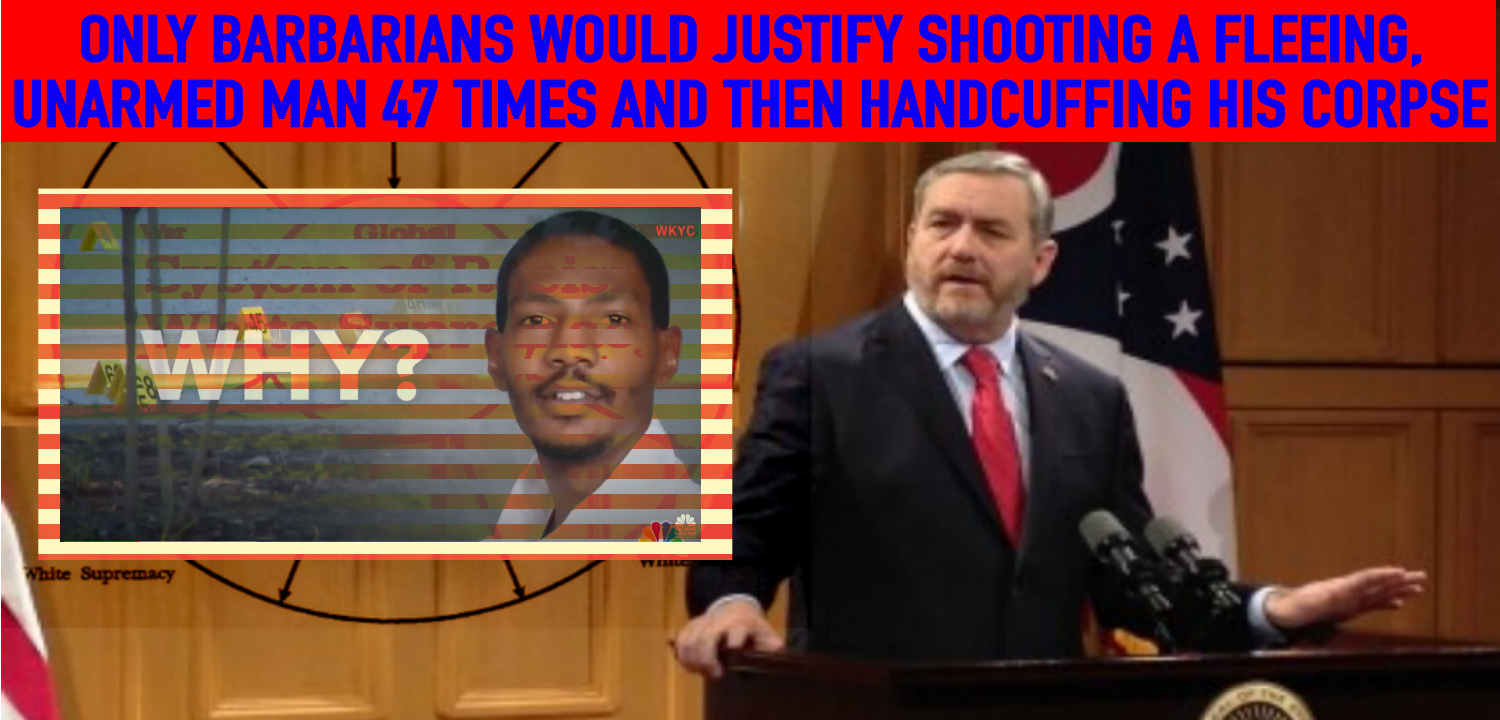
Corpse Biden Pardons Son Hunter Biden in Gun and Tax Cases–and Any Federal Crimes From 2014 Through 2024

From [HERE] After many denials he would do so, Joe Biden granted his son Hunter Biden a blanket pardon in the federal gun and tax cases against him Sunday night. The pardon, which covers any federal crimes by Hunter from 2014 to 2024, ends a case that was blown open by IRS whistleblowers who spoke out after the Biden Justice Department slow-walked an investigation into Hunter, allowing the statute of limitations to pass on some charges and offering Hunter a sweetheart plea deal that was ultimately rejected by an incredulous federal judge in Delaware resulting in the appointment of a special counsel by Attorney General Merrick Garland in the case. Incredibly, Garland appointed the same federal prosecutor who sabotaged the Hunter case, Robert Weiss, to be special counsel.

The pardon absolves Hunter of any possible drug involvement, sex trafficking, lobbying, bribery, foreign agent or other crimes involving Ukraine and several other foreign governments or companies including China. The start date of 2014 coincides with the year Hunter joined the board of the Ukraine energy firm Burisma in an influence peddling scheme alleged to have involved Joe Biden.

Hunter was later convicted on three felony charges related to the purchase of a gun in June of 2024. [MORE]

Forget DEI, White Presumacy is the Ultimate Form of Affirmative Action: Billionaire's Daughter w/No Cop Experience Named Head of NYPD. Goal is to Dominate Blacks in a City Controlled by Elite Liberals

DATA FROM THE COURT MONITORING PROJECT DEMONSTRATE THAT THE NYPD TARGETS BLACKS AND LATINOS: AS BLACKS/LATINOS MAKE UP 90% OF ALL NYPD ARRESTS, MOSTLY FOR VICTIMLESS CRIMES. NYC, a city controlled by elite white liberals is ONE OF THE WEALTHIEST AND LEAST EQUAL PLACES IN THE COUNTRY [MORE]

When Jessica Tisch was appointed as New York City's police commissioner last week, it was the first time many people had heard her name. But now that you know it, you may start seeing it everywhere. The industrious and philanthropic Tisch family is the 43rd richest in the United States according to Forbes, with members owning the Loews Corporation and the New York Giants.
The Tisch name graces university and hospital buildings across the city and country. Jessica Tisch's grandmother Wilma “Billie” Tisch was a longtime member of the WNYC Board of Trustees and was instrumental in the station transitioning out of city ownership and becoming an independent nonprofit. She is still an honorary board member to this day. (Gothamist and WNYC are part of New York Public Radio).

Jessica Tisch, however, has spent her career as a government insider. She got her start in the police department after graduating from Harvard in 2008 with a dual law and business degree. She later became commissioner of the city’s Department of Information Technology and Telecommunications and most recently headed the city sanitation department.

Black Power? Graphs on police killings are from Mapping Police Violence, graph on arrests above is from The Persistence of Racist NYPD Arrests [pdf]. The graph on NYPD stops and searches is from the NYCLU. Data on NYC’s overwhelming non-white jail population is here. In EVERY City Controlled by Elite White Liberals w/a Large Black Population, Cops Stop and Degrade Blacks in Grossly Disproportionate Numbers


As Jessica Tisch begins the tough work of leading the country’s largest police force, here are some facts about her family's history in NYC.

Ms. Tisch has never walked a beat or worn a police uniform. Ms. Tisch first decided to apply for a job at the Police Department in 2008, when she graduated from Harvard Law School, according to a 2019 interview with The Harvard Law Bulletin.

The financial crisis had hit the country and she was worried about finding a job. A friend suggested she go for a position in counterterrorism.

“I can’t even imagine what someone like me would do at the Police Department,” Ms. Tisch recalled thinking, according to the interview.

Raymond W. Kelly, the commissioner at the time, hired her as an analyst and Mr. Bratton later promoted her to deputy commissioner. [MORE]

Ms. Tisch’s family is deeply enmeshed in the city — two relatives sit on the board of trustees of the New York City Police Foundation and family members donated to Mr. Adams’s 2021 mayoral campaign.

Her family’s wealth nearly doubled between 2015 and 2024

Forbes ranked the Tisch family as the 43rd richest in the United States. It reported that the family's wealth grew from $6 billion in 2015 to more than $10 billion this year.

Larry and Bob Tisch purchased Loews Theatres in 1959 and turned it into a conglomerate with holdings in insurance, hotels, energy and packaging, according to news reports. Bob Tisch co-owned the New York Giants. His son Steve now co-owns the team.

The family’s business model is to buy failing companies and turn them around, netting the gain in the company’s stock price. Jessica’s grandfather Larry Tisch famously did this with CBS, first saving the broadcasting network from a hostile takeover, though he was later accused of selling off the company’s valuable music and publishing assets, according to his New York Times obituary. [MORE]