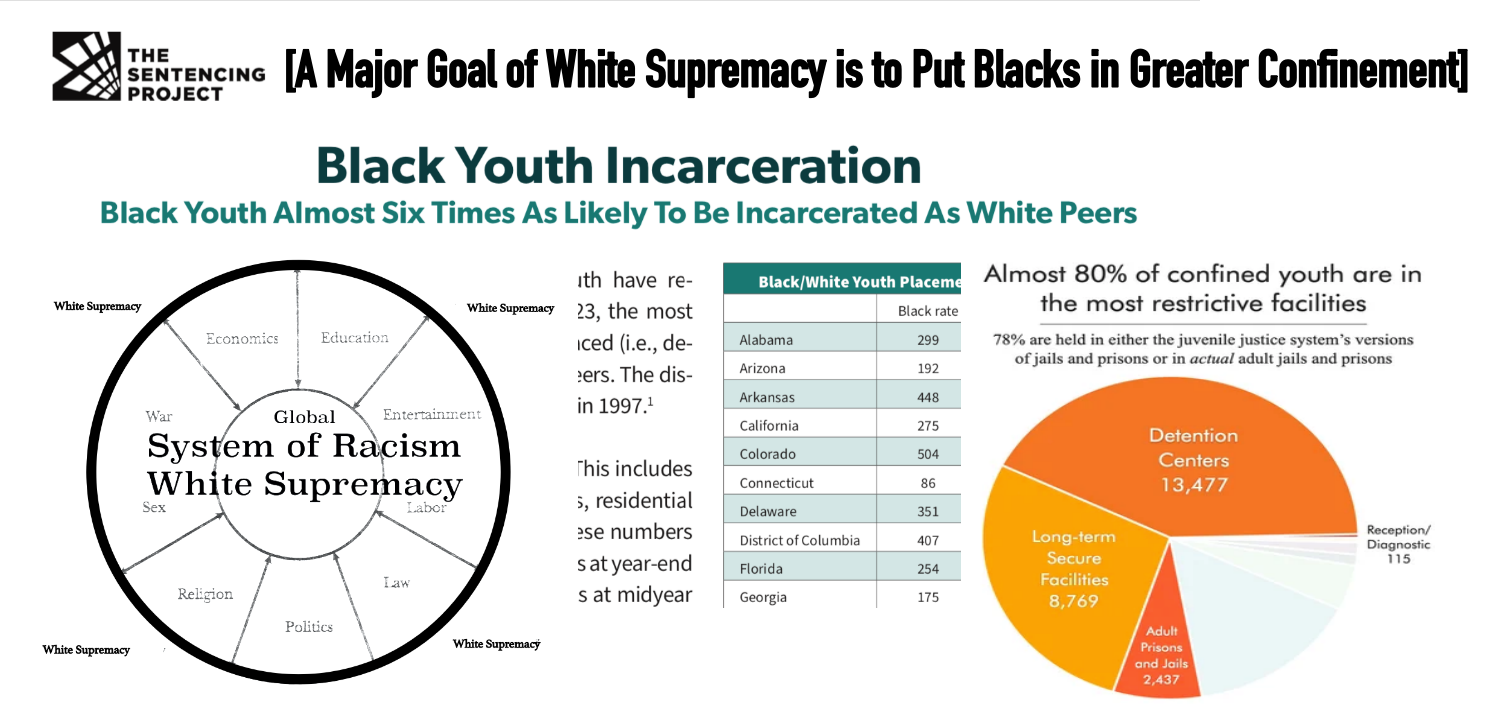
Filling the Jails with Black People: New Study Finds 46% of All Youth Locked Up are Black (despite being only 15% of all youth) and Black Youth are 5.6X more Likely to be Incarcerated than White Kids
/
The Sentencing Project released a series of briefs revealing a disturbing resurgence in youth incarceration and widening racial disparities as of 2023–just as the Trump Administration calls for increased criminalization of youth. Reporting from the Office of Juvenile Justice and Delinquency Prevention (OJJDP) showed the first consecutive annual increase in the one-day count of youth incarceration since 2000. The findings, compiled in three newly released briefs underscore the urgent need for systemic reform in youth justice practices nationwide.
Key findings include:
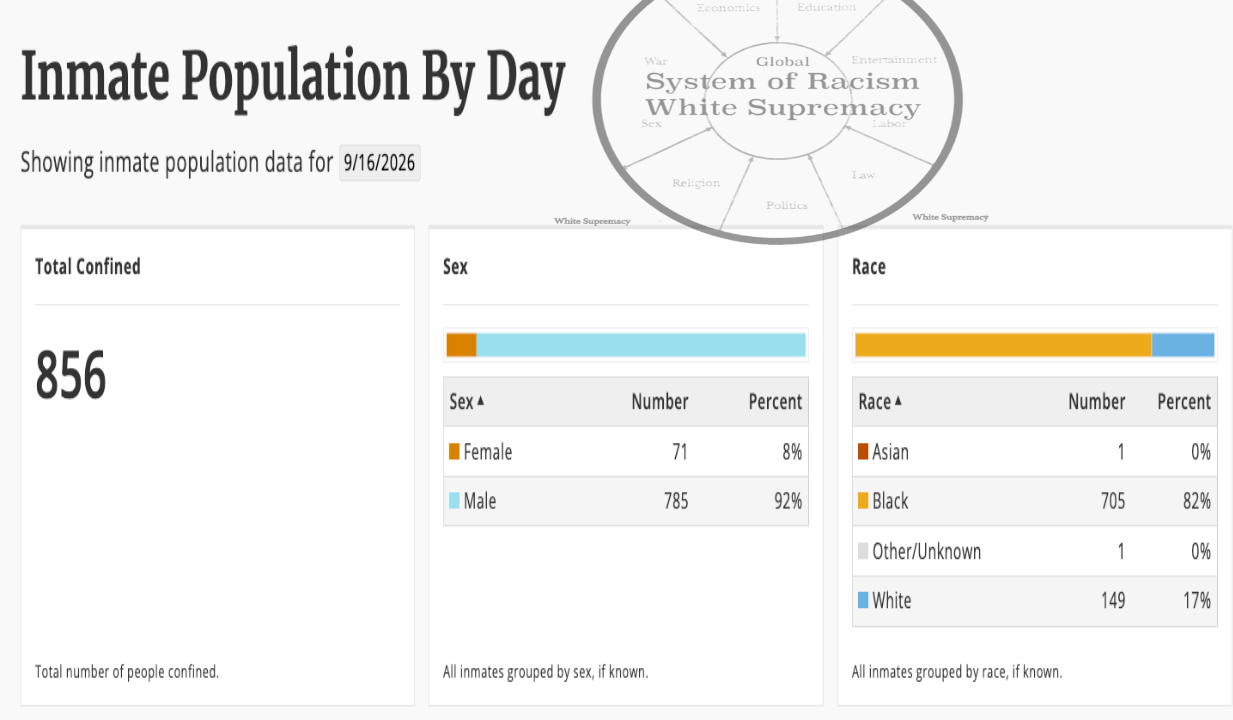
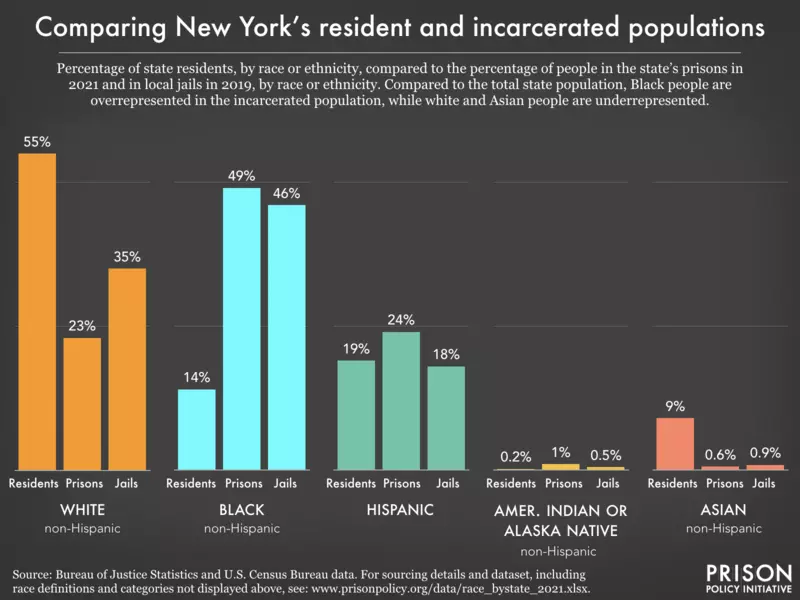
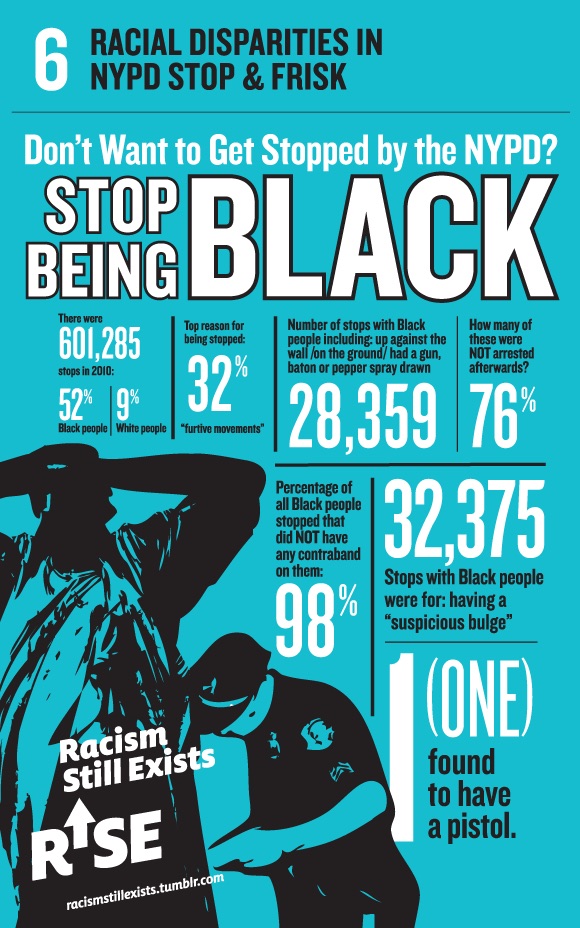
46% of youth in placement are Black, even though Black youth comprise only 15% of all youth in the United States
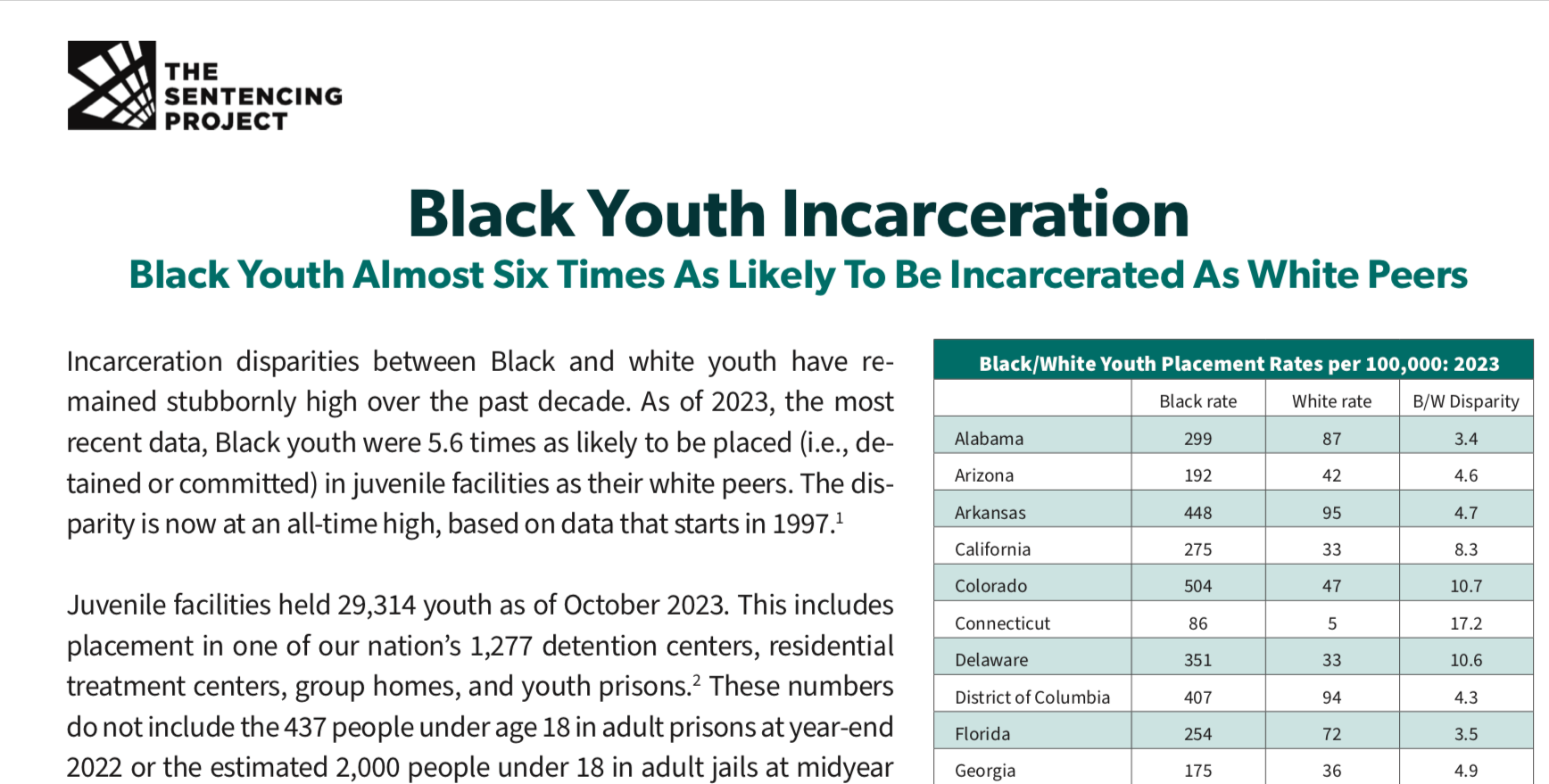
Black youth are 5.6 times as likely to be incarcerated than white youth– and the Black/white racial disparities in youth incarceration grew more than 10% in 23 states.
Nebraska has the highest Black youth incarceration rate, the second-highest Black/white disparity, and the third-fastest growing disparity over the past decade.
West Virginia ranks second in Black youth incarceration.
Latino youth are at least twice as likely to be incarcerated than white youth in 11 states.
The Latino/white disparity rate in youth incarceration grew more than 10% in 13 states over the last ten years.
West Virginia has the highest Latino youth incarceration rate.
Latino youth were at least three times as likely to be held in placement in Connecticut, Massachusetts, New Jersey, Utah, and South Carolina compared to their white peers.
Tribal youth are almost four times as likely to be incarcerated than white youth.
The Tribal/white disparity rate in youth incarceration has grown more than 10% in eight states with significant Tribal populations.
South Dakota leads the nation in Tribal youth incarceration, ranks third in its Tribal/white disparity, and has the third-fastest-growing disparity.
Minnesota has the highest Tribal/white disparity and ranks third in Tribal youth incarceration.
Tribal youth were at least ten times as likely to be held in placement as white youth in Minnesota, North Dakota, South Dakota, and Wisconsin. [MORE]

Additionally, a new Prison Policy Initiative report provides the most up-to-date picture of how many youth are detained and committed in the U.S., highlighting the persistent overincarceration of Black and Indigenous youth in a system that, in recent decades, has made great strides in reducing youth confinement overall. Youth Confinement: The Whole Pie 2025 explores the conditions facing 31,900 kids today — most of whom are held in youth prisons and jails — and offers data on youth confinement by offense type in all 50 states.
Over the past 25 years, the number of youth in confinement in the U.S. has fallen by more than 70 percent — impressive progress compared to the adult criminal legal system, whose populations have changed very little overall in that same period. Nevertheless, the U.S. still confines youth at a rate more than twice the global average, and its juvenile legal system mirrors the adult system in many alarming ways:
Severe racial disparities. 47% of boys and 39% of girls in juvenile facilities are Black — a level of disparity that has actually worsened in recent years. And even excluding youth held in Indian country facilities, Indigenous children make up 3% of girls and 2% of boys in juvenile facilities, despite comprising less than 1% of all youth nationally.
Large numbers of youth held pretrial or for minor offenses. Nearly 9,000 youth today are locked up before they’ve had a trial, and thousands are in detention for minor, low-level offenses. Select states — such as Indiana, which accounts for almost one-quarter of kids locked up for running away; and Texas and California, which hold 26% of kids confined for technical violations of parole — contribute heavily to this problem.
Prison-like conditions. While the number of kids in large facilities (holding 100 youth or more) has fallen steeply in the last few years, nearly 4 out of every 5 confined kids are held in youth or adult prisons and jails — an increase since 2017, when 65% of confined youth were held in such places.