Obama signs bill giving Supreme Court review of Virgin Islands high court rulings

Jurist

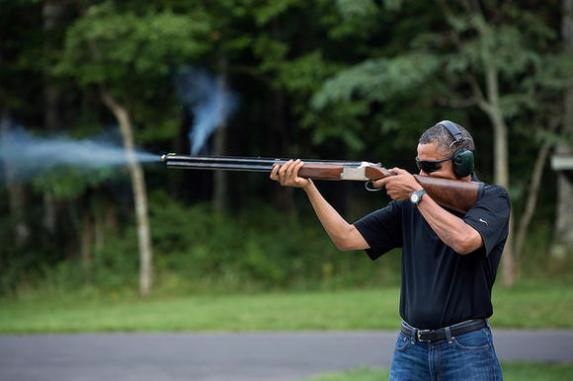
US President Barack Obama [official website] signed a bill [HR 6116, materials] on Friday authorizing the US Supreme Court direct review of decisions made by the Virgin Islands Supreme Court [official websites]. The bill was sponsored by Congresswoman Donna Christensen [official website], the Virgin Islands' congressional delegate. Christensen introduced the bill after the US Court of Appeals for the Third Circuit [official website] issued a report recommending that Virgin Islands high court decisions be reviewed directly by the US Supreme Court. Prior to the direct review bill, the Third Circuit heard appeals from the Virgin Islands Supreme Court. Christensen...

2 LAPD officers allegedly forced sex acts on women

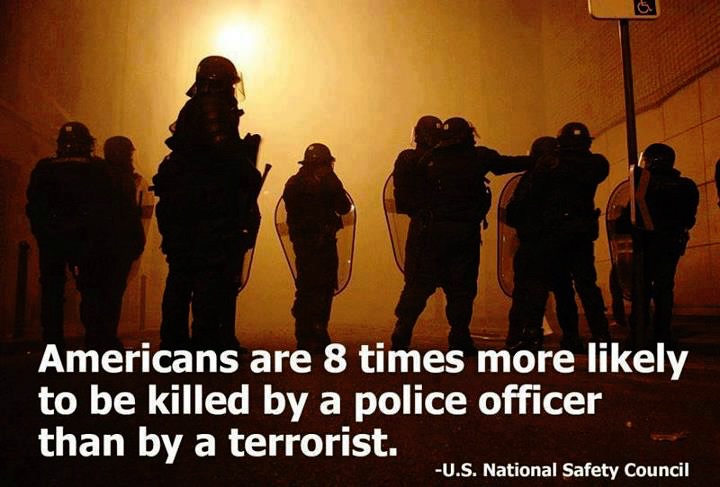
Two Los Angeles Police Department officers are under investigation for allegedly preying on women over a period of five years, luring them into an unmarked car and forcing them to perform sex acts, according to court records.

Detectives from the LAPD's internal affairs unit suspect that Officers Luis Valenzuela and James Nichols targeted at least four women whom they had arrested previously or who worked for them as informants, according to a search warrant reviewed by The Times.

The pair repeatedly used the threat of jail to get women into their car and drove them to secluded areas where one of the officers demanded sex while the other kept watch, the warrant alleges.

Valenzuela and Nichols worked together until recently as narcotics officers in the Hollywood Division. Investigators have identified four women who encountered the pair and made similar independent accusations against them.

The warrant cites sexually explicit text messages that one alleged victim claims she exchanged with the officers after their encounters. Last month, investigators obtained the woman's cellphone and computers in hopes of finding the messages the officers are alleged to have written. The department has yet to examine the electronic devices, a police official said.

Investigators had planned to confront the officers in a surprise operation early next week, but were forced to accelerate those plans Thursday, when one of the women unexpectedly filed a lawsuit against the officers. Fearing that Valenzuela and Nichols might destroy evidence, investigators rushed to sequester the officers and seize their computers and phones, police confirmed.

LAPD Chief Charlie Beck emphasized Thursday that the investigation was ongoing, but added he was "saddened by the allegations. If they are true, it would be horrific," he said.

Valenzuela, a 15-year department veteran, and Nichols, a 12-year veteran, were expected to be assigned to their homes pending the outcome of the probe, the head of the internal affairs group said. The officers could not be reached for comment.

The first woman to accuse Valenzuela and Nichols came forward in January 2010, when she told a supervisor in their narcotics unit that the officers had stopped her more than a year earlier, according to the warrant. The woman, who worked as a confidential informant for the narcotics unit and knew the men, said they were dressed in plain clothes and driving a Volkswagen Jetta. Valenzuela threatened to take the woman to jail if she refused to get in the car, then got into the back seat with her and exposed himself, telling the woman to touch him, the warrant said.

An investigation into the woman's claim went nowhere when the detective assigned to the case was unable to locate her, according to the warrant.

A year later, however, another woman demanded to speak to a supervisor after being arrested and taken to the LAPD's Hollywood station. Sometime in late 2009, according to the warrant, two officers driving a Jetta pulled up alongside her as she was walking her dog in Hollywood. The officers, whom she recognized as the same cops who had arrested her in a previous encounter, ordered her into the car, the woman recounted. It is not known why she was arrested.

Believing that the officers were investigating a case, the woman said she felt compelled to comply. Valenzuela then got into the back seat with the woman and handed her dog to Nichols, who drove the car a short distance to a more secluded area. "Why don't you cut out that tough girl crap," the woman recounted Valenzuela saying as he "unzipped his pants and forced [her] head down toward his lap and physically held her head down" as he forced her to perform oral sex on him, according to police records contained in the warrant.

The woman said she didn't report the incident immediately because she felt humiliated, thought no one would believe her and feared for her safety. Police noted that the woman displayed erratic behavior while recounting the events. Later, she made violent threats while in custody and was transported to a hospital.

Based on this allegation, the department reopened the investigation into the pair. The investigator assigned to the case interviewed this second accuser and managed, as well, to find the first woman who had come forward the year before. She, too, gave a statement, saying she had refused Valenzuela's commands to fondle him.

For reasons not explained in the warrant, the department's investigation made little progress for the next 18 months. During this time, police records show, the officers were transferred, with Valenzuela being reassigned to the Olympic Division and Nichols to the Northeast Division. (Nichols was involved in the high-profile arrest last year of Brian C. Mulligan, an executive at Deutsche Bank, who alleged he was the victim of excessive force. Police contend that Mulligan, while deranged on drugs, charged at Nichols and suffered injuries while Nichols and his partner took him into custody).

Cmdr. Rick Webb, who heads the LAPD's internal affairs group, declined to comment on the specifics of the probe, but said such cases are often difficult to complete.

The case picked up steam again in July 2012, when a man left a phone message for the vice unit at the Northeast station, saying he was a member of the Echo Park neighborhood watch and had been told by a prostitute that patrol officers in the area were picking up prostitutes and letting them go in exchange for oral sex, the warrant said.

Two more months passed before a third internal affairs officer was assigned to look into the Echo Park claim. The investigator was aware of the earlier allegations against Valenzuela and Nichols and "thought the circumstances and location were very similar."

It is not clear how, but the investigator identified another two women who reported encounters in which Nichols and Valenzuela had sought sexual favors in exchange for leniency.

One said Nichols had detained her in July 2011, handcuffed her and driven her to a quiet location. Removing the restraints, Nichols exposed himself and said, "You don't want to go to jail today, do you?" the woman recalled. Fearing she would be arrested, the woman performed oral sex on Nichols, who then released her, she said. She said Nichols had done the same thing to her six years earlier.

The other woman discovered by the internal affairs investigator alleged that she became a confidential informant for Valenzuela and Nichols after she was arrested, according to the warrant. Valenzuela, she said, told her that having sex with him would help her avoid jail, according to the warrant. She alleged that she had sex with the officer twice, once when he was off duty at her apartment in Los Angeles, and the second time in the back seat of an undercover police car while he was on duty. She said she was afraid he would send her back to jail if she refused.

She said Nichols contacted her in January 2011 and told her he would cancel her obligation to inform for him if she would have sex with him.

The woman filed a lawsuit against the city on Wednesday, alleging that the officers forced her to have sex with them several times in exchange for keeping her out of jail. The Times in general does not name the victims of alleged sex crimes.

That lawsuit was first reported by City News Service. Despite the officers' promises, the woman was sentenced to jail in April 2011 and remains there, the lawsuit alleged. A district attorney's spokeswoman said the woman is serving more than seven years in jail for possession of cocaine with intent to sell and identity theft.


Riverside County Deputy Shoots & Kills Handcuffed Black man

PressEnterprise

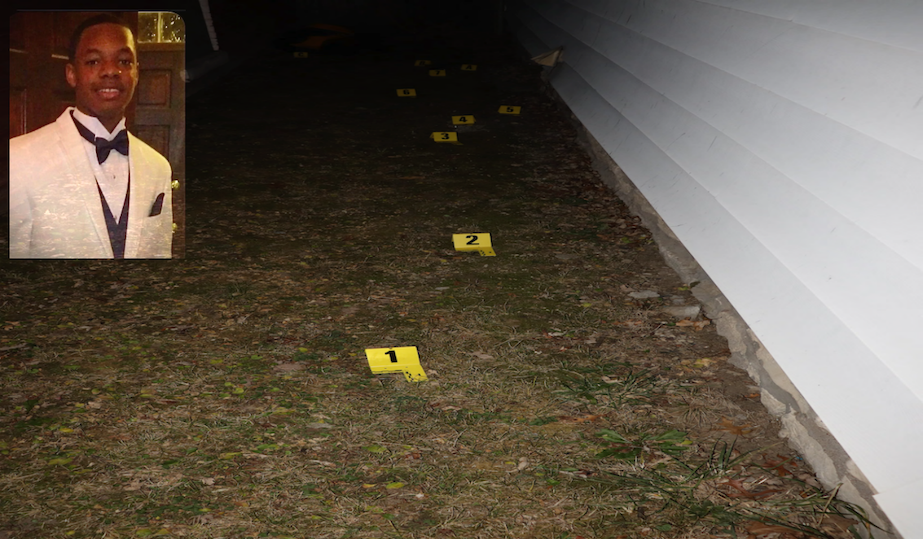
A deputy shot and killed a handcuffed man the Sheriff’s Department said had a gun Friday night, Dec. 28 in Moreno Valley.

The dead man, identified as Lamon Khiry Haslip, 18, of Ontario, died at the scene of the 8:38 p.m. incident in the 25000 block of Fir Avenue, according to a Riverside County Sheriff’s Department news release on Saturday.

The shooting happened after deputies responded to a report that several men in front of a residence brandishing a gun and creating a disturbance.

The first deputy arrived at the scene two minutes later, learning that the men had left in a vehicle.

Moments later, the news release stated, the person who reported the disturbance pointed to a passing vehicle and said the people inside were involved in the incident.
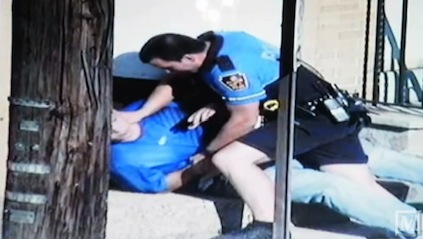
The deputy attempted to stop the vehicle, at which time a man ran from the car. The deputy caught up to him, held the man on the ground and put handcuffs on him, the release said.
A second deputy arrived during the arrest and “observed the subject roll onto his side,” the release stated. The first deputy backed away and “announced that the subject had a gun,” the release stated, “at which time an officer-involved shooting occurred.”

Deputies then searched the suspect and found a loaded gun, the release stated. They administered medical aid and summoned paramedics, but Haslip was pronounced dead at the scene.

The release did not say which deputy fired the gun or detail what happened between the time the man was handcuffed and the shots were fired. Sheriff’s spokesman Cpl. Angel Ramos said Saturday by phone that only one deputy fired at the man.

A Sheriff’s Department spokesman, contacted by phone Saturday, asked that specific questions about the incident would have to be submitted by email. Ramos said the email inquiry would be forwarded to investigators.

The sheriff’s department had not responded to the emailed questions as of 8 p.m. Saturday.

White man pleads guilty in hate attacks on Black People

SFGate

A sixth person pleaded guilty Thursday in connection with racially motivated attacks by young whites against blacks in Jackson.

Joseph Paul Dominick, 21, of Brandon pleaded guilty to conspiracy to commit a hate crime. He faces up to five years in prison. U.S. District Judge Carlton Reeves planned to sentence him later.

The death of James Craig Anderson, who was beaten and run over in Jackson on June 26, 2011, sparked the charges against a group of young whites. Anderson, a 47-year-old auto plant worker, was run down by a pickup truck outside a Jackson hotel.

Prosecutors said Dominick did not participate in the Anderson incident but was part of other group attacks. Dominick was immediately turned over to U.S. Marshals Thursday.

Prosecutors said starting about April 1, 2011, the group of white young men and women would drive from the majority-white suburbs of Rankin County into the majority-black capital city of Jackson, seeking black people to verbally harass and physically assault, and that they would later boast about the attacks. They would target people who appeared to be homeless or under the influence of drugs or alcohol, believing that such victims would be less likely to fight back or to report attacks to police.

In December, William Montgomery pleaded guilty in the death of Anderson, and Jonathan Gaskamp admitted to two federal hate crime charges in attacks on other blacks in Jackson.

Prosecutors said the group included Montgomery, Gaskamp and the three men who previously pleaded guilty in Anderson's death: Deryl Dedmon, Dylan Butler and John Aaron Rice. Sentencing is later for all five men.

Dominick appeared before Reeves dressed in a green polo shirt and light brown slacks. He was fidgety throughout the hour-long court hearing — frequently putting his hands in his pockets, rubbing his face with his hands, stifling a couple of yawns and turning around to look at his family.

He answered the judge's questions with simple "Yes, Your honor" and 'No, Your honor" and made no other statement during the proceedings.

Prosecutors said Dominick threw bottles and used sling shots with metal ball bearings against blacks. Dominick told Reeves the allegations were true.

Reeves told Dominick that even with the guilty plea he "has a chance to change the direction of your life."

Police have said at least seven people were there before dawn on June 26, 2011, when Anderson was beaten and run over, including two teenage girls who were in the truck with Dedmon. They found Anderson at a west Jackson hotel. Rice and Dedmon assaulted Anderson while others stayed in the vehicles, prosecutors said.

A video from a hotel surveillance camera shows Rice, Butler and two others in a white Jeep Cherokee leaving the hotel parking lot at 5:05 a.m. Less than 20 seconds later, Dedmon's green Ford F-250 backs up and then lunges forward. Anderson's shirt is illuminated in the headlights before he disappears under the vehicle next to the curb.

Dedmon, Butler and Rice pleaded guilty to federal hate crime charges in March. Dedmon also pleaded guilty to state murder and hate crime charges and was given two life sentences. Federal prosecutors have said Dedmon, Rice and Butler were cooperating in the continuing investigation of Anderson's death.

(a white Federal Judge): Racism's Hidden History in the War on Drugs

HuffPost

by Judge Frederic Block

What follows is an excerpt from ' Disrobed: An Inside Look at the Life and Work of a Federal Trial Judge,' a book where I try to explain life on the bench and the unknown parts of our legal system.

The first anti-drug law in our country was a local law in San Francisco passed in 1875. It outlawed the smoking of opium and was directed at the Chinese because opium smoking was a peculiarly Chinese habit. It was believed that Chinese men were luring white women to have sex in opium dens. In 1909 Congress made opium smoking a federal offense by enacting the Anti-Opium Act. It reinforced Chinese racism by carving out an exception for drinking and injecting tinctures of opiates that were popular among whites.
 

Cocaine regulations also were triggered by racial prejudice. Cocaine use was associated with blacks just as opium use was associated with the Chinese. Newspaper articles bore racially charged headlines linking cocaine with violent, anti-social behavior by blacks. A 1914 New York Times article proclaimed: "Negro Cocaine 'Fiends' Are a New Southern Menace: Murder and Insanity Increasing Among Lower Class Blacks Because They Have Taken to 'Sniffing.'" A Literary Digest article from the same year claimed that "most of the attacks upon women in the South are the direct result of the cocaine-crazed Negro brain." It comes as no surprise that 1914 was also the year Congress passed the Harrison Tax Act, effectively outlawing opium and cocaine.


Marijuana prohibition also had racist underpinnings. This time it was the Mexicans. Just as cocaine was associated with black violence and irrational behavior, in the southwest border towns marijuana was viewed -- beginning in the early 1920s -- as a cause of Mexican lawlessness. A Texas police captain suggested that marijuana gave Mexicans superhuman strength to commit acts of violence:


Under marijuana Mexicans [become] very violent, especially when they become angry and will attack an officer even if a gun is drawn on him. They seem to have no fear. I have also noted that under the influence of this weed they have enormous strength and it will take several men to handle one man while, under ordinary circumstances, one man could handle him with ease.


The American Coalition -- an anti-immigrant group -- claimed as recently as 1980: "Marihuana, perhaps now the most insidious of narcotics, is a direct byproduct of unrestricted Mexican immigration."


The racial fallout from our drug laws has persevered. In her article, The Discrimination Inherent in America's Drug War, Kathleen R. Sandy reported in 2003 that black Americans then constituted approximately 12 percent of our country's population and 13 percent of drug users. Nevertheless, they accounted for 33 percent of all drug-related arrests, 62 percent of drug-related convictions and 70 percent of drug-related incarcerations.


The country's concerted crackdown on drugs -- and the imposition of increasingly harsh punishment for illicit usage, importation, and distribution -- probably owes its genesis to the appointment in 1930 of Harry Anslinger as the commissioner of the newly created United States Narcotics Bureau. He started a media campaign to classify marijuana as a dangerous drug. For example, he wrote a major article titled "Marihuana, the Assassin of Youth." It was rife with accusations that marijuana was responsible for encouraging murder, suicide, and insanity. Anslinger's campaign was wildly successful. Before he took office only four states had enacted prohibitions against non medical usage of marijuana--California (1915), Texas (1919), Louisiana (1924), and New York (1927) -- but by 1937 46 of the nation's then 48 states had banned marijuana.


Since then Congress has enacted a spate of comprehensive anti-drug laws with strict penalties. For example, today one can be sentenced to life for distributing one kilogram of heroin; 40 years for distributing 100 grams, and 20 years for distributing any quantity at all. Nevertheless, this has not stemmed the country's appetite for illicit drugs in spite of every administration's continued "war on drugs" since President Nixon established the Drug Enforcement Agency in 1972, which has grown through the years to a staff of almost 10,000 employees and a budget of $2 billion.


According to data from the 2010 National Household Survey on Drug Use and Health, almost 120 million Americans 12 or older -- roughly 47 percent of that population -- reported illicit drug use at least once in their lifetime; 15.3 percent admitted to using an illegal drug in the prior year; and 8.9 percent -- roughly 23 million people -- did it within the prior month. The New York Times recently reported that one out of every 15 high school students smokes marijuana on a near daily basis.


When it comes to sentencing, the main culprit is drugs. About half of the roughly 220,000 criminals in the federal prisons have either brought them into our country, have distributed them here, or have otherwise associated themselves with this illicit activity. This means that probably half of the $6.8 billion of the Bureau of Prisons budget is eaten up by incarcerating the criminal druggies. Half of the prison population is there because of drugs, costing us billions of dollars a year to keep them in jail.

Frederic Block has practiced law for 34 years. He was appointed to the federal district court as a judge in 1994 by President Clinton. Block is the author of Disrobed: An Inside Look at the Life and Work of a Federal Trial Judge.

Philadelphia’s Mummers Racist parade features blackface performance by white men

TheGrio

Over 10,000 performers all decked out in elaborate and colorful attire invaded the streets on January 1 to spread some New Year’s cheer for Philadelphia’s annual Mummers parade. It is known as one of the oldest folklore celebrations in the country.

From string bands to comics, this carnival-esque event has garnered a reputation for its over-the-top performances, elaborate costumes and sometimes raunchy thematic elements.

Although the parade’s message is supposedly lighthearted, some acts featured this year may have crossed the fine line of being politically incorrect into the realm of the racially insensitive.

Joseph A. Ferko’s string band performance, titled “Ferko’s Bringin’ Back the Minstrel Days”, features a troupe of white men dressed lavishly in purple and pink clown-like costumes with red-painted faces and drawn-on exaggerated white lips. Both the performance’s title and the actors’ appearances not so subtly references blackface minstrelsy, a 19th century performance art where white actors would don makeup to portray offensive caricatures of African-Americans.

Music history and Africana Studies professor at University of Pennsylvania, Guthrie Ramsey, denounced the performance saying it references a “dark” period of American history.

“What they’re doing is irresponsible and that it’s unquestionably inappropriate for contemporary audiences,” Guthrie said in a phone interview with theGrio. “Ignorance is no reason to allow them to do those kinds of things.”

In fact, blackface was banned from the parade in the early 1960s. The NAACP and the Congress of Racial equality petitioned the Philadelphia Court of Common Pleas in 1963 to formally ban blackface performances in the parade. The petition, however, was criticized by Mummers, who claimed that it would ruin their tradition. In response, they staged a mock civil rights “sit-in” at the court.

Today, while spectators won’t see any performers with made up black faces, the practice has now been swapped for other elements that overtly allude to blackface culture. Aside from substituting the black paint for red paint, performers still have the exaggerated drawn lips and Southern-influenced outfits. The opening of Ferko’s string band performance had large cardboard white gloves, a traditional costume element of blackface actors. Even one of the large boards referenced the white actor Al Jolson, the iconic figure of blackface minstrelsy from the early 1920s.

“The exaggerated lips, coupled with the banjo – this is unmistakeably linked to this period,” Ramsey said in a phone interview with theGrio. “They want to have blackface but not actually do it? My god, why would even go there? There’s so many other aspects you can celebrate in history.”

While proponents firmly argue that the event is merely poking fun at a tradition in which black face has always been incorporated, spectators took to social media and denounced the minstrel performances as blatantly racist.

Heated discussions on social media sites, such as Twitter, emerged over whether the parade should showcase performances that overtly stereotype different ethnic groups.

“Having a ‘minstrel show’ and exaggerated lipped mammys is still racist even if you go in pink face instead of black face, FYI #mummers,” tweeted one user alrightalex1.

And the Ferko’s band wasn’t the only act that made some spectators uncomfortable. Another performance titled, “Indi-Insourcing” showcased white performers dressed in Native-American headdresses riding faux horses around a teepee, alongside men and women dressed in traditional Indian costumes working at a mock call center called “New Delhi Call Center.” The performers, both adults and children, later all broke out into the “Gangnam Style” dance routine.

“It was a skit.  It was designed to poke fun. It was a satire on a very timely political issue which is job outsourcing to India” said Mummer’s spokesman George Badey to My Fox Philly.

But while blackface has been apart of the parade since the beginning, “Indi-Insourcing” was a new performance that shocked some viewers who felt it crossed the line of political correctness.

“I think it’s concerning that there are any skits that play on dumb stereotypes of people who, largely, aren’t included in the parade.” wrote Dan McQuade from the Philly Post. “The “Indi-Insourcing” skit isn’t really mean-spirited, I don’t think. But Mummers should think about how unwelcoming some of the skits come across.”

Philadelphia’s Mummers parade features blackface performance

Over 10,000 performers all decked out in elaborate and colorful attire invaded the streets on January 1 to spread some New Year’s cheer for Philadelphia’s annual Mummers parade. It is known as one of the oldest folklore celebrations in the country.

From string bands to comics, this carnival-esque event has garnered a reputation for its over-the-top performances, elaborate costumes and sometimes raunchy thematic elements.

Although the parade’s message is supposedly lighthearted, some acts featured this year may have crossed the fine line of being politically incorrect into the realm of the racially insensitive.

Joseph A. Ferko’s string band performance, titled “Ferko’s Bringin’ Back the Minstrel Days”, features a troupe of white men dressed lavishly in purple and pink clown-like costumes with red-painted faces and drawn-on exaggerated white lips. Both the performance’s title and the actors’ appearances not so subtly references blackface minstrelsy, a 19th century performance art where white actors would don makeup to portray offensive caricatures of African-Americans.

Music history and Africana Studies professor at University of Pennsylvania, Guthrie Ramsey, denounced the performance saying it references a “dark” period of American history.

“What they’re doing is irresponsible and that it’s unquestionably inappropriate for contemporary audiences,” Guthrie said in a phone interview with theGrio. “Ignorance is no reason to allow them to do those kinds of things.”

In fact, blackface was banned from the parade in the early 1960s. The NAACP and the Congress of Racial equality petitioned the Philadelphia Court of Common Pleas in 1963 to formally ban blackface performances in the parade. The petition, however, was criticized by Mummers, who claimed that it would ruin their tradition. In response, they staged a mock civil rights “sit-in” at the court.

Today, while spectators won’t see any performers with made up black faces, the practice has now been swapped for other elements that overtly allude to blackface culture. Aside from substituting the black paint for red paint, performers still have the exaggerated drawn lips and Southern-influenced outfits. The opening of Ferko’s string band performance had large cardboard white gloves, a traditional costume element of blackface actors. Even one of the large boards referenced the white actor Al Jolson, the iconic figure of blackface minstrelsy from the early 1920s.

“The exaggerated lips, coupled with the banjo – this is unmistakeably linked to this period,” Ramsey said in a phone interview with theGrio. “They want to have blackface but not actually do it? My god, why would even go there? There’s so many other aspects you can celebrate in history.”

While proponents firmly argue that the event is merely poking fun at a tradition in which black face has always been incorporated, spectators took to social media and denounced the minstrel performances as blatantly racist.

Heated discussions on social media sites, such as Twitter, emerged over whether the parade should showcase performances that overtly stereotype different ethnic groups.

“Having a ‘minstrel show’ and exaggerated lipped mammys is still racist even if you go in pink face instead of black face, FYI #mummers,” tweeted one user alrightalex1.

And the Ferko’s band wasn’t the only act that made some spectators uncomfortable. Another performance titled, “Indi-Insourcing” showcased white performers dressed in Native-American headdresses riding faux horses around a teepee, alongside men and women dressed in traditional Indian costumes working at a mock call center called “New Delhi Call Center.” The performers, both adults and children, later all broke out into the “Gangnam Style” dance routine.

“It was a skit.  It was designed to poke fun. It was a satire on a very timely political issue which is job outsourcing to India” said Mummer’s spokesman George Badey to My Fox Philly.

But while blackface has been apart of the parade since the beginning, “Indi-Insourcing” was a new performance that shocked some viewers who felt it crossed the line of political correctness.

“I think it’s concerning that there are any skits that play on dumb stereotypes of people who, largely, aren’t included in the parade.” wrote Dan McQuade from the Philly Post. “The “Indi-Insourcing” skit isn’t really mean-spirited, I don’t think. But Mummers should think about how unwelcoming some of the skits come across.”

African American Teen Aces SAT

Afro

Cameron Clarke, an African-American teen from Philadelphia, attained a perfect score on this year’s Scholastic Aptitude Test, joining an elite group of 360 U.S. students.

More than 1.66 million pupils took the college preparatory test in the spring of 2011, but Clarke, a Germantown Academy senior, was among the few to score a perfect 2,400. His target college: Princeton University.

It was an achievement that the teenager, in his humility, didn’t want to “brag or boast” about, said his father, Peter Clarke, in an interview with BlackAmericaWeb.com.

“He really didn’t want anyone to know about his score, so he didn’t tell anyone at Germantown Academy about it when he got the result in June,” said the elder Clarke, manager of the The Jamaican Reef Restaurant and Lounge in South Philadelphia’s upscale Penn’s Landing neighborhood.

Clarke’s extraordinary feat began receiving public attention after Philadelphia Inquirer columnist Jenice Armstrong heard about it “through happenstance,” his father said, and published the news in her column.

“He is the one who set all this in motion,” said the elder Clarke of his child’s accomplishment. And, the gratified parent said he told his son, “I am very proud of you, but I am also very happy for you, because you did this on your own.”

In an interview with the Inquirer’s Armstrong, the 18-year-old scholar said his perfect score required hard work and perseverance. This was the second time Clarke took the test—the first time he scored 2,190, which is better than 98.5 percent of all test-takers. However, the high-schooler knew it did not reflect his full potential.

"I put in a lot of work," Clarke said. "I took a prep class with some of my friends, and I did a lot of practice tests from a book.

"But that only prepares you so much," he added. "The difference between getting, like, a 2,400 and a couple of points lower is just focus.

"You can screw up or mess up on the smallest of things. And I just feel like on that particular day, I was focused and I got kind of lucky, I guess, that I didn't make any mistakes."

But Clarke had also shown extraordinary ability from an early age. His parents, Mary Jones, a Spanish teacher at Father Judge High School, and his father, the restaurant manager, took him for an IQ test at age 4. He scored a 151

And he distinguished himself during his time at Germantown Academy, which he attended since pre-school. Clarke is first cellist in the Philadelphia Youth Orchestra, is also a member of Germantown Academy’s Math Club, a math tutor, writes for the school newspaper and a member of the school’s cross country team.

Young Clarke is “an extraordinary young man who represents all the best things of his generation,” said Richard Schellhas, the headmaster of Germantown Academy’s Upper School, in an interview with BlackAmericaWeb. “He is smart, funny and a true Renaissance man in the breadth of his talent.”

This year’s SAT saw the largest class of test-takers in history, according to officials, and also the most diverse. Forty-five percent of test-takers were minority students (up from 44 percent in the class of 2011 and 38 percent in the class of 2008).

Breaking the hold on America's incarceration industry

The Sentencing Project

The US Department of Justice released a report recently showing that 26 states had decreases in their prison populations during 2011.  This is the third consecutive year that the population has declined, and as a result, at least six states have closed or are attempting to close approximately 20 prisons this year.

But because incarceration has become a virtual jobs program in many states and because certain corporations are profiting from the incarceration binge of the past few decades, the reduction in prison populations and prison closures is often being met with resistance.

According to The Sentencing Project report, On the Chopping Block 2012: State Prison Closings, which detailed all the prison closures and attempted closures in the past year, several governors have been dragged into legal battles with state employees and unions who want the prisons to stay open.

Congress Disgracefully Approves the FISA Warrantless Spying Bill for Five More Years, Rejects All Privacy Amendments

BlackListedNews

Today, after just one day of rushed debate, the Senate shamefully voted on a five-year extension to the FISA Amendments Act, an unconsitutional law that openly allows for warrantless surveillance of Americans' overseas communications.

Incredibly, the Senate rejected all the proposed amendments that would have brought a modicum of transparency and oversight to the government's activities, despite previous refusals by the Executive branch to even estimate how many Americans are surveilled by this program or reveal critical secret court rulings interpreting it.

The common-sense amendments the Senate hastily rejected were modest in scope and written with the utmost deference for national security concerns. The Senate had months to consider them, but waited until four days before the law was to expire to bring them to the floor, and then used the contrived time crunch to stifle any chances of them passing.

Sen. Ron Wyden's amendment would not have taken away any of the NSA's powers, it just would have forced intelligence agencies to send Congress a report every year detailing how their surveillance was affecting ordinary Americans. Yet Congress voted to purposely be kept in the dark about a general estimate of how many Americans have been spied on.

You can watch Sen. Ron Wyden's entire, riveting floor speech on the privacy dangers and lack of oversight of the FISA Amendments Act here.

Hitler statue in former Polish ghetto creates furor

RT.com

The statue of Adolf Hitler placed in former ghetto in Warsaw caused public uproar, with many calling it a ‘senseless provocation’, while others claim the artwork has no intention to harm anyone’s memory.

­The artwork by Italian artist Maurizio Cattelan, titled HIM, presents Adolf Hitler standing on his knees with his hands put together as if for prayers. The statue can be seen from a hole in a wooden gate, so viewers can only see the back of the small figure in a courtyard.

Large numbers of visitors has seen the artwork since it was installed last month in the former Jewish ghetto in Warsaw. The controversial piece of art prompted sharp criticism. One Jewish advocacy group, the Simon Wiesenthal Center, regarded the placement the work in Warsaw as "a senseless provocation which insults the memory of the Nazis' Jewish victims."

The Refinement of White Supremacy: Chicago may reach 500 homicides in 2012

The Grio

Black on Black Crime is Caused by White Supremacy

Chicago police say it’s too soon to say whether the city has had its 500th homicide of the year.

The Chicago Police Department homicide tally stood at 499 on Thursday before a man was fatally shot in the head outside a convenience store on the city’s West Side. That would have made 40-year-old Nathaniel Jackson the 500th homicide victim.

But police clarified Friday afternoon that the department’s official homicide tally still stands at 499 because a death in a domestic dispute earlier in December has been classified by the coroner’s office as inconclusive pending toxicology tests. It was originally logged as a homicide.

The last time Chicago reached the 500-homicide mark was in 2008, when the year ended with 512 killings. Last year, city records show Chicago had 435 homicides.

Mexico urges US court to block part of Arizona immigration law

Jurist

Lawyers representing the Mexican government asked the US Ninth Circuit Court of Appeals [official website] in an amicus brief to uphold a lower court ruling that blocked enforcement of a section of the 2010 Arizona immigration law SB 1070 [text, PDF] that prohibits the harboring of illegal aliens. In their brief, Mexico's lawyers argued [AP report] that the prohibition harms diplomatic relations between the US and Mexico and encourages the marginalization of Mexicans and individuals who appear to be Latin American. In addition, the brief stated, "Mexico cannot conduct effective negotiations with the United States when the foreign policy decisions of the federal governments are undermined by the individual policies of individual states" The harboring ban had been in effect since its inception in July 2010 until it was struck down [JURIST report] by the US District Court for the District of Arizona in September. Arizona Governor Jan Brewer [official website], who signed the bill into law, appealed [JURIST report] the lower court's injunction in late September.

Immigration laws [JURIST backgrounder] have become a hot button issue over the past few years, as many states, Arizona being the first, passed laws giving state and local officials more power to crack down on illegal immigration. In June, the US Supreme Court [official website] ruled [JURIST report] in Arizona v. United States [SCOTUSblog backgrounder] to strike down sections of the Arizona law, but upheld the controversial portion allowing police officers to check immigration status of anyone arrested. In August, the US Court of Appeals for the Eleventh Circuit [official website] struck down [JURIST report] several provisions of Alabama's controversial law HB 56 [text, PDF], upheld a few sections of the law and rejected part of Georgia's law HB 87 [text, PDF]. That same month, the US Court of Appeals for the Third Circuit [official website] again heard arguments for the second time [JURIST report] on two immigration laws enacted in 2006 by the city of Hazleton, Pennsylvania, which deny permits to businesses that employ illegal immigrants and fine landlords who extend housing to them. In July a judge for the US District Court for the District of South Carolina [official website] declined to lift an injunction [JURIST report] against South Carolina's immigration law SB 20 [text], despite the Supreme Court's ruling. The lawsuit against the South Carolina immigration law had been put on hold [JURIST report] in January pending the outcome of Arizona v. United States.

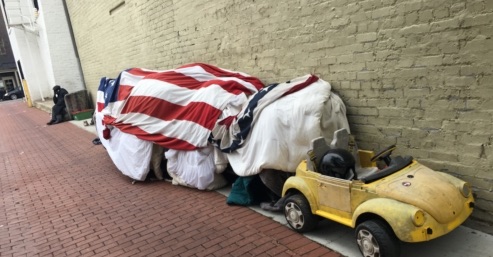
The 'We Support the Troops' Deception: Number of Homeless Iraq, Afghan Vets Doubles

BlackListedNews

The number of Iraq and Afghanistan veterans who are homeless or at risk of losing a roof over their heads has more than doubled in the past two years, according to government data.

Through the end of September, 26,531 of them were living on the streets, at risk of losing their homes, staying in temporary housing or receiving federal vouchers to pay rent, the Department of Veterans Affairs reports.

That’s up from 10,500 in 2010. The VA says the numbers could be higher because they include only the homeless the department is aware of.

The increase arrives as President Obama’s goal of ending homelessness for all veterans is showing some results.

Hidden US-Israeli Military Agenda: “Break Syria into Pieces”

BlackListedNews

A timely article in the Jerusalem Post in June brings to the forefront the unspoken objective of US foreign policy, namely the breaking up of Syria as a sovereign nation state –along ethnic and religious lines– into several separate and “independent” political entities. The article also confirms the role of Israel in the process of political destabilization of  Syria.  The JP article is titled: “Veteran Kurdish politician calls on Israel to support the break-up of Syria‘ (by Jonathan Spyer) (The Jerusalem Post (May 16, 2012)

The objective of the US sponsored armed insurgency is –with the help of Israel– to “Break Syria into Pieces”.

The “balkanisation of the Syrian Arab Republic” is to be carried out by fostering sectarian divisions, which will eventually lead to a “civil war” modelled on the former Yugoslavia. Last month, Syrian “opposition militants” were dispatched to Kosovo to organize training sessions using the “terrorist expertise” of the US sponsored Kosovo Liberation Army (KLA) in fighting the Yugoslav armed forces.

Sherkoh Abbas, President of the US based Kurdistan National Assembly of Syria (KNA)  has “called on Israel  to support the break-up of Syria into a series of federal structures based on the country’s various ethnicities.” (Ibid)

One possible ”break-up scenario” pertaining to Syria, which constitutes a secular multi-ethnic society, would be the formation of separate and  “independent” Sunni, Alawite-Shiite, Kurdish and Druze states:   “We need to break Syria into pieces,” Abbas said. (Quoted in JP, op. cit., emphasis added).

Read More

Cory Booker wants Lautenberg’s ‘blessing’ on 2014 Senate run

TheGrio

This week Newark mayor Cory Booker finally announced his plans for his next campaign, saying he will explore a run for the U.S. Senate in 2014.

The seat currently occupied by longtime Senator Frank Lautenberg (D-NJ) could open up if the 88-year-old senator retires.

After endless speculation over whether Booker would run for the Senate or perhaps take a run at Republican Governor Chris Christie next year, Booker told theGrio.com the choice had more to do with his current job than his future one.

Booker says if he ran for New Jersey governor, “[i]t would be an all consuming and full time campaign.  It would take me away from what could be the most productive year of my mayoralty.”

Booker, who is now in his second term as mayor, is focused on finishing up his tenure and putting Newark on more sure fiscal footing.

Read More

Pew study: Blacks may have voted at higher rate than whites for 1st time in history

TheGrio

A new study from the Pew Research Center suggests that the 2012 presidential election marks the first time in history where African-Americans were voting at a higher rate than their white peers.

“Unlike other minority groups whose increasing electoral muscle has been driven mainly by population growth, blacks’ rising share of the vote in the past four presidential elections has been the result of rising turnout rates,” reports the study.

Although blacks make up 12 percent of the so-called “eligible electorate”, 13 percent of the ballots cast for president were African-American voters.

“Did the turnout rate of blacks exceed that of whites this year for the first time ever? For now, there’s circumstantial evidence but no conclusive proof,” the Pew report says. “And there’ll be no clear verdict until next spring, when the U.S. Census Bureau publishes findings from its biannual post-election survey on voter turnout.”

The study also acknowledges that “in all previous presidential elections for which there are reliable data, blacks had accounted for a smaller share of votes than eligible voters.”

Read More

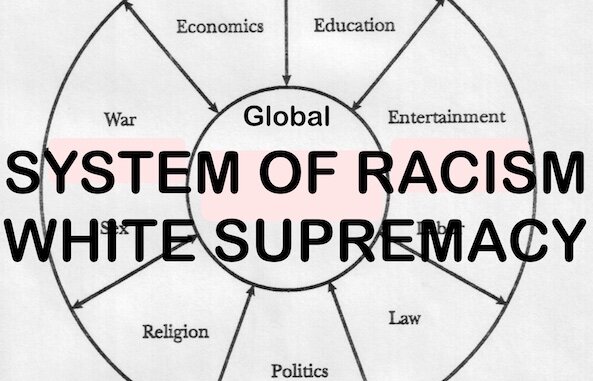
We Can't Fix Our Economy Without Confronting White Supremacy

ColorLines

Regardless of when the president and Congress decide to end their current budget standoff, it is increasingly clear that the emerging deal will do very little to reverse the fiscal wrongs at the heart of the tax code. These wrongs have transformed America's economy into the least equitable and most racially unfair it's been in almost a half century.

Our collective denial over the fundamental injustice at the heart of our economic system is a result of white supremacy. The words "white supremacy" are radioactive to be sure. It pains me to write them. However, as a trained economist I go where the facts lead me. Since I have written potentially inflammatory words, let me be clear about what I mean.

White supremacy is a low-level assumption about characteristics that white people allegedly have which transforms inequality between them and everyone else into something natural. It often masks itself as fairness and goes unquestioned as a result. Using this definition, our current tax code is a work of white supremacy.

The fact that we've arrived at this point on the watch of the country's first black president is an irony too large to ignore. Mostly victim, partly complicit, Obama is not fully to blame. Yet, economically speaking, the stubborn fact remains that the country is at a moment of racial injustice not seen in more than a generation. In the last four years, that injustice has only expanded and calcified.

White wealth is double what it was 30 years ago. Black and Latino wealth is at its lowest point ever recorded. These inequitable consequences flow directly from political choices embedded in our tax code. But since 1980 when these choices began to be implemented, we've talked ourselves out of race and into a mess when it comes to taxes. In fact the frame for our current fiscal debate has clear white supremacist roots.

Recent Origins

As I've written previously, it began in 1980 when Ronald Reagan announced that he wanted to reduce taxes and return money to the states. This was long a demand of southern White Citizens Councils. He did so in a Mississippi county were one of the most brutal murders of the civil rights era took place.

White Citizens Councils, the political wing of the Klu Klux Klan, detested federal taxes because they were used to promote economic fairness for blacks in the South. Government spending on economic opportunity had upset the pre-existing racialized economic order. So in speech after speech, Reagan promised to "turn back the clock" and won in a landslide.

Once in office, Reagan did as promised. He re-constructed a system which took money from the employed poor and working class--who are disproportionately black and brown--and gave it to a mostly white minority who were already wealthy.

The result of Reagan's policies--which were turbocharged under George W. Bush--is that the top 1 percent have a greater share of national income than at any point in American history. And 97 percent of the top 1 percent are white. Yet poverty is stuck at decades-high levels. One out of three blacks and one out of four Latinos is poor.

Reagan's policies, largely followed by his predecessors in both parties, have left us a country where a child born in poverty in any other advanced economy on the planet has a better chance of becoming rich than one born in the United States.

This is blatantly wrong to the vast majority of Americans, regardless of race. They would not allow this injustice to stand, if spoken to plainly about it.

But since Reagan's success in winning office off of white supremacist notions, the U.S. has struggled to be honest with itself about the racial impact of its economic choices. The trouble is that you can't solve a problem that you don't admit exists.

A Longterm Legacy

The stubborn truth is that economic white supremacy hangs like poison in the national air. It's been the default position of the United States since the country came into existence as a slave republic. The only way to neutralize white supremacy is to admit that it still animates many of our basic economic assumptions.

The fact that Oprah and Jay-Z are points of interests because they are people of color with vast wealth makes the point. We're conditioned to be astounded by the economic success of blacks and more unassuming about the wealth of whites. Our stereotypes about who's deserving and who's not are grounded in an ongoing white supremacist paradigm.

You would think that having a black president would help us work through some of this. But President Obama has yet to give one speech dedicated exclusively to the Depression-like economic distress in communities of color nor the three-decades-long government policies which caused it. In his silence Obama extends his party's complicity in our economic system's destructive racial aspects.

Democrats argue that they fight for race-blind, middle-class economic policies.

The only problem is that Americans aren't attune to issues of economic injustice. In our national subconscious, economic inequality is just assumed as a natural result of capitalism. It is not. However, through hundreds of years of struggle, Americans, are actually sensitive to racial injustice.

By not confronting the racial aspects of economic inequality, we've actually hardened our former racial caste system, which had economic implications, into an economic caste system that has racial implications. From the perspective of economic rights and wrongs, both approaches appear eerily similar.

Instead of a debate over tax increases or spending cuts, what we need to have is an argument about what kind of country we want to have. We need to ask ourselves whether the past was both right and good enough, and how we can build a better, stronger, and fairer future.

Until we have a real stand-off over our fundamental values, we'll continue to be stuck in a national economic cul-de-sac shaped by white supremacy. Without real change, we'll circle there in a fruitless, schizophrenic argument with ourselves.

'Anonymous' threatens to shut down California police department website

CitizensforLegitGov

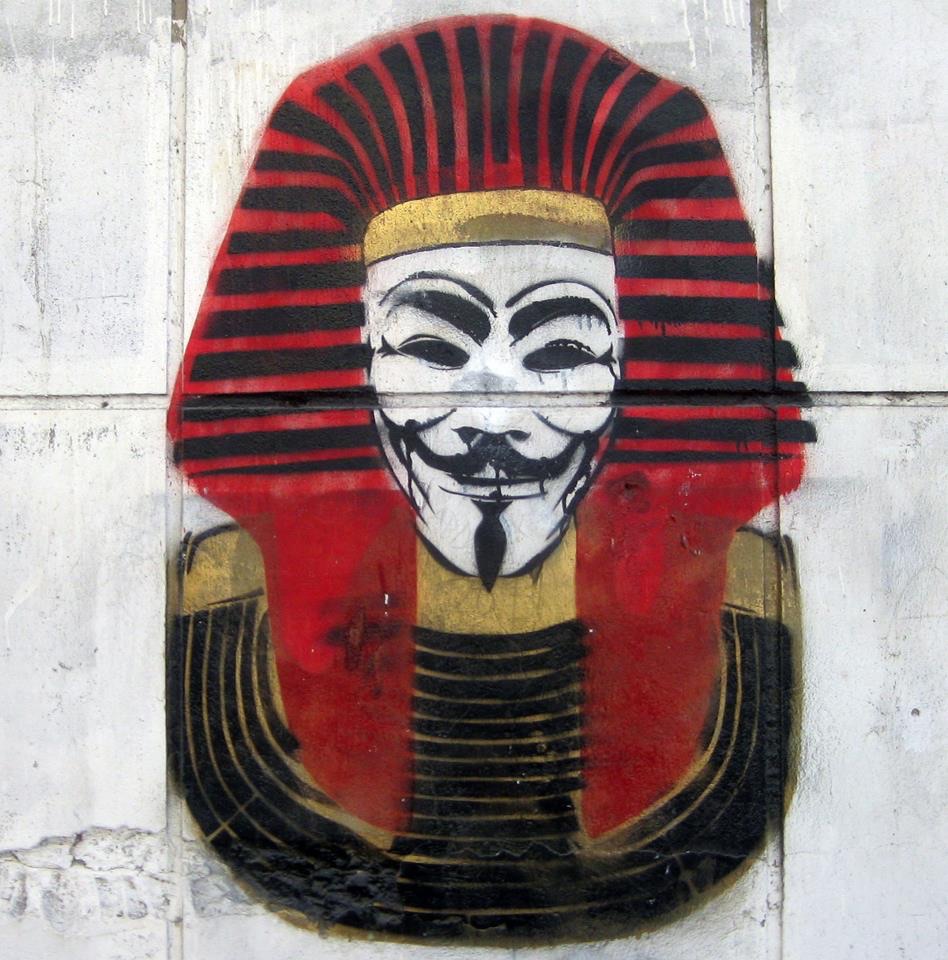
Manteca Police are taking threats seriously after Anonymous, a widely known "hacktivist" group, threatened to hack into the police department's public website, Fox40.com reported. On their YouTube channel, "Annonymous" shows video of Ernesto Duenez Jr., being shot and killed by Manteca Officer John Moody. The group demands that the officer be fired from the force. "Otherwise, Annonymous users will act appropriately with the inevitable shutdown of the official website," said someone on the site, disguised in a Guy Fawkes mask.