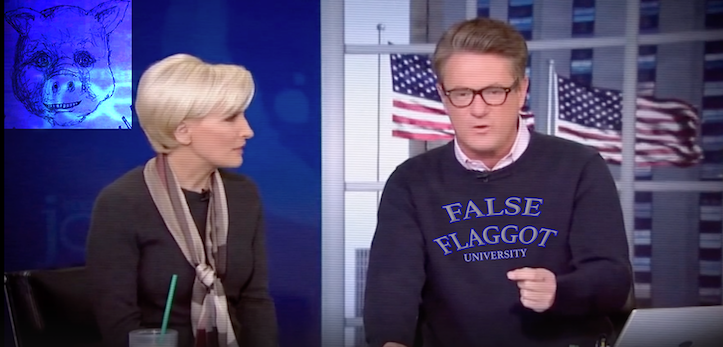
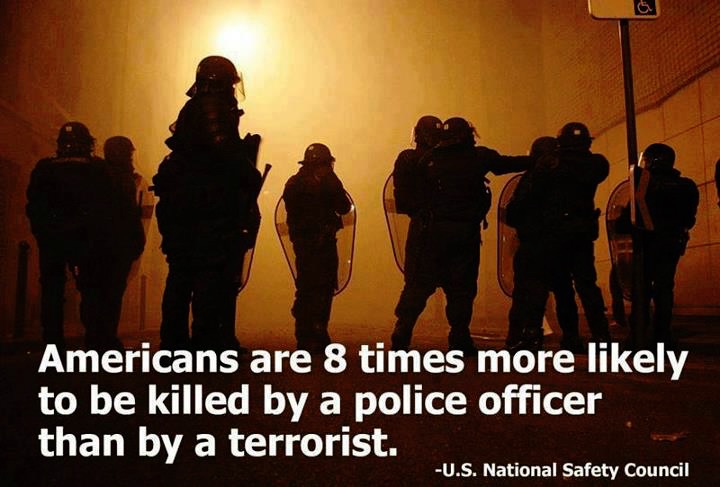
Secondly, it is contemptible that probots such as Scarborough, government authorities and other persons professing to be ‘freedom loving’ conservatives would push the propAgenda that emergency authority (in situations where it may be lawfully invoked) can be based on immeasurable criteria, such as hyperbole, subjective perceptions, opinion polls, sad stories or emotional pleas etc and actually ridicule the use of statistics to justify such extraordinary, temporary power. Courts have made it clear that an emergency declaration must be based on substantial evidence that is verifiable and objective and which shows such action is necessary for the imminent preservation of the public peace, health, safety, welfare or morals of people. Courts have explained that an ‘emergency must be grounded in a finding of facts and not just mere statements of the motivation for the enactment and must otherwise provide an adequate basis for review. The DC Court of Appeals has explained ‘the declaration of an emergency must be ‘supported by substantial evidence in the record that shows an emergency existed.’ Hobson v. D.C., 304 A2d 637, 637 and 640 (D.C. 1973). Arbitrary declarations are a goose step in the wrong direction. Based on such “clogic” it is easy to foresee future emergencies demanding people to immediately shelter in place because they believe the flu “is going around” and “gotten bad” or a declaration to confiscate all firearms from all licensed persons in a city because of authority’s emotional based perception about of the ‘scourge of gun violence’ and so on.
The specific details of their crime in DC is spelled about below in the introduction of the DC Attorney General’s complaint against the Blight House. Please indulge.
“1. More than 50 years ago, Congress empowered the people of the District of Columbia to govern themselves through the District of Columbia Home Rule Act (“Home Rule Act”), Pub. L. No. 93-198, 87 Stat. 774 (1973) (codified as amended at D.C. Code §§ 1-201.01, et seq.). Invoking its constitutional authority “[t]o exercise exclusive Legislation in all Cases whatsoever, over [the] District,” U.S. Const. art. I, § 8, cl. 17, Congress gave the inhabitants of the District of Columbia many of the “powers of local self-government” that other Americans enjoy: to elect a Mayor and a City Council, to adopt local laws, and to operate the institutions of local government—including local law enforcement—largely as they see fit. Home Rule Act, § 201. Congress reserved for itself the authority to review the District’s laws and legislate on matters of federal concern. But it otherwise left the operation of the local government in local hands.
2. By contrast, Congress gave the President an exceedingly narrow role in the governance of the District. In Section 740 of the Home Rule Act, Congress provided that if the President “determines that special conditions of an emergency nature exist,” the President may require that the Mayor “provide such services” of the Metropolitan Police Department (“MPD”) as the President deems necessary for “federal purposes.” D.C. Code § 1-207.40(a).
3. In the 52 years since the enactment of Home Rule, no President has ever attempted to exercise this limited authority.
4. The President’s authority under Section 740 is sharply limited in time: it must terminate within 48 hours unless the President sends proper notice to Congress, and, in all events, it must terminate upon the expiration of the emergency or within 30 days, whichever comes first. Id. § 1-207.40(a)-(b). For the President to obtain MPD’s services for longer than 30 days—even in the face of an ongoing emergency—Congress must pass a joint resolution permitting the extension. Id. § 1-207.40(d).
5. Moreover, by its terms, Section 740 only permits the President to require the Mayor to “provide services” of MPD for “federal purposes.” Id. § 1-207.40(a). It does not permit the President to seize control of MPD. Nor does it authorize the President to direct MPD in the policing of local crime. Congress left that responsibility to local leaders. Id.
6. In violation of the plain language of Section 740, the President announced on August 11, 2025, that he was “placing the D.C. Metropolitan Police Department under direct federal control,” and that Attorney General Pamela J. Bondi was “taking command” of MPD “as of this moment.” He also stated that he was appointing Terrance Cole, the Administrator of the Drug Enforcement Administration (“DEA”), as the “interim commissioner” of the MPD. Attorney General Bondi later added that Gady Serralta, the Director of the United States Marshals Service (“USMS”), would be “supervising command and control” of “the entire operation” of MPD.
7. That same day, the President issued an Executive Order that invoked his authority under Section 740 of the Home Rule Act. See “Declaring a Crime Emergency in the District of Columbia,” Exec. Order No. 14,333 (Aug. 11, 2025) (“EO”). The President did not identify any new or unusual exigency that justified the invocation of Section 740. Instead, he claimed that violent crime in the District is “increasing,” id. § 1, when, in fact, it has fallen 26% since 2024. The President also did not limit the scope of his order to specific “federal purposes,” instead directing the Mayor to provide any services the Attorney General deemed necessary to “maintain[] law and order in the Nation’s seat of Government.” Id. §§ 2-3. And in neither the EO nor his notice letter to Congress did the President state the period of time during which the need for MPD services was likely to continue.
8. For four days, the Administration asserted in public statements and social media posts that it had taken direct operational control of MPD, while District Mayor Muriel Bowser and MPD Chief of Police Pamela Smith stated that they were still in charge of MPD.
9. Then, on the evening of August 14, 2025, without any advance warning to MPD, Defendant Bondi issued Order No. 6370-2025, “Restoring Safety and Security to the District of Columbia” (“Bondi Order”).1 The Bondi Order purports to “order the Mayor of the District of Columbia and the [MPD] to immediately implement” multiple directives.
10. Defendant Bondi ordered that, “effective immediately,” Defendant Cole “shall serve as MPD’s Emergency Police Commissioner for the duration of the emergency declared by the President.” She further ordered that “Commissioner Cole shall assume all of the powers and duties vested in the District of Columbia Chief of Police.” And she stated that “the current Chief of Police” and all other senior leadership at MPD “must receive approval from Commissioner Cole before issuing any further directives to the MPD.”
11. The Bondi Order further purports to rescind or suspend provisions of three MPD orders issued by the Chief of Police that address MPD officers’ involvement in immigration enforcement. It also directs MPD to enforce “to the maximum extent permissible by law” certain municipal laws and regulations pertaining to unlawful occupancy of public spaces.
12. Finally, the Bondi Order generally “rescind[s]” any existing MPD directives that conflict with any of its provisions.
13. In every respect, the Bondi Order and Defendants’ assertions of authority over MPD exceed the narrow delegation that Congress granted the President in Section 740.
14. First, the Bondi Order purports to effect a complete takeover of MPD by the federal government. It installs a handpicked federal official as chief of police, grants him sweeping power to issue commands directly to MPD, and bars MPD senior leadership from acting without his approval. It also purports to suspend MPD policies that Defendant Bondi dislikes, impose enforcement policies she favors, and rescind any existing orders that stand in the way. In short, it attempts to divest the District and its residents of any control of their local police force and place it, for all purposes, under the control of the federal government.
15. Section 740 does not authorize this brazen usurpation of the District’s authority over its own government. That narrow statute permits the President and his delegee to request that the Mayor provide the “services” of MPD—nothing more. None of the directives in the Bondi Order fall within the compass of that limited grant of authority.
16. Second, Defendants have unlawfully made demands of MPD that far exceed the constraints of Section 740, which only permits the President to request “services” for a “federal purpose.” The Bondi Order directly interferes with and directs policies and enforcement related to purely local matters. The Order displaces the local Chief of Police, necessarily impacting MPD’s purely local, municipal policing functions. The Order directs enforcement of a local statute governing public disturbances on local lands. The EO additionally directs MPD to provide services to engage in purely local law enforcement activities, including “maintaining law and order” throughout the District. EO § 2. The entire structure of the statute reflects Congress’s judgment that control over local affairs should be left to the people of the District—not seized by the President based on his disagreements with local law enforcement policy.
17. Third, in invoking his authority under Section 740, the President has not articulated the nature of the “special” and “emergency” conditions with the specificity needed to determine when the purported emergency will end, as required by the Home Rule Act. On the contrary, his assertion that crime in general—and declining crime at that—represents the sort of “special” and “emergency” conditions that can trigger his authority under Section 740 sweeps so broadly that it would undermine Congress’s decision to transfer control for day-to-day governance of the city to locally elected and accountable leaders.
18. These unlawful assertions of authority will create immediate, devastating, and irreparable harms for the District. Most critically, the order threatens to upend the command structure of MPD and wreak operational havoc within the department, endangering the safety of the public and law enforcement officers alike. There is no greater risk to public safety in a large, professional law enforcement organization like MPD than to not know who is in command.
19. To redress these unlawful assertions of authority, the District seeks a preliminary and permanent injunction, declaratory relief, vacatur, and all other appropriate relief to ensure that control of MPD remains with the people of the District of Columbia and that the Home Rule Act is followed as Congress directed. “ [MORE]