Judge Denies San Francisco Government’s Claim that 2 White Cops are Immune from Suit after They Fabricated Evidence to Falsely Convict a Latino Man who Spent Most of His Life in Prison

From [HERE] San Francisco police inspectors will face a trial following a judge’s finding Tuesday that they can’t use qualified immunity to avoid claims that their investigation led to the wrongful imprisonment of a man for 32 years. 

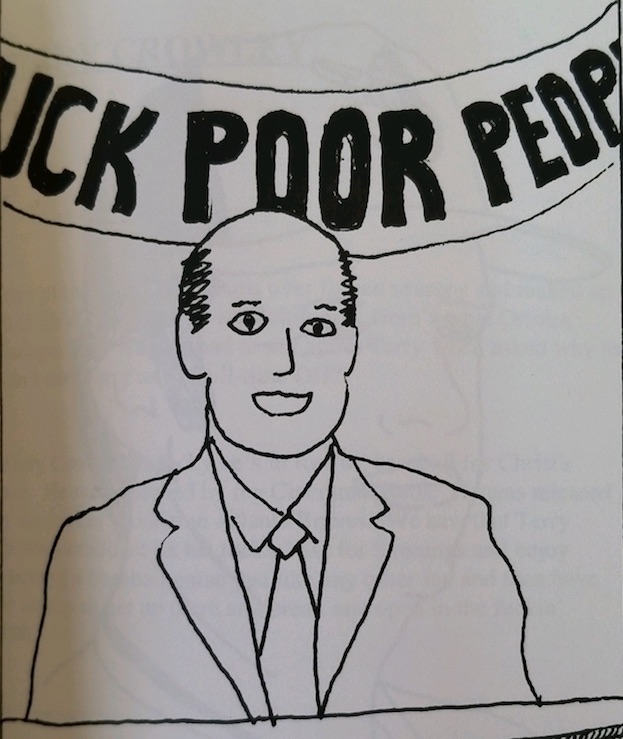
U.S. Magistrate Judge Kandis Westmore deemed Joaquin Ciria’s case against two San Francisco police inspectors ripe for a trial, denying most of their requests for summary judgment

However, two conspiracy claims, a claim for nondisclosure of evidence, and all claims against one officer who filed a report based on the inspectors’ case against Ciria, will not proceed to trial. 

Attorneys for Ciria did not immediately respond to requests for comment. Jen Kwart with San Francisco's city attorney's office said in an emailed statement, “We are pleased the court granted portions of our motion for summary judgment, and we are evaluating all options moving forward.”

The trial of Inspectors James Crowley and Arthur Gerrans is set for July 1.

Joaquin Ciria challenged the city for charging him with a 1990 killing he didn’t commit, leading to a conviction of first-degree murder at the age of 29. After spending most of his life behind bars, he was officially exonerated in the shooting death of his friend Felix Bastarrica in 2022 at age 61. 

He accused the city in the same year of conspiracy and false imprisonment, among other claims, saying that officials deprived him of his civil rights by fabricating evidence "despite obvious evidence of his innocence."

Westmore said in a 24-page order Tuesday that Ciria made a sufficient case for “a triable issue as to the state of mind of Inspectors James Crowley and Arthur Gerrans.” She added that qualified immunity "cannot act as a shield to judicial deception." 

The judge detailed the shaky case built by the city to charge Ciria for the shooting and prosecute him, from misidentifying him to using witness interviews with very little basis in fact, which led to his exoneration several decades later. 

At least one interview was coerced, as when the inspectors threatened to charge witness George Varela with murder if he did not identify Ciria as the shooter they were looking for.

"Much of the other cited evidence and witness interviews were not based on personal knowledge, and, instead, are more akin to gossip or rumor, which may not be relied upon for a finding of probable cause," the judge wrote.

The case built in total “falls far short of what is required for a finding of probable cause to arrest,” Westmore said, adding that it creates a triable case to explore “whether there was probable cause to prosecute.”

“If the jury believes plaintiff’s version of events, it could find that Crowley and Gerrans’ conduct, at the very least, involved reckless or callous indifference,” Westmore said. 

However, the judge granted most claims for summary judgment against Nicholas Rubino, another officer involved in filing the case against Ciria.

Westmore also granted summary judgment on the claims of intraconspiracy and state law conspiracy, and of nondisclosure of evidence, for the inspectors. She said the plaintiff failed to build a plausible case that any San Francisco department policy, custom or training was in place that would have allowed the inspectors to carry out the actions which Ciria accuses them of.

The city argued in a hearing before Westmore earlier this month that inspectors proved their investigation met the legal standard for probable cause, and that only the facts they had at the time they got the warrant matters. Attorneys cited a Ninth Circuit ruling that probable cause to arrest a person can come from an identification, a physical description and a connection to a vehicle used in a murder. 

Ciria’s family also separately filed claims in June 2023, saying they want the city to pay for his wrongful detention. His son Pedro and former partner Yojana Paiz say his conviction resulted from the city and police department’s “unconstitutional investigative policies” and a failure to train or intervene or to implement remedial measures to address “tainted, reckless and unconstitutional investigation and interrogation techniques.” 

Ciria says it was a pattern of tactics the city used to craft unreliable suspect identifications — including by suggesting that witnesses make less-than-certain identifications, selectively recording portions of interviews, falsely documenting witness identifications and priming witnesses to identify specific suspects.

The Northern California Innocence Project and The Innocence Commission successfully cleared Ciria’s name in 2020, saying police relied on rumors and coerced another man who drove the actual shooter to falsely name Ciria. 

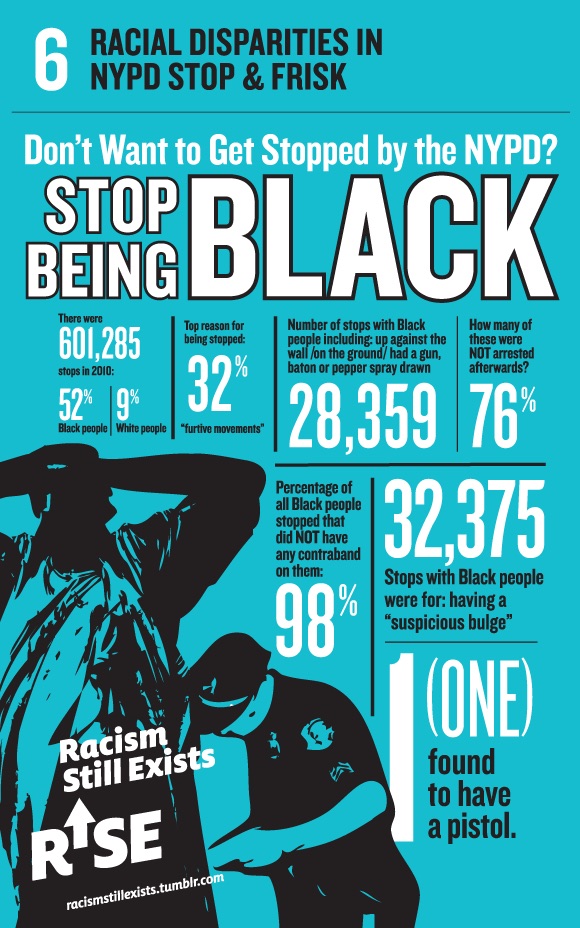
At least five Black men were falsely convicted of murders that occurred between 1990 and 1991 in San Francisco based on fabricated evidence, unconstitutionally influenced witness identification or improperly incentivized evidence from San Francisco Police Department officers and inspectors. 

Fed Judge Denies Immunity to a White Cop who Framed Desmond Green for Murder based on a “lying, drug-impaired jailhouse informant” whom she Steered to Select Black Man from a Photo lineup

From [HERE] The U.S. District Court for the Southern District of Mississippi issued a compelling decision Monday denying qualified immunity to a detective who falsely accused Desmond Green of capital murder based on a “lying, drug-impaired jailhouse informant” whom she steered to select Mr. Green’s face from a photo lineup. 

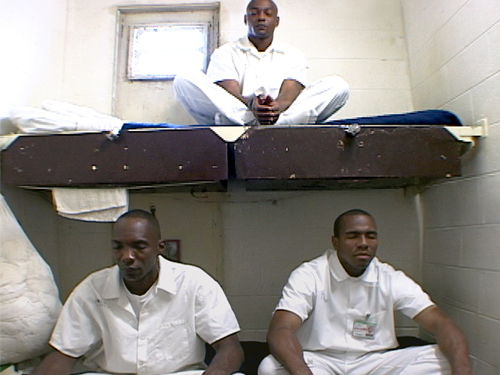
The “horrifying wrong” of being wrongly accused and arrested was compounded by Mr. Green’s imprisonment for nearly two years in the Hinds County Detention Center, which was full of violence, rodents and snakes, and moldy food, where he endured “constant yelling, fighting, and threats,” often had to sleep on the bare floor, and “constantly feared for his life.”

After the informant recanted and prosecutors dropped the charges, Mr. Green filed a federal civil rights lawsuit against the Jackson police detective (as well as the city itself and Hinds County, which runs the jail) seeking justice for his wrongful prosecution and conditions of confinement. 

The detective responded that Mr. Green’s suit should be dismissed under the doctrine of qualified immunity, a legal doctrine that, according to the court, “means people wronged by government agents cannot sue those agents unless the Supreme Court previously found substantially the same acts to be unconstitutional.”

In his 62-page order, District Judge Carlton W. Reeves concludes after a detailed legal analysis that the detective is not entitled to qualified immunity because her actions violated clearly-established law.

The court goes on, however, to address Mr. Green’s argument that qualified immunity is itself unlawful, setting out the historical context for the doctrine’s invention and tracing its evolution into what Justice Sonia Sotomayor has called “an absolute shield” against accountability for police officers accused of using excessive force. 

Qualified immunity “has no basis in law,” the court concludes. “It is an extra-constitutional affront to other cherished values of our democracy.”

“Waves of Terrorism”

The federal statute under which Mr. Green sued the police detective is usually called “section 1983,” but the court insists on using the law’s formal name—the Ku Klux Klan Act of 1871—to underscore why Congress passed it in the first place. The decision sets the historical stage this way (citations omitted):

After the Civil War, white supremacists unleashed waves of terrorism across the South. Lawlessness was the order of the day. Groups like the Ku Klux Klan carried out “thousands of beatings, lynchings, and incidents of torture and mutilation.” “These atrocities were inflicted with impunity because judges, politicians, and law enforcement officers were fellow Klansmen and loyal sympathizers.” White supremacy empowered them to kill Black men, women, and children without fear of consequences.

EJI has documented nearly 2,000 confirmed racial terror lynchings of Black people by white mobs during Reconstruction, the 12-year period following the Civil War. Thousands more were attacked, sexually assaulted, and terrorized by white mobs and individuals who were shielded from arrest and prosecution. [MORE]

Alabama DA Seeks New Trial for Toforest Johnson, Black Man on Death Row. No Physical Evidence Connected Him to the Crime, 10 witnesses placed him at a nightclub and Liar Witness Paid by Government

From [HERE] On May 20, 2024, Jefferson County, Alabama District Attorney Danny Carr asked a circuit judge to grant a new trial to Toforest Johnson (center), an Alabama death row prisoner whose conviction DA Carr believes is “fundamentally unreliable.” This extraordinary request is the latest in a series of appeals for Mr. Johnson, who was sentenced to death in 1998 for the 1995 murder of Jefferson County Deputy Sheriff William Hardy but has always maintained his innocence. “A thorough review and investigation of the entire case leaves no confidence in the integrity of [Mr.] Johnson’s conviction,” DA Carr wrote. “The interest of justice demands that [Mr.] Johnson be granted a new trial.” DA Carr initially filed a motion requesting a new trial for Mr. Johnson in 2020, voicing similar concerns over the validity of his conviction. The United States Supreme Court declined to hear Mr. Johnson’s case in October 2023.

Mr. Johnson was convicted in the murder of Deputy Sheriff Hardy, who was killed in a hotel parking lot, despite his maintenance that he was at a nightclub across town. His conviction relied largely on testimony from Violet Ellison, who claimed to have listened to phone calls between her daughter and heard someone at Jefferson County Jail who identified himself as “Toforest” confess to the shooting. DA Carr wrote that Mr. Johnson’s original prosecutor has acknowledged that the case hinged on Ms. Ellison’s testimony and that “nobody contests that [Ms.] Ellison is the key to [Mr.] Johnson’s conviction and the reason he is on death row today.” In 2008, several individuals submitted affidavits in support of Mr. Johnson, claiming they had seen him across town on the night of the murder and in 2022, information was revealed indicating Ms. Ellison was a key witness in several other criminal cases for the State. “We also know the [Ms.] Ellison was not believed by law enforcement initially and that a different theory of the case that contradicted her account was pursued after [Mr.] Johnson’s trial and that the lead prosecutor now has such grave concerns about [Ms.] Ellison that he supports a new trial for [Mr.] Johnson,” DA Carr wrote.

Lawyers for Mr. Johnson have long argued that the prosecution suppressed evidence that Ms. Ellison had knowledge of the $5,000 reward being offered in the case and testified in hopes of receiving that money. In a 2018 hearing in Jefferson County, a copy of the check that was paid to Ms. Ellison surfaced after the US Supreme Court sent Mr. Johnson’s case back to state court. The Circuit court ruled that Mr. Johnson’s legal team could not establish that Ms. Ellison knew there was a reward when she talked with the police.

Former Alabama Attorney General Bill Baxley, former Chief Justice Drayton Nabers, and several former judges and prosecutors have also voiced support for a new trial for Mr. Johnson, as well as three former jurors on the case. Shanaye Pool, Mr. Johnson’s daughter, was grateful for DA Carr’s support of her father. “Our hope is that the courts will agree with him. Our hope is for our family to finally be reunited,” said Ms. Poole.

Video Surfaces of Israel’s Security Minister Appearing to Celebrate the Murder of a Palestinian Baby (Ali Dawabsha) Who Was Burned Alive. Israeli’s Laugh, Sing, Stab and Burn a Picture of the Child

From [HERE] 8 YEARS before Oct 7, Israel’s current security minister, Itamar Ben-Gvir, was partying with settlers celebrating the burning alive of a Palestinian BABY, Ali Dawabsha! They laugh, sing, stab the picture, burn it & hit it jubilantly

One-and-a-half year old Ali Saad Dawabsha became a victim of Israeli violence on July 31, 2025. He was burnt to death. Other members of his family were also severely burnt in a Jewish settlers’ attack on their home in the village of Duma, near Nablus, in the West Bank.

A spokesman for Rabbis for Human Rights told Al Jazeera Arabic that this is the tenth attack on Nablus by settlers in July. A statement issued by the Palestine Liberation Organization (PLO) provided an even more alarming statistic, putting the number of Jewish settlers’ attacks, some of them lethal, at an estimated 11,000 since 2004.

Ali Dawabsha is not the first Palestinian child to be burnt to death, although the story of Mohamed Abu Khdeir who was tortured and burnt alive by a group of Jewish extremists in July 2014 now serves as a hideous benchmark for Israeli settler violence, which is often conducted under the watchful eye of – or as part of larger violent campaign led by – the Israeli army.

Despite Israeli political theater and statements of condemnations following Abu Khdeir’s grisly murder, Israeli violence against Palestinians is part and parcel of Israel’s Occupation policy, draped in numerous crimes gone unpunished. [MORE]

The IRS Finally Acknowledged that Racial Disparities in Taxpayer Audit Rates have Negatively Affected Black Taxpayers

From [HERE] The IRS finally acknowledged this month what Stanford’s Institute for Economic Policy research uncovered in 2023: Racial disparities in taxpayer audit rates have negatively affected Black taxpayers. The IRS has committed to reevaluating the mechanisms that caused the disparity and refining their compliance approaches—but tweaking the dials on the algorithm is insufficient.

We need true, fact-based accountability for why data-driven algorithms exhibited decidedly human biases in their outcomes. The tax system’s integrity depends on the IRS’s willingness to outline what went wrong and how taxpayers can be certain that the issue is resolved. Furthermore, open-sourcing the audit algorithms would provide both transparency and an opportunity to engage in a feedback loop with researchers and watchdog groups.

Biased Algorithms

Concern over racial disparities in IRS audits isn’t just about statistics. These disparities undermine how much taxpayers can trust the fairness of the tax system—especially if the IRS wants to foster voluntary compliance. Commissioner Danny Werfel has acknowledged that such disparities “degrade trust in our tax system,” and such degradation isn’t going to be improved with a mere assertion that the issue has been resolved.

Algorithms aren’t biased. But the people who write the algorithms—or the people who collect the data that the algorithms are applied to—may be. As artificial intelligence becomes increasingly popular for automating tasks and increasing operative efficiency, there are going to be more opportunities to scapegoat “the algorithm.” [MORE]

[racists spare no expense to Dominate non-whites] Costs to Arizona taxpayers to reach $314 Million in profiling verdict against Racist Sheriff Arpaio who Targeted Immigrants Based on Skin Color

Skin Color was the Criteria. The charge followed a 2011 court order by U.S. District Court Judge Murray Snow forcing Arpaio to stop racial profiling people based on the color of their skin. Arpaio’s police department was found to routinely racially profile Latinos, by prolonging traffic stops to determine the immigration status of individuals. In violation of the 4th Amendment Officers stopped people merely on the belief that 'they looked illegal.' [MORE]

From [HERE] Seven years after Joe Arpaio was ousted as sheriff of Arizona’s most populous county, taxpayers are still footing the bills from a racial profiling verdict over his signature immigration crackdowns — and those costs have been getting heavier since.

The tab for the legal and compliance costs in overhauling the Maricopa County Sheriff’s Office is expected to reach $314 million by mid-summer 2025, including $41 million approved Monday by county officials — the most expensive for Maricopa County taxpayers since the lawsuit was filed in 2007.

Nearly 11 years ago, a federal judge concluded sheriff’s deputies had racially profiled Latinos in Arpaio’s traffic patrols that targeted immigrants. Consequently, the judge ordered costly overhauls of the agency’s traffic patrol operations and, later, its internal affairs unit.

The taxpayer spending is expected to continue until the sheriff’s office attains full compliance with the court-ordered changes for three straight years. Though progress has been made on some fronts, the agency hasn’t yet been deemed fully compliant. [MORE]

Under the Guise of Creating Bird Flu Vaccines, the US Govt and Bill Gates are Funding Gain-of-Function Research to Make Bird Flu Viruses More Lethal and Transmissible Among Mammals

From [HERE] U.S. health officials only recently admitted to funding gain-of-function research at the Wuhan Institute of Virology in China — but for decades, the U.S. government has funded the same type of dangerous research on bird flu in the U.S.

And that research continues today.

The Centers for Disease Control and Prevention (CDC), the Biomedical Advanced Research and Development Authority (BARDA), the National Institute of Allergy and Infectious Diseases (NIAID), theU.S. Department of Agriculture (USDA) — even the Bill & Melinda Gates Foundation — have funded or are funding research to make bird flu more pathogenic and/or more transmissible in mammals.

Appearing on the “Kim Iversen Show” on May 16, Brian Hooker, Ph.D., Children’s Health Defensechief scientific officer, said he is concerned the U.S. is “making agents of … biological destruction” that could “put us into another pandemic.”

Hooker echoed warnings by former CDC Director Robert Redfield, who suggested the next pandemic would be sparked by a leak from a lab working to humanize bird flu viruses.

Hooker told Iversen the CDC’s Influenza Division infected ferrets with the currently circulating H5N1 avian influenza strain, then infected human lung cells, to make the virus more infective to humans.

Their justification, he said, is to be prepared for a zoonotic outbreak — where a virus from a bird or other animal jumps to humans.

“The party line that you hear all the time is, ‘Well, we have to develop these pathogens because then we can develop the countermeasures,’ — the vaccines, the monoclonal antibodies, the therapeutics,” he said.

Long list of gain-of-function studies on bird flu

The CDC, BARDA, NIAID and the World Health Organization (WHO) have conducted or funded dangerous bird flu studies.

Jessica Belser, a lead researcher with the CDC, was involved in numerous studies exploring the pathogenicity and transmissibility of bird flu viruses. She is co-author of a March 2024 study on the H5N1 strain causing fatal disease and transmitting between co-housed ferrets.

In 2020, Belser studied how different strains of the H9N2 flu virus, which have genetic and antigenic differences, show varying patterns of replication and transmission in mammalian animal models. The Chinese Center for Disease Control and Prevention was a collaborator.

In 2016, Belser studied how different bird flu strains, including H5N1, H7N9 and H9N2, could infecthuman pulmonary endothelial cells.

Richard Webby, Ph.D., a BARDA-associated researcher and director of the WHO Collaborating Centre for Studies on the Ecology of Influenza in Animals and Birds, is co-author of a May 2024 paper studying the susceptibility and transmissibility in the pig population of highly pathogenic avian influenza derived from mink.

In a 2017 study funded by the NIAID, Webby tested bird flu vaccines on ferrets, infecting them with the wild virus to determine the vaccines’ efficacy.

Hooker told The Defender this research is dangerous because ferrets “are immunologically very close to humans. … It’s not a huge leap for them to suddenly get into the human population and start human-to-human transmission.”

Christine Oshansky, chief of Pandemic Vaccines and Adjuvants at BARDA, co-authored a 2021 study ofhighly pathogenic influenza H7N9 and a vaccine formulation.

In 2018, Oshansky tested H5N1 vaccines stored in the national Influenza vaccine stockpile for up to 12 years to determine if they could be effective against divergent A (H5) influenza viruses.

The WHO funded the May 2020 study, “Pandemic potential of highly pathogenic avian influenza clade 2.3.4.4 A(H5) viruses.” Collaborators included the CDC, the Food and Agriculture Organization of the United Nations, the Chinese Center for Disease Control and Prevention, the European Centre for Disease Prevention and Control and other organizations. Webby and Yoshihiro Kawaoka, DVM, Ph.D.of the University of Wisconson are among the listed authors.

“That’s the huge danger of doing this work,” Hooker said. “Whether it’s an accidental or intentional release, you’re playing with these pathogens so that they’re basically creating variants that are infectious in humans.”

This article was funded by critical thinkers like you.

The Defender is 100% reader-supported. No corporate sponsors. No paywalls. Our writers and editors rely on you to fund stories like this that mainstream media won’t write. 

The vaccine cash cow

Hooker told Iversen there are “myriad patents associated with bird flu vaccines [and] bird flu pathogens.”

Kawaoka, the researcher long funded by NIAID to conduct bird flu research, has 78 patents in his portfolio, many of them related to bird flu vaccination.

In 2023, Kawaoka filed patents on:

  • Mutations that confer genetic stability to additional genes in influenza viruses (US-11802273-B2).

  • Recombinant influenza viruses with stabilized HA for replication in eggs (US-11807872 – B2).

  • A humanized cell line (US-11851648-B2).

In 2022, Kawaoka filed a patent for influenza virus replication for vaccine development (US-113906-B2).

Richard Bright, former BARDA director and a bird flu researcher at the CDC from 1998-2006, has an “extensive patent portfolio on — you guessed it — bird flu vaccines,” Hooker said. “And so these prophets of doom hit the airwaves and they scare everybody.” [MORE]

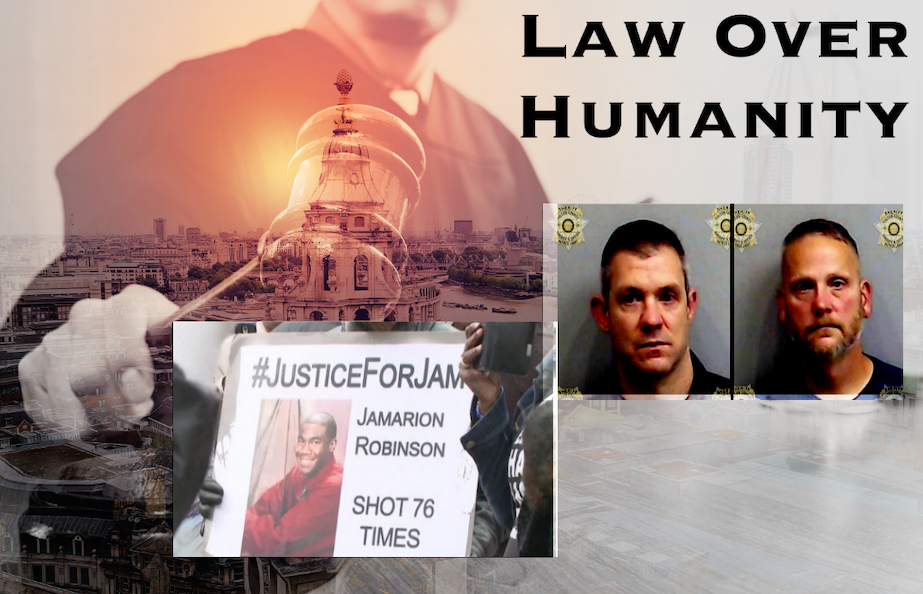
Will Federal Ct Uphold the Law of the Jungle or Hold Police Accountable for Murdering a Black College Student? White Cops 'Shot Jamarion Robinson to Bits' @ Close Range–Shot @ 76X, Engaged in Cover-up

From [HERE] The mother of a 26-year-old Black man who was fatally shot by police officers nearly eight years ago asked a federal appeals court Friday to reverse the dismissal of her civil rights suit. The three-judge circuit panel did not signal when they intend to issue a ruling.

Monteria Robinson's excessive force claims were dismissed by a lower court because the officers were acting as part of a federal task force law with the U.S. Marshal Service. 

On appeal, she argued that should be able to sue because the officers on the task force were acting under state law and abiding by state agencies' policies and procedures. 

Her attorney, Mario Williams, argued before the 11th Circuit panel on Friday that all members of U.S. Marshal Service enforcement operations are required to comply with state agency guidelines, including those concerning the use of firearms and deadly force. 

If the officers were not employed by local law enforcement agencies, which empower them with Georgia general arrest powers, they wouldn't have had the authority to execute the arrest warrant against Jamarion Robinson to begin with, Williams argued. 

But U.S. Circuit Judge Elizabeth Branch noted differences between this case and the Supreme Court Bivens case, which found that an implied cause of action existed for an people whose Fourth Amendment protections against unreasonable search and seizure had been violated by the Federal Bureau of Narcotics.

Unlike in Bivens where federal narcotic officers executed a warrantless arrest, the task force officers in this case were acting in execution of valid arrest warrants. They also engaged in a gunfight with Jamarion Robinson who was armed, where as the suspect in Bivens was unarmed. 

"This is a very hard hill for you to climb up," said Branch. "How is having an arrest warrant for him not meaningful?"

Williams said the fact that the arrestee was armed does not mean the officers did not engage in excessive use of force. 

U.S. Circuit Judge Jill Pryor asked whether a Bivens remedy applies against officers working as fugitive task force agents of the Marshal Service. The Supreme Court's recent decision in Egbert held that any claim that isn't highly similar to the facts in Bivens provides a "new context" in which a damages claim can't proceed if there is any reason to think Congress might be better equipped to create a damages remedy.

Assistant U.S. attorney Gabriel Mendel, representing task force officers Eric Heinze and Daniel Doyle, argued the circumstances of this case present a new context requiring consideration of special factors.

Mendel defended the lower court's finding that alternative remedial structures exist, including an administrative scheme under the Federal Tort Claims Act that permits plaintiffs to sue those acting on behalf of the United States. Monteria Robinson had already done so, and the 11th Circuit previously affirmed the judge's dismissal of those claims on summary judgment. 

U.S. Circuit Judge Frank Hull, expressed concern that Monteria Robinson may be barred from raising her claims because she did not raise the question, during her first appeal, of whether the court correctly held the defendants were acting as federal officers.

That was in 2022, when she appealed a judge's previous dismissal of the case finding that the officers' "use of force was objectively reasonable” and granting them qualified immunity.

An 11th Circuit panel found that evidence from a bystander's video created a "genuine dispute of material fact" and remanded the case for further proceedings on claims that officers Heinze and Doyle used excessive force after a flashbang exploded. [MORE]

According to the complaint in the civil case the facts are as follows:

On August 5, 2016, at approximately 12:30, seven or more members of the Task Force, including the Defendant-Officers, met at a church near Washington Road and Interstate 285 in Atlanta for the purpose of receiving information about serving an arrest warrant on decedent Jamarion Robinson at 3129 Candlewood Drive in Atlanta. Among other things, Steve O'Hare “relayed…ROBINSON’S mental health history” to the defendant officers in attendance. Approximately an hour after the meeting in the church the Defendant-Officers moved from the church near Washington Road and Interstate 285 to positions around and in front of 3129 Candlewood Drive. One or more of the Defendant-Officers pounded loudly on the front door of 3129 Candlewood Drive multiple times. Then one or more Defendant-Officers broke down the front door and, without cause or provocation by Jamarion Robinson, began “spraying” bullets around the interior of 3129 Candlewood Drive with one or more H&K 9 mm submachine guns, one or more H&K .40 mm submachine guns, and one or more Glock .40 pistols.

When one or more of the Defendant-Officers began “spraying” bullets around the interior of 3129 Candlewood Drive, they did not know how many people were in the building. Fifty-nine bullets or more from the sub-machine guns and Glocks of the Defendant Officers entered the body of Jamarion Robinson, killing him. After killing Jamarion Robinson, one or more of the defendants ascended a single flight of stairs to a second-floor landing, where the bullet-riddled corpse of Jamarion Robinson was lying.

With the intention of covering-up their actions by manipulating the evidence on the scene and with the intention making it more difficult if not impossible to accurately reconstruct the shooting-event, the defendant officers:

  • Set off a flash bang grenade after lethally shooting Jamarion Robinson;

  • Stood over Jamarion Robinson corpse and mutilated it by firing into it two 9 millimeter bullets;

  • Handcuffed the corpse knowing that it was lifeless and without the power of animation to react to them;

  • Put an oxygen rebreathing mask over the corpse knowing that it was lifeless and without the power of respiration;

  • Dragged the corpse from the second floor landing down a flight of stairs to the first floor, with the purpose of attempting to destroy the evidentiary connection:

  • between the bullet entry-and-exit wounds on the corpse and the surrounding walls, floor and ceiling;

  • between the corpse and the blood- and flesh-spatter patterns on the surrounding walls, floor and ceiling; and

  • between the corpse and its actual position when found by the defendant officers; and f. Otherwise tampered with the evidence on the scene with the intention of destroying the evidentiary value

Heinze and Hutchens are accused of using unnecessary force by continuing to shoot at Robinson even after he fell to the ground and was unresponsive. 

Daniel Doyle, another task force member who opened fire that day, died of cancer in March 2020 and was never charged.

According to a medical examiner’s report, Robinson was shot 59 times, with 75 bullet wounds that either entered or exited his body.  The family said that a pathologist found that Robinson had been shot several times through the palms of both hands.[3] Attorney for the state Natalie Adams said Thursday that the report showed that Robinson’s “hands and arms were shot to bits.”

None of the officers were injured in the incident.[4] None of the police officers involved in the shooting wore body cameras.[13] [MORE]

Ambulance was 1 Hour Too Late Causing a Miscarriage. 'So What?' says Federal Court, 'There's No Constitutional Right to Receive Emergency Services and Govt Has No Duty to Provide Rescue Services'

PURSUANT TO THE SO-CALLED “SOCIAL CONTRACT,” Citizens are contractually obliged to obey all laws and GOVERNMENT commands and IF they fail to do so the government CAN punish the citizen, usually with fines or imprisonment. IN CONTRAST, authorities HAVE NO SUCH OBLIGATION TO THE CITIZEN - AS AUTHORITIES are bound ONLY to do whatever they want to do, whenever they want to do it and to whom they choose, but no one in particular. AS STATED BY THE COURT IN THE MATTER DISCUSSED BELOW, ‘THE GOVERNMENT IS UNDER NO obligation To provide competent rescue services - if it chooses to provide SUCH SERVICES. HERE, “OBLIGATION” means a legally enforceable and vested right to receive services the citizen is entitled to RECEIVE. WE ARE OBLIGED TO OBEY THE GOVERNMENT BUT GOVERNMENT CAN PROVIDE SERVICES IF IT SO DESIRES. Dr. Blynd asks “Makes you feel like a fool, doesn’t it? ” [MORE]

If there is no social contract then there is no rational basis for the belief in political authority.

From [HERE] A federal court in Pennsylvania dismissed the wrongful death and negligence claims brought against a county by a married couple whose unborn daughter died after an ambulance took over an hour to arrive during the wife’s medical emergency. Their claims do not sustain a constitutional violation, and without this, their state law questions are not appropriate for the federal court to consider. The court ruled:

Plaintiffs’ Section 1983 claims against the other Defendants fail because Plaintiffs have not alleged a violation of Stephanie or Paisley Reiner’s constitutional rights. The Bill of Rights is a charter of negative liberties, prohibiting government action rather than requiring it. The Fourteenth Amendment to the United States Constitution is no different. It prohibits any state from “depriv[ing] any person of life, liberty, or property, without due process of law.”66

The Third Circuit has long-standing precedent that there is no constitutional right to receive emergency ambulance services, nor is there “an affirmative obligation on the State to provide competent rescue services if it chooses to provide them.” 67 So any injuries resulting from flawed or incompetent emergency rescue services are not constitutional injuries, and hence not actionable under Section 1983.68 Plaintiffs’ argument that they only waited an hour for the ambulance because they did not know it would take so long requires a closer analysis of this Circuit’s “state-created danger” theory of liability.

According to the court’s decision:

The complaint in this case revolves around the negligent training and response of a 911 Center and dispatcher, whose response to a call requesting emergency medical assistance exacerbated Stephanie Reiner’s injuries and resulted in the death of her unborn daughter, Paisley.

On September 23, 2022, Stephanie Reiner was approximately 32 weeks pregnant with Paisley.8 Stephanie Reiner began experiencing stomach discomfort that same afternoon, which worsened and became constant.9 Reiner contacted a triage nurse in the labor and delivery department at Geisinger Medical Center at approximately 3:00 p.m.10 While on the phone with the nurse, Reiner felt a sensation similar to her water breaking and believed she was going into labor.11 After Reiner described her condition, the nurse advised her to contact 911 so that she could be admitted to the hospital.12 After the call, however, Reiner discovered that her water had not broken, and that she was bleeding profusely.13 She immediately called 911 and spoke to a dispatcher at the 911 Center, informing the dispatcher that this was a medical emergency and that she was in need of an ambulance.14 The dispatcher advised Reiner that an ambulance would be dispatched immediately.15

Reiner’s mother-in-law Luann Snyder came to the residence minutes after Reiner called 911.16 Snyder observed a pool of blood beneath Reiner and throughout the kitchen.17 After waiting for the ambulance for ten minutes, Snyder called 911 to find out when it would arrive.18 The dispatcher stated that an ambulance had been dispatched and was on the way.19 After waiting another ten to fifteen minutes, Snyder called 911 again, asking where the ambulance was coming from and how far away it was.20 But the dispatcher refused to tell Snyder where the ambulance had been dispatched from.21 Instead, the dispatcher reiterated that an ambulance had been dispatched and would be there soon, and that Snyder should be patient.22 Snyder waited another ten to fifteen minutes, and then again called 911.23 She advised the dispatcher that if they could not get Reiner to an ambulance, they needed to get her to a helicopter because she was bleeding out.24 After an additional fifteen minutes of waiting, the ambulance finally arrived.25 Throughout the time Reiner waited for the ambulance to arrive, she experienced severe pain and constant gushes of blood from her vaginal area.26

Two ambulance companies are located within approximately ten miles of Reiner’s residence, while a third is located approximately 24 miles from her residence.27 Yet unbeknownst to Reiner and Snyder, the 911 Center never contacted these companies, which were in service and available on the date of Reiner’s incident.28 Instead, the ambulance which actually arrived was in fact coming from Harrisburg, Pennsylvania, which was over an hour away from Reiner’s residence.29 If Reiner and Snyder had known that the ambulance was coming from Harrisburg, they would have driven to the nearest hospital immediately.30

Reiner’s misfortune did not end with the arrival of the ambulance. The ambulance that was dispatched was from CLT, located approximately 60 miles from Reiner’s residence.31 After arriving at Reiner’s residence, the Emergency Medical Technicians (“EMTs”) forced Reiner to walk approximately 100 feet to the ambulance outside, even though Reiner advised them that she believed she was hemorrhaging.32 The EMTs then asked Reiner to get on the stretcher by herself, despite her profuse bleeding and difficulty walking.33 They then downgraded the call from a Code 3 response to a Code 1 response,34 and did not leave for approximately an additional seven minutes after Reiner was secured in the ambulance.35 The ambulance did not use lights and sirens and stopped at every red light on the way to Geisinger Medical Center (“Geisinger”).36 And the EMTs never took Reiner’s blood pressure or administered intravenous (“IV”) therapy.37 During the ambulance ride, Reiner vomited four times.38

The EMTs never contacted anyone at Geisinger on the way to the hospital, and Geisinger personnel were unaware of Reiner’s condition when she arrived.39 After the ambulance arrived at Geisinger, the Geisinger nurses asked why Reiner did not have an IV and sent the EMTs away.40 Upon Reiner’s arrival at Geisinger, Paisley Reiner, her unborn daughter, still had a heartbeat.41 Reiner was rushed to the operating room for an emergency Caesarean section.42 Geisiner medical personnel informed Reiner that she had a full placental abruption and hemorrhage.43 Reiner’s surgery continued for five hours because doctors could not stop her bleeding, and doctors were forced to give Reiner large doses of medications to promote blood clotting to attempt to stop the bleeding.44

Ultimately, Paisley Reiner was delivered stillborn that same day.45 Reiner’s treating physician advised her that if she had arrived at the hospital sooner, Paisley Reiner would have survived the trauma.46 The physician stated that Reiner’s condition started as a partial placental abruption and developed into a complete abruption by the time she arrived at Geisinger. As a result of this incident, Reiner suffers from blood clots and has had three miscarriages.47 On September 26, 2022—three days after Reiner’s incident—Russell Fellman, the 911 Coordinator in charge of the Northumberland County 911 Center, modified the Computer Aided Dispatch (“CAD”) station order relating to Reiner’s call at the 911 Center.48 Fellman changed the 13 EMS district station order to reflect the correct station order that should have been used when Reiner originally contacted the 911 Center.49 Although Area Services was not recommended for dispatch on September 23, 2022 because it was listed deep in the station order, Fellman also modified the CAD system station order to move Area Services higher on the list of emergency services dispatched to a particular location.50

The Northumberland County District Attorney’s Office investigated the incident.51 In October 2022, the Northumberland County Fire Chiefs Association’s vice president claimed that mismanagement of the 911 Center had placed the public in danger; another fire chief expressed concern that mismanagement of the 911 Center would result in civilian death.52 At this same meeting, fire officials aired grievances concerning prolonged dispatch times and significant dispatcher turnover, and called for Fellman’s termination.53 Fellman resigned as 911 Coordinator in December 2022.54 According to Plaintiffs, dispatchers at the 911 Center were not properly trained to dispatch ambulances.55

Chad Reiner, Stephanie Reiner, and the estate of Paisley Reiner now bring a five-count complaint against Defendants.56 Counts I and II seek damages against all defendants for alleged violations of Paisley Reiner and Stephanie Reiner’s federal constitutional rights under Title 18 U.S.C. § 1983.57 The remaining counts are brought exclusively against Defendant CLT under Pennsylvania state law. Count III states a claim for Gross Negligence, Count IV seeks damages under Pennsylvania’s Wrongful Death Act, and Count V seeks damages under Pennsylvania’s Survival Action statute.58 [MORE]

Tennessee Authorities Claim They Can Murder People Convicted for Child Sexual Assault in Direct Challenge to Supreme Court Death Penalty Precedent

From [HERE] On May 9, Governor Bill Lee of Tennessee signed a bill authorizing the death penalty for aggravated rape of a child, following Florida’s passage of a similar law last year. Both laws contradict longstanding Supreme Court precedent holding the death penalty unconstitutional for non-homicide crimes. Tennessee’s law takes effect on July 1. The state has had a death penalty moratorium in place since May 2022 after Governor Lee learned that state officials had failed to test execution drugs for bacterial contamination; he ordered a subsequent independent investigation which found that the state had systematically failed to follow lethal injection protocols. Governor Lee did not release a statement upon signing the bill and has issued no recent updates on the status of the moratorium.  

The Supreme Court held in Coker v. Georgia (1977) that the use of the death penalty is disproportionate to the crime of rape, violating the Eighth Amendment’s prohibition against cruel and unusual punishment. The Court extended that ruling to child rape in Kennedy v. Louisiana (2008). While the Court emphasized the “hurt and horror inflicted” by perpetrators of child rape and the “years of long anguish” endured by the victim, the Court noted that only a handful of states authorized the death penalty for child rape and only two men in the entire country were on death row as a result, making the punishment unconstitutionally “unusual” for the crime. The Court further noted the disproportionate nature of the punishment of death on a person who had not caused death, raising concerns about the “incongruity” between child sexual abuse and the “harshness” of the death penalty. “When the law punishes by death, it risks its own sudden descent into brutality, transgressing the constitutional commitment to decency and restraint,” the justices wrote.   

Critics have argued that such laws could further traumatize victims. Maria DeLiberato, Executive Director of Floridians for Alternatives to the Death Penalty, pointed out that 30% of child sex abuse victims are abused by family members and 90% of victims know their abuser. “You’ve got this whole dynamic where a child is going to bear the weight of a possible death sentence to a neighbor, an uncle, a grandfather,” she said. Similarly, the Court noted in Kennedy that it “is not at all evident that the child rape victim’s hurt is lessened when the law permits the death of the perpetrator,” as death penalty cases “require a long-term commitment by those who testify for the prosecution” and victims would have to relive their trauma through law enforcement interviews and testimony for decades. The practice “forces a moral choice on the child, who is not of mature age to make that choice,” the Court wrote.  

There is also evidence that such laws increase the risk of wrongful execution. The Kennedy Court discussed research showing children have a heightened susceptibility to suggestion or fabrication in law enforcement interviews. The National Registry of Exonerations has identified over 300 wrongful convictions involving child sex abuse.  

Governor DeSantis and Florida legislators designed their bill as an opportunity for the Supreme Court to overturn Kennedy. “This bill sets up a procedure to be able to challenge that precedent,” DeSantis said. Florida prosecutors announced their first case under the law in December. Some Tennessee legislators made the same argument; state Senator Janice Bowling suggested that “the atmosphere is different on the Supreme Court” and the bill’s sponsors were “simply challenging a ruling.” (Governor Lee denied signing the bill to “test” it in court.) These efforts come amidst challenges at the Supreme Court to the “evolving standards of decency” test used in Kennedy and numerous landmark capital punishment cases. A pending death penalty case from Alabama challenging the test, Hamm v. Smith, has been relisted by the Court fourteen times without a certiorari decision, and advocates recently appeared to sidestep a nearly-identical challenge to the test in a case argued before the Court in April.  

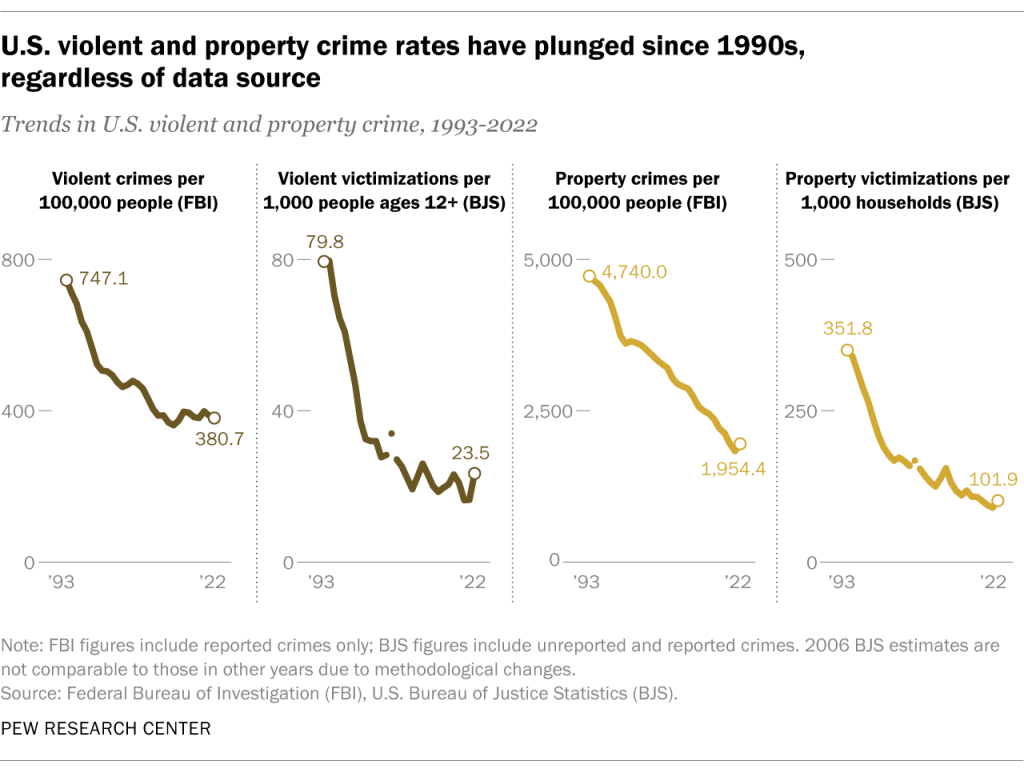
According to Pew Research FBI Data Shows the Violent Crime Rate Fell 49% between 1993 and 2022 and the Property Crime Rate Declined 59% between 1993 and 2022

From [HERE] A growing share of Americans say reducing crime should be a top priority for the president and Congress to address this year. Around six-in-ten U.S. adults (58%) hold that view today, up from 47% at the beginning of Joe Biden’s presidency in 2021. [MORE]

How have crime rates in the U.S. changed over time?

Both the FBI and BJS data show dramatic declines in U.S. violent and property crime rates since the early 1990s, when crime spiked across much of the nation.

Using the FBI data, the violent crime rate fell 49% between 1993 and 2022, with large decreases in the rates of robbery (-74%), aggravated assault (-39%) and murder/nonnegligent manslaughter (-34%). It’s not possible to calculate the change in the rape rate during this period because the FBI revised its definition of the offense in 2013.

The FBI data also shows a 59% reduction in the U.S. property crime rate between 1993 and 2022, with big declines in the rates of burglary (-75%), larceny/theft (-54%) and motor vehicle theft (-53%).

Using the BJS statistics, the declines in the violent and property crime rates are even steeper than those captured in the FBI data. Per BJS, the U.S. violent and property crime rates each fell 71% between 1993 and 2022.

While crime rates have fallen sharply over the long term, the decline hasn’t always been steady. There have been notable increases in certain kinds of crime in some years, including recently.

In 2020, for example, the U.S. murder rate saw its largest single-year increase on record – and by 2022, it remained considerably higher than before the coronavirus pandemic. Preliminary data for 2023, however, suggests that the murder rate fell substantially last year.

How do Americans perceive crime in their country?

Americans tend to believe crime is up, even when official data shows it is down.

In 23 of 27 Gallup surveys conducted since 1993, at least 60% of U.S. adults have said there is more crime nationally than there was the year before, despite the downward trend in crime rates during most of that period. [MORE]

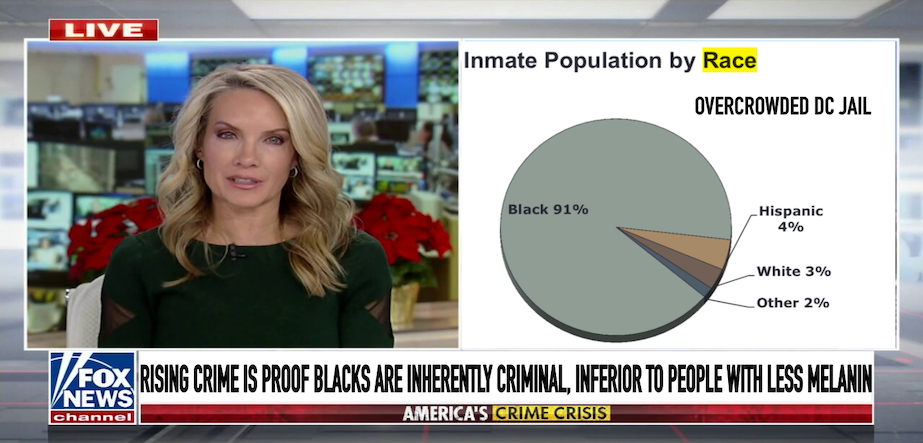
BLACK CRIMINALS FUNCTION AS A NEGATIVE REFERENCE GROUP VITAL TO MAINTAINING THE WHITE AMERICAN SELF-IMAGE. THE BLACK CRIMINAL IS USED TO SUPPORT THE WHITE AMERICAN COMMUNITY'S SELF-SERVING, SELF-JUSTIFYING JUDGMENTS OF ITSELF. WHITE AMERICA'S PREOCCUPATION WITH BLACK CRIMINALITY BETRAYS ITS OWN NEED FOR REASSURANCE; BETRAYS ITS OWN BASIC INSECURITY REGARDING ITS PROJECTED MORAL PURITY. CONSEQUENTLY, THE HIGHER THE INCIDENCE OF REPORTED BLACK CRIMINALITY, THE MORE EXCEPTIONALLY RIGHTEOUS WHITE AMERICA FEELS ITSELF TO BE. THE MORE RIGHTEOUS IT FEELS ITSELF TO BE THE MORE INTENSELY AND GUILTLESSLY IT PROMULGATES AND JUSTIFIES ITS DOMINATION AND EXPLOITATION OF AFRICAN PEOPLES AT HOME AND ABROAD.” THE ABOVE GOES FOR RACIST LIBERAL AND CONSERVATIVE MEDIA [MORE] THE ONLY PURPOSE OF RACE IS TO PRACTICE RACISM. [MORE]

Determined by Politicians Rather than Judges, Mandatory Minimums Perpetuate Mass Incarceration, according to New Study [gullible scholars Don't Realize Decarceration is Incompatible w/White Supremacy]

From [TheSentencingProject] Eliminating mandatory minimum sentencing laws is essential to creating a more just and equitable criminal justice system. Widespread evidence shows that mandatory minimum sentences produce substantial harm with no overall benefit to crime control.1 Determined by lawmakers rather than judges, these sentences represent a uniquely American approach to sentencing that has accelerated prison growth. They constrain judicial discretion, deepen racial disparities in the criminal legal system, and cause far-reaching harm to individuals, families, and communities.2

Despite building bipartisan agreement that such sentences are a policy failure, mandatory minimum sentences continue to be promoted as a tool to combat crime, even as the public signals waning support. This fact sheet identifies the main issues associated with mandatory minimum sentences. It documents the modest progress toward ending them, as well as efforts to reinstate them, and offers solutions to hasten change that will aid in ending mass incarceration.

Overview

Mandatory minimums are legal provisions in each state and the federal government that require a specific minimum prison term for certain crimes, regardless of individual circumstances.3 A range of criminal legal experts from ideologically diverse backgrounds4 maintain that mandatory minimums are an overly harsh, disproportionate punishment.5

As crime rose in the 1980s and early 1990s, federal and state lawmakers scrambled to calm public concern.6 With some support from academics, community leaders from areas with rising crime, corrections, law enforcement, and the legal community, politicians built on growing momentum to end indeterminate sentences, consisting of a range of years with no set minimum, and instead opted for longer, determinate sentences upon conviction with a long, minimum term. By 1995, all 50 states and the federal government constrained judges’ discretion in sentencing by mandating minimum imprisonment terms for a wide variety of offenses.7These policies encompassed:

  • Mandatory prison sentences for many drug-related crimes and longer, mandatory minimum sentences for violent crimes and repeat (i.e., habitual) offenses;

  • “Three strikes” laws that lengthened sentences, requiring minimum sentences of 25 years to life imprisonment for some, usually serious, offenses;8 and

  • “Truth-in-sentencing” laws, which required people to serve most of their sentences, typically 85%, before eligibility for release.9

Problems with Mandatory Minimums

Prosecutors hold the power

A deterrence rationale underpinned mandatory minimum sentences: individuals were expected to refrain from committing new crimes if sentences were lengthened, and such sentences would also “send a message” to those considering criminal acts. The laws were professed to target violent crime, but their broad authority resulted in far more drug and other nonviolent convictions than violent convictions. The use of mandatory minimums effectively vests prosecutors with powerful sentencing discretion. The prosecutor controls the decision to charge a person with a mandatory-eligible crime and, in some states, the decision to apply the mandatory minimum to an eligible charge.10 Rather than eliminate discretion in sentencing, mandatory minimums therefore moved this power from judges to prosecutors. The threat of mandatory minimums also encourages defendants to plead to a different crime to avoid a stiff, mandatory sentence.

Racial and ethnic disparities flourish

Studies show that Black people receive mandatory minimum sentences more frequently than whites.11 A 2019 study found that people of color in New York made up 91% of arrests for crimes that carry mandatory minimums, whereas whites made up only 7%.12 At the federal level, a 2017 United States Sentencing Commission report on drug sentences revealed that Black people were the most likely to have been sentenced under a mandatory minimum than any other group, and that, despite equal rates of using drugs,13 Black and Hispanic individuals comprised the majority of persons convicted of drug-related offenses (which are the most common federal offenses subject to mandatory minimums).14

The racial disparity associated with the sentencing of crack and powder cocaine offenses in the federal system after Congress passed the draconian Anti-Drug Abuse Act of 1986 is well known. The law created a quantity-based 100:1 disparity between federal crack cocaine and powder cocaine offenses, imposing the same five and ten-year mandatory minimum penalties for selling five and 50 grams of crack cocaine as for 100 times the amount of powder cocaine. In 1986, before the law passed, the average federal drug sentence for African Americans was 11% higher than for whites but within four years, this average was 49% higher.15 A 2007 analysis by the United States Sentencing Commission showed that 82% of people convicted of crack-related offenses were Black, a stunning difference compared to whites (9%).16 This injustice was reduced, but not eliminated through the Fair Sentencing Act in 2010 which lowered the disparity to 18:1 from 100:1.

DECARCERATION IS INCOMPATIBLE WITH WHITE SUPREMACY’S GOAL OF PLACING LARGE NUMBERS OF NON-WHITE PEOPLE INTO GREATER CONFINEMENT.

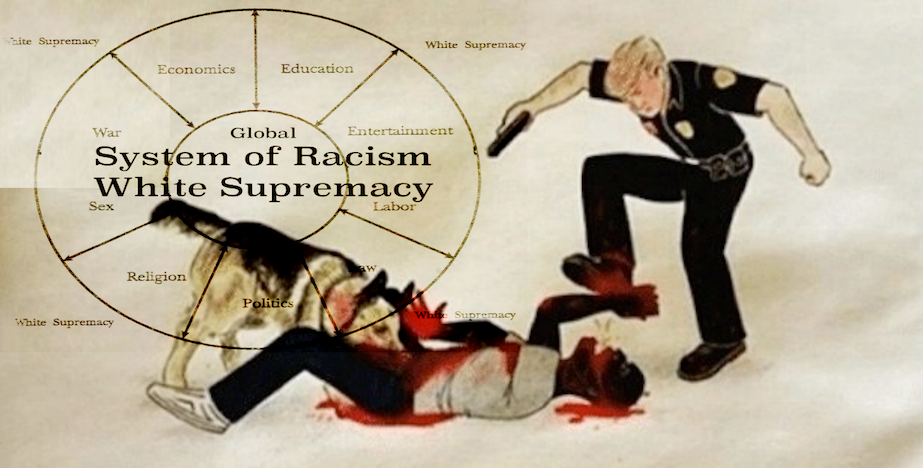
RWS REQUIRES THE GREATER CONFINEMENT OF SUBSTANTIAL NUMBERS OF NON-WHITE PEOPLE. UNDECEIVER NEELY FULLER MAKES IT PLAIN THAT “THE WHITE SUPREMACISTS KNOW THAT A WORLD SYSTEM BASED ON RACISM WHITE SUPREMACY REQUIRES THAT SUBSTANTIAL NUMBERS OF NON-WHITE PEOPLE BE GREATLY RESTRICTED IN THEIR MOVEMENTS FROM PLACE TO PLACE. THE WHITE SUPREMACISTS RESTRICT THE MOVEMENTS AND ACTIVITIES OF NON-WHITE PEOPLE SO AS TO KEEP THEM IDLE, AND/OR KEEP THEM FROM BECOMING CONSTRUCTIVELY SUFFICIENT.

THE RACISTS MAKE CERTAIN THAT LARGE NUMBERS OF NON-WHITE PEOPLE EXIST UNDER CONDITIONS THAT WILL MOST LIKELY CAUSE THEM TO DO THINGS THAT WILL GIVE RACISTS AN “EXCUSE” TO PUT THEM IN GREATER CONFINEMENT.” [MORE]

Prison conditions worsen

In addition to their profound racial differences, mandatory minimum sentences have contributed to prison overcrowding, which exacerbates extremely unsanitary and dangerous living conditions. Overcrowded prisons create resource deficits for rehabilitation, mental and behavioral health needs, and education needs. Eliminating mandatory minimums would allow the reallocation of resources that could instead go toward funding these services and programs, which have known community safety benefits.17

State and Federal Reforms Underway

After decades of lengthening prison terms to discourage engagement in crime, the failure of this approach is abundantly clear, and some jurisdictions are reversing course. A few notable reforms in recent years include:

  • Almost half of all states, as well as the federal government, have reduced or eliminated some mandatory minimums related to drug offenses.18

  • Colorado, Iowa, and Washington now forbid mandatory minimums for youth who are transferred to the adult system.19

  • Mississippi scaled back its truth-in-sentencing law so that certain nonviolent offenses committed by someone without a criminal history could be reviewed after serving one fourth of their sentence instead of the previous mandate of needing to serve 85% of their sentence.20

While states have yet to address the overuse of mandatory minimum sentences for violent offenses, the limits put on harsh penalties for nonviolent and drug offenses is encouraging. But even here, reform of mandatory minimums has been too sporadic and insufficient to meaningfully pull the prison population back to its pre-mass incarceration levels. Reforms should be strengthened so they point the way toward a new paradigm of sentencing that allows individualized assessments, that includes regular review, and earned release as soon as possible.

Support for Misguided Policies Remains

We are now in the 50th year of the uniquely American reliance on mass incarceration.21 Experts agree that this has come about by politics, not crime, and many of the policies are related to mandatory minimum sentences.9 From perpetuating racial disparities, hindering rehabilitation, and straining resources, these policies have had significant negative consequences for individuals, families, and communities.

While inroads have been made to reverse or reform mandatory minimum laws in select states, we are nowhere near an end to the “get tough” politics that brought them about. Old rhetoric tends to resurface when crime worries rise. In 2022, the Tennessee legislature passed a new truth-in-sentencing law,23which requires individuals to serve 100% of their sentence upon conviction for eight separate felonies. The law is expected to increase the prison population considerably.24

A successful push in California for two new mandatory minimums followed another highly televised crime by Stanford University student Brock Turner in 2016.25 Because the sexual assault did not fall neatly in the state definition of rape, the two new laws expanded the definition of rape and prohibited the use of probation in a wider range of crimes of a sexual nature. The case exemplifies the understandable emotional public outcry for immediate action. It is important to remember, though, that the burden of such quickly developed laws is likely to fall disproportionately on non-white individuals, unlike this defendant, perpetuating the crisis of punitiveness toward Black and Brown communities.26 [MORE]

Are Alabama Prisons for Confinement or Gender Annihilation? Gov Has Spent $10M Defending Claims that Overcrowded Inmates are Routinely Raped, Sexually Abused and Subjected to Horrific Sexual Violence

Findings issued by the United States Department of Justice documenting the extraordinary rise in violence and sexual assaults in Alabama's prisons over the last five years leave no doubt that there is a humanitarian crisis in our state's prisons. Photographs are now appearing in local and national media that provide a window into violence that state officials have long shielded from public view. [MORE]

FUNKTIONARY MAKES IT PLAIN:

prisons – U.S. Bureau of Gender Annihilation and Family Destruction. Prisons are indicative of society’s sickness, the political repression of the State and a corrupt—if not bankrupt—economic system of monopoly capitalism. There is a myth supported by Corporate media that prisons function to keep criminals away from society. This is patently false as most crimes are non-violent and actually go unreported. Most “criminals” operate and remain within agencies and boardrooms—though not in prison, making life for others a living hell. Prisons are but reflections of society’s infractions—refracted in the form of deformed grins and shadowed sins—missing the mark is the mark of the missing and exploited, the lost, oppressed, despised and compromised, left with only vices as their bootstrap devices in a misbegotten world gone astray. A place where the multitudes (have-nots) scrap amongst each other in order to taste the morsel of just another still-born day that brings the hope unborn aborted in the muffled moans of yesterday. The ghetto groans in the birth of a new dawn accompanied by the same old sirens serenading the pangs of hunger, souls murmur and pre-mumble the pre-amble to be free; free from the oppression of the OCTOCON and its emissaries. I’ve seen the whites of eyes, clear and teary—hold on my people, don’t get weary. We must all learn to discern and honor the sacredness of life—the life you deserve is the one you preserve, and the life you help save may help you save your own. (See: The OCTOCON, Penal Code, DL Brothers, Buck Rodgers Time, BOP, Capital Punishment, Monopoly Capitalism & Homo Tiempos) [MORE]

From [HERE] An incarcerated man sued Alabama, claiming state officials were deliberately indifferent to the risk of sexual violence in the state’s prisons. As the judge noted in 2023, Jacob Barefield’s complaint listed terrifying, credible examples. But something else caught the judge’s eye—the State’s response when asked why it spent over $10 million fighting such lawsuits.

We are “an easy target,” the State’s lawyers wrote in a court filing, and “baseless claims must still be defended.” Besides, the State said, Mr. Barefield’s complaint had not “plausibly” claimed a pattern of unchecked sexual violence.

U.S. District Court Judge W. Keith Watkins wrote:

Did they read the complaint? If they had then they would know that such a violent environment is exactly what [the plaintiff] alleges, and arguments to the contrary are disingenuous, if not bordering on outright dishonesty.

In Alabama, people incarcerated in overcrowded and understaffed prisons are routinely raped, sexually abused, and subjected to horrific sexual violence. Twenty years after Congress unanimously passed the Prison Rape Elimination Act (PREA), sexual violence in Alabama’s prisons is at an all-time high. 

For years, officials have been notified about a pattern of sexual assaults, rapes, and brutal attacks. Last year, the Alabama Department of Corrections received almost daily reports of prison sexual assaults.

Mr. Barefield’s complaint, filed in federal court, details allegations of a harrowing episode at an Alabama prison. 

According to the complaint,  Mr. Barefield, 25, was standing in the canteen snack line at Ventress Correctional Facility, a sprawling medium security prison in southeastern Alabama, on Sunday morning, November 11, 2018, when an incarcerated man wearing a teal wristband approached him with a knife.

The wristband meant the man lived in F Dorm, the section of Ventress reserved for prisoners with recent serious infractions and needing the highest level of management. LL, the man flashing the knife at Mr. Barefield, had been transferred to Ventress from St. Clair, a maximum security prison where he had allegedly stabbed a man to death in a fight five years earlier.

LL’s wristband signaled that he had no business being in the canteen that morning with Mr. Barefield and the other men there. But no guard was there to stop him. LL encountered not a single guard as he walked Mr. Barefield out of the canteen at knifepoint, across the prison yard, past a number of buildings, and toward F Dorm.

The complaint alleges that Ventress officials knew Mr. Barefield might be a target. They had determined that he was especially vulnerable to sexual assault. He wore the yellow wristband of C Dorm, whose residents are not allowed in F Dorm. But the guard at the door to F Dorm did not check his wristband, and no correctional officer was on duty inside the dorm. 

The door should have been locked. It wasn’t. LL opened it and forced Mr. Barefield into the open-bay dorm, a big room that housed more than 100 men classified as high risk. 

Marching his captive past the rows of metal bunk beds, LL forced Mr. Barefield onto a lower bunk. A nearby television had its volume turned all the way up. Sheets and blankets hung from the upper bunk, creating a makeshift tent, or “hump” in Alabama prison slang, that concealed what went on inside.

LL told another prisoner he was going “to show him how to take control of another inmate.” Then he entered the tent.

What happened next, according to the complaint, is described by Judge Watkins in his August 22, 2023, memorandum opinion in Mr. Barefield’s lawsuit: 

There, in the middle of the morning, in a violent offender’s dorm that Barefield should never have been allowed to enter, in a crowded area that should have been supervised by a guard, in a makeshift tent that should have been immediately taken down, using a knife that should have been confiscated, [LL] raped Jacob Barefield…The T.V. drowned out any cries.

After the rape finally ended, LL and another incarcerated person held Mr. Barefield hostage inside the ”hump” for more than five hours. During that time, in violation of Ventress policy, no guards patrolled or even monitored surveillance cameras in that section of F Dorm.  

If Mr. Barefield told anyone what had happened, he’d be killed, LL warned. 

When a prison official arrived to do the daily count before dinner, LL released Mr. Barefield, who immediately sought aid. He told the shift commander in the yard he had been attacked and repeatedly asked for his help.

The commander did not take a statement or file a report, as required. He did not direct Mr. Barefield to the infirmary or ask who had raped him. He simply ordered him back to C Dorm. 

That night Mr. Barefield telephoned a friend and asked her to report the rape to the warden and other supervisors. She did, promptly. But Mr. Barefield’s suit said that for two days, in violation of the Prison Rape Elimination Act, those officials took no action.
Weeks later, Warden Michael Strickland barged in on a meeting between Ventress’s PREA compliance officer and Mr. Barefield. As the ultimate authority at Ventress, the warden said to Mr. Barefield “something along the lines of ‘grow some hair on your chin,’” Judge Watkins wrote.  

“If true,” Judge Watkins wrote, “the allegations in this case tell a horrific story about excessively dangerous conditions in another Alabama state prison—and the failures of authorities to fix them.”

The judge added this footnote: 

This case does not come to the court in isolation. In the past year, several courts have found viable allegations of unconstitutionally violent conditions of confinement throughout the Alabama prison system. The common themes in these cases are easily detected: understaffing, overcrowding, proliferation of contraband weapons, and abject failures to monitor and supervise inmates—all of which have allegedly led to the highest rates of inmate-on-inmate violence in the country. And those failures, especially concerning egregious understaffing, are not new. Over five years ago, the Commissioner of the Alabama Department of Corrections (ADOC) was ordered to staff Alabama prisons at a constitutionally adequate level. He has not yet done so.  

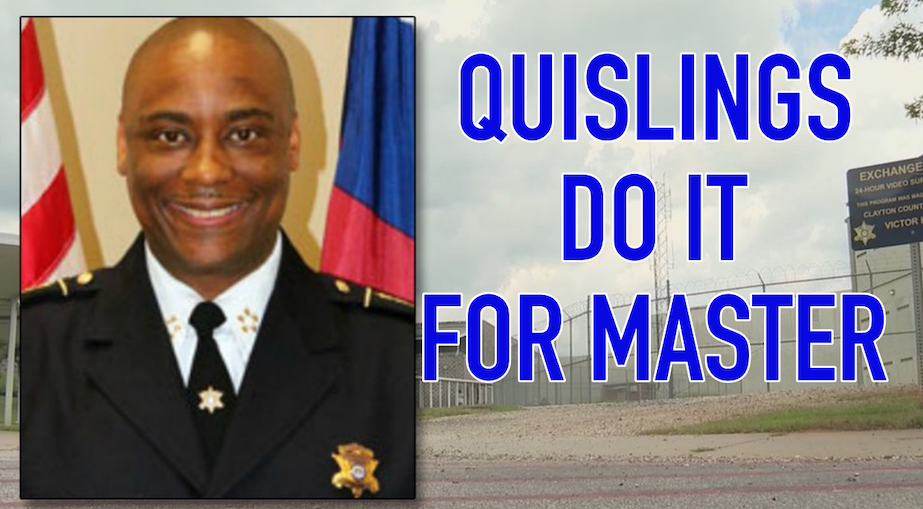
11th Circuit Affirms Sheriff Victor Hill’s Abuse Conviction: Black Strawboss Handcuffed Inmates to Restraint Chairs for Up to 6 Hours at a Time in Atlanta Area Jail

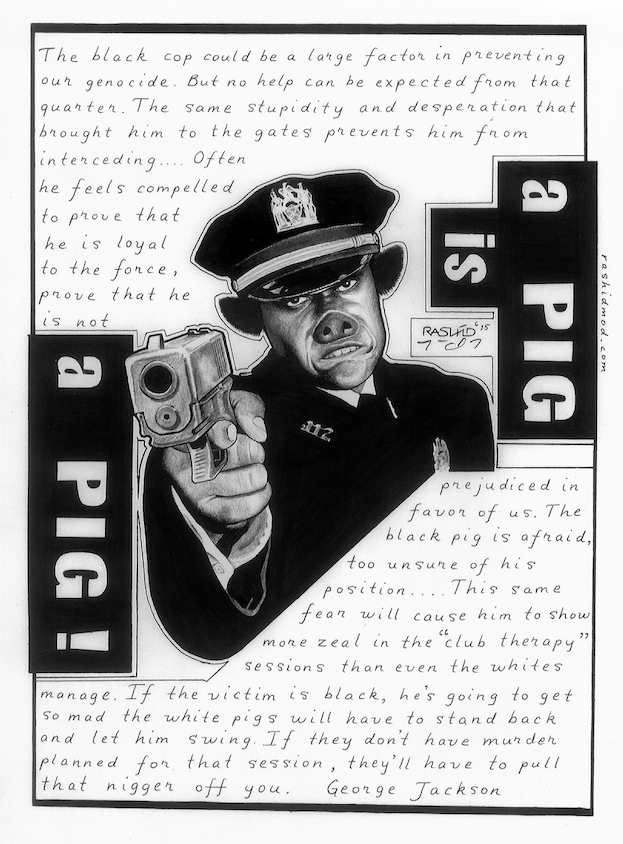
ALTHOUGH DO-GOODER REFORMERS OFTEN CLAIM DIVERSE POLICE FORCES ARE A CURE FOR POLICE BRUTALITY, BLACK COPS BRUTALIZE AND HARM BLACK PEOPLE AT A RATE NEARLY EQUAL TO WHITE COPS. SAID DO-GOODERS ARE DRUNK-OFF THEIR JESUSIZED BELIEF IN STATISM. SCHOLAR ALEX VITALE STATES, “REFORMERS OFTEN CALL FOR RECRUITING MORE OFFICERS OF COLOR IN THE HOPES THAT THEY WILL TREAT COMMUNITIES WITH GREATER DIGNITY, RESPECT, AND FAIRNESS. UNFORTUNATELY, THERE IS LITTLE EVIDENCE TO BACK UP THIS HOPE. EVEN THE MOST DIVERSE FORCES HAVE MAJOR PROBLEMS WITH RACIAL PROFILING AND BIAS, AND INDIVIDUAL BLACK AND LATINO OFFICERS APPEAR TO PERFORM VERY MUCH LIKE THEIR WHITE COUNTERPARTS.” HE STATES, “THERE IS NOW A LARGE BODY OF EVIDENCE MEASURING WHETHER THE RACE OF THE INDIVIDUAL OFFICERS AFFECTS THEIR USE OF FORCE. MOST STUDIES SHOW NO EFFECT. MORE DISTRESSINGLY, A FEW INDICATE THAT BLACK OFFICERS ARE MORE LIKELY TO USE FORCE OR MAKE ARRESTS, ESPECIALLY OF BLACK CIVILIANS.” [MORE] and [MORE]AND [MORE]

FUNKTIONARY EXPLAINS

Quisling – the name for a traitor, coined in April, 1940, meaning one who is content to accept the yoke of the conqueror for the sake of being given office and trinkets, even against the feeling and expression of the conquered people, and moreover, prepared to use the force continuum against his/her own people to impose the conquerors decrees. (See: SNAGs)
"The notion that '[n]o man is above the law and no man is below it' is fundamental to our democratic republic's continuing viability." So says the Eleventh Circuit(link is external) as its opening statement in affirming the conviction of Victor Hill, a former Clayton County, Ga. sheriff for gratuitously putting detainees in a restraint chair for hours at a time, causing extreme pain and lasting injuries.

The case is United States v. Victor Hill, 23-10934 (11th Cir. 2024).
Former CDC Director Robert Redfield Admits that People Under Age 50 Had No Reason to Get COVID Injections. Also Admits Experimental Shots Caused Significant Injury. Claims He Warned Government

From [HERE] Former CDC Director Robert Redfield said Thursday that many officials who tried to warn the public about potential problems with COVID-19 vaccines were silenced and that it’s time to acknowledge the jab resulted in “significant” side effects.

“Those of us that tried to suggest there may be significant side effects from vaccines … we kind of got canceled because no one wanted to talk about the potential that there was a problem from the vaccines, because they were afraid that that would cause people not to want to get vaccinated,” Dr. Redfield told Chris Cuomo on NewsNation.

Dr. Redfield, who helmed the CDC during Operation Warp Speed, argued the COVID shots were “important” and saved “a lot of lives,” but also admitted that individuals under 50 years old had no reason to receive the experimental COVID injection and that the shots caused “significant side effects.”

“They’re important for the most vulnerable people, those over 60, 65 years of age. They really aren’t that critical for those that are under 50 or younger. But those vaccines saved a lot of lives, but they also—we have to be honest, some people got significant side effects from the vaccine,” he said.

“I have a number of people that are quite ill and they never had COVID, but they are ill from the vaccine,” he continued. “And we just have to acknowledge that.”

Redfield was one of the first major government health officials to claim that in his “professional opinion” the virus that caused COVID-19 originated from the Wuhan Institute of Virology.

Cuomo himself recently admitted he experienced health issues from the COVID jab.

A bombshell report published by the Correlation Research in the Public Interest in September found the COVID jabs were causally linked to a drastic increase in all-cause mortality in 17 countries, ultimately resulting in at least 17 million deaths.

And a recent large-scale study through the Global Covid Vaccine Safety (GCoVS) Project analyzed health data from 99 million patients encompassing eight countries and confirmed a causal link between the shots and myocarditis, pericarditis, Guillain-Barré syndrome, cerebral venous sinus thrombosis and more.