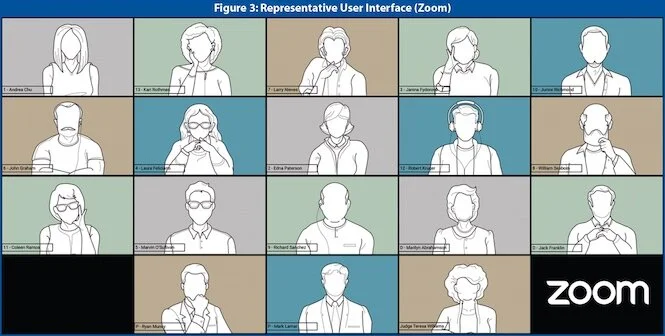
No Way to Look Your Accuser in the Eye on Zoom. In a Virtual Trial the 6th Amendment Right to Face-to-Face Confrontation and a "Representative" Jury is Guaranteed to be Unreal for Non-White Defendants

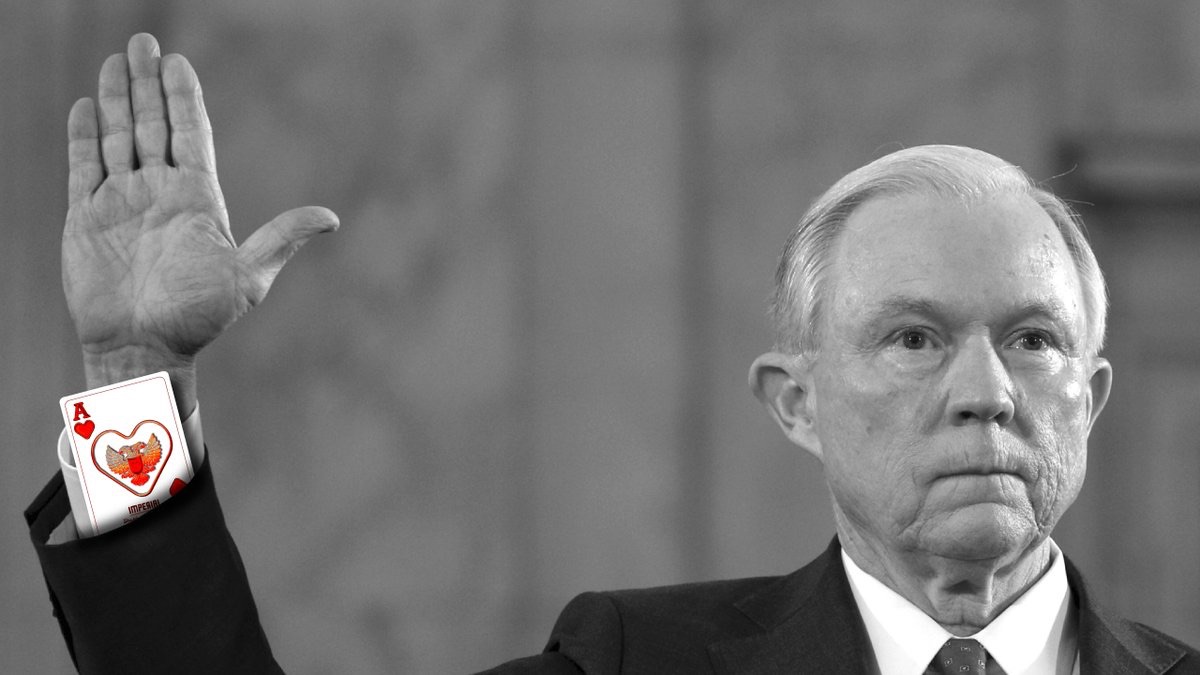
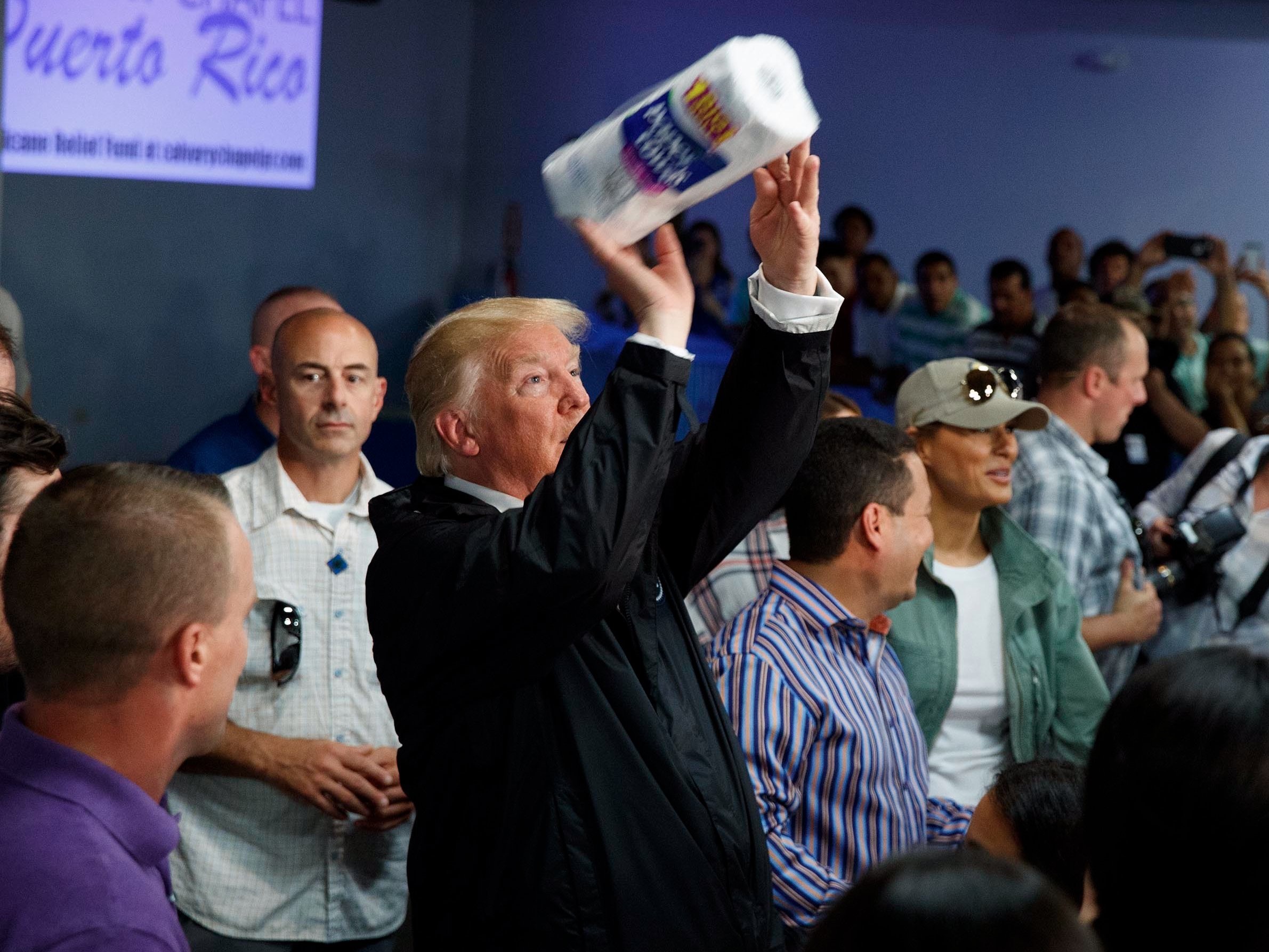
all white virtual jury.jpg

From [HERE] II. Virtual Criminal Trials Cannot Overcome Key Constitutional Hurdles

To keep the wheels of justice turning, most courts have been conducting a host of proceedings by video or teleconference, including arraignments, guilty pleas, and sentencing, with the consent of the defendant. This is a significant change for the legal system, where longstanding rights entitle defendants to be charged, tried, and judged by people they can look in the eye.

While no court has yet conducted a full jury trial remotely, there have been clear moves in that direction. For instance, in a statewide order staying all jury trials, Chief Justice Tani G. Cantil-Sakauye of California noted, "Courts may conduct such a trial at an earlier date, upon a finding of good cause shown or through the use of remote technology, when appropriate." 55Likewise, the U.S. District Court for the Southern District of New York

However, while "jury trial by video" may be permissible in the civil context, it raises grave constitutional concerns when applied to criminal proceedings. The arguments against remote testimony in criminal trials are plentiful. Remote testimony may violate defendant's right to be confronted with the evidence against him or her because the testimony is not "face-to-face Remote testimony cannot ensure truthfulness to the same extent as requiring the witness to testify live before the defendant. Remote testimony limits the information available to defendants when assessing juror bias. And remote testimony, as opposed to live testimony, does not provide the court and jury with the same opportunity as does live testimony to assess the demeanor and truthfulness of the witness. Each of these issues is addressed in turn below.

all white virtual jury.jpg

A. Criminal Defendants Have a Fundamental Right to Physically Face Their Accuser

The Sixth Amendment's Confrontation Clause assures the right of an accused "to be confronted with the witnesses against him." 57The U.S. Supreme Court has declared that face-to-face confrontation forms "the core of the values furthered by the Confrontation Clause. 58This core value serves dual purposes. First, facing one's accusers deters false accusations, as it is far more difficult to lie when looking directly upon the accused. 59Second, face-to-face confrontation enables jurors to "examine the demeanor of the witness as the witness accuses the defendant, as well as the demeanor of the defendant as he hears the accusations. ..." 60This, in turn, enables jurors to more properly assess credibility. 61

Whether the Confrontation Clause forbids virtual trials represents new terrain. No authority exists -- in the federal Constitution or most state analogues -- that outright prohibits the practice. On the other hand, no authority explicitly permits them, either. 62Thus, in assessing whether an appellate court would affirm a verdict arising out of a remote video proceeding, we must consult analogous precedents involving videoconferencing.

i. The Supreme Court's Guiding Principles

The Supreme Court encountered the issue of live, audiovisual testimony on two occasions. In Coy v. Iowa, the Supreme Court reversed a sexual-assault conviction, concluding that the lower court's decision to permit two child witnesses to testify behind a large screen where they could not see the defendant violated the defendant's confrontation rights. In reaching this conclusion, Justice Scalia, writing for the majority, stated: "We have never doubted ... that the Confrontation Clause guarantees the defendant a face-to-face meeting with witnesses appearing before the trier of fact." 63He further stated that "the irreducible literal meaning of the Clause" is "[the] right to meet face to face all those who appear and give evidence at trial." 64According to Scalia, "there is something deep in human nature that regards face-to-face confrontation between accused and accuser as 'essential to a fair trial in a criminal prosecution,'" 65in that a witness "may feel quite differently when he has to repeat his story looking at the man whom he will harm greatly by distorting or mistaking the facts." 66He further added, "It is always more difficult to tell a lie about a person 'to his face' than 'behind his back.' In the former [case], even if the lie is told, it will often be told less convincingly."

Despite this strong language, however, the right to confrontation is not absolute." In Maryland v. Craig," the Court held that the Confrontation Clause does not prohibit a state from using one-way closed-circuit television to capture testimony of a child witness in a child [*28] abuse case - even where the child cannot view the defendant while testifying.

The Court declared that, "[a]lthough face-to-face confrontation forms 'the core of the values furthered by the Confrontation Clause; ... it is not the sine qua non of the confrontation right." 71Rather, the Court found that the Confrontation Clause "reflects a preference for face-to-face confrontation at trial;' which "must

Applying these principles, Craig created a two-part test for determining whether an exception to the Confrontation Clause's face-to-face requirement is warranted: " [A] defendant's right to confront accusatory witnesses may be satisfied absent a physical, face-to-face confrontation at trial only where [1] denial of such confrontation is necessary to further an important public policy and [2] the reliability of the testimony is otherwise assured."

With respect to the first prong, Craig added the additional requirement of a " case-specific" finding of necessity. Thus, the Supreme Court indicated a willingness to retreat from a literal application of the Sixth Amendment -- but only in "narrow circumstances" and on a "case-specific" basis."

ii. A Split Amongst the Circuit Courts

Lower courts do not agree on how to apply the foregoing precedent. Some federal courts view the Confrontation Clause as guaranteeing the defendant a general right to contemporaneously cross-examine adverse witnesses. 76Other courts provide a more specific right to examine witnesses face-to-face in the defendants' physical presence. 77Whether a court is inclined to permit remote prosecution-witness testimony depends, in part, on the level of significance it attaches to the face-to-face component of the Sixth Amendment.

For instance, in Gigante, 78the Second Circuit found no violation of a defendant's Confrontation Clause rights when the trial court permitted a mob informant dying of inoperable cancer to testify from a remote location by two-way, live videoconferencing technology. 79While acknowledging that in-court testimony may have "intangible elements ... that are reduced or even eliminated by remote testimony," the court rejected the notion that the defendant was entitled to face his accuser "in the same room." 80Instead, the Court held that the two-way videoconferencing procedure "preserved the face-to face confrontation celebrated by Coy."

The Eleventh Circuit came to the opposite conclusion in Yates. There, the trial court's decision to allow two Australian nationals to testify remotely from Australia against two defendants in a criminal trial in Alabama violated the defendants' Confrontation Clause rights, notwithstanding that the witnesses were beyond the government's subpoena powers. 82Applying the Craig test, the court found that confrontation was not "necessary." Specifically, it found that, although "presenting the fact-finder with crucial evidence is, of course, an important public policy, . .. the prosecutor's need for the videoconference testimony to make a case and to expeditiously resolve it are not the type of public policies that are important enough to outweigh the defendants' rights, to confront their accusers face-to -face." 83The court noted that a Rule 15 deposition in Australia with all necessary parties was a potential alternative, which would have preserved the defendants' confrontation rights.

iii. Application to the Coronavirus Pandemic

Precedent suggests that traditional constitutional rights (such as confrontation) can be satisfied or modified if video conferencing satisfies other sufficiently important interests. Of course, existing confrontation clause jurisprudence did not consider the scope of a national emergency like COVID-19. The challenges posed by the virus -- i.e., the continued operation of the judiciary during a time when in-person jury trials could be deadly -- are certainly extreme. Keeping participants alive is indeed a public policy of prime importance.

But Craig requires more. It requires that any use of remote testimony be individually considered on a "case- specific" basis. Categorical assessments are simply not permitted. Any attempt by a court to impose a blanket rule, e.g., one which permits virtual testimony in all cases during the pandemic, would run afoul of this constitutional principle.

This requirement is no afterthought. The Supreme Court has rejected attempts to deprive defendants of face-to- face confrontation based on such blanket rules. For instance, in 2002, the Court considered a proposed amendment to Rule 26 of the Federal Rules of Crinunal Procedure that would have explicitly permitted video testimony in "exceptional circumstances." 85Under Proposed Rule 26(6), federal courts would have been able to authorize two-way, live videoconferencing technology from a remote location in criminal cases "in the interest of justice" when the requesting party established (1) "exceptional circumstances for such transmission," (2) the transmission used "appropriate safeguards," and (3) the witness was otherwise "unavailable" to attend the trial in person. 86The Court declined to adopt the proposal, however, for failure to "limit the use of testimony via video transmission to instances where there has been a case-specific finding that it is necessary to further an important public policy." The majority appeared to consider a separate statement filed by Justice Scalia, wherein he indicated that the proposed amendment was of "dubious validity under the Confrontation Clause." 87 He observed that " [v]irtual confrontation might be sufficient to protect virtual constitutional rights. I doubt whether it is sufficient to protect real ones." 88A court order that permits remote video trials during a pandemic -- while well-meaning -- would fail to meet this high bar.

It must also be noted that the diversity of state constitutions means that any analogy to the Confrontation Clause will be inapplicable in some states -- especially states whose highest courts have disagreed with Craig. For instance, the Illinois Supreme Court held, "[W]e conclude that the confrontation clause of the Illinois Constitution provides that a defendant is entitled to a face-to-face confrontation with a witness." 89Virtual trials are plainly unconstitutional in such states on separate grounds, irrespective of Supreme Court precedent.

iv. Case Law on Unavailability Provides Additional Guidance

Case law concerning the treatment of sick witnesses provides further guidance. In very limited circumstances, prosecution witnesses have also been permitted to testify remotely due to severe illness. No court has permitted virtual testimony based on the prospect that a witness will become ill in the future.

To the contrary, courts typically squabble over the extent and duration of the illness necessary to evidence unavailability. For example, in Gigante, Peter Savino, "a former associate of the Genovese family," was "in the final stages of an inoperable, fatal cancer, and was under medical supervision at an undisclosed location." 90After hearing testimony from physicians, the trial judge found that it would be medically unsafe for the witness to travel to New York for the trial, and allowed him to testify via two-way video.

Similarly, in Horn v. Quarterman, 92the Fifth Circuit allowed remote two-way testimony by a witness who was terminally ill, hospitalized for liver cancer, and [*29] not expected to improve. The Court found that, "after discussing Birk's condition with Birk's doctor, that use of the unorthodox procedure was necessary, and emphasized that other aspects of the Confrontation Clause were maintained." On that bas is, it found that the "state court

Nobody seriously disputes that witnesses suffering from the coronavirus and confined to a hospital may be permitted to testify remotely. But current proposals to conduct virtual trials make an additional logical leap. They permit remote testimony for witnesses that are not yet sick -- but merely risk becoming sick if they provide in-court testimony. Such speculation is insufficient to establish unavailability.

B. Defendants Have a Right to Participate in Their Own Defense

A criminal defendant's right to be present at his trial is "[o] ne of the most basic of the rights guaranteed by the Confrontation Clause." 94This right is closely tied to an accused's right to confront witnesses as he must necessarily be in the courtroom to obtain the face-to-face confrontation of the evidence against him contemplated by the Sixth Amendment. 95The defendant's right is also protected, in some situations, by the Due Process Clause. The Supreme Court has explained that a defendant has a due process right to be present at a proceeding "whenever his presence has a relation, reasonably substantial, to the fulness [sic] of his opportunity to defend against the charge .... [T]he presence of a defendant is a condition of due process to the extent that a fair and just hearing would be thwarted by his absence, and to that extent only." 96Additionally, the defendant's presence is also often mandated by court rule. For instance, of sets forth the Federal Procedure circumstances in which the defendant's presence is required, not required, and can be waived.

Remote video trials, where the court conducts the proceedings over an online webinar, raise several issues for a defendant's right to be present.

The Right to Be Present, Like the Right to Confront, Does Not Meet the Craig Bar

First, there is the question of whether appearing by video on a webinar would qualify as being present within the meaning of the Sixth Amendment. Though Justice Scalia, among others, argued that testimony via videoconference "improperly substitute[ed] 'virtual confrontation' for the real thing required by the Confrontation Clause in a criminal trial;" 98the Craig decision again clarified that the Confrontation Clause does not guarantee criminal defendants an absolute right to a face-to-face meeting with the witnesses against them. Thus, a remote video trial, in the absence of case specific findings of necessity, would likely violate a defendant's rights to be present for the same reasons as his or her confrontation rights. [MORE]
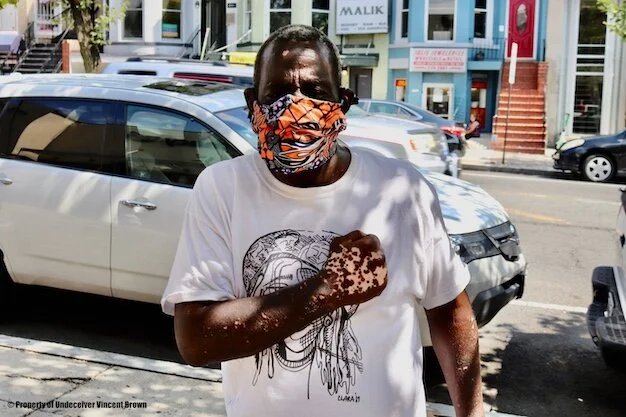
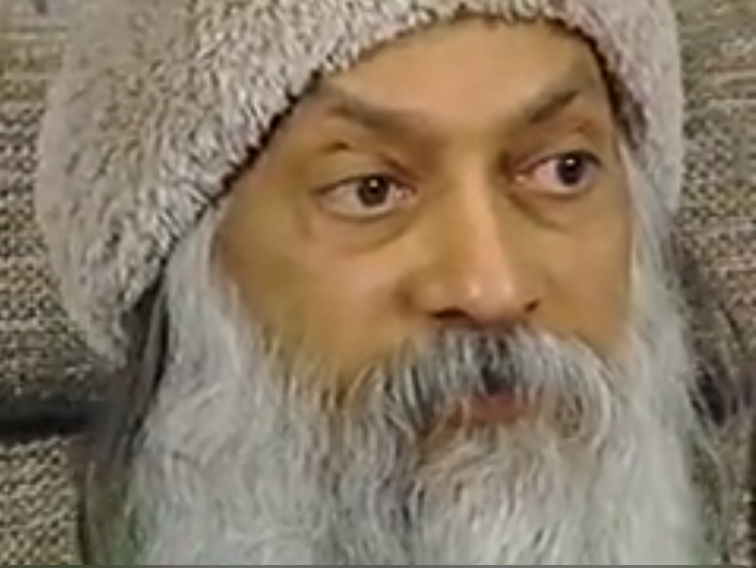
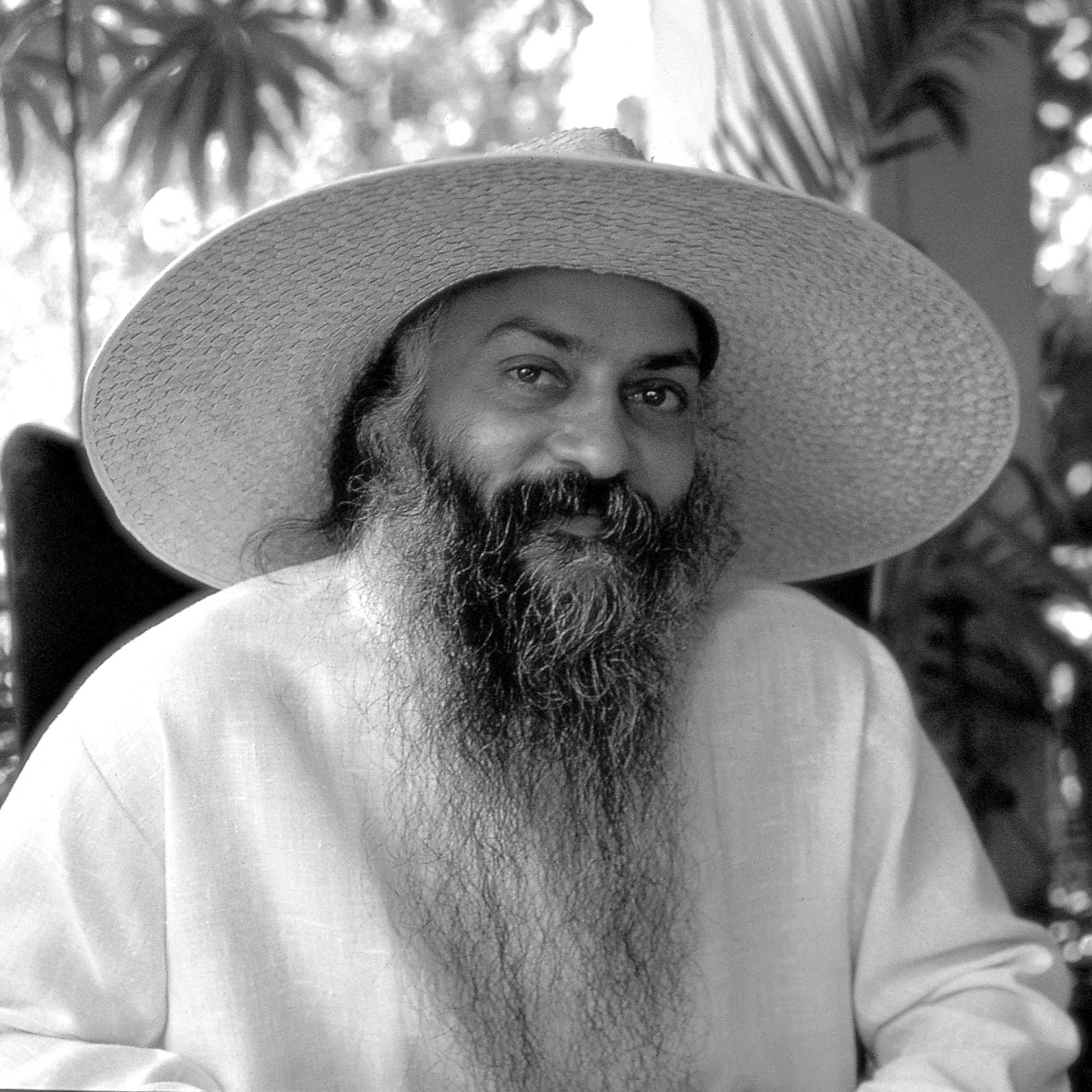
Osho Rajineesh and FUNKTIONARY: 'Real Public Service is Telling the Poor to Revolt Against the Vested Interests [CrimethInc.]’

PHOTO BY UNDECEIVER VINCENT BROWN.

PHOTO BY UNDECEIVER VINCENT BROWN.

According to OSHO:

Poverty - In the past we have praised poverty and made it equal to spirituality, which is absolute nonsense. You can live in absolute poverty, but poverty cannot help you to enlightenment. In poverty or in wealth, in a hut or in a palace, the basic thing is your meditation, your awareness. Wherever it happens, you will become enlightened. You don't have to renounce riches, you don't have to renounce anything. Remember that all the religions have been serving the poor for thousands of years, and poverty goes on growing. Real service is telling the poor to revolt against vested interests.

FUNKTIONARY explains:

Poor - impecunious and impeducated due to the force inflicted by the oligarchy and its Corporate State. 2) the inability to act according to one's consciousness (or be a convictim of its lack of development)----best according to principles (precepts) given by a stranger/oppressor. 3) in a state of perptually having much less than enough, i.e., the bottom 85% of the world's population. 4) the bottomless swell and the face at the bottom of the well. The majority peoples of the world are poor because the economic forms imposed and enforced upon us (the ones we live by) are backwards, oppressive, criminal and archaic. The poor remain poor because they are too poor to create the demand that would create employment that would provide them with the substantive rights ("money") to purchase the fruits of their own labor, and thus enable them to meet their basic needs and end or lighten their poverty. It isn't laziness, but the economic system of monetized-debt (imaginary debt made lendable, legally tenderable and thus spendable) that condemns the working poor and the destitute to illness, and the pre-ordained statistical denial of sufficient basic economic substantive fights. (See: State Capitalism, Voyeur Capitalism, Virtual Capitalism, Monopoly Capitalism, Socialism, Sheep, Conditioning, Indoctrination, Programming, Convictim, MONEY, "Monetized Debt," True  Debt, Peonage, Property, Language, Debtonation, MAMMON, REAPS & Gangbanking) 
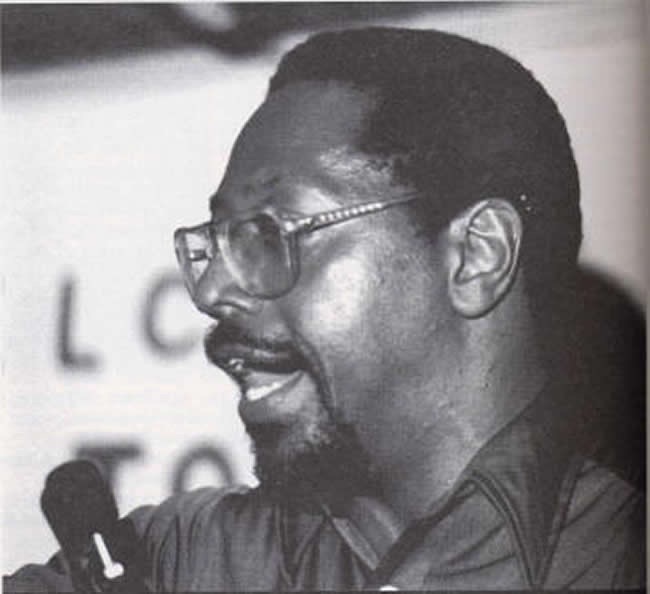
Crimeth Inc. - an elite class of intergenerational financiers and psychopathic human parasites. Crimethlnc. is a faction of men and their legal fictions created in this Matrix by those who make them rob widows and orphans, who take your sons and daughters into pre-emptive corporate invasions and occupations of foreign lands, who kill the innocent, jail the just, mine the womb of your daughters, devour the weak, terrorize and falsely imprison political activists, traumatize the oppressed, and covet the wealth of all. 2) Back-on-Track crime. 3) the twisted empty-souls of humanity's invisible oligarchy. Crimethlnc. is a geo­political agreement among territorial gangsters to share power over looted differential wealth of people's labor, minds, lands and natural resources. The objective pay-off is still empire no matter the condition of the ecology or many people expire. (See: Doggy. "Credit" & Reification)
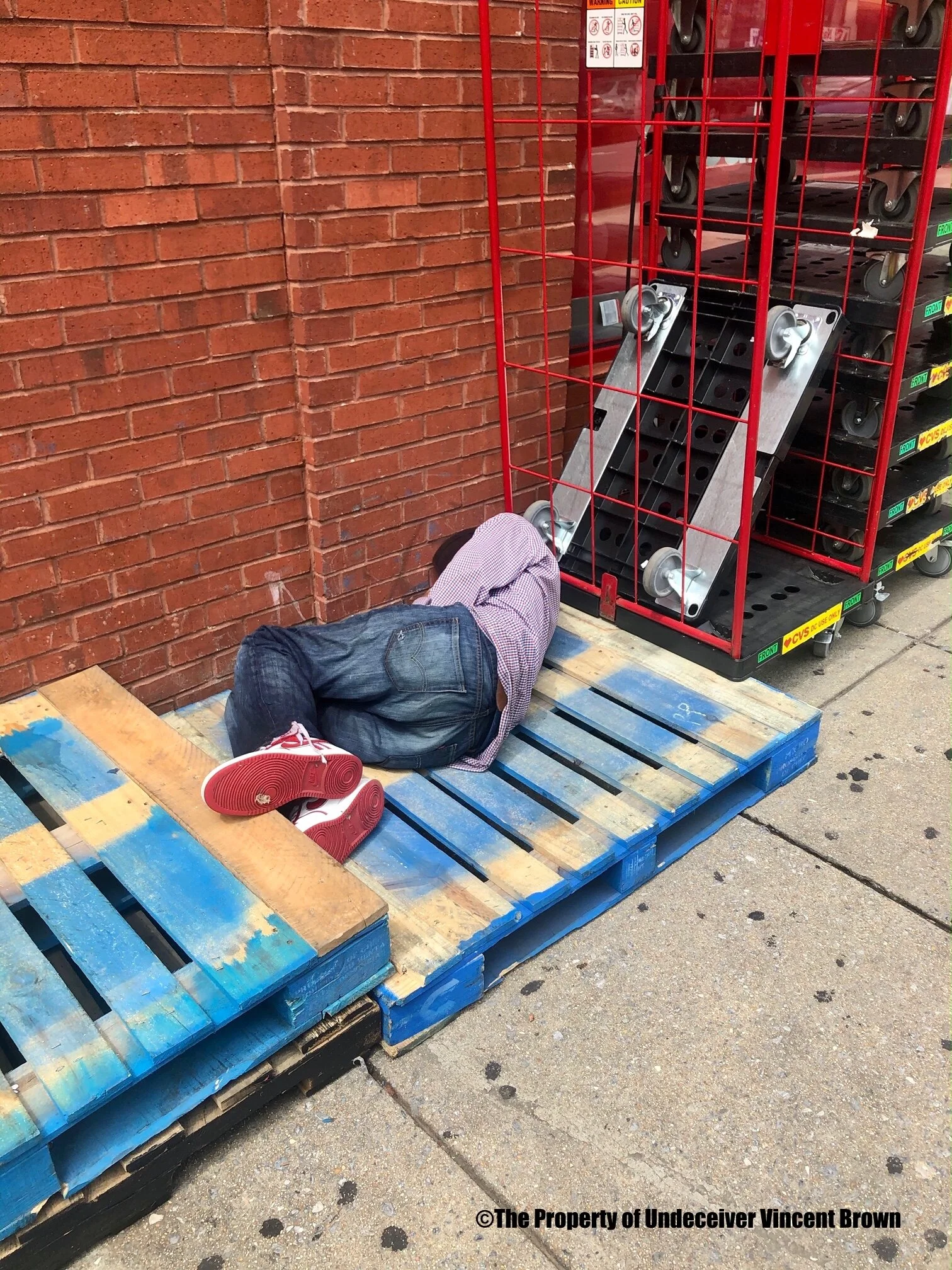
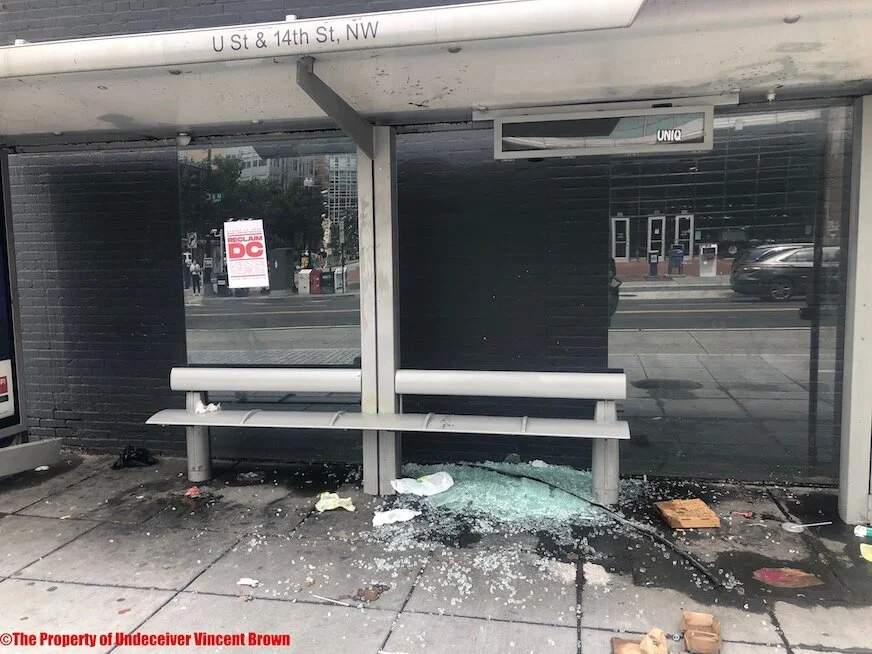
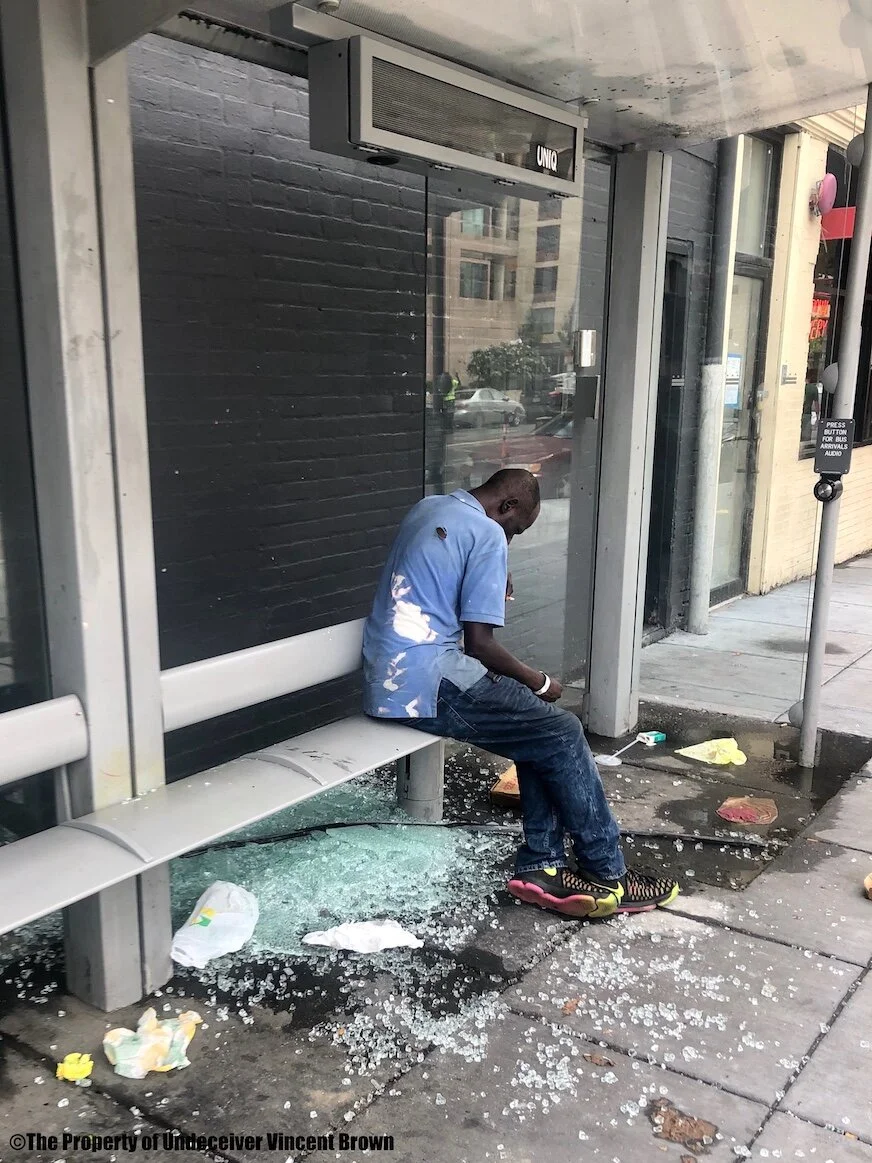
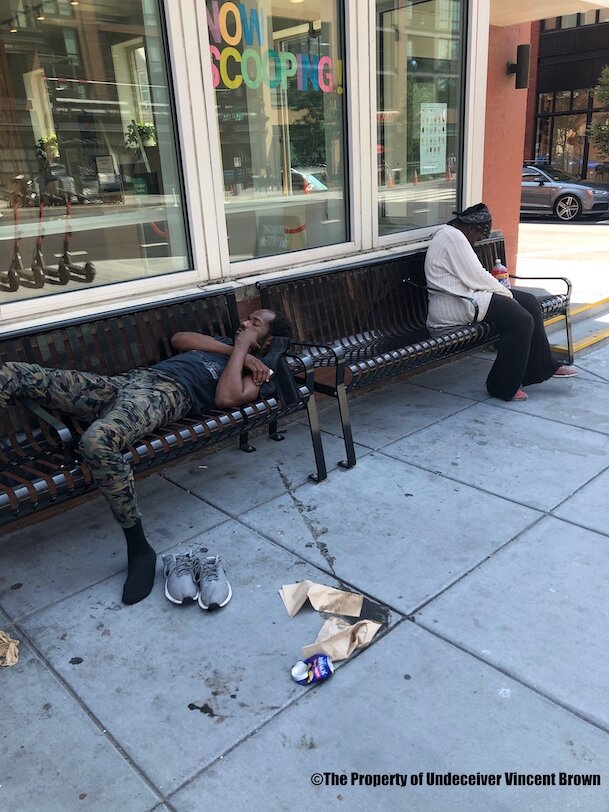
Homeless in The Nation's Capital: 'Looking for the Crate Outdoors' or Adapting to the Bum Proof Bench

THE NATIONS CAPITAL 8/12/20. PHOTO BY UNDECEIVER VINCENT BROWN.

THE NATIONS CAPITAL 8/12/20. PHOTO BY UNDECEIVER VINCENT BROWN.

According to "FUNKTIONARY:

homeless - the informationally disenfranchised and in many cases also the psychologically disengaged. The streets may belong to the people, but they make less than ideal places to live. In the cold the homeless look for the “grate” outdoors.

Washington DC yesterday. PHOTO BY UNDECEIVER VINCENT BROWN.

Washington DC yesterday. PHOTO BY UNDECEIVER VINCENT BROWN.

nation - (natural) a historically evolved stable community of people formed on the basis of a common language, a common territory, a common psychological makeup and worldview manifested in a common culture and common economic life. Sekou Sunidiata once said this about Blackfolk in America, that we are: "A nation within a nation in search of a nationality."

Nation - (law) a legal fiction (Corporate State) superimposed on the dwellers upon the land (country) by commercial interests for the perpetuation of lawlessness (force) over freedom (phfree association and absence of rule) and theft of life, liberty, labor and land with immunity and impunity. 2) a historical artifact or invention. The erected demarcations between languaculture, politics and economics are as artificial as the disingenuous that employ, evoke or invoke their existence. The modem distinction between nation and society is that while the former may be ordered (and ordered around)--the latter orders itself. Originally, nation meant simply a gathering of people and their interrelated kinfolk living in a certain area that had nothing whatsoever to do with geographical boundaries--it was the people that comprised the nation, not the landscape and its parameters defining the people. Nat is the root word for both nature and nation. Since the rise of stationary bandits and territorial gangsters and the legal fictions they have created to perpetuate them, nations have become synonymous with Corporate States and oppression. (See: Legal Fiction, Stationary Bandits, Tyranny, Corporate State, Society, "Government," Languaculture, Culture, Rulership, Citizenship, Involuntary Servitude, Statutory Oppression, Society & Feudal)

Nations - conquered countries and the dwellers (men, women and their offspring) upon these lands. 2) gigantic (transparent to the slave) labor camps of the ruling dynastic gangbanking families (the Oligarchy) and their Corporate States. 3) false geographical and political divisions of countries and continents. At a higher level of human consciousness and human organization, i.e., stateless societies--nations can actually exist (and be continuously shaped and reconstructed) without the superimposition of states, and at least theoretically speaking, nationalism can exist without statism. Although nations are not necessarily desirable in themselves--only just and liberated societies can bring about the sane survival of our species and our world (as we know it) on this planet that we all share (like the air we breathe) in common plight. It is possible to achieve self determination without the impediment of the nation. (See: Nation-State, Corporate State & BOW DOWN)
14th and u before .jpg
Washington DC yesterday. PHOTOs BY UNDECEIVER VINCENT BROWN.

Washington DC yesterday. PHOTOs BY UNDECEIVER VINCENT BROWN.

CAPITAL - Crime And Punishment Is Taking African Lives. (See: Capital Punishment, Maroon Culture & Death Penalty)

Nation-State - an unreal entity (granfalloon) used to conscript natural bodies into surrendered loyalties and massive sacrifice in the name of corporate profits in the theatre of war (perpetual conflict). 2) a concept, method and excuse a group of individuals use as a vehicle to commit crimes against individuals, humanity and other groups that they would never remotely consider (for fear of their lives) committing individually. A nation-state is a hybrid living contradiction--not unlike the notion of "political economy." We must rise to the level of consciousness that allows us to de-couple Nation from State in our thoughts and in our actions of human organization. (See: Political Economy) [MORE]

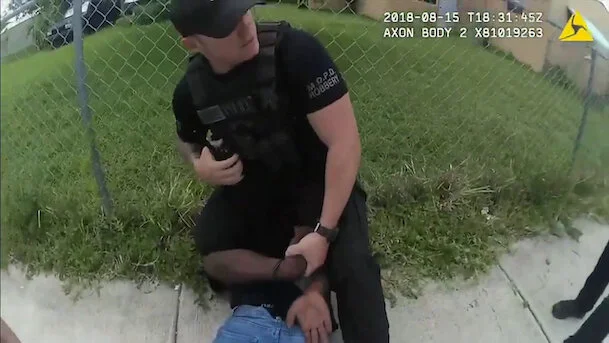
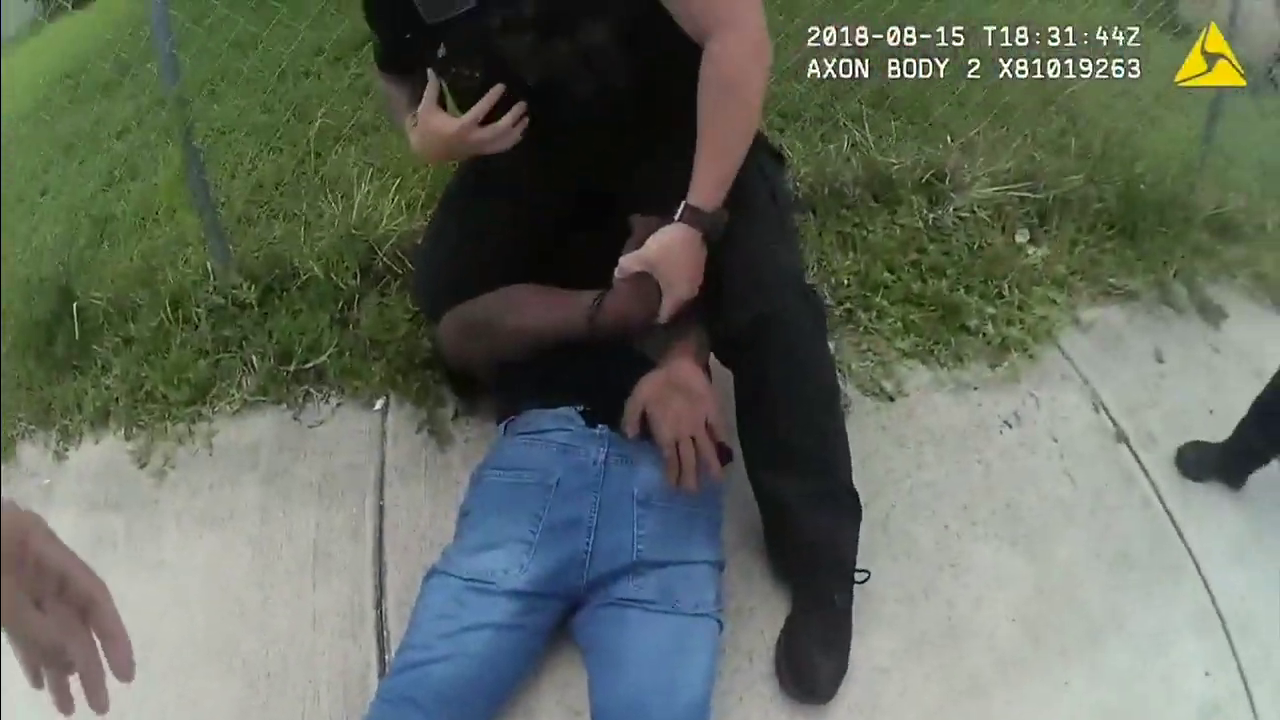
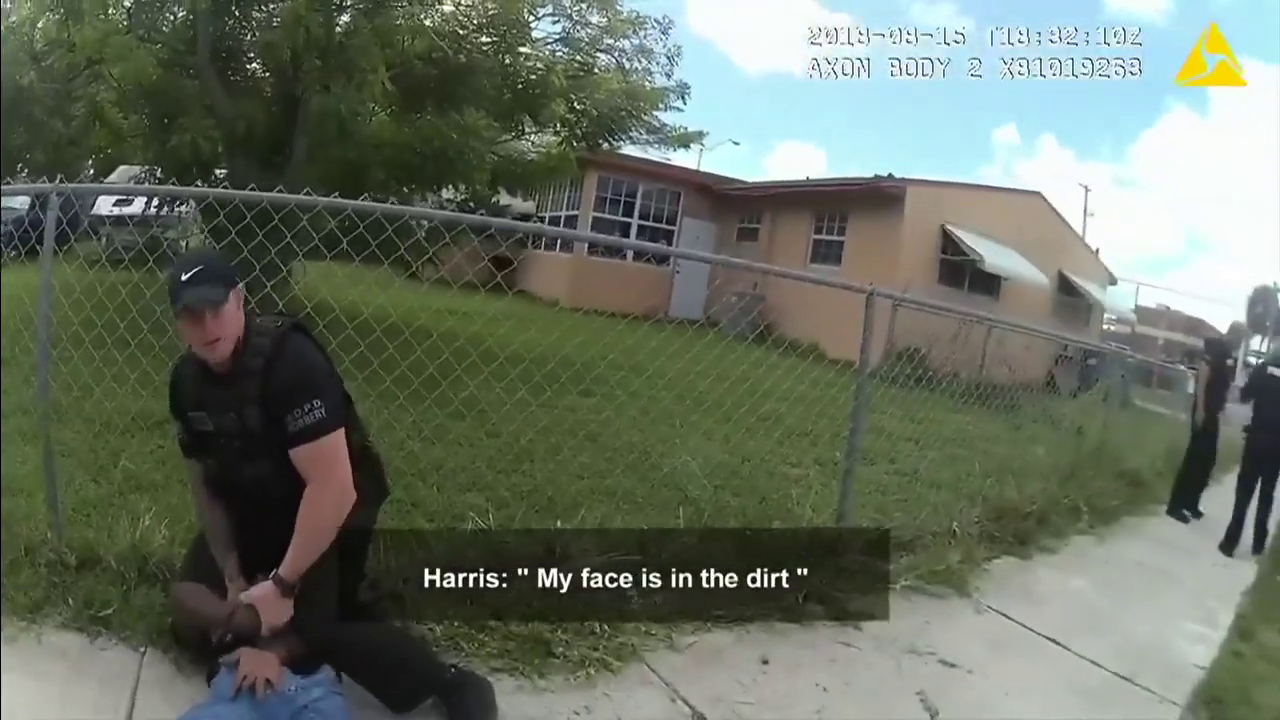
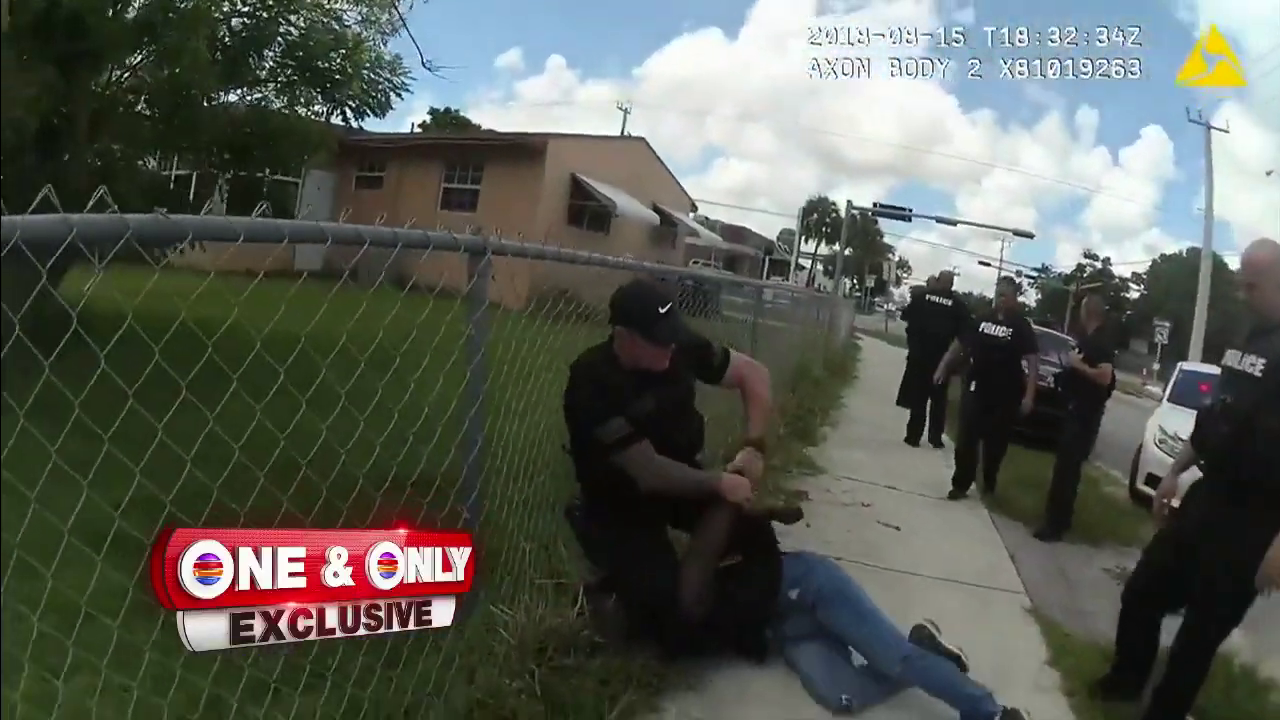
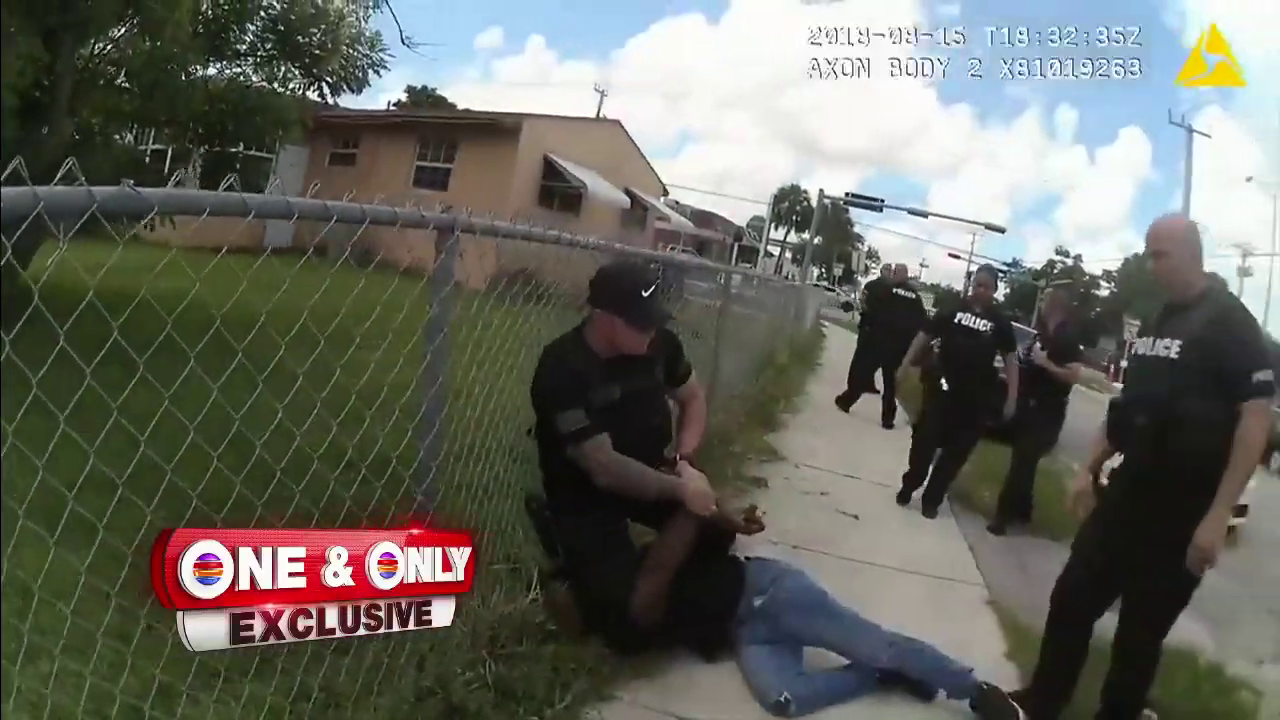
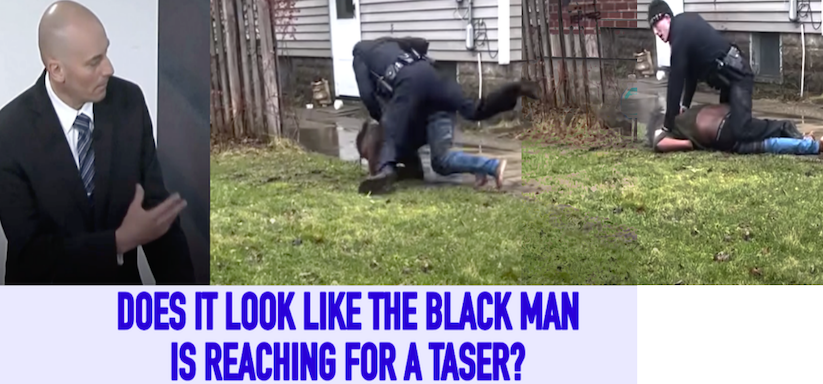
2018 Video Shows a Miami Cop Use His Knee to Choke a Handcuffed Black Man and Break His Arm While Sitting On His Head During Unlawful Stop for Theft of His Own Car, Held Pretrial 2 Yrs on BS APO Case

From [FTP] After his run-in with Miami-Dade police, Keeler Harris is lucky to be alive. He was handcuffed and face down on the ground and cops still put a knee in his back as he muttered those often tragically fatal words, “I can’t breathe.”

Harris was accused of stealing his own car. He had not actually stolen the car, but when police approached him, he feared for his life — which was apparently justified — and then took off running.

When police caught up to him, Harris was taken to the ground as an officer begins punching him over and over as they handcuff him.

“I can’t breathe. My face is in the dirt,” Harris is heard saying as the officer repeats, “Do not get up.”

But Harris wasn’t attempting to get up, he wasn’t even moving at some points.

“He got handcuffed. He was face down in the grass against the fence,” says attorney Sebastian Ohanian.

The attorney says there was no reason for what happened next.

Another officer walked up and knelt down, putting his weight on top of Harris.

“He puts his knee on Keeler’s neck, choking him,” Ohanian said. “Grabs his wrist and puts him in a wrist lock.”

“No matter what had happened before, the actions at this point in time were not justified at all,” Ohanian said. “At all.”

Ohanian explained that the situation was nearly fatal for Harris and resembled the last moments of George Floyd’s life as cops squeezed the breath out of him.

“He’s handcuffed. He’s not moving at all. It’s a very sad video when you watch it. It’s emotional.”  Ohanian says police used excessive force. “It’s a George Floyd-type scenario,” he said. “Keeler is lucky to have left with his life.”

While police were on his back, and because Harris had his arms handcuffed behind his body, the cop’s knee snapped Harris’ arm in two.

“It’s shocking that someone could treat another human being in such a callous manner,” Ohanian said. Ohanian says the knee to Harris’ back caused several injuries, including a broken arm. “During this, he manages to break Mr. Harris’ arm,” he said. “It’s required a rod to be placed into it.”

THE FOURTH AMENDMENT IS AN ILLUSION. The Supreme Court has said flight alone cannot give rise to probable cause; it must be coupled with pre-existing reasonable and articulable suspicion. United States v. Sharpe, 470 U.S. 675, 706 (1985).  However, flight along with other specific factors may imply consciousness of guilt giving rise to a Terry Stop. As far as BW knows, no other circumstances exist in this case.  The initial stop appears to violate the 4th Amendment because it is a factually impossibility for this Black man to have stolen his own vehicle. However, such legal truths entirely miss the reality of authority. Brazen cops so frequently abuse their power that no Black pedestrian, motorist, juvenile, adult or Black professional of any kind—could make a compelling argument that so-called constitutional rights afford any real protection from cops.

Harris was charged with battery on a law enforcement officer and resisting arrest. He is scheduled to go to trial next month on the 29th.

“There is not one point in the video where Mr. Harris hits anyone,” Ohanian said.

Miami-Dade Police released a statement saying, “The department has not received an official complaint. Professional compliance bureau is reviewing the incident.”

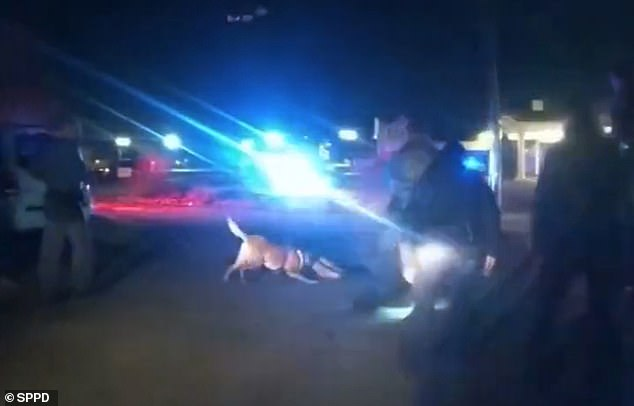
Black Man Was on His Knees w/His Hands in the Air When a White UT Cop Used a Dog to Attack Him. Amputation May be Required. Cops Were Investigating "Arguing" when They Found Him Alone, Smoking

From [HERE] and [HERE] When the police arrived at the home of Jeffery Ryans early one morning in April, the 36-year-old was startled, but said his reaction was almost instinctive.

Growing up as a Black man in Alabama, he said, you’re taught to cooperate. Put your hands up when you’re told. Get on the ground if they say so.

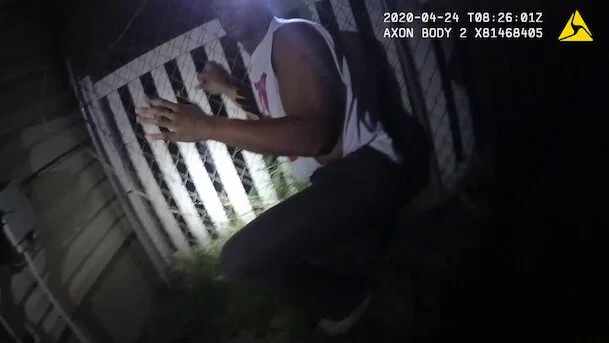
That’s what he was trying to do on April 24 when Salt Lake City police were called to his house after someone heard him arguing with his wife.

Body camera footage from the officers show Ryans was in his backyard smoking a cigarette — he says he was about to leave for his job as a train engineer — when the officers shined their lights on him and started yelling.

“Get on the ground!” one officer yelled, as his police dog barked. “Get on the ground or you’re going to get bit!”

Ryans dropped what was in his hands and put them in the air.

He recalled in an interview that he was confused. He didn’t know where to go or what to do: One officer was yelling for him to come to him, while another screamed to get on the ground.

He was worried if he did the wrong thing, he would get shot.

“I wasn’t running,” he recalled. “I wasn’t fighting. I was just cooperating. We’ve been through this. We’ve seen this. Always cooperate with the police, no matter what.”

Bodycam shows that though Ryans was kneeling on the ground with his hands in the air, the K9 officer still ordered his dog to attack.

The dog, Tuco, latched on to Ryans’ left leg, the footage shows. Even as another officer sat on top of Ryans and puts the man in handcuffs, the K9 officer continued to instruct his dog to “hit” — and Tuco responds by biting and tearing at Ryans’ leg.

“Why are you doing this?” Ryans yelled, according to the video. “Why are you biting me?”

“Good boy,” the officer said to his dog, as Ryans screamed in pain.

It’s body camera video that Ryans can’t watch now. It’s too difficult to watch the dog biting, pulling his leg, knowing that injury has led to multiple surgeries, a lost job and has limited his ability to play sports with his kids.

“I felt like a chew toy,” he said. “I didn’t know why this was happening to me. That’s what was going through my mind. Why?”

Ryans has taken the first steps toward filing a lawsuit against the Salt Lake City Police Department. In a notice of claim, which is required before a suit can be filed, his attorneys, Daniel Garner and Gabriel White, allege that the officer’s use of force was unnecessary — and has caused an injury that could have been avoided if the officer “performed the appropriate actions” while arresting Ryans.

They say Ryans has suffered nerve and tendon damage, infections and has difficulty walking. Doctors have not ruled out the possibility he will need to have his leg amputated.

White alleges that officers reacted the way they did because his client is Black.

The attorney, who is white, said he’s been in similar situations where he’s had an argument with his wife or been in his backyard in the middle of the night letting his dog out. But the police never come, especially not with a K9 dog.

“What’s different between the two of us that could make this happen to him, but I couldn’t imagine happening to me?” he said. “No one’s ever shown up at my house.”

On Tuesday, the department issued a statement referencing The Salt Lake Tribune’s reporting, saying that it has launched an internal affairs investigation after learning of the incident that morning. However, the notice that Ryans intended to sue was filed July 20 and The Tribune also called the police seeking comment last Thursday. A spokesman for the police department said at that time he could not comment because of the expected lawsuit.

Mayor Erin Mendenhall said in a tweet Tuesday that she has conveyed to Chief Mike Brown “the urgency to complete the internal affairs investigation in the matter of Mr. Jeffery Ryans and be as transparent as possible with the public about the process and results.”

It’s not clear from the body camera footage who called police to Ryans’ home, but the man said it wasn’t his wife.

Police sought to arrest Ryans because his wife had filed a protective order last December and he wasn’t supposed to be in their home. Court records show Ryans is facing domestic violence charges for an incident that occurred around that time, but charging documents offer no other details about what happened.

Ryans said his wife had told him that the protective order was lifted, and he had been back in their home for weeks before the police were called in April. He didn’t know that her request to have the protective order lifted was still pending — so he was technically in violation of it at the time of his arrest.

Ryans now faces a charge of violating that protective order, but no court dates have been set.

The man, who has lived in Salt Lake City for the more than 15 years, says he wanted to publicly talk about what happened to him during a time when people have been protesting for months supporting Black Lives Matter and opposing police brutality.

He says police often treat Black people differently, and he wanted Utahns to see that it’s happening here.

Ryans says he worked hard to get to where he is. He went to college, has a career and raised a family with his wife in a home they own. But he said that when that officer ordered his dog to keep biting him, it showed none of that mattered.

“People need to know Black lives matter,” he said. “Everybody matters, but you can’t just treat people differently because of their religion or their skin color. I developed myself to get to where I’m at right now. I should have the same respect as others. We don’t get it.”

Unaccountable Latino Straw Boss Refuses to Explain Why LA Sheriffs Shot Andres Guardado 5X in the Back 2 Months Ago and Claims There is No Surveillance Video- but Business Owners say Otherwise

Alex Villanueva SB.jpg

From [HERE] and [HERE] Los Angeles County sheriff’s officials said Wednesday that the Gardena area where Andres Guardado was fatally shot five times in the back by a deputy was a crime hot spot, generating 23 calls for service in the last five and a half years. 

But they said they have no evidence that Guardado, 18, was linked to any of those incidents and failed to describe what prompted Deputy Miguel Vega to shoot him.

The L.A. County Sheriff's Department said Wednesday there's no surveillance video of the fatal June 18 shooting of Andres Guardado because detectives had removed the digital recorder for the property's security cameras as part of the investigation into another shooting at the same location 11 days earlier.

However, business owners at the shopping center previously have said the cops removed cameras the day of the shooting. According to FTP after they killed him, police then destroyed all the cameras that may have caught the interaction before stealing the DVR from the repair shop.

Capt. Kent Wegener, the head of the department’s Homicide Bureau, told ABC7 that investigators have taken six or seven exterior cameras from the scene, claiming two of the cameras were missing their memory cards.

A search warrant was obtained to gain access to any “web-based video or security footage from the third-party vendor who supplies the service at the scene,” Wegener said.

However, Heney disputes this claim and said police “got the warrant after they took the cameras.”

“This is the first camera they yanked off the wall,” Heney said pointing towards one of the broken devices in an interview posted on Twitter. “They broke it off and took it right off the wall,” he said as he pointed out another.

“They were just trying to be malicious and covering themselves,” he said.

“They illegally got into everything, then they had the place locked down and then they got the warrant,” he said.

Other information released by Commander Chris Marks at a news conference addressed aspects of the incident, but not the central question: Why did Deputy Miguel Vega shoot the 18-year-old Guardado five times in the back? [MORE]

AFTER THE SHOOTING COPS REMOVED CAMERAS AND SNATCHED VIDEOS AND THEN CAME BACK WITH A WARRANT. NATURALLY, NOW THEY CLAIM NOTHING WAS ON THE VIDEO AND EXPECT PEOPLE TO BELIEVE THEM. THIS IS THE OPPOSITE OF DUE PROCESS, NO PROCESS BEFORE DEPRIVATION O…

AFTER THE SHOOTING COPS REMOVED CAMERAS AND SNATCHED VIDEOS AND THEN CAME BACK WITH A WARRANT. NATURALLY, NOW THEY CLAIM NOTHING WAS ON THE VIDEO AND EXPECT PEOPLE TO BELIEVE THEM. THIS IS THE OPPOSITE OF DUE PROCESS, NO PROCESS BEFORE DEPRIVATION OF RIGHTS AND PROPERTY. [MORE]

In a statement, the Guardado family’s attorney said the news briefing, which was billed as an update to the June 18 shooting investigation, “did nothing to explain to the family or the public” why Guardado was shot. 

“The department’s attempt to convolute and cherry pick the facts to create a narrative that links Andres’ death to previous incidents of crime near the shop is nothing more than an attempt to justify the killing of this young man,” attorney Adam Shea said in a statement. “The Sheriff’s Department has once again failed the Guardado family who were hoping today would be the day for truth in Andres’ death.”

At the briefing, sheriff’s officials played a short clip from a security camera that captured the beginning of Guardado’s encounter with the deputies. The clip, which skips intermittently throughout, shows Guardado talking with the occupants of a white Lexus. He runs away as two deputies get out of their patrol car and give chase. 

Investigators said they are still trying to identify the people in the Lexus.

On the night of June 18, Guardado had been seen talking to someone sitting in a car in front of the entrance to a car shop in Gardena, in southwest Los Angeles. According to the police version of events, Guardado looked at the deputies as they approached him. At some point, authorities say, Guardado, who worked as a security guard at a nearby auto shop but was not wearing a uniform, appeared to be carrying a handgun and began to run. As the teenager ran, one of the deputies fired. Deputy Miguel Vega hit Guardado in the back, killing him on the spot.

Guardado’s death prompted an immediate uproar and mass protests. The victim’s family demanded an investigation and the release of all information on the case. At first, the authorities refused to reveal the results of the official autopsy. Guardado’s parents responded by requesting an independent examination of the body. After those results were made public following days of protests, the local coroner relented and, against the wishes of the Sheriff’s Department, shared its conclusions and it confirmed what the family’s autopsy had already found: five chillingly precise gunshot wounds on Guardado’s back.

What followed paints a grim picture of the opacity that still surrounds the use of force in Los Angeles, a city with a long history of police brutality. After the results of both autopsies confirmed the killing of a young man who was clearly running for his life, Los Angeles County Sheriff Alex Villanueva went on the defensive. “These things take time, they are not done overnight,” Villanueva said. He then blamed accounts of potential witnesses from social media for slowing down the process, and insisted that “everyone who says that means that’s another potential witness that we have to interview.”

Guardado’s family would have none of it and demanded answers. Andrés, they said, did not own a gun. “My son wanted to be a doctor,” Elisa Guardado said. “He wanted to take care of me. Who’s going to take care of me now?”

Pressure surrounding the case has grown. And Villanueva has grown impatient.

County Supervisor Hilda Solis criticized the police response. “This young man who had his whole life ahead of him was killed at the hands of law enforcement,” Solis wrote in a statement. “I join the thousands of protesters in their demands for answers and accountability.” Solis then suggested an independent inquiry over Guardado’s death. “The status quo must change,” she said. A few days later, along with fellow supervisor Janice Hahn, Solis put forward a motion to reallocate funds away from Villanueva’s department. Villanueva did not take the criticism kindly. “Are you trying to sow more distrust between law enforcement and the community?” Villanueva asked. “Are you trying to earn the title of ‘La Malinche’?”

Villanueva’s reference to La Malinche, an indigenuous woman enslaved by Spanish conquistador Hernán Cortés long characterized as a traitor, is historically misguided, but it is also sexist and racist. Solis argued as much on Twitter, and rightly so.

For a city like Los Angeles, the Guardado case and the conflict between Villanueva and Solis suggests a dangerous juncture. In the aftermath of the mass protests over the killing of George Floyd in Minneapolis, the city of the Rodney King riots should be careful not to fan the flames of indignation. Groups of protesters have begun gathering outside the home of Vega, the deputy who shot Guardado, while the union that represents Guardado’s father has demandedVillanueva’s resignation, as well as that of Los Angeles County District Attorney Jackie Lacey.

Villanueva’s public mishandling of the Guardado case has also revealed disturbing attitudes inside his department. Capt. John Burcher, Villanueva’s chief of staff, posted an incendiary comment on Facebook, suggesting Guardado “chose his fate.” He has since been reassigned, but the insolence was not just an accident.

Orange County Cops Refuse to Release Bodycam of Cop Shooting Black Man in the Back b/c Although the Video is Owned by the Public, the Govt Owns the Public and Cops are Agents of It's Supreme Authority

orange county cops hide video.jpg

We, the people, are the government?” The government has no property of its own because the government’s property is the people’s property right? Or so goes the indoctrination. Undeceiver Larken Rose explains,

“In the US there is a ruling class and a subject class, and the differences between them are many and obvious. One group commands, the other obeys. One group demands huge sums of money, the other group pays. One group tells the other group where they can live, where they can work, what they can eat, what they can drink, what they can drive, who they can work for, what work they can do, and so on. One group takes and spends trillions of dollars of what the other group earns. One group consists entirely of economic parasites, while the efforts of the other group produce all the wealth.

In this system, it is patently obvious who commands and who obeys. The people are not the “government,” by any stretch of the imagination, and it requires profound denial to believe otherwise. But other myths are also used to try to make that lie sound rational. For example, it is also claimed that “the government works for us; it is our servant.” Again, such a statement does not even remotely match the obvious reality of the situation; it is little more than a cult mantra, a delusion intentionally programmed into the populace in order to twist their view of reality. And most people never even question it. Most never wonder, if “government” works for us, if it is our employee, why does it decide how much we pay it? Why does our “employee” decide what it will do for us? Why does our “employee” tell us how to live our lives? Why does our “employee” demand our obedience for whatever arbitrary commands it issues, sending armed enforcers after us if we disobey? It is impossible for “government” to ever be the servant, because of what “government” is, To put it in simple, personal terms, if someone can boss you around and take your money, he is not your servant; and if he cannot do those things, he is not “government.” However limited, “government” is the organization thought to have the right to forcibly control the behavior of its subjects via “laws,” rendering the popularly accepted rhetoric about “public servants” completely ridiculous. To imagine that a ruler could ever be the servant of those over whom he rules is patently absurd.”

ORANGE COUNTY COPS 2.jpg

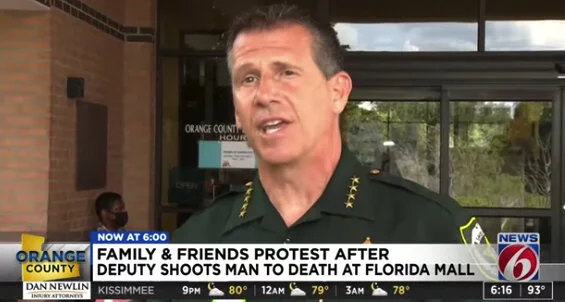
THE VIDEO IS THE PUBLIC’S VIDEO BUT THEY OWN THE PUBLIC From [HERE] About two hours after one of his deputies shot and killed 22-year-old Salaythis Melvin in the Florida Mall’s parking lot Friday, Orange County Sheriff John Mina confirmed that a body-worn camera had recorded the incident and told reporters had he had already reviewed it.

The Sheriff’s Office has since refused to make the footage public, even after it was revealed that Melvin, who deputies say had a hand on a gun in his waistband as he fled, had been shot in the back. The agency won’t show it to Melvin’s parents, either, said their attorney, Bradley Laurent.

“The family doesn’t really know what happened,” Laurent said. “It’s our position the family should have a right to see that footage, to see the last moments of their loved one. The mother has a right to see the last moments of her son.”

Law enforcement leaders, including Mina, have touted body-worn cameras as evidence of their commitment to transparency and a tool for holding officers and members of the public alike accountable. But local agencies differ widely in how quickly they release the footage.

The Sheriff’s Office rejected a public record request for the video from the Orlando Sentinel, citing an active investigation of the shooting by the Florida Department of Law Enforcement. OCSO also declined an interview request for Mina, citing “potential litigation” because an attorney for the Sentinel had emailed an agency lawyer seeking reconsideration of the video’s release.

Experts say OCSO’s rationale for withholding the video — often used by other local agencies, including the Orlando Police Department — is flimsy under Florida’s broad public records law and ill-advised in the current climate of distrust between police agencies and the communities they serve.

“At a time when law enforcement is being scrutinized, the last thing they want to do is hide information,” said Pamela Marsh, president of the First Amendment Foundation. “When you hide information, you lose trust.”

A PETITION TO GET THEIR OWN VIDEO. Meanwhile, a petition demanding the video be made public has already garnered more than 2,000 signatures, and local activists have taken to the streets to echo that message.

Miles Mulrain, founder of the nonprofit Let Your Voice Be Heard and one of the most visible leaders of recent Central Florida protests against brutality, said OCSO’s refusal to release the footage is part of a pattern of painting those injured or killed by police as guilty.

“They put out what they want to send a message ... that this person should deserve this kind of treatment,” Mulrain said.

Shooting questions remain

Though the Sheriff’s Office has released few details, court records indicate Melvin’s death came as deputies were seeking to apprehend another man, 19-year-old Vanshawn M. Sands.

On July 7, Sands had been at a house on Powers Ridge Court when two other men, who authorities say were associated with a rival gang, drove up and started shooting. Sands returned fire, resulting in a shootout that left one of the attackers dead, records say.

Because Sands has a record and admitted to having had the gun with him throughout that day, a detective got a warrant to arrest him on a charge of possession of a firearm by a convicted felon.

According to Mina, when deputies tried to make the arrest Friday outside the Florida Mall Dick’s Sporting Goods, they confronted a group of four people that included Melvin, who took off running.

In an affidavit, Deputy Marcus Bullock wrote that Melvin had his right hand on a handgun that was in his waistband when Agent James Montiel exited an unmarked vehicle. Melvin ran away from the agent, who chased him.

That’s when Melvin “turned his head and started to face [Montiel] while still holding his firearm,” Bullock’s report said, prompting Montiel to think Melvin was going to pull his gun. Montiel shot Melvin, who died the next day at Orlando Regional Medical Center.

In addition to withholding the video, the Sheriff’s Office has declined to answer other questions: Who were the other people with Melvin? Was Montiel in uniform? The agency posted on Twitter a photo of the gun deputies say Melvin was carrying, but wouldn’t say if it was loaded.

Laurent said he and Melvin’s family met with OCSO leaders Monday but emerged with more questions.

“That’s what these body cameras are for; there’s nothing left for people to speculate on, you get to see what happened,” Laurent said. “If he was doing something wrong, we should see it in the video. But they’re not letting us see the video. Why won’t you let us see the video?”

Transparency vs. discretion

Florida’s public records law — considered among the most broad in the country — has specific exemptions for body camera footage filmed under certain circumstances, but none that justify routinely withholding video of police shootings, experts said.

Body camera footage is considered confidential when it’s recorded inside someone’s house; a health care, mental health care or social services facility; or a place that a reasonable person would expect to be private.

There’s also an exemption for criminal investigative information. But that applies only if the case is active, which means the police agency anticipates an arrest or prosecution is forthcoming, said Samuel Morley, general counsel for the Florida Press Association.

“The sheriff will have a good deal of discretion in determining if the investigation is considered ongoing and active,” Morley said in an email. “That said, the sheriff can’t invoke it without any basis.”

In Melvin’s case, the active investigation would be the one being conducted by the FDLE, which the Sheriff’s Office and other local agencies task with reviewing police shootings. The agency forwards its findings to a local prosecuting office, which determines if officers broke any laws.

FDLE spokeswoman Gretl Plessinger said each police agency decides when to release public records related to a shooting by its officers. But sometimes FDLE does ask agencies “not [to] release certain evidence ... until after initial interviews have been conducted.”

“When specific information is released prior to the initial round of interviews, it can change perceptions of witnesses and make it more difficult for agents to determine the facts of what happened,” she said.

Marsh noted other Florida sheriffs release body camera footage immediately after police shootings. Mina, she said, has the discretion to do so.

“[B]ody cameras were adopted in Florida to improve transparency, to improve accountability in interactions between law enforcement and citizens,” she said. “… It was intended to become a public record.”

The Volusia County Sheriff’s Office, which also has FDLE review all shootings by deputies, routinely releases video within a day of them occurring.

“In a police shooting, how is it going to impede investigation when you’re seeing everything that’s there — what you see in the body cam video?” Sheriff Mike Chitwood, who wasn’t available for an interview this week, told News4Jax in June. “Put it out there, even if it’s bad.

Drop Your Phone Now! After a Group of Neuropeons Sic the IN Police on a Black Man for Filming w/His Cell Phone, White Cops Use Their Uncontrollable Power to Detain Him @ Gunpoint and Threaten His Life

neuropeons in IN.jpg

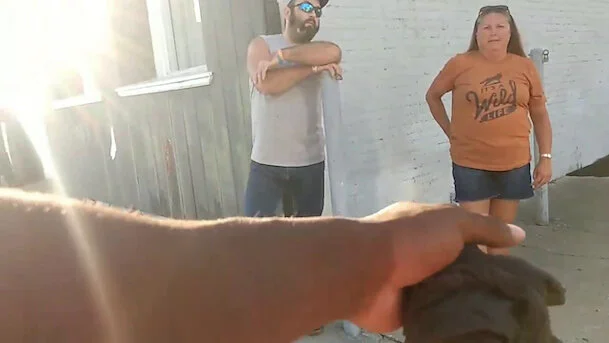
From [FTP] In an exclusive interview with the Free Thought Project, activist and First Amendment auditor, Floyd Wallace told FTP that he went to Clinton County and was walking around filming in public. He had committed no crime but being black and filming apparently set off a resident who called police to report him — for filming.

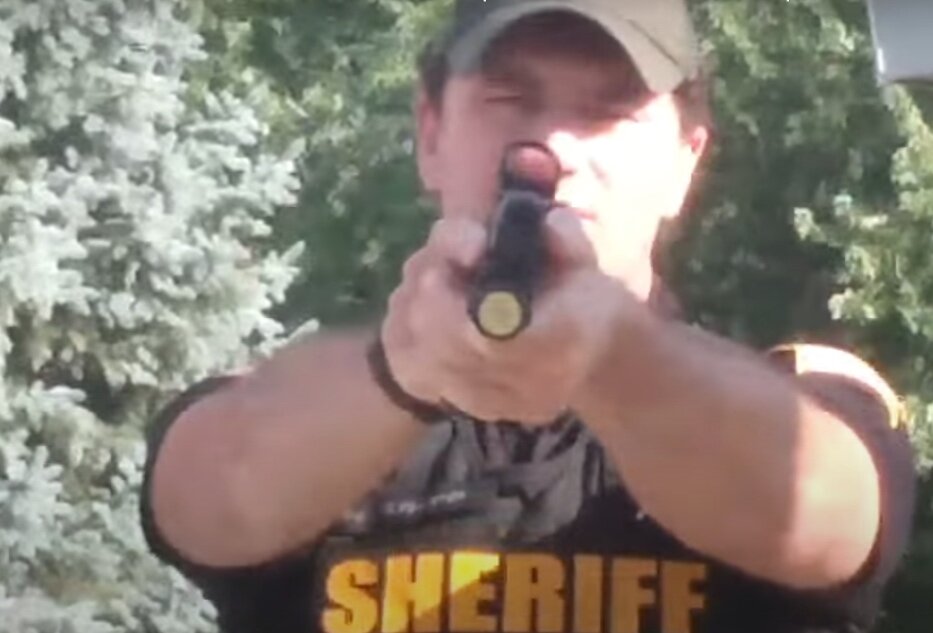
Clinton County Sheriff’s deputy B. Knapp shows up to the call and is apparently afraid of his own shadow. Within a few seconds of arriving to Wallace’s location, he pulls his gun out and points it at the innocent man. His gun would not go back in its holster for nearly five minutes.

“I was just walking around filming in public when they pulled guns on me,” Wallace tells the Free Thought Project.

The cop demanded Wallace “drop his phone” and stop filming but this would have ended the documentation of this incident. The officer could have shot him and simply claimed he feared for his life and that, as they say, would’ve been that.

Showing just how scared these deputies are of a black man filming is the fact that deputy Knapp called for backup and another deputy arrived and pointed an AR-15 at Wallace. He was then handcuffed and interrogated — for filming.

Wallace was then handcuffed and detained as a half dozen other cops show up to investigate a black man filming.

RIGHTS ARE MYTHS. TRUE BELIEVERS SHOULD UNDERSTAND THAT THIS BLACK MAN DID NOT “OWN “ THIS INCOMPETENT RACIST SUSPECT COP. “RIGHTS ARE MYTHS.” IF ANY SUCH “RIGHTS” EXIST THEN THEY ONLY EXIST UPON “THE THOUGHT STANDARD:” IF YOU THINK YOU HAVE RIGHTS AND A GOVERNMENT ORDERLY AGREES, THEN YOU HAVE RIGHTS.' HERE, A COSTUMED ORDERLY MERELY AGREED WITH THE BLACK MAN THAT HE HAD RIGHTS. HE DID SO EXERCISING HIS DISCRETIONARY AUTHORITY. BUT HE DIDN’T HAVE TO DO ANYTHING UNLESS HE WANTED TO. RULERS DON’T SERVE SUBJECTS.

INDIANA DUMB COPS.jpg

After Wallace refused to have his rights trampled, the cops were forced to leave as they had nothing on which to detain him.

At the end of the video, Wallace confronts the people who likely reported him. They yell at him and claim that Wallace was walking on the side of a building looking in windows — a claim he denies and has the video to prove it — yet not illegal at all.

Even if Wallace was attempting to provoke a response by filming in public, his actions were not criminal and therefore his subsequent treatment of being held at gunpoint for five minutes, unsubstantiated.

This is what filming in public looks like in 2020.

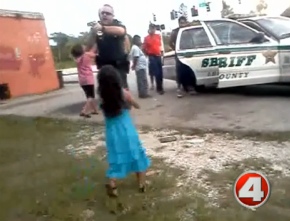
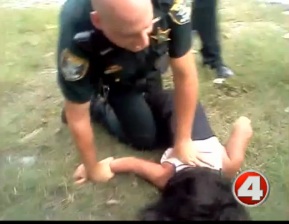
White Cops Just Following Protocol to Serve and Protect Themselves When They Handcuffed a 64lb, 3.5 Ft Tall, 8 yr Old Black Boy During Niggerization Lesson at [Blind Obedience to Authority] FLA School

key west cops at elementary school.jpg

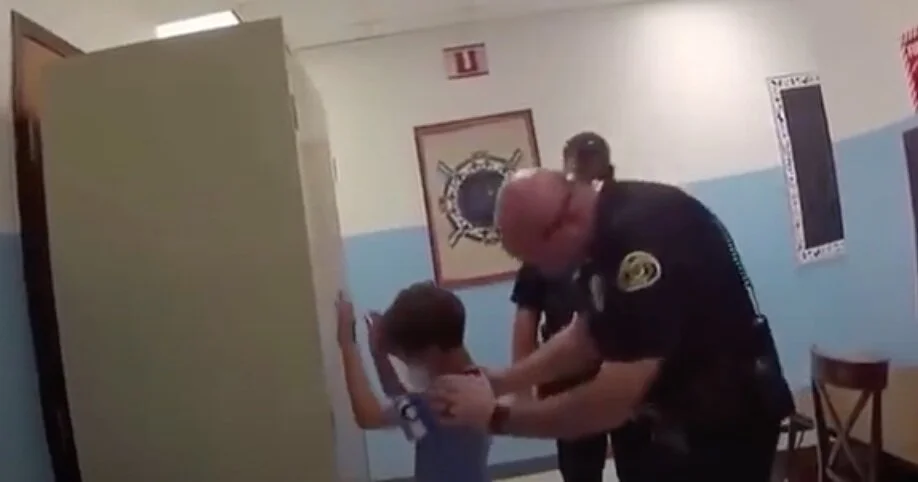
From [HERE] A Florida family is suing after a video surfaced showing the arrest of an 8-year-old Black boy at an elementary school.

Police said the child, whom the family says has special needs, was accused of punching a teacher in a 2018 incident in Key West, Florida. The video began circulating on social media this week.

Body camera video shows the child crying as he was handcuffed.

“He was so small the cuffs fell off his wrists!” civil rights attorney Benjamin Crump said in a tweet. “Unbelievable!!”

Crump, who is representing the boy’s family, provided the video, which shows white Key West police officers trying to arrest the 64-pound, 3.5-foot-tall boy only to realize the handcuffs were too big for him.

According to the police report, the teacher, who is not the boy’s normal teacher, claimed the boy punched her in the chest. The report said the teacher did not sustain any “obvious injuries.” The white media did not mention whether the teacher was also white - what do you think?

The boy was taken to a juvenile detention center and charged with felony battery, a charge that has since been dismissed.

The 8-year-old’s family said the boy takes medication for ADHD, oppositional defiant disorder, depression and anxiety, and he can become sensitive to touch. They said the school was aware of his disabilities.

The family is suing the three officers for excessive force, the school officials for failing to intervene, the city of Key West and the school district for violating the Americans with Disabilities Act.

“Where’s the decency, where’s the humanity. Where is the concern?” asked Crump. “That is somebody’s child. All those adults would never allow that to happen to their child, but for whatever reasons, they said, it’s fine to do it to this little boy.”

The Key West police chief told the Miami Herald that the officers involved did nothing wrong and followed standard operating procedures.

Ct Reinstates Hot Car Case: GA Cop Locked Indian Man in a Van w/o a Fan for 2 Hrs and Ignored His Resulting Unconsciousness, Shaking, Profuse Sweating and Labored Breathing. Denied Water and Med Care

doggy portrait.jpg

From [HERE] An Indian man’s deliberate-indifference claim against a police officer who left him in an unventilated, hot van for two hours should not have been dismissed, the 11th Circuit ruled. The officer found the man unconscious, sweating and hyperventilating in the van, denied his request for water, and left the man in the van while driving him to the sheriff’s office.  The court’s order states:

This case principally presents two constitutional questions arising out of a deputy sheriff’s decision to place a pretrial detainee in an unventilated, un-air-conditioned transport van on a hot autumn day. First, by placing the detainee in the van—for a total of about two hours, half of that time alone and unsupervised— did the officer use unconstitutionally excessive force? And second, by ignoring the detainee’s resulting distress—which included unconsciousness, shaking, profuse sweating, and labored breathing—did the officer exhibit deliberate indifference to a serious medical need? The district court answered both questions in the negative and granted summary judgment for the officer. We will affirm the district court’s decision in part—albeit on different grounds—and reverse in part.

We begin from the premises that exposure to uncomfortable heat is part and parcel of life in the South and, accordingly, that not every “hot car” case will give rise to a cognizable constitutional claim. Even so, viewing the facts of this particular case in the light most favorable to our detainee—as we must, given the procedural posture—we hold that the officer violated the Constitution in both respects. And while we conclude that the law underlying the detainee’s excessive- force claim was insufficiently “clearly established” to defeat the officer’s entitlement to qualified immunity, we hold that the detainee’s deliberate- indifference claim should have been allowed to proceed. We also hold that the district court erred in rejecting the detainee’s adjunct state-law claims on official- immunity grounds.

Plaintiff Nilesh Patel and defendant Deputy James Smith present dramatically different versions of the events underlying this appeal. Of course, when “reviewing a district court’s grant of summary judgment, we view all the evidence and draw all reasonable inferences in the light most favorable to the non- moving party,” Caldwell v. Warden, FCI Talladega, 748 F.3d 1090, 1098 (11th Cir. 2014), and affirm only if the evidence “presents no genuine issue of material fact and compels judgment as a matter of law in favor of the moving party.” Id. (quoting Owusu-Ansah v. Coca-Cola Co., 715 F.3d 1306, 1307 (11th Cir. 2013)). Accordingly, because the district court granted summary judgment for Deputy Smith over Patel’s opposition, we take the facts here in the light most favorable to Patel, and we draw all reasonable inferences in his favor.1

In 2014, Patel pleaded guilty in Georgia state court to gambling- and tax- related offenses and, as a result, was sentenced to five years’ probation and required to forfeit a store that he had owned—Live Oak Liquors. A couple of years later, Patel was arrested on charges that he had stolen or damaged previously forfeited property from Live Oak Liquors. Although the warrant for Patel’s arrest was issued in Lanier County, Georgia, he was held in a jail in the adjacent Cook County because Lanier County’s facilities were too small to house all of its detainees.

On October 4, 2016, Deputy Smith was tasked with transporting Patel from Cook County to Lanier County for a bond hearing in connection with his arrest. Deputy Smith initially placed Patel in a transport van and drove him from the Cook County jail to the Lanier County courthouse, without incident. Patel was granted bond at the hearing, but he couldn’t post it immediately, so Deputy Smith loaded him back into the van and returned him to the Cook County jail—again, without incident. A friend posted Patel’s bond shortly after he arrived back at the Cook County jail, so Deputy Smith put Patel back into the van to return him to Lanier County—this time to the Lanier County Sheriff’s Office—to complete some release-related paperwork.

Along the way, Deputy Smith had to make a stop in Lowndes County to pick up Brittney Grant, another pretrial detainee who was being taken to Lanier County to be released on bond. When Deputy Smith reached the Lowndes County jail, he parked in a sally port—described here as “a metal garage attached to the jail with large steel doors on both ends.” The outside temperature that day was at least 85 degrees Fahrenheit, and although the port provided some shade to the van, the port’s doors were closed, resulting in “very hot” conditions within the port generally and, more to the point, inside the van. Deputy Smith left Patel in the van for almost an hour—without any fan or air conditioning running—while he went inside to retrieve Grant.

When Deputy Smith returned to the van escorting Grant, he “banged on the window” several times, asking if Patel was “okay in there.” Having received no response, Deputy Smith opened the rear doors of the van to find Patel lying unconscious on the floor, sweating and hyperventilating. By performing a “sternum rub,” Deputy Smith was able to rouse Patel, who then told Smith that he had passed out from heat and asked for some water. Deputy Smith told Patel that he would get him “some water on the way back to Lanier County,” assisted Patel back onto the bench in the back of the van, got into the driver’s seat, and headed for Lanier County. It is undisputed that once Deputy Smith cranked the van, a ventilation fan circulated some air in the middle section, where Grant was seated. But Grant testified that the fan didn’t “move very much air at all” and, further, that because of a metal screen separating the middle section of the van from the rear section—where Patel was detained—she didn’t “believe any air could circulate into the back area.” Grant also explained that although she “could hear the air conditioner running in the front section of the van,” because of “a solid plexiglass screen between the driver and the back of the van . . . no cool air made it into the prisoner area of the van.”

During the drive to Lanier County, Patel again fell from the bench to the floor of the van, where he remained—unconscious, hyperventilating, and with mucus and saliva running from his nose and mouth—until Deputy Smith again roused him upon their arrival. Deputy Smith never stopped for water, as he had promised.2 By the time they arrived in Lanier County, Patel had been in the back of the van for more than two hours.

At the Lanier County Sheriff’s Office, Deputy Smith again roused Patel and helped him to his feet, and Patel immediately got a drink from a water fountain. Patel then waited in a holding room where he continued to show signs of distress— he was shaking and sweating profusely, he had mucus running from his nose, he

was still hyperventilating, and he was having noticeable difficulty speaking. Many of the events at the Sheriff’s Office were captured on a security camera.3

When Deputy Smith entered the holding room with the bond paperwork, Patel requested an ambulance. After initially objecting—“[W]hat do you need an ambulance for? You’re being released.”—Deputy Smith complied. When paramedics arrived, they transported Patel to a local hospital, where he was diagnosed with heat exhaustion, heat syncope, and panic attack. [MORE]

TX Appeals Ct Upholds the 15 Yr Jail Sentence of Liar White Cop who Murdered Jordan Edwards by Firing His Gun into a Car Packed w/Black Teens Even Though They Posed No Threat to Cops

roy-oliver 2.jpg

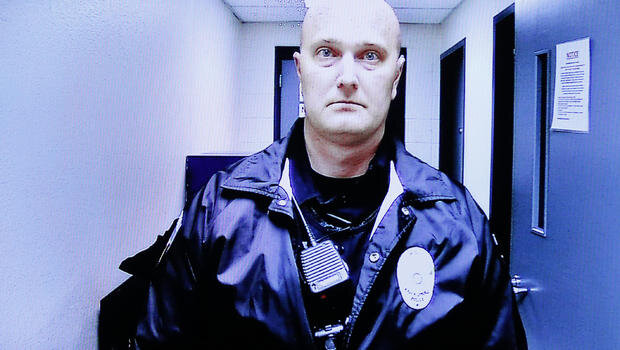
White Dallas police officer Roy Oliver — who fired his rifle five times into a car and killed unarmed, Black 15-year-old Jordan Edwards — was properly convicted of murder, an appeals court in Texas ruled. Oliver, convicted in 2017, was sentenced to 15 years’ confinement. 

Dallas County District Attorney Faith Johnson described Oliver as a "killer in blue" who violated his oath to protect citizens. Prosecutors sought a sentence of at least 60 years while the defense argued for 20 years or less. The court recited the facts as follows:

“Appellant, then a patrol officer in the Balch Springs Police Department, received a call at approximately eleven o’clock p.m. on April 29, 2017, informing him of intoxicated teenagers at a loud party at a residence on Baron Drive in Balch Springs. Officer Tyler Gross, who patrolled the district adjoining appellant’s, was also dispatched to the Baron Drive address; the officers arrived in separate cars at the same time and parked in the street in front of the residence. Parked cars lined the street, and the officers soon learned that more than 100 young people were attending the party. Contrary to the report they had received, they saw no drinking or drug activity on the premises; the teenagers were visiting, listening to music, and dancing. Nevertheless, when they heard the sirens of approaching police cars, many of the young people fled the house and yard and ran to their cars. When the officers had been in the house a short time, they heard a number of gunshots in rapid succession. Appellant testified that the shots sounded like a semiautomatic weapon.

Among the teenagers attending the party were three brothers—Vidal Allen, Jordan Edwards, and Kevon Edwards—and two of the brothers’ friends, Maximus and Maxwell Everette. Allen drove the five to the party in his father’s black Chevrolet Impala. The teens met back at the car after they heard the police arrive;

Allen had parked on the side of Baron Drive. As the five were gathered around the car, they heard the same gunshots the officers heard, jumped into the Impala, and attempted to leave.

After hearing the gunshots, the officers immediately left the house. Officer Gross turned east and headed in the direction from which the sound had come. Appellant ran to his patrol car, retrieved his rifle, and followed Gross. As they moved eastward on Baron Drive, amid running and screaming young people, the officers headed toward the intersection with Shepherd Lane. On the opposite side of Shepherd was a nursing home; evidence would later establish that men unconnected with the party had fired the gunshots in the nursing home’s parking lot and then driven away. The parked police cars had blocked Baron Road headed west, so the young people leaving the party had to proceed east on Baron. Appellant heard Gross tell one of those cars to stop, and he saw the driver comply. Then he heard Gross tell a second car that was slowly backing down Baron Drive to stop, but that car continued moving slowly toward Shepherd Lane. Appellant heard Gross again call out for the car to stop, this time more loudly, and heard him radio the license plate of the car to their dispatcher; the car did not stop.

Vidal Allen was driving the second car, backing down Baron Drive, and—he testified—thinking only of getting his brothers and friends home. He testified he did not know a police officer was telling him to stop. As he reached the intersection, he stopped briefly, and then proceeded forward, driving south on Shepherd. He was blinded by a flashlight on the side of the road and maneuvered the car into the northbound lane to avoid whoever was holding it.

Officer Gross was holding the flashlight that was attached to his pistol, pointing it at the Impala. As the car passed Gross, he stepped toward it and hit the rear window with that pistol. When appellant saw the Impala stop and then accelerate forward, he shot five times into the passenger side of the car to try and stop it. As the car drove on, appellant asked Gross if he was alright and said, “He was trying to hit you.”

Jordan Edwards was sitting in the front passenger seat in the Impala. One of appellant’s shots hit him in the head. The wound was immediately fatal.

Appellant was indicted and charged with murder. A jury found him guilty and assessed his punishment at fifteen years’ confinement and a fine of $10,000.“ [MORE]

Complaint says ICE Cops Arrested Non-White Men in Bend (OR) as They Got Off Work and Packed Them Into Buses for Hours. Cops Denied Access to Volunteer Attys and Seeks to Transport Them Out of State

From [HERE] U.S. Immigration and Customs Enforcement Field Director David Drasin refused an immigration attorney’s demand to meet with men seized from the streets of Bend, Oregon, and held on a bus for hours as protesters tried to block the bus from moving, according to a new lawsuit.

Federal agents in unmarked white vans rounded up two men on Wednesday and held them in a Bend parking lot. But before the vans could depart, a crowd of hundreds gathered to demand the men’s release. Hours of protest followed.

The families of the men watched as their fathers and husbands were held in vans with closed windows in 80-degree weather. They released a statement, which was read by Janet Llerandi-Gonzalez of Mecca Bend, according to plaintiff Innovation Law Lab.

“Consider the emotional trauma being inflicted not only on us as adults, but also on our children who witness this injustice,” Llerandi-Gonzalez read. “We are hard-working members of the community that have lost our jobs due to Covid, and our husbands are put at risk daily. We are simply trying to provide for our families, but because of the color of our skin and because of our country of origin that does not justify what has happened here today.” 

Bend City Councilor Barb Campbell blocked the unmarked vans with her parked car.

“I am here because people are being picked off the streets and detained for the crime of wanting to work hard,” Campbell told reporters, according to a statement from Innovation Law Lab. “These are good people who have immigrated to our country. We are right now trying to empty our jails and our prisons because they could be hotspots for Covid-19. The idea of my taxpayer money going toward harassing these individuals is intolerable.”

Volunteer immigration attorney Erin Carter arrived and tried to speak to the two men through the closed windows of the vans.

“Tell them I want a lawyer,” one man, identified in the lawsuit as J.A.C.S., told Carter.

Another immigration attorney standing nearby, Micaela Guthrie, told an ICE officer there that she wanted to speak with the two men. But the officer wouldn’t respond to Guthrie’s request.

Steven Manning, executive director of Innovation Law Lab, a pro bono immigration firm, called Drasin. Manning asked to speak to the two men before they were transferred out of Oregon. But Drasin denied the request and told Manning that ICE would move the men to the Northwest Detention Center in Tacoma, Washington, without first letting them speak to attorneys, according to the lawsuit filed late Wednesday night in federal court. There, they will be “functionally denied any meaningful opportunity” to consult attorneys, according to the complaint. It states,

“The government’s denial of attorney access to clients and prospective clients in the Central Oregon raid will causes serious irreparable harm to the detained individuals. Unlike in criminal proceedings, individuals in immigration proceedings are not generally entitled to appointed counsel if they cannot afford one. See generally CJLG v. Sessions, 880 F.3d 1122, 1128 (9th Cir. 2018). Because attorneys are not automatically provided by the government, immigration detainees seeking representation must contact a private attorney to retain them or rely on a patchwork of legal service providers who provide “know your rights” trainings and, in some cases, pro bono representation.

By denying attorney access, the federal government has effectively prevented detainees from obtaining any legal assistance from Plaintiff Law Lab’s attorneys, who have already agreed to represent them in their immigration proceedings.”

Innovation Law Lab wants U.S. District Judge Karin J. Immergut, to whom the case has been assigned, to prevent the men from being transferred out of Oregon for at least 48 hours and allow the firm’s attorneys to consult with the men before their immigration cases move forward.

Deschutes County District Attorney John Hummel weighed in about the incident and ensuing protest via Twitter late on Wednesday night.

“I’ve never been so disgusted by my government, and so proud of my community,” Hummel wrote.

The lawsuit was filed by Stephen Manning, Nadia Dahab and Jordan Cunnings with the Innovation Law Lab in Portland.

The PA Judicial Conduct Bd [committed to excellence] Only Seeks Suspension of a Judge who Called a Juror 'Aunt Jemima,' Ridiculed Litigants "Speaking Ebonics" and Referred to Inmates as "Sodomites"

From [HERE] The Pennsylvania Judicial Conduct Board is seeking the interim suspension of an Allegheny County judge who allegedly referred to a juror as “Aunt Jemima.”

The board sought the interim suspension of Judge Mark Tranquilli in an Aug. 12 petition—the same day that it filed ethics charges against the judge. A press release is here.

The ethics charges refer to the alleged Aunt Jemima comment, along with other alleged inappropriate comments and insulting remarks.

According to the charges, Tranquilli allegedly:

• Criticized a prosecutor in chambers over selection of jurors who acquitted a defendant on a drug dealing charge. Referring to a Black juror who wore a kerchief, Tranquilli allegedly asked the prosecutor why he put “Aunt Jemima” on the jury. Tranquilli said the juror’s demeanor showed a negative attitude toward the prosecution case. He allegedly told the prosecutor, he “knew darn well” that when the juror “goes home to her baby daddy, he’s probably slinging heroin, too.”

• During a custody conciliation, said he didn’t care about the couple’s children, his only concern was his own children, and he would “split [the couple’s] baby in half like Solomon and sleep like a baby that night.” He discussed the issue of communication between the parties, affecting an accent and dialect he described as Ebonics. “When I say communication, I don’t mean ‘and den da bitch done dis, and den da bitch done dat,’ ” he allegedly said.

• During a criminal sentencing hearing, allegedly said, “Are you familiar with the phrase, if you lay down with dogs, you wake up with fleas? … So now you have laid down twice with dogs, but you have woken up with two lovely children, probably two lovely children I’m betting you were probably not planning on. And for the cost of three shiny quarters in any bathroom in any rest stop in Pennsylvania, you probably could have gone a different direction.”

• In the same sentencing hearing, allegedly commented on probation, saying, “I was a [prosecutor] for 20 years, and for the last 13 years, all I did was dead body cases, dead body, dead body, dead body. For the last eight years, I ran the homicide unit. If I had a nickel for every picture of a dead person I looked at on my desk while I was eating a turkey sandwich, I could retire right now and be a rich man. As a result of these experiences, there is no milk of human kindness left in these veins. It is just too much death. So what that means for you is, the take away is this: If I ever see you again in my courtroom for a probation violation, the story ends with you in a red jumpsuit.”

• In another sentencing hearing, told the defendant, “So if you don’t show up in 30 days, you have violated my probation, and I’m going to cast you down against the Sodomites, all right, in state prison.”

The commission says Tranquilli failed to promote public confidence in the judiciary; manifested bias or prejudice in the performance of his duties; and failed to conduct himself in a patient, dignified and courteous manner.

Tranquilli was reassigned to administrative duties earlier this year after the prosecutor complained about Tranquilli’s in-chambers conversation.

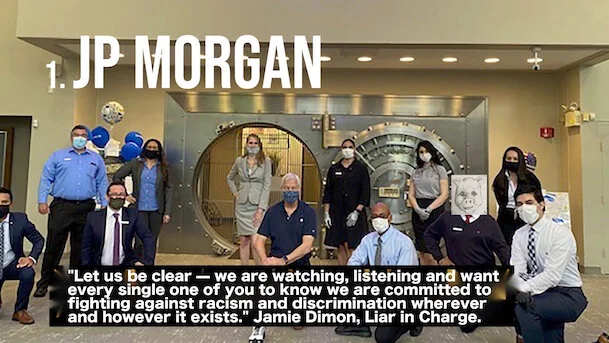
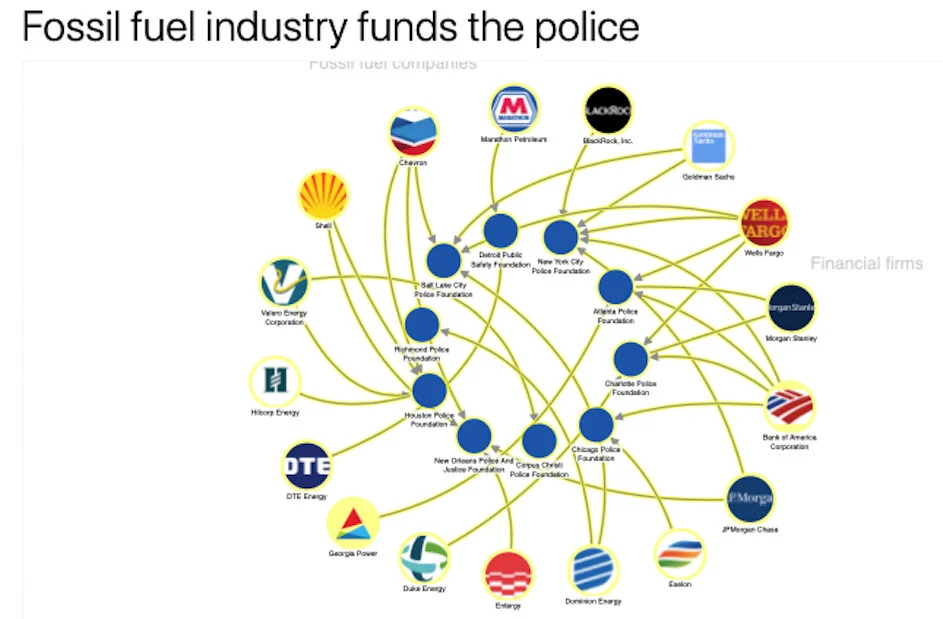
Boycott Those Who Fund the Police: “Woke" Corporations like JP Morgan, Wells Fargo and Chevron Bankroll Police Foundations, which Raise $ to Harm Non-White People and Put Them in Greater Confinement

jp Morgan liars .jpg

Mint Press reports “JPMorgan Chase CEO Jaime Dimon very publicly took a knee outside a New York branch of his bank in early June, also circulating a memo declaring the financial institution’s supposed dedication to struggling against injustice. “Let us be clear — we are watching, listening and want every single one of you to know we are committed to fighting against racism and discrimination wherever and however it exists,” he and the company’s diversity chief wrote together.

In the wake of worldwide public outrage over racist police violence, many of the United States’ largest corporations rushed to publicly align themselves with the growing movement for black lives. Yet a new report from the Public Accountability Initiative exposes how corporate America is actually bankrolling police departments across the country, including many of the same ones facing scrutiny over racist practices.”

The report states, “The same companies that drive environmental racism in Black and Brown communities through toxic and climate-changing pollution also fund police power in cities that stretch from Houston and Detroit to New Orleans and Salt Lake City.

Oil and gas companies, private utilities, and financial institutions that bankroll fossil fuels are all big backers of police foundations, which privately raise money to buy weapons, equipment, and surveillance technology for police departments, bypassing already outsized public police budgets. These corporate actors – from Chevron and Shell to Wells Fargo and JPMorgan Chase – can be found serving as directors and funders of police foundations nationwide. Furthermore, these companies sponsor events and galas that celebrate the police and remind the public that police power is backed up by corporate power.

Fossil fuel companies, utilities, and the banks that fund them are prominent political players in any local or regional power structure. These companies, which rely on extraction and exploitation to secure their profits, have an incentive to form tight bonds with police forces, which function to uphold and protect their interests in the face of community opposition. In many states, these companies go so far as to back laws to criminalize protests of dirty energy projects such as pipelines, openly weaponizing the police and criminal justice system to protect the profits of the fossil fuel industry and the banks that fund them.

This symbiotic relationship between the fossil fuel industry and police often means that the companies that are polluting Black and Brown communities – like Marathon Petroleum in Detroit, Valero in Corpus Christi, or Shell in Louisiana –  are the same ones that are aligned with and propping up police forces in these same cities. This is why divesting from fossil fuels and fighting to end environmental racism goes hand in hand with defunding the police in the fight for racial justice and reinvestment in Black and Brown communities.

  • Chevron, one of the top integrated oil and gas companies in the world, with a market capitalization value that ranked only behind ExxonMobil at the end of 2019. The fifth biggest US refiner, Chevron is a top polluter that owns two of the top six benzene-emitting refineries in the US. Chevron’s refineries are the targets of numerous environmental justice fights. For example, in Richmond, California, community residents have fought for years against the power, pollution, and environmental racism of Chevron, which owns a major refinery in the city made up of 80% people of color.


    Chevron is a “Corporate Partner of the Police” sponsor of the New Orleans Police & Justice Foundation, as well as a board member of the Houston Police Foundation and sponsor of the Houston Police Department’s mounted patrol. It is also donor to and, as of the end of 2018, a board member of the Salt Lake City Police Foundation.

  • Shell, one of the biggest fossil fuel companies in the world and a major global emitter of carbon pollution. It is building a huge ethane cracker plant near Pittsburgh, Pennsylvania that some feel could start to turn Appalachia into the next “Cancer Alley” – the nickname for the New Orleans-to-Baton Rouge corridor of Louisiana refineries, where Shell is also a major polluter. Cancer Alley runs through several Black communities that face extremely high rates of pollution and cancer – largely believed to be caused by refining and petrochemical operations.

    Shell is a “Featured Partner” of the New Orleans Police & Justice Foundation and a sponsor of the Houston Police Department’s Mounted Patrol.

  • Exelon is a publicly-traded energy company headquartered in Chicago and the largest utility in the country with eight subsidiaries. Exelon is a major political player and a prolific donor to police foundations where it and its subsidiaries operate, giving to foundations in Baltimore, Philadelphia, Chicago, and Washington D.C. For example, in Baltimore County, BGE, a subsidiary of Exelon, has a seaton the police foundation board and is a gold level sponsor.

  • Exelon is a publicly-traded energy company headquartered in Chicago and the largest utility in the country with eight subsidiaries. Exelon is a major political player and a prolific donor to police foundations where it and its subsidiaries operate, giving to foundations in Baltimore, Philadelphia, Chicago, and Washington D.C. For example, in Baltimore County, BGE, a subsidiary of Exelon, has a seaton the police foundation board and is a gold level sponsor.

  • Bank of America is the fourth biggest global financier of fossil fuels, with nearly $157 billion between 2016 and 2019 channeled toward oil, gas, and coal. Along with being a lender to some of the most controversial US pipeline projects, Bank of America also played a key advising role in Occidental’s acquisition of Anadarko Petroleum last year, the biggest oil merger in years. Bank of America also had the biggest increase in financing fossil fuels from 2018 to 2019 – $13.1 billion – of any bank globally, according to the 2020 Banking on Climate Change report.

    Bank of America is a sponsor of the Philadelphia Police Foundation and has seats on the ChicagoNYC, and Charlotte-Mecklenburg police foundation boards. Its charitable arm has given $200,000 to the NYC Police Foundation, $51,250 to the Atlanta Police Foundation, $25,000 to the Boston Police Foundation, $10,000 to the Los Angeles Police Foundation, and smaller donations to police foundations in Sarasota, Duluth, Sacramento, and elsewhere. Bank of America’s ties to racist practices go beyond its donations to policing – just last year it agreed to pay a $4.2 million “in back wages and interest to resolve alleged hiring discrimination violations found at several of the bank’s facilities,” according to the US Department of Labor.

  • BlackRock is the world’s largest asset manager and remains one of the biggest global investors in oil, gas, and coal. According to a 2019 Guardian report, BlackRock has $87.3 billion invested in fossil fuel companies through its listed portfolio funds. The Guardian report also notes that BlackRock has “routinely opposed motions at fossil fuel companies that would have forced directors to take more action on climate change, the analysis reveals.” And even as BlackRock has gestured towards more climate accountability with companies BlackRock invests in, some have criticized the limited extent of these measures and the firm’s overall credibility on climate issues.

    BlackRock’s Larry Fink is a big supporter of the one of the most powerful police foundations in the US, the NYC Police Foundation. Not only is Fink a donor to the foundation, but he has also co-chaired its annual gala from 2016 to 2019. Color of Change, which calls itself “the nation’s largest online racial justice organization,” is currently demanding that Fink and BlackRock stop supporting the foundation. [MORE]

    After George Floyd’s murder Fink stated “The past few weeks have been deeply painful for the black community. I am appalled – as is anyone who cares about diversity, fairness and justice – by the events of the last few weeks involving racial injustice in the U.S. The murders of Ahmaud Arbery and George Floyd, and the incident in Central Park, show how much work we have to do to build a stronger, more equal, and safer society.

    Many of us are struggling with these events. For our employees suffering pain from these tragedies, I want you to know that that the firm’s leadership stands with you, and we are listening. We will do everything we can to support you and give you the space to express your feelings and concerns.” [MORE]

  • Wells Fargo is the second biggest global banker behind fossil fuels, with nearly $198 billion in financing between 2016 and 2019. The scandal-ridden bank has a slew of ties to police foundations. It is a platinum sponsor and has two board seats with the Charlotte-Mecklenburg Police Foundation. It is also a partner and donor to the Seattle Police Foundation, a director and sponsor of the Atlanta Police Foundation, and a donor to the Salt Lake City Police Foundation. Moreover, when it comes to financial ties to racist practices and institutions, Wells Fargo coziness with the police is just one example: the bank has been involved in discriminatory lending, propping up private prisons, and much more (for more information, check out the ACRE’s Forego Wells campaign).

  • After George Floyd was murdered the Wells Fargo CEO stated: “As a white man, as much as I can try to understand what others are feeling, I know that I cannot really appreciate and understand what people of color experience and the impacts of discriminatory behavior others must live with.” [MORE]

Since George Floyd's Murder Black People Have Purchased More Guns than Any Other Group b/c Any Service Provided by Cops is Random or Incidental and There is No Other Protection Against Govt Violence

keep the piece.jpg

GETTING AND KEEPING THE PIECE. From [HERE] The spread of COVID-19, or the novel coronavirus pandemic, has changed the way normal life functions in America. Compounded by the national protests over racial injustice and police brutality, many Black Americans have been advocating for the purchase of firearms for protection amid the current political climate.

Overall, gun sales have been surging across the United States. According to The Brookings Institution, nearly 3 million firearms had been purchased since March when the public health crisis caused the shut down of major cities across the U.S. The research also shows that since March 13, when Trump first declared the viral outbreak a national emergency, firearm sales increased significantly over the next two weeks climbing as high as 176,000 orders on March 16 alone. In the month of March, there were an additional 700,000 firearms bought more than usual. The data showed that the number increased again with a 50% increase for June sales around the time the protests over police brutality began to take over the nation.

The protests over the death of George Floyd and others at the hands of law enforcement have sparked a surge in gun sales among Black Americans who have seen the highest increase since the beginning of the year.

“The highest overall firearm sales increase comes from Black men and women, who show a 58.2% increase in purchases during the first six months of 2020 versus the same period last year,” wrote Jim CurcurutoNational Shooting Sports Foundation (NSSF) director of Research and Market Development, in his report according to AOL News. “Bottom line is that there has never been a sustained surge in firearm sales quite like what we are in the midst of.”

Groups like the Black Gun Owners Association have been said to experience a tremendous spike in interest and online traffic since the protests started. “Whether it was fear of a food shortage, lack of a grocery store, the short response times for law enforcement or whether people were just fearful they were going to be attacked, I don’t know,” said Derrick Morgan, national commander of the Black Gun Owners Association, to Politico.

“A lot of people are reaching out to us, mainly new gun owners and people who wouldn’t have considered owning a gun or firearm for their protection, have been lining up to purchase firearms and access information from our website.”

psycho cop.jpg

FUNKTIONARY explains:

Sovereign Force - an abstract body of legal lawlessness unto itself administered by territorial gangsters.

2nd Amendment - 9th circuit judge Alex Kozinski summed up the importance of the right to keep and bear arms: "the prospect of tyranny may not grab the headlines the way vivid stories of gun crime routinely do. But few saw the third reich coming until it was too late. The second amendment is a doomsday provision, one designed for those exceptionally rare circumstances where all other rights have failed—where the government refuses to stand for reelection and silences those who protest; where courts have lost the courage to oppose, or can find no one to enforce their decrees. However improbable these contingencies may seem today, facing them unprepared is a mistake a free people get to make only once." The right to keep and bears arms actually serves as more than an insurance policy, it also serves as a deterrent. For when would-be tyrants know that the citizenry is well-armed, they think twice about imposing tyranny. (see: gun control & militia)

gun ban - the precursor to servitude. [MORE]

gun control - using both hands. [MORE]

slaves - disarmed men and women. [MORE]

gun safety - “to be able to shoot back if someone is shooting at you.” [MORE]

What is The Black Flask Brigade [BFG] and Should CrimethInc be Concerned?

black flask brigade BFG .jpg

According to FUNKTIONARY

Black Flask Brigade - a highly organized motley collective of African-American ex-military special forces and intelligence officers turned cognitive dissidents and street theatre political activists, who disguise themselves dressed as hobos wired with sophisticated listening and recording devices used to capture the schemes and plans of the rogue elements in (and behind) "government" and the divide and conquer strategies of Crimethlnc., when and where they least expect it. The BFG foments unsanctioned forms of emancipatory discourse in the penalized and colonized minds of the slumbering masses. Two of the original founders of the BFG were from the 666th Quartermasters. The members of the collective know and identify each other by the black leather flask they each carry and use. Wherever you see four empty liquor bottles in close proximity to a brother working on a fifth, he is a shadow member of the Black Flask Brigade. The current commander of the BFB is a 'Saqi-ul-Irshad' (unassuming Perfect Master). Only one little glass from his special cask can awaken the deluded and sanitize the polluted mind out of the passing-show of illusion (objective reality or duality as impermanence). Different states of consciousness give rise to different levels of consciousness. All spheres and planes are within you; the limited and the Limitless lie within you, and in actual fact are you. The Saqi-ul-Irshad is Knowingness Itself. The Black Flask Brigade was responsible for starting "Negro de Mayo"---or Black May Day. Black May Day is a non-unionized All-Hands (where my eyes can see) distress call-to-arms (carry concealed) in the form of (and disguised as) a freedom celebration---part St. Patrick's Day, part Juneteenth, part Cinco de Mayo, part Memorial Day, part Black Mystery Month, and part Mardi Gras. "Rabbit the Wino" is one of the shadow members of the Second Coming of the BFB. Rabbit saved Amiri Baraka's (LeRoi Jones) life. The BFG is a disassociated freedom-loving covert Black Concern serving as a Listening Post, intelligence dissemination operations and urban Mike Force that yankee whites and other authorities are still very concerned about. While others are busy supersizing orders, the BFG (like in their former days as the MFG--mobile force guerrilla) is quietly ordering everybody to Legal-ize Everything! Now just imagine that. (See: The Collective, Almo St. Empty, Liberation, Black, OM, Steganography, Genius Cartel, Gerps, STASH & Negrodamus)

Black Forest- an open source intelligence gathering system that collects information from the public Intemet, including social media, hacker forums and other sites where malware authors gather. The creators of Black Forest aim to provide cybersecurity teams advance warning of pending attacks. Black Forest was developed by Georgia Tech Research Institute, and disavows any affiliation with the Black Flask Brigade--a team of ex-MIALO's (Black ex-military intelligence and logistics operatives).

Powerless Blacks Feel Vicariously Empowered by Biden's Token Selection of a Symbolically Black VP as Human Resource Pageant btw a Caucasianal Orderly (Rice) and a Puppetician Rolebot (Harris) Ends

MSNBC moronic.jpg

FUNKTIONARY explains,  

Electoral politics - a polylogue of agreed-upon illusions and false (deflectionary) issues. (See: Politicking & Pathocracy)

To be clear, the Democrat and republican parties both function as plantations run by racist elites. That is, powerful, vested interests who have different strategies for maintaining the master-servant relationship between whites and Blacks. Endependent persons understand that in a worldwide system of government control, all prisons or plantations are not equal and it is a denial of reality to theoretically pretend they are interchangeable. Between the two “choices” presented to Black voters the democratic party offers more polite masters and a plantation with less restrictions as opposed to the GOP’s mean cracker masters who offer an overt genocidal menu of violence and hate on their punishing plantation.

If a Black individual is coerced into participating in this illusion there is obviously no choice but to make the best of a bad situation by voting for the candidate who is not an overt racist psychopath/neuropean corpse. Thus, a Black vote is an effort to avoid being on the crazy master’s plantation. As explained by A. John Simmons, “you thereby express a preference, approve of that candidate (over the others), but consent to the authority of no one.” A Black voter might “choose” to do so “if you like freedom of movement with your slavery.” Recognizing such realities and voting only when necessary to prevent the election of repressive Yurugu state managers, one is not under any illusion that he/she is participating in a democracy where none exists.

Unfortunately, the Black votary believes in the illusion of electoral politics and worse still, Black voters rarely demand anything in exchange for their votes- such as better living conditions on the plantation. Claud Anderson explains, “Both White and Black candidates for public office, various political parties, and this nation, all get a free ride with Black voters.”

SNAG [SNITCH ASS NEGRO AIDING GOVERNMENT] SUSAN KING IS AN OUT OF WORK Caucasianal Orderly. Above in support of racism white supremacy she comes to the aid of fellow Moteasuh Tribe member and Showcase Black Gayle King. SNOOP WAS CORRECT, FUCK GAYLE …

SNAG [SNITCH ASS NEGRO AIDING GOVERNMENT] SUSAN KING IS AN OUT OF WORK Caucasianal Orderly. Above in support of racism white supremacy she comes to the aid of fellow Moteasuh Tribe member and Showcase Black Gayle King. SNOOP WAS CORRECT, FUCK GAYLE KING.

Once racist suspect Joe Biden announced that he would only select a female for his VP running mate, the main criteria sought by the vocal Black votary and applied by Biden was a Blackface. The Blacks that were under consideration by Biden were “Black” only in skin color- as Karen Bass, Val Demings, Susan Rice and Kamala Harris basically function as assimilated “honorary whites” - none are known for Black advocacy. Here, “Blackness” to the Black votary means they are not Republican. In general, so long as the Black official is not Republican ‘the dependent media and its black media imitators and black parrot TV pundits lionize Black incumbents without critical examination of their records and support Black candidates for political office essentially on the basis of such non-Republicanness .’ For all non-cosmetic purposes there is little difference between said Black women and the white women that were under consideration. In fact Elizabeth Warren, who is hardly pro-Black, arguably may have done more for Black people than Rice and Harris combined. Said Black probots have no affiliation or connection with anything Black people oriented that could even be superficially described as “Black politics” and none have ever pushed “a Black agenda.” It is ironic that Black democrats ridicule Black conservative token puppeticians such as Michael Steele and Tim Scott when they are similarly used as potted plants on the GOP stage. The dependent media and their black counterparts have solely determined Rice and Harris’ visibility and esteem in the Black community - these rolebots are basically the creations of elite whites. Wilson observes, that while taking its cues from the dependent media ‘the Black press and safe negro TV incumbents make little or no demands on Black politicians while it constantly parades them before the Black community as role models, regardless of their success or lack of it in advancing the interests of the community. The achieve­ments of Black politicians, no matter how dubious, are often pre­sented by the Black press as vicarious achievements of the Black community as a whole. Black incumbents are given ready access to Black media outlets to massage the Black community, to maintain their public persona, and to rationalize their very frequent failures to provide the Black community with responsive and effective political leadership. Thus, they keep their opposition out of the media limelight and the community is cajoled into re-electing a political establishment whose accomplishments are meager when not plainly regressive.” The only thing Kamala Harris can do for Black people is make them superficially feel better about their servant condition. As explained by Dr. Amos Wilson, “To be oppressed is to make how one feels or expects to feel the measure of all things. To be oppressed is to be ruled through one’s feelings and emotions.”

Claud Anderson explains, “Black voters are led to believe there are two purposes to vote: 1) to elect the White candidate who is best able to lead and control resources or 2) to elect the Black candidate who is most deserving of a public job and personal recognition. The most we get is personal satisfaction that the candidate we supported won. We play politics just to play. Others play for the benefits of winning or being in the winner's circle. We often support campaign issues that do not benefit us. Blackness is excluded, but we hope that through some miraculous twinge of conscience, once in office the former candidate will offer us some spoils as supporters. We demand nothing and that is basically exactly what we get. We have yet to learn to play politics by the basic rules. We should stay out of any political game that promises that we will get nothing even when our candidate wins.“ Undeceiver Steve Cokely called this nonsense “playing for your sandwich.”

Turn on MSNBC or CNN and watch the babble in The Spectacle, negro pundits [persons who probably get dressed up for Zoom church] act like Black people won something when Biden selected Harris. In reality Black people and their welfare are not the end of the electoral process but merely the means for winning. As explained by Wilson, “For both parties electioneering is more of a social device for selling to the public, for shaping its opinion than for standing to account for past behavior and receiving instructions from the public regarding governance and policy decisions." [MORE] To much of the Black votary, whether Kamala Harris will ever deliver any tangible, material benefits or actually economically empower Black people or women or provide substantive justice to the Black community is beside the point.

HIDING FAVORABLE EVIDENCE FROM BLACK & BROWN DEFENDANTS AND KEEPING THE WRONGFULLY CONVICTED LOCKED UP WAS HER THING.

Neely Fuller correctly states in the system of racism white supremacy Black people are subject to the direct and indirect power of elite racists in all areas of activity including Economics, Education, Entertainment, Labor, Law, Politics, religion, Sex and War. Therefore, elite racists are the direct or indirect masters of Black people. Elite racists are responsible for everything that happens or does not happen in regards to Black people.’ Fuller describes Black people as “the powerless class” because it accurately describes their power relationship between Blacks and whites. He explains, "in a socio-material system dominated by White Supremacists, all major decisions involving non-white people are made by White Supremacists. The White Supremacists are their bosses, their masters, and their major decision-makers. Whatever a Black person gets, and/or is allowed to keep, is the result of decisions made by White Supremacists. This is the functional meaning of White Supremacy (Racism) that many people — particularly non-white people — prefer not to acknowledge. [MORE]

The rebel Dr. Amos Wilson Amos Wilson asks Blacks,

‘Who has control of your food? Who has control of your electricity? Who has control of your water? Of your jobs? Who tells you what to wear when you go to work? Who tells you when to come to work...when to leave...when to go to lunch...how to speak...how to write...how to do this...how to do that...and how are these things taught, and how they are conditioned?"-- It is by reward and punishment. " You do this you get paid; you don't do this you don't get paid; you get a raise, you get docked. What do we have here?’

To live under the power of another people is to be created by that people. To be rewarded or punished by that people is to be created by that people. We are living under them as the result of the exercise of the power of another people over us. Therefore, if we wish to change this situation (i.e., the conditions under which we live), then we must change the power relationships. If we are to prevent ourselves from being created by another people and are to engage in the act of self creation, then we must change the power relations.’

Wilson also explained that the so-called Black bourgeoisie has no independent power on its own. Rather it maintains it status through its direct political and corporate ties to the Democratic party establishment. The “Niggerati” or Jack & Jill Blacks from the Moteasuh Tribe would rather in engage in fantasy discussions about reparations and symbolic politics such as the removal of statutes than deal with the nuts and bolts work of economic development, the creation of sustainable independent communities and institutions and providing an education to Black children that teaches them how to solve their communities problems and defend their group interests, not mere training to serve elite whites, dominate their own people and enhance the system of authority.

Somnambulistic advocates forget that Blacks have been voting for a long time. Black elected officials at the highest levels and appointments to various government positions along with individual accomplishments in corporations have not translated into power for Black people. Black people should witness that Minnesota, Atlanta, St. Louis, Cleveland, Baltimore or NYC or many other places where white cops murder Blacks in broad daylight are all already dominated by liberal Democrats duly elected by the black votary. Said “black voting power” did not produce justice and does not prevent injustice from occurring to Black people.

jewish+resistance.jpg

Wilson explained 'our salvation requires that we perceive White supremacy as the major social, political, economic, and spiritual problem to be resolved by Afrikan peoples.’ The ‘make the most of a bad situation’ voting approach will never neutralize or destroy the system of racism white supremacy. Said current strategy by the Black votary can best be described as a temporary fix and just another “alleviation attempt,” not dissimilar to the various failed activities engaged in by Jews in Nazi Germany designed to avert danger, or, in the event that force has already been used, to diminish its effects

Wilson states, “The Black media establishment's gung-ho, indiscriminate support of Black politicians and the White male elite-dominated American political system is most clearly exposed during elections when it beats the drums to get Black voters to the polls to elect Black officials. This establishment strives strenuously to convince the Black electorate that every conceivable problem which confronts it can be resolved through voting heavily for Black and friendly White politicians. The Black media is ever quick to remind the Black electorate of the historical struggles necessary to achieve their right to vote. It indicts the community for its electoral apathy and seeks to evoke guilt feelings in those who do not participate in the electoral process — making such ritualistic participation emblematic of democracy and first-class citizenship. This is of special interest when it is realized that very few, if any, of the major political, economic and social goals achieved by Black America, including the Voting Rights Act, were accomplished through Black voting prowess. The ballot box has been a relatively impotent weapon in the achievement of major victories by the Black community. Suddenly vigorous protest and direct-action legal suits and extralegal processes such as boycotts, sit-ins, and the like, which were used so effectively by the community to achieve its sociopolitical ends and to fight injustice and oppression, have fallen far behind the election of Black politicians to achieve the same ends. The mystery of the Black media establishment's complicity with this type of political fraud — the electing of politicians to a bankrupt political system dominated by the ruling corporate elite whose values and aims are inimical to the cause of Black liberation; the election of Black politicians who are but pawns of the White Democratic Party machine and who seek to have the Black community identify its communal interest with the politicians' personal interests; the election of politicians who in no way are interested in developing a program for the economic emancipation and empowerment of the Black community, and who are not committed to the final overthrow of White supremacy, becomes clear when we recognize their bourgeois interests.” [MORE]

NGHR Due Process: Minn Cops Banged on a Door at 3AM and Immediately After a Black Man Opened It They Threw Him Down Steps, Handcuffed Him and Beat Him in an Alley b/c They Got a Domestic Dispute Call

From [HERE] Idrissen Brown says he was sitting in his Minneapolis apartment watching a movie with his girlfriend when he heard pounding on the door. It was about 3:20 a.m. on a Sunday in March 2016 and the couple wasn't expecting anyone after returning home from a night out.

They opened the door and found four Minneapolis police officers who said they were responding to a call from a neighbor about a domestic dispute.

What happened next, Brown said, still torments him four years later.

One of the officers grabbed him, threw him down the stairs and forced him into a squad car with another officer, Brown said. Instead of taking him to jail, Brown said, the cops brought him to an alley and pummeled him before dropping him off near his mother's house.

“When they turned the opposite direction of the jail, and he opened up the backseat and started to beat me some more, I thought I was going to die,” Brown said. ”I thought it was over.”

A few hours after he returned home, dazed and bruised, Brown said he called his local police precinct to file a formal complaint. He said he explained the entire incident to the woman on the phone and was told to call internal affairs, which he did.

Brown said he received a letter in the mail saying his complaint would be investigated. After some time passed, he said he called back and left voicemails but never got a response and eventually gave up.

“It felt like there was nothing I can do,” he said. “I felt like nobody cared.”

Brown’s complaint is on file with the Minneapolis Office of Police Conduct Review, which handles civilian misconduct complaints against law enforcement, but it was never investigated, according to police documents obtained by NBC News in a joint investigation with Minneapolis affiliate Kare 11. Instead it was labeled an “inquiry.”

The review office says complaints are labeled as "inquiries" when they are not in writing, when an investigator needs more information but can’t get in touch with the complainant, or when the person is reached but declines to cooperate.

Minn cops attack 2.jpg

Minneapolis police officers have been the subject of 2,034 misconduct complaints since 2016, but NBC News found that there have been an additional 791 "inquiries" in that time period — making up 28 percent of the total number of citizens who contacted the review office to file a complaint.

“Twenty-eight percent is a very high percentage,” said Susan Hutson, director of the National Association for Civilian Oversight in Law Enforcement, a nonprofit that works with agencies to establish and improve oversight in their own departments.

“The devil is in the details. Why is this occurring? Are people abandoning the process? Do they just not feel safe? But that is a statistically significant amount and you would want to know why.”

NBC News spoke to 50 people whose complaints about Minneapolis police officers ended up being classified as inquiries. They involved a variety of issues including excessive force, inappropriate behavior and unwanted injections of ketamine, a sedative. The death of George Floyd on May 25 sparked an increase in inquiries. Of those interviewed by NBC News, five were related to the Floyd case and one was about an issue at a protest that followed his death.

Twenty-three of the 50 said they received no response at all. Of the other 27, some said they were told to file a complaint in person and decided against it because it was too big of a hassle or they feared a face-to-face encounter soon after having a bad experience with the police.

Six said they received a call back asking for clarifying information but never heard from the office again. Four said they received a letter in the mail saying the complaint was not going to be pursued.

Floyd's death has focused attention on the complaint histories of the four officers present at the scene and the challenges in firing problematic cops. But the NBC News review of Minneapolis misconduct complaints suggests that the filing process is difficult and unclear and that a large number are going uninvestigated.

“I listened, and we did what we were supposed to,” Brown said. “And nothing happened.”

Andrew Hawkins, chief of staff of communications at the Minneapolis Department of Civil Rights, which oversees the police conduct review office, declined to comment on Brown’s case, citing privacy rules.

But he told NBC News that inquiries are typically followed up with two phone calls and a letter or an email. If the recipient does not respond, the department cannot proceed. Hawkins also said that phone calls are not treated as official complaints because complaints require a signature.

The police review office staff “clearly communicates to members of the community who call the office that they will need to file an actual complaint for it to be processed by the office,” Hawkins said.

But 18 of the 27 people who filed complaints by phone and spoke to NBC News said they didn’t recall being told about the signature requirement.

Even when a complaint is investigated, discipline is rarely administered in Minneapolis. Since 2016, there have been 2,034 misconduct complaints against officers in the Minneapolis Police Department. Of the 1,690 closed complaints, 23 officers, or 1.3 percent, were disciplined, a percentage considered low by Hutson.

Hawkins said the majority of the complaints involve lower level violations and do not require responses categorized as discipline. The responses include coaching and training.

Dave Bicking, a former member of the Civilian Review Authority, a prior iteration of the Office of Police Conduct Review, said he’s long been troubled by the police department’s oversight process.

“We have been in contact with a number of people that have filed complaints with the OPCR, and universally find out that it's very hard to get through and actually file a complaint,” said Bicking, who is now a member of the advocacy group Communities Against Police Brutality.