NJ Governor Signs Order Authorizing the Government to Take or Use Any Personal Property & Services & Real Property “to Protect Public Health"

murphy nj.jpg

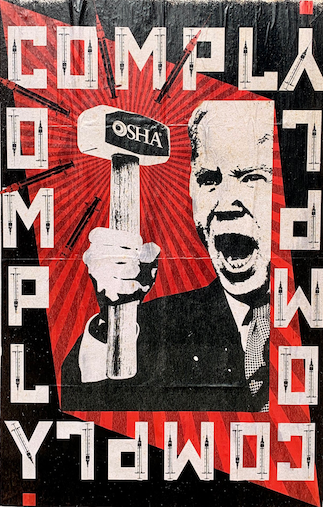
IF THE GOVT CAN TAKE YOUR PROPERTY WHEN IT WANTS TO THEN WHO DOES IT REALLY BELONG TO? From [HERE] On April 2, 2020, New Jersey Governor Phil Murphy issued Executive Order 113, which authorizes the New Jersey State Director of Emergency Management, in consultation with the Commissioner of the New Jersey Department of Health, to exercise the full authority afforded to the Governor under the New Jersey Civil Defense and Disaster Control Act to take or use personal services and personal and real property for the purpose of protecting or promoting the public health, safety or welfare.

Neither Executive Order 113 nor the Disaster Control Act identify the specific property to be subject to taking, other than to indicate it may include “medical resources.” Rather, the Disaster Control Act provides broad authority to commandeer and utilize any services or property “necessary to avoid or protect against any emergency.” Executive Order 113 references the Governor’s previous Executive Orders, however, providing insight into the types of property which are likely to be taken.

Executive Order 109 requires all businesses and non-hospital healthcare facilities to submit an inventory to the State of the Personal Protective Equipment (PPE), ventilators, respirators, and anesthesia machines in their possession that are not required for the provision of critical healthcare services. Similarly, Executive Order 111 requires all healthcare facilities to report, on a daily basis, data concerning their capacity and supplies, including available beds, ventilators and PPE. It appears that the reporting requirements in the previous Executive Orders were intended to identify the location and scope of the property which may be commandeered under Executive Order 113. While the items identified in the previous Executive Orders are the most likely to be commandeered under Executive Order 113, it is unlikely they will be the only such items.

Those whose property is appropriated will not be left without recourse, as both Executive Order 113 and the Disaster Control Act require the payment of just compensation for any property taken. The Disaster Control Act establishes emergency compensation boards for each county. Any party believing it is entitled to compensation for property or services taken under Executive Order 113 may file a petition, naming the State as a defendant, with the emergency compensation board in the county where property was located when taken. A copy of the petition must also be served upon the Attorney General. The emergency compensation board will schedule a hearing to fix the amount of any award, to be paid within one year of the board’s decision.

To the extent a petitioner believes they have been aggrieved by the decision of the emergency compensation board, they may file an action for such compensation against the State in the Superior Court of New Jersey pursuant to the practices and procedures applicable to condemnation proceedings.

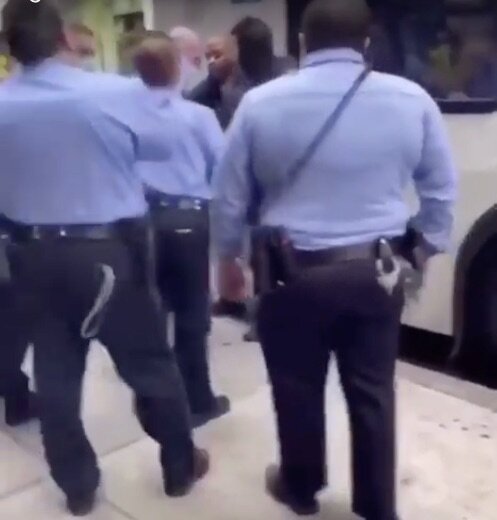
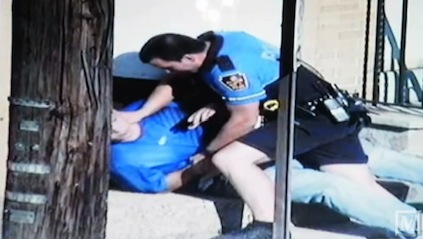
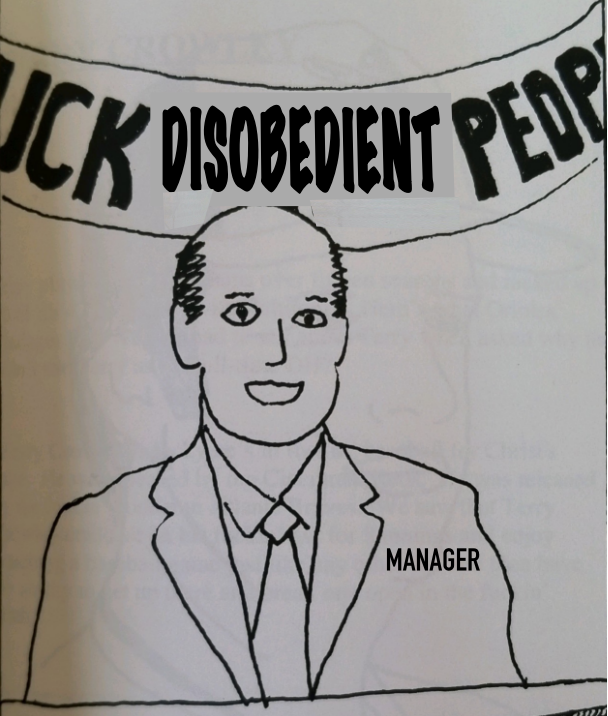
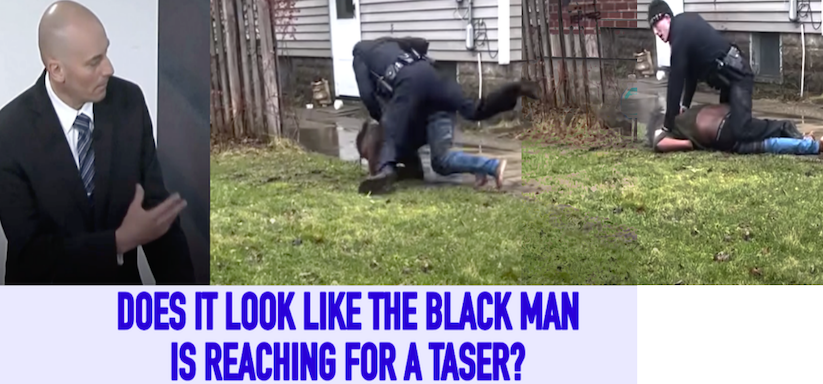
Wear a Mask or Get Dragged Off the Bus: A Gang of White Philadelphia Cops Violently Assault Black Man to En-Force Compliance with Virus Law in System of Coercive Authority [Demockery]

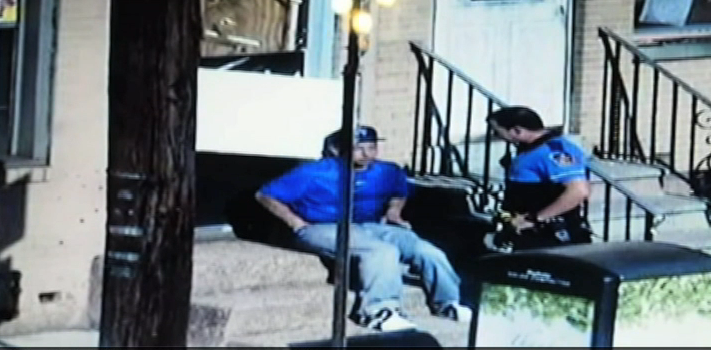
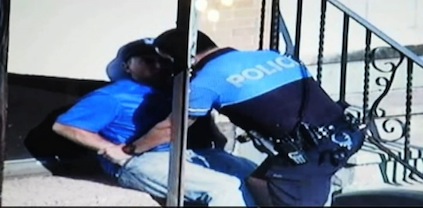
NON-VOLUNTARY COMPLIANCE NOT ALLOWED. After a viral backlash today SEPTA says it will no longer enforce a policy requiring riders to wear facial coverings after a widely shared video showing a Black man being dragged off a bus by a group of white cops, allegedly for not wearing one, prompted confusion about whether masks were mandatory while riding public transit.

The video shows several white Philadelphia police officers forcibly removing the man, who is later heard saying he was taken off the bus for not wearing a mask. “The police were responding to the fact that the person was asked to leave the bus and refused,” Managing Director Brian Abernathy said during the city’s news conference Friday. “I would expect my officers to continue to do that and support our SEPTA workers.” [MORE]

Such is the nature of unaccountable authority in a legal system that is based on force and violence. Michael Huemer explains “commands are often enforced with threats to issue further commands, yet that cannot be all there is to it. At the end of the chain must come a threat that the violator literally cannot defy. The system as a whole must be anchored by a non-voluntary intervention, a harm that the state can impose regardless of the individual’s choices. That anchor is provided by physical force.”

You can play pretend that you voluntarily comply with government authority all you want - but the reality is comply with the law or eventually authoritarians will place you in greater confinement.

septa authoritarians.jpg

FUNKTIONARY explains, “injustice” is the by-product of authority and its enforcement through legal fictions: the Corporate Police State and their tribunals. 2) forced obligations.

It states, “demockery” is “a spectacle of the true nature of democracy.” Democracy is “Dictatorship camouflaged as freedom. . . next to "monetized debt," and direct taxation (on labor) it is the biggest con-game perpetrated on a population. Democracy has proved only that the best way to gain and sustain power over people is to assure the people that they are ruling themselves. Once they believe that lie, they make wonderfully submissive and self-maintained slaves.” [MORE]

Not a System of Bigotry Run by Bigots but a White Over Black System of Vast Unequal Power that Most Whites Participate in: Impact of Virus Makes the System of Racism White Supremacy More Visible

Newsday observes “Inequities in society that have impacted many African Americans — such as living inadequate housing in poorer communities, low-wage jobs and illnesses like heart disease — are starting to show in coronavirus deaths across the state, according to preliminary data.” [MORE] The system of racism apparently is a new reveal to many who now have eyes to see what has been always right in front of their faces.

Dr. Frances Cress Welsing explained that Black people must understand what the system of racism white supremacy is and how it functions in order to disempower and unplug themselves from it. She stated:

“this deep investigation and understanding is essential if Black and other non-white peoples are to succeed in playing the "black side of the chess board" (defense-offense) in contrast to the "white side of the chess board" (offense-defense) in the planetary game of chess (white supremacy) being played out between white and non-white. Currently, the players on the black side of the chess board are in a continuous state of checkmate (a losing streak that is centuries long). This has happened because of our failure to understand the game. Heretofore, non-white people have not decoded white genetic survival.”

Racism is not primarily about bigotry - minor inconveniences such as trouble catching a cab, standing in a long line to vote or disrespect, stereotypes or bad conduct or mean words by white people. Rather racism/white supremacy is about the superior, dominate position of whites and vast unequal power, conditions and opportunities and maintaining that imbalance of power through your cooperative control and oppression. 

Belief that racism is only bigotry is a vital part of false programming sold to you by the vested interests for your cooperation and submission to your own oppression. Such belief is whitenology sold by elite whites - publishers, scholars, professionals and government representatives and also promoted by showcase Blacks who parrot such false consciousness programs in various styles

In reality, to be a racist is to be an "upholder, supporter and perpetrator of the institution of the White Supremacy Dynamic in a system of oppression (structured and perpetuated injustice—racism.)" 

Elite racists [neuropeans] like to use word tricks or confuse with language. The terms "racist" and "racists" and racism are used interchangeably or confusingly by racists with what is really bigotry or just name calling. Amos Wilson explained that defining racism in terms of attitude or bigotry leads to solving the wrong problems. [MORE]

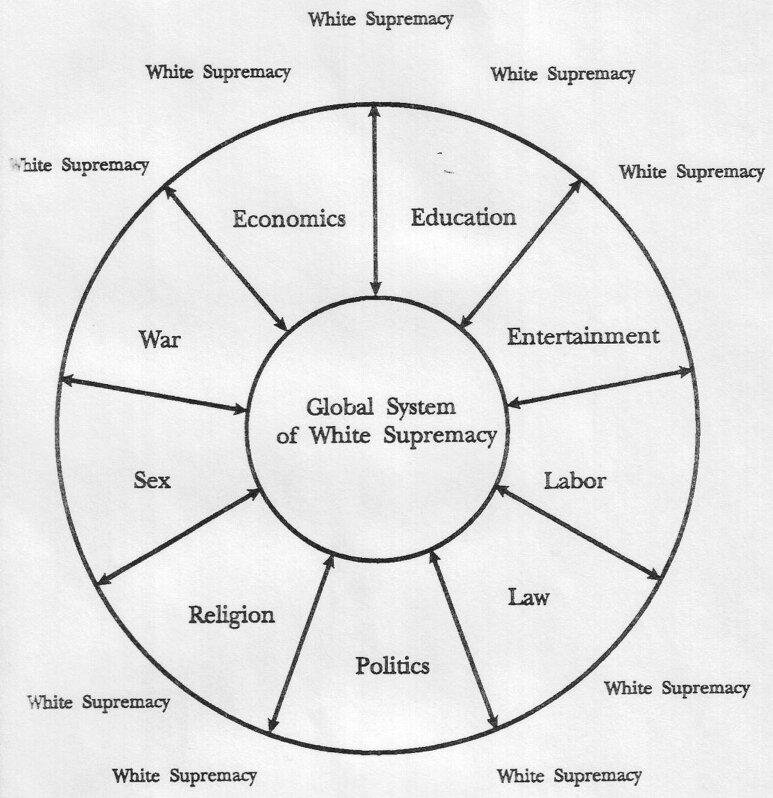
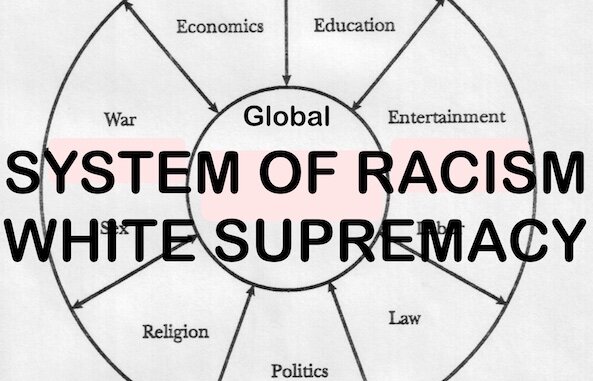
white supremacy chart 2.jpg

Dr. Blynd explains, "Racism is not individualistic, but institutional, cultural, economic, political, linguistic, self-perpetuating and systematic." White Supremacy is a power group dynamic involving the relationship between whites and Blacks in a vast system of unequal power. It is economic discrimination by one group over and against another for the purposes of subjugation and/or maintaining the imbalance of power through cooperative control, misinformation, indoctrination, genocide and oppression. Racists practice racism because they have the power to do so. As explained by Dr. Amos Wilson, 'to end racism/white supremacy we must end or neutralize white power.' [MORE]

Racism is white supremacy and white supremacy is racism.  'Everywhere one finds Whites and Blacks in close proximity to each other, whether it is Chicago or Zimbabwe, the Whites are in control. This extraordinary universal phenomenon which defies every known statistical law of probability is rarely questioned by African Americans (90% of the world is non-white)'. [MORE]

Specifically as defined in FUNKTIONARY;

bigot - one who manifests and expresses self hatred and self inferiority. Not to be confused with racism

Bigotry - manfestation of the self-alien(h)ated and self hatred projected towards others, especially those of a different so-called race. Bigotry is personal, whereas white supremacy racism is an institutionalized group power dynamic and impersonal. 

Racism White Supremacy - 1) psychopathic degeneracy. 2) "The local and global power system and dynamic, structured and maintained by persons who classify themselves as white, whether consciously or subconsciously determined, which consists of patterns of perception, logic, symbol formation, thought, speech, action and emotional response, as conducted simultaneously in all areas of people activity (economics, education, entertainment, labour, law, politics, religion, sex and war); for the ultimate purpose of white genetic survival and to prevent white genetic annihilation on planet earth—a planet upon which the vast majority of people are classified as non-white (Black, Brown, Red and Yellow) by white skinned people, and all of the nonwhite people are genetically dominant (in terms of skin coloration) compared to the genetic recessive white skin people." -Dr. Francis Cress Welsing, MD. 

"People who classify themselves as White, who wish to be taken seriously, and who are righteous and responsible, will only talk about ending White Supremacy (Racism) and replacing it with Justice."

There is no system of Black supremacy. Nelly Fuller has observed that there is only one functioning form of racism in the known world- White supremacy. He challen­ges his readers to identify and then to demonstrate the superiority or functional supremacy of any of the world's "non-white" peoples over anyone. Concluding that since there is no operational supremacy of any "colored" people, Fuller reveals that the only valid operational definition of racism is white supremacy. He observes that in spite of any and all statements the world's "non-white" peoples may make about themselves having economic and/or political independence and the like, in the final analysis, they are all victims of the white supremacy process.

In a system of white supremacy/racism non-whites cannot be racist to whites b/c they have no power to do so. It is a white over Black system of vast unequal power by design.   

Anon explains: 

Q: Why is it called “Racism/White Supremacy?”

A: Because this describes exactly WHO is practicing racism. For one group to practice racism that group must have MORE POWER than another group. Since whites control ALL the major areas of human activity in America — housing, education, health, entertainment, economics, politics, law, and religion — it is accurate to define all “racism” as “white supremacy.” We must be accurate so the victims of racism do not become confused. 

Q: Isn’t all racism the same, regardless of who is practicing it?

A: There is only ONE kind of racism: white supremacy. White people are the only group in America with the POWER to discriminate (deprive or punish other ethnic groups), and the systems and institutions to maintain the imbalance of power.

For example, rich people are more powerful than poor people. Rich people have the POWER to discriminate against poor people by depriving them of income, promotions, jobs, housing, land, justice, and any other rights – if they choose to do so.

In America, whites have the POWER to discriminate against blacks (and other non-whites) by depriving them of income, promotions, jobs, housing, land, justice, and any other rights – if they choose to do so. It doesn’t matter that some whites are poorer than some blacks.

In all things and in all places in America, whites are collectively more powerful than blacks are collectively. This imbalance of (white) power creates the opportunity and the ability to practice racism against non-whites. Racism is not empty rhetoric (words) or mindless emotion. Racism is economic, political, institutional, and systematic POWER. Since whites control all the institutions and systems of power in America, only whites have the power to practice racism. [MORE]

Race is not real but racism is. [MORE] Racists are obsessed with skin color and their inability to produce color. They created the concept of race out of thin air. The only purpose of race is to practice racism. Having little biological validity, the term "race" is better translated to mean organization. The sole purpose of such organization is to maintain white domination and world control of non-whites, who have been frictionalized into made up classifications of people by racists. [MORE

spike lee fraid.jpg

Gullible victims of RSW who have misunderstood the meaning of racism white supremacy have sought to reform the conduct of racists - reform their bad attitudes & behavior, mean words, stereotypes and prove their humanity to them through moral suasion. Such goals can be described as a moral quest for respect from racists and for more kinder & thoughtful white people. However, asking master "to do the right thing" misses the point entirely. At this point in history said goals are entirely pathological and perhaps even a sign of a mental disorder. The master-servant relationship must be destroyed, not updated and refined. 

Justice requires the elimination of the causes of injustice.  White Supremacy/Racism is the cause of problems such as poverty, economic inequality, lack of economic development, unemployment, drug addiction, infant mortality, AIDS, health disparities, chronic welfare dependency, lack of affordable housing, gentrification, homelessness, servant education, the unequal administration of justice, police brutality, jim crow like incarceration and much more. [MORE].

Although the system of racism/white supremacy is a main source of all Black people’s problems and oppression, it is not part of “the resistance” or “being woke” or the electoral “black politics” agenda. Rather, said approaches primarily focus on single issues such as “voting rights” or “police brutality” etc. and the unequal administration of laws in general as independent “civil rights” issues examined outside the context of racism/white supremacy. Said lens views issues separately and not as symptoms of the system of racism/white supremacy. In reality, most Blacks examine issues on an ad-hoc basis, the way white liberals and conservatives have defined said issues for them. Therefore, discussion never concerns how to attain the power to stop racists from practicing racism against them.

ACLU Seeks to Block the Launch of a Vast Aerial Surveillance System Created to Constantly Record the Movements of Baltimore’s 600,000 [mostly Black] Residents

b-more surveillance .jpg

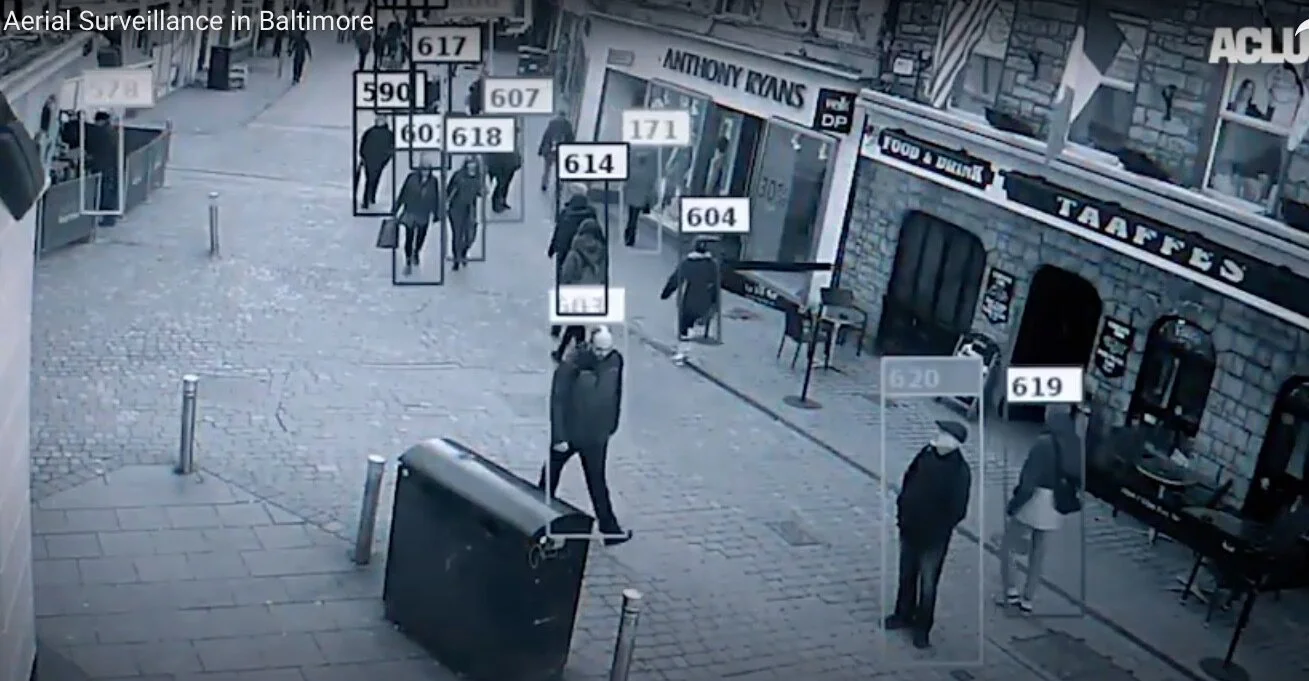
As Virus Spreads Authoritarianism Becomes More Visible. From [HERE] and [ACLU] The American Civil Liberties Union (ACLU) filed a lawsuit Thursday seeking to block the Baltimore Police Department from launching an aerial surveillance program.

The civil rights group argues in the case, filed on behalf of local activists in Maryland District Court, that the BPD’s mass surveillance system will persistently record the movements of virtually all of Baltimore’s 600,000 residents. According to the suit, “the BPD calls this system the “Aerial Investigation Research” program, or “AIR.”

The BPD has contracted with a company, aptly named Persistent Surveillance Systems, LLC (“PSS”), whose planes will fly over Baltimore at least 40 hours a week. Once per second, advanced wide-angle camera systems on those planes will collect images of over 90 percent of the city at a time, creating slow-frame-rate video recordings of pedestrians on sidewalks, parks, driveways, and back yards, and vehicles moving about on public streets and private lots. To Plaintiffs’ knowledge, the BPD has not yet commenced the program.

The AIR program would put into place the most wide-reaching surveillance dragnet ever employed in an American city, giving the BPD a virtual, visual time machine whose grasp no person can escape. And though the program’s objectives to reduce crime and violence are laudable, the Constitution dictates that this all-seeing and ever-present “eye in the sky” is not an available solution.”

The ACLU is seeking an injunction to the block the “Aerial Investigation Research” plan and a “declaration that the BPD’s policy and practice of persistent aerial surveillance violates their First and Fourth Amendment rights and an order requiring the BPD to destroy the information about them that it has collected in violation of their constitutional rights.“

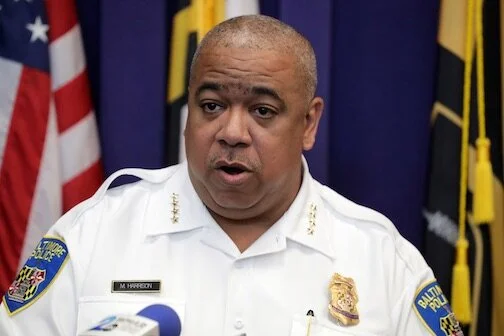
Baltimore Police Commissioner Michael Harrison is a BLACK PROBOT IN SERVICE OF RACISM WHITE SUPREMACY AND GOVT AUTHORITY

Baltimore Police Commissioner Michael Harrison is a BLACK PROBOT IN SERVICE OF RACISM WHITE SUPREMACY AND GOVT AUTHORITY

Baltimore officials earlier this month voted to approve the rollout of the system, which was developed by the police department and a company called Persistent Surveillance Systems. Baltimore Police Commissioner Michael Harrison had expressed skepticism over the use of the planes, describing the idea as an “untested” crime-fighting strategy, before he announced the pilot program in December. Democratic Mayor Bernard C. "Jack" Young said that he has full support in the spy plane program: "I stand behind my commissioner." [MORE]

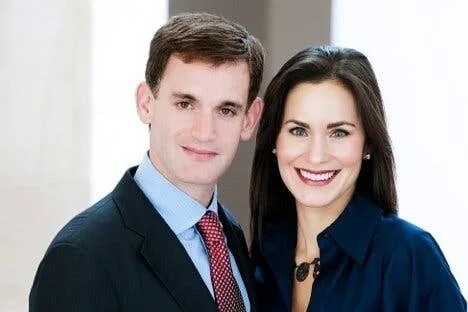
The planes, their pilots, analysts and hangar space will be funded by the nonprofit of Texas billionaires Laura and John Arnold. [MORE] Both are racist suspects. The deal also pays for grants to enable independent researchers to study whether the program has an impact on Baltimore’s violent crime rate. The city has recorded more than 300 homicides yearly for the last five years. Nevertheless, since 2018 the total number of crimes reported in the city has fallen by almost 6 percent compared to 2018, with violent crime falling by about 2.5 percent. Robbery, burglary, theft, and auto theft decreased modestly, while reported rape fell dramatically — with law enforcement documenting nearly 26 percent fewer offenses. [MORE]

ELITE RACIST SUSPECTS Laura and John Arnold ARE FUNDING THE PROGRAM TO SURVEIL BLACKS IN BALTIMORE. John is a former Enron trader whose hedge fund, Centaurus Advisors, made HIM billions before he retired in 2012.

ELITE RACIST SUSPECTS Laura and John Arnold ARE FUNDING THE PROGRAM TO SURVEIL BLACKS IN BALTIMORE. John is a former Enron trader whose hedge fund, Centaurus Advisors, made HIM billions before he retired in 2012.

The ACLU stated the new program “would be the most significant new surveillance system to be deployed in the U.S. in decades, and it would fundamentally change what it feels like to venture out in public in this country. It also violates our constitutional rights to freedom of association and privacy, and — on behalf of a group of Baltimore community activists — we are suing to stop it today.”

The technology is called wide-area aerial surveillance. It involves stationing an aircraft equipped with ultra-high-resolution cameras over a city to continuously track all visible pedestrians and vehicles within that city. Currently, the technology can cover a 32-square mile area, though better cameras are just an upgrade away. It was originally developed by the military for monitoring overseas battlefields in Iraq and Afghanistan in a program called “Gorgon Stare.” Now, a company called “Persistent Surveillance Systems,” founded by a colonel who worked on that program, wants to turn this mega-powerful “eye in the sky” inward onto American cities.

Although this company has been pitching American cities for years, no police department until now has been willing to embrace this truly dystopian technology. The term “Big Brother” is bandied about a lot these days, but rarely has a technology lived up to the term so well.

It’s no coincidence, of course, that this program is being unveiled in Baltimore, a city that’s more than 60 percent African American. Black and Brown communities in the U.S. are always first in line to come under surveillance by new technologies. Baltimore in particular has a terrible history of racism and a lack of accountability for abuses by police that makes it an especially problematic place to deploy this technology. In fact, the city is currently under a federal consent decree for routinely violating people’s constitutional rights.

The ACLU represents the plaintiffs: Leaders of a Beautiful Struggle, a grassroots think-tank that advances the public policy interests of Black people in Baltimore, Erricka Bridgeford, co-founder of the Baltimore Ceasefire 365 project to end gun violence in the city, and Kevin James, a community organizer and hip-hop musician.

The ACLU stated

“Unfortunately, this country has a long history — continuing to the present day — of law enforcement using surveillance technology against people not because they are suspected of committing a crime, but because of their beliefs. In Baltimore, that has meant the targeting of Black Lives Matter protesters, who have been subjected to sweeping surveillance, including aerial surveillance."

If this program moves forward in Baltimore, we can expect it to quickly spread to other cities with large Black and Brown populations and histories of racial bias. But nobody in America should think that they’ll be able to evade this technology. If it moves forward in Baltimore, we can expect police departments around the country to start adopting it. Eventually, when drones are able to fly freely over our cities, making this kind of constant surveillance cheap and automatic, it wouldn’t be surprising if much of the country ends up covered.
 
Persistent Surveillance Systems is a tiny company, but if it succeeds in winning acceptance for its trial pilot program in Baltimore, there are much bigger companies waiting in the wings — companies that already advertise wide-area surveillance devices and would no doubt love for a domestic market to open up. These are companies that could put much more powerful technology overhead, including automated AI analysis, multi-spectral imaging, and night vision capabilities, not to mention much higher camera resolutions.

We are filing a lawsuit in the hopes of stopping this train. Based on ample precedent — including a landmark 2018 case that the ACLU won in the Supreme Court, Carpenter v. United States — we argue that tracking individuals in the way that this technology does is something the government cannot do without a warrant. There is no doubt, we argue, that people’s long-term physical movements, even in public places, enjoy constitutional protection.

The government certainly can’t track everyone in a city, because even with a warrant, that would violate the Constitution’s ban on “general warrants” — the kind of broad, non-individualized authorization to carry out searches that angered the Founders so much. If the Baltimore police want to track a citizen over wide areas and extended periods of time, they have to seek a warrant specific to that person. They don’t get to fill a data warehouse with records of everyone’s movements, which they can then pluck at will without asking a judge. In this respect, Baltimore’s plan echoes the National Security’s Agency’s secret seven-year collection of Americans’ telephone records — which was found to be unlawful in another ACLU lawsuit, ACLU v. Clapper.

Finally, we argue that this system violates not just the Fourth Amendment’s prohibition against “unreasonable searches,” but also the First Amendment’s protection of the right of assembly. As the Supreme Court has found, overbroad searches will have an “inevitable chilling effect” on constitutionally protected activity like protests and marches.”

The Day Before Trump’s Inauguration CDC Issued Quarantine Regulations Allowing the Apprehension & Detention of Persons "Reasonably believed to be Infected" with a Communicable Disease

reg 7.jpg

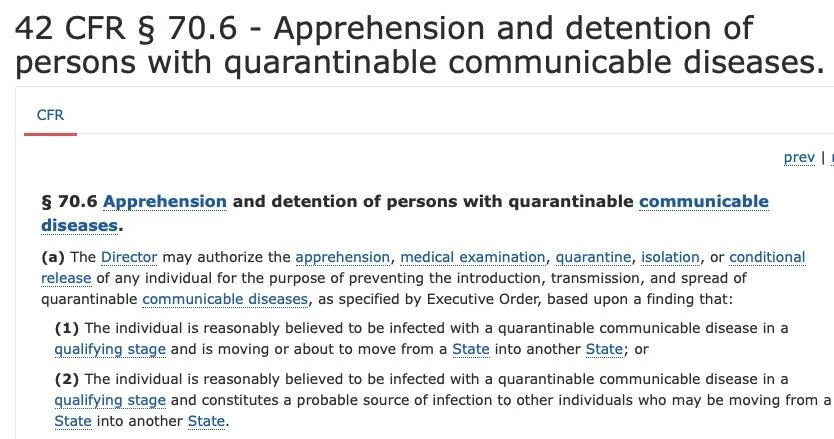
From [HERE] The current administration has at its disposal a parting gift from the Obama administration: new federal quarantine regulations. On January 19, 2017, the day before the inauguration of President Trump, the Department of Health and Human Services (HHS), with its Centers for Disease Control and Prevention (CDC), promulgated final rules amending the regulations governing domestic and foreign quarantine. Said regulations state:

§ 70.6 Apprehension and detention of persons with quarantinable communicable diseases.

(a) The Director may authorize the apprehension, medical examination, quarantine, isolation, or conditional release of any individual for the purpose of preventing the introduction, transmission, and spread of quarantinable communicable diseases, as specified by Executive Order, based upon a finding that:

(1) The individual is reasonably believed to be infected with a quarantinable communicable disease in a qualifying stage and is moving or about to move from a State into another State; or

(2) The individual is reasonably believed to be infected with a quarantinable communicable disease in a qualifying stage and constitutes a probable source of infection to other individuals who may be moving from a State into another State.

(b) The Director will arrange for adequate food and water, appropriate accommodation, appropriate medical treatment, and means of necessary communication for individuals who are apprehended or held in quarantine or isolation under this part.

The federal statutory authority to promulgate the 2017 federal quarantine regulations derives from Section 361 of the Public Health Service Act, codified at § 264 of Title 42 of the U.S. Code, which grants the Secretary of HHS authority to "make and enforce such regulations as in [their] judgment are necessary to prevent the introduction, transmission, or spread of communicable diseases from foreign countries into the States or possessions, or from one State or possession into any other State or possession." Regulations may not provide for the apprehension, detention, or conditional release of individuals except for the purpose of preventing the introduction, transmission, or spread of the diseases specified in Executive Orders of the President (the "quarantinable diseases"). Individuals who have a disease that is not listed in the Executive Order are not subject to apprehension or detention under this federal law. [MORE]

watching .jpg

The New England Journal of Medicine states: As Covid-19 spreads around the globe, governments have imposed quarantines and travel bans on an unprecedented scale. China locked down whole cities, and Italy has imposed draconian restrictions throughout the country. In the United States, thousands of people have been subjected to legally enforceable quarantines or are in “self-quarantine.” The federal government has also banned entry by non–U.S. nationals traveling from China, Iran, and most of Europe and is screening passengers returning from heavily affected countries. Still, the numbers of cases and deaths continue to rise.

Quarantines and travel bans are often the first response against new infectious diseases. However, these old tools are usually of limited utility for highly transmissible diseases, and if imposed with too heavy a hand, or in too haphazard a manner, they can be counterproductive.1With a virus such as SARS-CoV-2, they cannot provide a sufficient response.

In public health practice, “quarantine” refers to the separation of persons (or communities) who have been exposed to an infectious disease. “Isolation,” in contrast, applies to the separation of persons who are known to be infected. In U.S. law, however, “quarantine” often refers to both types of interventions, as well as to limits on travel. Isolation and quarantine can be voluntary or imposed by law.

Inside the country, isolation and quarantine orders have traditionally come from the states. Courts have typically upheld these orders in deference to the states’ broad powers to protect public health. Nevertheless, courts have occasionally intervened when a quarantine was unreasonable or when officials failed to follow necessary procedures. For example, in Jew Ho v. Williamson (1900), a federal court struck down a quarantine imposed by San Francisco in response to an outbreak of bubonic plague because it was racially motivated and ill-suited to stop the outbreak.

Although isolation and quarantine orders have been less common in recent decades, many states have isolated patients with tuberculosis who did not adhere to medication regimens.2 At least 18 states quarantined people returning from West Africa during the 2014 Ebola outbreak.3In March 2019, Rockland County, New York, prohibited all minors who were unvaccinated against measles from entering any place of public assembly. In W.D. v. County of Rockland (2019), a New York State judge struck down that order, ruling that there was no emergency. Most states, however, do not require an emergency declaration in order to issue a quarantine.

The federal quarantine power is limited to preventing the spread of communicable diseases into the country or across state lines. Section 361 of the Public Health Service Act grants the Surgeon General the power (since delegated to the Centers for Disease Control and Prevention [CDC]) to apprehend, detain, or issue a conditional release for the purpose of preventing the introduction into the country, or the spread across state lines, of a quarantinable disease, as designated by executive order (see box). The current list includes “severe acute respiratory syndromes,” which encompasses Covid-19.

Quarantinable Diseases:

  • Cholera

  • Diphtheria

  • Infectious tuberculosis

  • Plague

  • Smallpox

  • Yellow fever

  • Viral hemorrhagic fevers

  • Severe acute respiratory syndromes

  • Influenza that can cause a pandemic

* From the Centers for Disease Control and Prevention. Legal authorities for isolation and quarantine. www.cdc.gov/quarantine/aboutlawsregulationsquarantineisolation.html. opens in new tab.

Despite the breadth of its powers, the CDC has generally focused on providing expert guidance to states during outbreaks. In 2017, however, the agency issued new quarantine regulations (codified in 42 Code of Federal Regulations [CFR], parts 70 and 71) suggesting that it would no longer defer to the states. These regulations make clear that, independent of state action, the CDC may isolate, quarantine, examine, or bar travel of anyone within the country who CDC officials reasonably believe may bring a communicable disease into the country or spread it across state lines. When the secretary of health and human services declares a public health emergency, as Secretary Alex Azar did on January 31, these orders can be issued against persons in the precommunicable stage, which begins at a person’s earliest opportunity for exposure to an infection and ends on the latest date at which the person could reasonably be expected to become contagious.

The regulations also commit the CDC to providing medical care for people who are detained, but they may charge insurers for that care. In addition, they establish a multilevel internal administrative review process. But they do not ensure expeditious or independent review of detention orders or travel bans. Moreover, although the CDC stated that it would “seek to use the least restrictive means necessary to prevent the spread of communicable diseases,” the regulations do not require the agency to adhere to that standard. Though the CDC’s quarantine powers permit it to deny entry into the United States for a quarantinable disease, President Trump relied on Sections 212(f) and 215(a) of the Immigration and Naturalization Act to ban Chinese and Iranian nationals from entering the country.

Despite their breadth, the federal and state quarantine powers are subject to important constitutional limitations.2 First, as Jew Ho affirmed, quarantines cannot be imposed in a racially invidious manner. Second, governments must have a strong basis for the restrictions. Looking to case law regarding civil commitment, many scholars and some lower courts have concluded that isolation and quarantine are constitutional only when the government can show by clear and compelling evidence that they are the least restrictive means of protecting the public’s health. However, at least two federal courts reviewing postdetention challenges to Ebola quarantines held that the standard was not sufficiently well established to allow the claims to go forward.3 Third, persons who are detained, or whose liberty is otherwise restricted, are entitled to judicial review — traditionally under the writ of habeas corpus.3Finally, when governments detain people, they must meet those people’s basic needs, ensuring access to health care, medication, food, and sanitation. Such standards are not only constitutionally compelled: they are critical to ensuring that detained persons comply with orders.

Although we are likely to see greater use of robust social distancing measures, such as school closures or the cancellation of public meetings, broad sanitary cordons — in which geographic areas are quarantined — would raise serious constitutional questions. They also can present numerous logistical challenges and can increase the risk to those living in the restricted zone. Such measures may also have limited efficacy with a highly contagious disease such as Covid-19.4

With community transmission occurring in several parts of the United States, it is time to recognize that travel bans and mandatory quarantines alone cannot end the outbreak. In a public letter to the Trump administration, we (along with more than 800 other public health and legal scholars and organizations) argue that more constructive tools are needed.5 [MORE]

Is the Media Really Concerned about the Coronavirus’ Impact on Black Communities or Laying the Groundwork to Justify Coercive Gov Action Against People Deemed a Risk to Public Health?

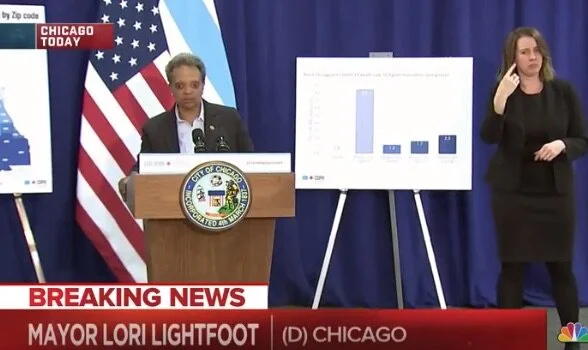
Although data on race and the coronavirus is too limited and way too small of a statistical sample to draw meaningful conclusions, disparate rates of sickness and death allegedly caused by the coronavirus have emerged. Over the past seven days the dependent media has been sounding the alarm about said disproportionate impact and black puppeticians (such as Muriel Bowser, Lori Lightfoot and Nick Mosby) have been parroting the message.

Undeceived persons understand that dependent media and obedient Black rolebots basically have the same racist suspect, elite white masters. To the extent that racists have anything to do with the creation and/or spread of the virus the purpose of such information should be scrutinized and critically analyzed because it may be propagandized in the wrong hands. Naturally, said information can and hopefully will be put to productive use by responsible and accountable persons.

To be clear the aforementioned are not claiming any biological difference has caused the disproportionate impacts between whites and Black people. Media outlets such as CNN and the New York Times have explained that the impact on black communities is due to “entrenched inequalities in resources, health and access to care.” Such explanations are weak attempts to minimize the actual context in which we live in - the system of racism white supremacy, a main source of Black people’s problems.

Another purpose could be afoot. Observe that during a health emergency that government can assert nearly limitless, unaccountable power to encourage or coerce changes in behavior of the populace. Although most people want to voluntarily comply with measures to remain healthy and have no desire to contract a dangerous disease, post 9-11 the government has chosen a compulsion approach over voluntarism approach to deal with an emergency -e.g., mandatory testing, screening, physical examination, reporting, directly observed therapy, isolation, orders to shelter in place, arrests and civil commitment.

Most people believe that if an individual is currently contagious the government has the authority to separate that person from others and to provide necessary treatment. But ‘what about where the government seeks to exercise compulsion against an entire class of individuals where some, but not all, members of the class pose a so-called future risk to the public health?’ Can compulsion be visited upon an individual simply by virtue of her inclusion in a class composed of some dangerous persons absent an individualized assessment of significant risk?

Here, under a circumstance where certain Black communities are being described as epicenters of the coronavirus it is not a leap in logic to assert that such areas could be deemed [by panicked, racist suspects lathered up in fear] dangerous to the health of the general public - as a large number of persons therein allegedly have the coronavirus and potentially carry the virus in the Black community and could spread it outside the community. Although quarantines cannot be imposed in a racially invidious manner could the state or federal government lawfully quarantine said neighborhood in a containment strategy calling for the en-forcement of shelter in place orders, isolate individuals and subject the neighborhood’s inhabitants to police surveillance, freedom of movement restrictions, ban outsiders from access to it, prevent residents from leaving and compel vaccinations or treatment and arrest and detain those who violate orders? Could the government turn such communities into a quarantined crime scene?

According to constitutional scholars such as Lawrence Gostein, Wendy Parmet and Michael Ulrich, the answer is yes, depending on the circumstances.

In fact, on January 19, 2017, the day before the inauguration of President Trump, the Department of Health and Human Services (HHS), with its Centers for Disease Control and Prevention (CDC), promulgated final rules amending the regulations governing domestic and foreign quarantine.

The new regulations grant broad quarantine authority to the CDC. They empower the CDC Director to authorize the "apprehension, medical examination, quarantine, isolation, or conditional release of any individual for the purpose of preventing the introduction, transmission, and spread of quarantinable communicable diseases, as specified by Executive Order." This applies to those who arrive in the United States, those who may move interstate, and to some whose movements remain intrastate.

The federal statutory authority to promulgate the 2017 federal quarantine regulations derives from Section 361 of the Public Health Service Act, codified at § 264 of Title 42 of the U.S. Code, which grants the Secretary of HHS authority to "make and enforce such regulations as in [their] judgment are necessary to prevent the introduction, transmission, or spread of communicable diseases from foreign countries into the States or possessions, or from one State or possession into any other State or possession." Regulations may not provide for the apprehension, detention, or conditional release of individuals except for the purpose of preventing the introduction, transmission, or spread of the diseases specified in Executive Orders of the President (the "quarantinable diseases"). Individuals who have a disease that is not listed in the Executive Order are not subject to apprehension or detention under this federal law.

The 2017 regulations set forth rules for the involuntary detention of individuals believed to be infected with a quarantinable communicable disease. Nevertheless the statute and its implementing regulations do not use the term quarantine (which refers to involuntary movement restrictions, including isolation.).

According to Ulrich, whether the statute and regulations comply with due process requirements depends on their compliance with the due process required for involuntary civil detention.

lightfoot mayor.jpg

Although the Supreme Court has not reviewed a quarantine case in the modern era, it has considered the substantive and procedural due process rights of individuals who suffer a loss of liberty in other circumstances. In its seminal procedural due process case, Matthews v. Eldridge, the Court explained that the specific demands of procedural due process depended upon "three distinct factors:" (1) the nature of the individual interest, (2) the risk of an erroneous deprivation of such interest, and (3) the government's interest. The Court has also set forth standards for the civil commitment of persons who have been diagnosed as having a mental disorder to prevent them from causing future harm to others. [MORE]

Ulrich explains, Isolation and quarantine share many characteristics with civil commitment for mental illness. In each case individuals are detained civilly, ostensibly not to punish them but to prevent future harm. Hence, the confinement is based upon a prediction of a future occurrence, rather than a judgment about a past action. Given these key similarities, it perhaps is not that surprising that as the law of civil commitment developed, courts and commentators began to see its applicability to isolation and quarantine. State courts have used these standards in civil commitment doctrine by analogy to determine when involuntary confinement is justified to prevent the spread of infectious disease.

In Foucha v. Louisiana, the Court made clear that to hold an individual involuntarily in civil commitment, the Due Process Clause required proof of two elements: mental illness and dangerousness to themselves or others.

By itself, neither element provides sufficient justification for confinement. Furthermore, the Court stated that the burden of proof lies with the State to show that each element exists with "clear and convincing evidence," as a preponderance of the evidence "fell short of satisfying due process." The Court recognized that a "loss of liberty produced by an involuntary commitment is more than a loss of freedom from confinement." Therefore, as explained by Ulrich "the Due Process Clause contains a substantive component that bars certain arbitrary, wrongful government actions 'regardless of the fairness of the procedures used to implement them.'" It is for this reason that substantive due process "requires that the nature of commitment bear some reasonable relation to the purpose for which the individual is committed."

Ulrich explains that statute and new regulations probably violate Due Process because they authorize involuntary confinement without requiring consideration of both of the factors required for civil commitment. “The regulations do not require any evidence that a person is likely to act in ways that will infect others. And, the regulations do not require an examination into the characteristics of the disease, which is critical to establishing what the potential magnitude of harm is to the public. Rather, a reasonable belief that an individual is infected with a quarantinable disease is the sole standard used to justify involuntary commitment.” [MORE]

Depending on how the the power to detain persons with infectious disease is challenged it could also be subject to the strict scrutiny test. Under said test a law is upheld if it proven necessary to achieve a compelling government purpose. The government must have a truly significant reason for the quarantine and it must show that it cannot its objective through any other alternative. This may not be hard for the government to do with a very deferential court in a public-frenzied, lathered up in fear environment.

Legal scholar, George Smith explains, “today, when the government claims emergency powers in times of disaster, it is most generally justified in doing so under the rubric of the inherent powers of states to advance and maintain the common good through the exercise of their broad police powers. Such broad police powers are, by their nature, "free from principled constraint."

Ulrich states, “there are good reasons to be skeptical of allowing such broad discretion to officials. History shows that officials have often enforced measures like quarantine and civil commitment disproportionately against minorities, immigrants, and the poor. 95 Infectious disease emergencies are typically accompanied by paranoia and fear, and "commonly trigger retributive and discriminatory instincts, so that actual quarantines often impose inhumane, stigmatizing, or even penal treatment upon persons who are confined based on caprice or even prejudice." . . .If the rules authorize discretion broad enough to enable or even invite abuse, they endanger guarantees of individual liberty.

Presently most policymakers embrace an approach that views public health policy through the prism of national security and law enforcement. As explained by the ACLU, this approach assumes that we must “trade liberty for security.” As a result, instead of helping individuals and communities through education and provision of health care, today’s pandemic prevention focuses on taking aggressive, coercive actions against those who are sick. People, rather than the disease, become the enemy.

The ACLU states since 9/11, the war metaphor has proven an effective tactic in winning support for the delegation of broad emergency powers or minimizing opposition to the executive's arrogation of such powers. Rather than focusing on how government can work with individuals and their communities to be healthy, public health policymakers now often emphasize the need to take tough, coercive actions against the very people they are charged to help. This approach not only targets people as the enemy instead of the disease, but also encourages health officials to believe that government cannot do much to help people in an epidemic.

In effect, individuals are viewed as personally responsible for the spread of illness as well as for their own care.

Legal scholar Lawrence Gostin has explained that “to protect the welfare of the public” the government may lawfully take coercion action against non-symptomatic people who may or may not carry the virus because, although there is no immediate risk to the public, a future risk exists. Also, the government may lawfully take compulsive actions against an entire class of persons, such as a Black neighborhood, even though individuals within the community may not pose any individualized assessment of risk to the public.

Gostin explains:

The government's duty to protect the health of citizens placed at risk of foreseeable harm is as strong its duty to protect against more imminent transmission of infection.

In constitutional adjudication, courts would be equally, or more, likely to uphold compulsory interventions based upon a reasonable assessment of future harm given the highly deferential approach [by the courts towards the actions of the executive and government agencies]. There have been communicable disease cases where courts have required persons to be actually infectious to be subject to isolation or quarantine. These cases, however, are distinguishable because the individual was completely deprived of liberty and there was little evidence that those detained were a danger to the public health--either currently or in the future. In any case where the state could demonstrate a rational nexus between a relatively unintrusive intervention such as directly observed therapy and the likely reduction in future harm to the public, there appears to be no judicial propensity to interfere with reasonable medical judgments.

The constitutional or disability-based rule authorizing compulsion to avert a foreseeable harm requires reasonably accurate predictions of future dangerousness. However, if the state can demonstrate through objective data that the person is likely to develop or reactivate clinical disease, there is no reason why it could not intervene to prevent the future risk to the public.

. . .It may well be possible to objectively demonstrate that the class as a whole presents a foreseeable risk to the public. The problem from the perspective of legal theory is that many members of the class subjected to compulsion pose no danger at all. The question arises whether compulsion can be visited upon an individual simply by virtue of her inclusion in a class composed of some dangerous persons absent an individualized assessment of significant risk.

This conceptual problem is fraught with difficulty whether viewed from the perspective of disability law or constitutional law. Perhaps the most revered principle under antidiscrimination law is the requirement to make individualized determinations of person's qualifications or eligibility.' To free the individual from the biases frequently associated with membership in the class, it is central to civil rights doctrine that each person must be assessed according to his or her own characteristics.

Given the unequivocal requirement for individualized assessments of risk, what recourse does the state have when, despite its best efforts, it is not able to reliably separate the perceived from the truly dangerous? This becomes a formidable dilemma when the state is capable of demonstrating that the class as a whole does pose a significant health threat and where the intervention proposed is both effective and non-draconian.

The inflexible requirement for individualized inquiries was rejected in Traynor v Turnage," where the Supreme Court concluded that the Veterans' Administration did not violate the Rehabilitation Act by characterizing primary alcoholism as "willful" misconduct. Even though all persons within the class of alcoholics had not engaged in willful misconduct, the Veterans' Administration was entitled to rely on a reasonable agency rule." The court held the following:

[A]n agency, in treating handicapped persons, may sometimes proceed by way of general rule or principle, at least where 1) the agency behaves reasonably in doing so, 2) a more individualized inquiry would impose significant additional burdens upon the agency, and 3) Congress, as well as the agency, has expressed some kind of approval of the general rules or principles concerned.230

The Health Department arguably could justify status-based determinations under the standard set in Traynor and Ward by showing that it acted reasonably by reference to objective scientific standards; that individual assessments of risk for the entire class would be disproportionately burdensome or even scientifically inconceivable; and that there was clear authority in state statutes or health regulations.

It is not necessary to agree with the judicial decisions in Traynor and Ward or even to agree generally with the principle of status-based determinations"' to conclude that in the narrow circumstances posited here proceeding against the class is warranted. The case of DOT is distinguishable from most other uses of status-based determinations because the invasion of autonomy for the individual is not extreme, the person benefits from the treatment, and the intervention is justified by a demonstrable benefit to the public health.

The requirement of individualized determinations is also inherent in the doctrine of overbreadth found in Fourteenth Amendment and other constitutional jurisprudence. Yet, constitutional analysis would likely be consistent with the disability-based conclusions suggested above. The requirement of narrowly tailored interventions is characteristically found in cases where the court engages in strict scrutiny." To the extent that the state deprives individuals of liberty, such as in a status-based isolation rule, it is likely the courts would carefully examine obvious over-inclusion. Yet, where the state strikes at a liberty interest that is less fundamental, such as in a requirement of DOT, it is more likely the court would engage in an interest balancing approach." Given the considerable health interest asserted by government, the courts' natural inclination to defer to medical judgments, and the relatively unintrusive nature of the requirement, claims based on the Fourteenth Amendment are not likely to succeed.” [MORE]

In 2018 after a black cop was killed [apparently by another cop], Baltimore turned the Harlem Park neighborhood into a crime scene and the entire neighborhood was cordoned off. For one week, mostly Black residents and persons entering or leaving the…

In 2018 after a black cop was killed [apparently by another cop], Baltimore turned the Harlem Park neighborhood into a crime scene and the entire neighborhood was cordoned off. For one week, mostly Black residents and persons entering or leaving the area were subject to interrogations, unlawful seizures, stops, pat down searches, ID checks and non-residents were barred from entering the area. Residents have said they were being required to show identification to get past the police tape to enter their homes. They complained about helicopters flying above their homes, flashing lights from police cars, and being subject to harassment [MORE]

Observe that there is no real limit to government authority exercised in the name of the public good. This is the essence of the lawless society that is rarely visible to the obedient citizenry - law is upheld and deified over humanity. FUNKTIONARY defines the “public good” as a Corporate Statist anti-concept – being the altar on which feudal-citizen-victims are immolated.”

At any rate, exactly when did you and I consent to this arrangement with the government? If this arrangement and relationship is not voluntary then what is it? Undeceiver Lysander Spooner states:

The current doctrine that private rights must yield to the public good, amounts, in reality, to nothing more nor less than this, that an individual or the minority must consent to have less than their rights, in order that other individuals, or the majority, may have more than their rights. On this principle no honest government could ever be formed by voluntary contract, (as our governments purport to be;) because no man of common sense would consent to be one of the plundered minority, and no honest man could wish to be one of the plundering majority.

The apology, that is constantly put forth for the injustice of government, viz., that a man must consent to give up some of his rights, in order to have his other rights protected—involves a palpable absurdity, both legally and politically. It is an absurdity in law, because it says that the law must be violated in some cases, in order that it may be maintained in others. It is an absurdity politically, because a man’s giving up one of his rights has no tendency whatever to promote the protection of others. On the contrary, it only renders him less capable of defending himself, and consequently makes the task of his protection more burdensome to the government. At the same time it places him in the situation of one who has conceded a part of his rights, and thus cheapened the character of all his rights in the eyes of those of whom he asks assistance. There would be as much reason in saying that a man must consent to have one of his hands tied behind him, in order that his friends might protect the rest of his body against an enemy, as there is in saying that a man must give up some of his rights in order that government may protect the remainder. Let a man have the use of both of his hands, and the enjoyment of all his rights, and he will then be more competent to his own defence; his rights will be more respected by those who might otherwise be disposed to invade them; he will want less the assistance and protection of others; and we shall need much less government than we now have.

If individuals choose to form an association or government, for the mutual protection of each other’s rights, why bargain for the protection of an indefinite portion of them, at the price of giving to the association itself liberty to violate the equally indefinite remainder? By such a contract, a man really surrenders everything, and secures nothing. Such a contract of government would be a burlesque on the wisdom of asses. Such a contract never was, nor ever will be voluntarily formed. Yet all our governments act on that principle; and so far as they act upon it, they are as essentially usurping and tyrannical as any governments can be. If a man pay his proportion of the aggregate cost of protecting all the rights of each of the members of the association, he thereby acquires a claim upon the association to have his own rights protected without diminution.

Texas Begins Checkpoint System Along Louisiana Border - Travelers Crossing "Their Border" must Self-quarantine Under Police Surveillance or Face Arrest

ACCORDING TO FUNKTIONARY: BORDERS - ARBITRARY GEOGRAPHICAL ABSTRACTIONS - ECONOMIC AND CULTURAL IMPEDIMENTS AND SURPRISINGLY INERADICABLE. 2) IMAGINARY GEOGRAPHIC DISTINCTIONS AND OCCULT POLITICAL RESTRICTIONS. BORDERS ARE WHAT ALLOWS FENCES (INTERN…

ACCORDING TO FUNKTIONARY: BORDERS - ARBITRARY GEOGRAPHICAL ABSTRACTIONS - ECONOMIC AND CULTURAL IMPEDIMENTS AND SURPRISINGLY INERADICABLE. 2) IMAGINARY GEOGRAPHIC DISTINCTIONS AND OCCULT POLITICAL RESTRICTIONS. BORDERS ARE WHAT ALLOWS FENCES (INTERNETWORKS OF STOLEN GOODS) TO BE ERECTED AND TRAFFICKED THROUGH. (SEE CORPORATE STATE, POLITICAL BORDERS & STATES).

From [HERE] Texas state troopers set up checkpoints along the Louisiana border Sunday, stepping up enforcement of Governor Greg Abbott’s order for travelers from Louisiana to self-quarantine for 14 days as the state has become the next hotspot of the coronavirus pandemic.

Texas House Speaker Dennis Bonnen, a fellow Republican, announced Department of Public Safety troopers will man “roadway screening stations” to collect mandatory travel forms from motorists from Louisiana.

There are more than 15 highways along Texas’ border with Louisiana. Interstate 20 connects Shreveport to Dallas and Interstate 10 connects New Orleans to Houston.

Abbott first issued mandatory 14-day self-quarantine orders on March 26, applying to air travelers from New Orleans, New York, New Jersey and Connecticut. It was expanded three days later to include air travelers from all of Louisiana, California, Washington, Atlanta, Chicago, Detroit and Miami. 

Abbott issued another order on March 30, restricting all travelers from Louisiana on roadways to mandatory 14-day self-quarantine. 

“Those who fall under the self-quarantine mandates outlined in GA-12 should remember that a violation of the Executive Order is subject to criminal penalties,” Bonnen tweeted. “GA-12 does not apply to travel related to commercial activity, military service, emergency response, health response and critical infrastructure functions.” 

Violators of the order face up to 180 days in jail and/or $1,000 in fines. Covered people have the option of self-quarantining at a hotel or residence and must inform state troopers of the address, according to the travel form. 

“DPS Special Agents will conduct unannounced visits to designated quarantine locations to verify compliance by confirming the physical presence of covered persons,” Abbott’s order states.

The checkpoints come two days after Abbott deemed Texas “fully prepared” for the peak in cases, stating the state’s 19,685 hospital beds should be enough.

Louisiana State Police confirmed the checkpoints and screenings Sunday, tweeting that motorists entering Texas “should use caution and remain alert.”

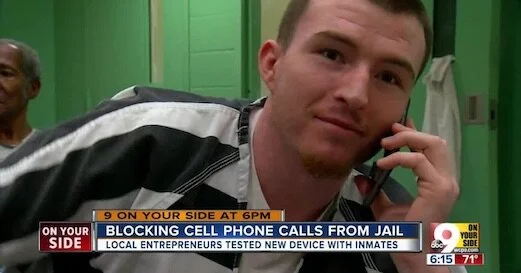
Under the Guise of Relaxing Movement Restrictions, the US Government Turns to “Unprecedented Surveillance"- Tracking Citizens’ [prisoners’] with their “Cell Phone" Data

cell phone.jpg

From [WJS] Western governments [allegedly] aiming to relax restrictions on movement are turning to unprecedented surveillance to track people infected with the new coronavirus and identify those with whom they have been in contact.

Governments in China, Singapore, Israel and South Korea that are already using such data credit the practice with helping slow the spread of the virus. The U.S. and European nations, which have often been more protective of citizens’ data than those countries, are now looking at a similar approach, using apps and cellphone data.

“I think that everything is gravitating towards proximity tracking,” said Chris Boos, a member of Pan-European Privacy-Preserving Proximity Tracing, a project that is working to create a shared system that could take uploads from apps in different countries. “If somebody gets sick, we know who could be infected, and instead of quarantining millions, we’re quarantining 10.”

The U.S. federal government, working with the Centers for Disease Control and Prevention, is creating a portal that will compile phone geolocation data to help authorities predict where outbreaks could next occur and determine where resources are needed, though the effort faces privacy concerns.

The anonymized data from the mobile-advertising industry shows which retail establishments, parks and other public spaces are still drawing crowds that could risk accelerating the transmission of the virus. Alphabet Inc.’s Google said Thursday it would share a portion of its huge trove of data on people’s movements.

Massachusetts Institute of Technology researchers have developed an app to track Covid-19 patients and the people they interact with, and are in talks with the federal government about its use, The Wall Street Journal has reported. [MORE]

‘It appears that COVID-19 has not yet surged in CA prisons:’ A Panel of 3 White Judges Denies Request to Remove California’s (66% Black & Latino) Prisoners Amid Outbreak

The standard for determining if there has been a so-called Eighth Amendment violation is whether there has been "deliberate indifference to the serious medical needs of prisoners.

The standard for determining if there has been a so-called Eighth Amendment violation is whether there has been "deliberate indifference to the serious medical needs of prisoners.

From [HERE] Three racist suspect judges overseeing a long-running legal battle over crowded and unsanitary conditions in California’s state prisons will not allow the mass release of inmates to mitigate the threat of a large-scale Covid-19 outbreak.

The prisoner population in California as of 2017 is around 115,000 inmates. Of the 35 state owned facilities, 13 are beyond the Supreme Court mandated target population. Of the 160,000 prisoners in California, two-thirds are African-American and Latino.. Latino inmates made up 39.8% of the population, African American inmates 28.9%, and white inmates 25.2%, with 6.1% classified as "other. [more]

In a ruling released over the weekend, the panel of judges denied the inmates’ emergency motion to reduce the state prison population, saying the decision was not theirs to make.

The panel was originally convened in 2007 in response to two inmate lawsuits brought in 1990 and 2001 against the state for constitutionally inadequate medical care.

The panel determined at the time that the only way that California could live up to its constitutional obligations was to reduce the state prison population significantly, which it ordered the state to do by 137.5% of its design capacity.

The U.S. Supreme Court affirmed the population reduction order in a 2011 ruling that found overcrowding to be the main cause of the state’s failure to provide prisoners with adequate medical and mental health care.

In 2015, the California Department of Corrections and Rehabilitation met the 137.5% population cap for the first time.

But the case took a new turn as the Covid-19 epidemic became ever more of a threat to the health and safety of inmates and prison staff.

On March 25, attorneys with the Prison Law Office filed an emergency motion to modify the population reduction order, requesting release of low-risk, non-violent prisoners.

At a telephonic hearing last week, attorneys Sara Norman and Donald Specter asked the panel to order the state to release as many inmates as necessary to allow remaining prisoners to stay six-feet away from each other.

“The conditions in the prisons are a tinderbox and will remain a tinderbox unless this court acts,” said attorney Donald Specter with the Prison Law Office, calling the persistent overcrowding “literally a matter of life and death.”

The panel, comprising U.S. District Judge Jon Tigar, U.S. District Judge Kimberly Mueller in Sacramento, and Ninth Circuit Court of Appeals Judge Kim Wardlaw, said its original population reduction order cannot apply to an unprecedented viral pandemic.

“That order was never intended to prepare defendants to confront this unprecedented pandemic. Nor could it have, given that the entire world was unprepared for the onslaught of the COVID-19 virus,” they wrote.

At last week’s hearing, an attorney representing the state said the CDCR has stopped admitting new inmates, and plans to release 3,496 non-violent offenders whose crimes do not involve sex offenses or domestic violence and who are within 30-60 days of their parole dates.

The CDCR touted those steps and others in a statement sent to Courthouse News Sunday.

“The order speaks for itself. CDCR has taken significant steps to address the safety and well-being of inmates and staff during the COVID-19 pandemic; including, temporarily suspending all intake from county jails, which, absent any other measures, would result in a net population reduction of about 3,000 inmates in 30 days due to normal attrition; the expedited paroles of approximately 3,500 non-violent male and female inmates who are within 60 days of their release date within the next several weeks; and approximately 480-530 inmates living in dorms will be transferred to other prisons with unoccupied buildings or space available to increase physical distancing space,” said spokeswoman Dana Simas.

“This is in addition to the other proactive steps we’ve taken to prevent the spread of COVID-19; including temperature and verbal screening of all staff entering CDCR and CCHCS locations, the development of comprehensive healthcare guidelines based on CDC and CDPH recommendations for correctional settings, and limited inmate movement to essential transfers only.”

The judges seem to trust the prison system’s current mitigation approach, at least for now.

“While we cannot know with certainty due to the pathogenesis of the virus, it appears that COVID-19 has not yet surged in California’s prisons,” they wrote. “Thus far, only thirteen inmates have confirmed cases of the disease. And, to their credit, defendants have already taken steps to combat the virus, including taking measures to reduce the prison population. But given the undisputed risk of further contagion in a carceral environment, plaintiffs’ desire to maximize the reduction in the state’s prison population is understandable.”

But the determining factor for the panel was the Prison Reform Litigation Act, which restricts a federal court’s ability to remedy a constitutional violation by releasing prisoners.

While the civil procedure rule empowers courts to change prior orders, the judges said it does not give them boundless authority.

“Rule 60(b)(5) does not provide us with free-standing authority to remedy any harm defendants may inflict upon plaintiffs, regardless of whether it is tethered to the previous findings of structural constitutional shortcomings in the delivery of medical and mental health care,” their order says.

They said the prisoners’ emergency motion doesn’t stem from unconstitutionally inadequate medical and mental healthcare, but a completely different constitutional injury—the system’s failure to protect inmates from a widespread contagion.

That there’s currently no vaccine for Covid-19 only furthers the premise that it could ravage the inmate population whether or not the prisons provide adequate medical care.

“We therefore conclude that to the extent plaintiffs can establish a constitutional violation based on the threat posed by COVID-19, it must be based on shortcomings in defendants’ response to the virus, not on the longstanding systemic constitutional deficiencies in California’s prison health care delivery system,” the judges wrote. [MORE]

The Dependent Media Insists that Author "Dean Koontz Did Not Predict the Coronavirus in 1981" because ‘There is No proof It was created in a Lab’

Nothing to see here according to dependent media outlets such as CNN, the Guardian and Reuters.

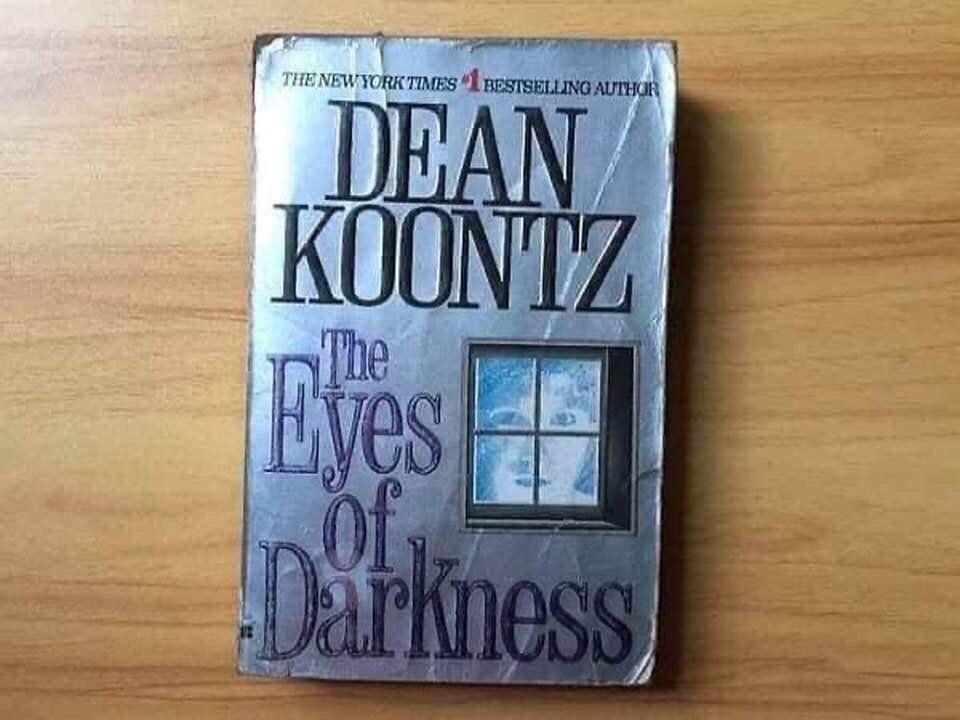
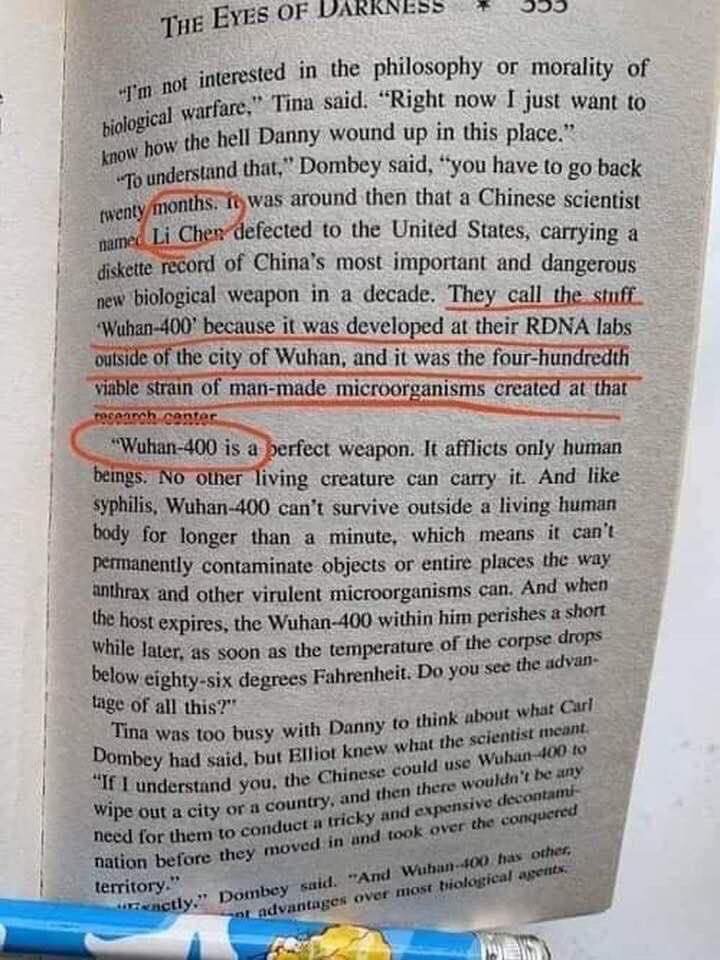
Reuters informs ‘don’t believe what you see’ because it is a “patently false claim” that “a 1981 book predicted the coronavirus 2019 outbreak:” A theory widely shared on social media claims that American author Dean Koontz predicted the 2019-2020 Coronavirus outbreak in 1981. Posts featuring the cover of “The Eyes of Darkness” book and a page in which Koontz allegedly describes the coronavirus in his novel have at least 39,000 shares (examples here and here) and at least 2,000 retweets on Twitter (examples here and here) as of February 27, 2020. 

Most of the claims circulating on social media show the book’s cover and a page in the book mentioning a virus called “Wuhan-400”. The widely circulated photo of Koontz’s book page includes some highlighted text reading: “They call the stuff ‘Wuhan-400’ because it was developed at their RDNA labs outside of the city of Wuhan, and It was the four-hundredth viable strain of man-made microorganisms created at that research center”. 

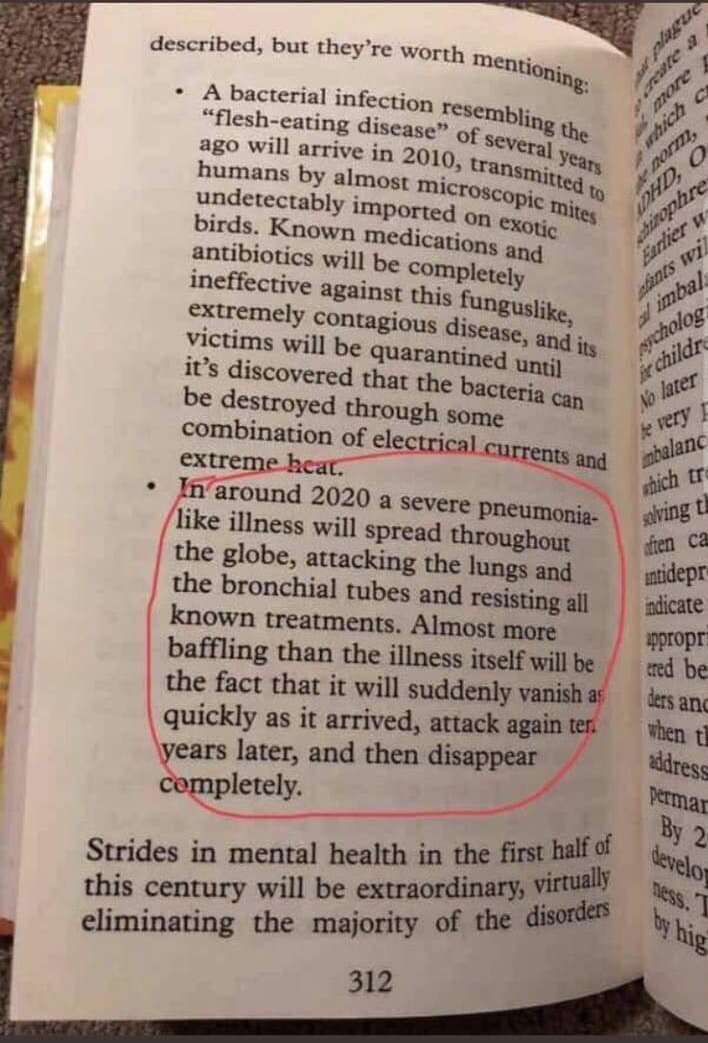
Some claims circulating also include an additional page that mentions the year 2020 and the outbreak of a “severe pneumonia-like illness”. 

This is partly false. While it is true that Koontz wrote about a fictional virus in his novel and that its name “Wuhan-400” refers the Chinese city in which the 2019 Coronavirus outbreak (COVID-19) (here) actually started, the illness in his book doesn’t share more traits with COVID-19. 

In his novel, Koontz described “Wuhan-400” as “China’s most important and dangerous: new biological weapon in a decade”. He also wrote it was developed by labs outside of the city of Wuhan. 

There is no proof that the new coronavirus was created in a lab. The virus is believed to have originated late last year in a food market in Wuhan that was illegally selling wildlife (see here). Health experts think it may have originated in bats and then passed to humans, possibly via another species.” [MORE]

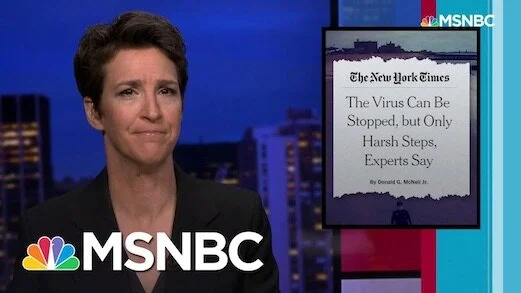
maddow .jpg

At any rate, said book is definitely not apart of The Spectacle as presented to us by ”Doggy.”

Dependent Media - Establishment (dependent) media is both unwilling and incapable of reporting events truthfully, accurately or without extreme bias. News coverage is just that - covering up (masking) and distorting the events and those wielding power behind the events (those reported and deliberately unreported). News coverage has simply become “disinfotaiment” with the sole purpose of perception and knowledge containment as well as reality concealment. You report in the interests of those who are paying you to do so. (see MEDIA, NBC & NEWS).

The Spectacle - a constructed reality; the concrete inversion of life; via the autonomous movement of the apparently non-living. 2) the mirrorization of the noumenon into the phenomenal universe without understanding or overstanding it as such an objectivization in duality. The Spectacle is not a collection of images but a social relation among people mediated by images. The Spectacle is a theoretical construct—a tool for explaining many things about society; how people live vicariously through the dominant images of production, consumption and power relations. It is the thoughtfofms in which people create, contemplate and consume mediated by images of what-life-is, so that they will forget how to live radically for themselves. It is the totality of images and illusions that alienate people from living, its the primary production of modern societies. It is ideology materialized. It is the social relations that are mediated by the mass media; it is what makes people apathetic and reduces them to inactivity. It is what prevents people from realizing what their collective problems are and dissolving them. It is what perpetually absorbs people into activities that prolong their misery. It is the mediated stream of unreality that channels desire-energy against itself, producing a separate world, a pseudo-world apart form one's self-history—from all those powerful institutions of Self-actualization. It is what motivates people to live a pseudo-life in submission to products and machines, basking passively in the acceptance of oppression, to blindly do what is manifestly against their own self-interest, to pollute the land they love and the air they breathe—it is a fundamental sickness of modern societies superimposed over and aided by the "Rolebots" (clones and drones) of Corporate State. It is the mass media and the propaganda from the pure war machine and the military prison industrial police state complex. It is Doggy, the double-bind of not knowing real from unreal, (hypereal) or what you say from what you want. It is the mass objectivization and unholy marriage (union) of the Beasthood with the Syndrome, leaving people fragmented, separated, isolated, alienated, fascinated, pixelated, dilated, intimidated, exasperated, mediated, concatenated, weak, docile, dependent, submissive and uncritical.

Obedient Nigratary (an outspoken, token) Clarence Thomas Writes an Opinion for Supreme Ct Allowing Cops to Stop Any Car Registered to a Person with a Revoked License Regardless of Who is Driving

ACCORDING TO FUNKTIONARY: Nigrataries - (outspoke-token) Negro dignitaries, e.g. Clarence Thomas, JD LJ (Juris Doctorate/Lawn Jockey), Armstrong Williams , L.J. et. al of like ilk. (See cross-overtime, SNiggers, Sambozo, Criss-crossover, Coin-operat…

ACCORDING TO FUNKTIONARY: Nigrataries - (outspoke-token) Negro dignitaries, e.g. Clarence Thomas, JD LJ (Juris Doctorate/Lawn Jockey), Armstrong Williams , L.J. et. al of like ilk. (See cross-overtime, SNiggers, Sambozo, Criss-crossover, Coin-operated & Cross-over).

From [HERE] The Supreme Court on Monday held it does not violate the Fourth Amendment for a police officer to pull over a car because it is registered to a person with a revoked license, so long as the officer does not have reason to believe someone other than the owner is driving the car.  

“We hold that when the officer lacks information negating an inference that the owner is the driver the vehicle, the stop is reasonable,” Justice Clarence Thomas wrote for the majority.

The case dates back to a simple traffic stop in April 2016. While on patrol in Douglas County, Kansas, Sheriff’s Deputy Mark Mehrer pulled over Charles Glover’s 1995 Chevy pickup after running the truck’s plates and finding Glover had a revoked license.

Glover, who was convicted of a misdemeanor for being a habitual violator, admits that he was driving with a revoked license, but says the stop never should have happened because Mehrer did not have reasonable suspicion to pull him over.

In facts stipulated at a suppression hearing before the trial court, Mehrer said he pulled Glover over because he “assumed” the person driving the car was the car’s registered owner. He did not give any other details about the circumstances surrounding the stop, such as the time of day, weather conditions, or how often people whose licenses are revoked drive in the area.

After the state courts flipped back and forth on whether the stop was constitutional, the Kansas Supreme Court eventually sided with Glover.

In a 10-page opinion for the eight-justice majority, Thomas wrote “common sense” supports a police officer’s inference that the person driving a car is its registered owner. The George H. W. Bush appointee noted studies have found people often continue driving even after having their license revoked or suspended, posing a risk to public safety. 

Citing court precedent, he dismissed arguments from Glover and a dissenting Justice Sonia Sotomayor that the stop was invalid because Mehrer did not base his inference that Glover was driving the car on his training and experience [or what he actually observed - the officer never attempted to corroborate any of the details on the record he found, details such as gender, weight, height, age and race). [MORE]

Sotomayor’s dissent is below:

JUSTICE SOTOMAYOR, dissenting.

In upholding routine stops of vehicles whose owners have revoked licenses, the Court ignores key foundations of our reasonable-suspicion jurisprudence and impermissibly and unnecessarily reduces the State’s burden of proof. I therefore dissent.

I

I begin with common ground. The Fourth Amendment permits “brief investigatory” vehicle stops, United States v. Cortez, 449 U. S. 411, 417 (1981), on “facts that do not con- stitute probable cause,” United States v. Brignoni-Ponce, 422 U. S. 873, 881 (1975). To assess whether an officer had the requisite suspicion to seize a driver, past cases have considered the “totality of the circumstances—the whole picture,” Cortez, 449 U. S., at 417, and analyzed whether the officer assembled “fact on fact and clue on clue,” id., at 419.

The stop at issue here, however, rests on just one key fact: that the vehicle was owned by someone with a revoked li- cense. The majority concludes—erroneously, in my view— that seizing this vehicle was constitutional on the record below because drivers with revoked licenses (as opposed to suspended licenses) in Kansas “have already demonstrated a disregard for the law or are categorically unfit to drive.” Ante, at 5. This analysis breaks from settled doctrine and dramatically alters both the quantum and nature of evidence a State may rely on to prove suspicion.

A

The State bears the burden of justifying a seizure. Flor- ida v. Royer, 460 U. S. 491, 500 (1983) (plurality opinion); Brown v. Texas, 443 U. S. 47, 51–52 (1979). This requires the government to articulate factors supporting its reason- able suspicion, usually through a trained agent. See Or- nelas v. United States, 517 U. S. 690, 696 (1996); see also United States v. Sokolow, 490 U. S. 1, 10 (1989). While the Court has not dictated precisely what evidence a govern- ment must produce, it has stressed that an officer must at least “articulate more than an ‘inchoate and unparticular- ized suspicion or “hunch”’ of criminal activity.” Illinois v. Wardlow, 528 U. S. 119, 123–124 (2000) (quoting Terry v. Ohio, 392 U. S. 1, 27 (1968)). That articulation must include both facts and an officer’s “rational inferences from those facts.” Brignoni-Ponce, 422 U. S., at 880, 884. A log- ical “gap as to any one matter” in this analysis may be over- come by “ ‘a strong showing’ ” regarding “ ‘other indicia of reliability.’ ” Florida v. Harris, 568 U. S. 237, 245 (2013). But gaps may not go unfilled.

Additionally, reasonable suspicion eschews judicial com- mon sense, ante, at 5, in favor of the perspectives and inferences of a reasonable officer viewing “the facts through the lens of his police experience and expertise.” Ornelas, 517 U. S., at 699; Cortez, 449 U. S., at 416–418 (explaining that the facts and inferences giving rise to a stop “must be seen and weighed . . . as understood by those versed in the field of law enforcement”); Heien v. North Carolina, 574 U. S. 54, 73 (2014) (SOTOMAYOR, J., dissenting) (“[O]ur enunciation of the reasonableness inquiry and our justification for it . . . have always turned on an officer’s factual conclusions and an officer’s expertise with respect to those factual conclusions”). It is the reasonable officer’s assessment, not the

ordinary person’s—or judge’s—judgment, that matters.1 Finally, a stop must be individualized—that is, based on “a suspicion that the particular [subject] being stopped is engaged in wrongdoing.” Cortez, 449 U. S., at 418; Prado Navarette v. California, 572 U. S. 393, 396–397 (2014). This does not mean that the officer must know the driver’s identity. But a seizure must rest on more than the “likelihood that [a] given person” or particular vehicle is engaged in wrongdoing. Brignoni-Ponce, 422 U. S., at 886–887. The inquiry ordinarily involves some observation or report about the target’s behavior—not merely the class to which he belongs. See, e.g., Navarette, 572 U. S., at 398, 402 (up- holding vehicle stop based on an anonymous tip about driver conduct, interpreted in light of the “accumulated experience of thousands of officers”); Sokolow, 490 U. S., at 10 (evaluating the collective facts giving rise to suspicion that an individual was transporting narcotics instead of relying on law enforcement’s simplified drug courier “ ‘profile’ ”).

B

Faithful adherence to these precepts would yield a significantly different analysis and outcome than that offered by the majority.

For starters, the majority flips the burden of proof. It permits Kansas police officers to effectuate roadside stops whenever they lack “information negating an inference” that a vehicle’s unlicensed owner is its driver. Ante, at 1.

This has it backwards: The State shoulders the burden to supply the key inference that tethers observation to suspicion. The majority repeatedly attributes such an inference to Deputy Mehrer. Ante, at 4, 6, 9. But that is an after-the- fact gloss on a seven-paragraph stipulation. Nowhere in his terse submission did Deputy Mehrer indicate that he had any informed belief about the propensity of unlicensed drivers to operate motor vehicles in the area—let alone that he relied on such a belief in seizing Glover. Ante, at 1–2.

The consequence of the majority’s approach is to absolve officers from any responsibility to investigate the identity of a driver where feasible. But that is precisely what officers ought to do—and are more than capable of doing. Of course, some circumstances may not warrant an officer approaching a car to take a closer look at its occupants. But there are countless other instances where officers have been able to ascertain the identity of a driver from a distance and make out their approximate age and gender. In- deed, our cases are rife with examples of officers who have perceived more than just basic driver demographics. See, e.g., Heien, 574 U. S., at 57 (officer thought that motorist was “ ‘very stiff and nervous’ ”); United States v. Arvizu, 534 U. S. 266, 270 (2002) (officer observed an “adult man” driving who “appeared stiff”); United States v. Ross, 456 U. S 798, 801 (1982) (officer pulled alongside car and noticed that the driver matched a description from an informant); Brignoni-Ponce, 422 U. S., at 875 (officers stopped a vehicle whose occupants “appeared to be of Mexican descent”). The majority underestimates officers’ capabilities and instead gives them free rein to stop a vehicle involved in no suspi- cious activity simply because it is registered to an unli- censed person. That stop is based merely on a guess or a “hunch” about the driver’s identity. Wardlow, 528 U. S., at 124 (internal quotation marks omitted).

With no basis in the record to presume that unlicensed drivers routinely continue driving, the majority endeavors to fill the gap with its own “common sense.” Ante, at 5. But simply labeling an inference “common sense” does not make it so, no matter how many times the majority repeats it. Cf. ante, at 5, 6, 7, 8. Whether the driver of a vehicle is likely to be its unlicensed owner is “by no means obvious.” Ante, at 1 (KAGAN, J., concurring). And like the concurrence, I “doubt” that our collective judicial common sense could an- swer that question, even if our Fourth Amendment juris- prudence allowed us to do so. Ante, at 3.

Contrary to the majority’s claims, ante, at 3–5, 7, the reasonable-suspicion inquiry does not accommodate the average person’s intuition. Rather, it permits reliance on a particular type of common sense—that of the reasonable officer, developed through her experiences in law enforcement. Cortez, 449 U. S., at 418. This approach acknowledges that what may be “common sense” to a layperson may not be relevant (or correct) in a law enforcement context. Indeed, this case presents the type of geographically localized inquiry where an officer’s “inferences and deductions that might well elude an untrained person” would come in handy. Ibid.; see also Arvizu, 534 U. S., at 276 (prizing an officer’s “specialized training and familiarity with the cus- toms of the area’s inhabitants”). By relying on judicial in- ferences instead, the majority promotes broad, inflexible rules that overlook regional differences.

Allowing judges to offer their own brand of common sense where the State’s proffered justifications for a search come up short also shifts police work to the judiciary. Our cases—including those the majority cites—have looked to officer sensibility to establish inferences about human be- havior, even though they just as easily could have relied on the inferences “made by ordinary people on a daily basis.” Ante, at 6. See, e.g., Navarette, 572 U. S., at 402 (pointing to “the accumulated experience of thousands of officers” to identify certain “erratic” behaviors “as sound indicia of drunk driving”); Wardlow, 528 U. S., at 124 (permitting of- ficers to account for the relevant characteristics of a loca- tion when interpreting whether flight from police is “eva- sive”); Sokolow, 490 U.S., at 9–10 (crediting the evidentiary significance of facts “as seen by a trained agent” to identify a suspicious traveler). There is no reason to de- part from that practice here.

Finally, to bolster its conclusion as grounded in “common experience,” the majority cites “empirical studies.” Ante, at 4. But its use of statistics illustrates the danger of relying on large-scale data to carry out what is supposed to be a particularized exercise. Neither of the referenced reports tells us the percentage of vehicle owners with revoked li- censes in Kansas who continue to drive their cars. Neither report even offers a useful denominator: One lumps drivers with suspended and revoked licenses together, while the other examines the license status of only motorists involved in fatal collisions. The figures say nothing about how the behavior of revoked drivers measures up relative to their licensed counterparts—whether one group is more likely to be involved in accidents, or whether the incidences are com- parable—which would inform a trooper’s inferences about driver identity.

As the concurrence recognizes, while statistics may help a defendant challenge the reasonableness of an officer’s actions, they “cannot substitute for the individualized suspicion that the Fourth Amendment requires.” Ante, at 4–5, n. If courts do not scrutinize officer observation or expertise in the reasonable-suspicion analysis, then seizures may be made on large-scale data alone—data that say nothing about the individual save for the class to which he belongs. That analytical approach strays far from “acting upon ob- served violations” of law—which this Court has said is the “foremost method of enforcing traffic and vehicle safety regulations.” Delaware v. Prouse, 440 U. S. 648, 659 (1979).

The majority today has paved the road to finding reason- able suspicion based on nothing more than a demographic profile. Its logic has thus made the State’s task all but automatic. That has never been the law, and it never should be.

II

The majority’s justifications for this new approach have no foundation in fact or logic. It supposes that requiring officers to point to “training materials or field experiences” would demand “‘scientific certainty.’” Ante, at 3. But that is no truer in this case than in other circumstances where the reasonable-suspicion inquiry applies. Indeed, the State here was invited to stipulate to the evidence it relied on to make the stop. It could have easily described the individual or “accumulated experience” of officers in the jurisdiction. Cf. Navarette, 572 U. S., at 402. The State chose not to pre- sent such evidence and has not shown that it could not have done so. Accordingly, it has proved no harm to itself.2

In fact, it is the majority’s approach that makes scant pol- icy sense. If the State need not set forth all the information its officers considered before forming suspicion, what conceivable evidence could be used to mount an effective challenge to a vehicle stop, as the concurrence imagines? Ante, at 4. Who could meaningfully interrogate an officer’s action when all the officer has to say is that the vehicle was registered to an unlicensed driver? How would a driver counter

——————
2 The majority suggests that requiring the State to supply the missing link between fact and suspicion would “considerably narrow the day- light” between the reasonable-suspicion showing and that required to es- tablish probable cause. Ante, at 7. But that may simply be a feature of this unique context, where the difference between a permissible and im- permissible stop turns on a single fact. Given that reasonable suspicion and probable cause are not “reducible to ‘precise definition or quantifica- tion,’ ” Florida v. Harris, 568 U. S. 237, 243 (2013), the gradation be- tween the two is bound to vary from case to case.

8 KANSAS v. GLOVER SOTOMAYOR, J., dissenting

that evidence—by stating that they were of a different age or gender than the owner and insisting that the officer could have easily discerned that? And where would a defendant bring his arguments if the trial judge makes the key infer- ence, or by the same token, fails to make an inference that “might well elude” the untrained? Cortez, 449 U. S., at 418.

Moreover, the majority’s distinction between revocation and suspension may not hold up in other jurisdictions. For one, whether drivers with suspended licenses have “demonstrated a disregard for the law or are categorically unfit to drive” is completely unknown. And in several States, the grounds for revocation include offenses unrelated to driving fitness, such as using a license to unlawfully buy alcohol. See, e.g., Ky. Rev. Stat. Ann. §186.560 (West Cum. Supp. 2019); Mont. Code Ann. §61–5–206 (2019); R. I. Gen. Laws §31–11–6 (2010). In yet other jurisdictions, “revocation” is the label assigned to a temporary sanction, which may be imposed for such infractions as the failure to comply with child support payments. Okla. Stat., Tit. 47, §6–201.1 (2011). Whether the majority’s “common sense” assumptions apply outside of Kansas is thus open to challenge.

***

Vehicle stops “interfere with freedom of movement, are inconvenient, and consume time.” Prouse, 440 U. S., at 657. Worse still, they “may create substantial anxiety” through an “unsettling show of authority.” Ibid. Before subjecting motorists to this type of investigation, the State must possess articulable facts and officer inferences to form suspicion. The State below left unexplained key components of the reasonable-suspicion inquiry. In an effort to uphold the conviction, the Court destroys Fourth Amendment jurisprudence that requires individualized suspicion. I respectfully dissent.


U Sure You Live Here? Fed Ct says If Anyone Else Beat Down Shase Howse on his Own Front Porch it would be Illegal but The Law of the Jungle [‘immunity’] Governs Relations btw Cops & Black People

trump's minions .jpg

From [HERE] A Black man who was approached and beaten by white plainclothes Cleveland officers right outside his own front door filed an en banc petition with the Sixth Circuit Court of Appeals on Wednesday seeking to have his lawsuit against the men reheard by all of the circuit’s judges. That move happened after a three-judge panel ruled that the officers were protected from litigation by “qualified immunity.”

The petition, filed by the NAACP Legal Defense and Educational Fund (LDF) and attorney James Hardiman on behalf of Shane Howse, claimed the court misconstrued the law when granting qualified immunity to the officers and dismissing the lawsuit.

Qualified immunity or “the law of the jungle” is a heavily-criticized legal doctrine developed by the Supreme Court.  It shields police from civil liability for any conduct that does not violate a person’s “clearly established” constitutional rights. But in order for such a right to be “clearly established,” the particular conduct of the alleged violator must have previously been established to such an extent as to place the statutory or constitutional question beyond debate – a subjective, and often times absurdly high bar for plaintiffs to clear.

Howse claimed he had just gotten home from a convenience store and began climbing the steps to his front porch when an unmarked police car pulled up and two plainclothes officers asked if he lived in the house. The officers, Thomas Hodous and Brian Middaugh, said they thought Howse was “lingering suspiciously” and “looked nervous,” so they asked if he was “sure” he lived there. Howse said “something like ‘yes, what the f—’ in response,” prompting one officer to say he had a “smart mouth and a bad attitude.”

The officers then attempted to arrest Howse, who insisted he had done nothing wrong, by bringing him to the ground with a leg sweep and punching him repeatedly in the neck.

Howse was charged with assaulting an officer but the charges were soon dismissed. He then sued the officers for violating his Fourth Amendment rights and committing assault and battery.

In a 2-1 decision last month, the U.S. Court of Appeals for the Sixth Circuit ruled that the officers’ actions were unlawful.  However, the majority said the officers were entitled to qualified immunity – meaning they could not be liable for their actions in a civil lawsuit – because “the unlawfulness of their conduct” had not be clearly established at the time they arrested Howse.

In a petition filed Wednesday, Howse’s attorneys argued that the court incorrectly defined the “clearly established” portion of the qualified immunity test by looking for a case involving Howse’s specific conduct as opposed to the officers’.

“Had the panel majority focused instead on whether the officers’ conduct was ‘clearly unlawful’ in light of established law concerning ‘unreasonable government intrusions,’ it would have recognized that the officers were not entitled to qualified immunity,” the petition stated.

“Rather than look for a case involving an officer who ‘tackle[d] someone who disobeyed an order,’ the Court should have analyzed whether it was lawful for the officer to: (a) accost Mr. Howse on his front porch and tell him he was going to jail, i.e., to arrest him, without probable cause, and (b) to tackle him even though he did not resist, and then punch him twice in the neck. In both respects, Officer Middaugh’s conduct was clearly unlawful.” [MORE]
American Courts
Malcolm X

Specifically, according to the Petition for Rehearing:

On July 28, 2016, at approximately 9:00pm, Shase Howse, then 20 years old, walked from his home in Cleveland, Ohio, to a nearby convenience store. Mr. Howse returned home and was standing on his front porch, talking on the phone with his mother. He was about to open the front door with his key when a man in plainclothes, riding in an unmarked car—later identified as Detective Brian Middaugh—asked Mr. Howse, “Is this your house?”

All parties agree that Mr. Howse had not committed any crime. Mr. Howse responded, “Yes, this is my house, I live here.” Id. The car started to pull off, but the questioning officer told the driver to back up.

The man then asked Mr. Howse a second time whether that was his house; Mr. Howse responded by saying, “Yes, . . . what the f---?”

According to Mr. Howse, the man in the car responded by saying, “You have a smart mouth and a bad attitude.”

Detective Middaugh exited the car and asked again if Mr. Howse lived there. Mr. Howse responded, “yes, I live here. I live here.”

At that point, without any provocation, Detective Middaugh told Mr. Howse to put his hands behind his back because he was going to jail.

Mr. Howse responded, “[N]o, I live here. I am going home. I am not doing anything.”

Detective Middaugh walked onto the porch and grabbed Mr. Howse, at which point Mr. Howse screamed at the top of his lungs, “I live here. I live here.”

Detective Middaugh responded by throwing Mr. Howse to the porch floor and attempting to handcuff him, but Mr. Howse stiffened his body to avoid being handcuffed.

At this point, Mr. Howse’s mother arrived, asked the officers what they were doing, and identified Mr. Howse as her son.

Mr. Howse heard his mother’s voice and looked up to her, and Detective Middaugh punched him twice in the neck. Mr. Howse never attempted to hit, knock over, or push Detective Middaugh and remained nonviolent. The detectives handcuffed Mr. Howse, lifted him from the porch floor, and put him in the back of the patrol car. Mr. Howse suffered a bruised neck and scratches from the officer tackling and punching him.

Although Mr. Howse had personal identification confirming his address in his pocket, the officers never asked to see his identification.

Next, the detectives transported Mr. Howse to central booking in downtown Cleveland, where Detective Middaugh completed a complaint charging Mr. Howse with assault and battery of a police officer. R29-5, Exh., 736. Detectives Middaugh and Hodous also completed “Use of Force” reports asserting that Mr. Howse resisted arrest and struck the officers. R37-2, Exh., p. 866; R37-4, Exh., p. 881. Mr. Howse spent three days and two nights in jail before his mother secured his release by posting a $1,000 bond. [MORE]

1 Territorial Gangster Outdoing the Other: Chinese Gov Asserts Claim to Global Leadership by Providing Supplies to Other Nations while Trump Raises His Liarability Rating & Floats More Paper Boats

The 1,000-Bed Comfort Was Supposed to Aid New York. It Has 3 Patients. “It’s a joke,” said a top hospital executive, whose facilities are packed with coronavirus patients. Probably sounded good though to Trump’s stupid believers. More at the bottom of the story.

US Govt Only Prepared to Wage Wars. From [WSJ] New York City’s Times Square stands empty, a testament to the threat the coronavirus poses to the biggest U.S. city. 

Meanwhile, 7,500 miles to the east, young people celebrate the end of quarantine over hotpot in a crowded restaurant in the Chinese city of Chengdu. 

And in Fujian province, a team of Chinese virus experts heads to the airport for a chartered flight to help an overwhelmed Italy.

The three images, posted close to each other on the Twitter feed of China’s official Xinhua News Agency one day last week, encapsulate a sweeping effort by the Communist Party to craft the story of the pandemic and cast China in the role of global savior. 

Chinese President Xi Jinping, speaking by video link to other leaders of the Group of 20 nations last week, said his country had made tremendous sacrifices to curtail the virus’s spread at home and would now help others.

China’s French embassy put it in starker terms in a tweet storm. “When the epidemic started to explode everywhere, it was China who the entire world asked for help, and not the United States, the ‘beacon of democracy,’” the embassy said. “It is China who lent a helping hand to more than 80 nations. Not the United States.”

China, the country where the virus first appeared and claimed its first several thousand lives, is now using the global spread of the disease to bolster an increasing vocal, assertive bid for global leadership that is exacerbating a yearslong conflict with the U.S. 

Combined with deliveries of essential goods, this public-relations push has enabled China to stake a claim to a void on the global stage left by an inward-looking America—while also helping Chinese leaders distract attention at home from criticism they mishandled the early stages of the outbreak.

Over a two-week period in March, Chinese government agencies, companies and charities donated more than 26 million face masks, 2.3 million testing kits and other supplies to 89 countries, according to a review of state media reports and government and company statements. On Tuesday, China’s Foreign Ministry said the number of countries receiving its coronavirus-related help has reached 120.

In hard-hit countries such as Italy, the aid has sparked ire that China was quicker to respond than closer allies such as Germany or the U.S. [MORE]

The NYT states: “Such were the expectations for the Navy hospital ship U.S.N.S. Comfort that when it chugged into New York Harbor this week,throngs of people, momentarily forgetting the strictures of social distancing, crammed together along Manhatt…

The NYT states: “Such were the expectations for the Navy hospital ship U.S.N.S. Comfort that when it chugged into New York Harbor this week,throngs of people, momentarily forgetting the strictures of social distancing, crammed together along Manhattan’s west side to catch a glimpse.

On Thursday, though, the huge white vessel, which officials had promised would bring succor to a city on the brink, sat mostly empty, infuriating local hospital executives. The ship’s 1,000 beds are largely unused, its 1,200-member crew mostly idle.

Only three patients had been transferred to the ship, officials said, even as New York hospitals struggled to find space for the thousands infected with the coronavirus. Another Navy hospital ship, the U.S.N.S. Mercy, docked in Los Angeles, has had a total of 15 patients, officials said.

“If I’m blunt about it, it’s a joke,” said Michael Dowling, the head of Northwell Health, New York’s largest hospital system. “Everyone can say, ‘Thank you for putting up these wonderful places and opening up these cavernous halls.’ But we’re in a crisis here, we’re in a battlefield.”

The Comfort was sent to New York to relieve pressure on city hospitals by treating people with ailments other than Covid-19, the illness caused by the coronavirus.

President Trump left a nine-day sequester in the White House last week to travel to Norfolk, Va., to personally see off the ship as it set sail for New York, saying it would play a “critical role.” The ship’s arrival on Monday was cheered as one of the few bright moments in a grim time for the city.

But the reality has been different. A tangle of military protocols and bureaucratic hurdles has prevented the Comfort from accepting many patients at all.“

While Promoting the Spread of Negrosis, Trump's SNiggers, Diamond & Silk, say the Media is exaggerating the Coronavirus to Make their Master Look Bad

From [MW] Even some of the staunchest Trump supporters have backed away from the idea that the coronavirus pandemic is a “media hoax” aimed at destroying the president’s chances for re-election. 

Not Diamond and Silk.

The vloggers, who are frequent Fox News guests and have their own show on the streaming channel Fox Nation, suggested Monday that the surge in reported deaths from the coronavirus outbreak is merely a media tactic “to make it look bad in front of our eyes.”

Diamond and Silk, who have visited Trump at the White House, have also popped up regularly on the president’s Twitter feed over the past few years.

Soon after Monday’s clip was posted, “Diamond & Silk” shot up Twitter’s trending charts [MORE

LOOK AT THE NICE CRIB IN THE BACKGROUND. ELITES KEEP THESE STUPID HOUSE SNIGGERS PAID TO PROMOTE NEGROSIS. FUCK YOU.

LOOK AT THE NICE CRIB IN THE BACKGROUND. ELITES KEEP THESE STUPID HOUSE SNIGGERS PAID TO PROMOTE NEGROSIS. FUCK YOU.

According to "FUNKTIONARY:

Negrosis - the psychological disease affecting and afflicting native Black Americans, Afrikans, Afrikan-Americans, Negroes and all other people of Afrikan genetic heritage characterized by double-consciousness resulting from the falsification of Afrikan consciousness, history and applied spiritual sciences. (See: Double-Consciousness & Asili)

BOHICAN means "Bend Over Here It Comes Again Negro." One who is the final token.

sniggering - 1) the modus vivendi of opportunist (sell-out) compromises. 2) the actions of SNiggers. (See Coin-Operated). 

SNigger ---a sold-out snitching-smiling Sambo-Negro. 2) a South-Bender offender. SNiggers smile for nothing except an empty mind while selling-out their own kind. They typically have an intellectual base yet are devoid of intelligence, thus promoting the on-going smiling face. They also often giggle and have a frivolous conception of society and scant knowledge of the vestiges of the trans-Atlantic slave trade that even brought their sorry-ass selves to shore. SNiggers are traitors and pawns of the downpressors. [MORE

Sambo - a self-loathing Negro lacking self-knowledge. "A willing slave gets upset if you refuse to acknowledge his or her master. 

Although Dr. Phil Valentine probably has very little in common with BOHICANS Diamond & Silk and does not promote white supremacy he also has indulged in corona virus conspiracy theory. Observe that studying and analyzing conspiracies in and of itself does not help an individual stop the conspiracy, solve his problem or otherwise prevent the conspiracy from harming them. At any rate, by the time an individual has figured out the conspiracy there is most likely nothing that can be done to stop it. Like Ice Cube said, ‘you knew the game and you still ended up on your back. Now ask yourself . . . who’s the mack?’ Not hating on Dr. Phil but analyzing conspiracies, without more does not empower Black people in tangible ways and can lead to a state of apathy.

Apathy - the indifference that makes the difference in whether or not you assert your phfreedom or remain a slave-subject. 2) rationalization for repression of interest. 3) listless disinterest; hum-drum-glum It is one thing to live, another to die. But to sit by and watch is a terrible lie.

Apathy is the pivotal position on which turns the swing towards either doomsday (naysayer nihilism) or “bloomsday"--a shitting and flowering of collective consciousness. It's time to supersize your life--live @Large! (See: Psychic Blockade, Orderlies, Conformity, Unlearning, Alive, Awakening, Bozone Layer & Greater System)

Conspiracy Theories - the notion that one particular group or combination of a group of going concerns plot and execute control over the various dwellers upon the land--when in reality no one controls Control, however there are a conglomerate of individuals, Secret Orders and owners of inter-generational dynastic families who administer the greed that control breeds by "The Greater System" via intrigue primarily within the veil of granfalloons (so-called "governments") for their collective nefarious vested interests at the expense, detriment, and or demise of the life-force of the real wealth producers in the lands. Conspiracy theories, however well they accurately explain historical events, tempt citizens and orglings to the "sins" of irresponsible apathy and willfully ambiguous incomprehension or misinterpretation. (See: The Greater System, Doggy. Leviathan, Gangbanking, Freemasonry, C.I.A, Corporations, Yurugu, Control, Psychological Reversal & White Supremacy) [MORE]

Gun Stores are Deemed ‘Essential’ [b/c Guns are Essential, especially when Unaccountable Government Doesn’t Serve Black and Latino People and Cops are Authorized to Murder Them in Broad Daylight]

9th Circuit Judge Alex Kozinski summed up the importance of the right to keep and bear arms: "The prospect of tyranny may not grab the headlines the way vivid stories of gun crime routinely do. But few saw the Third Reich coming until it was too lat…

9th Circuit Judge Alex Kozinski summed up the importance of the right to keep and bear arms: "The prospect of tyranny may not grab the headlines the way vivid stories of gun crime routinely do. But few saw the Third Reich coming until it was too late. The Second Amendment is a doomsday provision, one designed for those exceptionally rare circumstances where all other rights have failed—where the government refuses to stand for reelection and silences those who protest; where courts have lost the courage to oppose, or can find no one to enforce their decrees. However improbable these contingencies may seem today, facing them unprepared is a mistake a free people get to make only once." The right to keep and bears arms actually serves as more than an insurance policy, it also serves as a deterrent. For when would-be tyrants know that the citizenry is well-armed, they think twice about imposing tyranny. (See: Gun Control & Militia) FUNKTIONARY

From [CNS] The Trump administration has ruled that gun shops are “essential” businesses that should remain open as other businesses are closed to try to stop the spread of coronavirus. Gun-control groups are balking, calling it a policy that puts profits over public health after intense lobbying by the gun industry.

In the past several weeks, various states and municipalities have offered different interpretations of whether gun stores should be allowed to remain open as Americans stay at home to avoid spreading the virus. In Los Angeles, for example, County Sheriff Alex Villanueva has twice ordered gun shops in his territory to close, leading to legal challenges from gun groups.

After days of lobbying by the National Rifle Association, the National Shooting Sports Foundation and other gun groups, the Department of Homeland Security last weekend issued an advisory declaring that firearms dealers should be considered essential services —like grocery stores, pharmacies and hospitals — and allowed to remain open. The agency said its ruling was not a mandate but merely guidance for cities, towns and states as they weigh how to prevent the spread of the coronavirus.

Gun control groups called it a move to put profits over public health. The Brady group on Monday filed a Freedom of Information request with DHS seeking emails and documents that explain how the agency reached its decision to issue the advisory and to determine if it consulted with any public health experts.

“The gun lobby is not willing to stand for a few days or a few weeks of less profit in order to protect public health, and it’s outrageous and definitely not required by the Second Amendment,” said Jonathan Lowy, chief counsel for Brady.

He added: “It’s a public health issue, not a Second Amendment issue. The fact is that guns, the nature of guns, require that they be sold with a lot of close interaction. They can’t be sold from vending machines, can’t be sold with curbside pickup.”

The gun lobby has been pushing back vigorously against places where some authorities have deemed federally licensed gun dealers are not essential and should close as part of stay-at-home directives.

Gun sales have skyrocketed in recent weeks. Background checks — the key barometer of gun sales — already were at record numbers in January and February, likely fueled by a presidential election year. Since the coronavirus outbreak, gun shops have reported long lines and runs on firearms and ammunition.

Background checks were up 300% on March 16, compared with the same date a year ago, according to federal data shared with the NSSF, which represents gunmakers. Since Feb. 23, each day has seen roughly double the volume over 2019, according to Mark Oliva, spokesman for the group.

The Texas attorney general issued a legal opinion saying that emergency orders shuttering gun shops are unconstitutional. That stands in contrast to some municipalities, such as New Orleans, where the mayor has issued an emergency proclamation that declares the authority to restrict sales of guns and ammunition.

The NSSF and other gun lobbying groups hailed the ruling as a victory for gun owners.

Brady’s Lowy said it should not be considered a violation of Second Amendment rights since it’s temporary and in the midst of a pandemic. He likened it to constitutional rights to peaceably assemble, a right that is being curtailed at the moment as Americans practice social distancing.

“If you have a gun in the home, you are exercising your Second Amendment rights. No court has held that you have a Second Amendment right to a stockpile of guns,” he said.

The vast majority of states are allowing gun shops to remain open. However, some states that have been the hardest hit by the coronavirus have ruled that gun shops are not essential and should close. In the absence of a mandate from federal authorities, gun groups have been filing lawsuits challenging state and local authorities who are ordering gun shops and ranges to close. [MORE]

“Is he a black guy?" Suit says White Paramedics Did Nothing but Watch White Greensboro Cops Murder Marcus Smith by Hogtying Him & Bending his Knees Beyond a 90° Angle While Prone on the Ground

hog tying in NC.jpg

From [HERE] A March 25 ruling by U.S. district court judge Loretta C. Biggs allows the Federal Civil Rights lawsuit over the fatal hogtying of Marcus Deon Smith to move forward. The estate of Marcus Smith filed the lawsuit alleging that Greensboro Police Officers caused Marcus’s death by brutally restraining him prone on the ground and hogtying him like an animal until he stopped breathing, and the Guilford County EMS Paramedics, who were called to the scene, failed to intervene to protect Marcus from the use of unreasonable force and failed to promptly attend to his serious medical needs. His family has claimed that the force was unnecessary, unreasonable and excessive because Marcus was not engaged in any criminal conduct, was unarmed, made no threats to the police or others, presented no immediate danger to the officers, himself or to others, was not actively resisting arrest, and was particularly vulnerable to the excessive force because of his delusional and agitated mental state.

The lawsuit claims the written and de facto policies, practices and customs of Defendant City of Greensboro and its Police Department contributed to and were a moving force behind Marcus’s death, as the Defendant officers were acting pursuant to these policies, practices and customs, that included the use of restraint devices to hogtie people who are in a prone position, and the treatment of people who experience mental health crises.

Judge Briggs dismissed all counts against Guilford County, but allowed many against the City of Greensboro and police officers Justin Payne, Robert Duncan, Michael Montalvo, Alfred Lewis, Christopher Bradshaw, Lee Andrews, Douglas Strader and Jordan Bailey.

Also named as defendants are Guilford County EMTs Ashley Abbott and Dylan Alling. Judge Biggs let stand claims against the paramedics for violating Smith’s 14th Amendment right to equal protection under the law and due process, but dismissed claims that they violated Smith’s 4th Amendment right against illegal search and seizure. She let stand both 4th and 14th Amendment counts against the city and its eight officers.

The judge also dismissed claims that Smith’s rights under the Americans with Disabilities Act had been violated, and death/medical malpractice claims against the paramedics.

According to the complaint:

Marcus Deon Smith was a 38 year-old African American man, who had been diagnosed with bipolar disorder and schizophrenia. On September 8, 2018, shortly after midnight, Defendant Greensboro Police

Officers Payne, Duncan, Montalvo, Lewis, Bradshaw, Andrews, Strader, and Bailey encountered Marcus on North Church Street in Greensboro near the North Carolina Folk Festival that was happening downtown.

Marcus was pacing back and forth in the street and running around in circles. He appeared exasperated and frantic and was waving his arms in the air. He begged the officers for help, repeatedly stating, “Please help me, sir,” and to be taken to the hospital.

Defendants believed that Marcus was under the influence of drugs.

Marcus was unarmed, was not violent, and was not trying to flee.

Defendants called an ambulance to take Marcus to a hospital. While waiting for the ambulance to arrive, Defendants asked Marcus to get in the back of one of the police cars and told him they would take him to the hospital.

Marcus voluntarily entered the back of a police car, but after a short period of time of being alone in the car with no one driving him to the hospital as Defendants told him they would do, he began to panic and thrash around because he wanted to get out.

Marcus was not under arrest. He tried to open the door of the car, but it was locked, so he banged his hand against the window to get the Defendants’ attention. 31. Defendant Duncan then stated, “we probably ought to RIPP Hobble him.”

Marcus was not under arrest. He tried to open the door of the car, but it was locked, so he banged his hand against the window to get the Defendants’ attention.

Defendant Duncan then stated, “we probably ought to RIPP Hobble him.”

A RIPP Hobble is a restraint device used by police that is manufactured by a company called RIPP Restraints International. It consists of a belt-like strap made of polypropylene that is placed around an arrestee’s ankles to restrain their feet. The other end of the strap contains a hook and can be attached to the arrestee’s handcuffs.

By this time, Defendants Guilford County Emergency Medical Service paramedics Ashley Abbott and Dylan Alling arrived on the scene.

Defendant Strader spoke with Defendant Abbott and reported his observations of Marcus’s behavior. Defendant Abbott responded by asking, “is he a black guy?” to which Defendant Strader responded, “yes.”

The police Defendants then opened the door of the car and Marcus quickly got out.

Marcus did not kick or hit or threaten any of the Defendants or others as he got out of the car.

Defendant Duncan grabbed Marcus, and he and the other police Defendants forced Marcus down to the ground and then rolled Marcus onto his stomach in the prone position.

Marcus cried out in pain and said, “please don’t do that!” and “I’m not resisting!” Marcus was grunting and groaning and moving his body, but he was not actively resisting the Defendants.

While the police Defendants held Marcus down, Defendant Duncan handcuffed Marcus’s hands behind his back.

Defendants then hogtied Marcus while he was prone on the ground. Defendant Payne grabbed Marcus’s ankles and pushed Marcus’s feet toward his hands with extreme and unnecessary force, bending Marcus’s knees well beyond a 90 degree angle. Defendant Payne

pushed Marcus’s feet all the way to the point that they were touching his handcuffed hands at the small of his back.

Defendants Duncan, Andrews and Montalvo used the RIPP Hobble device to bind Marcus’s hands to his feet behind his back while Defendant Payne continued to violently push Marcus’s feet toward his back, causing Marcus’s knees to continue to be bent well beyond a 90 degree angle.

Defendants Andrews and Montalvo then tightened the strap on the RIPP Hobble device so tight that Marcus’s shoulders and his knees were suspended above the ground.

Defendants’ unreasonable use of force placed extreme stress on Marcus’s chest and severely compromised his ability to breathe.

During the course of this brutal hogtying, Marcus was wheezing, moaning, groaning, gasping for air, and in obvious respiratory and physical distress.

Marcus’s breathing quickly became strained and less than half a minute later he became unable to breathe and was unresponsive.

During and after the hogtying, Defendants allowed Marcus to remain prone on his stomach, with his knees bent well beyond 90 degrees, and they failed to continuously monitor Marcus’s condition and breathing.

Defendants Lewis, Bradshaw, Strader and Bailey were either holding Marcus down or standing right next to him during the prone restraint and hogtying. They each had the opportunity, duty and ability to intervene on behalf of Marcus, but failed to do so.

Defendants Abbott and Alling were also standing next to Marcus during the prone restraint and hogtying. They each had the opportunity, duty and ability to intervene on behalf of Marcus, but failed to do so.

A few moments after Marcus stopped breathing, one of the police Defendants looked down and saw that Marcus’s eyes were closed and ascertained that Marcus was unresponsive.

Defendants then placed Marcus on a gurney to move him inside of an ambulance.

Defendants Abbott and Alling knew Marcus was unconscious, unresponsive and not breathing, yet waited longer than two minutes to begin any resuscitative efforts. When they finally placed Marcus in the ambulance and attempted to resuscitate him, their efforts were unsuccessful. 52. The North Carolina Office of the Chief Medical Examiner determined that the manner of death was “homicide” and the cause of death was “sudden cardiopulmonary arrest due to prone restraint; n-ethylpentalone, cocaine, and alcohol use; and hypertensive and atherosclerotic cardiovascular disease.”

As a direct and proximate cause of the actions and inactions of Defendants as detailed above and below, Marcus suffered, among other things, bodily injury, pain, suffering, severe emotional distress and death.

Defendants’ conduct, as alleged herein, was unreasonable, conscience-shocking, and was undertaken in reckless disregard for the consequences to Marcus and his family.

Racist Suspect Federal Prosecutors Decline to File Charges Against 2 White Colorado Springs Cops who Murdered De'Von Bailey - Shot in the Back 3x as He Fled

D'von Bailey.jpg

From {HERE] Two white Colorado Springs police officers who fatally shot 19-year-old De'Von Bailey in the back as he fled an arrest in August did not violate federal law, authorities said Friday.

The U.S. Attorney's Office and the Denver field office of the FBI will not pursue charges against officers Alan Van’t Land and Blake Evenson.

"Both offices concluded that the fatal shooting of Mr. Bailey, although undoubtedly devastating to his family, friends, and community, did not result from any willful violation of Mr. Bailey’s constitutional rights," the agencies said in a joint statement. 

The Bailey family's attorney, Danny Kay, said he was notified of the decision earlier Friday. 

"They never contacted me about a review, or any of my clients, so I don’t know what review they looked at," Kay said. 

The news comes four months after an El Paso County grand jury also cleared Van't Land and Evenson of criminal wrongdoing. The panel ruled the shooting was justified.  

Bailey was shot repeatedly in the back when he turned and ran while being questioned about a reported armed robbery. He and his cousin, Lawrence Stoker, were stopped near a school on Aug. 3 in a neighborhood southeast of Memorial Park.

The officers said they shot him because they feared Bailey, who was later found to have a pistol in the pocket of his shorts, was reaching for a weapon as he ran.  

Police body-camera footage showed officers approach Bailey and Stoker, and question them about the reported robbery. When one of the officers approached Bailey to search for a gun, he dropped his arms, turned and ran away, the video showed.

On the video, both officers can be heard ordering Bailey to put up his hands before they fired.