The Declaration of Independence Encourages the Overthrow of Government that Rules by Force. If You Never Signed An Agreement Allowing the US Gov to Rule You then What is the Basis of Its Authority?
/
According to FUNKTIONARY:
Declaration of Independence – a 1,300 word document purportedly signed on July 4, 1776. Independence (for one faction of African-enslaving Caucasians versus another) was resolved and the signing by the Second Continental Congress took place two days prior July 2, 1776. The document was first published in two Pennsylvania papers on July 3, 1776. Erect members of Congress voted on the Declaration on July 4, 1776, but it wasn't until July 8th that the document was proclaimed by being read publicly from the balcony of Independence Hall. The official title of the document is “The Unanimous Declaration of the Thirteen United States of America,” with the word “Independence” occurring nowhere in the title. The Declaration of Independence is now widely known by those of African descent in Amerikka as the Fourth of Their Lie. The Declaration of Independence is a document declaring liberty written to encourage the overthrow of a government systematically and summarily violating the unalienable rights and liberties of those who empowered it into being. The State is always-only-ever a mask for other men. (See: Thirteen, Constitution, Declaration of Undie-Pendence, Gangster Government, Government, Constitutional Protections, Articles of Confederation, Constitution for the United States of America, Internal Revenue Service, Citizen of the United States, Granfalloon & Freemasonry
Independence Day – The Fourth of Their Lie. (See: Constitution & Declaration of Undie-Pendance)
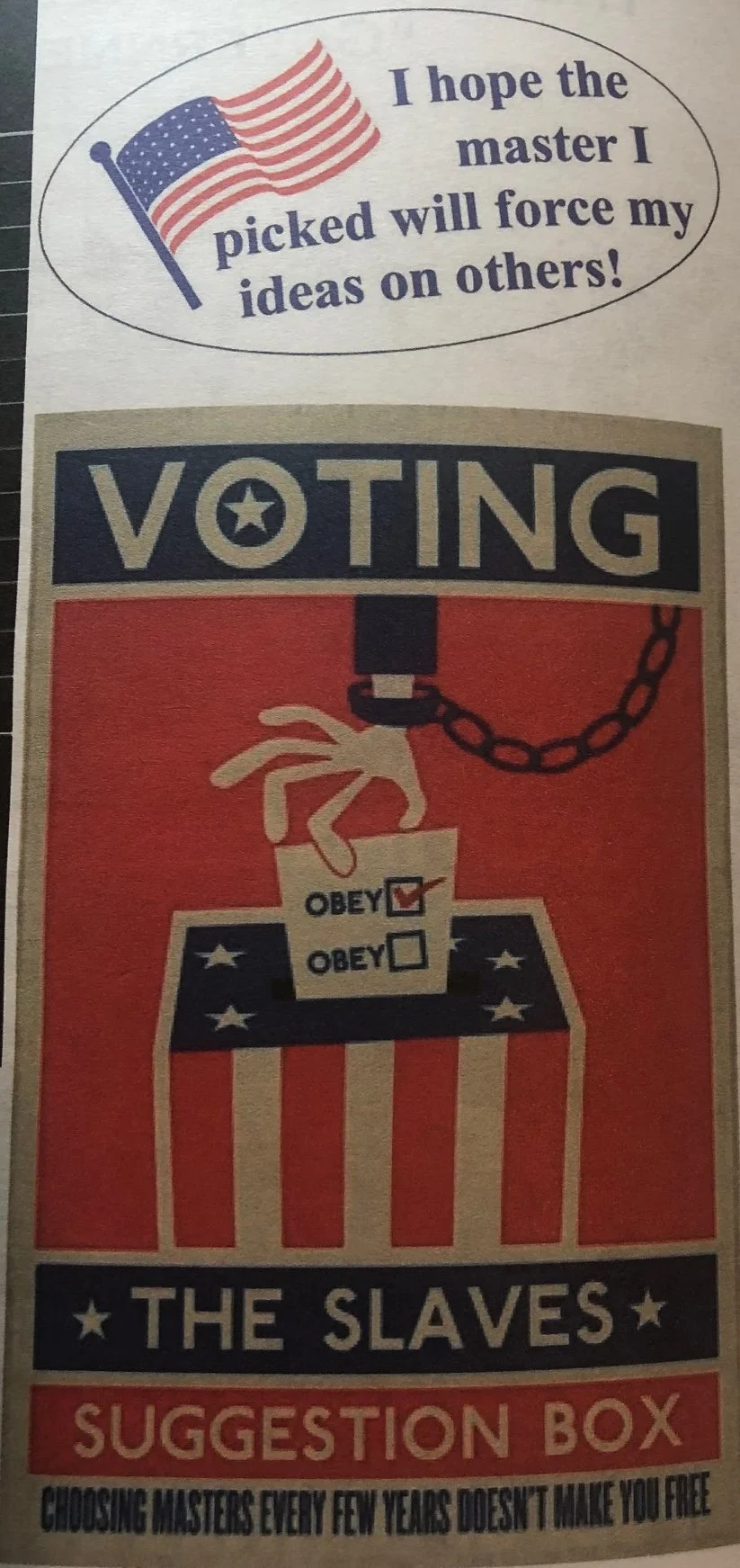
The Social Contract is Mind Control. According to Michael Huemer:
“The social contract theory cannot account for political authority. The theory of an actual social contract fails because no state has provided reasonable means of opting out – means that do not require dissenters to assume large costs that the state has no independent right to impose. All modern states, in refusing to recognize explicit dissent, render their relationships with their citizens nonvoluntary. Most accounts of implicit consent fail, because nearly all citizens know that the government’s laws would be imposed upon them regardless of whether they performed the particular acts by which they allegedly communicate consent. In the case of those governments that deny any obligation to protect individual citizens, the contract theory fails for the additional reason that, if there ever was a social contract, the government has repudiated its central obligation under the contract, thereby releasing its citizens from the obligations they would have had under that contract.
The central moral premise of the traditional social contract theory is commendable: human interaction should be carried out, as far as possible, on a voluntary basis. But the central factual premise flies in the face of reality: whatever else may be said about it, subjection to government is obviously not voluntary. In modern times every human being is born under this subjection and has no practical means of escaping it.” [MORE]
From [Lysander Spooner] The Constitution has no inherent authority or obligation. It has no authority or obligation at all, unless as a contract between man and man. And it does not so much as even purport to be a contract between persons now existing. It purports, at most, to be only a contract between persons living eighty years ago. [This essay was written in 1869.] And it can be supposed to have been a contract then only between persons who had already come to years of discretion, so as to be competent to make reasonable and obligatory contracts. Furthermore, we know, historically, that only a small portion even of the people then existing were consulted on the subject, or asked, or permitted to express either their consent or dissent in any formal manner. Those persons, if any, who did give their consent formally, are all dead now. Most of them have been dead forty, fifty, sixty, or seventy years. and the Constitution, so far as it was their contract, died with them . They had no natural power or right to make it obligatory upon their children. It is not only plainly impossible, in the nature of things, that they could bind their posterity, but they did not even attempt to bind them. That is to say, the instrument does not purport to be an agreement between any body but "the people" then existing; nor does it, either expressly or impliedly, assert any right, power, or disposition, on their part, to bind anybody but themselves. Let us see. Its language is:
We, the people of the United States (that is, the people then existing in the United States), in order to form a more perfect union, insure domestic tranquility, provide for the common defense, promote the general welfare, and secure the blessings of liberty to ourselves and our posterity, do ordain and establish this Constitution for the United States of America.
It is plain, in the first place, that this language, as an agreement , purports to be only what it at most really was, viz., a contract between the people then existing; and, of necessity, binding, as a contract, only upon those then existing. In the second place, the language neither expresses nor implies that they had any right or power, to bind their "posterity" to live under it. It does not say that their "posterity" will, shall, or must live under it. It only says, in effect, that their hopes and motives in adopting it were that it might prove useful to their posterity, as well as to themselves, by promoting their union, safety, tranquility, liberty, etc.
Suppose an agreement were entered into, in this form:
We, the people of Boston, agree to maintain a fort on Governor's Island, to protect ourselves and our posterity against invasion.
This agreement, as an agreement, would clearly bind nobody but the people then existing. Secondly, it would assert no right, power, or disposition, on their part, to compel their "posterity" to maintain such a fort. It would only indicate that the supposed welfare of their posterity was one of the motives that induced the original parties to enter into the agreement. [MORE]