Nearly 205K Deportations of Parents of U.S. Citizens in Just Over Two Years

ColorLines

The federal government conducted more than 200,000 deportations of parents who said their children are U.S. citizens in a timespan of just over two years, according to new data obtained by Colorlines.com. The figures represent the longest view to date of the scale of parental deportation.

Between July 1, 2010, and Sept. 31, 2012, nearly 23 percent of all deportations--or, 204,810 deportations--were issued for parents with citizen children, according to federal data unearthed through a Freedom of Information Act request. [See the full data set here.]

Because some people may have been deported more than once in the time period, the data represents total deportations conducted, not the number of individuals removed from the country. However, experts say that the total number of deportations of parents may be higher because some mothers and fathers fear telling authorities that they have kids. An additional group of parents whose kids are not U.S. citizens are not reflected in the numbers.

Bushmaster rifle used in CT shootings was same weapon used in Washington, D.C. sniper killings in 2002

CitizensforLegitGov

Federal agents planned to fan out to dozens of gun stores and shooting ranges across Connecticut, chasing leads they hoped would cast light on the life of [alleged] school shooter, Adam Lanza. The rifle used was a Bushmaster .223-caliber [described all day Friday as the weapon 'left on the car seat'], according to an official with knowledge of the investigation who was not authorized to speak about it and talked on condition of anonymity. The gun is commonly seen at shooting competitions and was used in a series of sniper killings in the Washington, D.C., area in 2002. Also found in the school were two handguns, a Glock 10 mm and a Sig Sauer 9 mm. [Yes, and we all know that D.C. sniper, John Allen Muhammad, was in the U.S. Army and worked for the FBI and CIA, so this is a real 'puzzler,' to say the least.]

Riddle me this: Adam Lanza, 'computer genius,' left no online footprint

CitizensforLegitGov

According to numerous media reports and witnesses, alleged Newtown, Connecticut shooter Adam Lanza was a 'genius' with computers. And yet, we are told that Lanza apparently left no online footprint. The question must be asked: Was the electronic history of Adam Lanza scrubbed?

Many articles, including witnesses' accounts, have described Adam Lanza's advanced skills with computers, a skill-level common with Asperger's sufferers. Indeed, many computer hackers have Asperger's syndrone -- Adrian Lamo, Ryan Cleary, and Gary McKinnon, for example. And yet, Adam Lanza 'left no online footprint?'

According to a New York Daily News article (15 Dec 2012), "[Adam] Lanza, who friends and officials said suffered from Asperger's syndrome or a personality disorder, had a tortured mind. He was socially awkward and at times unstable, but also extraordinarily bright. 'He was smart,' the insider said. 'He was like one of these real brainiac computer kind of kids.'"

A Honolulu Star Advertiser/New York Times (15 Dec 2012) article, 'Gunman left few hints about his life or motives,' noted the alleged shooter's lack of electronic footprints. "In his brief adulthood [Adam] Lanza had left few footprints, electronic or otherwise. He apparently had no Facebook page, unlike his older brother, Ryan... Lanza did belong to a technology club at school that held 'LAN parties' -- short for local area network -- in which students would gather at a member's home, hook up their computers into a small network and play games, The Associated Press reported."

Even 'original' school shooting suspect Ryan Lanza, Adam's brother, had his computers and phone records searched by law enforcement. "Ryan Lanza had been cooperative and was not under arrest or in custody, but investigators were still searching his computers and phone records." This news was reported in an MSN item (15 Dec 2012), 'Conn. gunman recalled as intelligent but remote.'

The MSN article includes a statement by one of Adam Lanza's classmates, Joshua Milas. "Adam Lanza attended Newtown High School, and news clippings from recent years show him on the honor roll. Joshua Milas, a classmate who was in the technology club with Lanza, said that he was generally a happy person but that he hadn't seen him in a few years. 'We would hang out, and he was a good kid. He was smart,' said Milas, who graduated in 2009. 'He was probably one of the smartest kids I know. He was probably a genius.'" The article also notes Adam's attendance at the LAN parties.

Anyone with enough computer knowledge to attend and participate in LAN parties would likely have an online footprint. Where's Adam Lanza's?

Public Buses Across Country Quietly Adding Microphones to Record Passenger Conversations

Wired.com

Transit authorities in cities across the country are quietly installing microphone-enabled surveillance systems on public buses that would give them the ability to record and store private conversations, according to documents obtained by a news outlet.

The systems are being installed in San Francisco, Baltimore, and other cities with funding from the Department of Homeland Security in some cases, according to the Daily, which obtained copies of contracts, procurement requests, specs and other documents.

The use of the equipment raises serious questions about eavesdropping without a warrant, particularly since recordings of passengers could be obtained and used by law enforcement agencies.

It also raises questions about security, since the IP audio-video systems can be accessed remotely via a built-in web server (.pdf), and can be combined with GPS data to track the movement of buses and passengers throughout the city.

According to the product pamphlet for the RoadRecorder 7000 system made by SafetyVision (.pdf), “Remote connectivity to the RoadRecorder 7000 NVR can be established via the Gigabit Ethernet port or the built-in 3G modem. A robust software ecosystem including LiveTrax vehicle tracking and video streaming service combined with SafetyNet central management system allows authorized users to check health status, create custom alerts, track vehicles, automate event downloads and much more.”

The systems use cables or WiFi to pair audio conversations with camera images in order to produce synchronous recordings. Audio and video can be monitored in real-time, but are also stored onboard in blackbox-like devices, generally for 30 days, for later retrieval. Four to six cameras with mics are generally installed throughout a bus, including one near the driver and one on the exterior of the bus.

Read More

The Other Crucial Civil Rights Case the Supreme Court Will be Ruling On

Propublica

On Friday, the U.S. Supreme Court said it would hear two cases challenging state and federal laws which prevent the legal union between same-sex couples.

But it's not the only significant civil rights case the Court has decided to take up this term.

Last month, the Supreme Court said it will consider the constitutionality of a key part of the Voting Rights Act of 1965, the hallmark legislation from the Civil Rights era that has come under increased challenge.

The cornerstone provision is known as Section 5, which holds some states accountable to get federal clearance before making any changes to their voting laws.

Many think the Court's decision to hear the case, announced just three days after the election, spells doom for the cornerstone provision. But whatever the justices' decision, the case may end up, as the influential SCOTUSBlog put it, "as one of the most significant rulings of the current Term."

Oral arguments in the case, Shelby County v. Holder, are set for next year, with a decision expected by June. Let's take a step back and see why this case is so consequential:

What's Section 5 again?

As we've explained before, Section 5 requires nine mostly Southern states — Alabama, Georgia, Louisiana, Mississippi, South Carolina, Alaska, Virginia, Texas and Arizona — and areas of seven others to preclear any change to a voting law or procedure with the federal government.

This review is conducted by the Civil Rights Division of the Department of Justice or a panel of federal judges on the U.S. District Court for the District of Columbia. If a voting change hasn't been submitted for review, the change can be legally unenforceable.

Section 5, which was enacted by the original Voting Rights Act, was meant to address the systemic disenfranchisement of African Americans by state lawmakers in the South since the end of Reconstruction.

Under the provision, covered jurisdictions must prove that any proposed voting change doesn't have a discriminatory purpose or effect or would diminish minorities' ability to elect a favored candidate.

Read More

The Senate Report on CIA Interrogations You May Never See

Propublica

A Senate committee is close to putting the final stamp on a massive report on the CIA’s detention, interrogation and rendition of terror suspects. Senator Dianne Feinstein, D-Calif., who heads the Select Committee on Intelligence, called the roughly 6,000-page report “the most definitive review of this CIA program to be conducted.”

But it’s unclear how much, if any, of the review you might get to read.

The committee first needs to vote to endorse the report. There will be a vote next week.

Republicans, who are a minority on the committee, have been boycotting the investigation since the summer of 2009. They pulled back their cooperation after the Justice Department began a separate investigation into the CIA interrogations. Republicans have criticized that inquiry, arguing that the interrogations had been authorized by President George W. Bush’s Justice Department.  (In August, Attorney General Eric Holder announced the investigation was being closed without bringing any criminal charges.)

Even if the report is approved next week, it won’t be made public then, if at all. Decisions on declassification will come at “a later time,” Feinstein said.

According to Reuters, the Senate report focuses on whether so-called “enhanced interrogation” tactics – including waterboarding, sleep deprivation, and other techniques – actually led to critical intelligence breakthroughs. Reuters reported earlier this year that the investigation “was expected to find little evidence” that the torture was in fact crucial.

Bush, Vice-President Dick Cheney and others have repeatedly said that such tactics produced important information. They’ve also said waterboarding was used on only a handful of high-level detainees, a claim which recently came into question. Feinstein has previously disputed claims that such interrogations led to Osama Bin Laden. (It is also still unclearwhat key members of Congress knew about the program, and when they knew it.)

Much about the CIA’s program to detain and interrogate terror suspects has remained officially secret, despite widespread reporting and acknowledgement by Bush.  Obama banned torture upon taking office and released documents related to program, including a critical report from the CIA’s Inspector General.

But the Obama administration has argued in courts that details about the CIA program are still classified. (As we have reported, this has led the administration to claim in some cases that Guantanamo detainees’ own accounts of their imprisonment are classified.)

ACLU Submits Statement for Landmark Senate Hearing on School Discipline

ACLU

Congress can help dismantle the school-to-prison pipeline with legislation that would promote positive alternatives to punitive and exclusionary school discipline practices that plague many classrooms around the country, the American Civil Liberties Union will urge a Senate committee.

The ACLU submitted a statement for a groundbreaking hearing to be held tomorrow by the Senate Judiciary Subcommittee on the Constitution, Civil Rights and Human Rights on the impact of overly severe school discipline.

"We commend Sen. Durbin for convening this groundbreaking hearing and we hope that the next Congress will enact legislation to prevent discriminatory and extreme discipline practices that disproportionately harm students of color and students with disabilities," said Laura Murphy, Director of ACLU’s Washington Legislative Office.

"There is a systemic problem nationwide involving overly punitive school discipline policies, which push our schoolchildren out of the classrooms and into jail cells," said Deborah J. Vagins, ACLU senior legislative counsel. "Congress and the Obama Administration can help address these disparities. Keeping students in school and out of the criminal justice system will dramatically benefit not only students and their families, but the country as a whole."

The school-to prison-pipeline is a disturbing national trend where children, predominantly students of color and students with disabilities, are pushed out of public schools and into the juvenile and criminal justice systems because of overreliance on these punitive discipline policies.

In the statement, the ACLU recommends that Congress and the Obama Administration support measures that promote positive alternatives to exclusionary school discipline and ending harmful practices like corporal punishment and seclusion and restraint; and to provide federal guidance to local school districts on the use of punitive discipline.

  • According to national data released by the Department of Education in March, African American students are 3 1/2 times more likely than their white peers to be suspended—and while they represented just 18 percent of the students in the sample, they accounted for 39 percent of expulsions.
  • Students with disabilities are more than twice as likely to receive one or more out-of-school suspensions. Furthermore, though they made up only 12 percent of the students sampled by the Department of Education in their most recent data collection, they made up 70 percent of those subject to physical restraints.
  • Both African American students and students with disabilities are disproportionately subjected to corporal punishment, a violent tactic still legal in 19 states.

Specific congressional reforms called for in ACLU’s statement include the following: The Ending Corporal Punishment in Schools Act (H.R. 3027); The Positive Behavior for Safe and Effective Schools Act (H.R. 3165), The Keeping All Students Safe Act (S. 2020); Juvenile Justice Delinquency Prevention Act; and the Youth PROMISE Act (H.R. 2721).

The hearing will take place tomorrow at 2 PM in Hart 216.

LAPD apologizes to Notorious B.I.G.’s family

TheGrio

Police detectives apologized to the family of Notorious B.I.G. for failing to warn them about the planned release of his autopsy report more than 15 years after he died in a drive-by shooting, the Los Angeles Police Department said.

The detectives had intended to notify the rapper’s family, but the report was released prematurely “due to an administrative error,” the department said in a statement Saturday.

“Our detectives personally spoke with the Wallace family (Friday) night, and apologized for not notifying them prior to the release” said Capt. Billy Hayes, who heads LAPD’s Robbery-Homicide Division, which is investigating the killing. “Obviously this has been a challenging case for us to solve. We hope that witnesses or other people with information will come forward and give us the clues we need to solve this case.”

Los Angeles County’s Chief Coroner Investigator Craig Harvey said a security hold placed on the report’s release was lifted last week. The 23-page report revealed the rapper, whose real name was Christopher Wallace, was hit by four bullets after leaving a music industry event in March 1997, but one that hit his heart, left lung and colon caused his death.

The attorney for the rapper’s family complained Friday that he was not given any notice that the report would be released and criticized police for not closing one of Los Angeles’ highest-profile unsolved murders.

Both Los Angeles police and the FBI investigated Wallace’s killing, which came just months after another rap superstar, Tupac Shakur, was gunned down in Las Vegas. The FBI looked into whether any Los Angeles police officers were involved in Wallace’s shooting.

The deaths of Wallace and Shakur have been the subject of rampant speculation about the motives. The one-time friends became rivals and instigators in an East Coast-West Coast rap rivalry during the mid-1990s.

A 2011 book by former Los Angeles police detective Greg Kading claimed both murders had been solved, although no arrests have been made and federal prosecutors in 2005 declined to file charges after a lengthy, bi-coastal investigation. Wallace is from the New York City borough of Brooklyn.

WhiteWashing White Supremacy - White Liberals Pretend that Long Lines to Vote were a Democrat thing

ThinkProgress

On Monday, the Pew Center on the States hosted an election post-mortem conference to discuss voting issues. During one panel focused on the long lines and voting difficulties many Americans faced this election, Republican campaign consultant Scott Tranter laughed off the idea that bipartisan support for election reform could ever be achieved. Tranter noted that, as campaign staffers, “we want to do everything we can to help our sides,” even when that means longer lines or voter ID laws:

I don’t hold out any hope that there’s going to be any grand bipartisan agreement on voter ID laws, or you know, Internet voting or whatever it may be to alleviate some of these problems, because at the end of the day, a lot of us are campaign professionals and we want to do everything we can to help our sides. Sometimes we think that’s voter ID, sometimes we think that’s longer lines, whatever it may be.

Tranter, whose data consulting company was hired by Mitt Romney’s campaign, conceded that he believed elections officials needed to be better prepared to minimize problems, and suggested he supports more polling locations per precincts. Still, his unguarded remark revealed that GOP campaign staffers think of voter ID laws and longer lines as simply a component in campaign strategy.

Tranter’s comments fall in line with admissions made by other Republicans that their motives for pushing new election laws are less than pristine. Florida Republicans recently conceded that new changes to election laws, which led to 6-hour lines at the polls, were intended to suppress Democratic and minority votes. Even earlier in the election cycle, Pennsylvania House Leader Mike Turzai (R-PA) championed the state’s voter ID law because it was “gonna allow Governor Romney to win the state of Pennsylvania, done.” The voter ID law was invalidated for the 2012 election, and Governor Romney did not win the state.

Watch the full clip at C-SPAN.

Michigan Governor Signs Union Busting Bills Behind Closed Doors

ThinkProgress

Michigan Gov. Rick Snyder (R) announced during a press conference on Tuesday afternoon that he had privately signed into law so-called “right-to-work” legislation, despite mass protests from unions. The measure would allow public and private union members to opt out of paying union dues, while benefiting from union contracts. It does not apply to existing union contracts.

Snyder attributed his sudden (and unexpected) push for the measure earlier last week to unions themselves, who unsuccessfully sought to pass a constitutional amendment (known as Proposition 2) voiding “existing and future laws restricting workers’ ability to organize unions, or to negotiate and enforce collective bargaining agreements, including employees’ financial support of their labor unions.” The governor argued that this failed effort divided the public and brought the issue to a head.

“I don’t believe we wouldn’t be standing here in this timeframe if it hadn’t been for Proposition 2 moving ahead,” Snyder said. “If you look at what clearly happened after the election, there was an extreme escalation in discussions on right-to-work that was very divisive. And so the divisiveness was there. And my view is, since it’s here, let’s step up, take some leadership, take a position and get an answer.” Union leaders and Democratic lawmakers, however, were surprised and caught off guard by Snyder’s sudden push for legislation, though the move that was supported by the Koch-funded Americans For Prosperity.

Challenged by a reporter as to why he signed the right-to-work legislation behind closed doors, Snyder again faulted union organizers. “It’s one of those things, there were a number of people out protesting. So I don’t see the need to have a public ceremony to over-emphasize that.”

Michigan voters may now seek to repeal the bill through a state ballot initiative.

US reports it has detained 200 juveniles in Afghanistan

JURIST

The US answered to allegations that it has illegally detained juveniles in a prison in Afghanistan in a recent report [text, DOC] given to the UN Committee on Rights of the Child [advocacy website]. The report was released in response to several inquiries regarding US compliance with the Convention on the Rights of the Child [text]. In response to an inquiry regarding detention of juveniles, the US claimed that holding the juveniles was not to punish them, but to prevent them from returning to fight. The report cited to Hamdi v. Rumsfeld [text] in justifying this decision. The US also emphasized that it is treating the juvenile detainees in a way that is consistent with the convention. This includes specialized medical attention, potential familial cohabitation and individualized educational, recreational and social activities.

The international community has been monitoring the rights of the child since to convention entered into force in 1990. In July a UN committee condemned [JURIST report] Israel's treatment of child detainees. Last November the UN asked [JURIST report] Syria to respond to inquiries regarding a report dealing with child torture. In November 2008, the US admitted [JURIST report] to the committee that it was detaining 12 juveniles in Guantanamo. This realization came only months after the committee asserted [JURIST report] that military tribunals were not the proper venue for juvenile detainees. In May of that year the Department of Defense confirmed a previous report [JURIST reports] that the US was detaining 2,500 juveniles in Afghanistan.

Padilla unlawful detention complaint filed before IACHR

Jurist

The mother of US citizen and convicted terrorist Jose Padilla [BBC profile; JURIST news archive] on Monday filed a complaint [text, PDF; press release] with the Inter-American Commission on Human Rights (IAHCR) [official website] for torture and unlawful detention. The petition was filed by the American Civil Liberties Union (ACLU) [advocacy website] and the Yale Law School Lowenstein International Human Rights Law Clinic [academic website] on behalf of Padilla and his mother, Estella Lebron. Lebron and Padilla have filed federal lawsuits in US courts, but those claims have been dismissed. According to the complaint:

In sum, no U.S. court has ever heard the merits of Mr. Padilla's claims that he was tortured. A court has never determined the "truth or error" or his allegations, much less provided him with a remedy. All three of the elements required by the Commission to satisfy an Article XVIII right to a remedy have been denied to Mr. Padilla: 1) he was denied access to a court or tribunal for years, 2) no court or tribunal has heard his case on the merits, and 3) no adequate remedy has been given. In sum, though Mr. Padilla had the right to file a civil suit in the United States, his right to a remedy proved to be "illusory" because, like other claimants before him, his cases were erroneously dismissed on national security grounds.

The petition requests that the IACHR conduct a full investigation into the alleged human rights violations, to find that Padilla's treatment violated the American Declaration of the Rights and Duties of Man [text], and to recommend that the US publicly acknowledge the violations and apologize for its conduct.

In June the US Supreme Court declined to accept Padilla's appeal challenging the dismissal [JURIST report] of his lawsuit against US officials for allegedly illegally detaining him at a military jail in South Carolina. Padilla was arrested in 2002 at Chicago's O'Hare International Airport and thereafter detained as an enemy combatant. He was convicted on terrorism charges in 2007 and sentenced [JURIST reports] to 17 years in prison. In September 2011 the US Court of Appeals for the Eleventh Circuit ruled that Padilla's sentence was too lenient and ordered a new sentencing hearing [JURIST report]. The court noted Padilla's 17 prior arrests and objected to a reduction of his sentence for the three-and-a-half years he was detained as an "enemy combatant" on a base in South Carolina before charges were brought against him.

Massachusetts top court rules police can search cell phones without warrants

Jurist

The Massachusetts Supreme Judicial Court [official website] ruled [opinion] Wednesday that police do not need a warrant to search a suspect's cell phone once the suspect been lawfully arrested. The defendant was arrested after police observed him participating in an apparent drug transaction, and, upon being booked the police seized his cell phone. From the defendant's phone police found numerous calls had been placed to the other party to the drug deal. The trial court ruled that the search of the phone was covered by the search incident to arrest exception to the Fourth Amendment warrant requirement, which permits "searching for weapons, instruments of escape, and evidence of crime when a person is taken into official custody and lawfully detained." Phifer appealed claiming cell phones are "inherently different" from other items a person may be carrying at the time of an arrest because of the "telephone's capacity to store vast quantities of private information." Writing for a unanimous court, Justice Botsford upheld the search:

Officer Fontanez had seen the defendant using the cellular telephone just before the observed drug transaction between the defendant and Claiborne took place; the police recognized Claiborne as a drug user and recovered cocaine from Claiborne; and Detective McCarthy testified that based on his experience, telephones are commonly used in the trug trade. Thus, the search of the call list in this case was a valid search incident to arrest.

Read More

ACLU sues Arizona governor for denying driver's licenses to Non-White Undocumented immigrants

Jurist

Rights groups, including the American Civil Liberties Union (ACLU) [advocacy website] filed a class action lawsuit [complaint, PDF; press release] on Thursday challenging Arizona Governor Jan Brewer's executive order preventing illegal immigrants in a federal program from obtaining driver's licenses. Brewer's order denies driver's licenses for illegal immigrants participating in the Deferred Action for Childhood Arrivals (DACA). The DACA provides a two-year period where young immigrants are not threatened with deportation if they abide by certain requirements, obtain a work permit and receive a Social Security Number. The ACLU argues that the Arizona order will make it difficult for young illegal immigrants to actively participate in the work force and in their communities. The complaint alleges that Brewer's order violates the Equal Protection Clause of the Fourteenth Amendment and the Supremacy Clause of the US Constitution by interfering with federal immigration policy. The complaint states:

As part of its immigration power, the federal government has exclusive authority to enact and to enforce regulations concerning which noncitizens to admit, exclude, remove, or allow to remain in the U.S. The federal government also has exclusive authority over the terms and conditions of a noncitizen's stay in the United States. Further, the federal government has exclusive authority to classify noncitizens, which include determining the categories of noncitizens who are granted federal authorization to remain in the United States. In contrast, state governments have none of these powers.

The complaint seeks a preliminary and permanent injunction to prevent the order form implementation and enforcement.

Last month the ACLU filed a class action lawsuit [JURIST report] on behalf of New Jersey immigrants challenging mandatory detention procedures. The policy in question is 8 USC § 1226(c) [text], which mandates the detention of noncitizens during deportation proceedings, and such noncitizens are not entitled to a bond hearing, even if they pose no danger or flight risk. In September the US Court of Appeals for the Ninth Circuit denied [JURIST report] a request for a new injunction against a controversial provision of Arizona's immigration law [SB 1070, PDF] requiring law enforcement officials to check the immigration status of persons they stop or arrest if there is a reasonable suspicion that the person is in the US illegally.

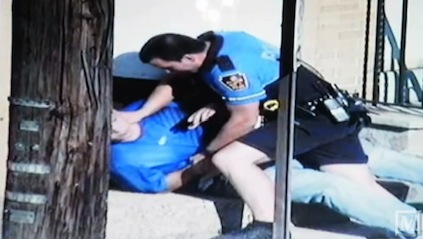
Cleveland Police Department's history of use of force against Black People suggests troubling trend

Cleveland.com

In 2000, the U.S. Justice Department began investigating allegations that Cleveland police repeatedly violated residents' civil rights.

Federal investigators criticized the way the police department handled complaints of use of force. The Justice Department said a lack of documentation raised "concerns about the competency, thoroughness and impartiality of use-of-force investigations."

It said some police shootings "may have been avoidable." Cleveland later signed a settlement agreement with federal officials, who were to monitor for a year how the department investigated police shootings.

A dozen years after the investigation began, some are calling for the Justice Department to return, saying a 26-minute police chase that ended in the hail of gunfire that left two dead Nov. 29 has become emblematic of the department's recent history.

Chief Michael McGrath has said he would reach out to federal authorities at some point in the investigation of the car chase, a probe being handled by state and local investigators.

Arlene Anderson, the executive director of the Cleveland chapter of the NAACP, called for the Justice Department to investigate the shooting. Critics say the department's past has made that necessary.

In the last few years, The Plain Dealer has chronicled complaints of excessive force that injured residents and led to lawsuits that accuse officers of violating residents' civil rights.

"Cleveland has been a highly troubled police department for many years," said Scott Greenwood, a civil rights lawyer who has served as general counsel to the state and national American Civil Liberties Union and studies police accountability.

"Individually, there have been a lot of red flags," he said. "Each by itself is problematic, but when you put them together collectively, it shows you how troubled the department is."

In the past, Cleveland police administrators have said they closely scrutinize cases in which officers use deadly and non-deadly force. In documents filed in civil cases against the department, lawyers have vigorously defended officers and denied allegations.

Last week, a city spokeswoman released information that showed McGrath has revised the department's use-of-force policies three times since he became chief in March 2005. A fourth revision is under law department review, the city said.

But a review of court records and Plain Dealer examinations in the past few years show a department that has been in the spotlight for the way it uses force and investigates it.

Read More

U.S. prison system 'moral equivalent of Jim Crow,' author tells Detroit audience

MLlive

DETROIT — You might think last month's presidential election proved one thing: That there are no longer any racial barriers to success in America.

But last weekend, author Michelle Alexander came to Detroit and told a spellbound audience that while she once shared that illusion, this happy image is anything but true. 

Instead, in a powerful speech and a best-selling book, she argues that America has created a new "racial caste system that is the moral equivalent of Jim Crow." 

Now a law professor at Ohio State University, she told a posh banquet in Detroit's Renaissance Center that we've created a military-industrial-prison system "based on the mass incarceration of poor people of color, particularly black men." 

Her theory — which she said she herself rejected a decade ago — is that "we haven't ended racial caste in America, we have merely redesigned it." Today, as she sees it, "poor folks of color are shuttled from rundown and underfunded schools to brand-new, high-tech prisons — and then out to life as a permanent undercaste."

Permanent, because in many states felons can be forever denied the right to vote. They can also be "automatically excluded from juries and legally discriminated against in employment, housing, access to education and public benefits." 

Even if legal barriers don't exist, the chance of a poorly educated black man with a criminal record succeeding in life is abysmally low. Nor are we talking about a small number of people.

"In many large cities, including Detroit, the majority of working age African-American men now have criminal records and are thus subject to legalized discrimination for the rest of their lives," she said."This is reality," she added, "and nobody, not in Congress, not President Barack Obama, is talking about this.

"But she is. Last year, Alexander started a ferocious debate with her book: "The New Jim Crow: Mass Incarceration in the Age of Colorblindness." 

Edition after edition sold out. On Dec. 2, the author was the keynote speaker at the annual Peace and Justice banquet sponsored by Detroit's Central United Methodist Church.Most big cities have a church whose religion is mainly social activism, and in Detroit, Central United, led by the Rev. Ed Rowe, has long been that place.

Visitors to the church are more likely to stumble over a welfare rights demonstration than choir practice.The crowd, heavy on activists and labor leaders, can sometimes be boisterous. 

But this year, when the tiny, delicately attractive law professor spoke, you could have heard a pin drop.Among those listening raptly was a black middle-aged woman dressed in blue. 

"I am here for my son," Sybrina Fulton told me. "His name was Trayvon Martin." Trayvon became a national figure after the unarmed black teen was shot to death in Florida last February. 

Though she herself is black, Michelle Alexander has spent her life far removed from the world of the permanent underclass. She grew up middle class, the daughter of an Oregon marketing executive. 

Alexander has degrees from Vanderbilt and Stanford Universities, and clerked for U.S. Supreme Court Justice Harry Blackmun before becoming a plaintiff's attorney and then a law professor. 

Tiny and elegant, she looks far younger than her 45 years.Originally, she thought that while there were certainly built-in racial biases in the system, it was possible for anyone to succeed. 

But gradually, while working with an ACLU racial justice project, she came to believe that the "war on drugs" really was a successful attempt to impose a new system of "well-disguised, racialized social control" to keep people oppressed.

Her theory is not without controversy, even in the black community. 

Among those who disagree is Carter Stewart, the U.S. District Attorney for the Southern District of Ohio. 

He also happens to be Michelle Alexander's husband, and best friend.But there were few dissenters Sunday in Detroit.

When she finished, U.S. Rep. John Conyers just said "wow.""You know, many authors can't speak, but she blew me away," said Conyers, who has represented Detroit in Congress since 1965. 

When asked if he thought what she said was true, he said, "of course it is. 

How do you think things got this way?""What do you think has been going on all these years?"

How to spot false majority-minority districts in three clicks

PrisonersoftheCensus

by Peter Wagner, October 25, 2012

Demographers working on voting rights issues frequently examine proposed election districts to ensure that the plans won’t dilute the political power of minority voters. One of the things they look for is the problem of false majority-minority districts.

From the Prison Policy Initiative and Dēmos report, Preventing Prison-Based Gerrymandering In Redistricting: What To Watch For (en español):

Sometimes, a district that seems to have a majority-minority population really doesn’t, because of prison-based gerrymandering. If the minority “population” of the district consists of large number of incarcerated persons – who can’t vote – the district population numbers may be distorted. This creates districts that appear to give minorities the ability to elect the candidate of their choice, but in reality, they cannot. You need to examine any majority-minority district that includes a prison, to ensure that the district really has enough voting-eligible persons of color to create a viable majority with the ability to elect a candidate of choice to office.

Example: In order to settle a Voting Rights Act lawsuit, Somerset County Maryland intended to draw a district where African-Americans could elect a candidate of their choice after the 1990 and 2000 Censuses. But the inclusion of a large prison in the 1st Commission District split the sizable African-American resident voting population between two districts, leaving neither district able to elect a candidate of the African-American community’s choice. While the 1st Commission District appeared to be majority-African-American, in reality the district was not able to function as intended, because many of the purported African-American “residents” of the district were actually behind bars.

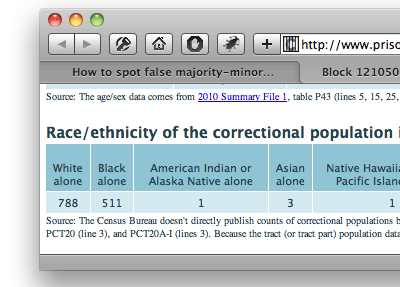
screenshot of the detailed demographics page for a particular census block

Read More

Indybay Refuses to Bow to Demand to Remove Vallejo Copwatch Post

IndyBay

A post by Vallejo Copwatch entitled "Vallejo Police Officer who murdered Mario Romero has been identified" states that "On September 2, 2012, Mario Romero was approached and gunned down while sitting in his parked car in front of his home by a Vallejo Police Officer, identified by multiple witnesses as Officer Dustin B. Joseph (age 32)." The post additionally lists a number of prior complaints against officer Joseph reportedly found in public records. 


 

Attorney David E. Mastagni of the Sacramento law firm Mastagni, Holstedt, Amick, Miller & Johnsen has demanded that the San Francisco Bay Area Independent Media Center (Indybay) remove the post by Vallejo Copwatch. It is unclear on whose behalf the overly broad demand was made as it requests that Indybay "remove any and all information pertaining to public safety officers employed by the City of Vallejo." The Indybay Collective has no intention of removing the post. 

Pearl Harbor: Roosevelt Knew

BlackListedNews

Today is the seventy-first anniversary of the Japanese attack on Pearl Harbor, an act that brought us into World War II, pushed a reluctant America onto the world stage, and ushered in the age of empire. The official history of that event is that it was a "sneak attack" precipitated by war-crazed Japanese militarists, and that the totally unprepared Americans – kept from arming themselves by evil "isolationists" in Congress and the Republican party – were caught completely by surprise.

There is, however, one big problem with this official history: it’s a lie.

The truth is that, by the winter of 1941, the Americans had decrypted the various Japanese military and diplomatic codes: President Roosevelt, key members of his cabinet, and top military leaders, including Gen. George C. Marshall, US Army chief of staff, had access to this intelligence, which was intercepted, decoded, and transmitted directly to them. We know this because Robert Stinnett, in researching his seminal book, Day of Deceit: The Truth About FDR and Pearl Harbor, obtained heretofore unknown documents under the Freedom of Information Act, which trace the intelligence stream from interception stations throughout the Pacific to the 36 Americans cleared to look through what was, in effect, a window into Japanese plans and preparations for the Pearl Harbor attack. The President and 35 other Americans in top political and military circles knew where the attack was to take place, they knew when it was to take place, and they watched it unfold, step by step, with full knowledge of its import.

Read More...