Recent Pew Research Poll Finds 80% of White People are Against Reparations for Black Americans

From [HERE] Discussions about atonement for the enslavement of Black Americans have a long history in the United States, and efforts toward reparations for slavery and racial discrimination have moved forward in some places in recent years. In 2021, Evanston, Illinois, became the first U.S. city to create a reparations plan for its Black residents, and California that year set up the nation’s first state-level reparations task force. Earlier this year, Harvard University created a $100 million “Legacy of Slavery” fund to allow scholars and students to examine the university’s connections to slavery. 

Americans view the prospect of reparations mostly negatively, a 2021 Pew Research Center survey found. Three-in-ten U.S. adults say descendants of people enslaved in the U.S. should be repaid in some way, such as given land or money. About seven-in-ten (68%) say these descendants should not be repaid.
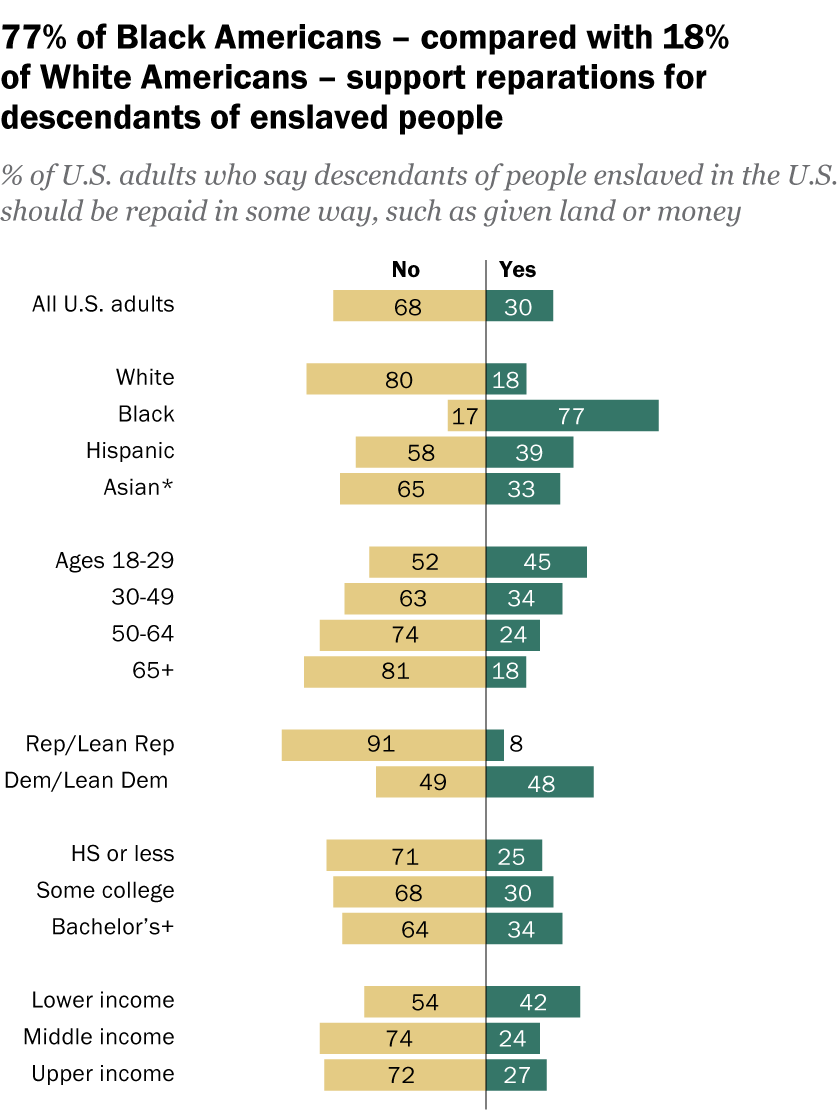
COMPLETE CHART AND SOURCES IS HERE. ALSO A Washington Post-ABC News poll FOUND wide opposition to reparations AND Gallup found that nearly 70% of Americans are against the government providing cash payments to slaves' descendants.

Views of reparations for slavery vary widely by race and ethnicity, especially between Black and White Americans. Around three-quarters of Black adults (77%) say the descendants of people enslaved in the U.S. should be repaid in some way, while 18% of White Americans say the same.

There are also notable differences by partisan affiliation. Among Democrats and Democratic-leaning independents, views are split: 48% say descendants of enslaved people should be repaid in some way, while 49% say they shouldn’t be repaid. By comparison, only 8% of Republicans and GOP leaners say these descendants should be repaid in some way, and 91% say they should not.

When it comes to age, younger adults are more likely than older ones to say the descendants of enslaved people should be repaid: 45% of adults under 30 take this view, compared with 18% of adults 65 and older.

When Americans are asked about the legacy of slavery’s effect on Black people today, 58% of the overall public says this affects the position of Black people in American society at least a fair amount, with 28% saying it affects them a great deal. Four-in-ten U.S. adults say the legacy of slavery has not much or not at all affected the position of Black Americans in the country today.

As with views of reparations, racial and ethnic differences on this question are notable. Black Americans (85%) are more likely than Hispanic (64%) and White (50%) Americans to say the legacy of slavery affects the position of Black people in the U.S. a fair amount or a great deal.

The partisan gap on this question is also wide. More than eight-in-ten Democrats (82%) say the legacy of slavery affects Black people in the U.S. a fair amount or a great deal, more than 50 percentage points greater than the share of Republicans who say this (29%).

Black Americans are much more likely to identify with or lean toward the Democratic Party; only about one-in-ten Black voters identify with or lean toward the Republican Party. As of 2020, White voters are slightly more evenly split, but the GOP has an advantage (53% to 42%).
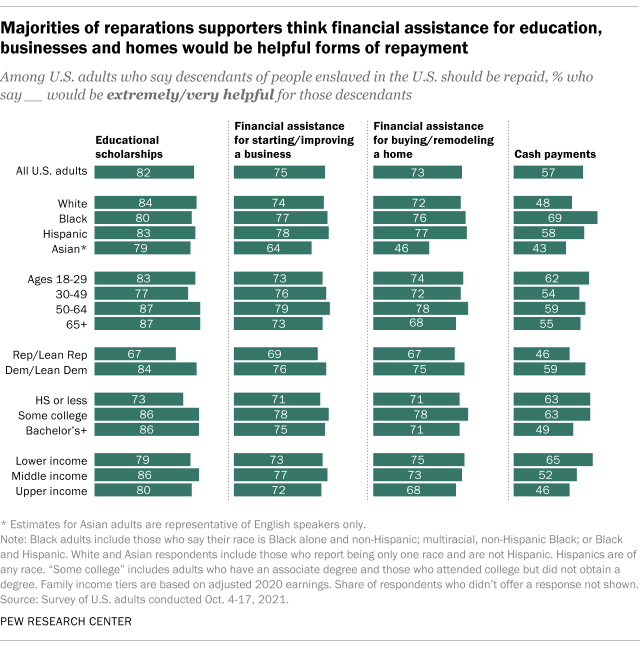
Some racial, ethnic and partisan differences over who bears responsibility for reparations, what form they should take

In the Center’s 2021 survey, the 30% of Americans who favored reparations were also asked about the institutions and individuals who bear responsibility for repayment. They were presented with four options: the U.S. federal government, businesses and banks that profited from slavery, colleges and universities that benefited from slavery, and descendants of families who engaged in the slave trade.

Three-quarters of reparations supporters say the federal government has all or most of the responsibility to repay descendants of enslaved people. A smaller share, though still a majority, say businesses and banks that profited from slavery (65%) have all or most of the responsibility. Fewer say the same about colleges and universities that benefited from slavery (53%) and descendants of families who engaged in the slave trade (44%).
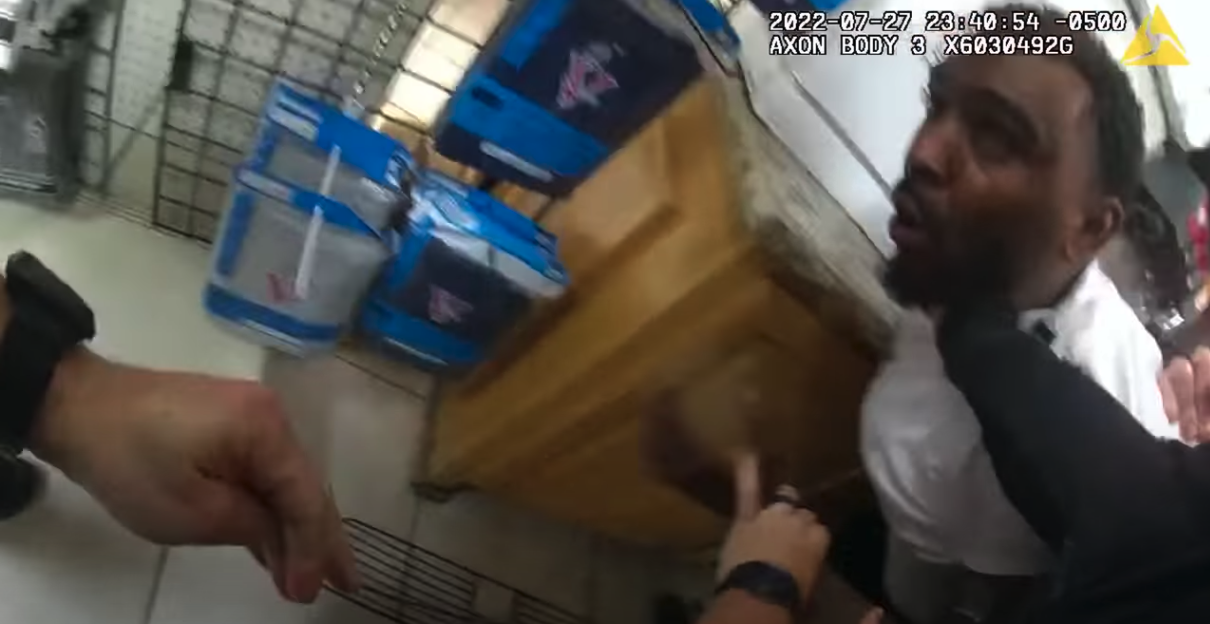
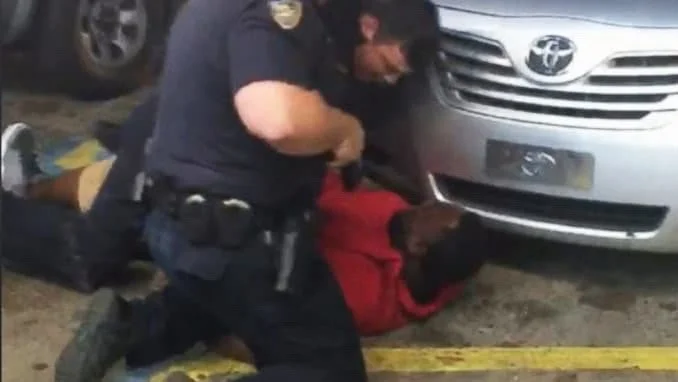
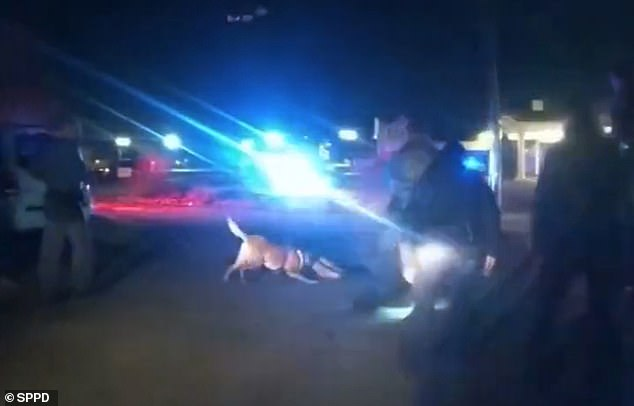
Attorneys Claim Dallas Police Murdered Kyle Dail in a Convenience Store During Unlawful Arrest. Video Shows 4 Lathered-Up White Cops Ambush Black Man and Fatally Shoot Him After He Dropped Gun

From [HERE] A civil rights attorney representing the family of Kyle Dail says he's filing a lawsuit on the family's behalf saying the Dallas Police Department used excessive force when Dail was fatally shot during an attempted arrest last summer.

Dail was in a Dallas convenience store on July 27, 2022, when police officers approached him from behind and attempted to take him into custody. Police said Dail was wanted for eluding police and selling drugs outside a gas station earlier in the evening.

In the video, officers can be heard telling Dail, "Don't move, don't move," and he can be heard saying "I'm not moving. I'm not moving. I can't breathe."

Dallas Chief of Police Eddie Garcia said Dail resisted and that as officers struggled to get him into custody he pulled out a handgun from his pocket and raised it in the air in front of an officer's face.

"Dail transitions the weapon from his right to his left hand then throws the weapon to another aisle in the business. A moment after Dail threw his weapon, Officer Hoffman fired his duty weapon," Garcia said, describing the video.

Attorney Justin Moore, who filed the lawsuit against the city, police department and officers, said in a statement this week that "all video evidence from the incident shows that Kyle was not a threat and was shot in the back unnecessarily."

Moore added that the department has not provided any evidence, including video evidence, that affirms Dail was the person selling drugs or eluding police and that his arrest may have been the result of bad police work and mistaken identity.

"We are fighting the police, we’re fighting the media:" Attorney Says DC Cop Shot Kevin-Hargraves Shird in the Head from Behind as He Fled and Posed No Threat to Cop. Lawsuit Pending

From [HERE] and [HERE] The family of Kevin-Hargraves Shird plans to sue the D.C. police sergeant who shot and killed the 31-year-old man in Fort Slocum Park last July. This comes after the U.S. Attorney’s Office for D.C. announced last week they were declining to file charges.

“While this officer may not ever face criminal charges for what he did, he will have his day in court with the estate of Kevin Hargraves-Shird,” Yaida Ford, a civil rights attorney representing Hargraves-Shird’s family, told DCist/WAMU on Tuesday.

Ford held a press conference on Tuesday afternoon to dispute the assertions made by the office of the U.S. Attorney for D.C in its decision to not prosecute the officer who shot Hargraves-Shird, Sergeant Reinaldo Otero-Camacho. Ford, who met with the USAO last week shortly before their decision was released, said the statement released by the USAO contained “glaring inaccuracies” regarding the evidence in the case. The USAO declined to comment further on the case, and extended “sincerest condolences to the family as they try to process this profound loss,” according to a statement shared with DCist/WAMU on Wednesday morning.

“Both I and the family were really shocked to see some of the remarks,” Ford said. “This statement was very, very concerning and…wildly, wildly irresponsible. For [his family] this ropened a wound. As much as I can try to manage expectations about what’s going to happen with a criminal investigation before a civil case is filed, you cannot prepare them…it was so raw.”

Representing the family, Ford said she will be filing suit against Reinaldo Otero-Camacho in “short order,” alleging the officer did not follow basic D.C. police protocol when he fired his gun without a verbal warning or command.

Otero-Camacho shot and killed Hargraves-Shird in the Brightwood Park neighborhood last summer, while responding to a 911 call regarding a shooting of two juveniles near Georgia Avenue and Longfellow Street NW. Otero-Camacho pursued a white sedan believed to be linked to the 911 call, until the sedan crashed into a curb on Madison Street NW, according to the USAO’s statements. Otero-Camacho, while still in his police car, pulled his gun out, according to body-worn camera footage that was released shortly after the shooting.

Three individuals exited the vehicle, including Hargraves-Shird. According to the USAO’s report, Hargraves-Shird appeared to return to the car to “look through it for something,” and began to flee when Otero-Camacho arrived. The officer, exiting his vehicle, screamed “gun, gun, gun, gun,” and fired one shot, striking Hargraves-Shird in the right ear, according to the USAO.

Matthew Graves, the U.S. Attorney for D.C. (who is white), issued a press release last Thursday stating that after a nearly seven month investigation into the shooting, there was “insufficient evidence” to bring federal or local charges against Otero-Camacho. In the USAO’s brief explanation of its determination, issued on Feb. 9, federal investigators claim that “based on the entry wound of the bullet, as well as Sergeant Otero’s and Mr. Hargraves-Shird’s positioning, Mr. Hargraves-Shird was likely facing Sergeant Otero at the time he fired his weapon.”

Ford disputes this statement, describing the USAO’s claim as “irresponsible” conjecture. A forensic pathologist hired for the family reported that Hargraves-Shird’s head was slightly rotated to the right when he was shot, as if he was looking behind him, according to Ford.

“[The USAO’s] testimony completely contradicts the evidence that Kevin was running away (he was 100 feet from the officer when his body fell after being shot) and that Kevin was looking back over his right shoulder, while running, as the officer said ‘gun, gun, gun, gun,'” Ford said in a press release on Tuesday. “That is how the bullet entered his right ear. If he were facing the officer, the bullet would have hit him in the face or entered his head from the front.”

According to the USAO, the investigation included a review of physical evidence, body-camera footage, radio and forensic reports, an autopsy, and interviews of police and civilian eyewitness accounts. There was a party happening near the shooting that afternoon, but an inflatable moon bounce blocked civilians’ the view of the incident, according to the USAO. Ford said the evidence presented by USAO also does not confirm that Shird was ever carrying the gun that was recovered a few feet from where he fell to the ground. (According to the USAO, the gun has Hargraves-Shird’s DNA on it.)

In the days after the shooting, D.C. Police Chief Robert Contee said he could not comment on Otero-Camacho’s action, seeing as he had not been interviewed yet, and because body-camera footage does not always show the full scope of a scene, or what an officer may have perceived to be threat. But Ford told DCist/WAMU that during her meeting with the USAO, she learned Otero-Camacho had not provided a statement to prosecutors, and instead asserted his Fifth Amendment right. She also said that prosecutors had not produced further evidence to prove that Otero-Camacho believed he was under threat, or that he had issued any lawful command beyond yelling “gun, gun, gun, gun.”

“As these cases play out in real life, it does not appear that officers can ever be wrong in estimating the level of danger with which they are confronted,” she said, adding that the city needs a mechanism of investigating officers that is not linked to the U.S. Attorney’s Office, which often works closely with the Metropolitan Police Department.

The USAO automatically reviews cases of excessive force to determine if the officer violated federal civil rights law or local D.C. law. This determination is a “heavy burden,” according to the USAO, and prosecutors must typically be able to prove the officers “willfully used more force than was reasonable necessary.” Ford said she and Hargraves-Shird’s family understand the burden of proof in criminal cases, but that the USAO’s lack of evidence in its statement was “shocking.”

“The criminal side is different from the civil side of things, there’s a different standard of proof, and I think the family might have been able to accept that. But to then add remarks and statements to a press release when there’s no evidence to back that up, in fact the evidence is contrary to that, was very shocking” Ford said. “It’s one thing to jury process that your loved one has died at the hands of an officer, it’s another to see the U.S. Attorney’s Office make these remarks regarding evidence that just wasn’t there.”

Only one D.C. officer in recent memory has been convicted, or even charged, for an on-duty murder. Terence Sutton was convicted of second-degree murder in the death of Karon Hylton-Brown in December. Hylton-Brown was killed during a chase by Sutton in October 2020. Hylton-Brown was riding a scooter and collided with a vehicle after turning onto a street; he died in the hospital days after the crash. Sutton and his supervisor, Lieutenant Andrew Zabavsky, were also found guilty of obstruction and conspiracy. (They are awaiting sentencing but are likely to appeal the verdict.)

In 2018, the city reached its largest settlement in a case of a fatal police shooting. Officer Brian Trainer shot killed an unarmed Black man, Terrence Sterling, in 2016, and did not not face charges.Years later, the city settled a $3.5 million wrongful death lawsuit with Sterling’s family. (After an internal review, D.C. police concluded that Trainer was not in danger when he fired, and ruled the shooting unjustified.)

Ford conceded that money won’t bring justice for the family — but in the absence of a criminal case, its the only place to turn. Otero-Camacho may still face disciplinary consequences from MPD, as its internal investigation into the shooting is on-going. As of last Friday, a spokesperson told DCist/WAMU that he was currently on a non-contact status, meaning he is not patrolling or engaging with the public.

“I don’t care how much money you give them, they have to accept that the officer or the department or the culture won’t be corrected, and that there will be no genuine accountability,” Ford said.

Baton Rouge to Pay $1.17M Settlement After Cops Violently Silenced People Protesting the Police Murder of Alton Sterling

From [HERE] The city of Baton Rouge will pay a $1.17 million settlement to 14 people who accused local law enforcement of using excessive force and violating their First Amendment rights at a protest over Alton Sterling’s death in 2016.

The city’s Metro Council approved the settlement in a 7-4 decision Wednesday, five-and-a-half years after the protest in which the plaintiffs say they were wrongly arrested.

“This settlement should send a message to all law enforcement agencies,” William Most, attorney for the plaintiffs, told WAFB-TV Thursday. “If you won’t hold your officers accountable, we will.”

The 2017 lawsuit states the 14 plaintiffs — two of whom were identified as journalists — attended the July 10, 2016, protest in downtown Baton Rouge when they were arrested for allegedly obstructing a highway or public passageway.

Widespread protests occurred following the fatal shooting of Sterling, a 37-year-old Black man, who was shot six times by a white Baton Rouge police officer outside a convenience store. The deadly interaction was caught on cellphone video. The officer was never charged.

In 2021 the Metro Council approved of a $4.5 million settlement to Sterling’s children.

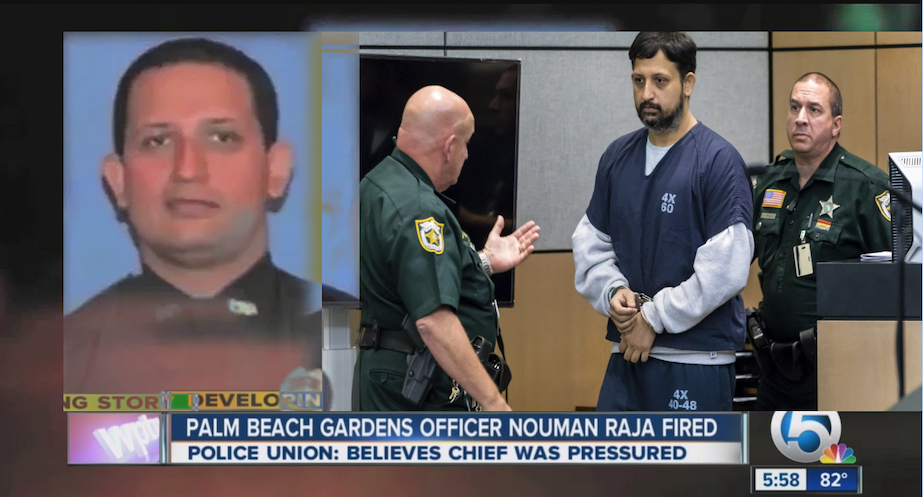
Palm Beach Gardens Settles Corey Jones Suit for $2M. Liar Cop Murdered Black Man Seeking Roadside Help; Audio Proved Cover-Up

 From [HERE] and [MORE] A South Florida city has reached a $2 million settlement with the family of a Black motorist who was fatally shot by a police officer after his vehicle broke down on an interstate off-ramp more than seven years ago.

The city of Palm Beach Gardens released a statement saying it had reached a settlement Thursday through mediation with the family of Corey Jones. The settlement is for the full amount covered by the city’s insurance policy, which the insurance carrier has offered to pay since 2016, according to the city’s statement.

Fired Palm Beach Gardens Officer Nouman Raja was convicted of manslaughter and attempted murder in 2019 and sentenced to 25 years in prison for the October 2015 killing of Jones. Raja was the first Florida law enforcement agent in nearly 30 years to be convicted and sentenced for an on-duty killing.

Prosecutors contended Raja escalated what should have been a routine interaction into a deadly confrontation with Jones, a 31-year-old housing inspector and part-time drummer.

Raja was not in uniform and never identified himself as a police officer before opening fire on the motorist, prosecutors said — a direct contradiction to the arrested officer’s story. An audio recording shows that the cop lied over and over about what happened. 

Audio reveals the officer, who was investigating car burglaries, was immediately aggressive with Jones and began barking commands at him without ever saying he was with the force.

Jones was leaving a late-night gig on Oct. 18, 2015 when his car broke down on the side of I-95. The 31-year-old musician called AT&T roadside assistance for help, and the call was still connected when Raja, who is of South Asian descent, exited an unmarked white van and approached the stalled car.

That recording captured the exchange between the two men.

“You good?” Raja, dressed in a T-shirt and jeans, asked.

Jones said he was fine, prompting Raja to ask “Really?”

“Yeah,” Jones replied, according to the audio.

Suddenly, Raja became belligerent, and started yelling at Jones.

“Get your f-----g hands up! Get your f-----g hands up!” he shouted as Jones pleaded “hold on, hold on!”

“Get your f-----g hands up! Drop!” Raja screamed again before firing two shots, prosecutors said.

Jones began running down an embankment and into the grass as Raja fired several more shots, killing him. Jones' unfired gun was found about 75 feet from his SUV. Jones' body was found another 125 feet away.

In a 911 call that prosecutors say Raja placed about 30 seconds later, the officer yelled for Jones to drop his gun — even though they say he knew Jones had been hit and was dying on the ground. Jones’ family said he had recently purchased the gun to protect the expensive drum gear in his vehicle's trunk and had a permit for the weapon.

But about four hours after the shooting, Raja voluntarily sat down with a Palm Beach County sheriff's detective and recounted the shooting.

He claimed that he walked up to Jones’ van thinking it had been abandoned, and he was surprised to find Jones inside.

"The door swung open and, uh, this guy jumps outside immediately," Raja told the investigator. "He got out of the van and then he's like, 'I'm OK, I'm OK man.' And at which point I said, 'Hey, man, police, can I help you?'”

Raja claimed that when he identified himself as a cop, Jones became violent.

“And the second I said police, he jumped back and I clearly remember him drawing and...pointing a gun at me,” he said. "It's just like, you know, your family flashed in front of you, your kids flashed in front of you.”

He said he ordered Jones to drop the gun and then fired when he didn't. [MORE]

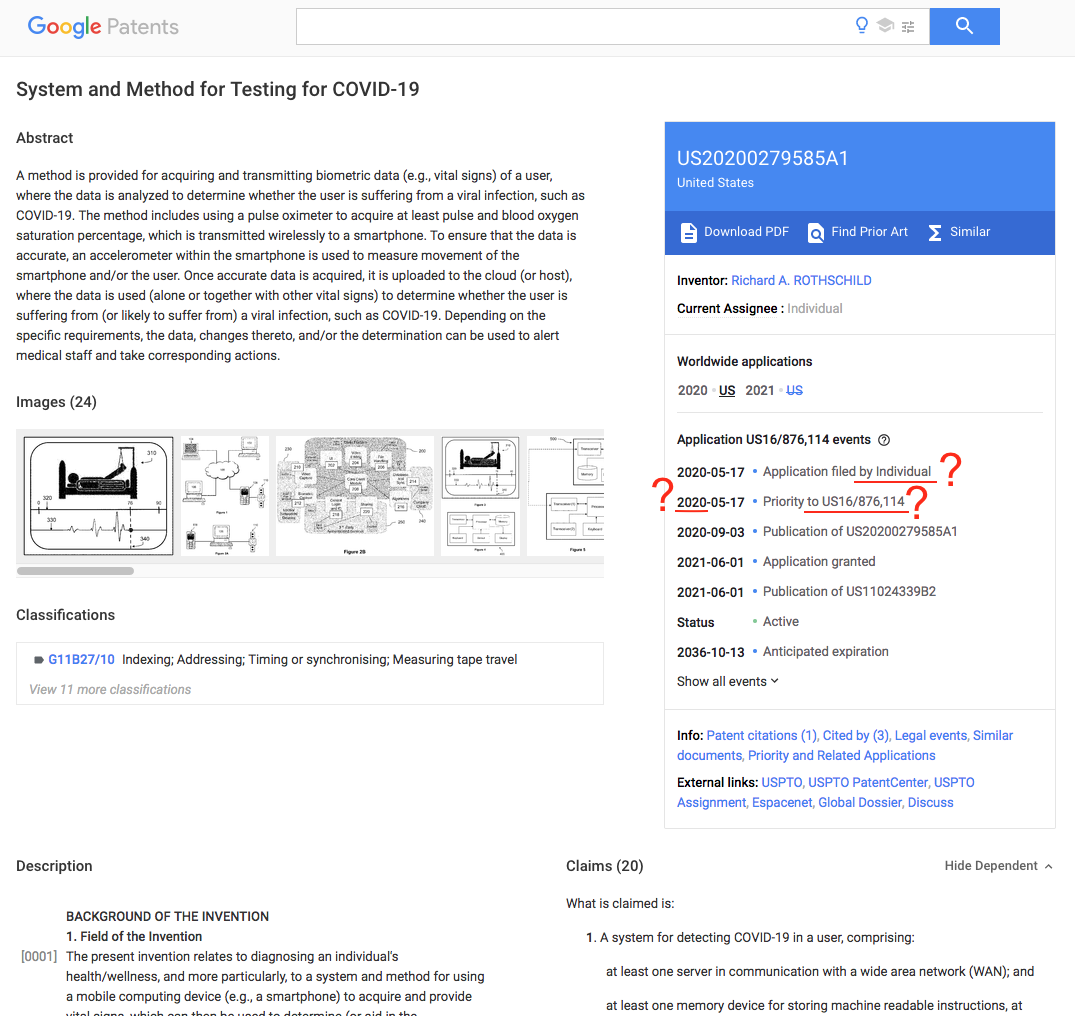
Google Hides Patent Data Showing Rothschild was Involved in COVID-19 Testing Since 2015

From [HERE] Compare the two following screenshots. The first screenshot shows the Google Patents publication of a system and method for testing for covid-19, dated 18 August 2022, which is also mentioned in our book Hope Amidst a Tsunami of Evil.

The second screenshot (from 21 February 2023) shows the same entry with some changes which have been made after September 2022.

Same link—two different versions.

Spot the differences: Image 1) shows the year 2015. Rothschild is stated as the applicant in 2020.

Image 2) begins with the application made in 2020 after the pandemic began. The name Rothschild is left out.

Accessed 18 August 2022:

[MORE]

Autopsies Confirm COVID Jab Hazards in Youth

STORY AT-A-GLANCE

  • When the COVID shots were first introduced, the U.S. Centers for Disease Control and Prevention made several claims about them that have since been proven completely false, including the claim that the mRNA would remain in the injection site, and that both the mRNA and resulting spike protein would rapidly be eliminated from your body

  • The mRNA goes everywhere and can remain intact for a month of more. Ditto for the spike protein your cells produce

  • Spike protein has been found in the brains of people with encephalitis (brain inflammation) and in jab-induced shingles lesions. Both mRNA and spike protein have been found in lymph nodes more than 60 days post-jab. Full-length mRNA has also been shown to circulate in people’s blood for up to 28 days post-injection, and it’s been detected in breastmilk

  • Research shows the primary difference between those who developed symptoms of myocarditis and those who didn’t was that symptomatic patients had markedly elevated levels of full-length spike protein unbound by antibodies in their plasma. Those who remained asymptomatic had no free spike protein in their blood. This would suggest that free-floating spike protein is a problem

  • Autopsies of two teenage boys found dead in their beds three and four days after their second dose of Pfizer concluded jab-induced heart damage was to blame. The myocarditis described in these instances did not have the typical histopathology of myocarditis. Instead, both cases resemble catecholamine-induced injury, similar to the cytokine storm experienced in severe SARS-CoV-2 infection

From [HERE] When the COVID shots were first introduced, the U.S. Centers for Disease Control and Prevention made several claims about them that have since been proven completely false.

They claimed the mRNA in the shot would remain in and only affect the cells around the injection site. They also claimed the mRNA and resulting spike protein wouldn't last long in your body. The mRNA, they said, would vanish within "a few days," and the spike protein produced by your cells would be eliminated within "a few weeks."

As it turns out, virtually every cell in your body is exposed to the mRNA and can remain intact for a month or more. Ditto for the spike protein your cells produce. Spike protein has been found in the brains of people with encephalitis (brain inflammation)1 and in jab-induced shingles lesions.2 It can bioaccumulate in several organs,3 4 including reproductive organs.

Both mRNA and spike protein have been found in lymph nodes more than 60 days post-jab.5 Full-length mRNA has also been shown to circulate in people's blood6 for up to 28 days post-injection,7 and it's been detected in breastmilk.8

In early August 2022, the CDC suddenly deleted those statements from its website — probably because they realized their lies were catching up to them. The cleanup effort was caught, however. Disclose TV exposed the deletion on its Twitter account,9 with an archived link showing the CDC's original webpage.

Free Spike Protein Linked to Jab-Induced Myocarditis

From the get-go, physicians and scientists warned that the SARS-CoV-2 spike protein was the most toxic part of the virus, and hence making your cells produce it for an undetermined amount of time could be an unmitigated disaster. Their warnings were "debunked" and censored, but mounting evidence now proves their concerns were valid — and should have been shared to prevent the loss of life.

We now have case reports, studies and autopsy findings showing that people suffering from post-jab myocarditis have mRNA-induced spike proteins in their hearts and blood.

Interestingly, a January 2023 study 10 in the journal Circulation found "extensive antibody profiling and T-cell responses" both in those who developed post-jab myocarditis and asymptomatic jabbed controls.

The primary difference between those who developed symptoms of myocarditis and those who didn't was that symptomatic patients had "markedly elevated levels of full-length spike protein unbound by antibodies" in their plasma. Those who remained asymptomatic had no free spike protein in their blood. This would suggest that free-floating spike protein is a profoundly serious problem. As concluded by the authors:

"Immunoprofiling of vaccinated adolescents and young adults revealed that the mRNA vaccine-induced immune responses did not differ between individuals who developed myocarditis and individuals who did not.

However, free spike antigen was detected in the blood of adolescents and young adults who developed post-mRNA vaccine myocarditis, advancing insight into its potential underlying cause."

Autopsy Reports Confirm Jab-Related Myocarditis

mRNA programming the heart cells to produce spike protein is also profoundly bad news. A case report 11 published in September 2022 describes the case of a 55-year-old man who died from acute myocardial infarction and lymphocytic myocarditis four months after a dose of Pfizer. As his first dose, he'd received the AstraZeneca shot. According to the author:

"SARS-CoV-2 Spike protein, but not nucleocapsid protein was sporadically detected in vessel walls by immunohistochemical assay … These findings indicate that myocarditis, as well as thrombo-embolic events following injection of spike-inducing gene-based vaccines, are causally associated with a injurious immunological response to the encoded agent.

Because of the fact that the immune response to a first gene-based vaccination is very low in comparison with the immune response to the second vaccination, the found adverse events has rather to be attributed to the mRNA-based second vaccination as to the initial vector-based one." [MORE]

Medicare Data Shows COVID Injections Increase Your Risk of Dying

Steve Kirsch reports In this article, I publicly reveal record-level vax-death data from the “gold standard” Medicare database that proves that:

  1. The vaccines are making it more likely that the elderly will die prematurely, not less likely

  2. The risk of death remains elevated for an unknown period of time after you get the shot (we didn’t see it return to normal)

  3. The CDC lied to the American people about the safety of these vaccines. They had access to this data the entire time and kept it hidden and said nothing.

If there is one article for you to share with your social network, this is the one.

Executive summary

Isn’t it a shame that none of the world’s governments make the vaccination-death records publicly available? My claim is that if they did that, it would end the debate instantly and prove to the world that the vaccines are unsafe. So that’s why they keep it locked up.

But apparently there is one whistleblower who is interested in data transparency. 

Last night, I got a USB drive in my mailbox with the Medicare data that links deaths and vaccination dates. Finally! This is the data that nobody wants to talk or even ask about. 

I was able to authenticate the data by matching it with records I already had. And the analysis that I did on the data I received matches up with other analyses I have received previously.

The nice thing about this Medicare data is that nobody can claim that it is “unreliable.” Medicare is the unassailable “gold-standard” database. It’s the database that the CDC never wants us to see for some reason. They never even mention it. They pretend it doesn’t exist. So you know it is important.

Do you want to know what it shows? 

It shows that these shots increase your risk of dying and once you get shot, your risk of dying remains elevated for an unknown amount of time. And that’s in the very population it is supposed to help the most!

Now you know why the CDC, which has always had access to the Medicare records, has never made them publicly available for anyone to analyze to prove that the vaccines are safe. Because the records show the opposite. That’s why they keep the data hidden from view and it’s why they NEVER talk about it.

Today, in this article, you will finally get to see what nobody outside the HHS has ever seen before: the “gold standard” Medicare records, i.e., the truth. You can analyze it yourself. [MORE]

The NFL Donates Money to Politicians. Here’s Who Gets It [Hershel Not on the List]

From [HERE] The National Football League’s Gridiron-PAC contributed $624,000 to political committees in the run-up to the 2022 midterms, according to records with the Federal Election Commission.

In 2021 and 2022, the PAC contributed a total of $70,000 to two party committees that aim to get Republicans elected to Congress, and it donated an equal amount to theDemocrats’ Congressional and Senatorial Campaign Committees. While PACs can only donate $15,000 a year to each of those committees, Gridiron-PAC squeezed in an extra $10,000 to each party by kicking in for their senate committees’ office-building expenses.

The parity carried over to the parties’ Congressional leadership. The campaign for then-House Speaker Nancy Pelosi (D-Calif.) received $10,000 from the NFL’s PAC, while the payout to the campaign for Minority Leader Kevin McCarthy’s (R-Calif.) hit $7,500. The Gridiron-PAC ran a reverse in the Senate, with Republican Leader Mitch McConnellreceiving $7,500, and Chuck Schumer (D-N.Y.) taking in $5,000. [MORE]

2 South Carolina Laws that Prosecute [mostly black] Kids for Disorderly Conduct by 'Using Obscene Language' or by Acting in an Obnoxious Manner' Near School are Unconstitutional, 4th Circuit says

From [HERE] A federal appeals court on Wednesday struck down two South Carolina laws that punish elementary and secondary school students who act “disorderly,” use “obscene” language or “act in an obnoxious manner” in or near a school.

In a Feb. 22 decision, a three-judge panel of the 4th U.S. Circuit Court of Appeals at Richmond, Virginia, ruled that South Carolina’s disorderly conduct law and disturbing schools law are unconstitutionally vague. The panel said they fail to warn students about what behaviors could expose them to criminal penalties and lack sufficient guardrails to prevent arbitrary enforcement or discrimination.

“Lest there be any confusion: We do not hold that schools are powerless to discipline elementary and secondary school students who disturb the learning environment,” the 4th Circuit said. “But unlike the policy in Tinker [v. Des Moines Independent Community School District] or the codes of conduct maintained in schools throughout the country, the laws challenged here expose minors to criminal prosecution and all the collateral consequences that follow.

“Laws imposing such weighty costs on free expression must define their bounds, so students have fair warning about what is prohibited and the discretion of those who enforce the laws is adequately constrained.”

Several students who had been referred or charged under the disorderly conduct or disturbing schools laws and a nonprofit organization that advocates for at-risk youths brought the lawsuit in 2016.

Education Week reports that one of those students, Niya Kenny, had been arrested the previous year after videotaping a school resource officer who took another student from her chair and slammed her into the floor.

A district court dismissed the case for lack of standing, but the 4th Circuit reinstated it in 2018. The district court later certified the challenge as a class action and ruled against South Carolina’s disorderly conduct and disturbing schools laws.

The disorderly conduct law makes it a misdemeanor to “conduct [one]self in a disorderly or boisterous manner” “at any public place” or use “obscene or profane language on any highway or at any public place or gathering or in hearing distance of any schoolhouse or church,” according to the 4th Circuit decision.

Similarly, the disturbing schools law makes it a misdemeanor “for any person willfully or unnecessarily (a) to interfere with or to disturb in any way or in any place the students or teachers of any school or college in this state, (b) to loiter about such school or college premises, or (c) to act in an obnoxious manner thereon.”

The 4th Circuit said “neither law represents an empty threat,” pointing out that 3,735 people between ages 8 and 18 were referred for prosecution under the disorderly conduct law during a six-year period that ended in July 2020. More than 9,500 students—including children as young as age 7—were referred for prosecution under the disturbing schools law during a period of less than six years that ended in March 2016.

“For those who have met—or been—elementary or secondary school students, a question naturally arises: How does this statute objectively distinguish criminally disorderly, boisterous, obscene or profane childhood misbehavior from garden-variety disorderly, boisterous, obscene or profane childhood misbehavior?” the appeals court said. “The [state] attorney general offers no satisfying answer, nor can we discern one for ourselves.”

The 4th Circuit also found that arbitrary enforcement of the laws by school resource officers and other school officials generated disparate outcomes.

“Evidence submitted to the district court shows that between 2015 and 2020, Black youth were charged with disorderly conduct for incidents in schools at roughly seven times the rate of their white peers,” the appeals court said. “The Constitution prohibits this type of inequitable, freewheeling approach.”

Judge Paul V. Niemeyer dissented from the majority opinion, writing that “for years, South Carolina has applied its disorderly conduct statute and disturbing schools statute to address disruption in schools, and there is little evidence that school officials, students and parents have had difficulty in understanding what conduct was prohibited.”

Reuters also has coverage of the decision in Carolina Youth Action Project v. Wilson.

Maryland bill seeks to open jury duty to [mostly Black] people formerly incarcerated

From [HERE] A Maryland bill under consideration for a fourth time in Annapolis would provide an avenue for people formerly incarcerated for a year or more to serve on juries.

The legislation would also enable people to qualify for jury service who have charges pending that could result in at least a year’s imprisonment, according to a nonpartisan outline of the bill. Sponsors and supporters say it would help people formerly incarcerated better reintegrate into society and make Maryland jury pools more representative.

“The status of a person’s current criminal charges and criminal history does not and should not determine their ability to serve on a jury for the rest of their lives,” state Del. Nicole Williams, the bill’s co-sponsor and a Democrat from Prince George’s County, said during testimony earlier this month.

Shrinking cities like Baltimore are burning through their eligible pools of jurors quickly; last year, 247,840 potential jurors were deemed eligible in Baltimore, less than half its population, according to a Maryland Judiciary spokeswoman. Last year, about 20,000 prospective jurors were summoned on average each month, but more than a third of those didn’t show. Another 8% of summons were undeliverable.

In addition to people who have experienced a year or more behind bars, non-U.S. citizens and non-English speakers are disqualified from serving in Maryland. And older adults, active-duty military, elected federal legislators and people with certain disabilities are exempt. [MORE]

California rolls out post-conviction justice unit

From [HERE] California Attorney General Rob Bonta officially opened the state Department of Justice’s first post-conviction justice unit Friday. 

“Whether it’s due to bias, changes in forensics or any other issues, the criminal legal system is not foolproof,” Bonta tweeted Friday. “Every effort must be made to protect the integrity of prosecutions in California."

In a statement, Bonta said the new unit will have broad discretion and work with local district attorneys to conduct investigations and reviews aimed at resolving wrongful or improper criminal convictions. That includes situations where there could be “evidence of significant integrity issues” so that officials can identify cases that may qualify for resentencing. 

He said conviction integrity units typically work to identify and address wrongful convictions — often by reviewing new credible information that may exonerate someone previously convicted of a crime — or take other actions within established law to remedy potential injustices. 

Although there are already avenues through the appellate process to address injustice claims in the current court system, Bonta said conviction integrity units provide an additional opportunity to proactively address issues and look to improve accuracy and legitimacy of prosecutorial conduct. 

“We fight each and every day to protect our communities and hold those who break the law accountable," Bonta said. "Yet, despite our best efforts, we know our criminal legal system is not infallible.”

The unit will be initially staffed by two deputy attorneys general within the Criminal Law Division who will build on existing resources. Subject to Bonta’s discretion, the new attorneys will be empowered to establish formal, finalized protocols and standards before taking external case review referrals. 

Some of their tasks will include reviewing state Justice Department cases and claims of innocence or wrongful conviction, or cases where there may be a significant integrity issue or local authorities do not operate a conviction integrity unit. They will also review cases for potential resentencing where local authorities need assistance, and coordinate leading conviction integrity units to “foster a culture of integrity, transparency, and efficacy that promotes public trust.”

The unit will also provide statewide leadership to support best practices across California, and “seek to remedy cases where there have been miscarriages of justice,” Bonta said. “Whether issues arise as a result of new exculpatory information or advancements in forensic science, it is incumbent on prosecutors to make good faith efforts to correct injustice.”

Elliot Hosman is a case and policy specialist with the San Francisco Public Defender's Office's Freedom Project, which helps individuals get their sentences reviewed by judges. Hosman said there have been about 267 wrongful convictions overturned in California since 1989, but experts estimate that up to 6% of people currently in prison are wrongfully convicted.

"In California, that means there are as many as 5,700 people whose cases await meaningful review and just as many families and communities awaiting reunification," Hosman said.

Hosman said new resentencing laws give DAs the power undo disproportionate sentences and give people second chances.

"Yet despite millions of dollars in targeted budget allocations, very few prosecutors are referring cases for correction," Hosman said. "We hope the attorney general’s office will act not just to review cases but to act swiftly to correct injustice around the state, whether from wrongful conviction, unfair tactics, or overly severe sentencing. We hope the attorney general will join the fight to ensure that public defender's offices — which are integral to representing community members in navigating the post-conviction relief process — continue to receive state funding for this urgent work."

Chinese Government Censoring AI Chatbots that Contradict Any Government Narratives (“disinformation”) with Their "Free Speech" in said More Restrictive Free Range Prison

From [HERE] At this point it should be common knowledge that if it has to do with any kind of speech, there is nothing that China won’t try to control and/or censor. It’s something of an amazing self-contradiction: in order to be large and powerful, the Beijing government believes it has to behave as though it is weak and cowardly. Wherever there might be real or potential speech or action against the government, there is the Chinese Communist Party trying to proactively make sure such speech can never reach a wider audience. Beijing, it would seem, has long desired for its people to be simple, programmable robots.

Or not? See, it turns out that some of our newer “robots” also engage in speech that the Chinese government is afraid of. Beijing officials have recently demanded the country’s tech companies disallow access to robot-poem-generator ChatGPT and its ilk for the populace, and added that any internally developed chat AI go through some form of digital re-education camp before being released to the Chinese people.

Chinese regulators have reportedly told the country’s tech giants not to offer access to AI chatbot ChatGPT over fears the tool will give “uncensored replies” to politically sensitive questions.

That’s according to a report from Nikkei Asia citing “people with direct knowledge of the matter.” Nikkei says Chinese regulators told tech firms Tencent and Ant Group (a subsidiary of e-commerce giant Alibaba) to not only restrict access to the US-developed ChatGPT, but to also report to officials before launching their own rival chatbots.

This is par for the course. Whenever some new avenue for potential unsanctioned speech comes about, Beijing is quick to regulate it. After all, the survival of the current regime appears to rely on that regime’s ability to keep its people from knowing anything that hasn’t gone through the government’s information cheesecloth. At least, that certainly is how the government behaves.

Which is ultimately kind of dumb anyway. Like many other attempts to strictly control its people’s use of technology, the Chinese public has already been able to access ChatGPT through VPNs and all kinds of other proxy platforms. While Chinese tech companies are happily playing whac-a-mole with those platforms, it isn’t working all that well.

“ChatGPT has gone viral in China, but there is growing concern that the artificial intelligence could provide a helping hand to the US government in its spread of disinformation and its manipulation of global narratives for its own geopolitical interests,” said ChinaDaily reporter Meng Zhe.

Here again China faces the same question it always faces in these situations: will it hamper its ability to strictly control its populace in order to advance technologically, or will it hamper its advancement in technology in order to maintain strict control over its populace. The government has and will continue to try to thread the needle in order to get the best of both worlds… and it will continue to fail.

Whatever happens next, Chinese tech giants will find it tricky to navigate such limitations. Restricting the training data for chatbots will hobble their abilities in comparison to Western rivals, and even if their input is tightly controlled, users may still be able to solicit unwanted responses for which the companies will likely be held accountable.

Which will temper any interest Chinese companies have in developing this technology in the first place. So, if AI systems like ChatGPT are to be an important part of the globe’s future, the China is setting itself up to be left behind. 

And if the quality of the poem I had ChatGPT write me about how awesome sausages are, this might not be a train the Chinese government want to miss.

Discover Card Now Tracking Gun Purchases Made by Law Abiding People to "Solve Crimes" where a Criminal Legally Buys a Gun and a Criminal Leaves a Gun @ a Crime Scene; 2 Situations that Rarely Occur

From [HERE] Discover Financial Services will start tracking gun purchases at retailers nationwide this coming April.

Discover is the fourth largest credit card provider after American Express, Visa, and Mastercard and is the first provider to publicly state that it will start tracking gun purchases. The credit card company claims it will begin monitoring gun purchases to help law enforcement agencies investigate gun-related crimes. The announcement comes five months after the International Organization for Standardization (ISO) approved a dedicated merchant code for gun stores.

Credit card companies have been under pressure from Democratic members of Congress to track gun purchases better. These members claim that assigning a different code to firearms sales will somehow help police solve crimes involving guns. They also claim that the data can and should be used for research into firearms-related crimes.

Although the codes will not show what exact guns the patron purchased from a federal firearms licensee (FFL), many in the Second Amendment community worry that these codes can be used to block the lawful purchase of firearms. Others fear that credit card companies will use the data to raise the transaction rates of gun stores, making it more cost prohibited to buy a firearm. Also, many others worry the data recovered will be used to create an anti-gun narrative by cherry-picking data.

These fears might not be unfounded. During the Obama administration, the Justice Department launched “Operation Chokepoint.” The operation designated gun stores as a risk for money laundering even though most, if not all, customers must fill out an ATF Form 4473 and complete a federal background check when buying an item from a gun shop.

Republican members of Congress worry that the data will violate the privacy rights of Americans who purchase lawful goods. Discover was quick to claim to Reuters that those fears were unfounded.

“We remain focused on continuing to protect and support lawful purchases on our network while protecting the privacy of cardholders,” Discover said in its statement to Reuters.

According to Discover, other credit card companies also plan to implement the new codes in April. The company refused to identify which other card companies would start using the “5723 – Gun and ammunition shops” codes. Master Card, Visa, and American Express are mum on the issue and have not responded to media inquiries.

ISO, which is based in Europe, said the merchant codes would be available to card companies by the end of this month. Although available for credit card companies use, they are not required to use the codes. Each company is free to choose whether to adopt the codes or not.

Discover only has 2% of the credit card market in the United States, but the U.S. credit card market is so large that the company processes $191.2 million worth of transactions each year. Gun owners can significantly dent Discover’s market cap by canceling or simply not using their Discover cards. Boycotts have been a successful tool of the left for many years. Using the same methods as the left, gun owners can send a strong message to these companies that Americans do not want their gun purchases tracked.

Discover did not respond to AmmoLand’s request for comment.

Twice a day, every day of the year, weather balloons are released simultaneously from almost 900 locations worldwide

From [HERE] Twice a day, every day of the year, weather balloons are released simultaneously from almost 900 locations worldwide! This includes 92 released by the National Weather Service in the US and its territories. The balloon flights last for around 2 hours, can drift as far as 125 miles away, and rise up to over 100,000 ft. (about 20 miles) in the atmosphere!

Weather balloons, which are made of latex or synthetic rubber (neoprene), are filled with either hydrogen or helium. The sides are about 0.051 mm thick before release and will be only 0.0025 mm thick at typical bursting altitudes! The balloons, which start out measuring about 6 ft. wide before release, expand as they rise to about 20 ft. in diameter! An instrument called a radiosonde is attached to the balloon to measure pressure, temperature and relative humidity as it ascends up into the atmosphere. These instruments will often endure temperatures as cold as -139°F (-95°C), relative humidities from 0% to 100%, air pressures only a few thousandths of what is found on the Earth's surface, ice, rain, thunderstorms, and wind speeds of almost 200 mph! A transmitter on the radiosonde sends the data back to tracking equipment on the ground every one to two seconds. By tracking the position of the radiosonde, we can also calculate wind speed and wind direction. The radiosonde is powered by a small battery. [MORE]