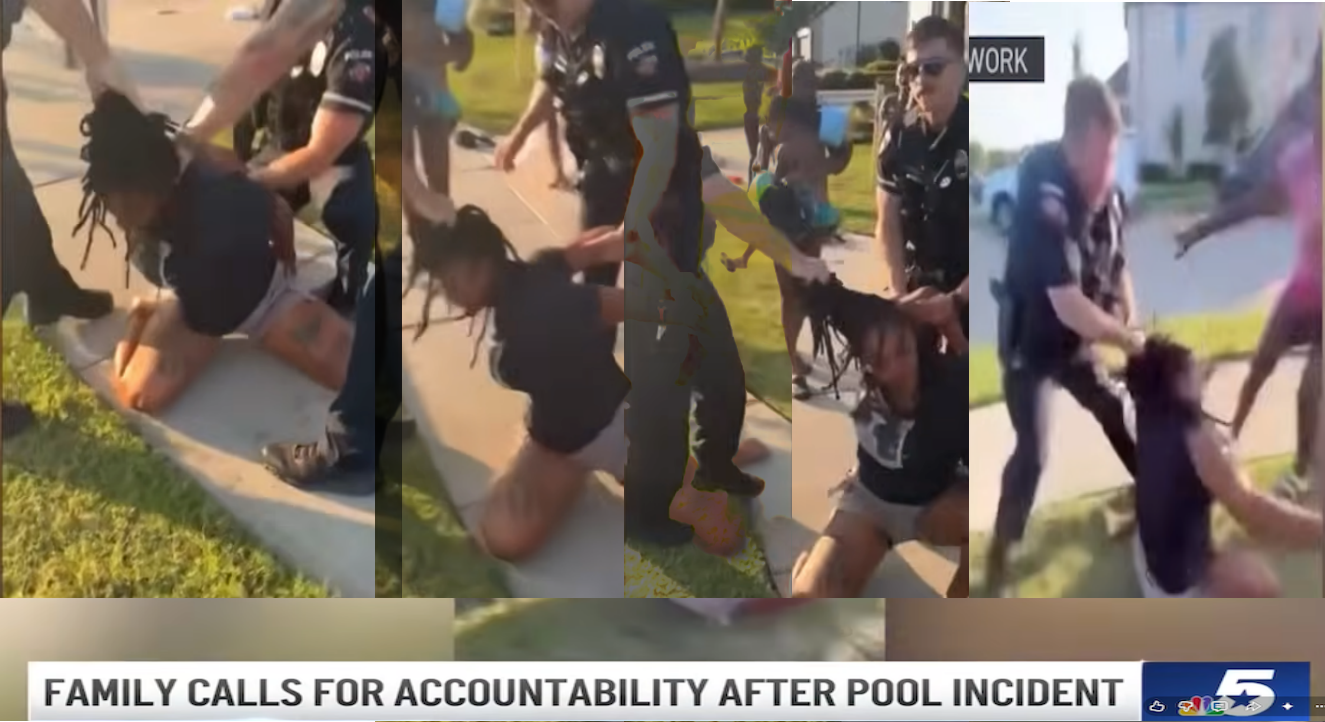

Study Shows Race is a Substantial Factor in Wrongful Convictions: 70% of People Proven Innocent Over Past 5 yrs were Black. Blacks 7X More Likely than Whites to be Falsely Convicted of Serious Crime
/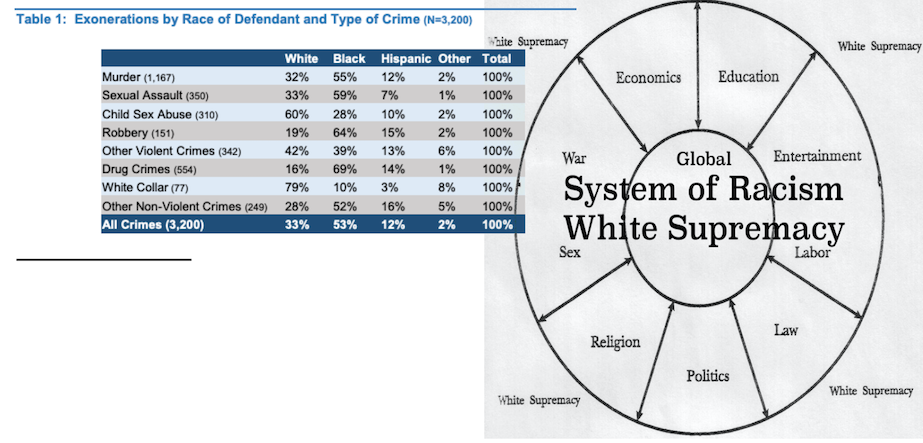
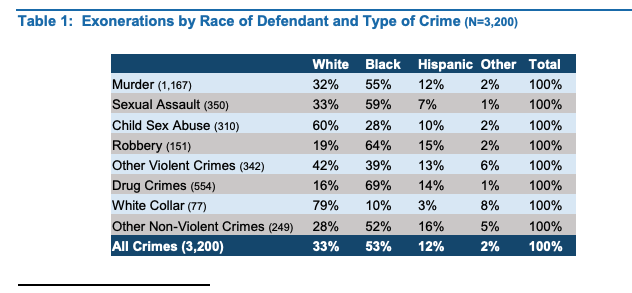
From [HERE] According to a recent study of wrongful convictions, the number of people convicted of crimes who have been proved innocent has increased 70% in the last five years. An analysis of those cases revealed that race is a substantial factor in why people are wrongly convicted.
The report, Race and Wrongful Convictions in the United States 2022, reviewed the cases of 3,200 innocent defendants exonerated in the U.S. since 1989 and found that Black Americans are seven times more likely than white Americans to be falsely convicted of serious crimes. This is true across all major crime categories except for white collar crime.
Black Americans are seven times more likely than white Americans to be falsely convicted of serious crimes.
For homicides, the risk of a wrongful conviction in cases where the victim was white is nearly twice that of cases where the victim was Black. Racial disparities are even worse for sexual assault crimes, where Black people are eight times more likely to be wrongly convicted than a white person for a crime involving sexual violence. Again, the risk of a wrongful conviction increases dramatically if the victim is white as opposed to a person who is Black.
Racial disparities are most extreme in cases involving drug crimes. Black people are 19 times more likely to be wrongly convicted of a drug crime than white people.
Can a Public Service be Compulsory? Can Racists Provide it? White Cop Fired for Making a "Feces Sandwich" and Giving it to Homeless Black Man was Rehired by a Nearby Town but Let Go Over Bad PR
/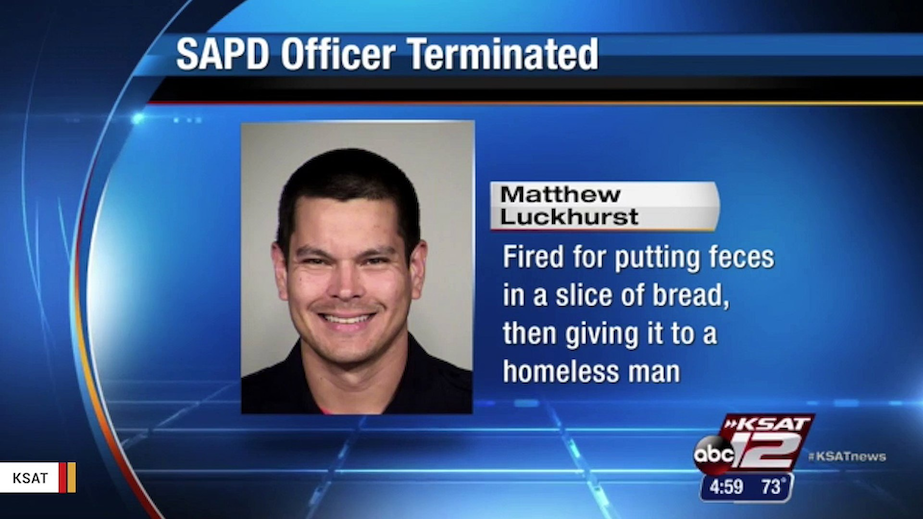
From [HERE] and [HERE] The white SAPD officer who was fired for allegedly making a sandwich with feces and giving it to homeless person in 2016 has now been terminated from his position with Floresville Police Department.
Floresville officials said Matthew Luckhurst had been working as a reserve officer for the city, having been "signed on" a few months after he was let from the San Antonio Police Department. According to Mayor Cecelia Gonzalez-Dippel, reserve officers don't work full-time, aren't paid and serve on a volunteer basis—but the city was apparently unaware of his history of alleged misconduct.
The city released a statement confirming Luckhurst was "released" from the reserve program on Tuesday, adding they will be changing their hiring policies.
"For the citizens of Floresville, we do apologize for the confusion. We were notified last weekend," the statement reads. "We are changing the hiring procedures for stricter rules on background checks. The next update will come from the office of the city manager." [MORE]
The white Texas police officer was fired from the San Antonio police department after two incidents involving feces.
Even when bad cops face consequences, police union rules often insulate them from punishment—even for "vile and disgusting" behavior.
In 2016, officers with the San Antonio Police Department cleared a homeless encampment from a private parking lot. Matthew Luckhurst, a bike patrol officer involved in the effort, was trying to get the residents to clean up on their way out when he allegedly offered a homeless man a shit sandwich—literally, dog feces on bread.
Luckhurst would later attest that he had picked up the feces with a discarded piece of bread so he wouldn't step on it, then put it in a food container which he assumed the man would throw away. But David Ramos, a fellow officer who was present, testified that Luckhurst had laughed about it at the scene before later telling other officers that he "had made a sandwich and force-fed someone." Ramos said that was false but claimed that "Luckhurst had spread the rumors because he was a prankster."
Luckhurst was fired in October 2016, with San Antonio arguing that he had created a liability for the city if the man had eaten the sandwich and become sick. The chief of police called it "a vile and disgusting act that violates our guiding principles of 'treating all with integrity, compassion, fairness and respect.'" But according to local government code, officers must be disciplined within 180 days of the incident in question. There was some confusion over the exact incident date, partly because Luckhurst's body camera was not turned on. Arbitrators determined in March 2019 that the department acted too late and ordered Luckhurst reinstated.
By that time, Luckhurst had committed another shitty prank: A female San Antonio officer complained about the cleanliness of the women's restroom facilities at the police station. In response, Luckhurst and another officer in June 2016 defecated in a toilet in the women's bathroom and spread a brown substance on the seat. Luckhurst bragged about it to other officers. The department placed him on another indefinite suspension, and in June 2020, four full years after the incident, an arbitrator affirmed the termination.
But earlier this month, the San Antonio Express-News reported that just five months after his final firing, Luckhurst was hired as a reserve officer by the police department in Floresville, Texas, 30 miles away. This week, after being inundated with emails, Floresville Mayor Cissy Gonzalez-Dippel announced that on December 13, "Matthew Luckhurst was released from employment," and the city would be "implementing stricter hiring policies for all city of Floresville employees."
After Luckhurst's second termination was upheld, San Antonio City Manager Erik Walsh said, "This individual clearly has no business wearing an SAPD uniform, and it should never have been this hard to fire him." This is a common problem among police departments: In Washington, D.C., for example, the city's police department reinstatedat least 37 fired officers over six years, at a cost to the city of more than $14 million in back pay. Nearly half of the officers had been terminated for conduct deemed a "threat to safety."
But Luckhurst's case provides a further example of how it is hard for a fired officer to stay fired. When Floresville hired Luckhurst, a cursory Google search would have revealed his history. Timothy Loehmann, the Cleveland police officer who killed 12-year-old Tamir Rice, has been hired as an officer twice in recent years, each time resigning when it was publicly reported. Loehmann was fired not for shooting an unarmed child but for concealing that a police department where he'd been previously employed had deemed him "unfit for duty."
Just like with Luckhurst, Loehmann's history posed no problem in securing further employment as a police officer, and he only left when public outcry demanded it.
California Report says Police Stop Blacks 2 Times as Much as Whites and Search Black Teens 6 Times as Much, even though Only 6% of the State is Black [CA is Dominated by White, Liberal Democrats]
/
From [HERE] An annual state report released on Tuesday showed that in California, law enforcement action by police was nearly twice on Black people than Whites. The report found that California law enforcement searched Black teenagers almost six times more than white teens during vehicle and pedestrian stops, AP reported.
The annual report was released by California's Racial and Identity Profiling Advisory Board, which focuses on police brutality and racial injustice in the US.
The report said, "The data show that racial and identity disparities persist year after year. The Board remains committed to analysing and highlighting these disparities to compel evidence-driven strategies for reforming policing and eliminating racial and identity profiling in California."
The Racial and Identity Profiling Advisory Board gathered data from 58 law enforcement agencies on vehicle and pedestrian stops in 2021. These 58 agencies include the 23 largest departments in the state, which collectively made nearly 3.1 million pedestrian and vehicle stops.
The data basically includes how an official differentiates one's race and gender, even if it's different from how the individual identifies, to determine bias.
According to the board's report, in these 3.1 million stops, police officers perceived nearly 42 per cent of individuals to be Latino or Hispanic.
Over 30 per cent of individuals were perceived as white, while 15 per cent as Black.
However, in the state, according to the 2021 census, only 6.5 per cent of individuals made up Black while 35 per cent were White.
The report said that despite being stopped by officers, no actions were taken indicating the Black individuals stopped were not engaged in criminal activity.
NYPD Settles Stop/Frisk Class Action w/5 Plaintiffs for $450k. But Cops Still Have Uncontrollable Authority to Stop Law Abiding Blacks and Check Names for Warrants Whenever They Want in Liberal NYC
/
From [HERE] The New York City Police Department has reportedly agreed to settle a class action lawsuit challenging its “digital stop and frisk” practice, according to NBC New York.
The challenged NYPD digital stop and frisk practice refers to situations in which officers would conduct a prolonged street stop while they checked for arrest warrants and potential connections to other cases.
Under the terms of the NYPD settlement, officers may only conduct warrant searches during street stops if they have “reasonable suspicion” that the person they stopped was committing or was about to commit a crime, or if there is probable cause that the person had committed a crime.
In addition, the NYPD has reportedly revised its policy on conducting street stops and is training officers on the policy. Under the terms of the NYPD settlement, all officers must be trained on the new policy by Jan. 31.
The NYPD will also pay $453,733 in damages and attorneys’ fees. Each of the five named plaintiffs will receive a payment ranging from $3,000 to $19,000.
Plaintiffs say NYPD digital search and frisk tactics were unconstitutional
The NYPD class action lawsuit was filed in 2019 and alleged that the practice was an unconstitutional violation of the Fourth Amendment’s prohibition against illegal detention and unlawful search and seizure. Critics raised concerns that officers could stop individuals for minor infractions and use the stop as an excuse to conduct a search into their criminal record.
People of color were often targeted for the NYPD digital stop and frisk practice, according to the class action lawsuit.
“This lawsuit has always been about bringing justice to innocent New Yorkers who are baselessly detained in the street so aggressive NYPD officers can run their IDs,” plaintiffs’ lawyer Cyrus Joubin said.
Nicholas Paolucci, a spokesperson for New York’s law department, noted that the NYPD settlement “was limited to these individual plaintiffs and does not indicate a broad issue.” He says the NYPD will clarify its existing policy to clarify when officers are allowed to check for arrest warrants during a stop.
The NYPD has faced several lawsuits in recent years, including class action lawsuits alleging excessive force and brutality against Black Lives Matters protesters. The police department was also recently hit with a class action lawsuit alleging it illegally made sealed arrest records public.
WSJ Analysis Finds Police Nationwide are Failing to Stop the Rise of Murders of Black Woman or to Solve the Cases [the numbers are Confounding Only if You Believe Cops Exist to Serve Black People]
/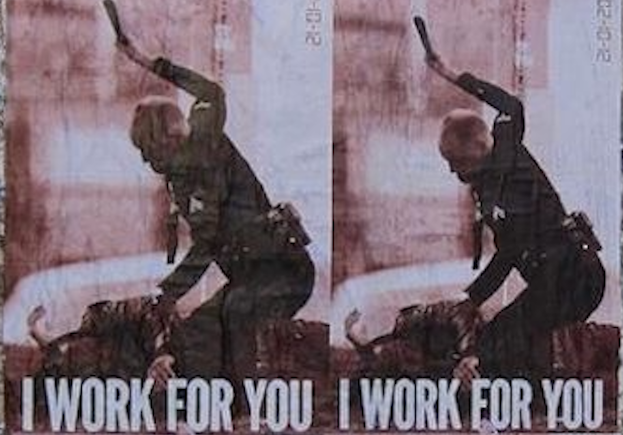
From [HERE] When homicides surged across America during the pandemic, murders of Black women and girls rose more dramatically than other groups. At the same time, the proportion of those killings solved by police fell faster than other demographics in nearly two dozen cities.
Some 2,077 Black women and girls were killed in 2021, a 51% increase over 2019 and the largest jump of any racial or gender group during that period, according to the Centers for Disease Control and Prevention. Overall, the number of killings nationwide increased 34% during that time frame.
Meanwhile, the number of unsolved homicides of Black women and girls rose by 89% in 2020 and 2021 compared with 2018 and 2019, according to a survey of 21 U.S. cities by The Wall Street Journal. It was a far bigger increase than any other demographic group during this period, data provided by the cities show.
The numbers are confounding to law enforcement, criminologists and community groups, who said they have yet to gain a complete understanding of the disparities.
They pointed to several variables that might have contributed to the changes, including the overall rise in homicides of Black women and girls, staffing shortages in police departments and deepening distrust of police in some Black communities following the killings of George Floyd and Breonna Taylor.
One factor, according to some in law enforcement: a shift in the types of homicide cases in which Black women and girls were victims. Police have typically solved more homicides of women than men. Killings of women often involve husbands, boyfriends or ex-partners, who are quickly identified. Men are more often killed in gang- and drug-related shootings or fights with strangers, cases that can be tougher to crack.
Amid a quarter-century high in gun violence during the pandemic, more Black women and girls were caught in the crossfire of drive-by shootings and other attacks where they weren’t always the intended targets, police said. These cases are often more difficult to solve.
The Federal Bureau of Investigation, which reports annual crime data nationwide, doesn’t fully track clearance rates by race and gender. The Journal queried more than 30 cities across the U.S., including the nation’s 10 largest. Most also said they don’t track such data. Twenty-one cities agreed to share both the number of homicides and the number of those cases cleared since 2018, along with the race and gender of the victims.
In these cities, the share of homicide cases for Black women and girls cleared by police—either by arrest, charges filed or identification of a suspect beyond the reach of authorities—fell to 59% in 2020 and 2021 from 67% in 2018 and 2019. Clearance rates for white women and girls fell from 78% to 73% over the same time period.
Clearance rates for men were lower to begin with, but saw smaller drops in that period, or none at all, remaining at 58% for white men and boys and dropping from 45% to 41% for Black men and boys, who had the lowest clearance rate of all. The overall homicide clearance rates in those 21 cities during that period fell to 49% from 51%.
Some states and cities have started examining differences in homicides and clearance rates for cases involving Black women and girls. The Los Angeles City Council in May ordered the city’s civil rights department to conduct an analysis of the issue. [MORE]
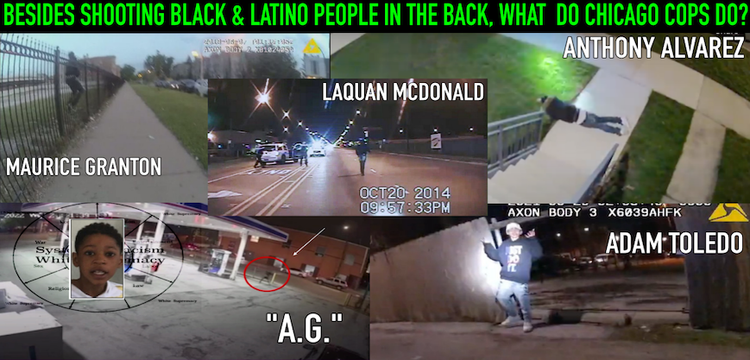
Chicago Trib Analysis Finds Its Easier for Black Residents to Get Pizza Delivery than for Them to Get Cops to Respond to 911 Calls [its White, Liberal Propaganda that Police Exist to Protect/Serve Us]
/
From [HERE] The Sunday sun was an hour or so from rising over the lake as the Jeffery Pub was closing on Aug. 14, sending patrons out the door and on their way.
It had already been a rowdy end to the night. Just after 4:30 a.m., somebody had called police to report an assault. During the wait for officers to arrive, an altercation spilled out onto the street. And then somebody made a chilling threat.
“I got something for you,” a man allegedly said, adding an obscenity, before he turned and walked a half-block north on Jeffery Boulevard, got into a car and pulled into traffic.
The man, according to court records, then floored the gas pedal and rammed it into the crowd. Four people were struck, including three who died.
The crash occurred at 4:58 a.m., according to court records. That was 27 minutes after the first 911 call about the earlier assault, but no officers had shown up by then.
An officer wasn’t dispatched to the bar until 5:20 a.m. and didn’t arrive until 5:35 a.m., city data shows. That was well after firefighters had arrived to start tending to the wounded — and 64 minutes after the first 911 call.
That lag highlights a staggering reality for Chicago residents: If you dial 911, it may be a while before police show up — even if the situation is so serious that department policy calls for an “immediate” response.
While police do respond relatively quickly to many calls, a Tribune analysis of 2022 city data found that tens of thousands of serious calls lingered in the 911 system for longer than it typically takes to get a pizza delivered.
Chicago has long struggled with times when there are too many calls for assistance and not enough police to respond, but the latest findings illustrate how significant the problem has become and how the burden isn’t shared evenly.
The Tribune’s analysis, based on data the city released last year as required by a legal settlement, also shows the waits for police can be particularly long in several South Side districts where the majority of residents are Black.
In some districts, including District 3 where the Jeffery Pub is located, nearly half the immediate-response calls made from January through November 2022 sat for 10 minutes before operators could dispatch an officer to start heading toward them.
Citywide, the wait for an officer to be dispatched topped an hour for more than 21,000 calls, according to the city’s data. That was roughly 1 of every 24 high-priority calls.
And those delays are only part of the problem. The time it takes to dispatch an officer doesn’t include the time it takes for a 911 operator to ready the call to be dispatched, nor the time it takes once the call is dispatched for the officer to arrive at the scene.
Analyzing the total response time is difficult because for many calls in the city’s data set no arrival time is logged. Even with those limitations, the Tribune identified thousands of additional calls in which officers didn’t report arriving to a scene within an hour of the 911 call being placed.
All told, the wait for police exceeded an hour for more than 29,000 high-priority calls in 2022, the Tribune found, and the true number is likely higher.
Those results are just for the “immediate” dispatch calls, which range from robberies in progress to someone spotted with a gun. Chicago police have two other lower-priority categories for calls — “rapid” dispatch and “routine” dispatch — where the data show that wait times are even more likely to exceed an hour.
A Chicago Police Department spokesperson did not respond to detailed questions about the Tribune’s findings, including possible reasons for delayed responses and why some dispatch times for high-priority calls exceeded 60 minutes. Instead, the department issued a brief statement saying it was “committed to timely response to calls for service within every neighborhood citywide.”
“Patrol resources are frequently analyzed and adjusted to ensure calls for service are responded to by officers in a timely manner,” the statement said.
That vague answer isn’t good enough for the head of the newly seated Community Commission for Public Safety and Accountability, Anthony Driver Jr.
“I think they should prove it,” Driver said. “If that is the case, they should have no problem publicly explaining what these numbers mean and defending the data they are putting on their website.”
The commission, created by city ordinance and formed this summer, was intended to give community leaders more input into who runs the police department and how it operates. The commission quickly became the latest entity to question what Chicago police are doing to better position officers across the city, particularly in an era when the number of active officers has shrunk.
Driver said the Tribune’s findings reinforce the dramatically different realities Chicagoans experience depending on where they live.
“It doesn’t instill confidence ... that when I call the police, as a Black man on the South Side, that I will get the same response as some of our North Side counterparts,” he said.
Missing data, chronic delays
Last year, the city quietly began posting charts on police response times, based on the same data it was forced to release as part of the legal settlement reached in fall 2021.
Inexplicably, the charts focused only on the final portion of a response: the time it takes, once officers are dispatched to a scene, for the first officer to arrive. In essence, the charts measure the travel time for officers, excluding the time it took for a 911 operator to pick up the phone, to discern the nature of the call and to hand the call off to a dispatcher, as well as the time that elapsed before the dispatcher directed an officer to the scene.
The charts also come with a big caveat: The data they’re based on doesn’t include all high-priority calls. In a third of those calls, the department didn’t track when officers arrived at the scene, so those calls were excluded from the department’s calculations. The department also warned that some of the arrival times logged may be inaccurate.
The city has said officers racing to high-priority calls may be too distracted in life-or-death situations to log arrival times properly. But the Tribune found record keeping was even spottier for lower-priority calls, such as parking violations, which suggests that adrenaline rushes aren’t always to blame.
Even given these limitations, the data on officers’ travel times isn’t flattering to the department.
In November, officers’ median travel time to the scene was 9.5 minutes for the highest-priority calls. In New York City, by contrast, the equivalent figure was less than 4 minutes, according to numbers posted online for a similar period. (In cases where an event results in multiple 911 calls, the earliest dispatch and arrival times are used to measure responses.)
Within Chicago, the data shows travel times varied dramatically among the city’s 22 police districts, ranging from a median of 5.8 minutes to nearly 12 minutes. (A median means half the calls took more time and half took less.)
But perhaps the most troubling revelations come from data that’s missing from the posted charts: the time it takes to send out an officer after the 911 operator readies a call for dispatch.
In essence, that’s the middle leg of the emergency response, the one before the travel leg that the city charted online. This information was buried in massive data sets the city posted at the bottom of the website, below the charts. Unlike the travel leg, times are listed for nearly every call, and reporters analyzed those numbers for all calls received from January through November 2022.
There will always be some lag when dispatching police, but it should be minimal. In New York City, for example, for its highest-priority calls during a similar period, that city reported a median time of 90 seconds between the time a 911 operator transferred the call to a dispatcher and the time when the first officer started heading toward the scene.
In Chicago, the Tribune found the same measurement for high-priority calls was more than double New York City’s, with a median time of 3.1 minutes. And in some places, the lag can be far greater, particularly in some South Side districts. [MORE]
Possible to Integrate Racism? The Office of Civil Rights Finds a Record Number of Discrimination Complaints Filed by Black Parents Nationwide in the Public Fool System
/
From [HERE] In both cases the reforms included educating students to recognize and report discrimination, and training school staff in how to respond to it. In Iowa, the district also agreed to reimburse the parents of the Black student for therapy the student needed as a result of the harassment.
The majority of complaints in the past year, as in previous years, allege discrimination against students with disabilities — a population whose plight became more visible during the pandemic when schools drew federal scrutiny for failing to serve such students during school closures.
In Colorado, advocates filed complaints citing a range of violations, including segregating disabled students from their peers in dilapidated trailers. In Arizona, complaints allege that disabled students were bullied by other students and staff members and disproportionately disciplined for disability-related behavior.
“Families really thought that something might change when we went back, and instead many families were stuck with the same bureaucracies that have always failed their kids,” said Denise Marshall, the chief executive officer of the Council of Parent Attorneys and Advocates, a disability rights advocacy group. “What we see from our members is that they’re desperate for somebody to do something about what they see as the chaos that public education is in right now.”
Some of the highest-profile complaints filed with the department show how culture wars waged by adults affect the nation’s children. [MORE]
LA County to Pay $20 Million for Beachfront Property Once Seized from Black Family
/From [HERE] The great-grandchildren of a Black couple whose beachfront property in Southern California was seized by local officials in 1924, and returned to the family last year, will sell it back to Los Angeles County for nearly $20 million, an official said on Tuesday.
The Manhattan Beach site once housed Bruce’s Lodge, a resort established in 1912 by the property’s owners, Willa and Charles Bruce, as a place where Black tourists could go to avoid harassment at a time of rampant discrimination against Black people in California and beyond. It was known informally as “Bruce’s Beach.”
Manhattan Beach officials condemned the property in 1924, paying the Bruces $14,500 and saying that they needed it for a public park. They ultimately left it undeveloped for more than three decades, and the couple lost a legal battle to reclaim it. The land was later transferred to Los Angeles County and now hosts a training center for lifeguards.
But three years ago, nationwide demonstrations against racism and police brutality led to a resurgence of local interest in the Bruce family’s campaign. And last July, after Los Angeles County and the California state legislature worked out the legal details, the county returned to the property to the couple’s closest living heirs, their great-grandsons Derrick and Marcus Bruce.
Derrick and Marcus Bruce declined to comment on Wednesday through George Fatheree, a lawyer for the family.
Janice Hahn, who chairs the Los Angeles County Board of Supervisors, said on Tuesday that the owners had decided to sell the property to the county for nearly $20 million, a value that her office said was determined through an appraisal process.
“This is what reparations look like and it is a model that I hope governments across the country will follow,” Ms. Hahn said on Twitter.
The county received notice of the sale from the family on Dec. 30, and the escrow process will likely be completed in 30 days, Liz Odendahl, a spokeswoman for Ms. Hahn’s office, said in an email on Tuesday evening. Members of the Bruce family could not immediately be reached for comment.
Duane Yellow Feather Shepard, a relative who lives in Los Angeles, said in a telephone interview on Tuesday night that the family was “very satisfied” with the sale price. He said they had wanted to sell the property because it is zoned only for public use.
Report: Inhumane Tennessee Authorities Have Repeatedly Violated Their Own Execution Protocols Since 2018
/From [HERE] An independent investigation into Tennessee’s execution practices has found that the state repeatedly failed to follow its own protocols in performing seven executions and preparing for an eighth between 2018 and 2022. Governor Bill Lee (pictured) commissioned the investigation in May 2022, shortly after he called off the execution of Oscar Smith “[d]ue to an oversight in preparation for lethal injection.” The report, which was publicly released on December 28, 2022, found that the same oversight that occurred in the leadup to Smith’s execution – failure to test the lethal-injection drugs for endotoxins – had also occurred in the preparations for the seven previous executions.
The investigation report, authored by former U.S. Attorney Ed Stanton, examined all executions in Tennessee since 2018, when the state last revised its execution protocol. During that time, two people were executed by lethal injection; five were executed by electrocution, but the state prepared lethal injection drugs in case they changed their choice of execution method; and one execution was called off after preparations had already begun. The report found that the state never provided a copy of the protocol to the compounding pharmacy that provided the execution drugs. The execution drugs were required to be tested for potency, sterility, and endotoxin contamination. The endotoxin test was only conducted in one of the eight instances. In one case, potency tests were also not performed, and in another, one drug failed potency testing. “The fact of the matter is not one TDOC employee made it their duty to understand the current Protocol’s testing requirements and ensure compliance," the report said. Many of these failures had already been documented in a May 25, 2022 report by The Tennessean.
"[Tennessee Department of Correction] leadership viewed the lethal injection process through a tunnel-vision, result-oriented lens rather than provide the necessary guidance and counsel to ensure that Tennessee’s lethal injection protocol was thorough, consistent, and followed," the report concludes. It offers several recommendations, including hiring an employee or consultant with a pharmaceutical background to “provide guidance in connection with the lethal injection process,” providing the execution protocol to the drug supplier, and establishing a team to review testing data before each execution.
Governor Lee, in a statement, identified four steps his administration will take in response to the report: “1. Make staffing changes at the department’s leadership level. 2. Hire and onboard a permanent TDOC commissioner in January 2023. 3. New department leadership will revise the state’s lethal injection protocol, in consultation with the Governor’s office and the Tennessee Attorney General’s office. 4. New department leadership will review all training associated with the revised protocol and make appropriate operational updates.”
Court Recommends New Trial for Jewish Death Row Prisoner, Trial Judge’s Virulent Hatred of Jews Violated his Rights
/From [HERE] A Dallas County judge has recommended that the conviction and death sentence of a Jewish death-row prisoner be overturned because his trial was poisoned by the virulent anti-Semitic bigotry of the Texas judge who presided over his case.
In a scathing 42-page set of fact findings issued on December 13, 2022, Judge Lela Lawrence May (pictured, left) recommended that the Texas Court of Criminal Appeals (TCCA) grant a new trial to Randy Halprin (pictured, right), finding that former Dallas County Judge Vickers Cunningham “harbored actual, subjective bias” against Halprin at the time of his trial because Halprin is Jewish. May credited the testimony of numerous witnesses that Cunningham subscribed to a White Christian Nationalist ideology, held long-standing bigoted views against Blacks, Hispanics, gays, Catholics, and Jews, and “planned to ensure convictions and death sentences for [Halprin and his] co-defendants in order to advance his personal interests” in becoming Dallas District Attorney.
Halprin is one of the so-called “Texas 7” who escaped from a maximum-security Texas prison in December 2000 and subsequently robbed a sporting goods store. Dallas police officer Aubrey Hawkins was killed responding to the robbery. While several of the escapees fired shots, Halprin has consistently maintained that he opposed bringing guns to the robbery, did not carry a gun, and did not fire any shots. He testified at trial, “before the robbery, I even told [the others], I’m not going to go in and carry a gun, and there was a little argument. … And so I told them I wasn’t going to pull a gun and they said, fine, just gather clothes, grab a shopping cart, and gather clothes.”
Halprin was sentenced to death under Texas’ controversial “law of parties,” which allows defendants to be convicted and punished based upon the actions and intent of others, if the defendant played even a small role in a crime that resulted in a person’s death. Four of the “Texas 7” have been executed, one committed suicide, and a sixth, Patrick Murphy, who remained in a car in the parking lot and did not participate in the robbery, remains on death row after the Texas Board of Pardons denied his application for clemency.
While Halprin’s appeal from the denial of his initial habeas corpus challenge to his conviction and death sentence was pending in federal court, evidence became available that for the first time publicly documented Judge Cunningham’s bigotry. The revelations came to light in 2018 when Cunningham was running for Dallas County Commissioner, following an earlier failed attempt to become Dallas District Attorney. During the race for commissioner, Cunningham’s brother Bill publicly disclosed that Vickers Cunningham had established a living trust for his children, conditioned upon their marrying a white Christian of the opposite sex. His brother also asserted that Cunningham was a long-time bigot who had frequently used the n-word to describe Black people, often referring to cases involving Black defendants as “TND” or “Typical N****r Deals.”
After further investigation, Halprin’s lawyers uncovered evidence from Cunningham’s relatives, court employees, and political campaign workers that they also had heard him talk about “GD Jews,” “filthy Jews,” and “f***ing Jews.” The investigation also revealed that Judge Cunningham — who presided over the trials of the six living members of the Texas Seven — had referred to the men with various racial, homophobic, and anti-Semitic slurs, describing them as “the Mexican, the queer, and the Jew” and vowing to “get them all the death penalty.” He also specifically referred to Mr. Halprin as “the k***” after the trial. Three of the Texas Seven who were tried in front of Cunningham and subsequently were executed were Latino.
With this new evidence, Halprin filed a new federal habeas petition in May 2019 seeking to overturn his conviction and death sentence. Dallas prosecutors responded in June 2019 by seeking a warrant for his execution, which Judge May issued in July. Halprin then filed his judicial bias claim in state court and sought a stay of execution to allow him to pursue that claim. On October 4, 2019 — six days before he was scheduled to die — the Texas Court of Criminal Appeals granted a stay and returned the case to the Dallas court to resolve his claim.
On remand, prosecutors agreed to submit the case to the court based on witness affidavits, after which Judge Mays found that “Judge Vickers Cunningham possessed anti-Semitic prejudice against Halprin which violated Halprin’s constitutional right to a trial in a fair tribunal, equal protection, and free exercise of religion.” The “only remedy” for Halprin, Mays wrote, is “a new fair trial.” However, the Texas Court of Criminal Appeals reversed that ruling and returned the case to the trial court for an evidentiary hearing, saying that live testimony was necessary before the court could conclude that Cunningham was biased.
At that hearing, Halprin presented evidence spanning decades of Cunningham’s repeated use of bigoted racial, religious, ethnic, and homophobic slurs. Judge Mays found that credible testimony had established that Cunningham exhibited a pattern of anti-Semitism that “was fully formed by the time he was old enough to drive,” and that he “took pleasure in disparaging Jews and abusing people of color throughout his life.” She also credited testimony that Cunningham continued to refer to Halprin and others of the Texas Seven with slurs during the course of his unsuccessful campaign for Dallas District Attorney after the trials and found no credible innocuous reason to explain Cunningham’s repeated reference to Halprin as “the Jew,” “Jew Halprin,” and “Randy the Jew.”
Mays concluded that Cunningham had “viewed the Texas 7 trial as a means of advancing his political career and agenda which included asserting White supremacy over Blacks and Latinos in Dallas County.” Mays recommended that the TCCA, which retained jurisdiction over the case, vacate Halprin’s conviction and sentence, finding that Cunningham’s bias violated Halprin’s rights to due process, equal protection of the law, and free exercise of religion.
Illinois Ct Allows Racist Cash Bail System to Remain in Place [there's No Empirical Evidence Pretrial Detention Increases Safety- Only Proof it Keeps Blacks in Greater Confinement, its true purpose]
/
WHATS WRONG NHGR? You Don’t Have $10,000 in the bank to post bail? From [HERE] The Supreme Court of Illinois Saturday put a hold on the controversial Safety, Accountability, Fairness and Equity-Today (SAFE-T) Act, finding that the pretrial release provisions under the act violated the Illinois Constitution.
The SAFE-T Act is a criminal justice reform law impacting many aspects of the criminal justice system such as policing, pretrial, sentencing and correction. Notable provisions include a body camera mandate for police officers and increased transparency in custodial death cases.
More than 60% of defendants are detained before trial because they can’t afford to post bail, according to a study finding that the impact falls most heavily on minorities and low-income people.
Nationally, the average bail amount for felonies is $10,000, according to the report released Thursday by the U.S. Commission on Civil Rights. The report is titled The Civil Rights Implications of Cash Bail.
A total of 631,000 people are held in jails every day, and 74% are awaiting trial, the report said.
Research suggests that people of color may be subjected to higher bail amounts and are more likely to be perceived as dangerous during bail hearings, according to the report.
One study, for example, found that when monetary bail was set for Black defendants, it was in significantly greater amounts than for white defendants.
Research also shows that Black and Hispanic defendants have higher rates of pretrial detention than white defendants and are more likely to have financial conditions imposed.
Pretrial detention has collateral consequences, such as job losses, housing insecurity, family problems and an increased likelihood of engaging in future criminal conduct, the report noted. Those consequences have led to increasing concerns, especially given the lack of empirical research showing that pretrial detention increases public safety. [MORE]
65 counties sued to stop the law from going into effect on January 1. Kankakee County Judge Thomas Cunnington of the 21st Judicial Circuit heard a consolidated lawsuit on the matter. Kankakee County State’s Attorney Jim Rowe argued that the legislation was unconstitutional since it violated the separation of powers clause of the Illinois Constitution and amendments to section 9, Article I of the Constitution were not put to a vote on the ballot. The judge ruled in favor of the argument, which means that bail reform and pre-trial release provisions cannot go into effect.
Governor of Illinois J.B. Pritzker said that Cunnington’s ruling was a “setback for the principles we fought to protect through the passage of the SAFE-T Act.”
The Supreme Court of Illinois upheld Cunnington’s ruling in an emergency supervisory order, stating:
The administration of the justice system is an inherent power of the courts upon which the legislature may not infringe and the setting of bail falls within that administrative power, the appropriateness of bail rests with the authority of the court and may not be determined by legislative fiat…..the pretrial release provisions do violate this separation of powers principle underlying our system of governance by depriving the courts of their inherent authority to administer and control their courtrooms and to set bail.
Illinois House Leader Jim Durkin called the ruling a “victory for the often neglected victims of crime and the men and women of law enforcement who wear the badge every day.”
The SAFE-T Act is controversial because it abolishes cash bail. Non-violent defendants no longer must post bail before trial. Exceptions to this include defendants deemed a risk to public safety or a risk of escaping. Republican lawmakers and law enforcement stakeholders argued that the law will lead to a rise in crime. Democratic lawmakers and advocates for criminal justice reform argue that abolishing cash bail is necessary to prevent discrimination against the poor.
NO CHARGES from White Liberal DA After 5 LA Cops Murdered Frederick Holder: Black Man Shot 30X at Close Range after Inarticulable Stop. Cops Claim Lighter (found under the car) Looked Like a Gun
/
From [HERE] and [HERE] The office of Los Angeles District Attorney George Gascón announced this week that it would not charge deputies Christopher Conger, Javier Fierros, and Jackie Rojas for shooting and killing Frederick Holder on June 23, 2021. Holder, a 28-year-old unarmed Black man, was driving a box truck and stopped at a red light on a freeway on-ramp in Norwalk, California.
The office said in a statement to Knock LA, “We know that this is not the news that the friends and family of Mr. Holder wanted to hear today. Their loss remains immeasurable. We can assure the public that the investigation was extensive and our analysis was thorough. We do not take these decisions lightly. Proof beyond a reasonable doubt is a very high standard. This declination does not mean that they have been absolved of any moral or civil responsibility.”
In their analysis, the DA’s office writes that, “the deputies acted in lawful self-defense and defense of a third party when they fired their weapons, reasonably believing, based on a totality of the circumstances, that deadly force was necessary to defend against a deadly threat.”
The deputies involved include Christopher Conger, Javier Fierros, and Jackie Rojas — all of which are still active members of the LA County Sheriff’s Department.
The deputies appear to have violated several departmental policies during the shooting. They failed to wear body cameras, engaged in a pursuit outside of procedure, and opened fire on an occupied vehicle on a crowded freeway on-ramp. Conger, Fierros, and Rojas are still on duty.
Just after 9:50 AM on June 23, 2021, a Los Angeles Police Department helicopter operator requested a Los Angeles County Sheriff’s Department (LASD) unit to attempt to stop a white Ford utility box truck Holder was driving. The helicopter also stated over dispatch that he was monitoring the vehicle for reckless driving after a call from the LAPD’s Southwest Station. The helicopter operator said the truck was “not wanted” for anything, but that he would continue to pursue it from the air because the tailgate was open.
The police have failed to explain exactly what facts tend to show that the Black man was driving erratically, recklessly or impaired. Such facts might be for instance, illegal lane changing, swerving, driving at inconsistent speeds, starting and stopping and facts indicating that pedestrians or other drivers were affected. The so-called 4th Amendment prevents police from stopping drivers without reasonable and articulable suspicion that the motorist had been or was engaged in unlawful activity - insofar as such “rights” are applied to white citizens in the free range prison. See Delaware v. Prouse, 440 U.S. 648, 661 (1979). Driving described as “erratic,” “reckless” or “impaired” are legal conclusions that must be supported by actual, articulable facts. Without more facts, the initial stop appears to be unlawful.
Christopher Conger said in a statement that his partner, deputy Steven Douma, radioed to Conger that he was going to initiate a felony traffic stop. [However, no felony had been committed]. It is against LASD’s policy to pursue vehicles for reckless driving. The department manual of policies and procedures states that:
A pursuit shall not be initiated or continued: Once it has been determined that the driver of a vehicle is refusing or failing to yield and the only known reason for the intended stop is:
An infraction or misdemeanor crime (including California Vehicle Code (CVC) violations), except as provided above;
Any crime not classified as a serious felony, as described in this section; or
A possible grand theft, vehicle.
Four LASD vehicles surrounded the truck on a residential street. According to the department, the deputies used a public announcement system to instruct Holder to exit the truck. He drove away slowly south on Piuma Avenue and was pursued by deputies. He drove onto the freeway on-ramp and merged with traffic stopped at a red light.
Deputies parked their vehicles behind Holder and exited carrying firearms. None of them were wearing body cameras, despite the department requiring the activation of body-worn cameras during vehicle stops and pursuits. According to the DA’s report, Conger had placed his own dash camera inside his vehicle.
The video shows Conger, Fierro, and Rojas briefly speaking from behind an LASD sedan, then proceeding toward Holder’s truck.
LASD policy explicitly states that “firearms should not be discharged at a stationary or moving vehicle, the occupants of a vehicle, or the tires of a vehicle unless a person in the vehicle is imminently threatening a Department member or another person present with deadly force by means other than the moving vehicle.” Furthermore, internal LASD documents state that “shooting at a vehicle is inherently dangerous and almost always ineffective.”
Department policy also states that once a pursued vehicle has stopped, deputies must develop a tactical plan, utilize “less lethal” weapons, and assign designated shooters as well as fire discipline and shooting backdrop — meaning the amount of times one fires and what is behind the target of fire, respectively.
Deputies Conger, Fierros, and Rojas did not do any of this.
In his statement, Conger says he was within three feet of the passenger door when he saw Holder “sitting in the driver’s seat. He was looking to his left — over his left shoulder out the driver’s side window, and he was holding his right hand up against his chest holding what I believe[d] to be a small pistol.”
Fierros said that Holder held the object across his chest with his right hand and pointed it at him. The item Conger and his colleagues say they believed was a gun is a butane lighter.
When Conger saw Holder with the lighter in his hands, he yelled, “Gun! Gun! Gun!” and fired ten rounds from a .223 rifle at Holder. Fierros says he “backpedaled” and fired at Holder until his weapon was empty. He then reloaded his weapon and fired some more — because, he says, he heard “other rounds” and thought Holder might be shooting at him. Fierros estimates he fired 19 times. Rojas did not give a voluntary statement.
COPS CLAIM THEY IMMEDIATELY MOVED EVIDENCE ON THE SCENE. Fierros said that he approached the truck and opened the driver door. Deputy Jose Pimentel said he stepped into the cabin and saw what looked like the butt of a gun near Holder. When he picked it up, he realized it was too light to be a firearm. For some reason, he moved the lighter from where it was and put it underneath the truck. Fierros believes (?) he was present when this happened. Three sergeants who responded to the scene had body-worn cameras and captured this on video. But the view is obstructed and does not show where in the cabin the torch lighter was located, according to the DA’s report. [Of course if there was no lighter at all cops would have no defense. As ridiculous as it sounds, the lighter must be in Holder’s hand and be pointed at the cop for there to be an imminent threat of danger to the officer. For what reason would police be moving material evidence around a crime scene? If a cop lied one time why would you trust anything he says? Nevertheless, the white DA and white media believe and parrot whatever police tell them especially when it comes to murdering Black people - if you believe “Authority” can be used somehow to help humanity then you are indeed a plaything in the hands of authorities and on the wrong website].
The deputies said they tried to provide medical aid but stopped when they saw Holder appeared to be deceased.
The gunshot wounds left Holder unrecognizable to his family. Earlier this year, Knock LA obtained the autopsy photos of Frederick Holder. Sources said the wounds to his body indicated he was shot at a range of no more than 10 feet with an assault rifle, blowing off his mouth.
His sister, Hali Holder, said “His face was blown off, mouth, teeth, tongue,” his sister said of the aftermath of the deadly shooting. Photos show chunks of Holder’s face and body missing.
The Holder family and supporters held numerous rallies on behalf of justice for Frederick, urging the district attorney to follow through with charges on the officers involved in his shooting death.
But the family says they have received pushback from former Sheriff Alex Villanueva, who refused to meet with them and even called them “fools” during a community forum event in Feb. 2022, where Holder’s sister called Villanueva’s deputies out.
Villanueva and Garcon are democrats.
The family said it took police over a week to inform them of Holder’s death.
NYPD Cops Said Khiel Coppin Threatened them w/an Imaginary Gun but In Reality the Black Teen’s Hands Were Up When Cops Shot Him 20 Times and Only Possessed a Comb. 15 Yrs Later NYC Settles $3M Claim
/
ROTTEN TO THE CORE. GENERALLY BLACK VOTER TURNOUT IN LIBERAL NYC IS GREAT AND WHITE LIBERALS AND HUNDREDS OF BLACK ROLEBOTIC AUTHORITIES REPRESENT BLACKS AND DOMINATE ALL LEVELS OF GOVERNMENT IN NYC. WTF DO THEY GET FOR THEIR VOTE IF LAW ABIDING BLACKS CAN BE STOPPED, SEARCHED, DETAINED AND MURDERED BY PUBLIC MASTERS ANYTIME? AS STATED BY FUNKTIONARY,
voting power – an oxymoron. 2) a transitory form of illusory power. 3) the appearance of power without the juice.“
From [HERE] Fifteen years after their loved one’s death, the family of a Black teen shot and killed by New York police has reached a multi-million-dollar settlement with the city.
Officials called the boy’s death “tragic” and said deciding to settle was “in the best interest of all parties.”
On Thursday, Dec. 21, the city of New York agreed to pay the estate of Khiel Coppin $3 million in damages after he was killed by police in 2007, according to PIX 11.
Khiel Coppin was killed by New York City police in 2007.
The 18-year-old was shot on Nov. 12, 2007, in the Bedford-Stuyvesant section of central Brooklyn by police officers who hallucinated that he was charging toward them with a gun.
Officers fired 20 bullets at Coppin, finding out he didn’t have a firearm later. In his hand, the young man had a hairbrush.
Within the 17-page lawsuit, the mother says her eldest son was unarmed and had his hands in the air when the police shot him.
In 2015, Flushing attorney Andrew Plasse filed a federal civil lawsuit for $40 million against the city on behalf of Denise Elliott-Owens, Coppin’s mother.
“Many citizens felt there was no rational excuse for shooting 20 times an unarmed man with his hands up in the air and then handcuffing him on the ground after he was seriously injured,” the complaint states.
The claim further states that because of the overwhelming “public outcry” over her son’s death, police retaliated against the woman’s other son, Na’im.
Seven years after Coppin’s death, Na’im was shot at 18 times on Aug. 31, 2014, by police near the same apartment where his brother was killed. One bullet struck his torso. The brother survived for a week before succumbing to his wounds on Sept. 6.
Both of Elliott-Owens’ sons’ deaths sparked public outrage, leading to demonstrations from several criminal justice advocates, who claimed the police purposely withheld the video of the fatal shooting to protect the officers, the Daily News reported. [? where is the video?]
In 2017, the city actually won a summary judgment to have the case dismissed — after the case was stuck at the state level for 10 years.
In 2020, the state appeals panel reversed that decision, deciding a jury should review the evidence and determine if they believe the officers violated Coppin’s civil rights by using excessive force.
One appeals panel member was Sylvia Hinds-Radix has been appointed to be the city’s corporation counsel.
Elliott-Owens has also changed her representation. Wale Mosaku is now her lawyer.
Reports say in the first incident, Elliott-Owens had called Interfaith Medical Center’s mobile crisis team seeking assistance for her “mentally disturbed son” around noon on the day of his death. Coppin had a history of mental illness, and according to the Daily News, he had stopped taking his anti-psychotic medication.
Six and half hours later, the medical center’s crisis team finally arrived, but the young man was not at home. Because he was not there, the team left. Coppin returned after, and the mother called the police.
The mom said, “If I knew that that would have been the outcome, maybe I would have proceeded another way.”
When the police arrived, they saw Coppin, who yelled out that he had a weapon, prompting the police to act.
The NYPD spokesperson Nick Paolucci said the officers erroneously made a “split-second” decision, which resulted in the death.
“When officers responded to a mother’s call for help, they were confronted by what they believed to be a lethal threat and had to make split-second decisions,” Paolucci stated.
“Officers testified that Mr. Coppin lunged at them with a knife, yelled that he had a gun, and reached for that weapon in the bulge of his sweatshirt, despite repeated orders to raise his hands,” he said in a statement. “While this incident ended tragically, a lower court agreed that the actions of these officers were justified under the circumstances. An appellate court, however, reinstated claims against the officers, saying a jury should weigh the evidence.”
“We have carefully reviewed this tragic case and have determined that this agreement was in the best interest of all parties,” the spokesperson reiterated.
Elliott-Owen said she believes the settlement was “just a legal tactic.”
“It still doesn’t bring back my son,” she said. “At the end of the day, it’s just money. You still have a loss.”
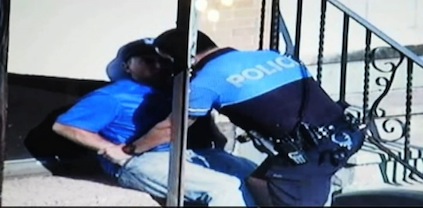
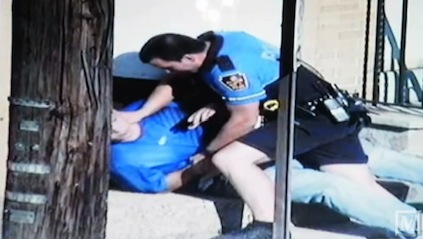
White Cop in Tampa Fired for Dragging Handcuffed Black Woman to Jail Entrance. No Charges b/c Police are Authorized to Initiate Unprovoked Attacks on Citizens. How Did Cops Acquire this Power?
/
From [HERE] A Tampa police officer has been fired after dragging a woman on the ground following an arrest, the department said in a statement.
The Tampa police department fired officer Gregory Damon following an internal investigation that determined he violated multiple departmental policies while booking a suspect into the Orient Road Jail on Nov. 17.
“Professionalism is not only expected, it is demanded, in every encounter our officers have with the public, regardless of the arrestee being uncooperative or unpleasant in return. As law enforcement officers, we are held to a higher standard,” said Interim Police Chief Lee Bercaw.
Body camera footage and surveillance footage has captured the incident.
Tampa Police Department fired officer Gregory Damon following an internal investigation that determined he violated multiple departmental policies while booking an inmate into the Orient Road Jail on November 17.
According to officials, Tampa police responded to a call regarding an individual sleeping outside the Tampa Family Health Center and refusing to leave despite requests made by employees.
Officers arrested the woman, who had previously been provided a warning for trespassing on the same property the month prior.
“Damon took the individual by the arm, dragging her from the vehicle to the entrance of the jail where he then buzzed the door entrance, prompting two deputies to come outside and assist with raising the individual from the ground and beginning the jail intake process,” the department said in a statement.
It continued, “Rather than remaining professional, Damon himself made rude and derogatory comments to the arrestee.”
The internal investigation found that Damon violated departmental policies related to searching, transporting, response to resistance, treatment of people in custody, standard of conduct, and more.
In 2013, Tampa revised its policy on handling uncooperative people following a similar incident, according to the department.
It added specific language that advised officers “that dragging an individual who is uncooperative is never an appropriate practice and instead, the correct procedure would be to request assistance from the booking staff.”
The department said that detention deputies are required to help lift someone from the transport vehicle and secure them in a restraining chair to be rolled into the intake area.
Tampa Police Department fired officer Gregory Damon following an internal investigation that determined he violated multiple departmental policies while booking an inmate into the Orient Road Jail on November 17.
“This former officer’s actions were unacceptable and are not tolerated at this department, which is why we acted swiftly in initiating an internal investigation, relieving him of his duties, and ultimately terminating his employment,” the department said in a statement.
Pew Study Shows that Since the Plandemic Mostly White Landlords Made Sizable Rent Increases in Liberal Metro Areas (DC/NYC/LA/Boston/Chicago/Atlanta) and Mostly Non-White Tenants Struggle to Pay It
/From [HERE] 60% of Americans say they’re very concerned about the cost of housing, according to a Pew Research Center survey conducted in October. Rising housing costs have hit renters hard during this span – and prices have continued to soar over the past year, making rent control and other related proposals prominent issues in the recent midterm elections.
Here are some key facts about U.S. renters and the problems they have faced with housing affordability during the COVID-19 pandemic, based primarily on a Center analysis of U.S. Census Bureau data.
Nearly 46 million households rented their homes in 2021. Renters accounted for more than a third of all households in the U.S., while homeowners accounted for nearly two-thirds, according to data from the Census Bureau’s 2021 American Housing Survey (AHS). The number of renters in 2021 was higher than a decade ago.
Relatively large shares of Americans who are younger, Black or Hispanic rented during the pandemic. A third of renting households were headed by someone under the age of 35; an additional 20% were ages 35 to 44, according to AHS data. The median age was 43 for renters in 2021, compared with 57 for homeowners. The median age of household heads overall was 53 that year.
Black and Hispanic adults made up a disproportionately large percentage of renters (21% each) compared with their overall shares of the U.S. population (12% and 19%, respectively). Still, the largest share of renters – half in 2021 – were non-Hispanic White.
A majority of renters lived with someone else, and two-bedroom arrangements were the most common. Household heads who rented were more likely to live with at least one other person than to live alone in 2021 (62% vs. 38%), according to AHS data. The largest share of renters who lived with other people (42%) were married couples living alone or with children or other family.
Among households who rented, 40% lived in two-bedroom housing, while about a quarter each lived in one-bedroom (27%) or three-bedroom accommodations (24%).
Renters tended to have much lower household incomes than homeowners. The median household income for renters was $41,000 in 2021, compared with $78,000 among homeowners. A majority of renters (57%) had annual household incomes of less than $50,000 that year.
The median monthly cost of rent alone increased 12% since before the pandemic, from $909 in 2019 to $1,015 in 2021, according to AHS data. By comparison, overall inflation was about 6% during this span.
The AHS estimates that about half of rental households (51%) spent $1,000 or more a month on rent in 2021 – up from 44% in 2019.
[MORE]
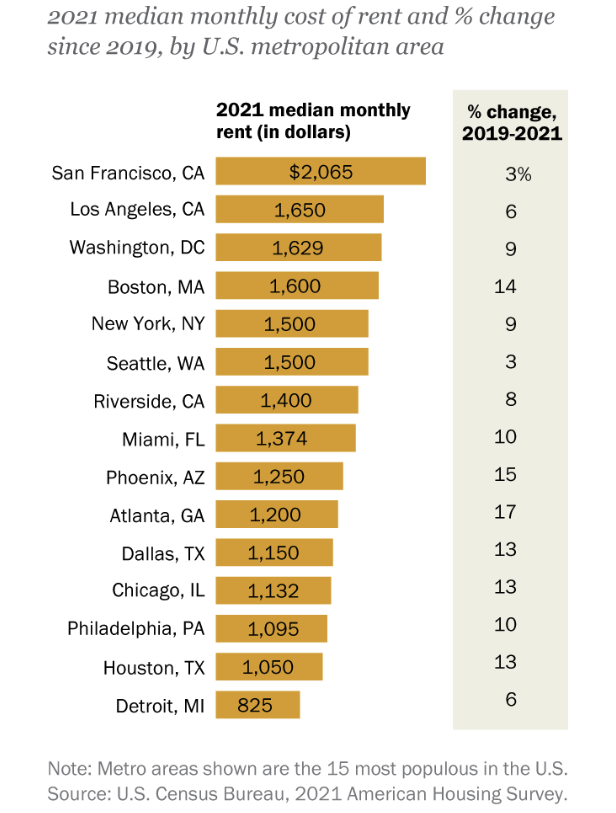
Renters in some metro areas faced especially sizable rent increases during the pandemic. Of the largest 15 metropolitan areas the Census Bureau’s AHS covers, eight saw increases of 10% or more in median monthly rent between 2019 and 2021. The median monthly cost of rent rose the most in Atlanta (17%), from $1,025 in 2019 to $1,200 in 2021.
Overall, the San Francisco metro area had the highest median monthly rent ($2,065) in 2021, followed by Los Angeles ($1,650), Washington, D.C. ($1,629) and Boston ($1,600). The New York City and Seattle metro areas were tied for the fifth-highest median monthly rent ($1,500).
Metropolitan areas were already seeing rent hikes before the COVID-19 outbreak. In 10 urban areas, median monthly rent increased 10% or more between 2017 and 2019. Riverside, California, and Phoenix, Arizona, saw the largest increases during that span (18%).
Some metropolitan renters reported housing inadequacies in 2021, when many Americans were spending more time at home. In the Houston and New York City metro areas, 14% of renter households said they had severely or moderately inadequate housing. (The AHS uses certain criteria – such as issues with plumbing, heating, electricity, wiring, upkeep or other problems – to classify this measure.) About one-in-ten renters in Dallas (11%) and 9% each in Boston and Washington said the same.
Some Americans struggled to pay rent early in the coronavirus outbreak. Around one-in-six U.S. adults (16%) said in an August 2020 Center survey that they had problems paying their rent or mortgage since the U.S. coronavirus outbreak started that February. Black (28%) and Hispanic (26%) adults were especially likely to report they struggled to pay for rent or a mortgage during this time; 11% of White adults said the same. Around a third of Americans with lower incomes (32%) also said they faced this issue.
Even before the pandemic, renters were spending substantial shares of their income on housing. In 2019, the median share of income that households who rent spent on their total monthly housing costs was 28%, according to AHS data.
Since much of renters’ household income already goes toward housing costs, rent increases can potentially push those at the lower ends of the income spectrum completely out of the market. A 2020 analysis from the U.S. Government Accountability Office found that a $100 increase in median rent was associated with a 9% increase in the estimated homelessness rate – even after factoring in other relevant factors such as changes in wages and the unemployment rate.
While the federal government’s national eviction moratorium protected renters during earlier stages of the coronavirus outbreak, the policy has since ended, and eviction filings have reportedly risen in recent months. Other state- and city-wide pandemic-related tenant protections are now expiring in Los Angeles and Oregon. And in New York City, tenants in rent-stabilized apartments are facing rent increases.
DOJ Settles ‘Crime-free housing’ Case: Racist Landlords in Hesperia, CA Used Law to Evict Black Tenants Accused but Not Convicted of Crimes. Black Renters 4X More Likely to be Evicted than Whites
/From [HERE] The US Justice Department on Wednesday filed what it is describing as a first-of-its-kind settlement in a racial discrimination case challenging a so-called “crime-free housing ordinance.”
The proposed consent decree was filed Wednesday in a lawsuit the Justice Department brought in 2019 against the central California city of Hesperia, alleging that the city’s ordinance violated the Fair Housing Act’s prohibitions on racial discrimination in housing access.
Hesperia continues to deny the allegations.
According to DOJ’s court filings, the 2015 ordinance instructed landlords to evict tenants accused of criminal conduct, even if those allegations have not resulted in an arrest or a conviction.
“As our complaint makes clear, Hesperia’s ordinance was a blatantly racially discriminatory solution to a problem that didn’t exist,” Assistant Attorney General Kristen Clarke, who leads the DOJ Civil Rights division, said on a press call Wednesday.
She noted under the program, Black renters were almost four times more likely to be evicted than White renters and Latino renters were 29% more likely to be evicted.
She said that some 2,000 jurisdictions across 48 states have enacted similar policies and that the new settlement sent a signal to other communities that they’d be held accountable if their housing policies violated anti-discrimination law.
“This landmark agreement is historic,” Clarke said. “It marks the Justice Department’s first settlement in a case challenge a crime-free ordinance and results in the full repeal of the program and nearly $1 million in monetary commitment.”
Last month, the city repealed the ordinance, which was previously amended in 2017 to make the program voluntary. According to the Justice Department, Hesperia and its co-defendants – the county of San Bernardino and the San Bernardino Sheriffs Department – have agreed to pay a $950,000 settlement.
It will compensate people who were harmed under the policy and will cover anti-discrimination training and other initiatives.
A lawyer for Hesperia said that the city’s move to resolve the case “was based solely on a sound financial decision on behalf of the citizens of the City.”
“At no time has the City admitted liability in this matter, and the City continues to vehemently deny all allegations contained within the complaint filed by the Department of Justice,” the lawyer, J. Pat Ferraris told CNN in an email.
According to Survey by the National Center for State Courts Americans' Confidence in Judiciary is in Steep Decline
/
From [HERE] From state courts up to the top of the federal system, Americans' confidence in the judicial system is falling fast. That was the grim takeaway from a recent survey by the National Center for State Courts (article available here.
The 2022 annual "State of the State Courts" survey released Wednesday also indicated public skepticism that state courts are living up to the promise of "equal justice to all," with responses showing a significant gulf between white people and people of color.
According to the survey, the percentage of respondents expressing confidence in the federal court system dropped from 60% in 2021 to 57% this year, while confidence in state courts took a dive from 64% to 60%.
Looking at race and the Supreme Court, the poll found a 9-point dip in confidence among white voters. But for Black respondents, the drop-off was a 19 points.