‘My honor is my loyalty’
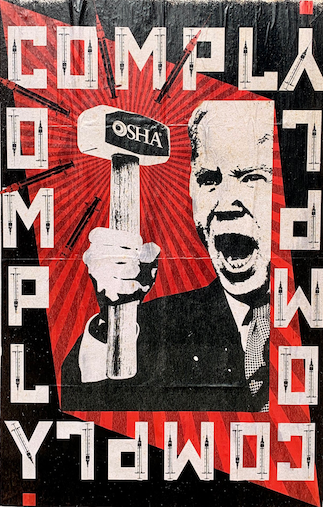
The government’s use of a psychological operation — aka PSYOP — to promote immunization follows standards and practices for engendering a cult mentality to reach its objectives.
The central technique for initiating and maintaining an obedient population is developing an “us versus them” mindset. The demonization of outsiders is essential.
Demands and sacrifices are made of the members, solidifying their involvement and ensuring they see themselves as superior to those who don’t participate.
These mesmeric psychological operations can be identified in groups small and large, including mass populations.
The most dramatic example of a PSYOP engendering a cult is the rise of fascism in Nazi Germany. An elite propaganda machine entranced a nation into believing they were a superior race, arousing a blind loyalty to their cause, with a loss of moral parameters unmatched in modern history.
Hitler’s most loyal troops, the SS, closely associated with forced labor and death camps, and deemed a criminal organization by the Nuremberg tribunals, wore belt buckles and kept daggers engraved with the words, “my honor is loyalty.”
More recently, less-militarized cults have made some dramatic impact in the United States.
The religious organization, the People’s Temple, in its early days gained the support of politicians and manipulated the media to project a positive spin on its activities.
The People’s Temple devolved into darkness, eventually leading to a quintessential cult event in Jonestown, Guyana. On the cusp of being arrested for the murder of a visiting congressman, their leader, Jim Jones, demanded the highest level of loyalty: Hundreds of members committed mass suicide, including their children, by drinking a cyanide-valium cocktail.
Mass hypnosis allows transference of an individual’s attention and priorities to a singular objective or ideology, and loyalty to the cause is elevated, overshadowing self-preservation.
Another example of an influential cult based in the United States is the Unification Church. Their members, the Moonies, were staunchly loyal to Sun Myung Moon, who was famous for presiding over spectacular mass weddings of arranged marriages.
The Unification Church also funneled money to powerful politicians through grants and speaking fees. Moon founded the Washington Times, which openly supported his political agenda.
As a lead investigator in a BBC biography of the Korean Cult leader, I met and interviewed former devotees and abettors who described the process of indoctrination into a trance of blind obedience.
Moon created a sophisticated psychological framework to attract and retain members, claiming he was a messiah greater than Buddha, Jesus and Mohammed combined. Good-hearted, intelligent people succumbed to a psychotic euphoria invoked by Moon and his agents, with support from government and media.
Only later did they awaken to their profound mistake, falling for rhetoric they eventually recognized as hypnotic, deeply flawed and dangerous.
One of the interviewees spoke most eloquently about having lost his soul, and given away years of his life.
An individual whose attitude embraces the affirmation — “my honor is loyalty” — towards any leader, cult or policy, has given up his or her personal power, often to abusive forces.
Symbolically, the SS motto has been illegal to use in Germany since 1947.
Cults are often viewed as aberrations that occurred in the past, however, they continue to thrive.
The susceptibility of humans to mass hypnosis and manipulation continues to be exploited and has never been applied for the greater good.
Cult of the vaccinated
Those who resist vaccination are reacting to harsh directives and overt hostility from a heavy-handed government. Their position is neither the result of mass hypnosis nor cult-like programming, rather an exercise in freedom of speech and choice.
Psychologically, there is an indisputable, definitive metric that demonstrates the difference between the anti- and pro-vaccine groups.
A large majority of the unvaccinated have reviewed information and statistics from a range of sources, that either support or contradict government policy. They have made choices based on concerns about efficacy and risks, but are open to engaging in debate.
Most of the pro-vaccine faction stand by what they deem unassailable information from the news media. They are willing to accept a filtered version of data, and staunchly refuse to look at any material that might cause doubt about their decisions or challenge authoritative mandates.
They refuse to engage in debate.
A majority of the general public has been beguiled into feeling threatened by the virus, and roused to angrily denounce those who doubt the efficacy or risks of COVID-19 inoculants.
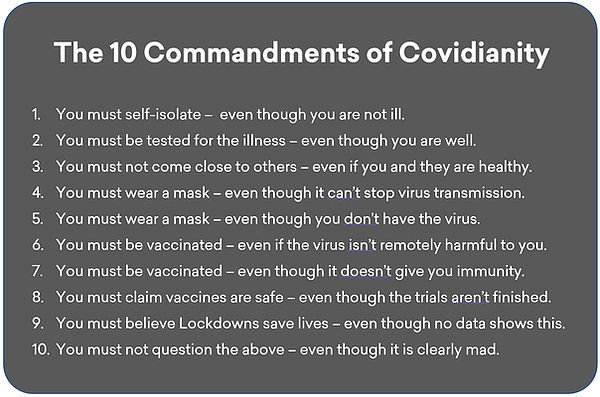
The pro-vaccine disciple’s lockstep, cult-like behavior is classic. The mentality includes:
Unbending loyalty to a methodology promulgated by influential leaders who make claims that are too good to be true.
Unquestioning adherence to and dependency on the group’s approach and procedures, with insistence that they are on the only true and worthy path.
Unwillingness to consider any written or spoken words, or ideas that counter the messaging of leaders or the group’s intentions.
Willingness to change lifestyle or engage in risky behavior, with blind acceptance that there are only benefits and minimal risks.
Continuing belief in dogma, even when firmly presented concepts devolve, or prove to be deeply flawed.
Denying any self-doubt in the name of a greater mission — critical thinking about the group is an abomination.
Persuading or pressuring new members to join, using guilt as primary motivation. When this fails, forcing submission through ridicule, mental anguish or material punishment.
Demeaning, isolating and penalizing anyone who defects or does not enlist.
Willingness to dishonor family or destroy long-term relationships in the name of the cult’s objectives.
Self-destructive behavior — as in all of the above — that eventually leads to dissolution of the cult and irreparable harm to the members.
Designing a PSYOP for a pandemic
A strong circumstantial case can be made that there is an imposed PSYOP in place in the United States. The vehement public support and willingness to obey without question are the precise results a government would seek in response to the perceived threat of a deadly pandemic.
The tactics used to generate this kind of outcome are not hidden from those willing to consider how the U.S. government applies its knowledge.
This excerpt from the opening chapter of the “U.S. Army Field Manual on PSYOP” makes intentions of a campaign very clear: [MORE]