Border Patrol Searched & Copied a Nigerian American Attorney's Cell Phone 5X in 4 Months So He Filed an Injunction to Stop It. Feds Oppose b/c Rights Become More Imaginary @ the Imaginary Border

borders.jpg

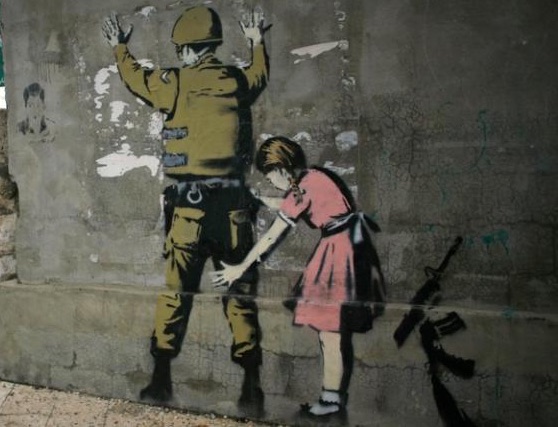
From [HERE] The federal government is opposing a Texas immigration lawyer’s request for an injunction to prevent warrantless border searches of his electronic devices.

Immigrant lawyer George Anibowei appealed to the 5th U.S. Circuit Court of Appeals at New Orleans after a federal judge denied an injunction in January, Law360 reports. Anibowei is a U.S. citizen and licensed attorney who maintains an office in Dallas.1 Before immigrating to the United States, Anibowei was licensed to practice law in Nigeria. He was admitted to the Texas Bar in 2002.

The government’s brief, filed July 22, argues that the lower court decision was not abuse of discretion, given Anibowei’s “novel theory” on a warrant requirement.

“Plaintiff George Anibowei sought a preliminary injunction under a theory that a warrant is required before a cellphone may be searched at the border,” the government brief said. “But as the district court correctly noted, no decision from this court or the Supreme Court has ever imposed such a requirement.”

Anibowei said border officials have searched his cellphone five times over a four-year period. In October 2016, the contents of his device were copied for examination, Anibowei said. His suit challenges the 2016 search, conducted at the Dallas/Fort Worth International Airport.

According to court documents, the first search incident occurred in October 2016, when Anibowei was returning from a short vacation to Canada. He had already been subjected to secondary inspection by Canadian border authorities when entering and exiting Canada, purportedly at the request of CBP. After Anibowei's return flight arrived at DFW Airport—while passengers were preparing to disembark—the flight crew told the passengers to return to their assigned seats, because officers from the Department of Homeland Security ("DHS") were there to remove a passenger. Anibowei was the passenger whom the officers removed. The officers, who were CBP agents,2 led Anibowei to an interrogation room and instructed him to place the contents of his pockets, including his cell phone, on a table. One of the agents then took Anibowei's cell phone out of the room. When Anibowei asked why, the agents told him that they had detained his cell phone for "examination and copying." Id. ¶ 35. The agents questioned Anibowei for roughly two hours about his background, his personal life, and the purpose of his trip to Canada. At no point did the agents suggest that Anibowei had broken the law or that he had any illegal material on his cell phone. After questioning him, the agents returned his cell phone and again told him that it had been copied for examination.

In February 2017, after Anibowei filed the instant lawsuit, CBP agents again detained him for questioning as he passed through customs at DFW Airport. This time, Anibowei was returning from a trip to Nigeria. Although the agents did not copy his cell phone, they performed a manual search of his emails and text messages. They also questioned Anibowei for nearly three hours. Once again, they never suggested that Anibowei had committed a crime or that his cell phone contained any illegal content. Anibowei alleges that his cell phone contains personal and private information as well as confidential and privileged materials relating to his work on behalf of clients. [MORE]

The government said Anibowei’s phone was returned to him immediately after the DFW airport search. Anibowei would have known if any copied information caused irreparable harm, but he instead offered “only generalities about speculative threatened harm,” the government argued.

Privacy expectations are lower at the border, the government said. “Routine border searches do not require even reasonable suspicion or probable cause, much less a warrant,” according to the brief.

Some courts have required individualized suspicion for forensic searches of electronic devices at the border, but they still reject the warrant requirement urged by Anibowei, the government brief said.

Is Marijuana Decriminalization Intended to Reduce or Facilitate Intrusive Searches? MD High Court says Cops Can't Stop & Search Based on the Odor of Weed, Reversing Black Man's Conviction

b-more cops suck.jpg

Odor-based pot arrests are unconstitutional. Police officers lack probable cause to arrest and search someone for marijuana possession simply for smelling of the drug, because possession of less than 10 grams of marijuana is not a crime in Maryland, the state’s top court unanimously ruled Monday in a 7-0 decision. According to the decision:

“Rasherd Lewis, Petitioner, was convicted in the Circuit Court for Baltimore City of wearing, carrying, or transporting a handgun upon the court’s finding him guilty of that charge based on an agreed statement of facts. That proceeding followed a hearing on Petitioner’s motion to suppress a handgun, marijuana, cash, and plastic baggies that the police seized during a search of him at a convenience store in downtown Baltimore City on February 1, 2017.
The Suppression Hearing

Baltimore City Police Officer David Burch, Jr., was the sole witness to testify at the suppression hearing, after being accepted as an expert in the identification and packaging of marijuana. The court, having credited the testimony of Officer Burch, denied Petitioner’s motion to suppress the items seized during the search. We summarize Officer Burch’s testimony, viewed in the light most favorable to the prevailing party, here, the State.

On February 1, 2017, Officer Burch received a tip about a potentially armed individual in the 400 block of West Saratoga Street in Baltimore City. The tipster was not a confidential informant but someone whom Officer Burch described as having provided reliable information to him for “a little less than a month” before the incident at issue in the present case. Officer Burch conveyed the tip and a description of the individual to CitiWatch, which monitors Baltimore City’s surveillance cameras. The CitiWatch Operator reported back that an individual matching the description given by Officer Burchlater identified as Petitionerwas observed on a surveillance camera entering the Bag Mart, a convenience store located at 401 West Saratoga Street. Officer Burch was familiar with that store, as it was in a “high crime area” and known to him as an “open air drug market” where marijuana was often distributed both inside and in front of the store. He previously made controlled dangerous substance and handgun arrests at the location.

Officer Burch and five other officers responded to the Bag Mart. The store is small. As he and the other officers were entering, Officer Burch saw that the store was “fairly crowded” and smelled of the odor of marijuana. Officer Burch spotted Petitioner move from a position near the cash register and follow others who were heading toward the exit. Petitioner had a red bag strapped across his chest, was walking normally, and appeared to be calm.

As Petitioner passed “literally right in front of” Officer Burch, the officer smelled “the odor of marijuana emitting from [Petitioner’s] person.” By that time, the officers had asked the other patrons to exit the store, leaving only the store’s owner, Petitioner, and the six police officers.

Officer Burch testified that he reached out and “stopped” Petitioner based on “the odor of marijuana and the information [he] received to further investigate.”1 Officer Burch described the stop. While standing “face to face” with Petitioner, he used his right hand to grab Petitioner’s right hand and his left hand to grab Petitioner’s left shoulder. The other five officers surrounded Petitioner, with Officer Curtis situated directly behind Petitioner.

Officers Burch and Curtis were wearing department-issued body worn cameras. Footage from each of the cameras was entered into evidence at the suppression hearing. Officer Burch testified that he turned on his camera when he came into direct contact with Petitioner. Officer Burch acknowledged, however, that for about thirty seconds the camera

was “buffering.” As best we can discern from the record, during that time, Officer Burch directed Petitioner to raise his hands and Petitioner complied. When Petitioner began to lower his hands, Officer Curtis, at Officer Burch’s direction, grabbed one then presumably the other of Petitioner’s arms and handcuffed Petitioner. Officer Curtis’s camera recorded Officer Burch advising Petitioner to calm down as Officer Curtis handcuffed him.

Once Petitioner was handcuffed, Officer Burch undertook a full search of Petitioner. He first searched the red bag and found a handgun inside. Then, as he searched Petitioner’s pockets and waistband, Petitioner advised that he was carrying a small amount of marijuana. Officer Burch found that quantity of marijuana in a sealed, one-inch plastic baggie in one of Petitioner’s pockets.2

Petitioner, through counsel, advanced two theories to support his motion to suppress the fruits of the search. He argued first that, pursuant to Terry v. Ohio, 392 U.S. 1 (1968), the police did not possess the requisite reasonable suspicion to “stop” Petitioner at the outset of the encounter.3 Independent of that argument, Petitioner contended that the full search of Petitioner and the bag he carried was unlawful because at the time the search was undertaken, the police lacked probable cause to believe he had committed a felony or was committing a felony or misdemeanor in their presence.

Specific to the probable cause argument, Petitioner argued that the search incident to arrest exception—the justification propounded by the State—did not justify a full-scale search because no probable cause existed to arrest him. Petitioner noted that someone in possession of less than ten grams of marijuana may be issued a civil citation but cannot be arrested, therefore no lawful arrest occurred. The State responded that the odor of marijuana provided Officer Burch with probable cause to arrest and search Petitioner because marijuana in any amount is contraband, and although possession of less than ten grams of marijuana was decriminalized, “it was never the legislature’s intention to reclassify marijuana as not being contraband.”

The suppression court determined that the tip that caused Officer Burch and his five fellow officers to respond to the Bag Mart lacked sufficient reliability to justify the initial stop of Petitioner. In making that determination, the court quoted Florida v. J.L., 529 U.S. 266, 272 (2000), which states that reasonable suspicion “requires that a tip be reliable in its assertion of illegality, not just in its tendency to identify a determinate person.” Given the lack of sufficient indicia of reliability, the court granted Petitioner’s motion to suppress evidence of the tip.

The suppression court credited Officer Burch’s testimony that he smelled the odor of marijuana on Petitioner’s breath and body as soon as he and Petitioner were “face to face.” Based on that finding, the court ruled that the odor of marijuana gave police probable cause to arrest Petitioner and, incident to such arrest, conduct a full search of his person. In making that ruling, the court relied on Robinson v. State, 451 Md. 94 (2017), which we

noted at the outset of this opinion involved the automobile exception, not the search incident to arrest exception, to the Fourth Amendment’s warrant requirement.

Extrapolating upon the reasoning of Robinson, the suppression court concluded: “[I]t would appear that the odor of marijuana emanating from a person provides probable cause to believe that that person contains evidence of a crime[; consequently,] a police officer may search that person under such circumstances.” Based on that ruling, the court denied the defense’s motion to suppress the handgun found during the search of Petitioner.4 Subsequent Procedural History

Petitioner pleaded not guilty on an agreed statement of facts to the charge of wearing, carrying, or transporting a handgun. After the State’s presentation of the agreed- upon facts, the circuit court found Petitioner guilty of the handgun charge and sentenced him to three years’ incarceration with all but ninety days suspended and three years’ supervised probation.”

Ruling on the case the court stated,

“For the reasons that follow, we agree with Petitioner that Robinson does not control the outcome of this case. Instead, it is Pacheco, decided after the Court of Special Appeals issued its opinion in the case at bar, that dictates the outcome here. We hold that more than the odor of marijuana is required for probable cause to arrest a person and conduct a search incident thereto. We therefore further hold that Petitioner was entitled to suppression of the handgun and other items seized during the search because Officer Burch, at the time he undertook the search of Petitioner that produced the seized items, did not have probable cause to believe that Petitioner had committed a felony or was committing a felony or misdemeanor. “ [MORE]

8 White Cops Murdered a Handcuffed Black Man Lying on His Stomach by Piling On Him, Suffocating Him to Death in a Grocery Store to Force Compliance w/Arkansas Shoplifting Law & Authority

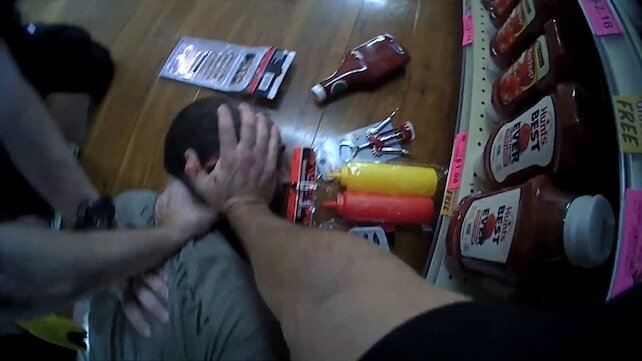
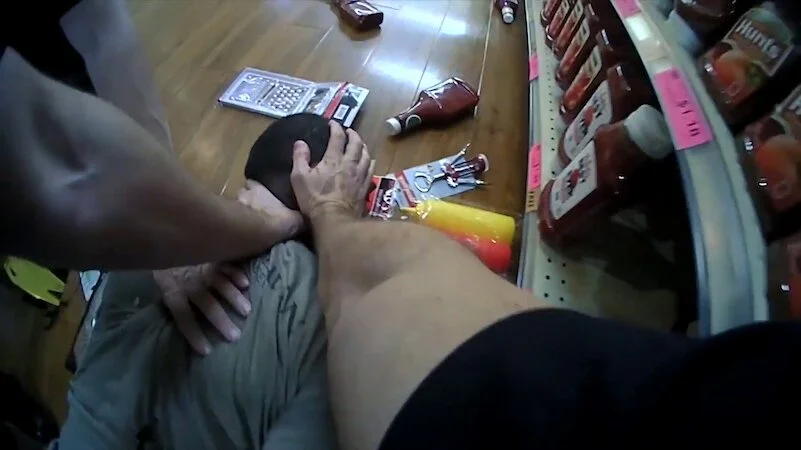
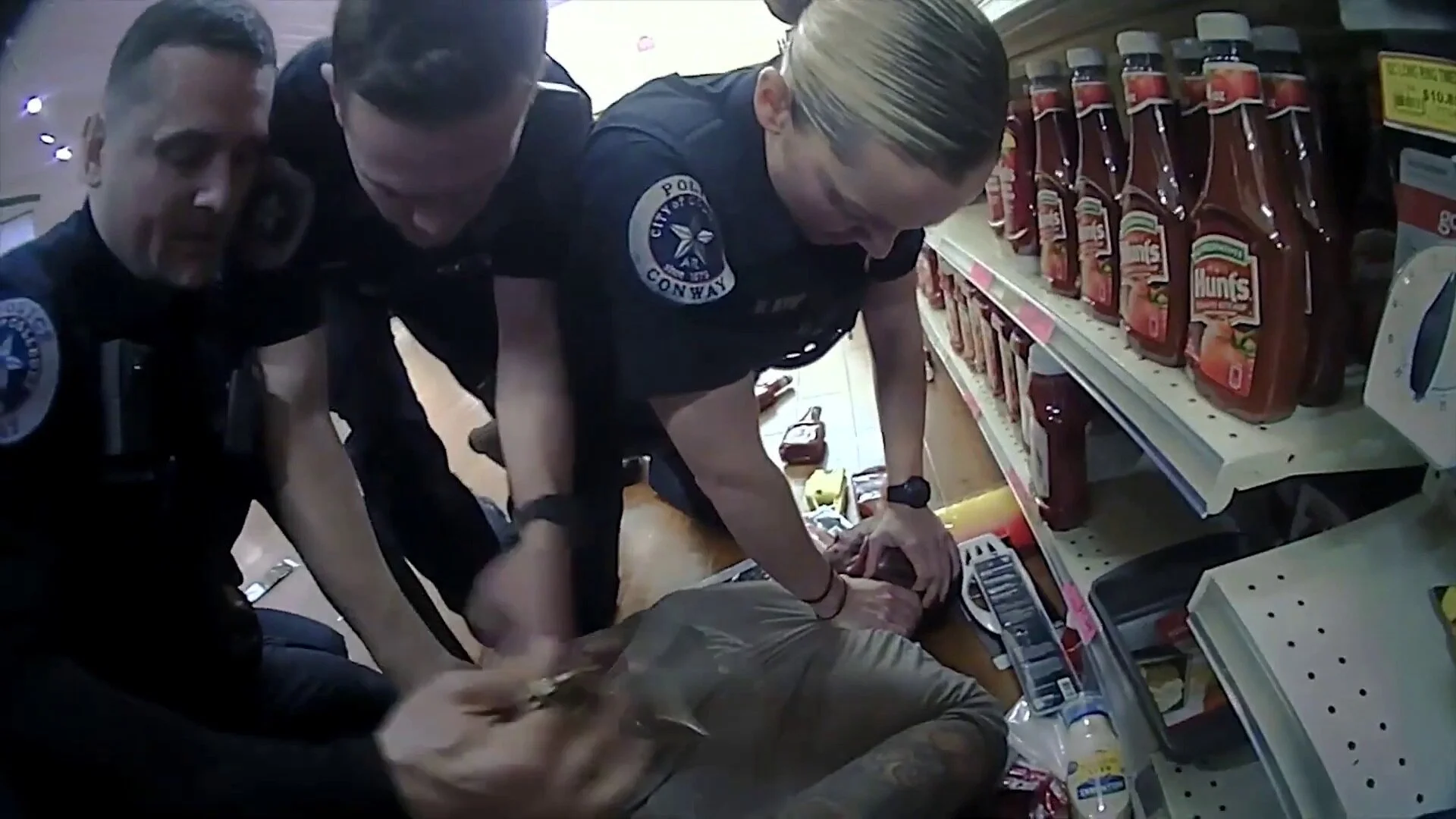
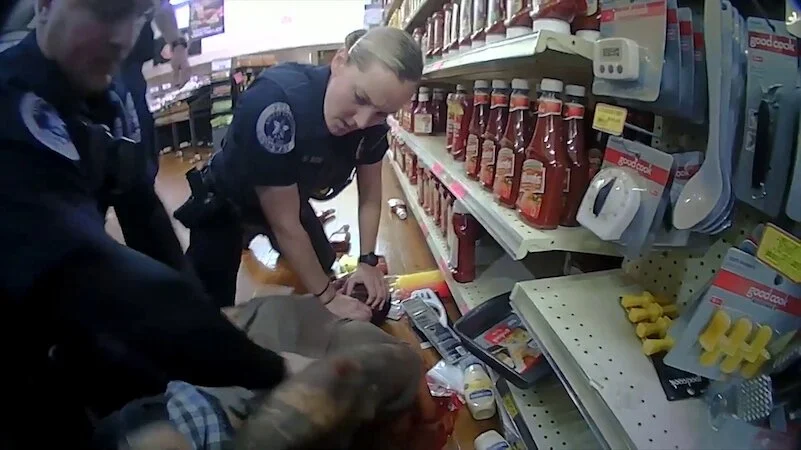
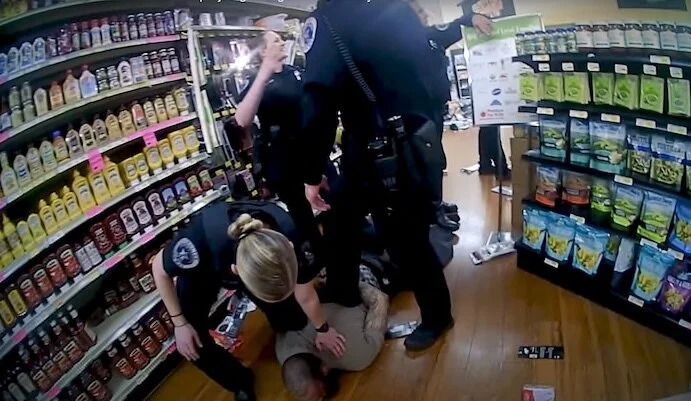
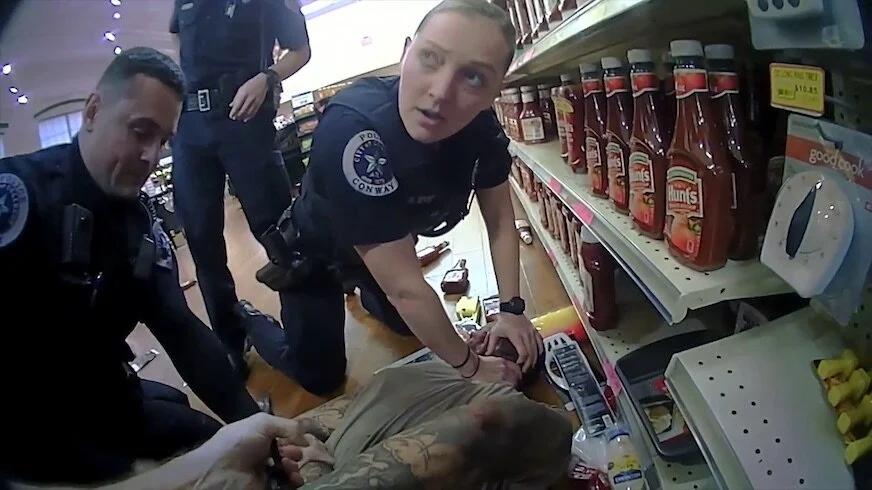
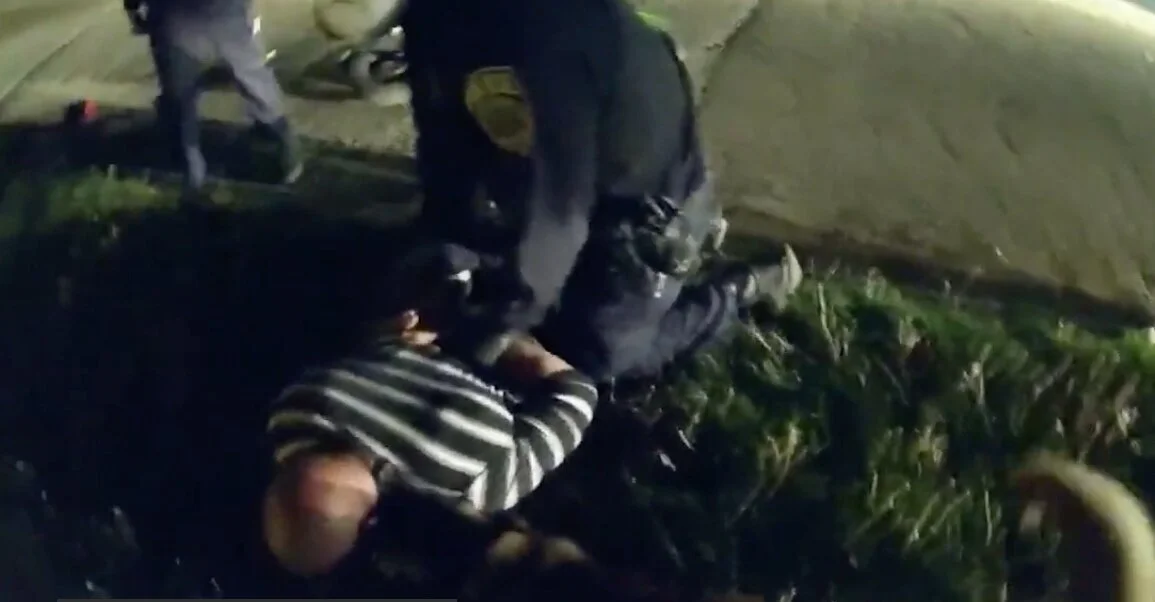
1 COMMAND AFTER ANOTHER LED TO MURDER IN A LEGAL SYSTEM ANCHORED BY PHYSICAL VIOLENCE. From [HERE] and [FTP] As he begged police to stop using a Taser on him on a supermarket’s floor, Lionel Morris’s cries echoed through the produce section of the store in Conway, Ark., for 6½ minutes. Body camera and surveillance footage from that fateful day on February 4, 2020 has just been released this week showing this man’s final moments alive. Morris took the last breaths he would ever take with multiple police officer combat boots and a knee on his back.

Morris had run from officers on Feb. 4 and then placed one officer in a chokehold and tried to pulled out a knife, according to police, after the supermarket had reported him for removing a drone from its packaging. But as an officer had his knee on the 39-year-old’s back inside Harps Food Store, Morris, handcuffed and lying face down, repeatedly offered a succinct and familiar plea: “I can’t breathe.”

“If you can talk, you can breathe. Chill out,” replied the officer, according to body-cam footage released by the Conway Police Department on Wednesday. “We got an ambulance. "

Minutes later, Morris was “pulseless and unresponsive” when medical personnel arrived. He was pronounced dead while being transported to the hospital.

On Wednesday, the officers involved in Morris’s death were cleared of criminal wrongdoing by the Arkansas State Police and prosecutors. That decision came the same day that police released edited body-cam and security footage that illustrated a chaotic incident in which Morris seemingly made clear repeatedly that he was in medical distress. The story was first reported by KTVH.

“After a thorough review, the prosecutor determined there was no evidence of any criminal wrongdoing by the Conway Police Department or the Conway police officers involved in this unfortunate incident,” Conway Police Chief William Tapley said in a recorded statement.

The medical examiner concluded that Morris died of “methamphetamine intoxication with a combination of exertion, struggle, restraint and conducted electrical weapon deployment,” according to a letter from prosecuting attorney Carol Crews. To explain his death in custody, Tapley pointed to the toxicology report’s findings that Morris had substances including methamphetamine, morphine, amphetamine, opiates and cannabinoids in his system. Meaning that if the white cops had piled on top of the average Olympic athlete death probably would not have resulted.

“The level of drugs Mr. Morris had in his system and the strain he exerted while struggling with police ultimately contributed to his death,” he said.

The February remarks from the Conway officer preceded similar comments made by Derek Chauvin, the former Minneapolis police officer who knelt on George Floyd’s neck for nearly nine minutes in late May. In response to Floyd’s pleas of “I can’t breathe,” Chauvin, who is charged with murder in Floyd’s death, said, “Takes a heck of a lot of oxygen to say that.”

Conway Mayor Bart Castleberry said Wednesday that he had ordered the body-cam footage of at least eight officers to be released to the public. The mayor said he instructed Tapley to place some of the officers involved in the incident on paid leave until the department’s ongoing internal investigation has concluded. It’s unclear how many officers have been placed on leave.

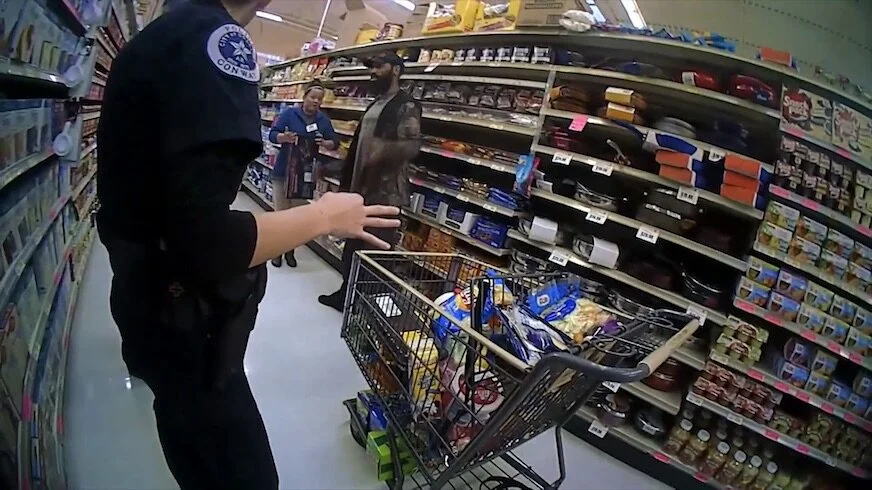
At 4:25 p.m. on Feb. 4, police received a call about an alleged shoplifting in progress at a Harps Food Store. When police made contact with Brandy Arnold and Morris — who had given the officers a fake name — the officers found a drone that had been removed from its packaging, Tapley said. When officers arrived at the store, Morris and a woman who was with him, initially complied with officers. When the employee brought over the drone box Morris had allegedly opened, he asked them to throw it in the cart with the rest of his groceries and he would purchase it. He told them that the box was already opened and he planned on purchasing the drone.

While Arnold was arrested without resistance, Morris began to sprint down the aisle, sparking a police footrace through the supermarket.

As police caught Morris in the produce section of the store, they demanded that he submit to arrest nearly 40 times during the 6½-minute struggle, Tapley said. Police used a Taser on Morris “multiple times,” including when he was on the ground. One officer acknowledged punching Morris two to four times in the back and elbow “in an attempt to gain compliance,” according to KTVH.

“Give me your f---ing hands!” one of the officers said to Morris, threatening to break his wrists.

Morris repeatedly told police he was in medical distress.

“Oh my God, oh my God! Please help me, please!” he yelled. “Help me please! Somebody help me!”

Police claimed that at one point during the struggle, Tapley said Morris reached for a knife clipped to his pocket, and that an officer gained control of it and threw it to a “safe location.” It is unclear in the edited video released Wednesday when the knife appeared or when it was tossed. White police also claimed that sometime during that conflict, Morris allegedly placed an officer in a chokehold, Tapley said.

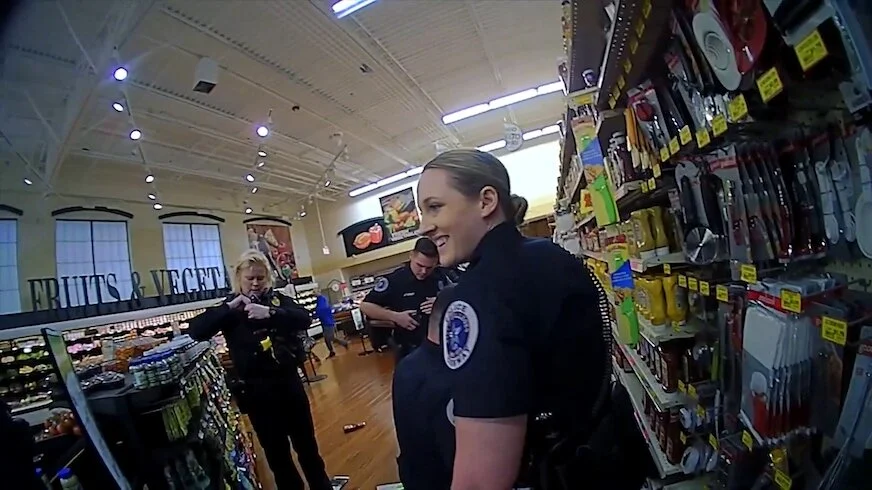
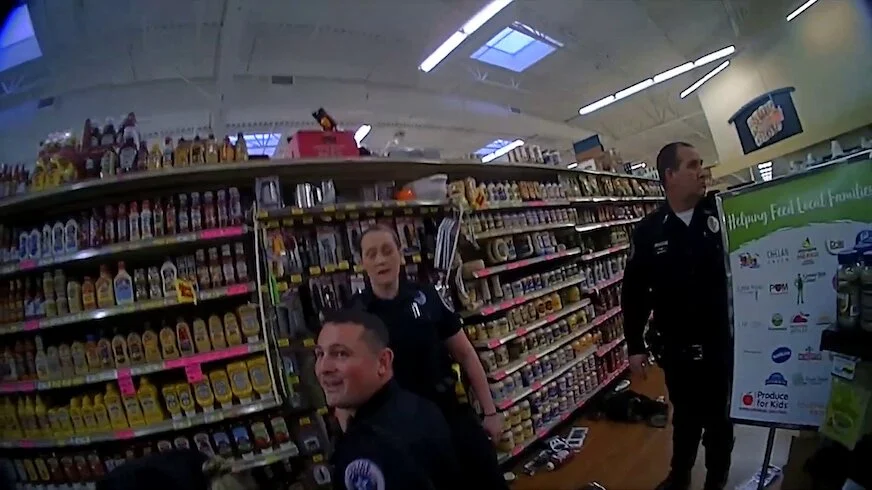
Additional white officers arrived placing their knees and feet on Morris’s back, body-cam footage shows at least one officer pressing both hands against his head and neck as he’s on the ground. Three or four of the cops are white women. The video speaks for itself for those who have eyes to see - this man was no threat to these hyped up yurugu cops. The Black man instinctively pulls away from being struck and strangled and the cops appear to use this situation to justify apply more and more force regardless of its consequences. After he is handcuffed laying face down in the aisle the white cops appear completely calm as they intentionally apply pressure. The white woman presses her weight onto his face and neck area mushing him against the floor while he is saying ”I can’t breathe.” After he is completely subdued the gang of white cops keeps him laying on his stomach while the stand around grinning and cracking smiles and jokes amongst each other - the Black man is still saying “I can’t breathe.”

Throughout the incident, Morris told police that he feared something was wrong with his heart, and implored the officers to call an ambulance. The officers had made a call for emergency medical services for Morris before he was arrested, Tapley said. While police say that Morris was put into a recovery position once he started vomiting, that is not shown in the footage.

At the time of the incident, police said Morris reportedly stopped breathing sometime after he was handcuffed, reported the Arkansas Democrat-Gazette.

“There are some behaviors that must change,” Conway Mayor Castleberry said in a video statement Wednesday . “There is no place for racism in the city of Conway…It’s time to have hard conversations.”

The video below shows what happens to people who open a box in a grocery store in the land of the free. 


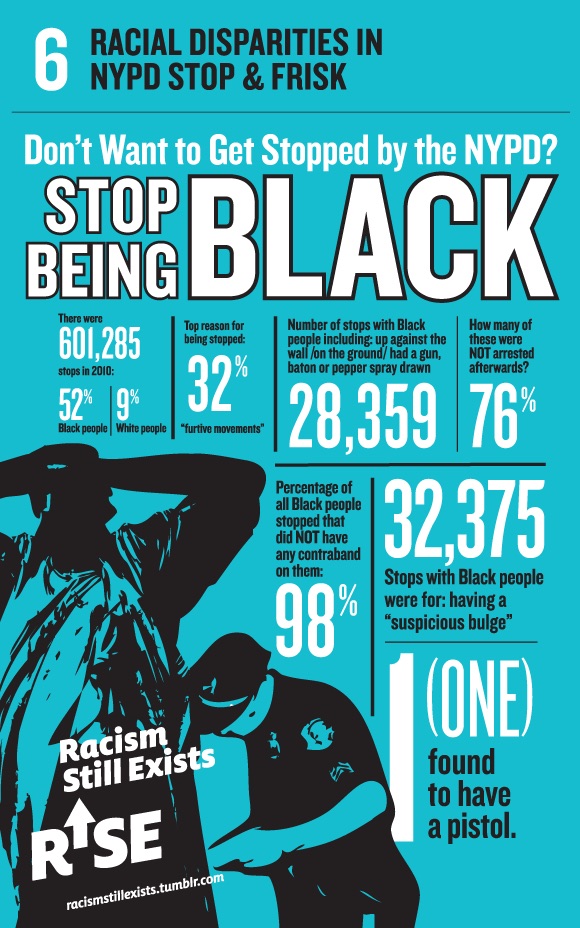
"Im Gonna Pat You Down:" White NC Cop's Stop of Teen Inside Store was Based Solely on Unreasonable, Inarticulable Hunches but It Didn’t Matter b/c the 4th Amendment Doesn't Protect Blacks from Cops

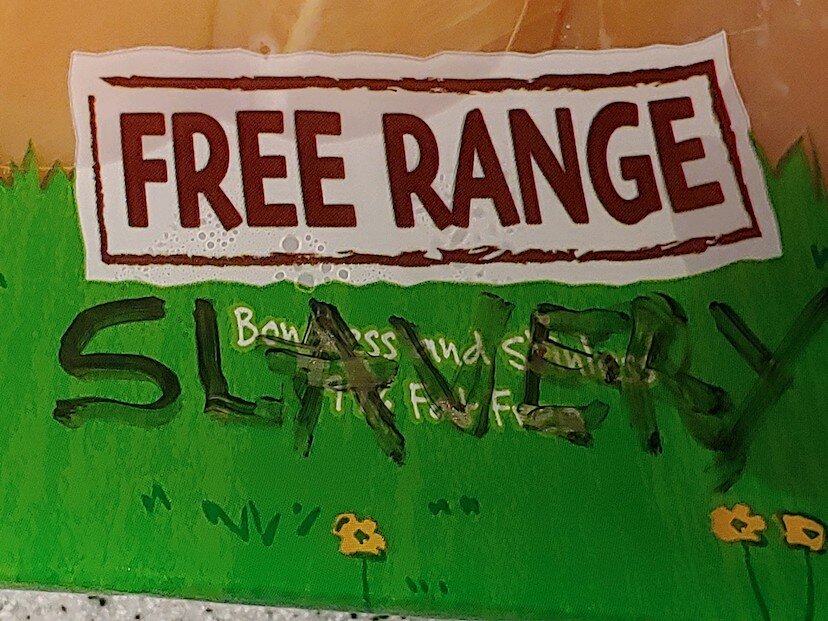
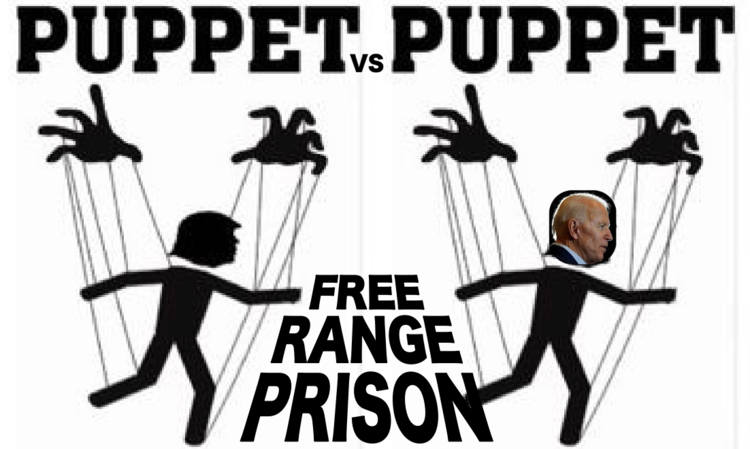
The 4th Amendment right to be free from unreasonable seizures and searches and right “to be secure" or to move freely without apprehension of oppression as you come and go is essentially a myth and propaganda with regard to its application Black people in this Free Range Prison.

Prominent defense attorney Leonard Stamm explains the following about the 4th Amendment prohibition against unreasonable searches and seizures:

“POLICE MAY FORCIBLY STOP AND BRIEFLY DETAIN A PERSON FOR FURTHER INVESTIGATION IF THE OFFICER HAS FACTS GIVING RISE TO A REASONABLE, ARTICULABLE SUSPICION THAT THE PERSON HAS COMMITTED, IS COMMITTING, OR IS ABOUT TO COMMIT A CRIME.” 

Police may not act on on the basis of an inchoate or unclear and unparticularized suspicion or a hunch - there must be some specific articulable facts along with reasonable inferences from those facts to justify the intrusion. Reasonable articulable suspicion is based on the totality of the circumstances. Nervous, evasive behavior, flight from police, may give rise to a reasonable articulable suspicion sufficient to justify a stop. But, a law enforcement officer cannot simply assert that innocent conduct was suspicious to him/her, but rather must explain how that conduct was indicative of criminal activity. 

AUTHORITY: Terry v. Ohio, 392 U.S. 1, 88 S.Ct. 1868, 20 L.Ed.2d 889 (1968); Illinois v. Wardlow, 528 U.S. 519, 120 S.Ct. 673, 145 L.Ed.2d 254 (2000); United States v. Arvizu, 534 U.S. 266, 122 S.Ct. 744, 151 L.Ed.2d 740 (2002) Goode v. State, 41 Md.App. 623, 398 A.2d 801, cert. den., 285 Md. 730 (1979); Lawson v. State, 120 Md.App. 610, 707 A.2d 947 (1998); Cartnail v. State, 359 Md. 272, 753 A.2d 519 (2000); Sullivan v. State, 132 Md.App. 682, 753 A.2d 601(2000); Wise v. State, 132 Md.App. 127, 751 A.2d 24 (2000); Rowe v. State, 363 Md. 424, 769 A.2d 879 (2001)(edge line crossing - stop held bad); Edwards v. State, 143 Md.App. 155, 792 A.2d 1197 (2002)(center line crossing - stop held good); Dowdy v. State, 144 Md.App. 325, 798 A.2d 1 (2002)(excessive lane changing and drifting -stop held good); Stokes v. State, 362 Md. 407, 765 A.2d 612 (2001)(black man in a black tee shirt is too vague); Muse v. State, 146 Md.App. 395, 807 A.2d 113 (2002)(approving stop for cracked windshield); Collins v. State, 376 Md. 359, 829 A.2d 992 (2003)(approving stop where defendant was spotted on foot, within about fifteen minutes after the robbery, about 200 yards away, and met the description with reference to height, weight, type of clothing and method of escape); Ransome v. State, 373 Md. 99, 816 A.2d 901 (2003)(Terry stop not justified by bulge in pocket, and defendant staring at police officer in high crime area); Craig v. State, 148 Md.App. 670, 814 A.2d 41 (2002)(police had articulable reasonable suspicion); State v. Blasi, 167 Md.App. 483, 893 A.2d 1152 (2006)(conducting field sobriety tests constitutes a search for 4th Amendment purposes, but pursuant to Terry, such a search only requires articulable reasonable suspicion); Sykes v. State, 166 Md.App. 206, 887 A.2d 1095 (2005)(officer’s grabbing, crumbling, and rolling techniques used in search were proper under Terry); Matoumba v. State, 162 Md.App. 39, 873 A.2d 386 (2005)(conduct of passenger of vehicle provided sufficient articulable reasonable suspicion for officer to frisk him following a stop); Madison-Shepard v. State, 177 Md.App. 165, 934 A.2d 1046 (2007)(officer did not have sufficient articulable reasonable suspicion to assume that the Appellant was the suspect described in the radio alert, because he was black, had corn row hair, did not have an ID, and acted nervous upon being approached by the police); State v. Williams, 401 Md. 676, 934 A.2d 38 (2007)(rear window was darker than “normal” did not provide sufficient articulable reasonable suspicion for the stop); State v. Dick, 181 Md. App. 693, 957 A.2d 150 (2008)(officer had reasonable articulable suspicion where suspect in high drug crime area riding bike in gas station for 15 minutes, go up the street, and engage in a hand-to-hand transaction); Crosby v. State, 408 Md. 490, 970 A.2d 894 (2009)(a law enforcement officer cannot simply assert that innocent conduct was suspicious to him/her, but rather must explain how that conduct was indicative of criminal activity); Hicks v. State, 189 Md. App. 112, 984 A.2d 246 (2009); In re Jeremy P., 197 Md. App. 1, 11 A.3d 830 (2011)(“Mere conclusory statements by the officer that what he saw made him believe the defendant had a weapon are not enough to satisfy the State’s burden of articulating reasonable suspicion that the suspect was involved in criminal activity.” The officer lacked reasonable suspicion based solely on adjustments in the waistband vicinity in an area known for criminal activity where the officer cannot recount additional specific facts that suggest that the suspect is concealing a weapon. The fact that the incident occurred in a “high risk area” also did not tilt the reasonable suspicion scale.).” [MORE]

With regard to police also touching you to search you Stamm explains:

“IN ADDITION TO THE REASONABLE, ARTICULABLE, SUSPICION REQUIRED FOR THE STOP, IF THE OFFICER HAS REASONABLE, ARTICULABLE SUSPICION TO BELIEVE THAT THE PERSON IS ARMED OR OTHERWISE A DANGER, THE OFFICER MAY FRISK OR PATDOWN THE SUSPECT FOR WEAPONS ONLY. 

For crimes which are inherently violent a frisk is appropriate based on the suspicion for the stop. The frisk or pat-down is only to search for weapons. Unless the pat-down search reveals the presence of a weapon, the officer may not reach in a pocket and remove an item which does not pose a threat to the officer's safety unless Minnesota v. Dickerson is satisfied. The officer may not pull the defendant's shirt out if the frisk is unsuccessful.” 

The Supreme Court has ruled that the police must have independent reasonable articulable suspicion that the person is armed and dangerous before they may touch you or put their hands on you (a cursory patdown for weapons). Police may not act on on the basis of an inchoate or unclear and unparticularized suspicion or a hunch - there must be some specific, actual & articulable facts along with reasonable inferences from those facts to justify the intrusion.

AUTHORITIES: Terry; Alfred v. State, 61 Md.App. 647, 487 A.2d 1228 (1985); Simpler v. State, 318 Md. 311, 568 A.2d 22 (1990); Quince v. State, 319 Md. 430, 572 A.2d 1086 (1990); Weedon v. State, 82 Md.App.692, 573 A.2d 92 (1990); Aguilar v. State, 88 Md.App. 276, 594 A.2d 1167 (1991); State v. Smith, 345 Md. 460, 693 A.2d 749(1997); Partee v. State, 121 Md.App. 237, 708 A.2d 1113 (1998)(passenger illegally detained when he was shot); In Re: David S., 367 Md. 523, 789 A.2d 607 (2002)(search exceeded scope of Terry frisk); Russell v. State, 138 Md. App. 638, 773 A.2d 564(nervousness of driver and taking items out of pocket and returning to pocket large enough to contain a weapon in high crime area after being asked if he had a driver's license supported pat down); Graham v. State, 146 Md. App. 327, 807 A.2d 75 (2002)(no basis for pat down); Bailey v. State, 412 Md. 349, 987 A.2d 72 (2010); Hicks v. State, 189 Md. App. 112, 984 A.2d 246 (2009)(Terry frisk for weapons justified based on the inherent dangers of drug enforcement and that a detention based on reasonable suspicion of drug dealing); In re Lorenzo C., 187 Md. App. 411, 978 A.2d 890 (2009)(reasonable belief that suspect may be armed stemmed from :refusal to take hands out of pockets, officer solo handling three subjects, subject’s attempt to walk away from officer, furtive movement, investigation into crime of violence, and early morning hour); Epps v. State, 193 Md. App. 687, 1 A.3d 488 (2010)(order that defendant lift his shirt exceeded permissible scope of Terry pat-down frisk of outer clothing for weapons.; pat-down would not have permitted recovery of plastic baggie that was protruding from waistline of defendant's pants, as it was not hard object that could have been mistaken for weapon). 

Question: where are “your rights” on the street? Perhaps rights exist if the cops also share in your illusion that they do - otherwise you better hope some other authoritarian such as a prosecutor or judge agrees that you had some rights, sometime subsequent to the harmful government intrusion. FUNKTIONARY calls this “the thought standard.” Brazen cops so frequently abuse their power that no one—no Black motorist, no juvenile, no adult, no professional of any kind—could make a compelling argument that constitutional rights afford Black or Latino people any real protection from police - not on the street. Dr. Blynd states, "The child who is taught to believe the law will be his protection is the child who will become the victim of its own beliefs."  "Unquestioned beliefs own you." Rights are myths and are better characterized as “master’s favors.” Believe in this bullshit at your own risk.

From [HERE] The city of Durham released body-camera footage Tuesday showing the initial interaction at a convenience store between a white police officer and a 16-year-old whose family is now suing the city. A second video from the store reportedly shows the white cop body slamming the teenager before he gets away. The initial stop and seizure of Scott was unlawful. Subsequent to the incident white cops used dogs to try to find the teenager.

Police falsely charged the teen, Tony Scott, with assault inflicting serious bodily injury, and assault on a law enforcement officer. The Hillside High School sophomore, who is now 17, has said he went to the store to get a snack during lunch.

The charges were dropped four months later, which Scott said came after the prosecutor watched the interaction on a separate, convenience-store video.

The body-camera video released Tuesday shows Officer Michael McGlasson walking into the Caroco gas station and convenience store on Jan. 23, 2019.

18 MONTHS AFTER THE FACT THE TRUTH COMES OUT. in a credibility contest between a sworn white police officer and a Black MAN AND NUMEROUS BLACK WITNESS BACKING HIM UP WOULD THE DEPENDENT [WHITE] MEDIA BELIEVE THE BLACK FOLKS OR BELIEVE ALMO…

18 MONTHS AFTER THE FACT THE TRUTH COMES OUT. in a credibility contest between a sworn white police officer and a Black MAN AND NUMEROUS BLACK WITNESS BACKING HIM UP WOULD THE DEPENDENT [WHITE] MEDIA BELIEVE THE BLACK FOLKS OR BELIEVE ALMOST ANY DAMM THING A WHITE COP SAYS?

An unidentified [white?] caller had telephoned 911 at 1:23 p.m. to report drug activity at the business at 3700 Fayetteville Road in Durham, according to a city of Durham news release. The gas station is across the street from Hillside High.

McGlasson was wearing a body-worn camera, which he activated upon arriving at the Caroco, the city news release states. He immediately approached Scott who was leaning against the counter to make a purchase.

“Officer McGlasson believed that Tony Scott, Jr. was the individual engaged in the drug activity referenced by the 911 caller, who had noted the color red in the individual’s clothing,” it states. That is, the officer did not make an independent assessment of the facts or attempt to corroborate what he heard prior to putting his hands on the young man. He simply saw the color red on the sleeves of the Black man’s jacket and immediately approached and put his hands on him. He certainly didn’t witness any crime being committed. He didn’t bother to corroborate details such as height, weight, age, skin color, hairstyle or length, facial hair, clothing etc. He did not bother to interview anyone on the scene, such as the store manager or workers. The cop also did not witness Scott making any furtive gestures, attempts to conceal anything or any conduct related to drug activity. He saw a Black man leaning against a counter and nothing more because he prevented himself from seeing anything more. As such, there was no reasonable articulable suspicion to seize or search Scott, so the stop and seizure violated the 4th Amendment - that is, if you believe in the actual existence of such things.

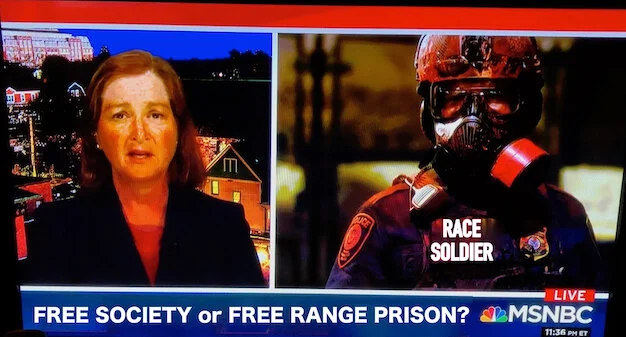
Nevertheless, this incompetent race soldier had all the info he needed. As explained by Dr. Amos Wilsonin the dominant White American consciousness the Black male is existentially guilty, (i.e., he is guilty by his mere existence) for merely having the audacity of being alive. As there is no innocent Black male, just Black male criminals who have not yet been detected, apprehended or convicted.’ [MORE].

“What you up to?” McGlasson asked.

“Who me?” Scott replied.

“I am going to pat you down real quick,” the officer said.

“I ain’t doing nothing,” Scott said, and the officer reached and grabbed his hand.

The officer, still holding Scott’s hand, repeated he was going to pat Scott down, and that the teen would go in hand cuffs if he didn’t stop.

Scott pulled his hand away, the officer yelled something and a scuffle followed for several seconds.

Scott ran out of the store.

“He is running,” McGlasson said. “I dislocated my shoulder.”

He later turned himself in at the jail with his mother and father.

Mayor Pro Tem Jillian Johnson also called the video disturbing, especially as the officer runs out the door, gun drawn, past young people outside the store.

“I didn’t see any reason for the officer to put his hands on Tony Scott, and it’s even more concerning that he then pointed a loaded gun at a group of teenagers,” she said. “I’m very interested to know how DPD plans to handle this situation.”

LAWYER DESCRIBES SECOND VIDEO

Sharika Robinson, one of Scott’s attorneys, said the convenience store video, which Scott’s legal team obtained soon after the incident, shows the officer slamming Scott onto the counter.

Scott is leaning on the front counter, then backs up with his hands held up, Robinson said the store video shows.

McGlasson tries to seize Scott’s wrists, and Scott moves back, she said.

“McGlasson then seizes Mr. Scott Jr., applies his body weight backward towards the counter and throws Mr. Scott Jr. in a semi circle into the counter,” Robinson stated in an email to The N&O and The Herald-Sun.

“Mr. Scott Jr. hits the counter with enough force to bounce off of it and send the contents of the counter flying,” she stated.

In June, Scott, who is Black, and his father filed a federal civil rights lawsuit accusing McGlasson, who is white, of picking him up and body slamming him. The officer then framed the teen for assault after the officer injured his shoulder using excessive force, the lawsuit states.

The lawsuit accuses the officer and Police Department of excessive force, battery, and violating the teen’s Fourth Amendment rights with an illegal search and seizure.

The lawsuit also accuses the officer, the city and Police Department of civil rights violations, illegal seizure and unlawful detention, along with abuse of process, false imprisonment, infliction of emotional distress and malicious prosecution.

The N&O and The Herald-Sun have asked to interview McGlasson and sent numerous questions about the case to Police Department officials, who have declined to comment.

The lawsuit calls the incident a “modern day lynching” and seeks to hold the Police Department and city accountable for creating an environment that allows the disparate treatment of Black children without consequence.

After the charges were dismissed, Scott’s father filed a complaint against McGlasson with the Police Department.

The department reviewed the complaint and sustained the allegations of warrantless search and seizure, meaning it found evidence to support them, according to an Oct. 31 letter from the Police Department to Scott’s father.

On July 13, 2019, two months after the charges against Scott were dismissed, McGlasson received a 5% merit increase to raise his annual pay to $42,766.

In general, if an officer receives a satisfactory or better performance review, which looks at a dozen different factors, the 5% merit raise is automatic, City Manager Tom Bonfield has said.

His employment record, which The N&O and The Herald-Sun requested, shows McGlasson was suspended Oct. 28, 2019, but doesn’t say why, for how long or provide any other information. [MORE]

Duped, Disarmed Statists Seek Govt Protection from Govt Violence or Better Relations w/Uncontrollable "Public Servants" [Masters] as Race Soldiers Revoke “Freedoms" [Permissions] in Portland

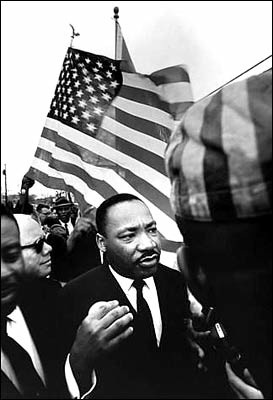
"The greatest purveyor of violence in the world today [is] my own government.” Martin Luther King quoted in FUNKTIONARY [protesters in Portland are enabling us to see what “authority” is.] “Defund the cops” statists (one who believes in “government”) think if police budgets are reduced the force continuum will somehow be better managed under the control of more responsible government orderlies. That is, the power to forcibly control us and interfere with our freedoms as they see fit will be in good hands. How and why this would occur is not clear. Most statists [democrat & republican] believe that we just haven’t found the right people to have power over us. To get the right folks we need to vote for better leaders and hire or appoint the right persons to be cops, etc. We are on a continual search for the right persons to exert power and control over us and have the right to rule over us. Such power and control is called “authority.” Citizens have the moral and legal duty to obey their government representative’s authority. Only another government authoritarian can determine whether a particular government action was unlawful or lawful. Murray Rothbard explains government is that ‘organization which maintains a monopoly on the use of force and violence; it is the only organization that obtains its revenue not by voluntary contribution or payment for services rendered but by coercion.’ All persons have the natural right to defend themselves and come to the defense of others if they reasonably believe the other person is in imminent danger from an aggressor. The “authority” of government representatives includes such power but also includes the extra-governmental power to initiate unprovoked acts of violence against citizens and to interfere with a citizens freedoms or property when they deem it necessary to do so.
statists in the range 23.jpg

Larken Rose states, ‘The average statist while lamenting all the ways in which “authority” has been used as a tool for evil, even in his own country, will still insist that it is possible for “government” to be a force for good, and still imagine that “authority” can and must provide the path to peace and justice.’ The average statist never questions the legitimacy of authority in the first place. If government power comes from the people then did “the people” give their servants the right to do with them and the products of their labor as they choose and give them the right to control our property whenever they deem it necessary and proper?

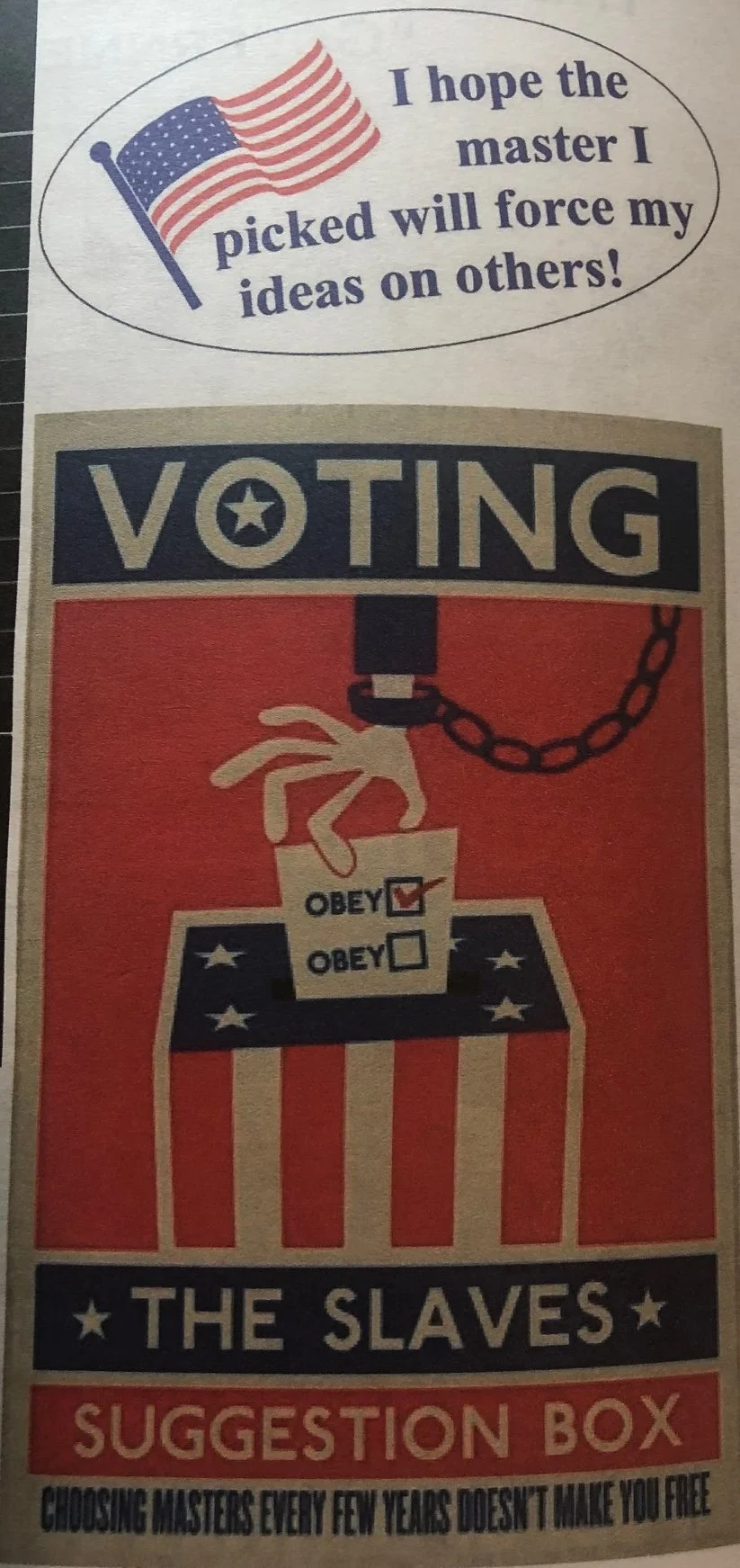
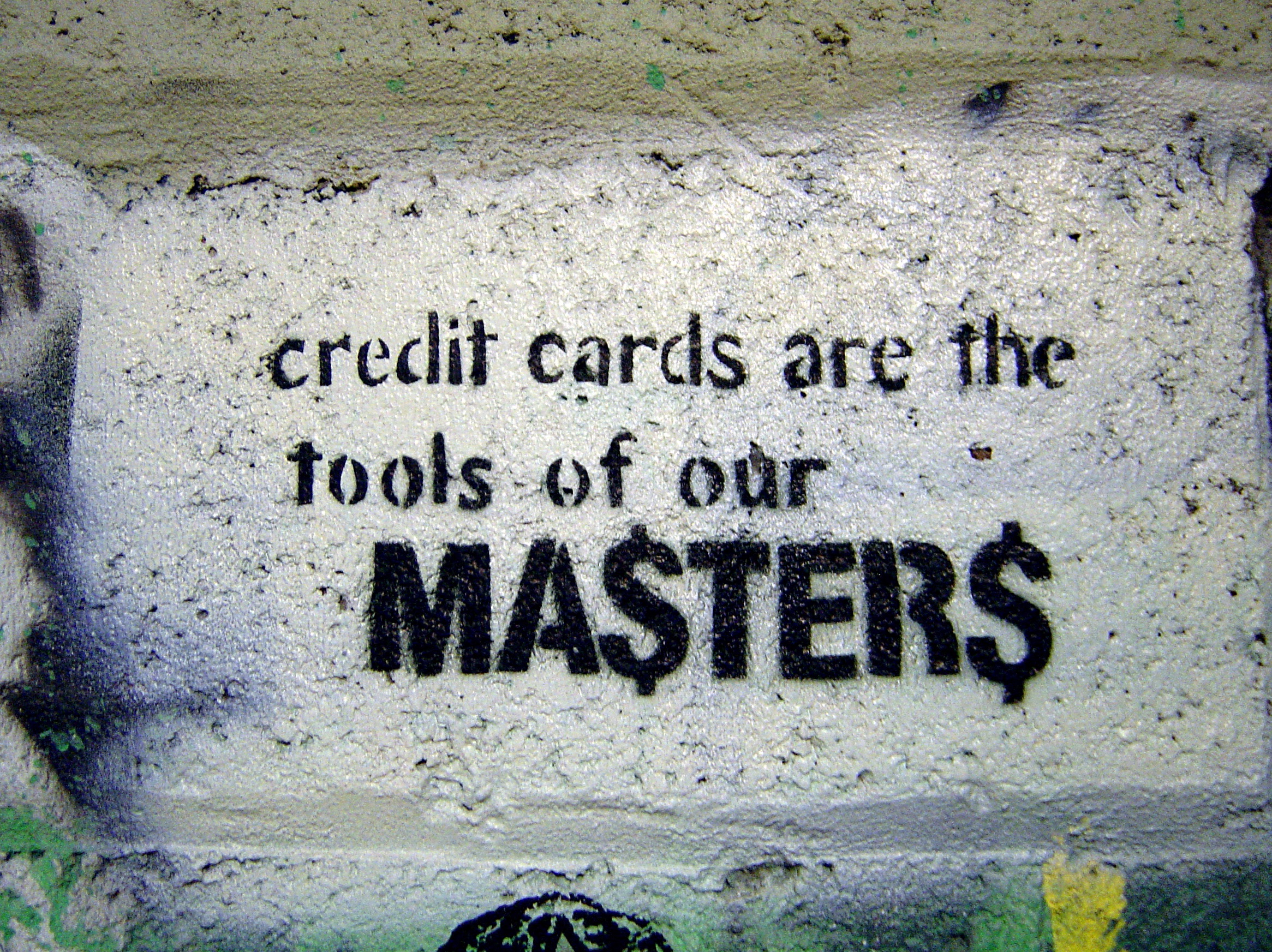
We are taught from birth that we have a “free government,” yet when did you consent to government control over you and agree to obey government authority? If our government is voluntary - how and where can you withdraw from it and be left the fuck alone? If a “public servant," such as a police officer, is uncontrollable, unaccountable, can’t be hired or fired by you, has irresponsible power over you and provides a “service” that you have no choice to accept or reject, then he is actually your Master. Undeceiver Lysander Spooner explained,

“A man is none the less a slave because he is allowed to choose a new master once in a term of years. Neither are a people any the less slaves because permitted periodically to choose new masters. What makes them slaves is the fact that they now are, and are always hereafter to be, in the hands of men whose power over them is, and always is to be, absolute and irresponsible.*

The right of absolute and irresponsible dominion is the right of property, and the right of property is the right of absolute, irresponsible dominion. The two are identical; the one necessarily implying the other. Neither can exist without the other. If, therefore, Congress have that absolute and irresponsible law-making power, which the Constitution—according to their interpretation of it—gives them, it can only be because they own us as property. If they own us as property, they are our masters, and their will is our law. If they do not own us as property, they are not our masters, and their will, as such, is of no authority over us.

But these men who claim and exercise this absolute and irresponsible dominion over us, dare not be consistent, and claim either to be our masters, or to own us as property. They say they are only our servants, agents, attorneys, and representatives. But this declaration involves an absurdity, a contradiction. No man can be my servant, agent, attorney, or representative, and be, at the same time, uncontrollable by me, and irresponsible to me for his acts. It is of no importance that I appointed him, and put all power in his hands. If I made him uncontrollable by me, and irresponsible to me, he is no longer my servant, agent, attorney, or representative. If I gave him absolute, irresponsible power over my property, I gave him the property. If I gave him absolute, irresponsible power over myself, I made him my master, and gave myself to him as a slave. And it is of no importance whether I called him master or servant, agent or owner. The only question is, what power did I put into his hands?” [MORE]

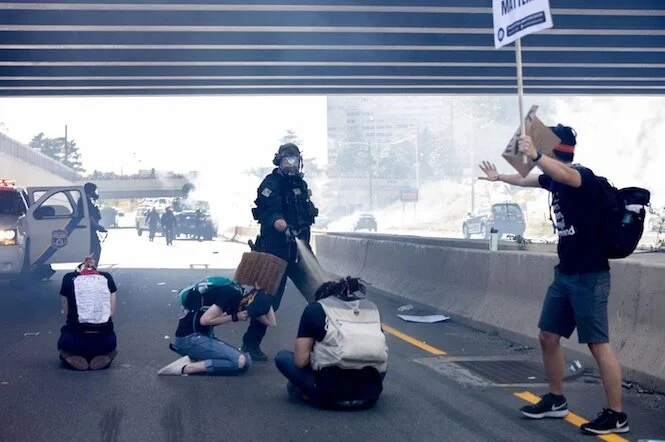
The WHITE Philadelphia SWAT officer captured on video last month pulling down protesters’ masks and pepper spraying them as they knelt on the Vine Street Expressway turned himself in to face criminal charges — the second officer to be arrested for a…

The WHITE Philadelphia SWAT officer captured on video last month pulling down protesters’ masks and pepper spraying them as they knelt on the Vine Street Expressway turned himself in to face criminal charges — the second officer to be arrested for alleged misconduct during days-long protests over police brutality that coursed through the city in May and June. Richard P. Nicoletti, 35, will face charges of simple assault, reckless endangerment, official oppression, and possession of an instrument of crime, District Attorney Larry Krasner said. [MORE] What a relief. Feel safer?

FUNKTIONARY states, “authority” is not a force but a farce,” ‘an implied right to exercise external control over others has no actual meaning in reality.” FUNKTIONARY further states, "The government hoax is probably the oldest, most pervasive and stubborn of hoaxes. It's the belief in non-existent "states" and "nations" and that "government" is both legitimate and necessary.” [MORE]

The real threat to "authority" is the masses overcoming info-gaps and verigaps through self-knowledge and the proliferation of symbols of opposition, not crime or destruction of property.” Jeremy Locke states,

“You were born to this world with sovereignty over your mind and over your life. Your abilities to think, to feel, to learn and to love are your liberty. In you, these capacities are infinite. You have infinite worth.

Evil seeks to destroy your liberty. It seeks to be in authority over you. It does not want you to have liberty. Evil seeks to destroy you so that it can use you as a puppet.

The implementation of evil is called authority. Authorities are what evil implements as it exercises control over the lives of people. Authority limits your ability to learn, to think, to feel, to love and to grow. This is why authority is evil.“

Larken Rose explains, “The belief in “authority,” which includes all belief in “government,” is irrational and self- contradictory; it is contrary to civilization and morality, and constitutes the most dangerous, destructive superstition that has ever existed. Rather than being a force for order and justice, the belief in “authority” is the arch-enemy of humanity. Of course, nearly everyone is raised to believe the exact opposite: that obedience to “authority” is a virtue (at least in most cases), that respecting and complying with the “laws” of “government” is what makes us civilized, and that disrespect for “authority” leads only to chaos and violence. In fact, people have been so thoroughly trained to associate obedience with “being good” that attacking the concept of “authority” will sound, to most people, like suggesting that there is no such thing as right and wrong, no need to abide by any standards of behavior, no need to have any morals at all. That is not what is being advocated here – quite the opposite.” [MORE]

Allegedly governmental power comes from the people. That is, we delegate our individual power to the government for it to act on our behalf. However, it goes without saying that people cannot delegate powers or rights that they do not possess. So if people have delegated their powers to lawmakers and lawmakers have empowered police officers to act on our behalf, how did police acquire the moral right to commit acts of unprovoked violence on people? Asked differently, if you don’t have the right to initiate unprovoked acts of violence against other people then how can you delegate or authorize police officers or anyone else acting on your behalf to do so? These are not rhetorical questions. Really, How did government representatives and police acquire such super-human powers? Spooner explained,

“it is impossible that a government should have any rights, except such as the individuals composing it had previously had, as individuals. They could not delegate to a government any rights which they did not themselves possess. They could not contribute to the government any rights, except such as they themselves possessed as individuals.”

Similarly, undeceiver Larken Rose observes,

“Despite all of the complex rituals and convoluted rationalizations, all modern belief in “government” rests on the notion that mere mortals can, through certain political procedures, bestow upon some people various rights which none of the people possessed to begin with. The inherent lunacy of such a notion should be obvious. There is no ritual or document through which any group of people can delegate to someone else a right which no one in the group possesses.‘

Authority is a “cartoon” or an “image of law” because “people cannot delegate rights they do not have, which makes it impossible for anyone to actually acquire the right to rule (”authority”). People cannot alter morality, which makes the “laws” of “government” devoid of any inherent “authority.” Ergo, “authority”-the right to rule-cannot logically exist. The concept itself is self-contradictory, like the concept of a “militant pacifist.” A human being cannot have superhuman rights, and therefore no one can have the inherent right to rule.’ [MORE]

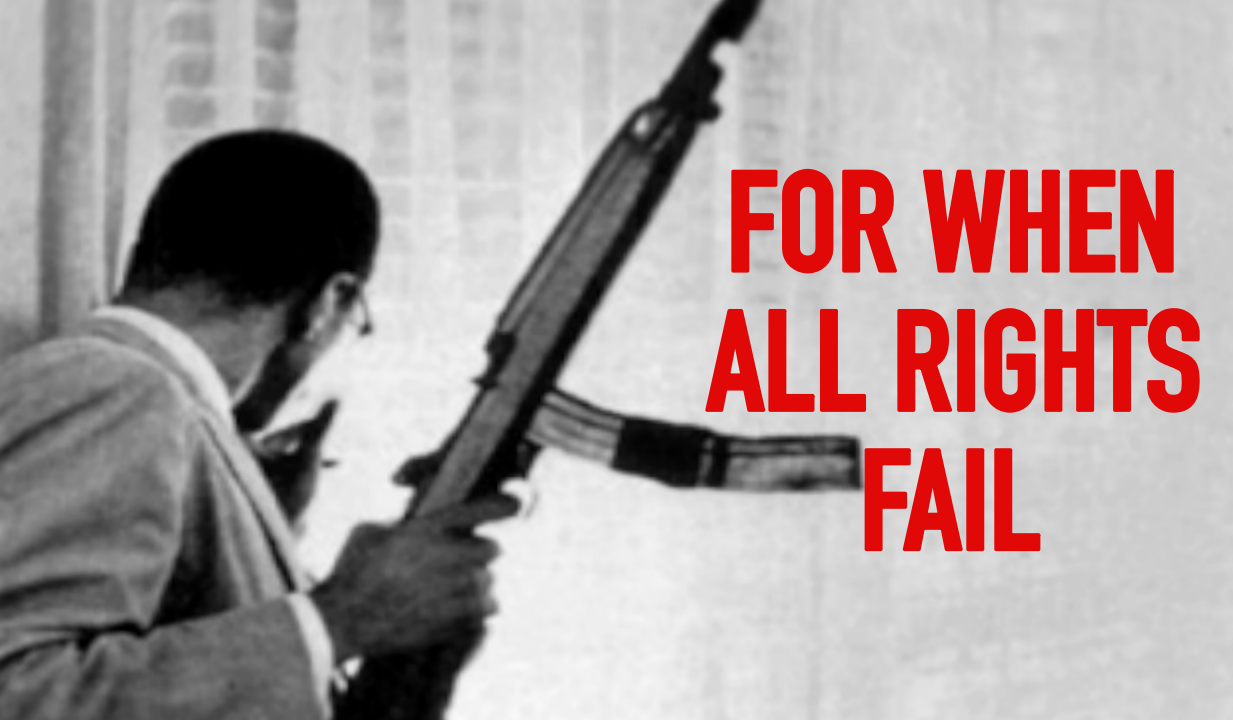
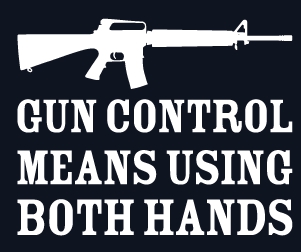
WOULD RACE SOLDIERS BE SO LAWLESS IN AN OPEN CARRY STATE? FUNKTIONARY DEFINES SLAVES AS “DISARMED MEN AND WOMEN” and “gun ban” as “the precursor to servitude” and “gun safety” as the right “to shoot back if someone is shooting at you.”

Dr. blynd also explains that “The second amendment is a doomsday provision, one designed for those exceptionally rare circumstances where all other rights have failed—where the government refuses to stand for reelection and silences those who protest; where courts have lost the courage to oppose, or can find no one to enforce their decrees. However improbable these contingencies may seem today, facing them unprepared is a mistake a free people get to make only once." The right to keep and bears arms actually serves as more than an insurance policy, it also serves as a deterrent. For when would-be tyrants know that the citizenry is well-armed, they think twice about imposing tyranny.” [MORE]

Yet authority is the basis of all governments, everywhere. FUNKTIONARY explains “Unfortunately, governments only function by force. Once established, they put laws into effect by threatening persecution, imprisonment, fine, or death against all who don't comply with those laws--including the use of the force continuum.” [MORE] "Government" is simply, unequivocally, and always initiation of force or coercion and nothing else.” [MORE] Locke explains, “The lie of tyranny is that you will maintain the freedom of life by obeying authority. The [false] choices it offers you are a lifetime of obedience or death. Evil is the master of deceit. The objective of evil is not violence, but obedience.“ He states, “The authority principle describes the behavior of people who live under the rule of law. The authority principle shows that people obey anything and anyone that they believe is an authority. Though the who, the why and the what have changed in history, the behavior of people is the same; they obey.

When people are taught that obedience is principle, they obey. When they are taught that the source of worth and knowledge is found in another person, rather than in themselves, they obey. This is the rule of law, and it teaches people that their will is subjective to the will of law and those who control the law.“

WASHINGTON DC, JULY 2020. Photograph is the property of UNDECEIVER VINCENT BROWN.

WASHINGTON DC, JULY 2020. Photograph is the property of UNDECEIVER VINCENT BROWN.

Where a critical mass of persons understand that authority is the source of the problem and cannot be the solution to the problem, drastic change will occur because the present arrangement citizens have with their masters will no longer be consensual. “ Government will cease to exist when people cease to grant it legitimacy—in other words stop believing in it, stop looking to it for solutions to problems in their lives, and stop supporting it." Fred Woolworth quoted in FUNKTIONARY. Dr. Blynd further explains:

“Throughout history many intelligent thinkers all around the world have tried to contemplate or design some way to have "government" and freedom too. Failing miserably and repeatedly to find one either in practice or in theory, it is time for intelligent human beings to give way to beings of higher consciousness using sagacity and sapience to finally realize that:. 1) "government" itself is a deadly mental contrivance and immanent threat to their freedom; 2) there is no way to prevent "government" from constantly increasing its power and eroding freedom; 3) "government" itself being a reification (deadly cartoon) will vanish when the illusion on which it rests dissipates.

This goes for all brands and flavors of "government" across the ideological spectrum.”

Rose explains,

There is a fundamental difference between having complaints about a particular ruling class, and recognizing and opposing the insanity of “authority” in principle, In short, in all the various societal manifestations of so-called rebelliousness and non conformity, almost none have actually escaped the myth of “authority.” Instead, they have merely attempted to make a new “authority,” a new ruling class, a new “government,” a new centralized machine of coercion through which they could forcibly subjugate and control their neighbors. In short, nearly all so-called “rebels” are phonies, who pretend to be resisting “the man,” but who really just want to be “the man.”

And this should be expected, If one starts with the assumption that there should and must be an “authority,” and that a “government” exerting control over a population is a legitimate situation, why would anyone not want to be the one in charge? Each person, by definition, wants the world to be the way he thinks it should be, and what better way could any person accomplish that than by becoming king? If someone accepts the notion that authoritarian power is valid, why would he not want it to be used to try to create the world as he wants it to be? This is why the only people who truly advocate freedom in principle are anarchists and voluntaryists – people who understand that forcibly dominating others is not legitimate, even when it is called “law,” and even when it is done in the name of “the people” or “the common good,” There is a big difference between striving for a new, wiser, nobler master, and striving for a world of equals, where there are no masters and no slaves. [MORE]

Government Doesn't Exist to Protect You. It's Out to Get You, Govern You, Watch You: A New “Atlas of Surveillance" Shows the Inescapable Creep of Government Surveillance by Law Enforcement

FUNKTIONARY explains "Government" - Latinized Greek ("Gubernatlo" = control; and from the Latin "mente" = mind; "The control of the mind." 2) an abstraction (hoax) created for the sole purpose of making theft respectable and mind-control acceptable.…

FUNKTIONARY explains "Government" - Latinized Greek ("Gubernatlo" = control; and from the Latin "mente" = mind; "The control of the mind." 2) an abstraction (hoax) created for the sole purpose of making theft respectable and mind-control acceptable. 3) the societal manifestation of mass individual psychological reversal, i.e., the statutes, regulations, agencies, and agents (so-called bureaucrats) needed to threaten and shrink one's comfort zone. 4) a granfalloon. 5) a fiction supported by those who kill on command and steal on demand under the guise of "protecting" their victims. The outworking of history consistently demonstrates that government will, in spite of the Bill of Rights, arrogate all power to itself eventually, if the people don't act to prevent it. [MORE]

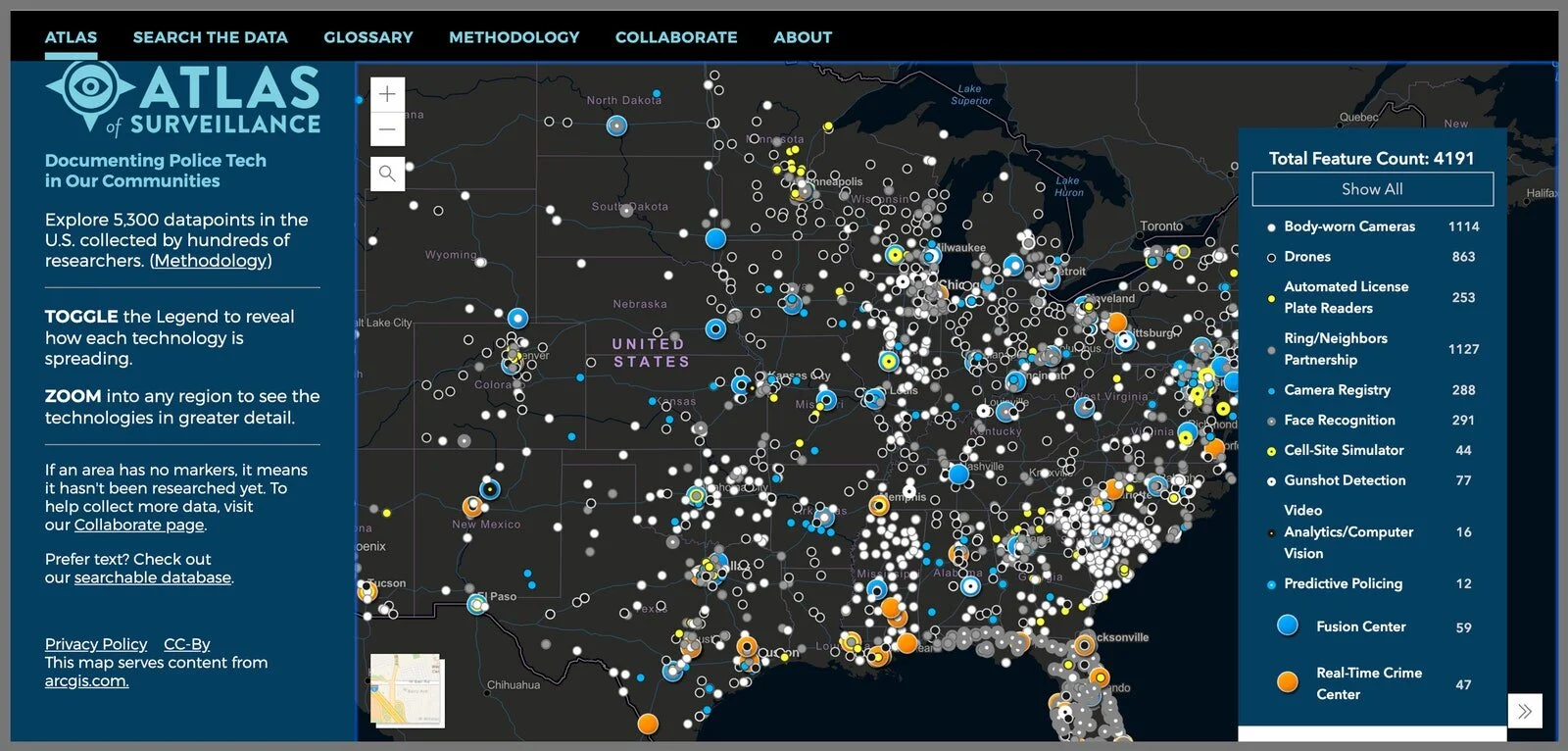
From [HERE] OVER 1,300 PARTNERSHIPS with Ring. Hundreds of facial recognition systems. Dozens of  cell-site simulator devices. The surveillance apparatus in the United States takes all kinds of forms in all kinds of places—a huge number of which populate a new map called the Atlas of Surveillance.

A collaboration between the Electronic Frontier Foundation and the University of Nevada, Reno, Reynolds School of Journalism, the Atlas of Surveillance offers an omnibus look not only at what technologies law enforcement agencies deploy, but where they do it. From automated license plate readers to body cameras to the so-called fusion centers that centrally process scores of surveillance data, the project drives home just how common these sophisticated tools have become. In fact, despite offering 5,300 data points from 3,000 police departments, it’s still only a sample of surveillance’s true sweep.

“We’re never going to be comprehensive,” says Dave Maass, a senior investigative researcher at EFF who helped lead the project as a visiting professor at the Reynolds School. “If our goal is to keep neck and neck with the growth of the surveillance state, we’d lose.”

Which reinforces the point. The map is unsettling enough in its current configuration. It’s almost impossible to imagine how crowded it would be if it included all of the 18,000 federal, state, county, and local agencies that comprise US law enforcement, by the Bureau of Justice Statistics' count.

Getting the map even this far has been a Herculean task, one that began around 18 months ago. Some of the most common questions the EFF gets from media, Maass says, relate to the distribution of surveillance technology in the US. The EFF had previously done investigatory work around automated license plate readers, and other organizations like Bard College’s Center for the Study of the Drone maintain their own specific databases. But what about a central repository? One that could answer many of those questions with a click or two? For that, you would need a small army of researchers—or a few hundred journalism students. Enter the Reynolds School.

Maass and the Gi Yun, the Director of the Reynolds School’s Center for Advanced Media Studies, first meted out data-gathering assignments using Google Drive and Google Survey before migrating to the EFF’s Report Backtool, an online portal that automatically parcels out small tasks to volunteers. To prove out the concept, they focused first on the 23 counties across the US-Mexico border, assigning a city or county to a team of students and tasking them with finding out what surveillance tools were in use there. The EFF published the results last September. “That ended up being really frustrating for the students, because they’re looking in small-town Texas for cell-site simulators, which they’re just never going to find,” says Maass. [MORE]

Fed Court Denies Expedited Review of Ruling Allowing Baltimore Cops to Continue Mass Aerial Surveillance of its Mostly Black Population 12 Hrs a Day, Every Day Until at Least September

mass surveillance .jpg

The Daily Record writes that A federal appeals court has rejected a request from civil rights groups that it expedite its consideration of their constitutional challenge to the Baltimore Police Department’s use of aerial surveillance to fight crime in the city. Without comment, the 4th U.S. Circuit Court of Appeals said this week that it will not hear before September arguments.

The ACLU’s brief states as follows:

the Baltimore Police Department (“BPD”) will begin to deploy aircraft to circle above Baltimore as part of a comprehensive system of long-term, persistent, wide-area aerial surveillance that will cover more than 90 percent of the city, recording second-by-second the movements of Baltimore’s 600,000 residents. This warrantless mass surveillance system presents a radical and society-changing threat to individual privacy and to free association, and it violates the Constitution.

There is no factual dispute about what this system, which the BPD calls the “Aerial Investigation Research” or “AIR” program, will do. For 180 days, three aircraft equipped with high-definition cameras will fly above Baltimore for 12 hours each day, stopping only at night and in bad weather—an estimated 80 hours per week. Their purpose is to help the BPD identify specific individuals who are suspected of committing or witnessing serious crimes, as well as those who cross their paths before and after the crimes took place. While the cameras will not capture people’s physical characteristics, they will record, second-by-second, the movements of virtually all of Baltimore’s residents. The BPD will retain a rolling log of those movements for 45 days before aging off older data. To put this pervasive surveillance program into practice, the BPD has signed a contract with a private corporation, candidly called “Persistent Surveillance Systems” (“PSS”). The contract describes the work that PSS will do at the BPD’s direction to record and track the movements of Baltimore’s residents; to link that information to other BPD-operated surveillance systems (including ground-based video cameras and automatic license plate readers); and to deliver reports to the BPD that comprehensively detail the movements of individuals who have been in the vicinity of crime scenes—and the movements of everyone those individuals have met.

The BPD’s system is the largest mass surveillance program ever implemented in an American city. The system puts into place an expansive surveillance dragnet, giving the BPD access to a comprehensive record of the movements and activities of every Baltimore resident each time they leave their home. “[T]his newfound tracking capacity runs against everyone,” “not
just . . . persons who might happen to come under investigation.” Carpenter v. United States, 138 S. Ct. 2206, 2218 (2018). By using advanced technology to aggregate location data over the long term, without a warrant, the AIR program offends the bedrock protections for a free society that the Constitution has long provided.

This Court should not allow Baltimore’s novel mass surveillance system to become a chilling and all-seeing part of daily life in this country. The program’s objectives to reduce crime and violence in Baltimore are laudable—indeed, that is one of the central aims of Plaintiffs’ own work. But the Constitution dictates that the use of the BPD’s indiscriminate and warrantless aerial dragnet is not an available solution to Baltimore’s ills. For the reasons that follow, the Court should reverse the district court and remand with instructions that it enter a preliminary injunction to halt this program. [MORE]

7 Non-White Detainees Sued ICE. In Retaliation Authorities Transferred them Without Notice to an Inhumane Alabama Jail [aka Family Destruction, Gender Annihilation & COVID Center]

faff1b73-d43f-4b52-af0e-cae6969319cf-08prison006.jpeg

From [HERE] On June 29, Stephen Brown was woken up around 4 a.m. and told that he was about to be moved from the jail in Clinton County, Pennsylvania. He didn’t know where he was heading. Brown, who came to the United States from Jamaica as a teenager 40 years ago, learned that six other immigrant detainees were being transferred from the jail. He realized that the seven of them had something in common: They were all suing Immigration and Customs Enforcement.

Over the next 24 hours, they were loaded into a van to cross through Pennsylvania, a plane to Texas and then Louisiana, and a bus to Alabama, according to a sworn declaration Brown submitted in federal court this month—all of which put them in close quarters with each other and with guards just as the number of COVID-19 cases nationwide was spiking. The seven men ended up an hour northeast of Birmingham at the Etowah County jail, which now has 20 active COVID-19 cases, according to ICE’s website. The Pennsylvania jail they left has none.

Neither the ACLU nor Brown’s immigration attorney had a chance to stop his transfer because they weren’t notified. The ACLU is demanding that ICE release Brown or safely return him to Clinton County, where he would be able to meet with his immigration attorney.

In addition to Brown, the ACLU is representing 10 other detainees who are vulnerable to COVID-19 and seeking release from three Pennsylvania immigration detention centers. Cho says Brown is the only plaintiff in the case who has been transferred out of the state. 

The other six detainees who were transferred, who were among dozens of people at Clinton County suing ICE without an attorney as part of a different lawsuit, had all taken part in a brief hunger strike at Clinton a few days before the transfer, according to Brown’s declaration. The ACLU argues in its lawsuit that the transfer was “blatant retaliation.” A jail roster shows that all six remain at Etowah. 

The transfer could make it harder for the six men to secure improved detention conditions. Their lawsuit focuses on conditions at the Clinton County jail. Transfers cause claims to become moot, or no longer legally relevant, when a lawsuit challenges conditions at a specific jail, Cho explains. If the six men filed a new lawsuit to demand better treatment at Etowah, ICE could transfer them again or choose to fight the case in the conservative Northern District of Alabama. 

Eunice Cho, a senior staff attorney at the American Civil Liberties Union, which is representing Brown in his suit, says ICE has long used transfers to the Deep South as a form of retaliation and to get people under the jurisdiction of conservative judges. What’s new is that those transfers now mean potentially exposing people like Brown, who has high blood pressure, to the virus that led them to sue for their release in the first place. They also risk spreading COVID-19 between detention centers.[MORE]

Federal Prison Authorities Used Nationwide Protests as an Excuse to Impose Lockdowns and Kept Inmates in Cells 24 hrs a day, w/o Access to Phones or Showers "until it is calm around the nation"

From [HERE] On June 2, for the first time in 25 years, the Bureau of Prisons directed all federal jails and prisons to implement a full lockdown, confining nearly 160,000 people to their cells and severely limiting contact with the outside world. The following day, on the orders of Attorney General William Barr, the Bureau pulled some of its most militarized units out of BOP facilities and deployed them to confront protesters on the streets of Washington, D.C. 

Typically, a lockdown occurs in a single facility at the discretion of the warden, usually in response to temporary incidents like fights or, more rarely, longer-term issues like inadequate staffing levels. But this June’s full lockdown was extraordinary in its pretext, scope, and duration. It heightened restrictions already in place in federal facilities, which have been on “modified” lockdown since March in an effort to contain the spread of COVID-19. A BOP employee told The Appeal in June that the heightened lockdown kept people in their cells or units for 24 hours a day, often without access to phones, email, or showers.

The BOP announced the lockdown would last “until it is calm around the nation,” referencing protests against police brutality and the killing of George Floyd, a black man, by a white Minneapolis police officer. The BOP did not mention any specific protest or incident that had yet occurred inside any facility. Rather, BOP Spokesperson Justin Long explained that the Bureau was acting “in an abundance of caution.” The preemptive nature of the lockdown distinguishes it from the last nation-wide lockdown in 1995, which followed two days of violent incidents at three prisons. [MORE]

“All Writs Denied:" To Control Speech & Maintain Obedience to Authority Judge Allowed NYPD Cops to Disappear BLM Protesters Into Jail for Days at a Time w/o Being Charged or Talk w/an Attorney

judge whatthefuckin233.jpg

From [HERE] IN EARLY JUNE, hundreds of Black Lives Matter protesters languished for days in cramped New York City jail cells. Stuck in holding pens without masks and exposed to soiled conditions amid the coronavirus pandemic, they were unable to reach loved ones or lawyers. The protesters were effectively disappeared into New York City’s detention system.

Attorneys from the Legal Aid Society went to court to demand the protesters’ immediate release. In a lawsuit filed against the New York Police Department, attorneys from Legal Aid, a public defense organization, alleged that over 400 individuals in city detention facilities had been held for more than 24 hours without seeing a judge, in breach of state law and detainees’ constitutional rights.

The public defenders accused the police department of deliberately slow-rolling standard procedures to keep protesters in jail as payback for demonstrations against police brutality. Lawyers for the police asserted that the NYPD faced unprecedented challenges with both a pandemic and widespread protests raging.

In a one-line decision, Judge James M. Burke of the State Supreme Court in Manhattan sided with the police. “All writs are denied,” he ruled. In doing so, Burke accepted the NYPD’s rationale that the conditions on the ground should overrule preexisting state law: The 1991 Roundtree v. Brown decision established the 24-hour standard from arrest to arraignment. [MORE]

NY Court Order Doesn't Apply to ProPublica So It Has Posted Thousands of NYPD Discipline Records the NYC Government Kept Secret for Decades

From [HERE] Days after a federal judge paused the public release of New York City police disciplinary records, a news website has published a database containing complaint information for thousands of officers.

ProPublica posted the database of police complaints and downloadable data Sunday, explaining in a note to readers that it isn't obligated to comply with Judge Katherine Polk Failla's temporary restraining order because it is not a party to a union lawsuit challenging the release of such records.

Their site says, ‘The New York City police officer whose use of a prohibited chokehold led to the death of Eric Garner in 2014 had a record of misconduct. Garner’s last words — “I can’t breathe” — became a rallying cry for the Black Lives Matter movement.

The city investigator who revealed the existence of the officer’s record was forced to resign in 2017; the officer himself wasn’t fired until 2019.“ When the death of George Floyd and footage of his pleas for his life ignited worldwide protests, activists in New York renewed their push to repeal the statute that kept disciplinary records under wraps, known as 50-a. State lawmakers finally acted, voting to repeal the provision, which had been on the books for decades.

Soon after, ProPublica asked New York’s Civilian Complaint Review Board, or CCRB, for a list of officers, along with the complaints against them, and what discipline, if any, had been recommended.

Today, we are making this information public and, with it, providing an unprecedented picture of civilians’ complaints of abuse by NYPD officers as well as the limits of the current system that is supposed to hold officers accountable. We’ve published a database that lets you search the police complaints so you can see the information for yourself. Data experts can also download the data. [MORE]

Deputy Managing Editor Eric Umansky said ProPublica requested the information from the city's police watchdog agency, the Civilian Complaint Review Board, soon after last month's repeal of state law that for decades had prevented the disclosure of disciplinary records.

Unions representing police officers and other public safety workers sued the city on July 15 to block Mayor Bill de Blasio from making good on a pledge to start posting misconduct complaints on a government website. The unions argue that allowing the public to see unproven or false complaints could sully officers' reputations and compromise their safety.

A state judge who first handled the case had issued a narrower restraining order that temporarily blocked the public disclosure of records concerning unsubstantiated and non-finalized allegations or settlement agreements.

ProPublica said it excluded allegations that investigators deemed unfounded from the material it published. In all, the searchable database contains 12,056 complaints against 3,996 active NYPD officers.

"We understand the arguments against releasing this data. But we believe the public good it could do outweighs the potential harm," ProPublica Editor-in-Chief Stephen Engelberg said. "The database gives the people of New York City a glimpse at how allegations involving police misconduct have been handled, and allows journalists and ordinary citizens alike to look more deeply at the records of particular officers."

Failla's ruling Wednesday  blocks the CCRB, the police department and other entities from disclosing disciplinary records until at least Aug. 18, when she'll hear arguments in the case. In issuing the temporary restraining order, Failla also barred the New York chapter of the American Civil Liberties Union from publicly releasing records it had already obtained.

The organization said it requested officer misconduct complaints from the CCRB under the state's open records law and received them before the union's lawsuit was filed. Like ProPublica, the NYCLU argued it was not a party to the lawsuit.

"The federal court has no authority to bar us from making it public, and we will contest this unprecedented order as quickly as possible," NYLU legal director Christopher Dunn said.

Bodycam Shows 3 Uncivilized White Lafayette Cops Attempt to Murder a Black Man by Turning a Police Dog Loose on Him "to get Him off a Moped." K-9 Mauled His Neck for 90 Seconds, 6 Days in Coma

FUNKTIONARY explains:

Yurugu - a mythological figure within the Dogon tribe (Africa) who is "the incomplete being" (fiend without a face) referring to Neuropeans (neurotic Europeans) within the European asili. 2) a regressive (degenerative) state of consciousness where the soul is cut off from itself. 3) the inability to recognize or abate unacknowledged destructive capabilities. Yurugu also expresses itself and manifests as the pathological condition that utterly fails to convince those in geographical proximity of its harmlessness, therefore has to kill them. Yurugu is in a vicious spiral increasingly at odds with his own humanity—as fragmented, pathological, and distorted as it is. [MORE]

Force - the source or sources of all possible actions of the particles or materials of the universe(s). 2) the manipulation of a man or woman in disregard of its own volition or nature. 3) the use of an outside physical coercion of any kind by one or more humanoids against another or others in order to make him/her or them obedient and compliant to higher or their will. 4) the basis of all social evils and can only be used in the sense of attack not defense. 5) You must! In the way I say! 6) the social disease. "Force (coercion) and fraud are the foundation of all social systems and the source of the aroma which they exhale." --Max Nomad. "Force" operates to remove personal volition from opportunity to act or not act. Someone '`makes" you behave in a certain way by threatening to injure or enslave you, someone you love, or something you prize, if you do not behave in that way. Force operates to obtain an intended behavior when the forced party would otherwise have exhibited a different behavior. Punishment, pain, suffering, and discomfort characterize force. Unfortunately, governments only function by force. Once established, they put laws into effect by threatening persecution, imprisonment, fine, or death against all who don't comply with those laws--including the use of the force continuum. [MORE]

lafayette white cops.jpg

“YOU’RE GONNA GET DOG BIT. HERE HERE HERE!” COMPULSORY PUBLIC SERVICE FROM YURUGU IN A SYSTEM OF PHYSICAL COERCION. From [HERE] and [HERE] Authorities have released additional police video footage and 911 audio in the May arrest of a Black northwestern Indiana man who was mauled by a police dog while being arrested for suspected battery.

A special prosecutor and the state police are investigating allegations that three Lafayette police officers used excessive force when arresting Richard Bailey Jr., who was seriously injured.

Bailey’s lawyers previously released some police video of the dog attack and the moments leading up to it in which officers tell Bailey to get off a moped and warn him that they will use a K-9 unit if he doesn't comply.

Bailey's attorneys called the use of the dog, which mauled Bailey's neck for 30 seconds, “extraordinarily violent” and said the three white officers used excessive force because Bailey is Black, according to the Journal & Courier. They said the 46-year-old Bailey spent days in a medically-induced coma after the attack and could have died.

As the dog viciously mauls his neck the white cop has the audacity to order “put your hands behind your back.” When the Black man stops moving the white cop grabs the dog to stop him from biting. He says, “good job.”

Attorneys Swaray Conteh and Fatima Johnson says that video shows the police had the intent to kill the Black man.

Police canines are bred and trained by authoritarians to ensure that their bite is far more severe than a normal dog bite. The pressure from a police canine bite has been likened by one court to the force of being run over by a car. For decades, the…

Police canines are bred and trained by authoritarians to ensure that their bite is far more severe than a normal dog bite. The pressure from a police canine bite has been likened by one court to the force of being run over by a car. For decades, the canine-industry contended that police dogs usually cause only minor injuries and bite for 10 to 15 seconds. The era of body cams and cellphone recordings shows they often bite for much longer and cause significant injury. Unlike normal dogs, police canines are trained to bite hard, use all their teeth and bite multiple times. Studies have found that over 3,500 police canine bitesannually result in emergency room visits, and that canine force results in a higher proportion of hospital visitations than any other type of police force. On rare occasions, police canines have killed people, including a suspected burglar, a likely trespasser and a homeless woman.

This level of violence cannot be justified by the threat posed. Police dogs routinely use force that unquestionably would be unlawful if used directly by a police officer. The dogs are overwhelmingly set on people suspected of crimes like burglary, car theft, trespassing, traffic violations or “fleeing” from the police, and often used during political protests and on Non-Whites in immigration raids. [MORE]

They told the newspaper that the 911 call doesn't offer a complete story of what happened in the house before police arrived.

“What the 911 tape failed to mention is that Mr. Bailey was attacked with a knife, had a gun pointed at him, and yet still managed to inflict less damage to his attackers than the police did to him,” said Elayne Rivers, a spokeswoman for Johnson’s law firm.

Police have called the allegations against the department baseless. ???

White LA Cop Claimed Josef Richardson was Reaching for a [non-existent] Gun in His Pants Pocket but Witness Says He Only Had On Underwear When the Cop Shot Him in the Back of the Head, 2nd Suit Filed

west baton rouge white guy cop.jpg

From [HERE] and [HERE] Nearly one year after Josef Richardson was shot and killed by a West Baton Rouge Sheriff's deputy as authorities were executing a search warrant, a woman who was with Richardson when he was killed is suing multiple individuals associated with the WBR Parish Sheriff's Office, including the deputy who fired the fatal shot.

Jessica Clouatre has filed a lawsuit against Deputy Vance Matranga Jr., Sheriff Mike Cazes and a host of other officials associated with the Sheriff's Office. Richardson's family also filed a lawsuit months ago, claiming Richardson was clearly unarmed when authorities entered his motel room, as he was dressed only in his underwear when shot.

The lawsuit names a total of seven individuals and four organizations, including the Parish of West Baton Rouge. The suit, which was filed with the Middle District of Louisiana, in Baton Rouge, claims Clouatre and Richardson were both victims of mistreatment by officials with the West Baton Rouge Parish Sheriff's Office and associated organizations.

The lawsuit says the case is about, "the violation of the civil rights of Josef Richardson and Jessica Clouatre at the hands of the West Baton Rouge Sheriff’s Office, and possibly other law enforcement officers and agencies, and its officers and leaders under color of state law."

The document goes on to claim the mistreatment continued for years, saying, "the systematic and illegal conduct existed over several years and was condoned by failures to act, passive actions, and simply ignoring obvious misconduct which ultimately resulted in the violent death of Josef Richardson, in front of Jessica Clouatre, causing severe emotional harm, fear, and intimidation, and false arrest and prosecution of the sole witness to the actions of the officers."  

white AG LA .jpg

In March of this year, state prosecutor Pat Magee [racist suspect in photo] decided that the white deputy who fatally shot Richardson, Vance Matranga Jr., would not face criminal charges. [the same office declined to file charges against the whote cops who murdered Alton Sterling.] The family’s attorneys tell WAFB they are concerned about what exactly investigators looked at to make that determination because the sheriff’s office does not have body cameras. They believe most of the outcome of the case depended heavily on the word of officers who say Richardson resisted several commands before being shot in the head near his neck.

"We have a civilian witness in the room who gives a completely different account," said attorney Christopher Murrell.

The deadly incident took place in July of 2019 when Deputy Matranga was working with members of the River West Narcotics Division to execute a no-knock warrant on the Budget 7 motel room Richardson and Clouatre occupied.

Upon entering the motel room, Matranga fired his gun once, fatally striking Richardson in the back of his neck. According to the prosecutors report which was based on Matranga told him, “Richardson's furtive movement of his hand to his pockets while simultaneously turning towards another officer and pulling his hand (which had in it a large bag approximately 9 grams of methamphetamine, 4.4 grams of cocaine, and 9 grams of marijuana) from his pocket, and towards the other officer, was viewed as an immediate threat to the life of his colleague, Deputy Cavaliere.”

Said report also states, “Upon arrival, the Deputies observed the door to room number 5 open and a subject known to them as Josef Richardson standing in the room with his right hand concealed in his right pants pocket.“ “Rather than simply complying with the Deputies' commands, Mr. Richardson placed his left hand in the waistband of his pants and turned his back toward the Deputies. Deputy Cavaliere holstered his handgun while Deputy Matranga held cover on Mr. Richardson with his handgun. Deputy Cavaliere took hold of Mr. Richardson in an attempt to subdue him. As the two struggled, Mr. Richardson jerked his left hand from his waistband and rapidly tumed to his right. The turning motion caused Mr. Richardson to turn in toward Deputy Cavaliere and away from Deputy Matranga. As Mr. Richardson turned, Deputy Matranga observed something in his left hand he believed to be a handgun. As Richardson continued to turn away from him, Deputy Matranga lost sight of his hand. Believing that Mr. Richardson was holding a handgun and was going to shoot Deputy Cavaliere, Deputy Matranga intentionally fired one shot from his handgun toward Richardson to stop him from harming Deputy Cavaliere. The fired bullet entered Mr. Richardson's neck and severed his cervical spine, resulting in his death.”

In reality there was no gun - no gun was found in the room and apparently there was nothing in Richardson’s hand - usually police claim a gun magically turns back into a phone or a toy or a bag of candy the second afterward a shooting. Here, cops seem to acknowledge that nothing was actually in his hand. [MORE]

Richardson’s wrongful death complaint states:

“Mr. Richardson was not armed with a weapon, nor was a weapon found inside of the motel room that he was occupied. In fact, Mr. Richardson was only clothed in his underwear when West Baton Rouge Sheriff Deputies entered into the motel room. According to eyewitness, Jessica Clouatre (who was also sharing the room with Mr. Richardson), Mr. Richardson was shot only a few seconds after the deputies entered into the room. Ms. Clouatre recalls the firearm being pointed directly to the back of Mr. Richardson’s skull before it discharged.“

Both lawsuits describes the Matranga's actions as "excessive," "reckless," and showing a "callous disregard" for Richardson's life and for Clouatre's civil rights. 

Her complaint states "Vance Matranga has stated that he intentionally shot Richardson in the back of the head. There was no legal cause to justify the use of force against Mr. Richardson, and the force used against Mr. Richardson was unreasonable and excessive. Ms. Clouatre had drawn guns pointed at her and was taken into custody, under arrest, immediately after the shooting of Mr. Richardson."  

Video Shows a White San Jose Cop Kick a Handcuffed Latino Woman in the Stomach & Drag her Across the Pavement Face First as Another White Cop Points a Gun at Kids To Enforce Car Registration Law

san jose white cops.jpg

From [HERE] and [HERE] A white San Jose police officer seen in cellphone video kicking and dragging a woman across a parking lot during an arrest has been placed on administrative leave, pending an internal affairs investigation of the incident, CBS San Francisco reports.

The arrest happened Wednesday in a McDonald's parking lot.

A Door Dash worker was picking up an order when he noticed a commotion involving police and started recording. The minute-long cell phone video, recorded Wednesday afternoon by San Jose resident Josh Gil, who witnessed the incident, shows a woman sitting outside a silver car as a police officer stands a few feet away. Within a few seconds, the officer appears to dart toward the woman and kick her in the side — sending her face-down onto the pavement — before handcuffing her.

He then drags her several feet by the wrists across the pavement toward an unmarked police SUV - face first.. The footage ends as the woman leans, upright, against the squad car, hands behind her back.

“It was nothing like she was trying to run or anything — she was already on her knees, there wasn’t much she could have done,” Jonathan Gastelum, another eyewitness to the incident, said Friday.

Gastelum, a San Jose resident, said he pulled into the parking lot of the McDonald’s at 28th and Santa Clara streets as the encounter unfolded, and saw the officer drag the woman across the sidewalk, shouting “Shut up,” and “I told you so.” A second officer, meanwhile, appeared to have his gun trained on the woman’s vehicle, where two children sat inside crying as another woman yelled that they had “just bought the car.”

san jose white cops 2.jpg

In an initial summary of the encounter, police wrote that the woman was arrested without incident. But Gastelum said that’s not how it appeared.

“It was a scary situation for everybody,” Gastelum said. “It was just — it was just bad.”

The video was shared to social media Thursday afternoon, after Gil sent it to friends, and was first reported in San José Spotlight. By Friday, it had been viewed more than 9,000 times.

“No child should ever have to see their mother endure that type of brutality, you know?” Gil told this news organization. “Even if she was guilty of the crime they suspected her of committing, there was no reason for them to use excessive force while she was complying. There’s absolutely no reason for that.”

"If anyone wanted a prime example of use of excessive force by a police officer, this incident is one," LaDoris Cordell, a retired judge and a former San Jose Independent Police Auditor who has reviewed police use of force cases for the city, told CBS SF.

"She is kneeling on the ground, there is no resistance. The officer then kicks her in the abdomen. He grabs her and drags her across the asphalt so her face is dragging on the ground to locate her away from the car. Again, another excessive use of force," she said.

Police said the officers conducted the car stop because the vehicle was wanted for evading officers on July 18, and again earlier Wednesday. San Jose police Chief Eddie Garcia said police had sought the silver car for a week, after officers tried to pull it over for an expired registration on July 18 and its driver fled. That prompted police to obtain a seizure warrant for the car; when officers tried to stop it on July 21, it sped away again. Officers saw the car again Wednesday and conducted. Really? Cops pulling people over for having dead tags during a pandemic? And then getting a warrant for a traffic citation? These people are not here to help you - they are hunting you.

A statement released by the department said: "Officers used force during the arrest after the suspect failed to comply with their commands. The department has initiated an internal investigation into this incident."

"It's important to understand — and for the public to understand fully — what exactly happened here. Having said that, it's not obvious that justifies the use of force we see in this video," said San Jose Mayor Sam Liccardo.

Liccardo said he asked Police Chief Eddie Garcia to immediately release officer's bodycam video of the McDonald's incident.

The suspect who police arrested in the video was booked into jail on minor charges, including resisting arrest, driving on a suspended license and possession of paraphernalia, according to CBS SF.

The incident is the latest in a series of controversies to hit the San Jose Police Department, including excessive force allegations stemming from Black Lives Matter protests in early June and reports of a secret Facebook group on which officers exchanged racist posts. Four officers are currently on leave in connection with the investigation into the private Facebook group.

Cordell told CBS SF that the recent incident points to a larger problem withing the department.

"This is not, in my view, about a bad apple. This is about a bad culture," Cordell said.

1 White Monroe Cop Charged after 8 Cops Stomped & Kicked a Homeless Black Man's Face as he Surrendered to False Arrest. Held for 2 Weeks in Isolation, Denied Meds & Phone. Bodycam Withheld

monroe cops.jpg

From [HERE] Monroe Police have confirmed, Jared Preston Desadier [racist suspect in photo below] has been booked into the Ouachita Correctional Center for second-degree battery and malfeasance in office. Desadier’s bond is set at $30,000. [more] Additionally, three Monroe Police officers have been placed on administrative leave, totaling four officers on leave.

The Monroe Police Department and The City of Monroe have released a statement regarding the excessive force complaint regarding the night of April 21, 2020, involving at least eight Monroe Police officers and Timothy Williams, a homeless Black man. Of the eight officers involved, the statement indicates that only two officers used force. Yet an arrest warrant for only one of the arresting officers has been issued.

Williams says on 4/21/2020 Monroe Police Officers stopped him on the street and asked to check his bookbag, he complied. It is not clear whether he consented to the search or if they took his bag and searched it. If he consented to the search it means he would have waived his so-called 4th Amendment right against unlawful searches & seizures. Clearly the cops didn’t have a warrant. As such, if he did not consent the cops would have had to have probable cause that he committed some crime involving something inside the bag to justify the search. If there was no PC then the stop and search were unlawful. Such details are unknown because the cops and dependent media have provided few details about the incident.

According to the arrest report, Williams produced a fake black handgun from underneath his shirt. [MORE] In a search, officers located a crack pipe in his pocket, the report states, and Williams fled the scene.

The report states the fake gun and crack pipe were logged into MPD's evidence lockers. Apparently possession of a crack pipe is a misdemeanor in LA.

However, when eight or nine officers surrounded him he said the situation escalated.

“I got scared and I started running,” said Williams.

When he realized he couldn’t outrun them, he surrendered.I put my hands up and I got down on the ground, put my hands behind my back.”

Instead of being taken into custody, Williams alleges that he was beaten, battered, and bruised. “They thought I was nobody,” said Timothy Williams. The officer came out of nowhere stomping and kicking me in my face and every time my face hit the ground I’d go to sleep, I’d wake up, I’d go to sleep, I’d wake up.”

He was then taken to St. Francis Medical Center where he was treated for a couple of hours. Then he was transported to the Ouachita Correctional Center. The police report said he was treated for "lacerations he suffered while trying to evade capture." 

“He was denied, I believe, it was two different prescriptions while he was in OCC and he also had seizures while he was in the rubber room,” said one of the attorneys on the case, Kristen Pleasant.

The rubber room, also known as isolation, was where Williams resided for two weeks. He couldn’t make any phone calls and had limited interaction with people.

As a result, Lead Counsel, Donecia Banks-Miley, and her team are calling for justice because Williams indicated this isn’t the first time police have put their hands on him. “This has happened to me in the past and I let it go because I had no help in the past,” he said.

The team has requested the bodycam footage, they say all inquires have been denied.“We want the city to be transparent, we want the bodycam footage because we believe it will speak for itself.” They are asking for a clearer timeline of when the body cam footage will be released. They believe it will prove Williams’ innocence and will show what really happened.

“No one is above the law. That is the whole reason body cam footage is there so it is what it is,” said Pleasant.

Williams’ counsel says the public is entitled to see that body cam footage. They’re also asking for the officers who didn’t help or report what happened to be held accountable as well. [more]

Williams is missing teeth and is left with multiple scars because of this incident. He says he still fears for his life but wants everyone to know that is it doesn’t matter the circumstance, every life matters even the homeless. “They thought I was a nobody, I was nothing just because I’m homeless. I am somebody, I am something.”

Authorities say they are conducting a criminal investigation based on a review of the body cam footage. Though this is a step in the right direction, lead counsel, Donecia Banks-Miley, says more needs to be done.

Questions still remain. This counsel wants to know why Williams was placed in isolation in the rubber room for hours once booked at Ouachita Correctional Center.

“We’re demanding answers for that. We are demanding to know why some of his medication was held from him, why he was not able to make the initial phone call,” said Banks-Miley.

Mayor Friday Ellis said “The City of Monroe and The Monroe Police Department will not tolerate or condone misconduct by officers nor the mistreatment of any of our citizens.”

The attorneys say one of the officers involved had been fired from the Monroe Police Department before, but he appealed, and his job was reinstated.

“We believe that Mr. Williams may not have been subjected to this type of brutality has his termination been upheld by the Civil Service Board,” said Attorney Jessica Williams.

“We want the public to know that there is a criminal investigation pending that’s against the officers,” said Pleasant. “We do not want it to be swept under the rug. We do not want a mere slap on the wrist just because these were officers that committed these crimes,” said Donecia Banks-Miley, Lead Counsel for Timothy Williams.

'Thanks for Your Sacrifice' is Whitenology: Mostly Greedy White Landlords Practice “Socialist Distancing" by Kicking Mostly Black & Brown Renters/McJob Workers to the Curb as Moratoriums Expire

VOX NOTES, “The reality is that essential workers in the midst of the coronavirus crisis are fast food workers, social workers, cleaners, retail associates, transit workers, home health aides, and even those who provide support for victims of domest…

VOX NOTES, “The reality is that essential workers in the midst of the coronavirus crisis are fast food workers, social workers, cleaners, retail associates, transit workers, home health aides, and even those who provide support for victims of domestic violence. They’re often not highly paid individuals, and they’re risking their lives.“ [MORE] Many are Black and Brown. After so-called “sacrificing for the country” in essential McJobs during the plandemic or having your labor or business “Taken” from you by the Government (with its stay in place orders) without compensation in violation of the Takings Clause of the 5th Amendment, the real message from elite racists is not “thank you” but “fuck you.” That is, “fuck you, you’re evicted”, “fuck you, pay your car note or we’ll take your car from you,” fuck you pay your electric bill or we’ll shut it off” and so on. Staying paid off of poor, working class Black & Brown people during COVID is called “richcraft” within the meaning of FUNKTIONARY, which further explains:

Socialist distancing – the ever-expanding and increasing disparity between the haves and the have-nots until the Socialist (i.e., monopoly capitalist) Welfare State becomes the Farewell State—farewell to your rights, your family, friends and even your life through Plandemics (Coronavirus), $camdemics (Corporate State turned Surveillance and Nanny State), 5G bio-weaponized eugenics, starvation, vaccinations, civil unrest, genocide and other nefarious LWO (Last World Order) activities that will greatly reduce the world’s population by 2030. Before Social Distancing, we were experiencing the effects of “Socialist Distancing”...the ever-widening separation between the “haves” (holders) and the “have-nots” (held-back) due to “monopoly capitalism” (centralization of credit in the hands of the State) which by wide academic recognition is the core attribute of communism / socialism, in fact, it is the 5th plank of the Communist Manifesto. The litmus test to any political system is what is used as “money” and who controls (monopolizes) its “issuance.” Labels just don’t cut it. Think deeper...learn to access the underlying reality behind the truth veneer you’ve been conditioned to hold or have been told. (See: Plandemic, $camdemics, Vaccines, Coronavirus, “Monopoly Capitalism,” Exchange, Economics, Matrix Capitalism, Political Money, GEO-Dollars, The Farewell State, Trapitalism, Cultural Induction & COVERT-19)

fuck you essential workers.jpg

From [HERE] An estimated 28 million renters in the U.S. are facing evictions over the next three months, as states begin lifting their COVID-19 related eviction moratoriums.

According to WKRC nationally whites own 82.8 percent of rented property. [MORE]  While 73.1% of white Americans owned homes as of the second quarter of 2019, a record low of 40.6% of black Americans had achieved homeownership and 46.6% of Hispanic Americans.

The resulting 32.5 percentage-point gap in homeownership between black and white Americans is 3.6 points wider than it was at the beginning of 2010, according to a new report by real estate brokerage Redfin. Ralph McLaughlin, deputy chief economist at CoreLogic, a real estate and data analytics provider said, “African American households tend to be overwhelmingly renters,” [MORE] and [MORE]. Approximately 70 percent of renter households had incomes below the national median and more than 40 percent had incomes in the bottom quartile. Half of African-American and Hispanic renters had close to $0 in net wealth. [MORE] and [MORE]

In April, most U.S. states imposed some manner of lockdown to control the spread of the virus, restricting most workers to their homes. Unemployment rates shot to 14.7 percent, according to the Bureau of Labor Statistics. More than one-third of renters did not pay their rent that month, according to data from the National Multifamily Housing Council.

Many states enacted eviction moratoriums, banning landlords from evicting a tenant due to non-payment of rent. But as those moratoriums expire in August, 20 to 28 million renters are facing evictions, said Emily Benfer, visiting professor and director of the Health Justice Clinic at Wake Forest School of Law and co-creator of the COVID-19 Housing Policy Scorecard with the Eviction Lab at Princeton University.

The Congressional CARES Act, which provides 120 days of eviction relief for tenants in federally-backed housing, is set to expire July 25.

“50 million renters today live in households that suffered COVID-19 related job loss or income loss. And 40 percent of that occurred in especially low income households,” said Benfer, at a July 17 briefing on evictions, organized by Ethnic Media Services. [MORE]

black homeowners.jpg

Attorney Peter Sabonis writes, Over the next few weeks, the doors to eviction courts will open wide again and we in Maryland will be able to witness structural racism in action.

The highest cost-burdened renters come disproportionately from communities of color. For the last four months, the ones experiencing rental arrearages have been protected by an eviction moratorium issued by Court of Appeals Chief Judge Mary Ellen Barbera.

The state moratorium will give way to what Attorney General Brian Frosh called a “tsunami” of evictions. While housing advocates called for $153 million in eviction assistance funds to meet the flood of cases, Gov. Larry Hogan could manage only $30 million, roughly 1% of the $2.3 billion the state received in federal CARES aid.

The low-wage service sector employs a disproportionate number of Black workers. An analysis of employment patterns by Associated Black Charities showed African-American employment concentrated in service-related occupations, which account for 24% and 29% of their employment in Baltimore City and its metro area, respectively.

June’s labor data were recorded before the COVID-19 resurgence. Yet they show the leisure and hospitality sector, a key employer of minorities, with an unemployment rate of 28.9%,while permanent job losses soared.Unemployment insurance, despite a federal expansion and supplement benefit, has an arcane legal structure where benefits are determined by the amount and timing of past wages. The system has struggled to keep pace with demand, avoid fraud, and determine who is eligible.  Undocumented immigrants, who pay an estimated $308 million in state and local taxes per year are excluded.  If annualized, the $600 weekly federal supplement, for those who actually receive it, is only 120% of the federal poverty level for a four-person household.

The system at work

The market statistics are relevant because the market is granted the same cultural assumption that most also give to our legal system: It’s neutral.

But the inequities in our economy that the COVID-19 pandemic has exposed and exacerbated are not the unexpected byproducts of Adam Smith’s “invisible hand” or Chief Justice John Roberts’ neutral “umpires.”  They were codified by law and public policy years ago, and we operate in their footprints today.

The gap between Black and white homeownership is now larger than it was when the Federal Housing Administration was created in 1934. Back then, we had just outlawed racial zoning, but were about to enter into four decades of “redlining,” block-busting, racial covenants, and FHA mortgage insurance for covenant communities, all of which kept Black households from becoming part of a post-World War II “middle class,” with its attendant wealth, education, and political power.

This is well documented in Richard Rothstein’s book, “The Color of Law.”

While the Fair Housing Act in 1968 prohibited discriminatory housing practices, they did not disappear.  Redlining continued, requiring passage of the 1977 Community Reinvestment Act. By this time, however, our economy shifted from manufacturing to service jobs, with stark inequalities based upon education levels.

As local property taxes play a key role in financing primary education, and children of homeowners are more likely to go to college, Black households, imprisoned by law and policy on property with little value, fell further behind whites.

“Predatory Inclusion” then followed racial exclusion. Black households were targeted by “sub-prime” mortgage loans that were securitized to inflate a swelling housing bubble. Black homeownership rose to  record levels, then collapsed when the bubble burst, pushing rates back to levels that were seen prior to the passage of the Fair Housing Act.

Since then, new barriers to Black homeownership have been created.  Reveal analyzed Home Mortgage Disclosure Act data in 2015-2016, controlling for nine economic and social factors, and found that Blacks were refused mortgage loans at higher rates than whites in 48 states. Latinxs were turned away similarly in 24 states. One commentator aptly called this the “coloring of risk.”

The challenge of Black homeownership is a key to understanding what lies ahead in Maryland over the next few weeks.  The distinction between tenant and homeowner is monumental, economically and legally.  Homes are our most likely wealth asset.

The Maryland legal system expanded protections during the foreclosure crisis, increasing homeowner opportunities to avoid displacement. A case cannot be docketed until 90 daysafter default, and residents have a right to mediation.

The legal system for tenants is quite the opposite. Nonpayment of rent is a summary ejectment process that can evict a household in 16 business days following rent nonpayment. These cases are fast-tracked and appeals require payment of surety.

In short, the historical subjugation of Black households in our housing policy and law makes them more likely than whites, over the next few months, to be facing summary ejectment in rent court rather than an extended foreclosure process.  As lawyers and judges, we can rationalize the distinction by citing different possessory interests.  But the fact is each group will face different due process and displacement risk because of race.

BlueLeaks: 269GB of Files From Hundreds of Police Departments Hacked and Leaked by Anonymous Trove of LEO Files Remains Available Despite Government and Corporate Efforts

i+work+for+you (1).jpg

Indybay writes, A transparency collective known as Distributed Denial of Secrets (DDoS) made a huge trove of law enforcement files publicly available on Juneteenth, in solidarity with the widespread George Floyd uprisings against racist police violence. The massive release spans nearly 24 years, from August 1996 through June 2020, and includes data from over 200 police departments, fusion centers and other law enforcement training and support resources. The Northern California Regional Intelligence Center is one of the agencies with the most data in BlueLeaks. Among the hundreds of thousands of documents are police and FBI reports, bulletins, guides and more

The hashtag #BlueLeaks was created in order to track and share discoveries. DDOSecrets founder Emma Best says the 269GB of leaked data were provided by the hactivist group Anonymous. Houston-based web development company Netsential confirmed that the files were expropriated from their hosting facilities. 

The complete 269GB BlueLeaks dataset remains available for download using BitTorrent, despite ongoing repression and suppression efforts by corporations and governments. 

Judge Bars the Use of Force Against Journalists in Portland but the Law of the Jungle is Sill in Effect for Citizens in Their Relations w/Uncontrollable, Unidentifiable & Immune Federal Cops

FUNKTIONARY defines:Sovereign immunity - ''government" so-called, applying the law of the jungle to its relationship to the people. We are bound by the written law but those who wrote the law are bound by the law of the jungle. Makes you feel like a…

FUNKTIONARY defines:

Sovereign immunity - ''government" so-called, applying the law of the jungle to its relationship to the people. We are bound by the written law but those who wrote the law are bound by the law of the jungle. Makes you feel like a fool, doesn't it? Minority rule majority fooled? Surely, on earth as it is in heaven. Why would we ever allow "government" to assert the position that it is not bound by the same law that binds us? The answer is that we are fools sweet-talked by judges into believing that the "natural state of affairs" is to bind the people by law, and the "'government" by fiat. "Government" has replaced religion as the opiate of the masses using the Media as its subduing gasses (fumes of subterfuge). (See: CHAOS, Overrulers, Judicial System, Constitution, Law, Domestication, Justice, Economics, Civilization, Weitiko Disease & "Government")

From [HERE] A judge for the US District Court for the District of Oregon on Thursday granted a temporary restraining order against federal agents in Portland to prevent them from arresting or using physical force against journalists or legal observers.

Federal agents have allegedly been arresting and using physical force against journalists and legal observers in Portland, which led the American Civil Liberties Union to file suit against the Department of Homeland Security (DHS) in federal court. Index Newspapers LLC brought suit against Portland, the Portland Police Bureau (PPB), the DHS, and the US Marshals Service (USMS) to restrain the federal agents on June 28.

Plaintiffs sought to enjoin defendants from “assaulting news reporters, photographers, legal observers, and other neutrals who are documenting the police’s violent response to protests over the murder of George Floyd.” In the complaint, plaintiffs alleged violations of their First and Fourth Amendment rights, as well as violations of the Oregon Constitution. They moved for a temporary restraining order and preliminary injunction on June 30, which the court entered then against the city. On July 17, the DHS and USMS were added to the lawsuit, and the plaintiffs filed a motion for a temporary restraining order against them.

On Thursday, the court found that the plaintiffs provided sufficient circumstantial evidence of retaliatory intent to show a serious threat to their rights. The complaint described situations in which plaintiffs were identifiable as members of the press who were not engaging in unlawful activity or protesting, yet they were subjected to violence by federal agents.

The federal defendants argued that the journalists had no right to stay and document when the government closes down public streets, but the court stated that the federal defendants did not have the power to close down the streets because that was a local police function. Additionally, journalists’ intent in observing and documenting government action is to record whether it is lawfully originated and carried out. The court found that there was a likelihood of irreparable injury under the plaintiffs’ claims, and none of the government’s stated interests outweighed the public’s interest in “accurate and timely information about how law enforcement is treating protesters.”

Because of this, the court enjoined the federal agents from arresting, threatening to arrest, or using physical force against a journalist or legal observer, unless they had probable cause to believe that the person had committed a crime.  The order will expire 14 days after entry.