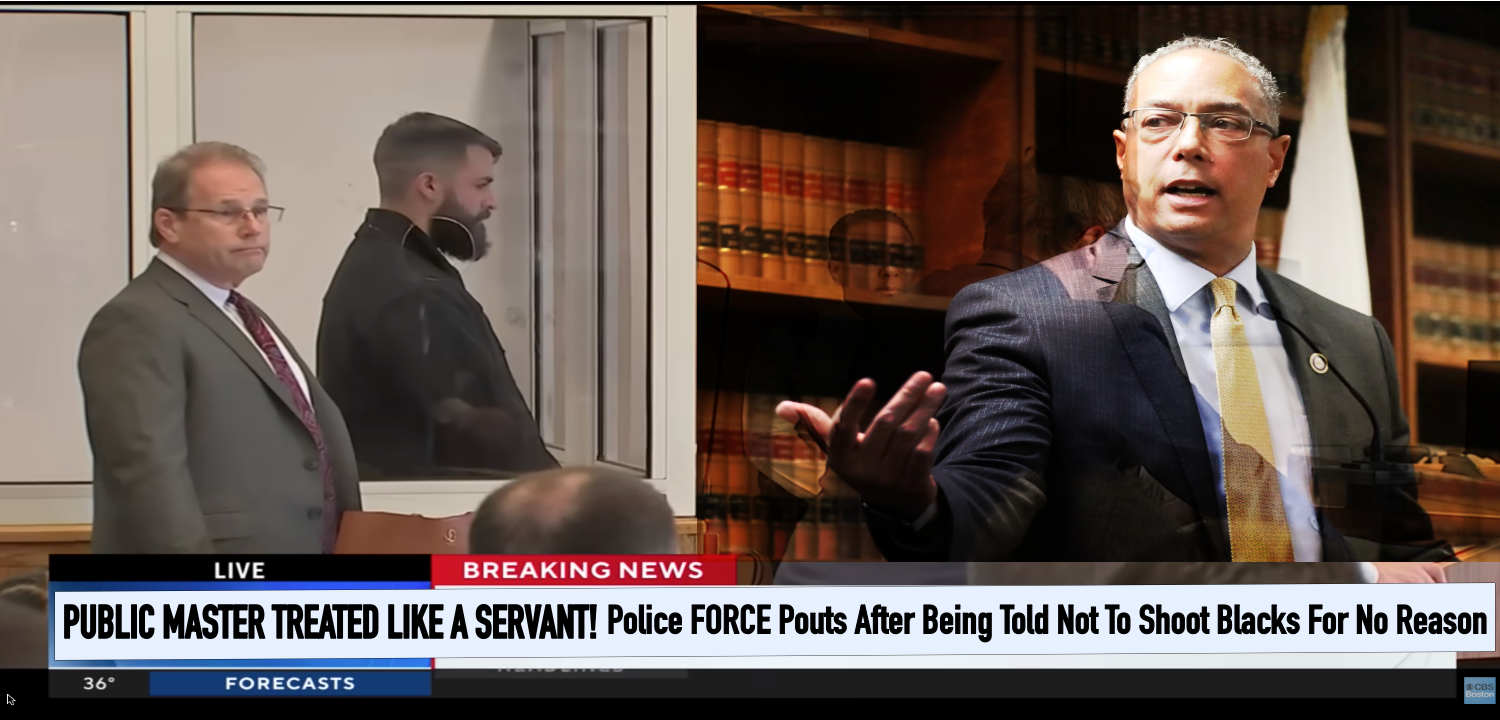
A Black DA Had the Audacity to Treat a White Police Officer just like any Other Person; Boston Cop Promptly Arrested and Charged w/Manslaughter for Shooting Stephenson King 3X when He Posed No Threat
/
From [HERE] A white Boston Police officer who fatally shot a Black man last month was arrested and charged with manslaughter on April 1, 2026.
Officer Nicholas O’Malley, 33, of Randolph, pleaded not guilty Thursday afternoon in Roxbury Municipal Court. He was released on personal recognizance but made to surrender his firearms.
Suffolk County District Attorney Kevin Hayden said they have brought the charge to a grand jury. It’s believed to be the first time in decades that a Boston police officer has been charged with manslaughter for an on-duty shooting.
The prosecutor alleges that during a traffic stop on March 11 for a suspected carjacking O’Malley fatally shot 39-year-old Stephenson King while he was attempting flee police. Although he was unarmed and posed no imminent threat of harm to police, he was Black.
According to the government’s charging documents:
As a result of an on-going investigation by members of the Boston Police Homicide Unit, Squad 2 Nights, the Boston Police Firearm Discharge Team (EDIT), and the Suffolk County District Attorney's Office into the Homicide of Stephenson King (DOB: 01/14/87), through physical evidence and numerous witness interviews, investigators have determined there is probable cause to believe that Nicholas O'Malley committed the crime of Voluntary Manslaughter. G.L. C.265, Sec 13, specifically, that he; 1) committed an act intended or likely to cause death, 2) did cause Stephenson King's death, and 3) was not acting in proper self-defense or defense of another

On March 11. 2026, at approximately 9:43 PM, BPD officers responded to 1590 Tremont Street for a report of a carjacking. Officers received information from the female victim that while she was seated in the passenger's seat of her running vehicle, she was assaulted and ordered her out of the vehicle by an unknown male.

The aforementioned information was broadcast to Boston Police officers, including the registration of the vehicle.

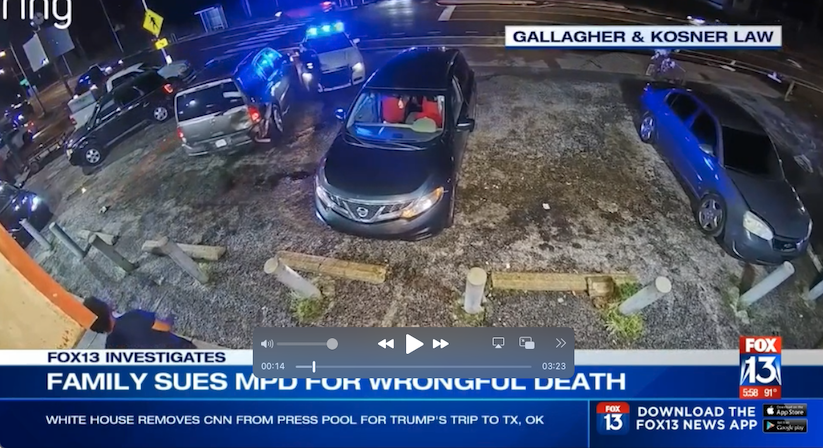
A short time later, Boston Police Officers Nicholas 0 Malley and Todd Ho observed the victim's vehicle parked at 10 Linwood Square in Roxbury, nose into the sidewalk. They stopped their cruiser behind the vehicle and as they approached the vehicle, captured on both of their Body Worn Cameras (BWC), they observed King, seated in the reclined drivers seat of the running vehicle.

As captured on their BWC's as well as partial witness statements, both officers, firearms drawn, began to yell commands to King such as; show me your hands, shut off the vehicle and unlock the vehicle. King did show the officers his hands at times, did partially open his driver's window, but did not shut off the vehicle or unlock the doors.

Officer O'Malley, outside the drivers window and while holstering his firearm in favor of a Taser, shouted to King: "aro, I'm gonna fueldng shoot you? Immediately after that statement, King put the car in reverse and backed into the cruiser behind him. King then maneuvered his vehicle forward, reverse, and forward again, in an attempt to escape the police. At the moment King's vehicle began to move forward the last time, PO O'Malley again drew his firearm and fired three shots at King through the drivers window.

After Officer O'Malley discharged his firearm, King accelerated and drove down the street, only to crash into a stone wall at the bottom of the street Officers O'Malley and Ho ran to the vehicle where they located King unresponsive. The officers requested Boston Emergency Medical Services (EMS) respond to the scene. EMS transported King to the hospital where he was pronounced deceased at 10:24 PM.

An autopsy was performed on King on March 13, 2026, where it was determined King had been struck by three (3) projectiles, two of which were recovered from his torso. Investigators found a third projectile in the passengers area of the carjacking victim's vehicle. There were no weapons recovered from that vehicle or King's person.

After his discharge, Officer O'Malley did broadcast that the officers were involved in a discharge, and that the suspect -tried to run us over". Based upon BWC footage and the interviews of the officers, regardless of their perception, that statement was not factually true

During his interview with the FDIT, Officer O'Malley stated that he fired his weapon because he thought Officer Ho was going to be crushed by the suspect's vehicle. Again, although that was his stated perception, 8WC footage revealed that such a belief was unreasonable, and that neither officer was In danger of being struck by the vehicle at the time of Officer O'Malley's discharge An eyewitness who observed the Incident stated that neither officer was in the path of the vehicle as it drove sway.

Although the law allows police officers to use deadly force when reasonably necessary. GI, c. 6E sec 14(d) provides: A law enforcement officer shall not discharge any firearm Into or at a fleeing motor vehicle unless, based on the totality of the circumstances, such discharge is necessary to prevent Imminent harm to a person and the discharge is proportionate to the threat of imminent harm to a person.
Hayden said the body camera footage will not be released to the public because it could influence the grand jury.
Following O’Malley’s arraignment, his defense attorney and the police union accused Hayden of acting politically during an election year. “I just want to say that this is unprecedented,” O’Malley’s attorney, Ken Anderson, told reporters outside of Roxbury District Court. “I think at the end of this case, he’s going to walk away as an innocent man. I’ve been involved in probably a hundred or more police shootings. This is the first one anyone’s ever been arrested. This is not preferential treatment. This is election year tactics.”
Hayden, who is up for reelection, denied that politics played any influence in the decision to arrest O’Malley, and stressed in his own comments to reporters that the case is moving forward within the normal legal process.
“People are arrested and charged in district court prior to the matter going to the grand jury all the time,” Hayden said. “This case was not treated any differently than any of those other cases.”
Several legal experts who spoke with GBH News agreed with that comment in terms of process, even if it is unusual for a police officer to face charges in a case like this.
“I think perhaps because police officers are almost never charged and held accountable for shootings, that’s why we haven’t seen them arrested,” said Shira Diner, a lecturer and clinical instructor in the Defender Clinic at Boston University School of Law. “And that’s where we haven’t seen bail requests being made on their behalf. That’s why we haven’t seen them being brought into court, right? So, if it never happens to police officers, the regular process that happens to other people hasn’t happened for those police officers.”
The process that’s being followed now is treating O’Malley like any other criminal defendant, Diner said.
“The way our system works in Massachusetts is almost entirely that people are arrested, they’re brought into the district court, or the municipal court in this case,” Diner said. “And then after that, a grand jury would meet and issue an indictment, and then the case would go to superior court.”
If anything is unusual about O’Malley’s treatment, Diner said, it’s that he was released on personal recognizance and wasn’t held in custody while the case is pending.
“I think that someone in another situation, the judge might’ve imposed a really high cash bail, more than the person could make, or there would’ve been a move to hold them as someone who was a danger to the community,” Diner said. “But none of those things happened and the defendant is now released and he’s out and he is able to assist his lawyer in a really meaningful way in preparing his defense.”
Retired Massachusetts Superior Court Judge Jack Lu, who is now teaching at the University of Massachusetts School of Criminology and Justice Studies, sees the case similarly.
“I will applaud the district attorney for treating this individual like anyone else,” Lu said.
In court, prosecutors said O’Malley shot and killed King on March 11 as he was fleeing police in a car he had allegedly stolen in a carjacking. According to investigators, no weapon was found on King or in the vehicle.
“Any person, with or without legal training, can see that this police officer was in a terrible position,” Lu said. “So I have a world of sympathies for this individual, and I wish them all the luck in the legal process.”
Even so, Lu said, that legal process should be the same for all defendants.
“Why should this police officer get different treatment than somebody who shoots somebody on the street in allegedly self-defense?” Lu asked. “Why should there be different treatment for police officers?”
LOL. In addition to anger over the district attorney’s decision to arrest O’Malley, his defense attorney and the police union also criticized how it happened. The officer was arrested at his home, rather than being allowed to turn himself in.
“We’re outraged at the way the arrest took place,” Boston Police Patrolmen’s Association President Larry Calderone told reporters after the arraignment. “You have an individual with an impeccable record, that volunteered to go give testimony … at the homicide division. He could have very easily volunteered to come in here and submit himself to the accusations at hand.”
O’Malley’s attorney, Anderson, asserted that his client is not a flight risk.
“They ask for $25,000 cash bail for someone who’s lived every day of his life in Massachusetts, married … two young kids, not a fight risk. And they grab him off the street, they arrest him, they book him to embarrass him, to put this show on for all of you,” he said to the assembled reporters.
Professor Chris Dearborn of Suffolk University Law School, who directs the Suffolk Defenders Program, said he’s seen plenty of cases in which defendants have been allowed to turn themselves in.
“That courtesy is often given to somebody when they reach out ahead of time,” he said.
Dearborn said it’s not clear, though, if the timing of the decision to bring charges allowed the district attorney to offer that opportunity to the defense lawyer. And he took issue with the suggestion that the Hayden’s tactics were driven by politics.
“I don’t think he was thinking, ‘Gosh, I better arrest this cop instead of allowing him to turn himself in, otherwise I might lose the election.’ I just think that’s silly. I think that’s nonsensical,” he said. “I do agree that there is a credible argument, as with any criminal defendant, that given this circumstance, maybe they could have given him the opportunity to turn himself in. But at the end of the day, [the judge] did the right thing with a guy with no record and released him on personal [recognizance] with conditions.”
Dearborn said the district attorney’s office deserves credit for their decision to charge O’Malley.
“Especially what we’re seeing happen in other jurisdictions with other law enforcement agencies, where investigations are being slid under the carpet or not even happening,” he said, pointing to recent fatal shootings of protestors Alex Pretti and Renee Good in Minnesota by federal agents, which the U.S. Department of Justice has declined to investigate.
“And I don’t think this is like an overreaction to that. I think this is just the district attorney’s office recognizing what this is, having viewed the evidence and believing at the very least there’s probable cause to go forward with a charge,” Dearborn said. “But that’s why we have juries. This is a case that I anticipate going to a jury trial and letting a jury decide whether there should be a conviction or not.”
But first, the case will be heard by a grand jury, and Dearborn says it could be several months before they decide whether to issue an indictment. [MORE]